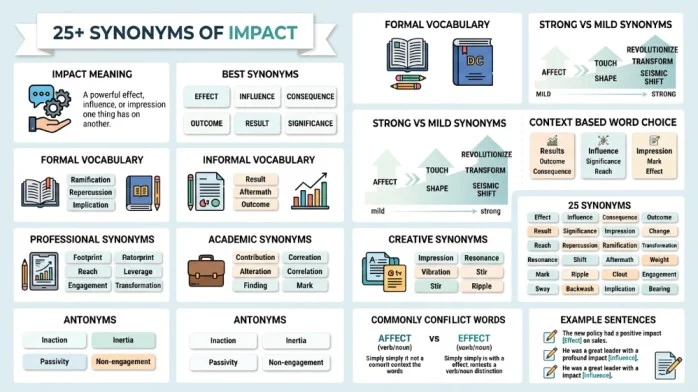
Impact is a powerful word, but using it repeatedly can make your writing feel flat. The right alternative can make an idea sharper, more precise, and easier to understand. If you are looking for an impact synonym, the best choice depends on whether you mean influence, effect, force, or a noticeable change. Understanding these differences helps you avoid using words that only seem similar.
This guide explores another word for impact, along with a practical synonym for impact and a clear synonym of impact for different situations. You will find useful impact synonyms, impacts synonym options, and accurate synonyms of impact for everyday, academic, and professional writing. We also cover other words for impact, synonyms for impact, and another term for impact when you need a more natural or specific expression. Each option is explained by meaning, tone, and context so you can choose the word that fits your sentence.
What Are the Best Synonyms of “Impact”?
The best synonyms of impact include effect, influence, consequence, outcome, significance, impression, force, result, reach, and change. For formal or academic writing, use effect, significance, consequence, or influence. Professional writing often favors effect, outcome, influence, or results, while casual and creative contexts may use impression, force, or change.
Meaning, Tone, and Context
Simple Definition
Impact refers to the effect or influence that one thing has on another. It can describe a physical force, a noticeable change, an emotional reaction, or the consequences of an action, decision, event, or idea.
For example:
“The new policy had a major impact on employees.”
Here, impact means the effect or influence the policy had on employees.
The word can also describe a physical collision:
“The car was badly damaged on impact.”
In this sense, impact refers to the force created when two objects strike each other.
Part of Speech
Impact can function as both a noun and a verb.
As a noun, it means an effect, influence, or force.
“The campaign had a positive impact on sales.”
As a verb, it means to affect or influence something.
“The changes could impact future development.”
Overall Tone
The word impact is generally neutral. It does not automatically express something positive or negative.
The surrounding words determine its tone:
“The program had a positive impact.”
“The decision had a negative impact.”
“The storm had a devastating impact.”
This flexibility makes impact useful in many forms of communication.
Formality Level
Impact is a neutral to moderately formal word. It works naturally in:
- Academic writing
- Business reports
- Professional emails
- News writing
- Resumes
- Presentations
- Everyday conversations
- Social media
- Creative writing
Some alternatives, such as consequence, significance, ramifications, and implications, can sound more formal or analytical.
Common Uses
Native English speakers commonly use impact when discussing:
- Business performance
- Social change
- Education
- Technology
- Health
- Environmental issues
- Personal experiences
- Government policies
- Research findings
- Marketing campaigns
- Financial decisions
- Relationships
- Career decisions
- Historical events
- Physical collisions
Word Forms
| Word Form | Example |
|---|---|
| Noun | “The decision had a lasting impact.” |
| Verb | “The decision may impact future plans.” |
| Related noun | “The impact was difficult to measure.” |
| Related adjective | “The report examined the impactful changes.” |
A useful usage note is that impactful is common in modern business and general English, but many writers prefer more specific alternatives such as effective, influential, significant, or powerful when they can name the exact quality involved.
When and How to Use “Impact”
Use impact when you want to describe the effect, influence, or consequences of something. It is especially useful when the exact type of effect is broader than a simple result.
Professional
“The new training program had a positive impact on employee productivity.”
Here, impact refers to the overall effect of the training program.
Academic
“The study examines the impact of social media on student behavior.”
In academic writing, impact can describe an important relationship between one factor and another.
Workplace
“Please consider how this change could impact the rest of the team.”
The verb form works naturally in workplace communication.
Personal
“Her advice had a lasting impact on my career.”
Here, impact describes a long-term personal influence.
“We should discuss the potential impact of the proposed changes before making a final decision.”
This sounds professional without being unnecessarily complicated.
Resume
“Developed a customer retention strategy that had a measurable impact on annual revenue.”
The phrase measurable impact works particularly well when a specific achievement or result follows.
Social Media
“That experience had a huge impact on the way I see success.”
The phrase works naturally in personal and conversational writing.
Best Synonyms of “Impact”
No synonym of impact works perfectly in every sentence. The best choice depends on whether you mean an effect, influence, consequence, result, emotional reaction, physical force, or broader significance.
Professional Writing
Effect is one of the safest alternatives in professional writing.
“The policy had a significant effect on employee retention.”
It sounds clear and precise without adding unnecessary emotion.
Academic Writing
Effect and significance are particularly useful in academic contexts.
“The study examined the effects of sleep deprivation.”
Use significance when you want to emphasize importance or meaning rather than a direct cause and result.
Business Communication
Influence, effect, and outcome are strong choices.
“The campaign had a measurable influence on customer behavior.”
“The new strategy produced positive outcomes.”
These alternatives allow you to specify exactly what kind of impact you mean.
Casual Conversation
Effect, change, and difference can sound more natural than a formal expression.
“That conversation really made a difference.”
This is often more conversational than saying:
“That conversation had a significant impact.”
Emotional Writing
Impression and influence can work well when describing how a person or experience affects emotions or thinking.
“Her kindness left a lasting impression on me.”
Creative Writing
Force, resonance, impression, and influence can provide more expressive choices.
“His words carried a force that stayed with her long after the conversation ended.”
Resume Writing
Results, effect, influence, and outcomes are often more specific than impact.
Instead of:
“Had a major impact on sales.”
Try:
“Increased quarterly sales by 18%.”
Whenever possible, a resume should show the actual result rather than relying only on the word impact.
Workplace Communication
Effect, influence, consequence, and outcome can clarify workplace discussions.
“We need to understand the potential consequences before changing the schedule.”
Stronger Meaning
Influence, force, profound effect, and far reaching effect can create stronger emphasis when the context supports it.
“The discovery had a profound effect on modern medicine.”
Softer Meaning
Change, difference, impression, and role can work when you want less dramatic language.
“The update made a small difference to the final result.”
When Not to Use “Impact”
Although impact is versatile, it can become vague when a more specific word would tell readers exactly what happened.
When “Impact” Is Too General
Less precise:
“The project had a big impact.”
The reader still does not know what changed.
Better:
“The project increased customer retention by 15%.”
The second sentence communicates the actual result.
When “Impact” Is Too Vague
Less precise:
“The decision impacted the company.”
Better:
“The decision reduced operating costs.”
The second version identifies the specific effect.
When “Impact” Sounds Too Formal
In casual conversation, impact may sometimes sound more formal than necessary.
Less natural:
“The movie had a significant impact on me.”
More conversational:
“The movie really affected me.”
Or:
“The movie left a strong impression on me.”
When “Impact” Is Too Informal
In highly technical or analytical writing, impact may not always be precise enough.
Less precise:
“The treatment had a big impact on patients.”
Better:
“The treatment produced measurable improvements in patient recovery.”
When “Impact” Is Too Weak
If you want to emphasize serious consequences, impact alone may not communicate enough urgency.
Less effective:
“The error had an impact on the project.”
Stronger:
“The error significantly delayed the project.”
When “Impact” Is Too Strong
If the effect was very small, impact can sound unnecessarily dramatic.
Less effective:
“The formatting change had a major impact.”
Better:
“The formatting change made a minor difference.”
When a More Specific Word Is Available
If you know the exact relationship, use it.
Instead of:
“The manager impacted employee morale.”
Consider:
“The manager influenced employee morale.”
Instead of:
“The decision impacted profits.”
Consider:
“The decision reduced profits.”
Specific language usually communicates more information than a broad synonym.
Words Commonly Confused With “Impact”
Effect
Difference: Effect usually refers to the result or change produced by something.
When to Use It: Use it when describing a direct result.
Example:
“The new schedule had a positive effect on productivity.”
Influence
Difference: Influence emphasizes the power to affect decisions, behavior, opinions, or development.
When to Use It: Use it when one person, idea, or event shapes another.
Example:
“Her teacher had a strong influence on her career choice.”
Consequence
Difference: Consequence focuses on what happens because of an action or decision, often with a serious or negative implication.
When to Use It: Use it when discussing results that follow an action.
Example:
“The company considered the consequences of the policy change.”
Outcome
Difference: Outcome refers to the final result of an event, process, decision, or activity.
When to Use It: Use it when discussing the end result.
Example:
“The outcome of the negotiation was positive.”
Significance
Difference: Significance emphasizes importance, meaning, or value rather than the direct result of an action.
When to Use It: Use it when explaining why something matters.
Example:
“Researchers discussed the significance of the findings.”
Impression
Difference: Impression describes the feeling, idea, or opinion something leaves in someone’s mind.
When to Use It: Use it for emotional reactions, personal experiences, or first encounters.
Example:
“The presentation left a strong impression on the audience.”
Best Synonyms of “Impact” by Context
| Context | Best Synonym | Why It Works | Example |
|---|---|---|---|
| Formal writing | Effect | Clear and broadly accepted | “The policy had a lasting effect.” |
| Academic writing | Significance | Highlights meaning or importance | “The findings have significant implications.” |
| Professional communication | Influence | Emphasizes effect on people or decisions | “Leadership can influence team performance.” |
| Business emails | Effect | Direct and easy to understand | “Please consider the effect on our clients.” |
| Resume writing | Results | Focuses on measurable achievements | “Delivered results that improved retention.” |
| Workplace communication | Consequence | Useful for decisions and risks | “We should consider the consequences.” |
| Casual conversation | Difference | Natural and conversational | “It made a big difference.” |
| Everyday speaking | Change | Simple and accessible | “The experience changed how I think.” |
| Creative writing | Impression | Highlights emotional response | “The encounter left a lasting impression.” |
| Storytelling | Influence | Shows lasting personal effect | “His advice influenced her decision.” |
| Emotional writing | Resonance | Suggests a lasting emotional response | “The story had emotional resonance.” |
| Strong emphasis | Force | Conveys power or intensity | “Her words carried tremendous force.” |
| Mild tone | Difference | Avoids unnecessary intensity | “The update made a small difference.” |
| Social media captions | Effect | Simple and flexible | “This trip had such a positive effect on me.” |
| American English | Impact | Common across formal and casual settings | “The decision could impact future plans.” |
| British English | Effect | Often preferred where a direct result is meant | “The policy had a noticeable effect.” |
How to Choose the Best Synonym of “Impact”
Choosing the right synonym becomes easier when you first identify exactly what impact means in your sentence.
If You Mean a Result
Choose effect, result, or outcome.
“The new policy had a positive effect on attendance.”
If You Mean Power Over Someone
Choose influence.
“The coach had a strong influence on the players.”
If You Mean a Result That Follows an Action
Choose consequence.
“The decision could have serious consequences.”
If You Mean Importance or Meaning
Choose significance.
“The discovery has considerable significance for future research.”
If You Mean an Emotional Reaction
Choose impression, resonance, or response.
“The speech left a powerful impression on the audience.”
If You Mean a Final Result
Choose outcome.
“The final outcome exceeded expectations.”
If You Mean Physical Force
Choose force, collision, or shock, depending on the sentence.
“The force of the impact damaged the structure.”
Consider Your Audience
- For students and academic readers, effect, significance, and consequence are often precise choices.
- For business readers, outcome, results, influence, and effect can make the message clearer.
- For everyday conversation, difference, change, and effect are usually easy to understand.
Consider Emotional Strength
A sentence such as:
“The experience had an effect on her.”
sounds relatively neutral.
Compare it with:
“The experience had a profound effect on her.”
The second version communicates much stronger emotional significance.
Consider Your Writing Purpose
A resume should emphasize measurable results.
A research paper may focus on effects and significance.
A personal story may describe an impression or influence.
A business report may discuss outcomes and consequences.
Choose Natural Language
Do not replace impact simply because you want a more sophisticated word. A synonym is useful only when it expresses the intended meaning more accurately.
For example:
“The new software made a big difference.”
sounds more natural in casual conversation than:
“The new software produced a significant consequence.”
The second sentence is grammatically possible in some contexts, but it does not match the intended meaning or tone.
Real Life Examples of “Impact”
School
Basic:
“Teachers have an important impact on students.”
More precise:
“Teachers can have a lasting influence on students’ confidence and learning habits.”
College
Basic:
“The research had an impact on the student’s argument.”
More precise:
“The research strengthened the student’s argument.”
The second sentence identifies the actual effect.
Workplace
Basic:
“The schedule change had an impact on the team.”
More precise:
“The schedule change affected the team’s productivity.”
Business
Basic:
“The advertising campaign had a positive impact on sales.”
More precise:
“The advertising campaign increased sales and improved brand awareness.”
Basic:
“We need to understand the impact of this decision.”
More precise:
“We need to understand how this decision will affect our customers.”
Resume
Basic:
“Had a major impact on company performance.”
Stronger:
“Improved operational efficiency by 20% through process redesign.”
Specific results are usually more persuasive than broad claims.
Conversation
Basic:
“That experience had a big impact on me.”
Natural alternative:
“That experience really changed the way I think.”
Storytelling
Basic:
“Her words had a strong impact on him.”
More expressive:
“Her words stayed with him long after she had left.”
Blogging
Basic:
“Technology has a major impact on education.”
More precise:
“Technology has changed how students access information, communicate, and complete assignments.”
Social Media
Basic:
“This trip had a huge impact on me.”
Natural alternative:
“This trip completely changed how I see the world.”
25 Best Synonyms of “Impact”
| Synonym | Simple Meaning | Best Used For | Example Sentence |
|---|---|---|---|
| Effect | A change caused by something | Academic and general writing | “The new rule had a positive effect on attendance.” |
| Influence | Power to affect someone or something | People, ideas, behavior | “Her mentor had a lasting influence on her career.” |
| Consequence | A result that follows an action | Decisions and serious situations | “The decision could have serious consequences.” |
| Outcome | The final result | Business and projects | “The outcome of the meeting was encouraging.” |
| Result | Something produced by an action | General and professional writing | “The changes produced impressive results.” |
| Significance | Importance or meaning | Academic and formal writing | “The discovery has considerable significance.” |
| Impression | An effect left on someone’s mind | Emotional and personal writing | “His speech made a strong impression.” |
| Change | A difference from an earlier state | Everyday communication | “The experience created a major change in her outlook.” |
| Difference | A noticeable effect or improvement | Casual conversation | “The new strategy made a noticeable difference.” |
| Force | Strength or power | Physical and figurative writing | “Her argument carried considerable force.” |
| Reach | Extent of influence or exposure | Marketing and media | “The campaign expanded the company’s reach.” |
| Power | Ability to affect people or events | Leadership and persuasive writing | “Words have the power to influence behavior. |
| Role | Part played in producing an effect | Business and academic writing | “Education plays a central role in development.” |
| Ramification | A complex consequence | Formal and analytical writing | “The decision could have unexpected ramifications.” |
| Implication | A possible meaning or consequence | Academic and professional writing | “The findings have important implications for policy.” |
| Resonance | Lasting emotional or intellectual effect | Creative and emotional writing | “The story has strong emotional resonance.” |
| Reaction | Response caused by something | Social and personal contexts | “The announcement received a mixed reaction.” |
| Response | A reaction to an event or action | Communication and research | “The policy received a positive response.” |
| Contribution | Something that helps produce a result | Academic and professional writing | “Her contribution strengthened the research team.” |
| Transformation | A major change in form or condition | Creative and professional writing | “The program led to a significant transformation.” |
| Shift | A noticeable change in position or attitude | Trends and analysis | “The campaign caused a shift in public opinion.” |
| Difference | An amount by which something changes | Everyday and practical writing | “The update made a clear difference.” |
| Importance | The quality of being significant | Formal and academic contexts | “The report explains the importance of early intervention.” |
| Efficacy | Ability to produce a desired result | Technical and academic writing | “The study measured the efficacy of the treatment.” |
| Potency | Strength or effectiveness | Medicine, science, and figurative use | “The message demonstrated considerable persuasive potency.” |
Synonyms of “Impact” by Usage
Professional vs Personal Synonyms
Professional writing benefits from precise words such as effect, influence, outcome, consequence, results, and significance.
For example:
“The new strategy had a measurable effect on customer retention.”
Personal writing can sound warmer with impression, change, difference, influence, or resonance.
“Her advice made a real difference in my life.”
The key difference is not simply formality. Professional language often needs analytical precision, while personal language can emphasize emotion and experience.
Formal vs Conversational Synonyms
- For reports, essays, and formal business writing, consider:
- Effect
- Significance
- Consequence
- Implication
- Influence
- Outcome
- For presentations and professional emails, these are also useful:
- Effect
- Influence
- Results
- Outcome
- Impact
- For casual conversations and texting, simpler choices often sound more natural:
- Difference
- Change
- Effect
- Reaction
- Big effect
- For example:
Formal:
“The policy had significant implications for regional development.”
Conversational:
“The policy really changed things for the community.”
Academic Synonyms
Academic writing requires careful distinctions between cause, effect, significance, and outcome.
Effect
Use effect when discussing a direct change caused by something.
“The researchers examined the effect of exercise on sleep quality.”
Significance
Use significance when explaining why a finding, event, or idea matters.
“The study explores the significance of the findings.”
Influence
Use influence when one factor shapes behavior, thought, or development.
“Family environment can influence academic performance.”
Consequence
Use consequence when discussing what follows from a decision or event.
“The policy had several unintended consequences.”
Implication
Use implication when discussing what a finding may mean for future research, policy, or practice.
“The findings have important implications for educators.”
Outcome
Use outcome when referring to the final result of research, treatment, or an intervention.
“The researchers compared outcomes across the two groups.”
These alternatives make academic writing more precise because each word identifies a different relationship.
Professional and Business Synonyms
Resumes
Use results, outcomes, influence, and contributions when describing achievements.
Instead of:
“Had an impact on sales.”
Use:
“Increased annual sales by 22%.”
Interviews
Use influence, contribution, effect, or results when explaining what you accomplished.
“My process changes had a measurable effect on customer response times.”
Meetings
Use effect, consequence, outcome, or implications.
“Let’s consider the potential consequences before approving the proposal.”
Presentations
Use impact when the broad idea matters, but choose results when you have measurable evidence.
“The campaign generated a 30% increase in qualified leads.”
Performance Reviews
Use contribution, results, influence, and outcomes.
“Her contribution to the project helped the team meet its deadline.”
Client Communication
Use effect, outcome, and implications for clarity.
“We are reviewing how the update may affect your current workflow.”
Business Emails
Use simple and direct language.
“Please let us know how this change will affect your team.”
This is often clearer than using several abstract nouns in the same sentence.
Creative and Literary Synonyms
Creative writing often benefits from words that show how an event feels rather than simply stating that it had an impact.
Impression
Useful for describing a lasting feeling.
“The abandoned house left a strange impression on him.”
Resonance
Useful for emotional or thematic depth.
“The poem continues to have emotional resonance for modern readers.”
Force
Useful when an idea, voice, or action feels powerful.
“Her final words carried unexpected force.”
Influence
Useful for showing how a person changes another person’s thinking.
“The old professor became a lasting influence on the young writer.”
Transformation
Useful when the effect involves major change.
“The journey became a transformation that changed her priorities.”
These alternatives can make creative writing more vivid than repeatedly using impact.
Slang or Modern Synonyms
There is no single slang word that perfectly replaces impact in every context. Casual speakers often use phrases rather than direct synonyms.
Make a Difference
Meaning: To produce a noticeable effect.
Acceptable in:
- Conversations
- Social media
- Personal writing
- Informal workplace communication
Avoid when:
- A highly technical distinction is required
- A measurable result needs to be stated precisely
Example:
“Your support made a huge difference.”
Leave a Mark
Meaning: To create a lasting impression or influence.
Acceptable in:
- Personal writing
- Speeches
- Storytelling
- Social media
Example:
“She left a lasting mark on the organization.”
Make Waves
Meaning: To attract attention or create noticeable change.
Acceptable in:
- Informal writing
- Journalism
- Social media
- Creative content
Example:
“The startup is making waves in the technology industry.”
This phrase is not a universal synonym for impact, so it should be used only when the context supports its more specific meaning.
Strongest to Mildest Synonyms
The intensity of an alternative depends on context, but the following guide provides a practical hierarchy.
Mild
- Difference
- Change
- Impression
- Effect
These words can describe ordinary or moderate effects.
Moderate
- Influence
- Outcome
- Result
- Significance
- Reach
These suggest a more noticeable or meaningful effect.
Strong
- Consequence
- Force
- Transformation
- Profound effect
- Major influence
These indicate substantial change, power, or importance.
Very Strong
- Far reaching effect
- Profound influence
- Devastating consequence
- Transformative effect
These should be reserved for situations where the evidence or context genuinely supports strong language.
A useful rule is to avoid choosing a dramatic synonym simply because it sounds impressive. Strong vocabulary works best when it accurately reflects the strength of the effect.
Emotional vs Neutral Synonyms
Emotional Synonyms
These words can carry stronger feelings or personal significance:
- Impression
- Resonance
- Transformation
- Force
- Profound effect
- Lasting influence
Example:
“Her story left a profound impression on everyone in the room.”
Neutral Synonyms
These words communicate information without adding much emotion:
- Effect
- Result
- Outcome
- Influence
- Significance
- Consequence
- Change
Example:
“The researchers measured the effect of the intervention.”
Use neutral terms for academic and technical communication. Emotional alternatives work better when the reader needs to understand how deeply an experience affected someone.
Antonyms of “Impact”
Because impact has several meanings, it does not have one universal opposite. The following words represent genuine contextual opposites of impact as effect, influence, significance, or effectiveness.
| Antonym | Meaning | Example Sentence |
|---|---|---|
| Insignificance | Lack of importance or meaningful effect | “The issue was dismissed because of its insignificance.” |
| Ineffectiveness | Failure to produce a desired effect | “The program was criticized for its ineffectiveness.” |
| Ineffectuality | Lack of power to create a result | “The policy’s ineffectuality became obvious over time.” |
| Irrelevance | Lack of meaningful connection or influence | “The detail was considered irrelevant to the investigation.” |
| Triviality | State of having little importance | “The triviality of the disagreement surprised everyone.” |
| Meaninglessness | Lack of meaningful value or significance | “Without context, the numbers seemed meaningless.” |
| Inconsequence | Lack of importance or consequence | “The event was treated as a matter of inconsequence.” |
| Futility | Inability to produce a useful result | “The team recognized the futility of continuing the failed approach.” |
| Powerlessness | Lack of ability to influence events | “The group felt powerless to change the decision.” |
| Inefficacy | Lack of ability to produce the intended result | “Researchers questioned the efficacy of the treatment.” |
| Unproductiveness | Failure to produce useful results | “The meeting ended because of its unproductiveness.” |
| Fruitlessness | Failure to produce a useful outcome | “The negotiations continued despite their fruitlessness.” |
| Negligibility | State of being too small to matter | “The cost difference was negligible.” |
| Minorness | Quality of being limited in importance or effect | “The minorness of the change made little difference to users.” |
| Pointlessness | Lack of useful purpose or effect | “They questioned the pointlessness of repeating the same process.” |
Comparison: “Impact” vs Similar Words
Impact vs Effect
Main Difference
Impact is broader and can refer to influence, force, or an overall effect. Effect more directly describes the change or result caused by something.
Which Is Stronger?
Neither is automatically stronger. The distinction is mainly about meaning and context.
Which Is More Formal?
Both are suitable for formal writing.
When to Use Each
Use effect when you are describing a specific result. Use impact when discussing a broader effect or influence.
Examples
Impact:
“The policy had a major impact on housing.”
Effect:
“The policy had a measurable effect on housing prices.”
Impact vs Influence
Main Difference
Influence emphasizes the power to shape behavior, opinions, choices, or development.
Which Is Stronger?
Influence can suggest a continuing or indirect effect.
Which Is More Formal?
Both are appropriate for professional and academic writing.
When to Use Each
Use influence for people, ideas, trends, and decisions. Use impact when describing a broader result.
Examples
Impact:
“The campaign had a strong impact on sales.”
Influence:
“The campaign influenced customer preferences.”
Impact vs Consequence
Main Difference
Consequence focuses on what follows an action or event. It often suggests an important or potentially negative result.
Which Is Stronger?
Consequence can sound more serious.
Which Is More Formal?
Both can be formal, but consequence is particularly useful in analytical writing.
When to Use Each
Use consequence when discussing what may happen because of a decision.
Examples
Impact:
“The decision had a significant impact.”
Consequence:
“The decision had serious consequences.”
Impact vs Outcome
Main Difference
Outcome refers specifically to the final result of a process or event.
Which Is Stronger?
Neither is inherently stronger.
Which Is More Formal?
Both are widely used professionally.
When to Use Each
Use outcome when you know the final result. Use impact when describing the effect produced along the way or afterward.
Examples
Impact:
“The training had a positive impact on employees.”
Outcome:
“The outcome of the training was improved performance.”
Impact vs Significance
Main Difference
Impact describes an effect or influence. Significance describes importance, meaning, or value.
Which Is Stronger?
Neither is inherently stronger.
Which Is More Formal?
Significance is especially common in academic writing.
When to Use Each
Use significance when explaining why something matters.
Examples
Impact:
“The discovery had a major impact on medicine.”
Significance:
“The discovery has great significance for medical research.”
Impact vs Impression
Main Difference
Impression focuses on the feeling or idea something leaves in a person’s mind.
Which Is Stronger?
An impression can be emotionally strong, but it does not necessarily imply practical consequences.
Which Is More Formal?
Both can be used formally, although impression is especially natural in personal and creative writing.
When to Use Each
Use impression for emotional reactions and personal experiences.
Examples
Impact:
“The speech had a lasting impact on the audience.”
Impression:
“The speech left a lasting impression on the audience.”
Common Phrases and Expressions with “Impact”
Have an Impact
Meaning: To affect someone or something.
Example Sentence:
“Small changes can have a meaningful impact on productivity.”
Make an Impact
Meaning: To create a noticeable effect or influence.
Example Sentence:
“The new teacher quickly made an impact on the school community.”
Positive Impact
Meaning: An effect that produces a beneficial result.
Example Sentence:
“The program had a positive impact on student attendance.”
Negative Impact
Meaning: An effect that produces an undesirable result.
Example Sentence:
“Excessive screen time may have a negative impact on sleep.”
Significant Impact
Meaning: A noticeable or meaningful effect.
Example Sentence:
“The investment had a significant impact on the company’s growth.”
Lasting Impact
Meaning: An effect that continues for a long time.
Example Sentence:
“Her work had a lasting impact on the organization.”
Major Impact
Meaning: A very noticeable or important effect.
Example Sentence:
“The storm had a major impact on local businesses.”
Impact on
Meaning: The effect that something has on a person, group, system, or situation.
Example Sentence:
“The study examined the impact of exercise on mental well being.”
Common Mistakes to Avoid
Choosing a Vague Synonym Instead of a Precise One
Incorrect:
“The campaign had a major impact.”
Better:
“The campaign increased website traffic by 35%.”
Why:
The second sentence explains the actual result instead of making a broad claim.
Confusing Impact With Influence
Incorrect:
“The teacher impacted my decision to study science.”
Better:
“The teacher influenced my decision to study science.”
Why:
Influenced clearly describes how one person shaped another person’s decision.
Using an Informal Synonym in Formal Writing
Incorrect:
“The new policy made a big difference in the results.”
Better:
“The new policy had a significant effect on the results.”
Why:
The second version better matches academic or professional writing.
Selecting an Overly Dramatic Synonym
Incorrect:
“The font change had a devastating impact on the report.”
Better:
“The font change had a minor effect on the report.”
Why:
Devastating suggests extremely serious consequences and is inappropriate for a minor formatting issue.
Repeating “Impact” Too Often
Incorrect:
“The policy had an impact on workers, which had an impact on productivity and impacted customer satisfaction.”
Better:
“The policy affected workers, reduced productivity, and lowered customer satisfaction.”
Why:
Using different sentence structures and precise verbs creates cleaner writing.
Choosing the Wrong Emotional Tone
Incorrect:
“The graduation had a significant consequence for her.”
Better:
“The graduation was a meaningful milestone for her.”
Why:
Consequence sounds analytical, while meaningful milestone better expresses personal significance.
Using Slang in Academic or Professional Writing
Incorrect:
“The research really made waves.”
Better:
“The research had a significant influence on the field.”
Why:
Made waves is informal and emphasizes attention or excitement rather than precise academic influence.
Frequently Asked Questions
What are the best synonyms of “impact”?
The best synonyms of impact include effect, influence, consequence, outcome, result, significance, impression, change, and reach. The best choice depends on whether you mean an effect, influence, final result, emotional reaction, or broader importance.
What are the best formal synonyms of “impact”?
Formal alternatives include effect, influence, consequence, significance, implication, outcome, and ramification. Academic and professional writers should choose the word that accurately describes the relationship rather than simply selecting the most sophisticated option.
What are common informal synonyms of “impact”?
Common informal alternatives include effect, difference, change, and phrases such as make a difference or leave a mark. The best option depends on whether you are describing a result, personal reaction, or lasting influence.
What is another word for “impact” in professional writing?
In professional writing, useful alternatives include effect, influence, outcome, result, consequence, and contribution. For resumes, measurable results are usually stronger because they show exactly what changed.
What is the difference between “impact” and “effect”?
Impact can describe a broad effect, influence, or physical force, while effect usually refers to a specific result produced by something. In many contexts they overlap, but effect is often more precise for direct results.
What is the opposite of “impact”?
There is no single universal opposite because impact has several meanings. Depending on context, opposing concepts include insignificance, ineffectiveness, irrelevance, triviality, meaninglessness, and lack of influence.
Conclusion
The word impact can describe an effect, influence, force, change, or consequence, making it useful across academic, professional, personal, and everyday English. However, the strongest alternative depends on the exact meaning you want to communicate.
Use effect for a direct result, influence for the power to shape people or decisions, consequence for what follows an action, outcome for a final result, significance for importance or meaning, and impression for an emotional response. In professional writing, results can be more powerful than impact when you can provide a measurable achievement.
There is no single perfect replacement in every sentence. When choosing among the synonyms of impact, consider your meaning, audience, tone, and purpose first. A simple vocabulary habit can make a major difference: whenever you write impact, pause and ask whether a more specific word explains the effect more clearly.
Read More Related Articles:
- 50+ Best List of Synonyms | for Better Writing and …
- 50+ Synonyms of Love | Powerful Words to Express Every …
- Synonyms for Thus | Meaning, Examples, and Better Word …