A writer may use the word vessel several times in a paragraph without realizing that its meaning changes with context. A shipping article, it can refer to a ship. In a laboratory report, it can mean a container. In anatomy, it can describe a tube that carries blood or another fluid.
Knowing the right synonym of vessel helps you avoid repetition while keeping your meaning accurate. Words such as ship, boat, container, receptacle, craft, artery, vein, and tube can work in particular contexts, but they are not interchangeable in every sentence. The best choice depends on what kind of vessel you mean, how formal your writing is, and what you want the reader to understand.
What Are the Best Synonyms of “Vessel”?
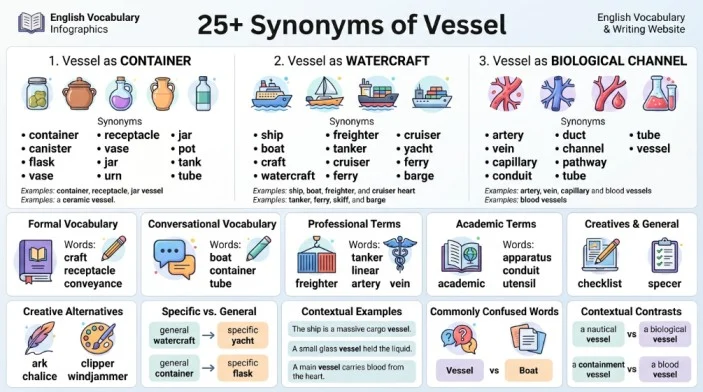
A vessel can mean a container, a ship or boat, or a tube that carries fluid in anatomy or biology. The best alternatives depend on the meaning: use receptacle or container for objects, ship or watercraft for maritime contexts, and artery, vein, or tube for biological contexts.
Meaning, Tone, and Context
Simple Definition
The word vessel has several established meanings.
Most commonly, it refers to a container used to hold something, such as liquid, food, chemicals, or other materials. It can also refer to a ship or boat used for transportation, travel, fishing, research, or other maritime activities.
In anatomy and biology, vessel can describe a tube or passage that carries blood, fluid, or other substances through an organism.
Because these meanings are quite different, context is essential when selecting a synonym.
Part of Speech
Vessel is primarily a noun.
Examples:
- “The laboratory vessel contained a chemical solution.”
- “The vessel entered the harbor before sunrise.”
- “The surgeon examined the damaged blood vessel.”
Overall Tone
The word vessel is generally neutral.
Its tone changes according to context. In maritime writing, it often sounds technical or professional. In scientific and medical writing, it is also a standard technical term. Ordinary conversation, people may prefer simpler words such as boat, ship, or container.
Formality Level
Vessel is generally neutral to formal.
It is especially common in:
- Maritime writing
- Legal documents
- Scientific writing
- Medical writing
- Technical reports
- Historical writing
- Government regulations
- Professional communication
In casual conversation, a speaker will often choose a more specific word.
For example:
“That vessel is entering the harbor.”
sounds more formal than:
“That ship is entering the harbor.”
Common Uses
Native English speakers use vessel in several major contexts.
Maritime Use
A vessel can be a ship, boat, or other watercraft.
Example:
“The research vessel returned to port after a two week expedition.”
Container Use
A vessel can be an object designed to hold something.
Example:
“Pour the mixture into a clean glass vessel.”
Medical and Biological Use
A vessel can be a tube that transports blood or other fluids.
Example:
“The procedure repaired a damaged blood vessel.”
Religious or Literary Use
In some formal, historical, or literary contexts, vessel can refer to a person regarded as a carrier or instrument of something.
Example:
“The poet described himself as a vessel for inspiration.”
This sense is much less common in everyday American English.
Word Forms
| Form | Word |
|---|---|
| Noun | vessel |
| Plural noun | vessels |
| Related noun | vesselness is not a standard everyday form |
There is no commonly used everyday verb or adverb form of vessel. The noun itself is normally sufficient for ordinary communication.
When and How to Use “Vessel”
Use vessel when the context makes its intended meaning clear or when the more technical term is appropriate. If your audience may misunderstand the word, choose a more specific alternative.
Professional
“The cargo vessel arrived at the designated port ahead of schedule.”
Here, vessel is appropriate because maritime professionals commonly use the term.
Academic
“The researchers placed the solution in a sealed glass vessel.”
The word works well in scientific writing because it describes a container without unnecessarily specifying its shape.
Workplace
“The maintenance team inspected the vessel before beginning operations.”
This works particularly well in industrial or technical settings.
Personal
“My grandfather spent most of his career working aboard a fishing vessel.”
The maritime meaning is clear from the phrase “working aboard.”
“Please confirm that the vessel has received clearance to enter the harbor.”
The formal maritime context makes vessel more appropriate than boat.
Resume
“Managed maintenance schedules for commercial vessels operating along the Atlantic coast.”
The word sounds precise and professional in a maritime resume.
Social Media
“Our research vessel finally reached the island after three days at sea.”
For a general audience, ship could sound more conversational, but vessel works when the expedition itself is the focus.
Best Synonyms of “Vessel”
No single synonym works for every meaning of vessel. The word can describe a container, a watercraft, or a biological passage, so the best alternative must match the intended sense.
Professional Writing: Watercraft or Receptacle
Use watercraft when discussing marine transportation and receptacle when referring to a container.
Example:
“The company operates several commercial watercraft.”
“The sample was transferred to a sterile receptacle.”
Academic Writing: Receptacle or Container
Scientific writing often benefits from precise nouns.
Example:
“The compound was stored in a sealed container.”
Business Communication: Vessel
In shipping and logistics, there is often no reason to replace vessel. It is already a precise professional term.
Example:
“The vessel is scheduled to arrive on Tuesday.”
Casual Conversation: Ship or Boat
Everyday speakers generally use ship or boat when talking about watercraft.
Example:
“We saw a large ship near the coast.”
Emotional Writing: Ship, Boat, or Carrier
The appropriate alternative depends on what the sentence is trying to emphasize.
Example:
“The old boat carried generations of memories.”
Creative Writing: Craft
Craft can create a more literary or atmospheric tone when describing a vehicle on water.
Example:
“The small craft disappeared into the morning fog.”
Resume Writing: Ship, Watercraft, or Vessel
Use the term that accurately reflects the job and industry.
Example:
“Coordinated maintenance operations for commercial vessels.”
Workplace Communication: Vessel
In maritime, industrial, chemical, or scientific workplaces, vessel is often more precise than a casual alternative.
Stronger Meaning: Specific Type of Vessel
Rather than looking for a stronger synonym, specify the exact type.
For example:
“cargo vessel”
“research vessel”
“oil tanker”
“container ship”
Specific terminology usually communicates more information than a vague substitute.
Softer or Simpler Meaning: Container, Ship, or Boat
For general readers, a familiar word can make the sentence easier to understand.
When Not to Use “Vessel”
When the Word Is Too General
Vessel can be less useful when the reader needs to know exactly what type of object you mean.
Less precise:
“Put the sample into the vessel.”
Better:
“Put the sample into the glass container.”
The second sentence gives the reader more practical information.
When a Simple Maritime Word Is Better
In casual conversation, vessel can sound unnecessarily formal.
Less natural:
“We took the vessel across the lake.”
Better:
“We took the boat across the lake.”
When the Biological Meaning Is Intended
Do not replace an anatomical vessel with a general container word.
Incorrect:
“The doctor examined the damaged container.”
Better:
“The doctor examined the damaged blood vessel.”
The medical context requires a biological term.
When the Exact Type Matters
If you know the watercraft is a tanker, ferry, yacht, or cargo ship, naming it directly is more informative.
General:
“The vessel transported fuel.”
More precise:
“The tanker transported fuel.”
When the Audience Is Unfamiliar With Technical Language
A general reader may understand ship more quickly than vessel.
Technical:
“The vessel departed at dawn.”
Accessible:
“The ship departed at dawn.”
Choose the simpler word when clarity matters more than technical terminology.
Words Commonly Confused With “Vessel”
Ship
Difference: A ship is a large watercraft, while vessel has a broader maritime meaning that can include different types of boats and ships.
When to Use It: Use ship when you specifically mean a large seagoing watercraft.
Example:
“The cargo ship arrived at the port.”
Boat
Difference: A boat generally refers to a smaller watercraft, although everyday usage can be flexible.
When to Use It: Use boat in casual or general descriptions of smaller watercraft.
Example:
“We rented a fishing boat for the afternoon.”
Container
Difference: A container holds something, while vessel can mean a container or a watercraft.
When to Use It: Use container when discussing an object used to store or carry something.
Example:
“The liquid was transferred to a sealed container.”
Receptacle
Difference: A receptacle is specifically an object designed to receive or hold something.
When to Use It: Use it in formal, technical, or precise descriptions of containers.
Example:
“Place the used material in the designated receptacle.”
Craft
Difference: Craft can refer to a vehicle, especially a boat or aircraft, while vessel has additional meanings.
When to Use It: Use craft when emphasizing the vehicle itself, especially in descriptive or maritime writing.
Example:
“The small craft moved quietly through the water.”
Tube
Difference: A tube is a hollow structure that carries or contains something. It can be a suitable synonym only when vessel refers to a biological or fluid carrying structure.
When to Use It: Use tube for simple explanations of anatomical or mechanical passages.
Example:
“The narrow tube carries fluid from one section to another.”
Best Synonyms of “Vessel” by Context
| Context | Best Synonym | Why It Works | Example |
|---|---|---|---|
| Formal writing | Receptacle | Precise for a container | “The solution was placed in a sealed receptacle.” |
| Academic writing | Container | Clear and broadly understood | “The sample was stored in a sterile container.” |
| Professional communication | Vessel | Standard in many technical industries | “The vessel is ready for inspection.” |
| Business emails | Vessel | Appropriate in shipping contexts | “The vessel is expected to arrive Friday.” |
| Resume writing | Vessel | Industry specific and professional | “Supervised maintenance of commercial vessels.” |
| Workplace communication | Vessel | Useful in technical environments | “Inspect the vessel before operation.” |
| Casual conversation | Boat | Natural for everyday watercraft | “We took the boat to the island.” |
| Everyday speaking | Ship | Familiar for larger watercraft | “The ship left the harbor.” |
| Creative writing | Craft | Adds a descriptive maritime tone | “The craft vanished beyond the horizon.” |
| Storytelling | Boat | Simple and accessible | “The boat drifted toward the shore.” |
| Emotional writing | Boat | Can create a familiar, personal image | “The old boat reminded him of his childhood.” |
| Strong emphasis | Specific type | Gives greater precision | “The tanker carried thousands of gallons of fuel.” |
| Mild tone | Container | Simple and neutral | “Place it in the container.” |
| Social media captions | Ship or boat | More conversational | “Watching the ships leave the harbor.” |
| American English | Vessel, ship, boat | All are natural in their contexts | “The research vessel returned home.” |
| British English | Vessel, ship, boat | Similar usage applies | “The fishing vessel entered the harbor.” |
How to Choose the Best Synonym of “Vessel”
Choosing an alternative starts with identifying the meaning of vessel in your sentence.
Step 1: Identify the Meaning
Ask whether you mean:
- A container
- A ship
- A boat
- A biological structure
- A symbolic carrier
This is the most important step because the synonyms for one sense may be completely inappropriate for another.
Step 2: Consider Your Audience
A maritime engineer may understand vessel immediately. A general reader may understand ship or boat more easily.
Choose the word that communicates the idea without unnecessary technical language.
Step 3: Consider Formality
For a technical report, vessel or receptacle may be appropriate.
For casual conversation, boat or container may sound more natural.
Step 4: Consider Precision
If you know the exact object, name it.
Instead of:
“The vessel carried goods.”
Consider:
“The cargo ship carried goods.”
Instead of:
“The vessel held the liquid.”
Consider:
“The glass container held the liquid.”
Step 5: Consider Natural Usage
A synonym should fit naturally into the sentence.
Not every alternative can replace vessel grammatically or semantically. Always check whether the word describes the same type of object in that particular context.
Real Life Examples of “Vessel”
School
Original:
“The scientist put the liquid in a vessel.”
Improved:
“The scientist placed the liquid in a glass container.”
The improved version gives students a clearer mental picture.
College
Original:
“The vessel carried the research team.”
Improved:
“The research vessel carried the team to the study site.”
The more specific phrase communicates the purpose of the ship.
Workplace
Original:
“Workers inspected the vessel.”
Improved:
“Workers inspected the industrial vessel before restarting the system.”
The added detail makes the workplace context clearer.
Business
Original:
“The vessel will arrive tomorrow.”
Improved:
“The cargo ship will arrive tomorrow.”
The second version may be easier for clients outside the shipping industry.
Original:
“Please confirm that the vessel has departed.”
Improved:
“Please confirm that the cargo vessel has departed.”
Adding the vessel type can reduce ambiguity.
Resume
Original:
“Worked with vessels.”
Improved:
“Maintained and inspected commercial vessels.”
The revised sentence is more specific and professional.
Conversation
Original:
“We went on a vessel.”
Improved:
“We went on a boat.”
The simpler word sounds more natural in everyday conversation.
Storytelling
Original:
“The vessel moved through the fog.”
Improved:
“The small craft moved silently through the fog.”
The alternative adds a more atmospheric tone.
Blogging
Original:
“The vessel industry is changing.”
Improved:
“The maritime industry is changing rapidly.”
Here, replacing the noun with an industry term produces a more natural sentence.
Social Media
Original:
“Beautiful vessel at sunset.”
Improved:
“Beautiful sailing boat at sunset.”
The more specific expression creates a clearer image for readers.
25 Best Synonyms of “Vessel”
Because vessel has several meanings, the following table includes accurate context specific alternatives and closely related substitutes. They should not be treated as interchangeable in every sentence.
| Synonym | Simple Meaning | Best Used For | Example Sentence |
|---|---|---|---|
| Container | An object used to hold something | General storage | “Place the mixture in a clean container.” |
| Receptacle | Something designed to receive or hold material | Formal and technical writing | “The sample was placed in a sterile receptacle.” |
| Holder | Something that supports or contains another object | General physical objects | “The holder kept the glass securely in place.” |
| Canister | A container, often cylindrical | Storage and chemicals | “The powder was stored in a sealed canister.” |
| Jar | A container with a wide opening | Food and household use | “She placed the spices in a glass jar.” |
| Bottle | A container with a narrow opening | Liquids | “The liquid was poured into a bottle.” |
| Flask | A container designed for liquids, especially in science | Laboratory use | “The researcher heated the solution in a flask.” |
| Pot | A container used for cooking or holding plants | Household and gardening | “The plant was growing in a clay pot.” |
| Bowl | An open container with a rounded shape | Food and household use | “The ingredients were mixed in a large bowl.” |
| Dish | A shallow container used for food or other materials | Household use | “The sample was placed in a glass dish.” |
| Basin | A wide container used for holding liquid | Household and industrial use | “The water was collected in a basin.” |
| Tank | A large container for storing liquids or gases | Industrial use | “The fuel was stored in a large tank.” |
| Tub | A large open container | Household and industrial contexts | “The workers filled the tub with water.” |
| Cask | A large barrel used for storing liquids | Historical and specialized use | “The wine was stored in a wooden cask.” |
| Barrel | A rounded container, traditionally made of wood | Storage and shipping | “The barrels contained aged wine.” |
| Vat | A large container used for processing liquids | Manufacturing | “The ingredients were mixed in a large vat.” |
| Drum | A large cylindrical storage container | Industrial storage | “The chemicals were sealed inside a steel drum.” |
| Ship | A large watercraft | Maritime transportation | “The ship entered the harbor at dawn.” |
| Boat | A watercraft, often smaller than a ship | Everyday conversation | “They rented a boat for the weekend.” |
| Watercraft | A vehicle designed to travel on water | Technical and formal writing | “The watercraft was tested offshore.” |
| Craft | A vehicle, especially a boat or other transport | Maritime and creative writing | “The craft disappeared beyond the waves.” |
| Carrier | A vehicle that transports people or goods | Transportation and military contexts | “The carrier transported supplies to the island.” |
| Freighter | A ship designed to carry cargo | Shipping | “The freighter delivered machinery to the port.” |
| Tanker | A ship designed to carry liquids | Oil and chemical shipping | “The tanker transported crude oil.” |
| Barge | A flat bottomed boat used mainly for transporting goods | Rivers and ports | “The barge carried construction materials.” |
Synonyms of “Vessel” by Usage
Professional vs Personal Synonyms
In professional settings, use terminology that matches the industry.
For maritime work, vessel, watercraft, freighter, tanker, and cargo ship can provide useful precision.
For everyday communication, boat, ship, or container is usually easier for a general audience.
Formal vs Conversational Synonyms
Formal writing often favors vessel, receptacle, and watercraft.
Conversational English commonly uses boat, ship, container, jar, or bottle.
For example:
Formal:
“The chemical was transferred to an appropriate receptacle.”
Conversational:
“The chemical was put in a container.”
Both communicate a similar basic idea, but the first is more technical.
Academic Synonyms
Academic vocabulary should prioritize precision.
- For scientific writing, use container, receptacle, flask, or vessel according to the actual object being described.
- For maritime studies, vessel, watercraft, freighter, and tanker may be appropriate.
- For anatomy, use the specific structure whenever possible, such as artery, vein, or capillary.
Professional and Business Synonyms
For resumes and interviews, specific terminology is usually stronger than a vague synonym.
Examples include:
- Commercial vessel
- Cargo ship
- Research vessel
- Tanker
- Freighter
- Watercraft
Instead of saying:
“I worked with vessels.”
A stronger resume statement would be:
“Inspected and maintained commercial vessels in accordance with company procedures.”
Creative and Literary Synonyms
Creative writing gives you more flexibility.
Words such as craft, boat, ship, and vessel can create different moods.
“Ship” feels familiar.
“Boat” feels personal and accessible.
“Craft” can sound atmospheric.
“Vessel” can sound formal, historical, mysterious, or symbolic depending on the surrounding language.
Slang or Modern Synonyms
There is no universally accepted slang synonym for vessel that works across its meanings.
Words such as boat and ship are ordinary modern English rather than slang.
Expressions such as “ride” may occasionally refer informally to someone’s vehicle, but it is not a reliable synonym for vessel and should not replace it in formal or technical writing.
Strongest to Mildest Synonyms
Unlike words describing emotions, vessel does not have a simple intensity scale. The main difference between its alternatives is usually specificity and context, not emotional strength.
A useful scale is therefore based on how specific the word is.
Mild or General
Vessel
A broad term that can refer to several kinds of objects or watercraft.
Moderate Specificity
Boat, ship, container, receptacle
These identify the general category more clearly.
Strong Specificity
Freighter, tanker, barge, flask, canister, barrel
These words identify a particular type of vessel.
Very Specific
Cargo vessel, research vessel, oil tanker, blood vessel, glass flask
These expressions tell the reader exactly what kind of vessel is meant.
The key lesson is that a more specific word is often more useful than a supposedly stronger synonym.
Emotional vs Neutral Synonyms
Emotional Synonyms
The word vessel itself is usually neutral, but creative alternatives can create different emotional effects.
Boat can feel familiar and personal.
Ship can suggest travel, distance, history, or adventure.
Craft can create a more literary or atmospheric feeling.
Example:
“The old boat reminded her of summers with her father.”
The word boat feels more personal than the technical term vessel.
Neutral Synonyms
For straightforward communication, use:
- Vessel
- Container
- Receptacle
- Ship
- Watercraft
- Tank
- Bottle
These words communicate information without adding much emotional meaning.
Antonyms of “Vessel”
Vessel does not have 15 genuine dictionary antonyms. It is a concrete noun with several different meanings, and none of those meanings has a natural opposite in the same way that words such as “open” and “closed” do.
Creating 15 supposed antonyms would therefore be misleading. For accuracy, the following table gives contextual contrasts, not true antonyms. These words represent things that may be contrasted with a vessel in particular situations, but they should not be presented as dictionary opposites.
| Contextual Contrast | Meaning | Example Sentence |
|---|---|---|
| Contents | Material held by a vessel | “The contents were removed from the vessel.” |
| Cargo | Goods carried by a vessel | “The cargo was unloaded at the port.” |
| Passenger | Person transported by a vessel | “Every passenger left the ship safely.” |
| Shore | Land beside a body of water | “The vessel moved away from the shore.” |
| Harbor | Protected place where vessels stay | “The ship returned to the harbor.” |
| Land | Solid ground, contrasted with travel by water | “The crew finally reached land.” |
| Interior | Inside space of an object | “The liquid filled the interior.” |
| Exterior | Outside surface of an object | “The exterior of the vessel was damaged.” |
| Solid | Matter that is not a hollow container | “The material formed a solid block.” |
| Surface | Outer boundary rather than a container | “The boat moved across the water’s surface.” |
| Opening | An entrance into a container | “The opening was covered with a lid.” |
| Lid | Cover placed over a container | “The lid was tightly sealed.” |
| Fluid | Liquid or gas that may be carried by a vessel | “The fluid was transferred carefully.” |
| Destination | Place toward which a vessel travels | “The vessel reached its destination.” |
| Structure | Physical arrangement rather than a container itself | “The structure was inspected for damage.” |
Comparison: “Vessel” vs Similar Words
Vessel vs Ship
Main Difference
A ship is specifically a large watercraft, while vessel can refer to many types of watercraft and also to containers or biological structures.
Which Is Stronger?
Neither is stronger. Ship is more specific when discussing a large watercraft.
Which Is More Formal?
Vessel often sounds more formal or technical in maritime contexts.
When to Use Each
Use ship for everyday references to large watercraft. Use vessel in technical, legal, shipping, or professional contexts.
Examples
Vessel:
“The vessel entered the restricted area.”
Ship:
“The ship carried thousands of passengers.”
Vessel vs Boat
Main Difference
A boat usually refers to a smaller watercraft, while vessel is broader.
Which Is Stronger?
Neither.
Which Is More Formal?
Vessel is generally more formal.
When to Use Each
Use boat for casual conversation and smaller watercraft. Use vessel for technical or professional contexts.
Examples
Vessel:
“The fishing vessel returned before sunset.”
Boat:
“We took the boat across the lake.”
Vessel vs Container
Main Difference
A container is an object used to hold something. Vessel can have this meaning, but it can also mean a watercraft or biological structure.
Which Is Stronger?
Neither.
Which Is More Formal?
Vessel can sound more technical in scientific contexts.
When to Use Each
Use container when the storage function is the main idea.
Examples
Vessel:
“The solution was placed in a glass vessel.”
Container:
“The solution was placed in a sealed container.”
Vessel vs Receptacle
Main Difference
A receptacle is specifically something that receives or holds material.
Which Is Stronger?
Neither, although receptacle can sound more specialized.
Which Is More Formal?
Receptacle is often more formal than everyday container.
When to Use Each
Use receptacle for technical or formal descriptions of containers.
Examples
Vessel:
“The liquid remained inside the vessel.”
Receptacle:
“The waste was placed in the proper receptacle.”
Vessel vs Watercraft
Main Difference
Watercraft specifically means a craft designed for travel on water. Vessel has broader meanings.
Which Is Stronger?
Neither.
Which Is More Formal?
Both can be technical, but watercraft is useful when the focus is specifically on a water vehicle.
When to Use Each
Use watercraft when discussing boats and ships as a category.
Examples
Vessel:
“The vessel transported scientific equipment.”
Watercraft:
“The watercraft was tested in rough conditions.”
Vessel vs Tube
Main Difference
A tube is a hollow structure used to carry or contain something. It can substitute for vessel only in certain biological or mechanical contexts.
Which Is Stronger?
Neither.
Which Is More Formal?
Vessel is more technical in medical anatomy when referring to blood vessels.
When to Use Each
Use tube for a simple physical description. Use vessel when referring to a recognized anatomical or biological structure.
Examples
Vessel:
“The blood vessel carries oxygenated blood.”
Tube:
“The narrow tube carries fluid through the system.”
Common Phrases and Expressions with “Vessel”
1. Blood Vessel
Meaning: A tube that carries blood through the body.
Example Sentence:
“The scan revealed a damaged blood vessel.”
2. Cargo Vessel
Meaning: A ship designed to transport goods.
Example Sentence:
“The cargo vessel arrived at the port early Monday morning.”
3. Research Vessel
Meaning: A ship equipped for scientific research.
Example Sentence:
“The research vessel spent two weeks collecting ocean samples.”
4. Commercial Vessel
Meaning: A vessel used for commercial activities.
Example Sentence:
“The regulations apply to all commercial vessels operating in the area.”
5. Sailing Vessel
Meaning: A vessel that uses sails as a primary means of propulsion.
Example Sentence:
“The sailing vessel moved slowly along the coast.”
6. Vessel at Sea
Meaning: A vessel that is currently traveling or operating on the ocean.
Example Sentence:
“The vessel at sea reported rough weather conditions.”
7. Vessel Traffic
Meaning: The movement of ships and boats through a particular waterway.
Example Sentence:
“Heavy vessel traffic delayed the ferry.”
8. Vessel of Honor
Meaning: A formal or literary expression describing someone or something regarded as a carrier or embodiment of a valued quality.
Example Sentence:
“The poem presents the artist as a vessel of hope.”
Common Mistakes to Avoid
1. Treating Every Synonym as Interchangeable
Incorrect
“The blood container carries oxygen through the body.”
Better
“The blood vessel carries oxygen through the body.”
Why
A blood vessel is a biological structure. Container does not accurately describe its anatomical function.
2. Using “Boat” for Every Maritime Vessel
Incorrect
“The aircraft carrier is a large boat.”
Better
“The aircraft carrier is a large ship.”
Why
Boat and ship have different conventional meanings, and large military or commercial watercraft are normally described as ships.
3. Using “Vessel” When a Specific Type Is Available
Incorrect
“The vessel carried crude oil.”
Better
“The tanker carried crude oil.”
Why
Tanker immediately identifies the type of ship and provides more useful information.
4. Using Technical Vocabulary With a General Audience
Incorrect
“The receptacle was placed on the kitchen counter.”
Better
“The container was placed on the kitchen counter.”
Why
Container is simpler and more natural for everyday readers.
5. Assuming Vessel Always Means a Ship
Incorrect
“The vessel contained the chemical solution.”
Better
“The container contained the chemical solution.”
Why
In this sentence, vessel means a container rather than a watercraft. The context determines the meaning.
6. Using a Narrow Synonym for a Broad Meaning
Incorrect
“The laboratory vessel was a ship.”
Better
“The laboratory container held the solution.”
Why
A ship is only one meaning of vessel. It cannot replace vessel when the intended meaning is a laboratory container.
7. Choosing a Word That Sounds Too Formal
Incorrect
“Please put the leftovers in the receptacle.”
Better
“Please put the leftovers in the container.”
Why
Receptacle is grammatically possible, but container sounds more natural in ordinary conversation.
Frequently Asked Questions
1. What is the best synonym of vessel?
The best synonym of vessel depends on its meaning. For a ship, use ship, boat, or watercraft. For a container, use container or receptacle. In anatomy, use specific terms such as artery, vein, or capillary.
2. What are the best formal synonyms of vessel?
Formal alternatives include receptacle, watercraft, ship, and container, depending on context. In professional maritime writing, however, vessel itself is often the most precise and appropriate choice.
3. What are common informal synonyms of vessel?
For everyday speech, boat, ship, and container are usually more natural than vessel. The best choice depends on the intended meaning and the specific object being discussed.
4. What is another word for vessel in professional writing?
In professional writing, alternatives include watercraft, ship, cargo ship, receptacle, and container. However, vessel is often preferable in maritime, industrial, scientific, and legal contexts because it is precise.
5. What is the difference between vessel and ship?
Vessel has several meanings, including container, watercraft, and biological passage. Ship specifically refers to a large watercraft, so it cannot replace vessel in every context.
6. What is the opposite of vessel?
Vessel has no standard direct antonym. It is a concrete noun with several meanings rather than a quality that naturally has an opposite. Terms such as shore, contents, and land may contrast with vessel in specific contexts, but they are not true antonyms.
Conclusion
The best synonym of vessel depends entirely on what the word means in your sentence. When referring to watercraft, ship, boat, watercraft, freighter, and tanker can provide greater specificity. When describing containers, container, receptacle, canister, flask, and bottle may be more natural. In biological contexts, specific terms such as artery, vein, and capillary are usually clearer.
No alternative works perfectly in every situation because vessel has several distinct meanings. Before replacing it, identify the intended meaning, consider your audience, check the level of formality, and choose the most specific word that communicates your idea clearly.
A useful vocabulary habit is to replace a general word only when the alternative adds genuine precision. That approach makes your writing more natural and helps you use the synonym of vessel that best fits the context.
Read More Related Articles:
50+ Synonyms of Autonomy | Meanings, Uses, Examples, and …
Synonyms for Pros and Cons | Meaning, Examples, and Better …
25+ Synonyms, Meanings, Uses, and Best Alternatives