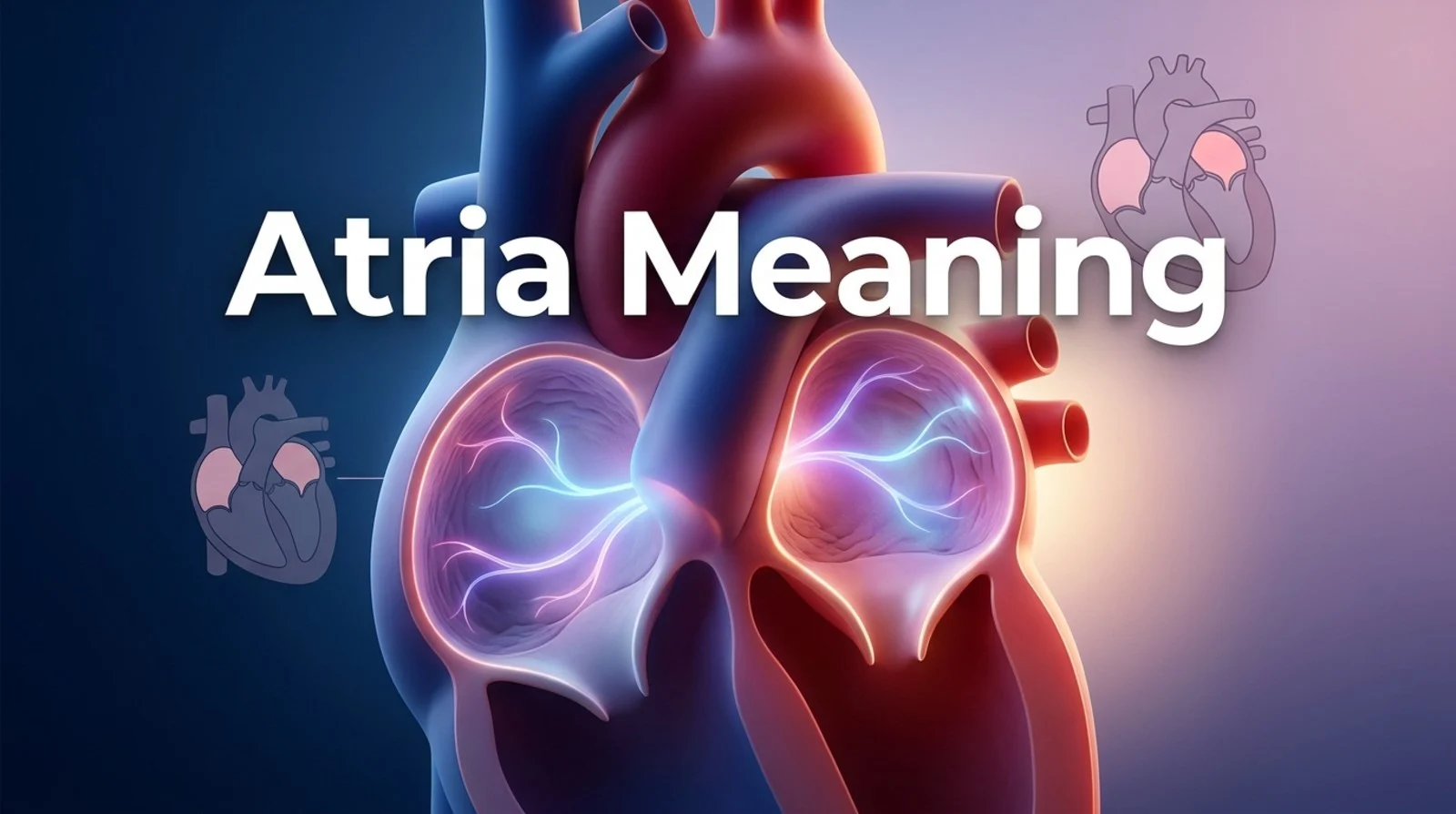
The word atria means the two upper chambers of the heart. It is the plural form of atrium. The atria receive blood returning to the heart and help move it into the lower chambers, called the ventricles. The right atrium receives oxygen-poor blood from the body, while the left atrium receives oxygen-rich blood from the lungs.
Understanding the atria meaning is useful when studying human anatomy, biology, medicine, or basic health science. The term may look complicated at first, but its role becomes much easier to understand when you follow the path of blood through the heart.
Atria Meaning in Simple English
Atria refers to the two upper chambers of the human heart.
There are two atria:
- Right atrium: receives oxygen-poor blood returning from the body.
- Left atrium: receives oxygen-rich blood returning from the lungs.
The atria do not work alone. They are connected to the ventricles below them. After receiving blood, each atrium helps move that blood into the corresponding ventricle.
A simple way to remember their role is:
Atria receive. Ventricles pump.
This is a useful starting point for understanding the basic structure of the heart.
What Does Atria Mean in Anatomy?
In anatomy, atria is the plural form of atrium.
The heart has four main chambers:
| Heart chamber | Position | Main role |
|---|---|---|
| Right atrium | Upper right side | Receives oxygen-poor blood from the body |
| Right ventricle | Lower right side | Pumps blood toward the lungs |
| Left atrium | Upper left side | Receives oxygen-rich blood from the lungs |
| Left ventricle | Lower left side | Pumps blood to the rest of the body |
The atria form the upper part of the heart. They act as receiving chambers before blood moves into the ventricles.
The term atrium can also refer to an entrance hall or chamber in other anatomical contexts. In the cardiovascular system, however, it commonly refers to one of the two upper chambers of the heart.
Atria vs. Atrium: What Is the Difference?
One of the most common points of confusion is the difference between atrium and atria.
The distinction is simple:
- Atrium = singular
- Atria = plural
For example:
The right atrium receives blood from the body.
But:
The atria are the upper chambers of the heart.
This follows a Latin-based plural pattern found in several medical terms. Learning the singular and plural forms can make anatomy textbooks and medical explanations easier to understand.
Quick Example
One chamber: an atrium
Two chambers: the atria
So, if someone asks, “What is an atrium?” they are asking about one upper heart chamber. If they ask, “What are the atria?” they mean both upper chambers.
What Are the Atria of the Heart?
The atria are the heart’s two upper chambers. Each one has a different blood supply and connects to a different ventricle.
Right Atrium
The right atrium receives oxygen-poor blood from the body.
This blood has already delivered much of its oxygen to body tissues. It returns to the heart through two major veins:
- The superior vena cava, which carries blood from the upper part of the body.
- The inferior vena cava, which carries blood from the lower part of the body.
The right atrium then passes the blood into the right ventricle.
From there, the right ventricle pumps the blood toward the lungs.
Left Atrium
The left atrium receives oxygen-rich blood from the lungs.
After blood travels through the lungs, it picks up oxygen and returns to the heart through the pulmonary veins.
The left atrium receives this oxygen-rich blood and passes it into the left ventricle.
The left ventricle then pumps the blood through the systemic circulation to supply the body.
What Is the Function of the Atria?
The main function of the atria is to receive blood and help move it into the ventricles.
Although the atria are not the heart’s main pumping chambers, they play an important part in keeping blood moving through the circulation.
Their functions can be summarized in three steps:
- Receive returning blood
- Hold blood briefly
- Help transfer blood into the ventricles
The atria also contribute to the final filling of the ventricles before the ventricles contract.
This coordinated movement allows blood to travel efficiently through the pulmonary and systemic circulatory pathways.
How Do the Atria Work With the Ventricles?
The atria and ventricles work as connected pairs.
The right side handles blood traveling between the body and lungs. The left side handles blood traveling between the lungs and the rest of the body.
The basic sequence is:
Body → Right atrium → Right ventricle → Lungs → Left atrium → Left ventricle → Body
This sequence is one of the easiest ways to understand heart anatomy.
Right Side of the Heart
The right atrium receives oxygen-poor blood from the body.
That blood moves into the right ventricle, which sends it to the lungs.
In the lungs, carbon dioxide is released and oxygen is taken up.
Left Side of the Heart
Oxygen-rich blood returns from the lungs to the left atrium.
It then moves into the left ventricle.
The left ventricle pumps the blood into the body’s systemic circulation, where oxygen and nutrients can be delivered to tissues.
Atria and Blood Circulation
The atria are an important part of both major circulation pathways.
Pulmonary Circulation
Pulmonary circulation carries blood between the heart and lungs.
The right side of the heart sends oxygen-poor blood to the lungs. Oxygen-rich blood then returns from the lungs to the left atrium.
In simplified form:
Right ventricle → lungs → left atrium
Systemic Circulation
Systemic circulation carries blood between the heart and the rest of the body.
The left ventricle pumps oxygen-rich blood into the body’s arteries. After tissues use oxygen, oxygen-poor blood returns through the veins to the right atrium.
The simplified pathway is:
Left ventricle → body → right atrium
Together, these two circulation pathways keep blood moving continuously.
Why Are the Atria Important?
The atria are important because they provide the connection between returning blood and the ventricles.
Think of them as receiving areas in a continuous transport system.
The right atrium receives blood that has traveled through the body. The left atrium receives blood that has traveled through the lungs.
This arrangement helps separate the oxygen-poor and oxygen-rich sides of circulation.
The atria also contribute to proper ventricular filling. During a normal heartbeat, the chambers contract and relax in a coordinated pattern. This timing allows blood to move from the atria into the ventricles before the ventricles contract.
Atria Anatomy: Key Structures to Know
Several structures are closely connected to the atria.
| Structure | Connection to the atria |
|---|---|
| Superior vena cava | Brings blood into the right atrium |
| Inferior vena cava | Brings blood into the right atrium |
| Pulmonary veins | Bring oxygen-rich blood into the left atrium |
| Tricuspid valve | Connects the right atrium and right ventricle |
| Mitral valve | Connects the left atrium and left ventricle |
| Interatrial septum | Separates the right and left atria |
These structures work together to direct blood through the heart.
What Separates the Two Atria?
The right and left atria are separated by a wall called the interatrial septum.
This structure helps keep the two sides of the heart separate.
In a healthy adult heart, blood normally follows its designated pathway rather than freely moving between the two atria.
The septum is therefore an important part of normal cardiac anatomy.
What Is the Role of the Heart Valves Near the Atria?
The atria connect to the ventricles through valves.
The tricuspid valve is between the right atrium and right ventricle.
The mitral valve, also called the bicuspid valve, is between the left atrium and left ventricle.
These valves help control the direction of blood flow.
When blood moves from an atrium into its ventricle, the valve allows forward movement. During ventricular contraction, the valve closes to help prevent blood from flowing backward into the atrium.
This one-way movement is essential for efficient circulation.
Atria and the Heartbeat
The atria are involved in the rhythm of each heartbeat.
The heartbeat is coordinated by the heart’s electrical conduction system. The sinoatrial node, commonly called the SA node, is located in the right atrium and normally initiates the electrical signal that starts each heartbeat.
The signal spreads through the atrial tissue, causing the atria to contract.
The electrical impulse then travels through the heart’s conduction system toward the ventricles.
This coordination allows the atria to contract before the ventricles.
That timing matters because it gives the ventricles an opportunity to fill before they contract and pump blood onward.
Atria Examples in Sentences
Seeing the word in context can make its meaning easier to remember.
- The atria are the two upper chambers of the heart.
- The right atrium receives blood returning from the body.
- The left atrium receives oxygen-rich blood from the lungs.
- Blood moves from the atria into the ventricles.
- The atria help fill the ventricles before ventricular contraction.
- The pulmonary veins carry blood to the left atrium.
- The venae cavae deliver blood to the right atrium.
- The atria and ventricles work together during each heartbeat.
- The interatrial septum separates the two atria.
- Students often learn the atria before studying the complete blood-flow pathway.
These examples show how the word is normally used in biology and anatomy.
Atria vs. Ventricles
The atria and ventricles are both heart chambers, but their jobs are different.
| Feature | Atria | Ventricles |
|---|---|---|
| Number | Two | Two |
| Location | Upper chambers | Lower chambers |
| Main role | Receive blood | Pump blood out |
| Right chamber | Receives blood from the body | Pumps blood to the lungs |
| Left chamber | Receives blood from the lungs | Pumps blood to the body |
| Relative wall thickness | Thinner | Thicker |
The difference is especially important when learning cardiac anatomy.
The atria primarily receive blood, while the ventricles provide the stronger pumping action needed to move blood toward the lungs or throughout the body.
A Simple Way to Remember Atria
A useful memory trick is:
Atria = Arrive
Blood arrives at the atria.
Then:
Ventricles = Vent blood onward
This is not a formal medical definition, but it can make the basic pathway easier to remember.
Another quick memory pattern is:
Right atrium → from body
Left atrium → from lungs
Right ventricle → to lungs
Left ventricle → to body
Once this pattern is familiar, many heart anatomy questions become easier to follow.
Common Mistakes About the Atria
Some misunderstandings appear frequently when people first learn about the heart.
Mistake 1: Thinking the atria are lower chambers
They are not.
The atria are the upper chambers. The ventricles are the lower chambers.
Mistake 2: Thinking both atria receive the same type of blood
They do not.
The right atrium receives oxygen-poor blood from the body. The left atrium receives oxygen-rich blood from the lungs.
Mistake 3: Using atrium and atria interchangeably
The terms have different grammatical numbers.
Atrium refers to one.
Atria refers to more than one.
Mistake 4: Thinking the atria pump blood directly to the entire body
The ventricles perform the major pumping work that sends blood toward the lungs or the rest of the body.
The atria receive blood and help fill the ventricles.
Mistake 5: Assuming oxygen-poor blood means blood contains no oxygen
Oxygen-poor blood still contains oxygen. It simply has less oxygen than oxygen-rich blood after tissues have used some of it.
Atria Meaning in Medical and Academic Contexts
You may encounter atria in several settings.
Biology Classes
Students often learn the atria when studying the circulatory system and human anatomy.
Medical Education
The term appears in discussions of cardiac structure, blood flow, heart rhythm, and cardiovascular conditions.
Anatomy Textbooks
Anatomy resources commonly use atrium for one upper chamber and atria for both.
Health Information
General health articles may mention the atria when explaining heart chambers, circulation, or certain cardiac conditions.
The meaning remains the same, but the amount of detail changes according to the context.
Why the Atria Have Different Jobs on Each Side
At first, it can seem strange that both chambers are called atria when they receive different kinds of blood.
Their basic role is similar, but their connections are different.
The right atrium is connected to veins returning blood from the body.
The left atrium is connected to pulmonary veins returning blood from the lungs.
This difference reflects the two-part organization of circulation.
The right side sends blood toward the lungs for gas exchange. The left side sends oxygen-rich blood toward the body.
Atria and Oxygen-Rich vs. Oxygen-Poor Blood
A helpful distinction is to focus on direction rather than color.
Right atrium:
Body → heart
The blood has traveled through body tissues and is returning to the heart.
Left atrium:
Lungs → heart
The blood has traveled through the lungs and is returning with oxygen.
This explains why the right and left atria have different incoming blood vessels.
Related Terms You May See With Atria
Learning related vocabulary can make anatomy explanations much easier to understand.
- Atrium: One upper chamber of the heart.
- Atria: Both upper chambers.
- Ventricle: One of the two lower heart chambers.
- Septum: A wall that separates parts of the heart.
- Tricuspid valve: Valve between the right atrium and right ventricle.
- Mitral valve: Valve between the left atrium and left ventricle.
- Vena cava: Major veins that return blood to the right atrium.
- Pulmonary veins: Vessels that return oxygen-rich blood to the left atrium.
- Circulation: The movement of blood through the cardiovascular system.
- Cardiac: Relating to the heart.
Quick Reference: Atria Meaning
| Question | Answer |
|---|---|
| What does atria mean? | The two upper chambers of the heart |
| What is singular? | Atrium |
| How many atria are there? | Two |
| Where are they located? | At the top of the heart |
| What does the right atrium receive? | Oxygen-poor blood from the body |
| What does the left atrium receive? | Oxygen-rich blood from the lungs |
| What chambers receive blood from the atria? | The ventricles |
| What separates the atria? | The interatrial septum |
| What is the main function of the atria? | Receiving blood and helping fill the ventricles |
FAQs
What does atria mean?
Atria is the plural form of atrium and refers to the two upper chambers of the heart. The right atrium receives oxygen-poor blood from the body, while the left atrium receives oxygen-rich blood from the lungs.
Is atria singular or plural?
Atria is plural. The singular form is atrium. For example, “the left atrium” refers to one chamber, while “the atria” refers to both upper chambers.
What are the two atria of the heart?
The two atria are the right atrium and left atrium. The right atrium receives blood returning from the body, and the left atrium receives blood returning from the lungs.
What is the main function of the atria?
The atria receive blood returning to the heart and help move it into the ventricles. They also contribute to ventricular filling before the ventricles contract.
What is the difference between atria and ventricles?
The atria are the two upper chambers and primarily receive blood. The ventricles are the two lower chambers and pump blood out of the heart toward the lungs or the rest of the body.
Which atrium receives oxygen-rich blood?
The left atrium receives oxygen-rich blood from the lungs through the pulmonary veins.
Which atrium receives oxygen-poor blood?
The right atrium receives oxygen-poor blood returning from the body through the superior and inferior vena cava.
Are atria and atrium the same thing?
They refer to the same type of heart chamber, but the grammatical number is different. Atrium means one chamber, while atria means two or more atria.
Final Takeaway
The simplest atria meaning is the two upper chambers of the heart. The singular form is atrium. The right atrium receives oxygen-poor blood from the body, while the left atrium receives oxygen-rich blood from the lungs.
The atria then help move blood into the ventricles, which carry out the heart’s main pumping action. Remembering the basic pattern, atria receive and ventricles pump, makes the entire blood-flow pathway much easier to understand.
Discover More Post:
- ENO Meaning in Text | Definition, Uses, Context & What It …
- 111 Meaning | Spiritual Significance, Symbolism, Love & the …
- Abut Meaning | Definition, Examples, Usage & How to Use It …