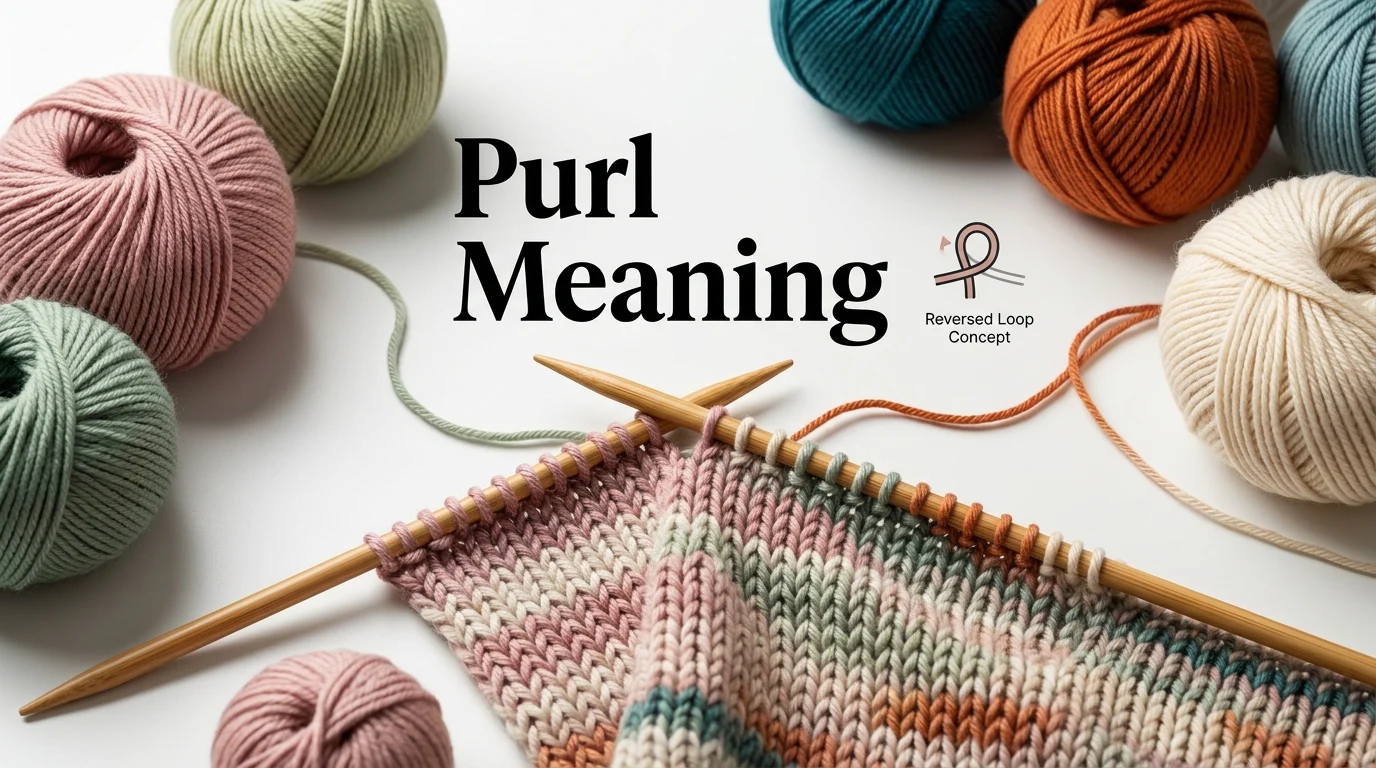
The purl meaning depends on the context. In general English, purl can describe a soft, murmuring sound, such as water moving gently in a stream. In knitting, purl refers to a basic stitch made with the working yarn positioned in front of the needle. The purl stitch creates a raised, textured appearance on one side of the fabric and forms the foundation of many knitting patterns.
If you are reading a knitting pattern and see instructions such as “purl 10 stitches” or “P2”, you are being told to make purl stitches. Understanding this small word makes knitting instructions much easier to follow.
What Does Purl Mean?
Purl has several meanings, but two are especially important:
- In knitting: to make a purl stitch, one of the two fundamental knitting stitches.
- In general English: a soft, continuous murmuring or bubbling sound, especially the sound made by flowing water.
The word can function as both a verb and a noun.
| Use | Meaning | Example |
|---|---|---|
| Knitting verb | To make a purl stitch | “Purl five stitches.” |
| Knitting noun | A purl stitch | “The pattern uses a purl here.” |
| Sound verb | To make a gentle murmuring sound | “The stream purled over the stones.” |
| Sound noun | A soft murmuring sound | “We could hear the purl of the brook.” |
For someone searching purl meaning in knitting, the knitting definition is the one that matters most.
Purl Meaning in Knitting
In knitting, a purl is one of the two basic stitch techniques. The other is the knit stitch.
A purl stitch is created by bringing the working yarn to the front of the work and inserting the needle into the stitch from the required direction. The yarn is then wrapped and pulled through to create the new stitch.
The exact hand movement becomes much easier after a few repetitions. At first, the terms can seem confusing because a purl stitch looks different depending on which side of the fabric you are viewing.
What Does a Purl Stitch Look Like?
A purl stitch usually appears as a small horizontal bump or ridge on the front-facing side of knitted fabric.
A knit stitch generally looks like a series of small V shapes.
This difference gives knitters a simple visual clue:
- Knit stitch: V-shaped appearance
- Purl stitch: raised horizontal bump
- Knit and purl together: create a wide range of textures and patterns
The two stitches are not simply decorative variations. They interact to control the texture, structure, and appearance of knitted fabric.
Knit vs. Purl: What Is the Difference?
The easiest way to understand purl is to compare it with knit.
| Feature | Knit | Purl |
|---|---|---|
| Basic role | Fundamental knitting stitch | Fundamental knitting stitch |
| Typical appearance | Small V shapes | Raised horizontal bumps |
| Yarn position during the basic stitch | Behind the work | In front of the work |
| Common use | Smooth-looking fabric | Texture and contrast |
| Used alone | Yes | Yes |
| Used together | Yes | Yes |
There is an important detail here: knit and purl are closely related. A stitch that appears as a knit stitch from one side can appear as a purl stitch from the opposite side.
That is why experienced knitters often think about the relationship between the two stitches rather than treating them as completely separate techniques.
What Does “Purl” Mean in a Knitting Pattern?
Knitting patterns often shorten instructions to save space.
You may see:
- P = purl
- P1 = purl one stitch
- P2 = purl two stitches
- P5 = purl five stitches
- P to end = continue purling until the end of the row
For example, if a pattern says:
P3, K4, P3
it means:
- Purl three stitches.
- Knit four stitches.
- Purl three stitches.
These abbreviations are common in knitting instructions, so learning them can make patterns much easier to read.
What Is the Purpose of a Purl Stitch?
A purl stitch does much more than add another option to a knitter’s vocabulary.
It can help create:
Texture
Purl stitches can produce raised ridges and textured surfaces.
Ribbing
Alternating knit and purl stitches creates ribbed fabric.
A simple example is:
K1, P1, K1, P1
This creates a basic 1×1 rib pattern.
Garter and Other Textures
Different combinations of knit and purl stitches produce distinctive textures and patterns. Many classic knitting designs depend almost entirely on changing the sequence of these two basic stitches.
Shaping and Pattern Definition
Purl stitches can separate sections of a design and make certain shapes or motifs easier to see.
The interesting part is that a huge number of knitting patterns can be created from only these two fundamental stitch types.
What Is the Difference Between Knit and Purl in Fabric?
One useful way to understand the difference is to stop thinking about the stitch only as an action and start looking at the fabric it creates.
A knit stitch viewed from the front commonly shows a V-shaped loop. The corresponding reverse side displays a purl bump.
A purl stitch produces the opposite visual effect.
This explains why a knitted fabric can look smooth on one side and textured on the other. The fabric is built from interlocking loops, and the direction from which you view those loops changes what you see.
Purl Meaning in General English
Outside knitting, purl has an older and more literary use connected with sound.
As a verb, purl can mean to make a soft, continuous murmuring or bubbling sound.
For example:
“The stream purled quietly through the meadow.”
Here, purled does not have anything to do with yarn or needles. It describes the gentle sound of flowing water.
As a noun, purl can refer to the sound itself:
“The gentle purl of the brook made the garden feel peaceful.”
This use is less common in everyday conversation than the knitting sense, but it can appear in descriptive or literary writing.
Purl Meaning in a Sentence
Here are examples showing the different senses of the word:
- “Purl the next six stitches.”
Here, purl refers to a knitting technique. - “She learned how to purl after mastering the knit stitch.”
The word refers to the basic knitting action. - “The stream began to purl over the smooth rocks.”
Here, purl describes a soft water sound. - “The purl of the river could be heard from the cottage.”
In this example, purl is a noun describing the sound. - “The pattern alternates knit and purl stitches.”
The word refers to a specific type of stitch. - “Purl two, then knit two across the row.”
This is a typical knitting instruction.
How to Pronounce Purl
Purl is generally pronounced:
/pɜːrl/
For many American English speakers, it sounds close to “perl.”
The pronunciation can be easier to remember if you think of it as a single syllable.
Purl vs. Pearl
The words purl and pearl can sound very similar in English.
However, their meanings are completely different.
- Purl: a knitting stitch or a soft murmuring sound
- Pearl: a hard, rounded object formed inside certain mollusks and also a word used for jewelry
Context usually makes the intended meaning clear.
How to Purl in Knitting
The basic purl movement can be summarized like this:
- Hold the knitted work in your usual position.
- Bring the working yarn to the front.
- Insert the working needle into the next stitch according to the pattern.
- Wrap the working yarn around the needle.
- Pull the new loop through.
- Move the completed stitch off the original needle.
Different knitting styles can change how the hands hold and move the yarn. Continental and English knitting, for example, use different hand positions and yarn handling.
The important point for beginners is to learn the movement slowly rather than trying to build speed immediately.
Common Mistakes Beginners Make With Purl Stitches
Purling is simple once the movement becomes familiar, but several small errors appear frequently.
Keeping the Yarn in the Wrong Position
For a standard purl stitch, the yarn is brought to the front of the work.
Leaving it behind can change the stitch or create an unintended yarn over.
Accidentally Knitting Instead of Purling
The hand movement for knit and purl is similar enough to cause confusion when learning.
A useful habit is to check the resulting fabric regularly instead of waiting until the entire row is finished.
Pulling the Yarn Too Tightly
Tight tension can make the next stitch difficult to work and can produce uneven fabric.
Try to keep the yarn controlled but relaxed.
Losing Track of the Pattern
When switching between knit and purl stitches, beginners can easily lose their place.
Reading the pattern in small groups, such as K2, P2, can make the sequence easier to remember.
Purl, Knit, and Ribbing
One of the most practical uses of purl stitches is ribbing.
Ribbing is commonly used in areas that need a flexible, structured edge, such as:
- Cuffs
- Hat edges
- Sweater hems
- Sock openings
- Necklines
A common rib pattern is K1, P1, known as 1×1 ribbing.
Another is K2, P2, known as 2×2 ribbing.
The alternating structure allows the knitted fabric to contract and expand, which makes ribbing useful for garments that need some stretch.
Purl vs. Crochet
A common beginner mistake is assuming that purl is a crochet term.
Purl is primarily a knitting term.
Crochet uses a different system of stitches, including:
- Single crochet
- Half double crochet
- Double crochet
- Treble crochet
- Slip stitch
Knitting and crochet both work with yarn, but their tools, construction methods, and stitch terminology differ.
So if a pattern tells you to purl, it is almost certainly describing a knitting technique.
Words Related to Purl
The best related words depend on the sense being used.
Knitting-related terms
- Knit
- Stitch
- Yarn
- Needle
- Ribbing
- Stockinette
- Pattern
- Loop
- Fabric
- Texture
- Needlework
Sound-related terms
- Murmur
- Bubble
- Ripple
- Flow
- Gurgle
- Babble
- Stream
- Brook
These words are related to the different meanings of purl, but they are not all direct synonyms.
Purl Synonyms
There is no single synonym that works for every use of purl.
For the water-sound sense, contextually related words include:
- Murmur
- Gurgle
- Babble
- Ripple
- Flow
For the knitting sense, words such as knit, stitch, and knitting technique may be related, but they are not exact substitutes. A purl stitch and a knit stitch are distinct techniques.
This distinction matters because replacing purl with a loosely related word can change the meaning of a sentence or knitting instruction.
Quick Guide to Purl Meaning
| Question | Short Answer |
|---|---|
| What does purl mean? | It can mean a knitting stitch or a soft murmuring sound. |
| What is a purl stitch? | One of the two basic knitting stitches. |
| What does P mean in knitting? | Usually “purl.” |
| What does P2 mean? | Purl two stitches. |
| What does purl look like? | It commonly appears as a raised horizontal bump. |
| Is purl a knitting term? | Yes, it is a fundamental knitting term. |
| Is purl used in crochet? | Purl is primarily associated with knitting. |
| What is the opposite of purl? | In basic knitting terminology, knit is commonly contrasted with purl. |
| Can purl describe water? | Yes. It can describe a soft bubbling or murmuring sound. |
Frequently Asked Questions
What is the simple meaning of purl?
Purl has two major English uses. In knitting, it means to make a purl stitch. In descriptive English, it can refer to a soft murmuring or bubbling sound, especially from flowing water.
What does purl mean in knitting?
In knitting, purl refers to a basic stitch technique. The working yarn is brought to the front for the standard purl motion, producing a characteristic textured appearance.
What does P mean in knitting?
P is a common abbreviation for purl in knitting patterns. For example, P4 generally means to purl four stitches.
What is a purl stitch?
A purl stitch is one of the two fundamental knitting stitches. Along with the knit stitch, it can be combined in different sequences to create textures, ribbing, patterns, and many types of knitted fabric.
Is purl the same as knit?
No. Knit and purl are two distinct basic knitting techniques. They are closely related, and a stitch can appear as a knit on one side of the fabric and a purl on the other.
What does purl mean in a knitting pattern?
It tells the knitter to perform the purl stitch. A pattern might say P2 for two purl stitches or K2, P2 for two knit stitches followed by two purl stitches.
What does purl mean when describing water?
As a verb, purl can describe the soft, continuous murmuring or bubbling sound made by flowing water. For example, “The brook purled through the valley.”
Is purl a crochet stitch?
Purl is primarily a knitting term. Crochet has its own stitch vocabulary and does not use the standard knit-and-purl system found in knitting.
How do you remember knit and purl?
A useful visual trick is to remember that knit stitches commonly create V shapes, while purl stitches commonly create raised bumps. Looking at the fabric can help reinforce the difference.
Final Takeaway
The word purl becomes much easier to understand once its context is clear. In knitting, it means a fundamental stitch technique that works alongside the knit stitch to create texture, ribbing, and patterns. In general English, purl can also describe the gentle murmuring sound of flowing water.
For someone reading a knitting pattern, the most important terms to recognize are purl, P, P1, P2, knit, K1, and K2. Once these become familiar, many basic knitting instructions start to look far less complicated.
Discover More Post:
- Manifest Meaning | Definition, Uses, Examples & the Power of …
- Rizz Meaning | Definition, Examples, Types, and the Modern …
- Grifter Meaning | Definition, Examples, Origins & How to Spot …