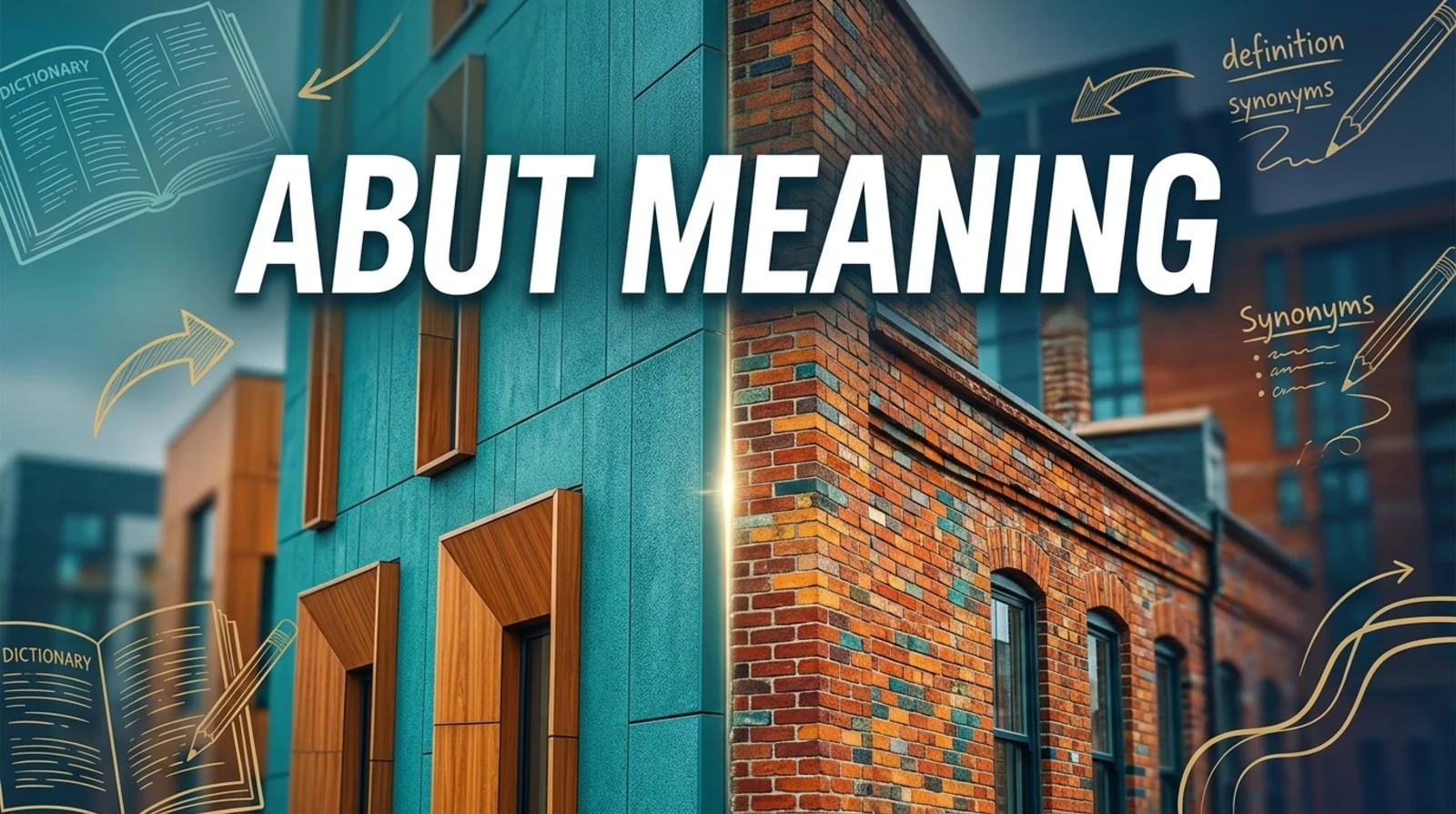
A small word can make a big difference when describing how two places, buildings, or areas meet. Abut meaning refers to being next to something or sharing a boundary with it, usually without overlapping. You may see this word in property descriptions, geography, architecture, legal writing, and formal English. Although “abut” is less common in everyday conversation, it is useful when you need to describe a precise physical relationship between two things.
In practical usage, “abut” is usually followed by the object that another place or structure touches or borders. For example, “The garden abuts the park” means the garden directly borders the park. Understanding abut meaning also helps distinguish it from words such as border, adjoin, and touch, which can have slightly different tones and uses. Learning these distinctions makes your writing more accurate, especially in formal or descriptive contexts.
What Does Abut Mean?
Abut means to be next to something and share a boundary with it.
It usually describes a direct physical connection between two things. The things do not need to overlap. They simply meet along an edge, border, or boundary.
Simple example:
“The property abuts the river.”
Meaning: The property directly borders the river.
Abut at a Glance
| Word | Part of Speech | Simple Meaning | Example |
|---|---|---|---|
| Abut | Verb | To share a boundary with something | The farm abuts the forest. |
| Abuts | Verb | Shares a boundary | The house abuts the road. |
| Abutted | Past tense | Shared a boundary | The property abutted the park. |
| Abutting | Present participle | Sharing a boundary | The abutting buildings were renovated. |
Abut Definition in English
The definition of abut is to be directly next to something and meet it at a boundary or edge.
The word focuses on physical contact or a shared border. It is especially useful when two areas meet in a clearly defined way.
For example:
- A garden can abut a sidewalk.
- A house can abut another property.
- A road can abut a field.
- A city can abut a neighboring town.
- One building can abut another building.
The idea is not simply that something is nearby. Abut suggests that the two things meet directly.
A Simple Way to Remember Abut
Think of abut as:
abut = meet at the edge + share a boundary
If two properties are several blocks apart, they do not abut each other. If their boundaries touch directly, they can be described as abutting properties.
Abut as a Verb
Abut is a verb. It normally describes the relationship between one physical thing and another.
Common structures include:
Subject + abuts + object
- The house abuts the park.
- The road abuts the property.
- The garden abuts the wall.
It can also appear as abut against, particularly when the meaning emphasizes direct contact with something.
- The wall abuts against the older structure.
In many property and geographical contexts, simply using abut with a direct object is natural:
“The eastern boundary abuts the neighboring farm.”
Abut Meaning in Different Contexts
The basic meaning stays the same, but the word appears in several settings.
1. Property and Real Estate
This is one of the most common formal contexts for abut.
“The lot abuts a public road.”
The sentence tells the reader that the lot directly meets the road.
Real estate descriptions may use the word to explain boundaries, access points, neighboring parcels, or nearby public land.
2. Roads and Transportation
Abut can describe roads, highways, paths, and streets that meet or border another area.
“The driveway abuts the main street.”
This indicates that the driveway directly meets the street.
3. Buildings and Structures
The word can describe structures that directly meet one another.
“The new office building abuts the historic courthouse.”
Here, abut highlights the physical relationship between the two buildings.
4. Geography
Geographical writing can use abut to describe areas that share a boundary.
“The northern district abuts the city center.”
The expression is more formal than simply saying “is next to.”
5. Legal and Planning Language
You may encounter abut in zoning documents, property records, planning reports, regulations, and legal descriptions.
For example:
“The parcel abuts a protected wetland.”
In this context, the word precisely describes a boundary relationship.
Abut in a Sentence: Realistic Examples
Here are practical examples showing how abut works naturally.
- The backyard abuts a small public park.
- The farm abuts the eastern edge of the village.
- The driveway abuts the main road.
- The two properties abut one another.
- The school abuts a residential neighborhood.
- The restaurant’s patio abuts the sidewalk.
- The forest abuts the northern boundary of the town.
- The warehouse abuts an old railway line.
- The apartment complex abuts a busy avenue.
- The field abuts the riverbank.
- The garden abuts the stone wall.
- The western boundary abuts privately owned land.
- The new development abuts an established neighborhood.
- The parking area abuts the entrance to the building.
- The two lots abut along their southern boundaries.
Notice that these sentences describe a direct boundary relationship, not merely general closeness.
Abut vs. Adjacent
Abut and adjacent are related, but they are not always interchangeable.
Adjacent means next to or very close to something. Abut specifically emphasizes meeting or sharing a boundary.
| Word | Meaning | Example |
|---|---|---|
| Abut | Meet directly at an edge or boundary | The property abuts the road. |
| Adjacent | Next to or nearby | The property is adjacent to the road. |
Consider this difference:
“The houses are adjacent.”
This tells us that the houses are next to each other.
“The houses abut.”
This gives a stronger sense that they directly meet at their boundaries.
In everyday writing, next to or adjacent to may sound more natural. Abut becomes particularly useful when the exact boundary relationship matters.
Abut vs. Adjoin
Adjoin is one of the closest words to abut.
Both can describe things that directly touch or share a boundary.
| Word | Main Idea | Typical Use |
|---|---|---|
| Abut | Meet at a boundary or edge | Land, roads, buildings |
| Adjoin | Be next to or connected with something | Rooms, buildings, areas, properties |
| Border | Form a boundary with something | Countries, regions, land |
| Touch | Come into physical contact | General physical contact |
| Neighbor | Be located near something | People, places, properties |
For example:
“The garden abuts the house.”
“The garden adjoins the house.”
Both sentences can work, but abut places more attention on the boundary or edge.
Abut vs. Border
Border is broader and very common in geographical contexts.
A country borders another country. A property can also border another property.
Abut has a more formal physical-boundary feel.
Compare:
“The state borders the neighboring state.”
“The property abuts the neighboring property.”
The first sounds natural for political or geographical boundaries. The second sounds particularly suitable for property and land descriptions.
Abut vs. Touch
Touch is much broader than abut.
You can say:
“The two boxes touch.”
But abut is more specific and formal:
“The two buildings abut.”
Touch can describe physical contact in many situations. Abut usually appears when the contact involves an edge, boundary, or adjoining area.
Abut Synonyms
The best synonym depends on the context.
Common Synonyms
- adjoin
- border
- meet
- touch
- be next to
- be adjacent to
- connect with
- share a boundary with
Formal Alternatives
For property, planning, or geographical writing, these can work well:
- adjoin
- border
- share a boundary with
- be contiguous with
- be adjacent to
Simple Everyday Alternatives
If the audience may not know the word abut, simpler expressions are often clearer:
- be next to
- touch
- meet
- border
For example:
Formal:
“The property abuts a public road.”
Simple:
“The property borders a public road.”
Very simple:
“The property is next to a public road.”
The best choice depends on the audience and the level of precision required.
Abut Antonyms
There is no single perfect opposite of abut in every context. The natural opposite usually expresses separation, distance, or lack of contact.
Useful opposites include:
- separate
- be distant from
- be apart from
- be disconnected from
- be away from
- be detached from
For example:
“The two buildings abut each other.”
Opposite idea:
“The two buildings are separated by a wide courtyard.”
This shows why context matters. Abut describes direct boundary contact, while its opposite often involves physical separation.
Abutting Meaning
Abutting means sharing a boundary with or directly bordering something.
It is the present participle of abut, and it is also commonly used as an adjective.
For example:
“The abutting properties were sold together.”
Here, abutting properties means properties that share a boundary.
More examples:
- abutting land
- abutting properties
- abutting buildings
- abutting roads
- abutting lots
- abutting parcels
This form is especially common in real estate and legal descriptions.
Abutted Meaning
Abutted is the past tense and past participle of abut.
It means that something shared a boundary with or directly met something in the past.
Example:
“The old factory abutted the railway.”
This means the factory directly bordered or met the railway.
Another example:
“The original property abutted the river.”
The sentence describes the property’s past boundary relationship.
Abuts Meaning
Abuts is the third-person singular present form of abut.
Examples:
- The house abuts the road.
- The field abuts the forest.
- The property abuts a public park.
- The building abuts the neighboring structure.
A useful grammar pattern is:
He/She/It + abuts + object
“The property abuts the highway.”
With plural subjects, use abut:
“The properties abut the highway.”
How to Use Abut Correctly
The safest approach is to use abut when the sentence describes a direct physical boundary.
Correct
“The backyard abuts the park.”
The backyard directly meets the park.
Less Precise
“The backyard abuts a restaurant several streets away.”
That does not fit the normal meaning because the restaurant is not directly meeting the backyard.
A better sentence would be:
“The backyard is near a restaurant several streets away.”
The distinction is simple: abut describes direct contact at a boundary, not general proximity.
Common Mistakes With Abut
Mistake 1: Treating Abut as a General Synonym for “Near”
Abut does not simply mean “near.”
Incorrect idea:
“The hotel abuts the airport,” when the hotel is several miles away.
Better:
“The hotel is near the airport.”
Use abut when the two areas directly meet.
Mistake 2: Using It Too Often in Casual Conversation
The word is grammatically normal, but it has a formal tone.
In casual speech, people are more likely to say:
“Our yard is next to the park.”
A formal property description might say:
“The property abuts the park.”
Both communicate the relationship, but their tone differs.
Mistake 3: Assuming It Always Means Physical Touch
The word usually describes a boundary relationship, but the exact physical arrangement can vary by context. The important idea is that the things meet at an edge or boundary.
Mistake 4: Confusing Abut With About
Abut and about look and sound different.
- Abut: share a boundary with something
- About: concerning, approximately, or around
Example:
“The property abuts the road.”
But:
“The article is about property boundaries.”
A single letter changes the meaning completely.
Abut Pronunciation
Abut is commonly pronounced:
uh-BUT
The stress falls on the second syllable.
The pronunciation is roughly:
/əˈbʌt/
The final sound is similar to the vowel sound in cut.
Related Pronunciations
- abut: uh-BUT
- abuts: uh-BUTS
- abutted: uh-BUT-id
- abutting: uh-BUT-ing
Is Abut Formal or Informal?
Abut is generally formal or neutral-formal.
It is especially natural in:
- real estate descriptions
- legal documents
- zoning information
- geographic writing
- architectural descriptions
- planning documents
- technical writing
In everyday conversation, next to, beside, border, or touch may sound more natural.
That does not make abut overly complicated. It simply belongs to a more specific vocabulary set.
When Should You Use Abut?
Use abut when you want to describe a direct boundary relationship clearly and efficiently.
It works particularly well when:
- describing land boundaries
- explaining property relationships
- discussing roads and lots
- describing buildings that meet
- writing geographic descriptions
- explaining planning or zoning information
For general audiences, consider a simpler alternative if the formal word does not add useful precision.
Example: Formal vs. Simple
Formal:
“The residential parcel abuts the commercial district.”
Simpler:
“The residential property borders the commercial district.”
Plain English:
“The residential property is next to the commercial area.”
All three can communicate a similar idea, but the first has a more formal property-description style.
A Useful Grammar Guide
Here are the most important forms of the word:
| Form | Usage | Example |
|---|---|---|
| Abut | Base form | The properties abut the road. |
| Abuts | Present tense, singular | The property abuts the road. |
| Abutted | Past tense | The property abutted the park. |
| Abutting | Present participle/adjective | The abutting property was sold. |
Does Abut Take “To”?
Usually, abut can take a direct object:
“The property abuts the highway.”
You do not need to write:
“The property abuts to the highway.”
That construction is generally unnecessary.
A useful pattern is:
abut + noun
- abut the road
- abut the river
- abut the park
- abut the property
- abut the wall
Words Similar to Abut
Several words share part of the meaning, but each has its own shade of meaning.
Adjoin
Means to be next to or directly connected with something.
Border
Means to form a boundary with something. It is particularly common for countries, states, regions, and properties.
Adjacent
Means next to or nearby. It does not always carry the same strong boundary sense as abut.
Touch
Means to come into physical contact with something. It is broader and more conversational.
Contiguous
Means sharing a common border or touching along an edge. It is highly formal and common in technical or geographical contexts.
Neighbor
Means to be located near something or someone. It is broader than abut.
Abut in Property Descriptions
Property language is one of the clearest places to understand the word.
Consider this sentence:
“The parcel abuts the northern boundary of the municipal park.”
The sentence communicates three useful details:
- The subject is a parcel of land.
- The parcel shares a boundary with the park.
- The relationship occurs along the park’s northern boundary.
A simpler version would be:
“The parcel borders the municipal park.”
For a general audience, the second version may be easier. For a formal property description, abut can be a precise and efficient choice.
Quick List of Abut Alternatives
Depending on context, you can replace abut with:
- adjoin
- border
- meet
- touch
- be next to
- be adjacent to
- share a boundary with
- be contiguous with
Do not treat these as perfect substitutes in every sentence. Abut specifically highlights a direct boundary relationship.
Frequently Asked Questions
What does abut mean in simple words?
Abut means to be directly next to something and share a boundary with it. For example, “The garden abuts the road” means the garden directly meets the road at its boundary.
Is abut a verb?
Yes. Abut is a verb. Its common forms are abut, abuts, abutted, and abutting.
What is a synonym for abut?
Common synonyms include adjoin, border, meet, touch, and be adjacent to. The best choice depends on the context and the level of formality.
What is the difference between abut and adjacent?
Abut emphasizes directly meeting or sharing a boundary. Adjacent means next to or nearby and can be broader. “The properties abut” gives a stronger sense of a shared boundary.
What does abutting mean?
Abutting means sharing a boundary with or directly bordering something. For example, “abutting properties” are properties that share a boundary.
What does abutted mean?
Abutted is the past tense of abut. It means that something shared a boundary with something else in the past.
Can you say “abut to”?
Normally, abut takes a direct object without to. Say “The property abuts the road,” rather than “The property abuts to the road.”
Is abut a formal word?
Yes, abut has a formal or neutral-formal tone. It is especially common in property, legal, geographic, planning, and technical writing.
What is the opposite of abut?
There is no single perfect antonym in every situation. Words and phrases such as separate, be apart from, be distant from, and be disconnected from can express the opposite idea.
Final Takeaway
Abut means to share a boundary with something or to meet it directly along an edge. It is a verb commonly used for properties, land, roads, buildings, geographic areas, and other physical spaces.
The key distinction is simple: abut is stronger and more precise than merely being nearby. If two properties directly meet at their boundaries, you can say they abut each other. If they are simply close, near or adjacent may be more appropriate.
Once you connect abut with the idea of a shared edge or boundary, its use becomes much easier to recognize and apply accurately.
Read More Related Articles:
- RSVP Meaning | What This Invitation Term Really Means and …
- Demisexual Meaning | Attraction, Relationships, Examples …
- Martyr Meaning | Definition, History, Examples & the Deeper …