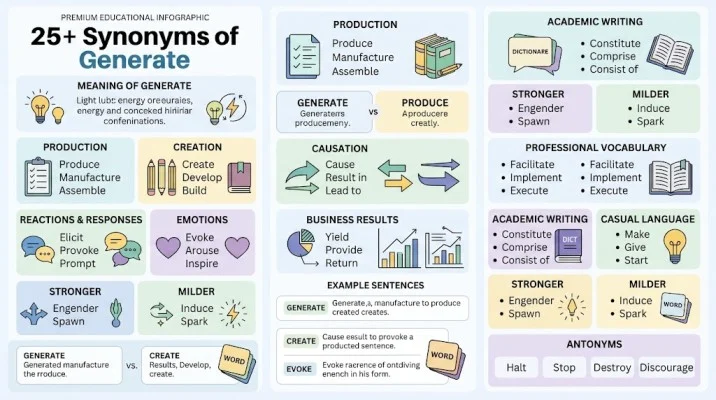
A writer may use generate several times in one essay, business report, email, or blog post without noticing how repetitive it sounds. One sentence might say a campaign generates sales, another says it generates interest, and a third says it generates ideas. Looking for the right synonym of generate can make each sentence more precise and natural.
The best alternative depends on what generate means in context. Produce works well for results and products, create suits ideas and content, cause fits effects, while elicit and evoke are better for reactions and emotions. Choosing the right word improves clarity without changing the original meaning.
What Are the Best Synonyms of “Generate”?
The best synonym of generate depends on what is being produced or caused. Use produce for results, create for ideas or content, cause for effects, yield for returns, elicit for responses, and evoke for emotions. Formal writing often favors produce, yield, or engender, while casual writing can use make or spark.
Meaning, Tone, and Context
Simple Definition
Generate generally means to produce, create, cause, or bring something into existence. The word can describe physical things, energy, information, ideas, emotions, reactions, income, interest, or effects.
For example:
“The solar panels generate electricity.”
Here, generate means to produce electricity.
The meaning changes slightly in another sentence:
“The announcement generated a lot of interest.”
Here, generate means to cause or bring about interest.
This makes context especially important when choosing a synonym.
Part of Speech
Generate is a verb.
It describes an action in which something is produced, created, caused, or brought about.
Overall Tone
The word generate is generally neutral. It does not normally express a positive or negative emotional attitude by itself.
Its tone depends on the noun that follows it.
For example:
“The campaign generated revenue.”
This sounds neutral and professional.
“The story generated excitement.”
This communicates a positive reaction.
“The decision generated controversy.”
This communicates a negative or mixed reaction.
Formality Level
Generate is a neutral to moderately formal word. It is especially common in:
- Business writing
- Academic writing
- Technical writing
- Marketing
- Journalism
- Scientific discussions
- Professional communication
- Everyday conversation
It is usually more formal than make, but less specialized than some alternatives such as engender or induce.
Common Uses
Native English speakers commonly use generate with words such as:
- Generate income
- Generate revenue
- Generate electricity
- Generate energy
- Generate ideas
- Generate interest
- Generate leads
- Generate results
- Generate data
- Generate discussion
- Generate excitement
- Generate demand
- Generate traffic
- Generate heat
- Generate pressure
- Generate controversy
- Generate opportunities
- Generate support
- Generate a response
The noun following generate often tells you which synonym will sound most natural.
Word Forms
| Word | Part of Speech | Example |
|---|---|---|
| Generate | Verb | The campaign generated new leads. |
| Generates | Verb | The system generates electricity. |
| Generated | Verb | The project generated strong interest. |
| Generating | Verb | The company is generating more revenue. |
| Generation | Noun | Power generation increased this year. |
| Generator | Noun | The backup generator started automatically. |
| Generative | Adjective | The course explores generative technology. |
When and How to Use “Generate”
Use generate when you want to describe the production or creation of something, especially when the result comes from an activity, system, process, person, or event.
The word is particularly useful when the result is not necessarily a physical object.
For example, a company can generate revenue, a discussion can generate ideas, a machine can generate electricity, and a news story can generate controversy.
Professional
Example:
“The new marketing strategy generated more qualified leads.”
Why it works:
Generate clearly describes the result produced by the strategy and sounds natural in business communication.
Academic
Example:
“The experiment generated data that supported the researchers’ hypothesis.”
Why it works:
The word fits analytical and research contexts because it focuses on the production of information.
Workplace
Example:
“The new process generated several opportunities to reduce costs.”
Why it works:
The word connects a workplace action with the results it produced.
Personal
Example:
“Her story generated a lot of excitement among her friends.”
Why it works:
Generate can describe a reaction created by something a person says or does.
Example:
“The updated proposal generated positive feedback from the client.”
Why it works:
This phrasing is concise and professional.
Resume
Example:
“Developed a digital campaign that generated $200,000 in new revenue.”
Why it works:
Generated clearly connects the candidate’s work with a measurable business result.
Social Media
Example:
“The post generated thousands of views within the first day.”
Why it works:
The word naturally describes attention or activity produced by online content.
Best Synonyms of “Generate”
No synonym of generate works perfectly in every sentence. The most accurate replacement depends on what is being produced, how it comes into existence, and the tone you want.
Professional Writing: Produce
Produce is one of the safest alternatives in professional writing.
“The new system produced better results.”
It works especially well for reports, business results, products, and measurable outcomes.
Academic Writing: Yield
Yield is useful when something produces a result, finding, return, or outcome.
“The experiment yielded valuable findings.”
It sounds concise and analytical.
Business Communication: Generate
In many business contexts, generate itself is already a strong choice.
When repetition becomes a problem, produce, create, yield, or bring about can replace it depending on the sentence.
“The campaign produced strong sales results.”
Casual Conversation: Make
Make is usually more natural in everyday speech.
“The movie made a lot of excitement.”
However, this sentence is less natural than:
“The movie created a lot of excitement.”
This shows why a simple synonym cannot always replace generate directly.
Emotional Writing: Evoke
Use evoke when something brings out a feeling, memory, image, or emotional response.
“The photograph evoked memories of childhood.”
It is more precise than generate when emotion is the main focus.
Creative Writing: Spark
Spark suggests starting or triggering something suddenly.
“Her question sparked a lively conversation.”
It gives creative writing more energy than the neutral generate.
Resume Writing: Produce
Produce works well when describing measurable achievements.
“Produced a 20 percent increase in customer engagement.”
For revenue, generate is often even more natural:
“Generated a 20 percent increase in customer revenue.”
Workplace Communication: Create
Create works particularly well when discussing ideas, opportunities, solutions, or content.
“The workshop created new opportunities for collaboration.”
Stronger Meaning: Bring About
Bring about emphasizes that an action or event directly caused a result.
“The policy changes brought about major improvements.”
It is useful when you want to emphasize causation.
Softer Meaning: Contribute To
Contribute to is useful when something is one factor among several rather than the sole cause.
“The training contributed to improved employee performance.”
This is often more accurate than saying the training generated the entire result.
When Not to Use “Generate”
Although generate is flexible, it can sound vague when a more precise verb explains exactly what happened.
When the Word Is Too General
Less Effective:
“The company generated a new product.”
Better:
“The company developed a new product.”
Why:
Developed tells the reader more about the process.
When the Word Is Too Vague
Less Effective:
“The speaker generated a response.”
Better:
“The speaker elicited a strong response from the audience.”
Why:
Elicit specifically describes drawing a response from someone.
When a More Formal Word Is Needed
Less Effective:
“The study generated important findings.”
Better:
“The study yielded important findings.”
Why:
Yielded is concise and fits formal research language naturally.
When the Word Sounds Too Formal
Less Effective:
“The meeting generated some good ideas.”
Better:
“The meeting created some great ideas.”
Why:
In casual communication, create can sound more conversational.
When the Word Is Too Weak
Less Effective:
“The announcement generated a major public reaction.”
Better:
“The announcement triggered a major public reaction.”
Why:
When the event caused a strong and immediate reaction, a more forceful verb may communicate the situation better.
When the Word Is Too Strong
Less Effective:
“The small change generated widespread concern.”
Better:
“The small change contributed to growing concern.”
Why:
If the change was only one factor, contributed to avoids exaggerating its effect.
When a More Specific Word Is Available
Less Effective:
“The machine generates heat.”
Better:
“The machine produces heat.”
Why:
Produces is often the more direct choice for physical output.
Words Commonly Confused With “Generate”
Produce
Difference:
Produce means to make, create, or bring forth something. It is one of the closest general alternatives to generate.
When to Use It:
Use it for products, results, crops, energy, sounds, and other outputs.
Example:
“The factory produces thousands of units each month.”
Create
Difference:
Create emphasizes bringing something new into existence. It is especially natural for ideas, content, plans, opportunities, and artistic work.
When to Use It:
Use it when the focus is on making something new.
Example:
“The workshop helped employees create new solutions.”
Cause
Difference:
Cause focuses on the relationship between an action and its result rather than the act of producing something.
When to Use It:
Use it when you want to emphasize an effect.
Example:
“The storm caused major delays.”
Yield
Difference:
Yield emphasizes the result or return produced by an activity, process, investment, or experiment.
When to Use It:
Use it in academic, financial, agricultural, and analytical contexts.
Example:
“The research yielded useful information.”
Evoke
Difference:
Evoke means to bring a feeling, memory, image, or response into someone’s mind.
When to Use It:
Use it for emotions, memories, associations, and reactions.
Example:
“The music evoked memories of her childhood.”
Elicit
Difference:
Elicit means to draw out a response, reaction, answer, or information from someone.
When to Use It:
Use it when a person or situation produces a response from another person.
Example:
“The question elicited several thoughtful answers.”
Best Synonyms of “Generate” by Context
| Context | Best Synonym | Why It Works | Example |
|---|---|---|---|
| Formal writing | Produce | Clear and professional | The process produced reliable results. |
| Academic writing | Yield | Concise and analytical | The study yielded useful findings. |
| Professional communication | Produce | Works well for measurable outcomes | The strategy produced better results. |
| Business emails | Create | Natural for ideas and opportunities | The meeting created new opportunities. |
| Resume writing | Produce | Highlights achievements | Produced measurable improvements in sales. |
| Workplace communication | Create | Natural for solutions and ideas | The team created a practical solution. |
| Casual conversation | Make | Simple and familiar | The change made a big difference. |
| Everyday speaking | Cause | Directly expresses an effect | The delay caused confusion. |
| Creative writing | Spark | Adds energy and movement | Her comment sparked an argument. |
| Storytelling | Evoke | Works for memories and feelings | The old house evoked childhood memories. |
| Emotional writing | Evoke | Clearly communicates emotional response | The letter evoked strong emotions. |
| Strong emphasis | Trigger | Suggests a powerful or immediate effect | The announcement triggered criticism. |
| Mild tone | Contribute to | Avoids overstating causation | The program contributed to growth. |
| Social media captions | Spark | Sounds lively and engaging | The post sparked a conversation. |
| American English | Generate | Common and versatile | The campaign generated new leads. |
| British English | Generate | Also widely understood and used | The project generated considerable interest. |
How to Choose the Best Synonym of “Generate”
Choosing the right alternative starts with identifying what generate means in your sentence.
If Something Is Being Produced
Use produce, make, or manufacture.
“The factory produces medical equipment.”
If Something New Is Being Created
Use create, develop, formulate, or build.
“The team developed a new marketing strategy.”
If Something Causes an Effect
Use cause, bring about, induce, or trigger.
“The policy brought about significant changes.”
If Something Produces a Result
Use yield, produce, or lead to.
“The experiment yielded unexpected results.”
If Something Produces an Emotion
Use evoke, elicit, or arouse.
“The speech evoked strong emotions.”
If Something Starts Interest or Activity
Use spark, stimulate, or prompt.
“The article sparked a useful discussion.”
If Something Produces Money
Use generate, earn, produce, or raise, depending on the exact meaning.
“The campaign generated additional revenue.”
Consider Your Audience
Academic readers may prefer yield, produce, or induce.
Business readers often respond well to generate, produce, create, and drive.
Everyday readers usually find make, cause, create, and start easier to understand.
Consider Emotional Strength
Choose a neutral word when you only want to report information.
Choose spark, trigger, or ignite when you want stronger imagery or emphasis.
Consider Natural Usage
A synonym can be grammatically possible but still sound unnatural.
For example:
“The advertisement generated a memory.”
This is understandable, but:
“The advertisement evoked a memory.”
is much more natural because evoke specifically fits memories.
Real Life Examples of “Generate”
School
Original:
“The experiment generated useful results.”
Improved:
“The experiment yielded useful results.”
Why:
Yielded fits academic and scientific writing.
College
Original:
“The discussion generated several ideas.”
Improved:
“The discussion produced several useful ideas.”
Why:
Produced clearly describes the result of the discussion.
Workplace
Original:
“The meeting generated new solutions.”
Improved:
“The meeting produced several practical solutions.”
Why:
The improved sentence gives a clearer description of the outcome.
Business
Original:
“The campaign generated revenue.”
Improved:
“The campaign generated $75,000 in additional revenue.”
Why:
Here, keeping generate is actually better because the word naturally collocates with revenue.
Original:
“The proposal generated interest from the client.”
Improved:
“The proposal sparked interest from the client.”
Why:
Sparked adds energy while preserving the idea of creating interest.
Resume
Original:
“Generated new customer leads.”
Improved:
“Generated more than 500 qualified customer leads.”
Why:
Keeping generated is effective because it directly communicates a measurable professional achievement.
Conversation
Original:
“That comment generated an argument.”
Improved:
“That comment caused an argument.”
Why:
Caused sounds more natural in casual conversation.
Storytelling
Original:
“The photograph generated memories of his childhood.”
Improved:
“The photograph evoked memories of his childhood.”
Why:
Evoked is the more precise verb for memories.
Blogging
Original:
“The article generated discussion.”
Improved:
“The article sparked a lively discussion.”
Why:
Sparked makes the sentence more vivid and engaging.
Social Media
Original:
“The video generated thousands of comments.”
Improved:
“The video attracted thousands of comments.”
Why:
Attracted focuses on drawing attention and engagement.
25 Best Synonyms of “Generate”
| Synonym | Simple Meaning | Best Used For | Example Sentence |
|---|---|---|---|
| Produce | Make or bring something into existence | Results, products, energy | The factory produces medical equipment. |
| Create | Make something new | Ideas, content, opportunities | The team created a new training program. |
| Make | Produce or form something | Everyday communication | The change made a noticeable difference. |
| Yield | Produce a result or return | Research, investments, results | The experiment yielded valuable information. |
| Cause | Make something happen | Effects and consequences | The storm caused widespread delays. |
| Bring about | Cause a particular result | Formal and professional writing | The reform brought about major improvements. |
| Give rise to | Cause something to develop | Formal writing and analysis | The decision gave rise to several concerns. |
| Elicit | Draw out a response | Questions, reactions, information | The survey elicited honest responses. |
| Evoke | Bring a feeling or memory to mind | Emotions and memories | The song evoked powerful memories. |
| Induce | Cause a particular condition or response | Medical and formal contexts | The treatment induced a temporary reaction. |
| Prompt | Cause someone to act or respond | Communication and decisions | The message prompted him to reconsider. |
| Spark | Start something suddenly | Interest, debate, conversation | The article sparked a lively debate. |
| Stimulate | Encourage activity or growth | Economy, discussion, development | The investment stimulated local growth. |
| Engender | Cause a feeling or condition to develop | Formal writing | The decision engendered public support. |
| Spawn | Produce or cause many new things | Informal, biological, and descriptive contexts | The new technology spawned several businesses. |
| Originate | Begin or come from a source | Ideas, movements, processes | The concept originated in a university lab. |
| Manufacture | Produce goods, usually industrially | Products and factories | The company manufactures electronic devices. |
| Develop | Create or bring something to a more advanced stage | Products, ideas, plans | Engineers developed a more efficient system. |
| Formulate | Carefully create a plan or idea | Strategies, policies, theories | The committee formulated a new policy. |
| Build | Develop or create gradually | Systems, relationships, businesses | The company built a strong customer base. |
| Establish | Create something that becomes recognized or stable | Organizations, systems, practices | The program established a reliable support network. |
| Raise | Collect or bring in something | Funds, money, awareness | The event raised thousands of dollars. |
| Earn | Receive money through work or activity | Income and profits | The business earned additional revenue. |
| Cultivate | Develop something gradually | Interest, relationships, support | The program cultivated interest in science. |
| Form | Cause something to take shape | Groups, structures, ideas | The discussions formed the basis of a new plan. |
Synonyms of “Generate” by Usage
Professional vs Personal Synonyms
- Professional writing often needs verbs that communicate measurable outcomes clearly.
Professional Choices
Produce is excellent for results and output.
Generate works particularly well with revenue, leads, traffic, and demand.
Create fits ideas, opportunities, and solutions.
Yield works well in analytical or research based communication.
Stimulate is useful when discussing economic or organizational activity.
Personal Choices
Everyday conversations often sound more natural with simpler words.
- Use make for general situations.
- Use cause when describing an effect.
- Use spark when something starts a reaction or conversation.
- Use evoke when discussing memories and emotions.
Formal vs Conversational Synonyms
Reports
Prefer produce, yield, cause, induce, or bring about.
“The intervention produced measurable improvements.”
Essays
Use create, produce, yield, cause, or engender, depending on meaning.
“The policy engendered considerable public debate.”
Business Writing
Use generate, produce, create, stimulate, or yield.
“The campaign generated strong customer interest.”
Presentations
Use generate, create, produce, or spark.
“The initiative sparked new conversations across the organization.”
Emails
Use generate, create, produce, or cause.
“The proposal generated positive feedback.”
Casual Conversations
Use make, cause, create, or start.
“That movie caused a lot of discussion.”
Texting
Simple verbs are usually best.
“That post started a huge conversation.”
Academic Synonyms
Academic writing benefits from precision. Instead of replacing generate automatically, choose a word that explains the relationship between the action and its result.
Yield
Use yield for findings, results, returns, or outcomes.
“The study yielded consistent results.”
Produce
Use produce when emphasizing an observable result.
“The experiment produced measurable changes.”
Induce
Use induce when one condition causes another condition or response.
“The treatment induced a temporary change.”
Elicit
Use elicit for answers, reactions, or information obtained from participants.
“The interview questions elicited detailed responses.”
Engender
Use engender when something causes a feeling, attitude, or condition.
“The policy engendered considerable debate.”
These words can make academic writing more precise because each one describes a different type of result.
Professional and Business Synonyms
Resumes
Use generate, produce, create, or build to describe measurable achievements.
“Generated $300,000 in annual revenue.”
Interviews
Use create, produce, or generate when explaining results.
“My campaign generated a 25 percent increase in qualified leads.”
Meetings
Use generate, produce, or spark depending on the result.
“The discussion generated several practical solutions.”
Presentations
Use generate, stimulate, or spark.
“The presentation sparked new ideas among the leadership team.”
Performance Reviews
Use produce, generate, or create when describing achievements.
“The new process produced measurable efficiency gains.”
Client Communication
Use generate, create, or produce.
“The revised campaign generated stronger engagement.”
Business Emails
Choose the most specific verb.
“The campaign generated new leads.”
“The proposal created new opportunities.”
“The report produced useful insights.”
The exact noun determines the most natural verb.
Creative and Literary Synonyms
Creative writing often benefits from verbs that show movement and emotional impact.
Spark
Spark suggests that something starts suddenly.
“Her words sparked an unexpected friendship.”
Evoke
Evoke works for memories, emotions, and mental images.
“The smell of rain evoked memories of home.”
Stir
Stir can describe an emotional reaction.
“The speech stirred a feeling of hope.”
Ignite
Ignite is highly expressive and suggests the sudden beginning of passion, conflict, or enthusiasm.
“The discovery ignited his curiosity.”
Awaken
Awaken suggests bringing a feeling, awareness, or interest into consciousness.
“The journey awakened her interest in photography.”
These words should be used selectively because they add more emotion than neutral terms such as produce or create.
Slang or Modern Synonyms
There is no single slang word that perfectly replaces generate across its many meanings.
Casual expressions such as make, start, bring on, and kick off can sometimes replace it, but their meanings are narrower.
For example:
“The post generated a debate.”
Casual:
“The post started a debate.”
The casual version is appropriate in conversation and social media, but a formal report would usually favor generated or prompted.
Strongest to Mildest Synonyms
Because generate has several meanings, there is no universal intensity ranking. The following scale applies mainly when the verb describes causing a reaction or effect.
| Level | Useful Synonyms | General Effect |
|---|---|---|
| Mild | Contribute to, form, create | Suggests development without strong emphasis |
| Moderate | Produce, generate, yield | Clearly describes a resulting output |
| Strong | Stimulate, prompt, induce | Suggests an active cause or influence |
| Very Strong | Trigger, ignite, bring about | Emphasizes a powerful or noticeable effect |
For example:
“The article contributed to discussion.”
is milder than:
“The article sparked a heated debate.”
The stronger word should only be used when the context supports that level of intensity.
Emotional vs Neutral Synonyms
Emotional Synonyms
Use these when the sentence involves feelings, memories, enthusiasm, conflict, or strong reactions.
- Evoke
- Spark
- Ignite
- Stir
- Awaken
- Trigger
Example:
“The speech sparked hope among the audience.”
Neutral Synonyms
Use these when reporting information without adding strong emotion.
- Produce
- Generate
- Create
- Yield
- Form
- Develop
- Cause
Example:
“The study produced reliable results.”
Neutral vocabulary is usually safer for academic, technical, and professional writing.
Antonyms of “Generate”
Because generate can mean produce, create, or cause, its opposites vary by context. The following words describe stopping, preventing, removing, reducing, or destroying an output or effect.
| Antonym | Meaning | Example Sentence |
|---|---|---|
| Destroy | Completely damage or eliminate something | The fire destroyed the equipment. |
| Eliminate | Remove something completely | The new system eliminated unnecessary costs. |
| Prevent | Stop something from happening | The policy prevented further delays. |
| Suppress | Stop something from developing or becoming visible | The treatment suppressed the symptoms. |
| Inhibit | Make an action or process less likely or effective | The chemical inhibits bacterial growth. |
| Block | Stop something from progressing | The filter blocks harmful particles. |
| Halt | Stop an activity or process | The company halted production temporarily. |
| Stop | Bring an action or process to an end | The machine stopped producing electricity. |
| Reduce | Make something smaller or lower | The changes reduced energy consumption. |
| Decrease | Become or make something lower | The policy decreased demand. |
| Deplete | Use up a supply | Excessive use depleted the available resources. |
| Consume | Use something rather than produce it | The device consumes more energy than expected. |
| Dissipate | Cause something to spread out or disappear | The heat dissipated quickly. |
| Extinguish | Put out or end something | The firefighters extinguished the flames. |
| Remove | Take something away | The update removed unnecessary data. |
Comparison: “Generate” vs Similar Words
Generate vs Produce
Main Difference
Both words can mean to make or create something. Generate often emphasizes bringing about a result, while produce focuses more directly on output.
Which Is Stronger?
Neither is inherently stronger.
Which Is More Formal?
Both are appropriate for professional and academic writing.
When to Use Each
Use generate for revenue, interest, leads, electricity, and reactions.
Use produce for products, results, goods, and measurable output.
Examples
Generate:
“The campaign generated new leads.”
Produce:
“The factory produced 10,000 units.”
Generate vs Create
Main Difference
Create emphasizes bringing something new into existence. Generate often emphasizes the result produced by a process.
Which Is Stronger?
Neither is automatically stronger.
Which Is More Formal?
Both are widely accepted.
When to Use Each
Use create for ideas, content, plans, opportunities, and artistic work.
Use generate for results, revenue, electricity, data, and interest.
Examples
Generate:
“The campaign generated revenue.”
Create:
“The designer created a new logo.”
Generate vs Cause
Main Difference
Cause focuses on making something happen. Generate can describe both production and causation.
Which Is Stronger?
Cause can sound more direct because it clearly identifies a causal relationship.
Which Is More Formal?
Both are suitable for formal writing.
When to Use Each
Use cause when the result is the main focus.
Examples
Generate:
“The article generated discussion.”
Cause:
“The article caused controversy.”
Generate vs Yield
Main Difference
Yield emphasizes the result produced by a process, investment, or experiment.
Which Is Stronger?
Neither is stronger.
Which Is More Formal?
Yield is particularly common in academic, scientific, agricultural, and financial writing.
When to Use Each
Use yield when the result or return is more important than the process.
Examples
Generate:
“The study generated useful data.”
Yield:
“The study yielded useful findings.”
Generate vs Elicit
Main Difference
Elicit specifically means drawing out a response, reaction, or information from someone.
Which Is Stronger?
Neither is stronger, but elicit is more precise for human responses.
Which Is More Formal?
Elicit is more formal and precise.
When to Use Each
Use elicit for responses, answers, emotions, and information.
Examples
Generate:
“The speech generated interest.”
Elicit:
“The question elicited strong reactions.”
Generate vs Evoke
Main Difference
Evoke means to bring a feeling, memory, image, or association into someone’s mind.
Which Is Stronger?
Evoke can sound more emotionally specific.
Which Is More Formal?
Both can appear in formal writing, but evoke is especially useful in literary and descriptive contexts.
When to Use Each
Use evoke for memories, emotions, feelings, and mental images.
Examples
Generate:
“The story generated interest.”
Evoke:
“The story evoked memories of childhood.”
Common Phrases and Expressions with “Generate”
Generate Revenue
Meaning:
To produce income or money for a business or organization.
Example:
“The new service generated significant revenue during its first year.”
Generate Interest
Meaning:
To cause people to become interested in something.
Example:
“The announcement generated interest among potential investors.”
Generate Leads
Meaning:
To produce potential customers for a business.
Example:
“The campaign generated hundreds of qualified leads.”
Generate Electricity
Meaning:
To produce electrical power.
Example:
“The solar panels generate enough electricity for the building.”
Generate Ideas
Meaning:
To produce or develop ideas.
Example:
The brainstorming session generated several creative ideas.”
Generate Discussion
Meaning:
To cause people to discuss a topic.
Example:
“The article generated discussion among local residents.”
Generate Demand
Meaning:
To cause people to want or seek a product or service.
Example:
“The campaign generated strong demand for the new product.”
Generate Results
Meaning:
To produce an outcome or measurable effect.
Example:
“The revised strategy generated better results.”
Common Mistakes to Avoid
1. Choosing a Vague Synonym
Incorrect:
“The company made a result.”
Better:
“The company produced a strong result.”
Why:
Produce naturally describes creating or achieving a result, while make a result is not the normal collocation.
2. Confusing Generate With Create
Incorrect:
“The machine creates electricity.”
Better:
“The machine generates electricity.”
Why:
Generate is the conventional choice for producing electricity and energy.
3. Using an Informal Synonym in Formal Writing
Incorrect:
“The experiment made some interesting results.”
Better:
“The experiment yielded interesting results.”
Why:
Yielded is more precise and natural in academic writing.
4. Choosing an Overly Dramatic Synonym
Incorrect:
“The meeting ignited a few useful ideas.”
Better:
“The meeting generated several useful ideas.”
Why:
Ignited is expressive and may sound exaggerated when the result was simply the production of ideas.
5. Repeating Generate Too Often
Incorrect:
“The campaign generated leads, generated interest, and generated discussion.”
Better:
“The campaign attracted leads, sparked interest, and prompted discussion.”
Why:
Different verbs make the sentence more precise and reduce repetition.
6. Choosing the Wrong Emotional Tone
Incorrect:
“The photograph generated memories of his childhood.”
Better:
“The photograph evoked memories of his childhood.”
Why:
Evoke specifically describes bringing memories or feelings to mind.
7. Using Slang in Academic or Professional Writing
Incorrect:
“The study kicked off a lot of discussion.”
Better:
“The study generated considerable discussion.”
Why:
The second version fits formal and academic communication better.
Frequently Asked Questions
1. What are the best synonyms of “generate”?
The best synonym of generate depends on context. Produce works for output, create for new ideas, cause for effects, yield for results, elicit for responses, and evoke for emotions or memories.
2. What are the best formal synonyms of “generate”?
Strong formal alternatives include produce, yield, cause, induce, engender, and bring about. The best option depends on whether you are describing an output, result, reaction, condition, or broader effect.
3. What are common informal synonyms of “generate”?
Common conversational alternatives include make, create, cause, and start. The exact choice depends on context. For example, people may say something “started a discussion” instead of saying it “generated discussion.”
4. What is another word for “generate” in professional writing?
Produce, create, yield, and generate itself are useful professional choices. For business results, generate is especially natural with revenue, leads, demand, traffic, and interest.
5. What is the difference between “generate” and “produce”?
Generate often emphasizes creating a result, effect, or output, while produce focuses more directly on making or supplying something. For example, machines generate electricity, while factories produce goods.
6. What is the opposite of “generate”?
Common opposites include destroy, eliminate, prevent, suppress, inhibit, block, and halt. The best antonym depends on whether generate means create, produce, cause, or bring something about.
Conclusion
Generate means to produce, create, cause, or bring something about, but its best replacement depends on the context. Produce is useful for outputs and results, create works well for ideas and opportunities, yield fits research and returns, while elicit and evoke provide greater precision for responses and emotions.
No synonym of generate works perfectly in every sentence. Consider the meaning, audience, tone, and purpose before replacing the word. A useful vocabulary habit is to identify exactly what is being generated first, then choose the verb that describes that relationship most precisely.
Read More Related Articles:
50+ Synonyms of Autonomy | Meanings, Uses, Examples, and …
Synonyms for Pros and Cons | Meaning, Examples, and Better …
25+ Synonyms, Meanings, Uses, and Best Alternatives