Some ideas are easy to explain until they become layered, detailed, or difficult to understand. That is where choosing the right word can transform your writing. Synonyms of complex give you more precise ways to describe something complicated, intricate, sophisticated, confusing, or made up of many connected parts. The right alternative can make your sentences sharper while matching the exact meaning and tone you want.
You are writing an academic paper, professional report, creative piece, or everyday message, word choice matters. Using synonyms of complex can help you avoid repetition and express subtle differences with greater confidence. From formal alternatives like “intricate” and “multifaceted” to simpler choices such as “complicated” and “difficult,” each word brings its own shade of meaning and purpose.
What Are the Best Synonyms of “Complex”?
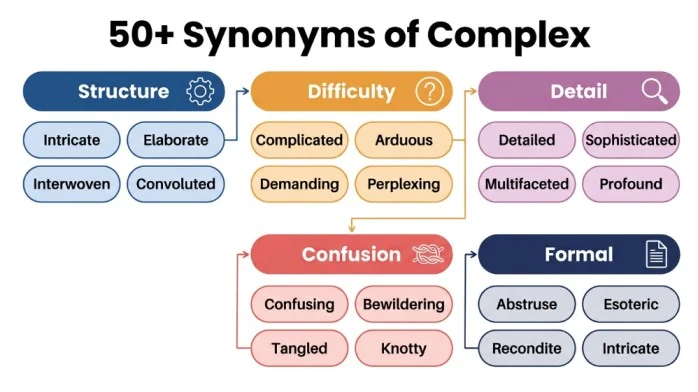
Complex means consisting of many interconnected parts or difficult to understand. The best synonyms depend on context. For difficulty, use complicated or intricate. For structure, use sophisticated or elaborate. Confusion, use convoluted or tangled. Formal writing, use multifaceted or composite. Casual conversation, use tricky or tough.
Meaning, Tone, and Context
Understanding the word complex is the first step to using it effectively.
Simple Definition:
Complex has two main meanings. First, it means consisting of many different and connected parts. Second, it means difficult to understand or deal with.
Part of Speech:
Adjective and Noun
Overall Tone:
Neutral. Complex can be positive when describing sophistication or negative when describing difficulty.
Formality Level:
Semi-formal. Complex works in professional, academic, and casual contexts, though it is more common in formal writing.
Common Uses:
Native English speakers use complex to describe systems, problems, ideas, relationships, machinery, and situations that have many layers or are hard to understand.
Word Forms:
- Adjective: complex
- Noun: complexity (the state of being complex)
- Adverb: complexly (in a complex way)
- Noun: complex (a group of buildings or psychological term)
Opposite Forms:
Simple, straightforward, basic, easy, uncomplicated, clear.
When and How to Use “Complex”
The word complex fits many situations where you want to describe something with many parts or something that is hard to understand.
Professional Context:
The company faced a complex challenge that required input from multiple departments.
Academic Context:
The professor explained the complex theory using simple analogies.
Workplace Context:
We need to simplify this complex process to improve efficiency.
Personal Context:
Their relationship was complex, filled with both love and misunderstanding.
Email Context:
I apologize for the delay; this is a complex issue that requires careful consideration.
Resume Context:
Managed complex projects with cross-functional teams.
Social Media Context:
Life is complex, but that is what makes it interesting.
Best Synonyms of “Complex”
No single synonym works perfectly in every situation because complex has multiple meanings. The best choice depends on what you are trying to express.
For Difficulty (Hard to Understand):
Use complicated, convoluted, or tangled. These words emphasize confusion and challenge.
For Structure (Having Many Parts):
Use sophisticated, elaborate, or intricate. These words emphasize detail and refinement.
For Intricacy (Finely Detailed):
Use intricate or labyrinthine. These words suggest something with many small, interconnected parts.
For Confusion (Hard to Follow):
Use convoluted or tangled. These words suggest something that is twisted and hard to untangle.
For Variety (Having Many Aspects):
Use multifaceted or diverse. These words suggest many different elements.
- For Professional Writing:
- Use sophisticated, multifaceted, or composite.
- For Academic Writing:
- Use complex itself or elaborate and intricate.
- For Casual Conversation:
- Use complicated, tricky, or tough.
- For Creative Writing:
- Use labyrinthine, maze-like, or intricate to add imagery.
When Not to Use “Complex”
Even though complex is a useful word, there are times when it is not the best choice.
When the Word Sounds Too Technical:
Complex can sound overly formal in casual conversation.
Original:
The recipe was complex and time-consuming.
Better Recommendation:
Use complicated or tricky.
Rewritten Sentence:
The recipe was complicated and time-consuming.
When the Word Sounds Too Neutral:
Complex does not always capture frustration.
Original:
The instructions were complex.
Better Recommendation:
Use convoluted or confusing.
Rewritten Sentence:
The instructions were convoluted and hard to follow.
When the Word Sounds Too Vague:
Complex does not specify what makes something difficult.
Original:
The situation was complex.
Better Recommendation:
Use multifaceted or nuanced.
Rewritten Sentence:
The situation was multifaceted and required careful analysis.
When the Word Is Overused:
Complex becomes meaningless when repeated.
Original:
The complex project had complex requirements and complex stakeholders.
Better Recommendation:
Use intricate, diverse, and challenging.
Rewritten Sentence:
The intricate project had diverse requirements and challenging stakeholders.
Words Commonly Confused With “Complex”
Several words are often confused with complex because they share similar meanings.
- Complex vs Complicated
- Difference: Complex suggests many interconnected parts. Complicated suggests difficulty and confusion.
- When to Use It: Use complex for structure. Use complicated for difficulty.
- Example: The human brain is complex. / The instructions were complicated.
- Complex vs Intricate
- Difference: Intricate emphasizes fine details and delicate connections. Complex is broader.
- When to Use It: Use intricate for detailed work. Use complex for many parts.
- Example: The intricate embroidery took months to complete. / The complex machine had hundreds of parts.
- Complex vs Sophisticated
- Difference: Sophisticated suggests refinement and advanced development. Complex is neutral.
- When to Use It: Use sophisticated for advanced systems. Use complex for many parts.
- Example: The software is highly sophisticated. / The problem is complex.
- Complex vs Elaborate
- Difference: Elaborate suggests careful planning and detail. Complex is more neutral.
- When to Use It: Use elaborate for detailed plans. Use complex for many parts.
- Example: The elaborate wedding took months to plan. / The complex network of roads was confusing.
- Complex vs Convoluted
- Difference: Convoluted suggests something twisted and hard to follow. Complex is neutral.
- When to Use It: Use convoluted for confusing explanations. Use complex for many parts.
- Example: The convoluted plot was hard to follow. / The complex machine was impressive.
- Complex vs Multifaceted
- Difference: Multifaceted emphasizes many different aspects. Complex emphasizes many interconnected parts.
- When to Use It: Use multifaceted for diverse aspects. Use complex for interconnected parts.
- Example: The multifaceted issue required a comprehensive solution. / The complex system had many moving parts.
Best Synonyms of “Complex” by Context
| Context | Best Synonym | Why It Works | Example |
|---|---|---|---|
| Formal Writing | Multifaceted | Sounds precise and scholarly | The multifaceted issue requires careful analysis. |
| Academic Writing | Elaborate | Sounds precise and detailed | The elaborate theory was supported by evidence. |
| Professional Communication | Sophisticated | Sounds advanced and capable | We developed a sophisticated solution to the problem. |
| Business Emails | Complicated | Clear and professional | This is a complicated matter that needs review. |
| Resume Writing | Complex | Standard and professional | Managed complex projects from start to finish. |
| Workplace Communication | Challenging | Emphasizes effort and growth | This is a challenging task, but we can do it. |
| Casual Conversation | Tricky | Simple and friendly | That’s a tricky question to answer. |
| Everyday Speaking | Tough | Simple and clear | This is a tough problem to solve. |
| Creative Writing | Labyrinthine | Adds imagery and depth | The labyrinthine plot kept readers guessing. |
| Storytelling | Intricate | Adds detail and richness | The intricate design of the castle amazed visitors. |
| Emotional Writing | Tangled | Adds emotional depth | Their tangled relationship was full of conflict. |
| Strong Emphasis | Convoluted | Emphasizes confusion | The convoluted explanation made no sense. |
| Mild Tone | Involved | Gentle and approachable | This is an involved process that takes time. |
| Social Media Captions | Complicated | Relatable and clear | Life is complicated, and that is okay. |
How to Choose the Best Synonym of “Complex”
Choosing the right synonym depends on several factors. Use this practical guide to make the best decision.
Meaning:
What does complex mean in your sentence? Is it about difficulty, structure, or many parts? Choose a synonym that matches the specific meaning.
Tone:
Do you want to sound formal, casual, or emotional? Formal words like sophisticated fit professional writing. Casual words like tricky fit conversation.
Audience:
Who is reading your writing? Academic readers expect precise vocabulary. Friends expect natural language. Business readers expect clear communication.
Emotional Strength:
Do you want to emphasize confusion, challenge, or sophistication? Strong words like convoluted and labyrinthine suggest extreme difficulty.
Writing Purpose:
Are you writing a report, an email, a story, or a social media post? Match your synonym to the purpose.
Level of Formality:
Consider the formality of your situation. Reports, essays, and official documents require formal synonyms. Texting and social media allow casual language.
Natural Sounding Usage:
Always read your sentence aloud. If the synonym sounds forced or awkward, choose a different word.
Real Life Examples of “Complex”
School Context:
The math problem was so complex that only a few students solved it.
Stronger Version:
The math problem was so intricate that only a few students solved it.
College Context:
The professor’s lecture on quantum physics was incredibly complex.
Stronger Version:
The professor’s lecture on quantum physics was incredibly sophisticated.
Workplace Context:
We need to break down this complex project into smaller tasks.
Stronger Version:
We need to break down this complicated project into smaller tasks.
Business Context:
The company developed a complex strategy to enter new markets.
Stronger Version:
The company developed a multifaceted strategy to enter new markets.
Email Context:
This is a complex issue that requires input from all team members.
Stronger Version:
This is a complicated issue that requires input from all team members.
Resume Context:
Successfully managed complex projects with cross-functional teams.
Stronger Version:
Successfully managed multifaceted projects with cross-functional teams.
Conversation Context:
My relationship with my brother is complex.
Stronger Version:
My relationship with my brother is complicated.
Storytelling Context:
The complex network of tunnels stretched beneath the city.
Stronger Version:
The labyrinthine network of tunnels stretched beneath the city.
Blogging Context:
Building a successful business is complex but rewarding.
Stronger Version:
Building a successful business is challenging but rewarding.
Social Media Context:
Life is complex, but that is what makes it beautiful.
Stronger Version:
Life is complicated, but that is what makes it beautiful.
25 Best Synonyms of “Complex”
| Synonym | Simple Meaning | Best Used For | Example Sentence |
|---|---|---|---|
| Complicated | Hard to understand | General use | The instructions were too complicated to follow. |
| Intricate | Finely detailed | Creative, descriptive | The intricate pattern on the rug was beautiful. |
| Sophisticated | Advanced, refined | Professional | The software is highly sophisticated. |
| Elaborate | Detailed, carefully planned | Formal writing | The elaborate plan required months of preparation. |
| Multifaceted | Having many aspects | Academic, formal | The multifaceted issue required a comprehensive solution. |
| Convoluted | Twisted, hard to follow | Criticism, confusion | The convoluted plot made no sense. |
| Tangled | Mixed up, confused | Emotional writing | Their tangled relationship was hard to understand. |
| Labyrinthine | Maze-like, confusing | Creative writing | The labyrinthine corridors were easy to get lost in. |
| Daunting | Intimidating, challenging | Professional | The daunting task required a team effort. |
| Involved | Complicated, requiring effort | Mild, formal | The involved process took several weeks. |
| Challenging | Difficult but rewarding | Professional, personal | The challenging project pushed us to grow. |
| Tricky | Hard to handle | Casual conversation | That is a tricky situation to navigate. |
| Tough | Difficult | Everyday speaking | This is a tough decision to make. |
| Elaborate | Detailed, complex | Formal writing | The elaborate design was stunning. |
| Interwoven | Closely connected | Creative writing | The interwoven themes created a rich story. |
| Byzantine | Extremely complicated | Formal, literary | The byzantine regulations were impossible to understand. |
| Gordian | Extremely complex | Literary, formal | The gordian problem required a creative solution. |
| Nuanced | Having subtle differences | Academic, professional | The nuanced argument required careful consideration. |
| Layered | Having multiple levels | Creative, descriptive | The layered meaning of the poem was profound. |
| Composite | Made of many parts | Formal, technical | The composite structure was incredibly strong. |
| Diverse | Having varied elements | General, formal | The diverse team brought different perspectives. |
| Manifold | Many and varied | Formal, literary | The manifold benefits of the program were clear. |
| Abstruse | Hard to understand | Academic, formal | The abstruse theory was difficult to grasp. |
| Perplexing | Confusing, puzzling | General, descriptive | The perplexing mystery remained unsolved. |
| Intricate | Elaborate, detailed | Creative, descriptive | The intricate carvings on the wall were breathtaking. |
Synonyms of “Complex” by Usage
Professional vs Personal Synonyms
Professional Synonyms:
Sophisticated, multifaceted, composite, elaborate, nuanced.
Why They Work:
These words sound precise and capable. They fit reports, emails, and professional communication.
Personal Synonyms:
Complicated, tricky, tough, tangled, involved.
Why They Work:
These words feel natural in conversation, personal writing, and emotional expression.
Formal vs Conversational Synonyms
Formal Synonyms:
Multifaceted, elaborate, sophisticated, abstruse, byzantine.
Why They Fit:
These words sound authoritative and precise. They work in academic papers, business reports, and official documents.
Conversational Synonyms:
Complicated, tricky, tough, tangled, involved.
Why They Fit:
These words feel natural in everyday speech, texting, and casual writing.
Academic Synonyms
Recommended Words:
Multifaceted, elaborate, nuanced, abstruse, composite.
Why They Work:
These words sound precise and scholarly. They show attention to detail and accurate communication.
Professional and Business Synonyms
Recommended Words:
Sophisticated, multifaceted, elaborate, nuanced, involved.
Why They Fit:
These words are specific and professional. They fit business emails, reports, and presentations.
Creative and Literary Synonyms
Recommended Words:
Labyrinthine, intricate, interwoven, layered, gordian.
Why They Fit:
These words add imagery, emotion, and variety to storytelling, poetry, and descriptive writing.
Modern English Synonyms
Recommended Words:
Complicated, tricky, tough, involved, challenging.
These words are widely used in modern American English. They are clear, direct, and easy to understand.
Strongest to Mildest Synonyms
Mild (Moderate Difficulty):
Involved, elaborate, multifaceted.
Moderate (Clear Difficulty):
Complicated, challenging, intricate, nuanced.
Strong (Significant Difficulty):
Convoluted, tangled, labyrinthine, daunting.
Very Strong (Extreme Difficulty):
Byzantine, gordian, abstruse, perplexing.
Emotional vs Neutral Synonyms
Emotional Synonyms:
Tangled, daunting, challenging, convoluted, labyrinthine.
When to Use Emotional Synonyms:
Use them in personal writing, creative writing, and situations where confusion, effort, or frustration matters.
Neutral Synonyms:
Sophisticated, multifaceted, elaborate, composite, intricate.
When to Use Neutral Synonyms:
Use them in professional writing, academic papers, and factual communication.
Antonyms of “Complex”
| Antonym | Meaning | Example Sentence |
|---|---|---|
| Simple | Easy to understand | The simple instructions were easy to follow. |
| Straightforward | Clear and direct | The straightforward process saved time. |
| Basic | Fundamental, not complex | The basic concept was easy to grasp. |
| Easy | Not difficult | The easy task was completed quickly. |
| Clear | Easy to understand | The clear explanation made sense. |
| Uncomplicated | Not complex | The uncomplicated design was efficient. |
| Plain | Simple and clear | The plain language was easy to read. |
| Obvious | Clearly understood | The obvious solution was overlooked. |
| Elementary | Basic, simple | The elementary problem was solved quickly. |
| Undemanding | Not requiring much effort | The undemanding job was stress-free. |
| Effortless | Requiring no effort | The effortless process was smooth. |
| Lucid | Clearly expressed | The lucid explanation was helpful. |
| Direct | Straightforward | The direct answer was appreciated. |
| Minimal | Very small, basic | The minimal design was effective. |
| Pristine | Pure, uncomplicated | The pristine concept was easy to understand. |
Comparison: “Complex” vs Similar Words
Complex vs Complicated
Main Difference:
Complex suggests many interconnected parts. Complicated suggests difficulty and confusion.
Which Is Stronger?
Complicated is stronger for difficulty. Complex is neutral.
Which Is More Formal?
Complex is more formal.
When to Use Each:
Use complex for structure. Use complicated for difficulty.
Examples:
Complex: The human brain is complex.
Complicated: The instructions were complicated.
Complex vs Intricate
Main Difference:
Intricate emphasizes fine details and delicate connections. Complex is broader.
Which Is Stronger?
Intricate is more descriptive and vivid.
Which Is More Formal?
Both are formal.
When to Use Each:
Use intricate for detailed work. Use complex for many parts.
Examples:
Intricate: The intricate embroidery was beautiful.
Complex: The complex machine had hundreds of parts.
Complex vs Sophisticated
Main Difference:
Sophisticated suggests refinement and advanced development. Complex is neutral.
Which Is Stronger?
Sophisticated is more positive and impressive.
Which Is More Formal?
Both are formal.
When to Use Each:
Use sophisticated for advanced systems. Use complex for many parts.
Examples:
Sophisticated: The software is highly sophisticated.
Complex: The complex network of roads was confusing.
Complex vs Elaborate
Main Difference:
Elaborate suggests careful planning and detail. Complex is more neutral.
Which Is Stronger?
Elaborate suggests more effort and planning.
Which Is More Formal?
Both are formal.
When to Use Each:
Use elaborate for detailed plans. Use complex for many parts.
Examples:
Elaborate: The elaborate wedding took months to plan.
Complex: The complex system was hard to understand.
Complex vs Convoluted
Main Difference:
Convoluted suggests something twisted and hard to follow. Complex is neutral.
Which Is Stronger?
Convoluted is more negative and dramatic.
Which Is More Formal?
Both are formal.
When to Use Each:
Use convoluted for confusing explanations. Use complex for many parts.
Examples:
Convoluted: The convoluted plot was hard to follow.
Complex: The complex machine was impressive.
Complex vs Multifaceted
Main Difference:
Multifaceted emphasizes many different aspects. Complex emphasizes many interconnected parts.
Which Is Stronger?
Multifaceted suggests more variety and depth.
Which Is More Formal?
Both are formal.
When to Use Each:
Use multifaceted for diverse aspects. Use complex for interconnected parts.
Examples:
Multifaceted: The multifaceted issue required comprehensive analysis.
Complex: The complex system had many moving parts.
Common Phrases and Expressions with “Complex”
| Phrase | Meaning | Example Sentence |
|---|---|---|
| Complex issue | A difficult problem | The complex issue required careful consideration. |
| Complex system | A system with many parts | The complex system was difficult to understand. |
| Complex relationship | A complicated relationship | Their complex relationship was full of ups and downs. |
| Complex problem | A difficult problem | The complex problem took months to solve. |
| Complex process | A process with many steps | The complex process required patience. |
| Complexity of something | The state of being complex | The complexity of the issue was overwhelming. |
| Inferiority complex | A psychological term | He struggled with an inferiority complex for years. |
Common Mistakes to Avoid
Choosing a Vague Synonym Instead of a Precise One
Incorrect:
The problem was hard.
Better:
The problem was complex.
Why:
Complex is more specific than hard.
Confusing “Complex” With “Complicated”
Incorrect:
The complicated machine had hundreds of parts.
Better:
The complex machine had hundreds of parts.
Why:
Complex emphasizes many parts. Complicated emphasizes difficulty.
Using an Informal Synonym in Formal Writing
Incorrect:
The tough issue required analysis.
Better:
The complex issue required analysis.
Why:
Complex is more formal and appropriate.
Selecting an Overly Dramatic Synonym
Incorrect:
The labyrinthine recipe was hard to follow.
Better:
The intricate recipe was hard to follow.
Why:
Labyrinthine is too dramatic for a recipe.
Repeating the Same Word Too Often
Incorrect:
The complex project had complex requirements and complex stakeholders.
Better:
The multifaceted project had intricate requirements and diverse stakeholders.
Why:
Varying synonyms improves flow and readability.
Choosing a Word With the Wrong Emotional Tone
Incorrect:
The convoluted project was rewarding.
Better:
The complex project was rewarding.
Why:
Convoluted has a negative tone. Complex is neutral.
Frequently Asked Questions
What are the best synonyms of “complex”?
The best synonyms of complex depend on context. For difficulty, use complicated or convoluted. For structure, use sophisticated or elaborate. Many parts, use multifaceted or intricate. For confusion, use tangled or labyrinthine.
What are the best formal synonyms of “complex”?
The best formal synonyms of complex are multifaceted, elaborate, sophisticated, composite, and nuanced. These words sound precise and authoritative. They fit academic papers, business reports, and professional presentations.
What are common informal synonyms of “complex”?
Common informal synonyms of complex include complicated, tricky, tough, tangled, and involved. These words are used in casual conversations, friendly writing, and everyday speech. They are simple and natural.
What is another word for “complex” in professional writing?
In professional writing, use sophisticated, multifaceted, elaborate, or nuanced. These words are specific, capable, and professional. They fit reports, business emails, and presentations.
What is the difference between “complex” and “complicated”?
Complex means having many interconnected parts. Complicated means difficult to understand. Use complex for structure and complexity. Use complicated for difficulty and confusion.
What is the opposite of “complex”?
The opposite of complex is simple. Other opposites include straightforward, basic, easy, uncomplicated, and clear. Choose the most accurate opposite based on your context.
Conclusion
Complex is a versatile and useful word, but using the same word repeatedly weakens your writing. The best synonyms of complex help you communicate clearly, match the right tone, and express yourself with precision. You write a business report, a college essay, a personal reflection, or a social media post, there is a perfect synonym for every situation.
Remember that no synonym works perfectly in every context. Choose words based on your audience, your purpose, and the specific meaning you want to express. Complicated or convoluted for difficulty. Use sophisticated or elaborate for structure. Intricate or labyrinthine for detail. Use multifaceted or composite for many aspects.
The more you practice choosing the right synonym, the more natural and confident your writing will become. A strong vocabulary helps you connect with readers, express your ideas clearly, and make a lasting impression.
Definitions, meanings, and usage recommendations should be verified with trusted language references before publication. Recommended sources include Cambridge Dictionary, Oxford English Dictionary, Merriam Webster, Collins Dictionary, and Britannica.
Read More Related Articles:
Synonyms for Thus | Meaning, Examples, and Better Word …
50+ Synonyms of Significant | Meanings, Uses, Examples, and …
Synonyms for Review | Meaning, Examples, and Better Word …