When you write an email, essay, review, caption, or personal message, using enjoyable repeatedly can make your writing feel predictable. Finding the right synonym of enjoyable gives you more ways to describe something that brings pleasure, satisfaction, amusement, or positive feelings.
The best alternative depends on what made the experience enjoyable. A movie can be entertaining, a vacation can be delightful, a conversation can be pleasant, and an activity can be fun. Choosing the word that matches the exact feeling makes your writing clearer, more natural, and more expressive.
What Is the Best Synonym of “Enjoyable”?
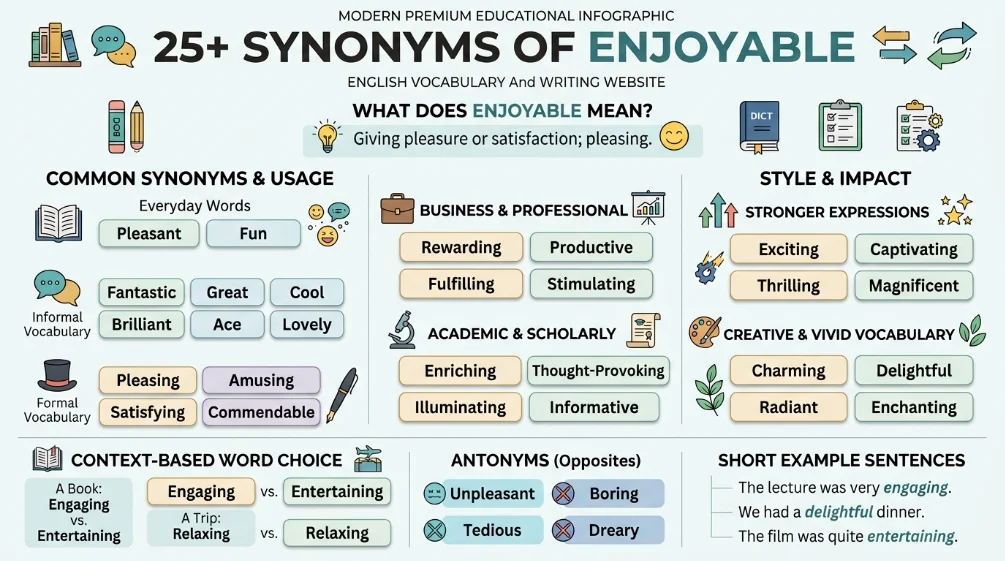
An enjoyable experience is pleasant, satisfying, entertaining, or fun. The best synonym depends on context: use pleasant for neutral or formal writing, entertaining for amusing activities, delightful for stronger positive feelings, fun in casual conversation, and rewarding when an experience provides satisfaction or personal benefit.
Meaning, Tone, and Context
Simple Definition
Enjoyable describes something that gives you pleasure, satisfaction, amusement, or a positive experience. It can describe activities, events, conversations, books, movies, trips, meals, classes, and many other experiences.
For example:
“The workshop was enjoyable and informative.”
Here, enjoyable tells the reader that the workshop was pleasant and gave the person a positive experience.
Part of Speech
Enjoyable is an adjective.
It describes a person, activity, experience, object, event, or situation that someone likes or finds pleasurable.
Overall Tone
The word enjoyable has a positive tone. It usually communicates pleasure without being extremely emotional or exaggerated.
For example:
“We had an enjoyable evening.”
This sounds positive but measured.
Formality Level
Enjoyable is a neutral word that works in both formal and informal English.
It can appear naturally in:
- Academic writing
- Professional communication
- Business reviews
- Personal messages
- Conversations
- Social media
- Travel writing
- Entertainment reviews
Common Uses
Native English speakers commonly use enjoyable to describe:
- Movies
- Books
- Classes
- Trips
- Meals
- Conversations
- Events
- Activities
- Experiences
- Vacations
- Meetings
- Performances
- Hobbies
- Social occasions
Word Forms
| Word | Part of Speech | Example |
|---|---|---|
| Enjoy | Verb | “I enjoy reading.” |
| Enjoyable | Adjective | “The book was enjoyable.” |
| Enjoyment | Noun | “She found great enjoyment in painting.” |
| Enjoyably | Adverb | “The evening passed enjoyably.” |
The opposite idea can be expressed with words such as unenjoyable, unpleasant, or tedious, depending on the context.
When and How to Use “Enjoyable”
Use enjoyable when you want to say that something provided pleasure or was pleasant to experience. It is especially useful when you want a positive description without making the statement sound overly emotional.
Professional
“The training session was informative and enjoyable.”
This works well when giving balanced feedback about workplace training.
Academic
“The course was challenging but enjoyable.”
Here, the word describes a positive learning experience.
Workplace
“We had an enjoyable team meeting.”
This sounds friendly and positive, although productive may be more precise if you want to emphasize results.
Personal
“We had an enjoyable evening together.”
The word naturally describes a pleasant personal experience.
“Thank you for organizing such an enjoyable event.”
This is appropriate for a polite professional or personal email.
Resume
“Created enjoyable learning activities for elementary students.”
In a resume, engaging may sometimes be stronger because it describes how the activities captured attention.
Social Media
“Such an enjoyable weekend with great friends and amazing food.”
For casual social media, fun or amazing may sound more conversational.
Best Synonyms of “Enjoyable”
No synonym of enjoyable works perfectly in every sentence. Each alternative adds a slightly different idea, such as amusement, comfort, satisfaction, beauty, excitement, or emotional pleasure.
Professional Writing: Pleasant
Pleasant is a strong choice for professional communication because it sounds positive without being overly enthusiastic.
“The interview was a pleasant experience.”
It is especially useful for describing meetings, interactions, environments, and experiences.
Academic Writing: Engaging
Engaging works well when something holds attention and makes learning interesting.
“The professor used engaging activities throughout the course.”
It is often more informative than enjoyable in educational contexts.
Business Communication: Positive
Positive is useful when describing an overall experience in a neutral professional manner.
“The client reported a positive experience with our service.”
Casual Conversation: Fun
Fun is one of the most natural alternatives in everyday American English.
“The concert was really fun.”
It sounds relaxed and conversational.
Emotional Writing: Delightful
Delightful expresses stronger pleasure and warmth.
“It was a delightful surprise.”
It works particularly well when the experience creates happiness or pleasant emotion.
Creative Writing: Charming
Charming adds personality and warmth.
“We spent a charming afternoon exploring the old town.”
It can create a more vivid and expressive description.
Resume Writing: Engaging
For a resume, engaging can communicate that something successfully captured people’s interest.
“Developed engaging educational content for young learners.”
Workplace Communication: Pleasant
Pleasant is appropriate when describing interactions, meetings, environments, or experiences in a professional setting.
“The discussion was productive and pleasant.”
Stronger Meaning: Delightful
Choose delightful when you want to express more enthusiasm than enjoyable.
“The restaurant offered a delightful dining experience.”
Softer Meaning: Pleasant
Choose pleasant when you want a mild, measured positive description.
“It was a pleasant afternoon.”
When Not to Use “Enjoyable”
When You Mean “Entertaining”
If something keeps people interested through humor, action, drama, or amusement, entertaining can be more precise.
Less precise:
“The movie was enjoyable.”
Better:
“The movie was entertaining.”
Why:
Entertaining specifically highlights amusement or interest.
When You Mean “Useful and Satisfying”
If an experience provides personal benefit or a sense of achievement, rewarding may be better.
Less precise:
“Volunteering was enjoyable.”
Better:
“Volunteering was rewarding.”
Why:
Rewarding suggests satisfaction that comes from achievement, contribution, or personal growth.
When You Need Stronger Emotion
If something creates intense pleasure or happiness, delightful may communicate the feeling more effectively.
Less precise:
“The surprise was enjoyable.”
Better:
“The surprise was delightful.”
When You Need a Casual Tone
In everyday conversation, fun often sounds more natural.
Less natural:
“We had an enjoyable time at the beach.”
More conversational:
“We had a lot of fun at the beach.”
When You Mean Something Was Interesting
Interesting and enjoyable are not identical.
Less precise:
“The lecture was enjoyable.”
Better:
“The lecture was fascinating.”
Use fascinating when the main quality is that something captured your curiosity or attention.
Words Commonly Confused With “Enjoyable”
| Word | Difference | When to Use It | Example |
|---|---|---|---|
| Pleasant | Describes something agreeable or comfortable. | Formal and everyday situations. | “We had a pleasant conversation.” |
| Fun | Emphasizes amusement or lighthearted pleasure. | Casual conversation. | “The game was fun.” |
| Entertaining | Focuses on amusement or sustained interest. | Movies, shows, books, events. | “The performance was entertaining.” |
| Interesting | Means something attracts attention or curiosity. | Lessons, ideas, information. | “The lecture was interesting.” |
| Rewarding | Suggests satisfaction from achievement or benefit. | Work, volunteering, learning. | “Teaching can be rewarding.” |
| Delightful | Expresses stronger pleasure and warmth. | Experiences, surprises, places, food. | “We had a delightful afternoon.” |
Best Synonyms of “Enjoyable” by Context
| Context | Best Synonym | Why It Works | Example |
|---|---|---|---|
| Formal writing | Pleasant | Polite and measured | “The experience was pleasant.” |
| Academic writing | Engaging | Shows that something holds attention | “The lesson was engaging.” |
| Professional communication | Pleasant | Positive without exaggeration | “The meeting was pleasant.” |
| Business emails | Positive | Neutral and professional | “We received positive feedback.” |
| Resume writing | Engaging | Shows ability to capture attention | “Created engaging content.” |
| Workplace communication | Pleasant | Appropriate for interactions | “We had a pleasant discussion.” |
| Casual conversation | Fun | Natural and relaxed | “The trip was fun.” |
| Everyday speaking | Enjoyable | Simple and versatile | “The meal was enjoyable.” |
| Creative writing | Delightful | Adds warmth and emotion | “It was a delightful morning.” |
| Storytelling | Memorable | Emphasizes lasting impact | “It was a memorable journey.” |
| Emotional writing | Heartwarming | Adds emotional warmth | “It was a heartwarming experience.” |
| Strong emphasis | Delightful | Expresses greater pleasure | “The dinner was delightful.” |
| Mild tone | Pleasant | Soft positive feeling | “It was a pleasant visit.” |
| Social media captions | Fun | Short and conversational | “A fun weekend with friends.” |
| American English | Fun | Very natural in casual speech | “We had so much fun.” |
How to Choose the Best Synonym of “Enjoyable”
Choosing the right alternative starts with identifying what you actually liked about the experience.
If It Was Simply Pleasant
Use pleasant.
“We had a pleasant afternoon.”
If It Was Amusing
Use fun or entertaining.
“The party was fun.”
“The show was entertaining.”
If It Held Your Attention
Use engaging or interesting.
“The presentation was engaging.”
If It Created Strong Happiness
Use delightful.
“The news was delightful.”
If It Gave You Personal Satisfaction
Use rewarding.
“The experience was rewarding.”
If It Created Excitement
Use exciting.
“The trip was exciting.”
If It Was Beautiful or Appealing
Use lovely or charming.
“We spent a lovely afternoon by the lake.”
If You Are Writing Professionally
Prefer pleasant, positive, engaging, or rewarding, depending on your intended meaning.
If You Are Writing Casually
Choose fun, great, lovely, or awesome, depending on the level of informality.
Real Life Examples of “Enjoyable”
School
Original:
“The science class was enjoyable.”
Improved:
“The science class was engaging because students conducted their own experiments.”
College
Original:
“The course was enjoyable.”
Improved:
“The course was rewarding because it connected theory with real world projects.”
Workplace
Original:
“The team lunch was enjoyable.”
Improved:
“The team lunch was pleasant and gave everyone time to connect.”
Business
Original:
“The customer found the shopping experience enjoyable.”
Improved:
“The customer reported a positive shopping experience.”
Original:
“Thank you for an enjoyable meeting.”
Improved:
“Thank you for a productive and pleasant meeting.”
Resume
Original:
“Created enjoyable activities for students.”
Improved:
“Designed engaging activities that encouraged student participation.”
Conversation
Original:
“The party was enjoyable.”
Improved:
“The party was really fun.”
Storytelling
Original:
“We had an enjoyable afternoon in the village.”
Improved:
“We spent a delightful afternoon wandering through the quiet village.”
Blogging
Original:
“The book was enjoyable.”
Improved:
“The book was entertaining and surprisingly easy to read.”
Social Media
Original:
“It was an enjoyable weekend.”
Improved:
“It was such a fun weekend with amazing people.”
25 Best Synonyms of “Enjoyable”
| Synonym | Simple Meaning | Best Used For | Example Sentence |
|---|---|---|---|
| Pleasant | Agreeable and comfortable | Formal and everyday writing | “We had a pleasant evening together.” |
| Fun | Amusing and enjoyable | Casual conversation | “The festival was so fun.” |
| Entertaining | Amusing and interesting | Movies and performances | “The documentary was surprisingly entertaining.” |
| Delightful | Very pleasing | Emotional and descriptive writing | “The children had a delightful afternoon.” |
| Enjoyable | Giving pleasure | General use | “The book was enjoyable from beginning to end.” |
| Engaging | Holding attention | Education and professional content | “The speaker gave an engaging presentation.” |
| Rewarding | Providing satisfaction or benefit | Work and learning | “Mentoring students is rewarding.” |
| Exciting | Producing enthusiasm | Travel and activities | “The hiking trip was exciting.” |
| Amusing | Causing laughter or entertainment | Humor and entertainment | “His story was genuinely amusing.” |
| Entertaining | Providing amusement | Shows and activities | “The performance was highly entertaining.” |
| Charming | Pleasant and appealing | Places and experiences | “We stayed in a charming little town.” |
| Lovely | Beautiful or pleasing | Personal and descriptive writing | “We had a lovely dinner.” |
| Satisfying | Giving a feeling of fulfillment | Food, work, achievements | “Completing the project was satisfying.” |
| Pleasurable | Giving physical or emotional pleasure | Formal writing | “The activity was both relaxing and pleasurable.” |
| Fascinating | Extremely interesting | Ideas and information | “The lecture covered a fascinating topic.” |
| Stimulating | Encouraging interest or thought | Academic and intellectual contexts | “The discussion was stimulating.” |
| Refreshing | Pleasantly new or revitalizing | Experiences and ideas | “The change of scenery was refreshing.” |
| Relaxing | Helping reduce stress | Vacations and leisure | “The weekend was relaxing.” |
| Invigorating | Making you feel energetic | Exercise and outdoor activities | “The morning hike was invigorating.” |
| Memorable | Worth remembering | Events and experiences | “It was a memorable celebration.” |
| Heartwarming | Creating warm emotional feelings | Personal and emotional writing | “Their reunion was heartwarming.” |
| Appealing | Attractive or pleasing | Products and experiences | “The resort offers an appealing atmosphere.” |
| Captivating | Holding attention strongly | Stories and performances | “The novel was captivating.” |
| Uplifting | Improving mood or spirits | Music and emotional experiences | “The film was uplifting.” |
| Exciting | Creating enthusiasm or anticipation | Events and adventures | “The final match was exciting.” |
Some words in this list overlap in meaning but are not interchangeable in every sentence. For example, relaxing emphasizes reduced stress, while captivating emphasizes strong attention. Rewarding highlights satisfaction or benefit, while fun emphasizes amusement.
Synonyms of “Enjoyable” by Usage
Professional vs Personal Synonyms
Professional writing usually benefits from precise and measured words.
Use pleasant, engaging, positive, and rewarding in workplace contexts.
Personal communication can be more expressive. Fun, lovely, delightful, and memorable often sound natural when describing personal experiences.
Formal vs Conversational Synonyms
For reports and essays, pleasant, engaging, stimulating, and pleasurable can work when they accurately describe the experience.
For conversations and texting, fun, great, lovely, and awesome are more natural choices.
Academic Synonyms
Academic writing often benefits from words that explain why something was enjoyable.
Engaging suggests that an activity captured attention.
Stimulating suggests that it encouraged thought or discussion.
Rewarding suggests that learning produced satisfaction or personal growth.
For example:
“The seminar was stimulating because it encouraged students to debate competing theories.”
This gives the reader more information than simply saying the seminar was enjoyable.
Professional and Business Synonyms
- For resumes, engaging is particularly useful when describing content, presentations, training, or educational activities.
- For performance reviews, rewarding can describe work that provides satisfaction.
- For client communication, pleasant and positive are usually safer choices because they sound professional and measured.
- For business emails:
“Thank you for the pleasant discussion.”
- For a presentation:
“The workshop was engaging and informative.”
Creative and Literary Synonyms
Creative writing allows more expressive choices.
- Use delightful to communicate warmth.
- Use charming to create a pleasant atmosphere.
- Use captivating when something holds attention strongly.
- Use memorable when the experience leaves a lasting impression.
- Use heartwarming when the experience creates emotional warmth.
These alternatives can make descriptive writing more specific than simply repeating enjoyable.
Slang or Modern Synonyms
There is no single slang word that perfectly replaces enjoyable in every situation.
In casual American English, fun is the most natural everyday alternative.
Awesome can also describe an enjoyable experience, but it is broader and more enthusiastic.
“The concert was awesome.”
Use such expressions in conversations, texts, and social media. Avoid them in formal academic or professional writing unless the context is intentionally informal.
Strongest to Mildest Synonyms
There is no exact universal intensity scale because these words describe different kinds of positive experiences. However, they can be grouped by the strength of positive emphasis.
Mild
- Pleasant
- Appealing
- Refreshing
- Relaxing
These communicate a positive experience without strong emotion.
Moderate
- Enjoyable
- Fun
- Lovely
- Satisfying
- Entertaining
- Engaging
These indicate clear pleasure, amusement, or interest.
Strong
- Delightful
- Exciting
- Rewarding
- Fascinating
- Captivating
- Invigorating
These express a stronger or more specific positive reaction.
Very Expressive
- Heartwarming
- Uplifting
- Remarkable
These can communicate a stronger emotional response, although their exact intensity depends on context.
Emotional vs Neutral Synonyms
Emotional Synonyms
These words add feeling to the sentence:
- Delightful
- Heartwarming
- Lovely
- Charming
- Uplifting
- Memorable
- Exciting
Example:
“The reunion was heartwarming.”
This communicates more than simple enjoyment.
Neutral Synonyms
These alternatives provide a more measured description:
- Pleasant
- Enjoyable
- Engaging
- Entertaining
- Satisfying
- Appealing
- Stimulating
Example:
“The presentation was engaging.”
This sounds informative rather than highly emotional.
Antonyms of “Enjoyable”
| Antonym | Meaning | Example Sentence |
|---|---|---|
| Unpleasant | Not enjoyable or agreeable | “The weather made the trip unpleasant.” |
| Boring | Not interesting or entertaining | “The lecture was boring.” |
| Tedious | Long, repetitive, and tiring | “The paperwork became tedious.” |
| Dull | Lacking excitement or interest | “The movie felt dull.” |
| Uninteresting | Failing to hold attention | “The article was uninteresting.” |
| Miserable | Extremely unpleasant or unhappy | “We had a miserable day in the rain.” |
| Painful | Causing physical or emotional discomfort | “The experience was painful for everyone.” |
| Distressing | Causing worry or emotional suffering | “The news was distressing.” |
| Frustrating | Causing annoyance because of difficulty or failure | “The process was frustrating.” |
| Tiresome | Causing tiredness or boredom | “The repeated task became tiresome.” |
| Monotonous | Repetitive and lacking variety | “The work was monotonous.” |
| Uncomfortable | Causing physical or emotional discomfort | “The chair was uncomfortable.” |
| Irritating | Causing annoyance | “The constant noise was irritating.” |
| Disagreeable | Unpleasant or difficult to accept | “The meeting became disagreeable.” |
| Depressing | Making someone feel sad or discouraged | “The gloomy atmosphere was depressing.” |
Comparison: “Enjoyable” vs Similar Words
Enjoyable vs Pleasant
Main Difference
Enjoyable directly describes something that gives pleasure. Pleasant emphasizes comfort, agreeableness, or a generally positive experience.
Which Is Stronger?
Neither is always stronger. Enjoyable focuses more directly on pleasure.
Which Is More Formal?
Pleasant can sound slightly more polished in professional communication.
When to Use Each
Use enjoyable when discussing activities and experiences you liked. Use pleasant for interactions, surroundings, visits, and general experiences.
Examples
Enjoyable:
“The class was enjoyable.”
Pleasant:
“The conversation was pleasant.”
Enjoyable vs Fun
Main Difference
Fun is more casual and often emphasizes amusement. Enjoyable is broader and more neutral.
Which Is Stronger?
Neither is inherently stronger, but fun can sound more enthusiastic in casual speech.
Which Is More Formal?
Enjoyable is more suitable for formal contexts.
When to Use Each
Use fun with friends and in casual conversation. Use enjoyable when you want a neutral description.
Examples
Enjoyable:
“The workshop was enjoyable.”
Fun:
“The party was fun.”
Enjoyable vs Entertaining
Main Difference
Entertaining means something provides amusement or holds attention. Enjoyable has a broader meaning.
Which Is Stronger?
Entertaining is more specific rather than necessarily stronger.
Which Is More Formal?
Both can work in formal writing.
When to Use Each
Use entertaining for movies, shows, books, performances, and humorous activities.
Examples
Enjoyable:
“The novel was enjoyable.”
Entertaining:
“The novel was entertaining.”
Enjoyable vs Rewarding
Main Difference
Rewarding suggests satisfaction gained from achievement, effort, contribution, or personal growth.
Which Is Stronger?
They express different ideas rather than different levels of intensity.
Which Is More Formal?
Both are suitable for professional and academic contexts.
When to Use Each
Use rewarding for work, volunteering, education, relationships, and experiences that provide personal fulfillment.
Examples
Enjoyable:
“The project was enjoyable.”
Rewarding:
“The project was rewarding because it helped the community.”
Enjoyable vs Interesting
Main Difference
Interesting means something attracts curiosity or attention. It does not necessarily mean the person enjoyed it.
Which Is Stronger?
Neither. They describe different reactions.
Which Is More Formal?
Interesting is neutral and widely used in academic and everyday contexts.
When to Use Each
Use interesting for ideas, facts, subjects, discussions, and information.
Examples
Enjoyable:
“The class was enjoyable.”
Interesting:
“The topic was interesting.”
Enjoyable vs Delightful
Main Difference
Delightful expresses a stronger sense of pleasure, charm, or happiness.
Which Is Stronger?
Delightful generally sounds more expressive.
Which Is More Formal?
Both are grammatically appropriate in formal writing, but delightful can sound more literary or emotionally expressive.
When to Use Each
Use delightful when you want to emphasize warmth or strong positive feeling.
Examples
Enjoyable:
“We had an enjoyable afternoon.”
Delightful:
“We had a delightful afternoon in the garden.”
Common Phrases and Expressions with “Enjoyable”
Enjoyable Experience
Meaning: An experience that provides pleasure or satisfaction.
Example:
“Traveling alone was an enjoyable experience.”
Enjoyable Time
Meaning: A period spent having a positive or pleasant experience.
Example:
“We had an enjoyable time at the festival.”
Enjoyable Evening
Meaning: An evening that was pleasant or fun.
Example:
“Thank you for such an enjoyable evening.”
Enjoyable Activity
Meaning: An activity that people like doing.
Example:
“Reading can be an enjoyable activity after a busy day.”
Enjoyable Experience for Everyone
Meaning: Something intended to provide pleasure to a group.
Example:
“The organizers worked hard to create an enjoyable experience for everyone.”
Enjoyable Way to Learn
Meaning: A method of learning that is also pleasant or interesting.
Example:
“Games can provide an enjoyable way to learn new vocabulary.”
Make Something Enjoyable
Meaning: To make an activity more pleasant or fun.
Example:
“Adding practical examples can make the lesson more enjoyable.”
Common Mistakes to Avoid
Mistake 1: Treating Every Synonym as Identical
Incorrect:
“The research was fun.”
Better:
“The research was rewarding.”
Why:
Research can be satisfying and interesting, but fun may sound too casual for many academic contexts.
Mistake 2: Using “Interesting” When You Mean “Pleasant”
Incorrect:
“The hotel staff were interesting.”
Better:
“The hotel staff were pleasant.”
Why:
Interesting describes something that attracts curiosity, while pleasant describes a positive interaction.
Mistake 3: Using Informal Language in Formal Writing
Incorrect:
“The conference was awesome.”
Better:
“The conference was highly engaging.”
Why:
Engaging sounds more professional and explains that the event held the audience’s attention.
Mistake 4: Using “Delightful” for Every Positive Experience
Incorrect:
“The quarterly report was delightful.”
Better:
“The quarterly report was informative and useful.”
Why:
Delightful is emotionally expressive and usually fits experiences, people, places, food, or surprises better than technical documents.
Mistake 5: Repeating “Enjoyable”
Incorrect:
“The trip was enjoyable, the food was enjoyable, and the activities were enjoyable.”
Better:
“The trip was memorable, the food was delicious, and the activities were fun.”
Why:
Specific vocabulary gives readers more information.
Mistake 6: Confusing “Rewarding” With Simple Pleasure
Incorrect:
“The comedy show was rewarding.”
Better:
“The comedy show was entertaining.”
Why:
Rewarding usually suggests personal satisfaction or benefit, while entertaining directly describes amusement.
Mistake 7: Using “Fun” in Academic Writing
Incorrect:
“The experiment was fun for the students.”
Better:
“The experiment was engaging for the students.”
Why:
Engaging is more appropriate when discussing educational activities in formal writing.
Frequently Asked Questions
What is the best synonym of enjoyable?
The best synonym of enjoyable depends on context. Pleasant is a versatile formal choice, fun works naturally in casual speech, entertaining fits amusement, rewarding suggests satisfaction, and delightful adds stronger positive emotion.
What are the best formal synonyms of enjoyable?
The best formal synonyms include pleasant, pleasurable, engaging, stimulating, rewarding, and satisfying. The strongest choice depends on whether you mean comfort, intellectual interest, personal fulfillment, or general pleasure.
What are common informal synonyms of enjoyable?
Common informal alternatives include fun, great, awesome, lovely, and a good time. Among these, fun is one of the most natural choices for everyday American conversation.
What is another word for enjoyable in professional writing?
In professional writing, pleasant, engaging, rewarding, and positive are useful alternatives. Engaging works especially well for presentations and training, while pleasant fits meetings and interpersonal experiences.
What is the difference between enjoyable and pleasant?
Enjoyable emphasizes the pleasure someone gets from an experience, while pleasant describes something agreeable, comfortable, or generally positive. For example, a movie can be enjoyable, while a conversation can be pleasant.
What is the opposite of enjoyable?
Common opposites include unpleasant, boring, tedious, dull, uninteresting, and frustrating. The best antonym depends on why an experience was not enjoyable, such as boredom, discomfort, annoyance, or emotional distress.
Conclusion
Enjoyable describes something that gives pleasure, satisfaction, amusement, or a positive experience. Although it is a useful and flexible word, choosing a more specific alternative can make your writing clearer and more expressive.
Use pleasant for measured and professional descriptions, fun for casual conversation, engaging for learning and presentations, entertaining for amusement, rewarding for satisfying experiences, and delightful when you want stronger positive emotion.
There is no single perfect synonym of enjoyable for every situation. The best word depends on your audience, purpose, tone, and the exact kind of pleasure you want to describe. A useful vocabulary habit is to identify why something was enjoyable before choosing its replacement.
Read More Related Articles:
- Synonyms for Empty | Meaning, Examples, and Better Word …
- Synonyms for Creativity | Meaning, Examples, and Better …
- Synonyms for Pros and Cons | Meaning, Examples, and Better …