You may find yourself using the word aptitude again and again in a resume, school assignment, performance review, or professional profile. Although the word is useful, choosing a more precise alternative can make your writing clearer and show exactly what kind of ability or potential you mean.
The synonyms of aptitude include words such as ability, talent, capability, competence, proficiency, knack, and potential. However, these words are not interchangeable in every situation. Some emphasize natural talent, others suggest learned skill, while others focus on a person’s capacity to develop or perform well.
What Are the Best Synonyms of “Aptitude”?
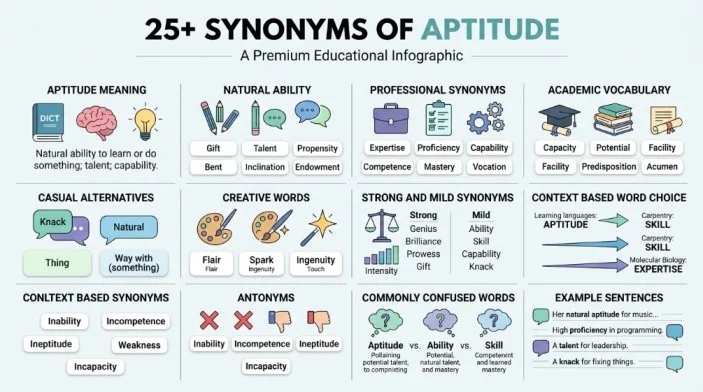
Aptitude means a natural ability or potential to learn or perform something well. The best synonyms include ability, talent, capacity, capability, knack, and potential. Use capability or competence professionally, ability or talent generally, and knack in casual conversation. Potential works best when emphasizing future development.
Meaning, Tone, and Context
Simple Definition
Aptitude refers to a natural ability, potential, or tendency to learn something or perform a particular type of task effectively.
The word often describes someone’s suitability for a specific area, such as mathematics, languages, music, technology, leadership, or mechanical work.
For example:
“She has a strong aptitude for mathematics.”
This means she appears naturally well suited to understanding and performing mathematical tasks.
Part of Speech
Aptitude is a noun.
It is normally used with for when identifying the activity or subject involved.
“He has an aptitude for learning languages.”
“She demonstrated an aptitude for problem solving.”
Overall Tone
Aptitude has a positive and neutral tone. It usually expresses a favorable assessment of someone’s ability or potential.
It does not automatically mean that a person has mastered a skill. Instead, it often suggests that the person has a natural capacity to learn or perform it successfully.
Formality Level
Aptitude is generally neutral to formal.
It is especially common in:
- Resumes
- Job applications
- Career assessments
- Educational discussions
- Performance reviews
- Professional profiles
- Academic writing
- Training evaluations
In casual conversation, simpler words such as ability, talent, or knack may sound more natural.
Common Uses
Native English speakers commonly use aptitude when discussing someone’s potential or natural suitability for a particular field.
Common combinations include:
- Aptitude for mathematics
- Aptitude for languages
- Aptitude for learning
- Aptitude for technology
- Aptitude for music
- Aptitude for leadership
- Aptitude for problem solving
- Aptitude for teaching
- Aptitude for technical work
- Strong aptitude
- Natural aptitude
- Demonstrate aptitude
Word Forms
| Word | Part of Speech | Example |
|---|---|---|
| Aptitude | Noun | She has an aptitude for science. |
| Aptitudes | Plural noun | The assessment measures several aptitudes. |
| Aptitudinal | Adjective, uncommon | The study examined aptitudinal differences. |
The most useful everyday form is aptitude. In ordinary writing, it is usually better to describe the specific ability directly rather than rely on less common forms.
When and How to Use “Aptitude”
Use aptitude when you want to describe someone’s natural suitability, potential, or capacity for learning or performing a particular activity. It is especially useful when the emphasis is on what someone appears capable of developing, rather than simply describing a skill they have already mastered.
Professional
“The candidate demonstrated a strong aptitude for data analysis.”
Here, aptitude suggests that the candidate has a natural capacity to perform and develop analytical skills.
Academic
“The student has a clear aptitude for advanced mathematics.”
This works well when discussing academic strengths or learning potential.
Workplace
“Employees with an aptitude for problem solving often adapt quickly to new systems.”
The sentence focuses on an underlying ability that can support workplace performance.
Personal
“My brother has always had an aptitude for repairing mechanical equipment.”
This describes a natural tendency or ability rather than formal training alone.
“Based on your recent work, you appear to have an aptitude for handling complex projects.”
This is suitable for constructive professional feedback.
Resume
“Demonstrated aptitude for learning new software and adapting to changing workflows.”
This presents potential and adaptability in a concise professional style.
Social Media
“I’ve always had an aptitude for learning languages, so starting Spanish has been a lot of fun.”
Here, aptitude is understandable, although ability or talent may sound more relaxed in casual social media writing.
Best Synonyms of “Aptitude”
No synonym for aptitude carries exactly the same meaning in every context. The key distinction is whether you want to emphasize natural talent, general ability, learned competence, future potential, or ease with a particular task.
Professional Writing: Capability
Capability is a strong professional alternative when you want to emphasize what someone is able to do.
“The applicant has demonstrated strong technical capability.”
It works particularly well in resumes, evaluations, and business writing.
Academic Writing: Ability
Ability is clear and broadly useful in academic contexts.
The assessment evaluates students’ ability to solve complex problems.
It is less specialized than aptitude and can describe either natural or developed skill.
Business Communication: Capability
Capability works well when discussing an employee, team, department, or organization.
“The team has the capability to manage larger projects.”
It focuses on practical capacity and performance potential.
Casual Conversation: Knack
Knack is an informal word for a special ability to do something easily or naturally.
“She has a knack for explaining difficult ideas.”
It sounds much more conversational than aptitude.
Emotional Writing: Talent
Talent can express admiration for someone’s natural ability.
“His talent for music became obvious at an early age.”
It often sounds warmer and more personal.
Creative Writing: Gift
Gift can describe an exceptional natural ability, especially in artistic or creative contexts.
“She seemed to have a gift for storytelling.”
It is expressive and can suggest unusual natural ability.
Resume Writing: Ability
Ability is simple, direct, and widely understood.
“Strong ability to analyze data and identify trends.”
For a resume, however, a specific skill or achievement is usually stronger than a vague claim about aptitude or ability.
Workplace Communication: Competence
Competence emphasizes the ability to perform a task effectively.
“Her technical competence made her a valuable member of the team.”
This is especially useful when the person has demonstrated practical skill rather than merely potential.
Stronger Meaning: Talent
Talent can sound stronger than aptitude when it refers to a clearly demonstrated natural ability.
“He has exceptional talent for design.”
Softer Meaning: Potential
Potential is useful when someone has the capacity to develop an ability but has not necessarily demonstrated advanced skill yet.
“The student shows strong potential in science.”
When Not to Use “Aptitude”
Although aptitude is useful, it can sound less natural when the sentence is actually about demonstrated skill, professional qualifications, or a simple ability.
When It Sounds Too General
Less Effective:
“She has an aptitude for doing her job.”
Better:
“She has strong skills in project management.”
The second version identifies the actual area of competence.
When It Sounds Too Vague
Less Effective:
“He has an aptitude for success.”
Better:
“He has strong leadership ability and excellent communication skills.”
Aptitude normally works better when connected to a specific activity or field.
When It Sounds Too Formal
Less Effective:
“My friend has an aptitude for fixing computers.”
More Natural:
“My friend has a knack for fixing computers.”
Knack sounds more relaxed and conversational.
When It Is Too Weak
If someone has already demonstrated advanced ability, aptitude may understate their actual skill.
Less Effective:
“She has an aptitude for graphic design.”
Better:
“She has expertise in graphic design.”
The second sentence communicates established knowledge rather than potential.
When It Is Too Strong
In some situations, aptitude can imply a natural ability that the evidence does not establish.
Less Effective:
“He has a natural aptitude for every technical task.”
Better:
“He has experience with several technical tasks.”
The revised version makes a factual claim about experience rather than assuming natural ability.
When a Specific Skill Is More Useful
Less Effective:
“The applicant has an aptitude for office work.”
Better:
“The applicant has strong organizational and administrative skills.”
Specific language gives the reader more useful information.
Words Commonly Confused With “Aptitude”
| Word | Difference | When to Use It | Example |
|---|---|---|---|
| Ability | General power or skill to do something. | Use for broad or specific skills. | “She has the ability to learn quickly.” |
| Talent | Natural ability, often suggesting noticeable skill. | Use for exceptional or creative ability. | “He has a talent for music.” |
| Capacity | Potential or room to develop, handle, or accomplish something. | Use when emphasizing capability or potential. | “She has the capacity to lead the team.” |
| Skill | An ability developed through learning or practice. | Use for demonstrated competence. | “He has excellent writing skills.” |
| Potential | The possibility of future development or achievement. | Use when someone has room to grow. | “The student has strong potential.” |
| Competence | Sufficient ability to perform effectively. | Use in professional or evaluative contexts. | “Her competence was clear during the presentation.” |
Best Synonyms of “Aptitude” by Context
| Context | Best Synonym | Why It Works | Example |
|---|---|---|---|
| Formal writing | Capability | Sounds precise and professional. | “The program develops technical capability.” |
| Academic writing | Ability | Clear and suitable for educational discussion. | “The test measures verbal ability.” |
| Professional communication | Competence | Highlights demonstrated effectiveness. | “Her competence impressed the hiring team.” |
| Business emails | Capability | Fits practical workplace language. | “The team has the capability to complete the work.” |
| Resume writing | Ability | Direct and widely understood. | “Strong ability to analyze complex data.” |
| Workplace communication | Skill | Focuses on practical performance. | “He has strong communication skills.” |
| Casual conversation | Knack | Sounds natural and informal. | “She has a knack for teaching.” |
| Everyday speaking | Talent | Common when praising natural ability. | “He has a real talent for cooking.” |
| Creative writing | Gift | Adds expressive or artistic meaning. | “She has a gift for storytelling.” |
| Storytelling | Talent | Highlights natural creative ability. | “His talent for humor made the story memorable.” |
| Emotional writing | Gift | Can express admiration or appreciation. | “Her gift for comforting others was remarkable.” |
| Strong emphasis | Talent | Can imply notable natural ability. | “She has exceptional talent for design.” |
| Mild tone | Ability | Neutral and straightforward. | “He has the ability to learn quickly.” |
| Social media captions | Talent | Short, familiar, and positive. | “A natural talent for photography.” |
| American English | Ability | Very common and versatile. | “She has the ability to solve complex problems.” |
How to Choose the Best Synonym of “Aptitude”
The easiest way to choose the right synonym is to identify exactly what you are trying to communicate.
If You Mean Natural Ability
Choose talent, gift, or knack.
“She has a talent for painting.”
If You Mean General Ability
Choose ability or capability.
“He has the ability to learn quickly.”
If You Mean Developed Skill
Choose skill, expertise, or competence.
“She has strong technical skills.”
If You Mean Future Possibility
Choose potential or capacity.
“The young athlete has considerable potential.”
If You Mean Professional Performance
Choose competence, capability, or proficiency.
“His technical competence made him suitable for the role.”
If You Want a Casual Tone
Choose knack.
“She has a knack for making people feel comfortable.”
If You Want an Academic Tone
Choose ability, capacity, or aptitude itself.
“The assessment measures verbal and numerical ability.”
The best word is not necessarily the most sophisticated one. It is the word that communicates your intended meaning most accurately.
Real Life Examples of “Aptitude”
School
Original:
“Maria has an aptitude for science.”
Stronger alternative:
“Maria has a strong aptitude for scientific reasoning.”
The revised version identifies the specific area of ability.
College
“The professor noticed the student’s ability to analyze complex arguments.”
Why it works:
Ability sounds natural when describing an academic skill that has been demonstrated.
Workplace
“Jordan has a natural aptitude for problem solving and quickly learns new systems.”
This is appropriate when discussing a person’s potential to handle unfamiliar tasks.
Business
“The company is looking for candidates with strong technical capability.”
Capability works better than aptitude when discussing practical performance requirements.
“You have shown a strong aptitude for learning new software, and I believe you could take on the new training role.”
The wording gives positive professional feedback while focusing on learning potential.
Resume
Less specific:
“Has an aptitude for marketing.”
Better:
“Demonstrated strong marketing skills through campaign planning, audience research, and content development.”
The improved version gives evidence instead of making a broad claim.
Conversation
“My sister has a real knack for languages.”
This sounds more natural in casual speech than aptitude.
Storytelling
“From childhood, Elena showed a remarkable gift for music.”
Gift adds a more expressive tone suitable for narrative writing.
Blogging
“Some people have a natural talent for explaining complicated subjects in simple language.”
This is more engaging than repeatedly using aptitude in general-interest content.
Social Media
“Apparently, I have a knack for finding great coffee shops.”
The informal word knack fits the relaxed tone of social media.
25 Best Synonyms of “Aptitude”
| Synonym | Simple Meaning | Best Used For | Example Sentence |
|---|---|---|---|
| Ability | Power or skill to do something | General writing | “She has the ability to learn quickly.” |
| Talent | Natural skill | Creative and personal contexts | “He has a natural talent for music.” |
| Capability | Power or capacity to perform | Professional writing | “The team has the capability to handle larger projects.” |
| Capacity | Potential ability or room to develop | Academic and professional contexts | “She has the capacity to become an effective leader.” |
| Skill | Learned ability | Workplace and resumes | “His writing skills are excellent.” |
| Knack | Natural ease with something | Casual conversation | “She has a knack for solving puzzles.” |
| Potential | Possibility of future achievement | Education and careers | “The student has considerable potential.” |
| Competence | Ability to perform effectively | Professional evaluation | “Her competence was evident during the interview.” |
| Proficiency | High level of skill | Work and education | “He demonstrated proficiency in Spanish.” |
| Expertise | Specialized knowledge or skill | Professional writing | “She has expertise in digital marketing.” |
| Gift | Exceptional natural ability | Creative writing | “He has a gift for storytelling.” |
| Faculty | Natural mental ability | Formal or academic writing | “The program develops students’ analytical faculties.” |
| Fitness | Suitability for a particular purpose | Formal contexts | “The assessment considers his fitness for the role.” |
| Competency | Demonstrated ability in a specific area | Workplace and training | “The position requires competency in data analysis.” |
| Mastery | Very high level of developed skill | Advanced abilities | “Her mastery of the instrument was impressive.” |
| Acumen | Sharp judgment or ability in a field | Business | “His financial acumen helped the company grow.” |
| Finesse | Skillful handling of something | Professional and creative writing | “She handled the negotiation with remarkable finesse.” |
| Facility | Natural ease in learning or using something | Formal writing | “He has a facility for learning languages.” |
| Adeptness | Skill and effectiveness | Formal or professional contexts | “Her adeptness with new technology was impressive.” |
| Dexterity | Skillful physical control | Practical and technical tasks | “The technician showed great manual dexterity.” |
| Genius | Exceptional intellectual or creative ability | Very strong descriptions | “The invention demonstrated his creative genius.” |
| Inclination | Natural tendency toward something | General and personal contexts | “She has an inclination toward artistic work.” |
| Propensity | Natural tendency or leaning | Formal writing | “He has a propensity for analytical thinking.” |
| Leaning | Preference or tendency | General writing | “She has a strong leaning toward creative subjects.” |
| Versatility | Ability to handle different activities | Professional and creative contexts | “His versatility makes him valuable to the team.” |
Synonyms of “Aptitude” by Usage
Professional vs Personal Synonyms
In professional settings, capability, competence, proficiency, and expertise are usually more useful because they focus on demonstrated or practical ability.
In personal conversations, talent, knack, gift, and ability often sound warmer and more natural.
Compare:
“She has demonstrated professional competence in project management.”
With:
“She has a real knack for organizing events.”
The first sentence evaluates workplace performance. The second expresses an informal observation about someone’s natural ability.
Formal vs Conversational Synonyms
- For reports, essays, and business writing, consider capability, capacity, competence, proficiency, or aptitude.
- For presentations and professional emails, ability, capability, and skill are usually clearer.
- For casual conversations and texting, talent, knack, gift, or simply ability sound more natural.
Academic Synonyms
Academic writing benefits from precise distinctions between natural potential and demonstrated skill.
Ability
Use ability when describing what a student can actually do.
“The test measures students’ ability to interpret complex texts.”
Capacity
Use capacity when discussing potential or intellectual room for development.
“The program aims to develop students’ capacity for independent research.”
Aptitude
Use aptitude when discussing a natural suitability for learning or performing something.
“The assessment identified an aptitude for numerical reasoning.”
Proficiency
Use proficiency when the person has already developed a measurable level of skill.
“The student demonstrated proficiency in academic writing.”
These distinctions make academic writing more precise.
Professional and Business Synonyms
Resumes
Use ability, competence, proficiency, or specific skill names instead of relying heavily on aptitude.
“Proficiency in Excel and data analysis.”
This is stronger than:
“Aptitude for Excel.”
Interviews
Aptitude can be useful when discussing learning ability.
“I have demonstrated an aptitude for learning new technologies.”
Meetings
Use capability when discussing what a person or team can accomplish.
“Our team has the capability to deliver the project on schedule.”
Presentations
Expertise works well when discussing established knowledge.
“Our department has extensive expertise in cybersecurity.”
Performance Reviews
Competence is useful for evaluating demonstrated performance.
“She consistently demonstrates competence in client communication.”
Client Communication
Capability and expertise are often more persuasive because they communicate practical value.
“Our team has the expertise required to manage complex accounts.”
Business Emails
Use ability or capability when clarity matters more than formality.
“The new system gives our staff greater capability to manage customer requests.”
Creative and Literary Synonyms
Creative writing gives you more freedom to choose expressive alternatives.
Gift
Best for exceptional natural ability.
“He possessed a rare gift for storytelling.”
Talent
Useful for artistic or creative skill.
“Her talent for painting became obvious at an early age.”
Knack
Works when the writing has a conversational feel.
“He had a knack for turning ordinary moments into funny stories.”
Finesse
Useful when describing refined skill in handling something.
“She negotiated the difficult conversation with remarkable finesse.”
Genius
Reserve this for exceptionally high ability. It is much stronger than aptitude and should not be used casually unless the context supports such praise.
Slang or Modern Synonyms
There is no single slang word that precisely replaces aptitude.
In casual modern English, speakers may use expressions such as a knack for, a talent for, or being good at.
A Knack For
Meaning: A natural and often effortless ability.
Acceptable: Conversations, social media, informal writing.
Avoid: Formal reports, academic papers, and highly professional documents.
“She has a knack for making complicated topics easy to understand.”
Being Good At
Meaning: Having the ability to perform something well.
Acceptable: Everyday speech and casual writing.
Avoid: Formal professional documents when a more precise term is available.
“He’s really good at fixing computers.”
Strongest to Mildest Synonyms
Unlike words that describe importance or urgency, aptitude does not have a strict intensity scale. Its alternatives differ mainly in whether they emphasize potential, natural ability, developed skill, or exceptional achievement.
| Level | Useful Words | Main Idea |
|---|---|---|
| Mild | Ability, potential | General capacity or possibility |
| Moderate | Aptitude, capacity, capability | Natural suitability or practical ability |
| Strong | Talent, proficiency, competence | Noticeable or developed ability |
| Very Strong | Expertise, mastery, genius | Advanced or exceptional ability |
A person can have an aptitude for something without having mastery of it. This distinction is important when choosing a synonym.
Emotional vs Neutral Synonyms
Emotional Synonyms
Words such as gift, talent, and genius can add admiration or emotional emphasis.
“She has an extraordinary gift for helping people.”
These words are useful in personal profiles, storytelling, speeches, and creative writing.
Neutral Synonyms
Ability, capacity, capability, competence, and aptitude are more neutral.
“The assessment measures the candidate’s analytical ability.”
Use neutral terms when you want to communicate information objectively without adding praise or emotional judgment.
Antonyms of “Aptitude”
Because aptitude refers to natural ability or suitability, its opposites are usually words and phrases that indicate lack of ability, suitability, skill, or potential.
| Antonym | Meaning | Example Sentence |
|---|---|---|
| Inability | Lack of ability | His inability to adapt caused difficulties. |
| Incompetence | Lack of necessary skill | The report revealed serious incompetence. |
| Ineptness | Lack of skill or effectiveness | Her early ineptness improved with practice. |
| Unsuitability | Lack of fitness for a purpose | His unsuitability for the role became clear. |
| Unfitness | Lack of ability or suitability | The assessment identified his unfitness for the demanding position. |
| Incapacity | Lack of capacity to do something | The injury caused a temporary incapacity. |
| Ineptitude | Lack of skill or competence | His technical ineptitude slowed the project. |
| Inexperience | Lack of practical experience | Her inexperience was understandable for a new employee. |
| Unskilledness | Lack of developed skill | The work reflected his unskilledness. |
| Awkwardness | Lack of ease or skill | His awkwardness with the equipment was obvious. |
| Clumsiness | Lack of physical skill or coordination | The task exposed his clumsiness with delicate tools. |
| Unpreparedness | Lack of readiness or preparation | Their unpreparedness affected the presentation. |
| Unsuitability | Not appropriate for a particular role or task | The test showed the applicant’s unsuitability for the position. |
| Weakness | An area of limited ability | Mathematics was his main academic weakness. |
| Deficiency | A lack or shortfall in ability or quality | The evaluation identified a deficiency in technical knowledge. |
Comparison: “Aptitude” vs Similar Words
Aptitude vs Ability
Main Difference
Aptitude usually suggests natural suitability or potential for learning something. Ability is broader and can describe either natural or developed skill.
Which Is Stronger?
Neither is inherently stronger. Aptitude focuses more on potential, while ability can describe actual performance.
Which Is More Formal?
Both are suitable for formal writing. Aptitude sounds slightly more specialized.
When to Use Each
Use aptitude when discussing potential or natural suitability.
Use ability when describing what someone can actually do.
Examples
Aptitude:
“She has an aptitude for mathematics.”
Ability:
“She has the ability to solve complex equations.”
Aptitude vs Talent
Main Difference
Talent usually suggests a natural ability that is noticeable or impressive. Aptitude can refer to potential that may still need development.
Which Is Stronger?
Talent often sounds stronger and more complimentary.
Which Is More Formal?
Aptitude is generally more neutral and professional.
When to Use Each
Use aptitude for assessments and potential. Use talent for natural skill, especially in creative areas.
Examples
Aptitude:
“He showed an aptitude for programming.”
Talent:
“He has a talent for designing intuitive software.”
Aptitude vs Skill
Main Difference
Skill normally refers to an ability developed through learning, training, or practice. Aptitude refers more to natural potential.
Which Is Stronger?
Skill can be stronger when actual performance is being discussed.
Which Is More Formal?
Both work in professional writing.
When to Use Each
Use aptitude for potential and skill for demonstrated ability.
Examples
Aptitude:
“She has an aptitude for graphic design.”
Skill:
“She has strong graphic design skills.”
Aptitude vs Capability
Main Difference
Capability emphasizes what someone is capable of doing. Aptitude emphasizes natural suitability or potential.
Which Is Stronger?
Neither is automatically stronger.
Which Is More Formal?
Capability is especially common in professional and business writing.
When to Use Each
Use capability for practical performance and aptitude for natural potential.
Examples
Aptitude:
“He has an aptitude for leadership.”
Capability:
“He has the capability to lead a large team.”
Aptitude vs Capacity
Main Difference
Capacity refers to the ability or potential to contain, handle, learn, or accomplish something. Aptitude is more specifically associated with natural suitability for learning or performing an activity.
Which Is Stronger?
Neither is inherently stronger.
Which Is More Formal?
Both can work in formal writing, but capacity has broader uses.
When to Use Each
Use capacity for potential or ability to handle something. Use aptitude for natural ability in a particular area.
Examples
Aptitude:
“She has an aptitude for foreign languages.”
Capacity:
“He has the capacity to manage several responsibilities.”
Aptitude vs Competence
Main Difference
Competence suggests sufficient demonstrated ability to perform effectively. Aptitude suggests potential or natural suitability.
Which Is Stronger?
Competence is stronger when discussing proven performance.
Which Is More Formal?
Competence is particularly useful in professional and academic evaluations.
When to Use Each
Use aptitude for potential. Use competence when evaluating established performance.
Examples
Aptitude:
“The candidate demonstrated an aptitude for data analysis.”
Competence:
“The candidate demonstrated competence in data analysis.”
Common Phrases and Expressions with “Aptitude”
Aptitude for Learning
Meaning: A natural ability to learn effectively.
Example:
“The employee has a strong aptitude for learning new technologies.”
Aptitude for Mathematics
Meaning: Natural suitability for understanding mathematical concepts.
Example:
“Her aptitude for mathematics became clear during elementary school.”
Aptitude for Languages
Meaning: Natural ability to learn or use languages.
Example:
“He has an impressive aptitude for languages.”
Aptitude for Problem Solving
Meaning: Natural ability to understand problems and develop solutions.
Example:
“The position requires an aptitude for problem solving.”
Aptitude Test
Meaning: An assessment designed to measure abilities or potential related to particular tasks or areas.
Example:
“Applicants may need to complete an aptitude test before the interview.”
Natural Aptitude
Meaning: An ability that seems to come naturally to someone.
Example:
“She has a natural aptitude for teaching.”
Strong Aptitude
Meaning: A noticeable or well developed potential for a particular activity.
Example:
“The student showed a strong aptitude for computer science.”
Demonstrate Aptitude
Meaning: To show evidence of natural ability or potential.
Example:
“The applicant demonstrated aptitude for analytical work during the assessment.”
Common Mistakes to Avoid
1. Treating Aptitude and Skill as Identical
Incorrect:
“His aptitude in coding comes from ten years of professional experience.”
Better:
“His coding expertise comes from ten years of professional experience.”
Why:
Aptitude emphasizes natural potential, while expertise reflects advanced knowledge gained through experience.
2. Using Aptitude Without a Clear Area
Incorrect:
“She has a strong aptitude.”
Better:
“She has a strong aptitude for data analysis.”
Why:
The phrase becomes much clearer when the specific area is identified.
3. Using a Casual Synonym in Formal Writing
Incorrect:
“The candidate has a knack for financial analysis.”
Better:
“The candidate has demonstrated proficiency in financial analysis.”
Why:
Knack is conversational. Proficiency sounds more appropriate in a professional evaluation.
4. Calling Every Ability an Aptitude
Incorrect:
“He has an aptitude for operating the software after completing the training.”
Better:
“He has developed proficiency in operating the software.”
Why:
The second sentence correctly emphasizes learned and demonstrated skill.
5. Overstating Natural Talent
Incorrect:
“She has a natural aptitude for every subject.”
Better:
“She performs particularly well in science and mathematics.”
Why:
Specific evidence is more credible than an unsupported claim about ability in every area.
6. Confusing Potential With Mastery
Incorrect:
His aptitude for programming means he is an expert programmer.
Better:
“His aptitude for programming suggests strong potential for further development.”
Why:
Natural aptitude does not automatically mean advanced expertise.
7. Choosing a Synonym That Changes the Meaning
Incorrect:
“The candidate has a talent for completing the required training.”
Better:
“The candidate has the ability to complete the required training.”
Why:
Talent suggests a natural or notable skill, while ability is more appropriate for a straightforward capacity to complete something.
Frequently Asked Questions
1. What are the best synonyms of “aptitude”?
The best synonyms of aptitude include ability, talent, capability, capacity, skill, knack, potential, competence, proficiency, and expertise. The best choice depends on whether you mean natural ability, developed skill, or future potential.
2. What are the best formal synonyms of “aptitude”?
The best formal alternatives include capability, capacity, competence, proficiency, aptitude, and faculty. For professional writing, capability and competence are especially useful when discussing demonstrated performance.
3. What are common informal synonyms of “aptitude”?
Common informal alternatives include knack, talent, and being good at something. Knack is particularly natural when describing an ability that seems easy or natural to someone.
4. What is another word for “aptitude” in professional writing?
Capability, competence, proficiency, and ability are strong professional alternatives. Choose capability for practical capacity, competence for demonstrated performance, and proficiency for a developed level of skill.
5. What is the difference between “aptitude” and “ability”?
Aptitude usually suggests natural potential or suitability for learning something, while ability has a broader meaning and can describe both natural and developed capacity to perform a task.
6. What is the opposite of “aptitude”?
There is no single perfect opposite in every context, but common antonyms include inability, incompetence, ineptitude, incapacity, inexperience, deficiency, and unsuitability. The best choice depends on the specific meaning.
Conclusion
Aptitude refers to a natural ability, potential, or suitability for learning or performing a particular activity. The best alternative depends on the exact idea you want to communicate. Ability is broad and neutral, talent emphasizes natural skill, capability works well professionally, competence suggests demonstrated performance, and knack fits casual conversation.
Remember that aptitude is not the same as expertise or mastery. Someone can have an aptitude for programming without being an expert programmer. Choosing words based on audience, tone, purpose, and the difference between potential and demonstrated skill will make your writing much more precise.
A useful vocabulary habit is to identify exactly what you mean before replacing a word. Ask whether you are describing natural talent, learned skill, practical capability, or future potential, then choose the synonym that communicates that idea most clearly.
Read More Related Articles:
25+ Synonyms, Meanings, Uses, Examples, and Best …
Meaning, Uses, Examples, and the Best Synonym of Complain
25+ Synonyms of Frequency | Meanings, Uses, Examples …