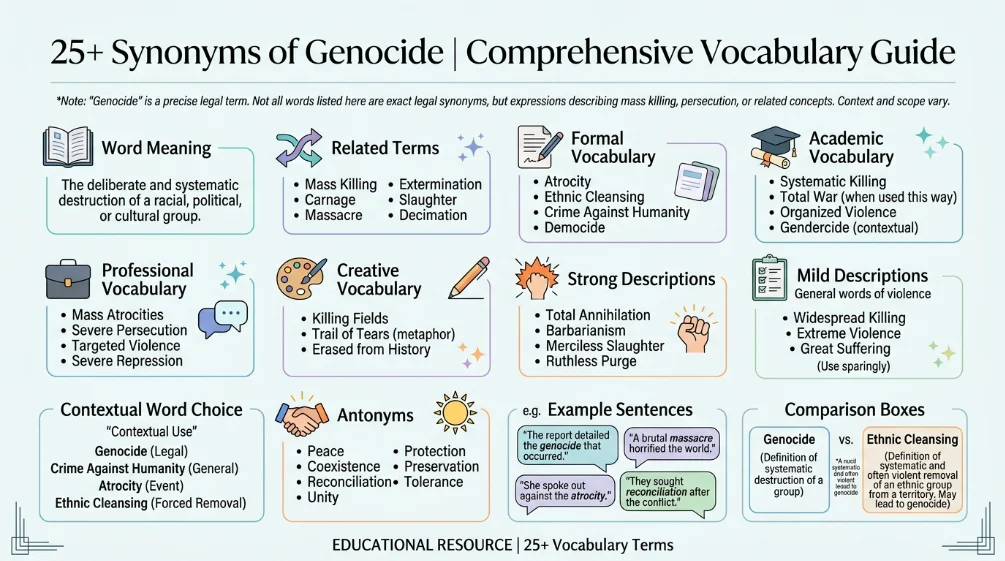
Writers often reach for the same word when discussing mass violence, historical atrocities, human rights, or international law. In essays, reports, articles, and educational writing, simply repeating genocide can make the language feel limited, especially when a more precise term can describe the specific action or context.
Understanding the synonyms of genocide requires care because many related expressions are not exact synonyms. Words such as mass extermination, annihilation, and destruction can describe aspects of genocide, while terms such as massacre or ethnic cleansing refer to related but legally or conceptually different acts. Precise word choice helps writers communicate the severity of an event without blurring important distinctions.
What Are the Best Synonyms of “Genocide”?
Genocide refers to the deliberate destruction of a national, ethnic, racial, or religious group, in whole or in part. Depending on context, related terms include mass extermination, group destruction, annihilation, systematic killing, and mass murder, but these expressions are not always legal synonyms.
For formal and academic writing, genocidal destruction or systematic destruction of a group can provide precision. In historical or emotional writing, annihilation may convey the scale of destruction, while mass murder is broader and should not automatically replace genocide.
Meaning, Tone, and Context
Simple Definition
Genocide is the deliberate destruction of a protected human group, with the intent to destroy the group, in whole or in part, because of its national, ethnic, racial, or religious identity.
The word has a specific legal meaning under international law. Because of that, writers should avoid treating every instance of mass killing or persecution as genocide without considering the necessary context and intent.
Part of Speech
Genocide is a noun.
The related adjective is genocidal, which describes an act, policy, campaign, or pattern associated with genocide.
Overall Tone
The word genocide carries an extremely serious, grave, and condemnatory tone. It is not a casual term and should be used carefully, particularly when describing historical or contemporary events.
Formality Level
Genocide is a formal term used in:
- International law
- Human rights discussions
- Academic research
- Historical analysis
- Journalism
- Government reports
- Political and diplomatic discussions
- Educational writing
It is not appropriate as casual slang or an exaggerated substitute for words such as disaster, failure, or loss.
Common Uses
Native English speakers use genocide when discussing the deliberate destruction of a protected group. Common phrases include:
- genocide prevention
- genocide research
- genocide survivors
- genocide victims
- genocide awareness
- genocide investigation
- genocide convention
- genocide denial
- genocide prevention efforts
- acts of genocide
Word Forms
| Form | Word | Example |
|---|---|---|
| Noun | genocide | The report examined evidence of genocide. |
| Adjective | genocidal | The investigation examined allegedly genocidal policies. |
| Related noun | genocidist | A person responsible for or advocating genocide, though this term is relatively uncommon. |
When and How to Use “Genocide”
The word should be used when the evidence and context support the concept of intentional group destruction. In academic and professional writing, it is especially important to distinguish genocide from other forms of mass violence.
Professional
“The organization published a report examining allegations of genocide and other international crimes.”
Academic
“Historians continue to examine the political and social conditions surrounding the genocide.”
Workplace
“Employees attended a training session on recognizing warning signs of genocide and mass atrocities.”
Personal
“She wrote about her family’s experience as survivors of genocide.”
“Please review the attached academic sources on genocide before our seminar.”
Resume
“Conducted research on genocide, mass atrocities, and international human rights law.”
Social Media
“Learning about genocide history can help communities understand the consequences of dehumanization and persecution.”
Best Synonyms of “Genocide”
There is an important distinction between an exact synonym and a closely related term. Because genocide has a specific legal and conceptual meaning, no ordinary synonym can replace it safely in every context.
Professional Writing: Systematic Destruction of a Group
This phrase can be useful when explaining the concept without relying on the legal label itself.
Example:
“The report documented a campaign involving the systematic destruction of a targeted group.”
It emphasizes organized destruction while allowing the writer to describe the conduct directly.
Academic Writing: Genocidal Destruction
Genocidal destruction is useful when discussing conduct, policies, or historical processes associated with genocide.
Example:
“The researchers examined evidence of genocidal destruction during the conflict.”
It preserves the connection to the specific concept without treating unrelated forms of violence as identical.
Business or Organizational Communication: Mass Atrocity
Mass atrocity is broader and may be more appropriate when discussing severe crimes against civilians without making a specific legal determination.
Example:
“The organization developed policies for preventing mass atrocities.”
Casual Conversation: Mass Killing
Mass killing is a plain, descriptive expression for the killing of many people. However, it does not necessarily communicate the group based intent associated with genocide.
Example:
“The documentary examined the history of mass killing during the conflict.”
Emotional Writing: Annihilation
Annihilation can convey the devastating scale of an attempt to destroy a population or community.
Example:
“The survivors described the campaign as an attempt at the annihilation of their community.”
Because the word is highly dramatic, it should be used when the context genuinely supports that level of intensity.
Creative Writing: Destruction
Destruction is broader and can be used in literary writing when the surrounding context makes the nature of the destruction clear.
Example:
“The story follows a community struggling to rebuild after the destruction of its cultural and social world.”
Resume Writing: Research on Mass Atrocities
For a resume, a descriptive phrase can be clearer than forcing a synonym into a job responsibility.
Example:
“Conducted research on mass atrocities, genocide prevention, and international humanitarian law.”
Workplace Communication: Atrocity Prevention
When discussing prevention, atrocity prevention may be more useful than simply repeating genocide.
Example:
“The training focused on atrocity prevention and early warning systems.”
Stronger Descriptive Meaning: Annihilation
Annihilation conveys complete or near complete destruction and therefore has strong emotional force.
Softer or Broader Meaning: Mass Atrocity
Mass atrocity is broader and less legally specific. It can describe several categories of serious violence without necessarily asserting that genocide occurred.
When Not to Use “Genocide”
When You Mean Any Large Number of Deaths
Not every event involving many deaths is genocide.
Less Precise:
“The earthquake caused genocide.”
Better:
“The earthquake caused a mass loss of life.”
Why:
Genocide involves intentional destruction of a protected group. A natural disaster does not meet that concept.
When You Mean a Single Massacre
A massacre describes the killing of many people, often civilians, but it does not automatically establish genocidal intent.
Less Precise:
“The incident was a genocide.”
Better:
“The incident was a massacre of civilians.”
When You Mean Forced Removal
Ethnic cleansing generally refers to efforts to remove a population from a particular territory. It should not automatically be treated as synonymous with genocide.
Better:
“The report described a campaign of forced displacement and ethnic cleansing.”
When the Evidence Does Not Establish Intent
The concept of genocide involves a specific intent to destroy a protected group, in whole or in part.
When the available evidence does not establish that intent, broader terms such as mass atrocity, persecution, or mass killing may be more accurate.
When You Need a Broader Category
If you are discussing several types of international crimes together, mass atrocities may be the better umbrella term.
Example:
“The course examines genocide, crimes against humanity, war crimes, and other mass atrocities.”
Words Commonly Confused With “Genocide”
| Word | Difference | When to Use It | Example |
|---|---|---|---|
| Massacre | Refers to the killing of many people, often civilians, but does not itself establish genocidal intent. | Describing a specific mass killing. | “The massacre left hundreds of civilians dead.” |
| Ethnic cleansing | Usually refers to the forced removal of an ethnic or religious population from a territory. | Discussing displacement campaigns. | “The investigation documented forced displacement and ethnic cleansing.” |
| Mass murder | Describes the intentional killing of many people but does not necessarily involve group destruction. | Describing large scale intentional killing. | “The case involved the mass murder of civilians.” |
| Persecution | Means severe or systematic mistreatment of people because of their identity or beliefs. | Discussing discrimination, repression, or targeted abuse. | “The community faced years of religious persecution.” |
| Extermination | Refers to deliberate destruction or killing on a large scale. | Describing extreme killing campaigns. | “The policy sought the extermination of the targeted population.” |
| Crimes against humanity | A broader category of serious widespread or systematic attacks against civilians. | Legal and human rights contexts. | “The investigation examined possible crimes against humanity.” |
Best Synonyms of “Genocide” by Context
| Context | Best Synonym or Related Term | Why It Works | Example |
|---|---|---|---|
| Formal writing | Genocidal destruction | Maintains precision while describing the process. | “The report examined genocidal destruction.” |
| Academic writing | Genocidal campaign | Useful for discussing organized conduct. | “The study analyzes the genocidal campaign.” |
| Professional communication | Mass atrocity | Broader and appropriate when legal classification is uncertain. | “The organization monitors risks of mass atrocity.” |
| Business emails | Mass atrocity | Avoids making unsupported legal conclusions. | “The briefing covers mass atrocity prevention.” |
| Resume writing | Mass atrocity research | Describes an area of expertise clearly. | “Conducted mass atrocity research.” |
| Workplace communication | Atrocity prevention | Useful for training and prevention discussions. | “The workshop focused on atrocity prevention.” |
| Casual conversation | Mass killing | Plain and understandable. | “The documentary examines a mass killing.” |
| Everyday speaking | Mass violence | Broad, accessible language. | “The discussion focused on mass violence.” |
| Creative writing | Annihilation | Conveys extreme destruction. | “The novel portrays the threatened annihilation of a community.” |
| Storytelling | Destruction of a community | Descriptive without forcing a legal label. | “The story explores the destruction of a community.” |
| Emotional writing | Annihilation | Communicates devastating destruction. | “Survivors remembered the attempted annihilation of their community.” |
| Strong emphasis | Extermination | Conveys deliberate large scale destruction. | “The policy involved the attempted extermination of a population.” |
| Mild tone | Mass atrocity | Broader and less legally specific. | “The report discusses mass atrocity risks.” |
| Social media captions | Genocide awareness | Clear when discussing education or remembrance. | “Genocide awareness encourages historical understanding.” |
| American English | Genocide | The standard term in U.S. English. | “The class studied genocide prevention.” |
How to Choose the Best Synonym of “Genocide”
The first step is to determine exactly what you are describing. If you mean the deliberate destruction of a protected group, genocide may be the most precise term. If you are describing a different form of mass violence, a related term may be more accurate.
Consider the Meaning
- Use massacre for a specific mass killing.
- Use mass displacement or ethnic cleansing when forced removal is the central issue.
- Use persecution when systematic mistreatment is the focus.
- Use mass atrocity when discussing severe violence broadly.
- Use genocide when the specific concept of intentional group destruction is supported.
Consider the Tone
Academic writing benefits from precise, neutral terminology.
Personal or literary writing may use words such as annihilation when the emotional context warrants stronger language.
Consider Your Audience
General readers may understand mass killing or mass violence more immediately.
Researchers, historians, lawyers, and human rights professionals may require more precise terminology.
Consider Emotional Strength
Mass violence is broad.
Mass killing is more specific.
Extermination is much stronger.
Annihilation carries especially strong destructive imagery.
Consider Your Purpose
If you are making a legal or historical argument, accuracy should come before dramatic wording.
If you are explaining a broad humanitarian issue, mass atrocities may be a useful umbrella term.
Check Whether the Word Is Actually Interchangeable
Before replacing genocide, ask whether the proposed synonym preserves the original meaning. If it does not, use a related term and explain the distinction instead of presenting it as an exact synonym.
Real Life Examples of “Genocide”
School
Basic:
“Students learned about genocide in their history class.”
More precise:
“Students examined how genocide is defined and distinguished from other forms of mass violence.”
College
Basic:
“The paper discusses genocide.”
Improved:
“The paper examines the evidence used to characterize a campaign as genocide.”
Workplace
Basic:
“The organization discussed genocide prevention.”
Improved:
“The organization developed training materials focused on genocide prevention and early warning.”
Business
Basic:
“The company supports genocide awareness.”
Improved:
“The company supports educational initiatives focused on genocide awareness and human rights.”
Basic:
“Please read the information about genocide.”
Improved:
“Please review the attached material on genocide prevention before tomorrow’s discussion.”
Resume
Basic:
“Studied genocide.”
Improved:
“Conducted academic research on genocide, mass atrocities, and international human rights law.”
Conversation
Basic:
“That was genocide.”
More careful:
“The evidence raises serious questions about whether the campaign meets the definition of genocide.”
Storytelling
“The novel follows survivors rebuilding their lives after the destruction of their community.”
Blogging
“A responsible article about genocide should distinguish genocide from related concepts such as ethnic cleansing, massacre, and crimes against humanity.”
Social Media
“Learning about genocide history can help readers understand the consequences of organized persecution and dehumanization.”
25 Best Synonyms and Closely Related Terms for “Genocide”
Because genocide has a specific meaning, the following list includes close descriptive alternatives and related expressions. They should not all be treated as legally interchangeable.
| Term | Simple Meaning | Best Used For | Example Sentence |
|---|---|---|---|
| Genocidal destruction | Destruction associated with genocide | Academic writing | “The study examines genocidal destruction.” |
| Genocidal campaign | Organized campaign associated with genocide | Historical analysis | “Researchers documented the genocidal campaign.” |
| Group destruction | Destruction of a targeted group | Explanatory writing | “The evidence suggests deliberate group destruction.” |
| Mass extermination | Large scale deliberate killing or destruction | Historical writing | “The archive contains evidence of mass extermination.” |
| Extermination | Deliberate destruction or killing | Strong formal descriptions | “The policy involved attempted extermination.” |
| Annihilation | Complete or near complete destruction | Literary or emotional writing | “The community feared annihilation.” |
| Mass killing | Killing of many people | General descriptions | “The report describes a mass killing.” |
| Mass murder | Intentional killing of many people | Criminal or historical contexts | “The investigation concerns mass murder.” |
| Mass atrocity | Extremely serious large scale violence | Human rights discussions | “The group monitors mass atrocity risks.” |
| Mass violence | Large scale violence affecting many people | General writing | “The region experienced prolonged mass violence.” |
| Systematic killing | Organized or methodical killing | Analytical writing | “The evidence describes systematic killing.” |
| Systematic destruction | Organized destruction of a group or community | Academic analysis | “The article examines systematic destruction.” |
| Destruction of a population | Large scale destruction affecting a population | Explanatory writing | “The evidence concerns the destruction of a population.” |
| Destruction of a community | Severe destruction affecting a community | Historical or literary writing | “The survivors described the destruction of their community.” |
| Atrocity | An extremely cruel or violent act | General human rights writing | “The museum documents the atrocity.” |
| Mass atrocity campaign | Organized large scale atrocity | Policy discussions | “The report assesses risks of a mass atrocity campaign.” |
| Ethnic persecution | Targeted mistreatment based on ethnicity | Human rights contexts | “The report documents ethnic persecution.” |
| Religious persecution | Targeted mistreatment based on religion | Historical analysis | “The community suffered religious persecution.” |
| Ethnic cleansing | Forced removal of an ethnic population | Conflict analysis | “The investigation documented ethnic cleansing.” |
| Persecution | Systematic mistreatment of a group | Legal and historical contexts | “The minority faced prolonged persecution.” |
| Elimination | Removal or destruction of something or a group | Context dependent | “The policy sought the elimination of opposition.” |
| Group annihilation | Destruction of a targeted group | Strong descriptive writing | “The campaign threatened group annihilation.” |
| Population extermination | Destruction or killing of a population | Historical analysis | “The records describe attempted population extermination.” |
| Destruction of a people | Destruction of a population or community | Historical and literary writing | “The text remembers the destruction of a people.” |
| Atrocity crimes | Serious international crimes involving mass violence | Legal and policy contexts | “The organization studies atrocity crimes.” |
Synonyms of “Genocide” by Usage
Professional vs Personal Synonyms
Professional writing requires precision. Terms such as mass atrocity, genocidal campaign, systematic destruction, and atrocity crimes can be useful when the writer needs to describe evidence carefully.
Personal writing may use destruction, annihilation, or mass killing, depending on the context and intended emotional effect. However, emotional language should not replace factual accuracy.
Formal vs Conversational Synonyms
For reports, essays, and presentations, use terms such as genocidal destruction, systematic killing, mass atrocity, or genocidal campaign when they accurately describe the subject.
In casual conversation, mass killing or mass violence may be easier for a general audience to understand. Even in informal speech, however, genocide should not be casually applied to unrelated events.
Academic Synonyms
Academic writing benefits from distinctions rather than simply replacing one word with another.
Useful terms include:
- Genocidal campaign
- Genocidal destruction
- Mass atrocity
- Systematic destruction
- Systematic killing
- Persecution
- Crimes against humanity
- Ethnic cleansing
These terms allow students and researchers to describe different forms of violence without incorrectly treating them as identical.
Professional and Business Synonyms
In professional settings, the strongest choices depend on what is actually being discussed.
Resumes
Use phrases such as genocide research, mass atrocity research, or human rights research to describe academic or professional experience accurately.
Interviews
Mass atrocity prevention can be appropriate when discussing policy, humanitarian work, or conflict prevention.
Meetings
Genocide prevention is suitable when the discussion specifically concerns genocide risk.
Presentations
Mass atrocities can work as an umbrella term when several forms of severe violence are being discussed.
Performance Reviews
If relevant to the role, phrases such as human rights research or atrocity prevention analysis can communicate professional expertise more clearly.
Client Communication
Use neutral, evidence based language and avoid labeling an event as genocide unless the context supports the designation.
Business Emails
Terms such as mass atrocities, human rights violations, or genocide prevention may be appropriate depending on the subject.
Creative and Literary Synonyms
Creative writing can use stronger descriptive language, but the chosen word should still match the meaning.
Annihilation emphasizes complete destruction.
Destruction of a community creates a more descriptive image.
Mass killing focuses directly on loss of life.
Extermination conveys deliberate destruction and carries considerable emotional weight.
In fiction, these terms can shape the reader’s emotional response, but historical or nonfiction writing should prioritize accuracy over dramatic effect.
Slang or Modern Synonyms
There are no reliable slang synonyms for genocide that should be recommended for serious writing.
Expressions such as wipe them out may appear in informal speech or fictional dialogue, but they are not suitable replacements for genocide in academic, professional, legal, or historical writing.
Using casual expressions for an atrocity can also minimize the seriousness of the subject.
Strongest to Mildest Related Terms
These terms cannot be placed on a perfect synonym scale because they describe different concepts. However, in terms of descriptive force, a useful general progression is:
Mass violence → Mass killing → Mass atrocity → Systematic killing → Extermination → Annihilation
The scale should not be interpreted as a legal ranking. For example, mass atrocity may be broader than genocide, while annihilation emphasizes destruction rather than providing the specific legal meaning of genocide.
Emotional vs Neutral Synonyms
Emotional Synonyms
- Annihilation
- Extermination
- Destruction of a people
- Group annihilation
- Destruction of a community
These expressions can carry strong emotional weight and are most appropriate when the surrounding context genuinely calls for emphasis.
Neutral Synonyms
- Mass violence
- Mass killing
- Mass atrocity
- Persecution
- Systematic killing
- Genocidal campaign
Neutral language is generally preferable in academic, journalistic, and professional writing because it allows the evidence to carry the argument.
Antonyms of “Genocide”
There is no single perfect everyday antonym for genocide because the term describes an extreme form of intentional group destruction. The following expressions represent genuine conceptual opposites involving group protection, survival, inclusion, or preservation.
| Antonym or Opposing Concept | Meaning | Example Sentence |
|---|---|---|
| Group preservation | Protecting a group from destruction | “The policy focused on group preservation.” |
| Population protection | Safeguarding a population | “International forces prioritized population protection.” |
| Human protection | Protecting people from severe harm | “The program emphasizes human protection.” |
| Community preservation | Maintaining a community’s survival | “The initiative supports community preservation.” |
| Cultural preservation | Protecting cultural identity and heritage | “The museum promotes cultural preservation.” |
| Peacebuilding | Efforts to establish lasting peace | “The organization invests in peacebuilding.” |
| Reconciliation | Restoring relationships after conflict | “The communities began a reconciliation process.” |
| Inclusion | Ensuring people are welcomed and represented | “The program promotes inclusion.” |
| Coexistence | Different groups living together peacefully | “The policy encourages peaceful coexistence.” |
| Integration | Bringing groups into a shared social system | “The project supports social integration.” |
| Protection | Keeping people safe from harm | “The agreement provides protection for civilians.” |
| Preservation | Preventing destruction or loss | “The effort focuses on preservation of cultural heritage.” |
| Survival | Continued existence of a person or group | “The community fought for its survival.” |
| Flourishing | Thriving and developing successfully | “The community is now flourishing.” |
| Human rights protection | Safeguarding fundamental rights | “Human rights protection remains central to the program.” |
Comparison: “Genocide” vs Similar Words
Genocide vs Massacre
Main Difference
Genocide concerns the intentional destruction of a protected group, while massacre refers to the killing of many people, often civilians, without necessarily establishing an intent to destroy a group.
Which Is Stronger?
They are not simply stronger and weaker versions of the same word. Genocide is more specific, while massacre describes a type of mass killing.
Which Is More Formal?
Both are common in formal writing, but genocide has a specific legal meaning.
When to Use Each
Use genocide when the necessary concept of group destruction is supported.
Use massacre when describing a particular mass killing.
Examples
Genocide:
“The researchers examined evidence concerning genocide.”
Massacre:
“The investigation documented a massacre of civilians.”
Genocide vs Ethnic Cleansing
Main Difference
Genocide involves intent to destroy a protected group, while ethnic cleansing generally concerns forcibly removing a population from a particular territory.
Which Is Stronger?
Neither is simply stronger. They describe different concepts.
Which Is More Formal?
Both are used in academic, historical, and international affairs writing.
When to Use Each
Use ethnic cleansing when forced population removal is the central issue.
Examples
Genocide:
“The study examines allegations of genocide.”
Ethnic cleansing:
“The report describes an ethnic cleansing campaign.”
Genocide vs Mass Murder
Main Difference
Mass murder means the intentional killing of many people. It does not necessarily involve the intent to destroy a protected group.
Which Is Stronger?
Genocide is more specific because of the group based intent involved.
Which Is More Formal?
Both can appear in formal writing.
When to Use Each
Use mass murder when focusing on the act of killing many people.
Examples
Genocide:
“The case concerns the destruction of a targeted group.”
Mass murder:
“The investigation focused on the mass murder of civilians.”
Genocide vs Persecution
Main Difference
Persecution involves systematic mistreatment because of identity or beliefs. It can occur without an intent to destroy the group.
Which Is Stronger?
Genocide generally describes a more extreme form of group destruction.
Which Is More Formal?
Both are standard terms in legal and academic writing.
When to Use Each
Use persecution when discrimination, imprisonment, displacement, or other targeted mistreatment is the focus.
Examples
Genocide:
“The research examines whether the campaign involved genocide.”
Persecution:
“The minority experienced years of religious persecution.”
Genocide vs Extermination
Main Difference
Extermination emphasizes deliberate killing or destruction on a large scale. It does not independently communicate all the specific elements associated with genocide.
Which Is Stronger?
Extermination can sound more forceful in describing killing, but it is not a direct legal substitute for genocide.
Which Is More Formal?
Both can appear in formal historical or legal discussions.
When to Use Each
Use extermination when deliberate large scale destruction or killing is the focus.
Examples
Genocide:
“The investigation examines evidence of genocide.”
Extermination:
“The documents describe an attempted extermination campaign.”
Genocide vs Crimes Against Humanity
Main Difference
Crimes against humanity is a broader legal category covering certain widespread or systematic attacks against civilians. Genocide has additional requirements concerning the targeted group’s destruction.
Which Is Stronger?
Neither should be treated as a simple stronger version of the other.
Which Is More Formal?
Both are highly formal terms.
When to Use Each
Use crimes against humanity when the broader legal category is the subject.
Examples
Genocide:
“The researchers investigated allegations of genocide.”
Crimes against humanity:
“The court examined allegations of crimes against humanity.”
Common Phrases and Expressions with “Genocide”
Genocide Prevention
Meaning
Efforts designed to reduce the risk of genocide and address warning signs before mass atrocities escalate.
Example Sentence
“Genocide prevention requires careful attention to patterns of persecution and escalating violence.”
Genocide Awareness
Meaning
Education and public understanding concerning genocide, its history, warning signs, and consequences.
Example Sentence
“The school organized a genocide awareness program for students.”
Genocide Prevention Efforts
Meaning
Specific actions, policies, or programs intended to prevent genocide.
Example Sentence
“International organizations continue to support genocide prevention efforts.”
Genocide Survivors
Meaning
People who survived a genocide.
Example Sentence
“The museum collected oral histories from genocide survivors.”
Genocide Victims
Meaning
People who were killed, harmed, or otherwise victimized during genocide.
Example Sentence
“The memorial honors genocide victims and their families.”
Genocide Research
Meaning
Academic or professional study of genocide, its causes, characteristics, consequences, and prevention.
Example Sentence
“Her graduate work focuses on genocide research.”
Genocide Investigation
Meaning
A formal examination of evidence concerning alleged genocide.
Example Sentence
“The commission began a genocide investigation.”
Genocide Denial
Meaning
The rejection or denial of established evidence concerning a genocide.
Example Sentence
“The course examines how genocide denial affects survivors and historical memory.”
Common Mistakes to Avoid
1. Treating Every Mass Killing as Genocide
Incorrect:
“The large number of deaths automatically means genocide.”
Better:
“The large number of deaths indicates mass killing, while the classification of genocide requires further evidence.”
Why:
The scale of death alone does not establish genocide.
2. Confusing Genocide With Ethnic Cleansing
Incorrect:
“Ethnic cleansing and genocide always mean the same thing.”
Better:
“Ethnic cleansing and genocide are related concepts but describe different forms of group targeted violence.”
Why:
Forced removal and group destruction are not identical concepts.
3. Using a Casual Expression in Academic Writing
Incorrect:
“The government tried to wipe out the group.”
Better:
“The evidence suggests an attempt to systematically destroy the targeted group.”
Why:
The second version is more precise and appropriate for academic analysis.
4. Using Genocide as an Exaggeration
Incorrect:
“The company committed genocide against its competitors.”
Better:
“The company aggressively competed with its rivals.”
Why:
Using genocide metaphorically can distort its serious historical and legal meaning.
5. Replacing Genocide With Massacre Automatically
Incorrect:
“Genocide simply means a massacre.”
Better:
“A massacre involves mass killing, while genocide refers to the intentional destruction of a protected group.”
Why:
The terms describe different concepts.
6. Using Strong Language Without Evidence
Incorrect:
“The campaign was definitely genocidal.”
Better:
“Researchers are examining whether the campaign meets the criteria for genocide.”
Why:
Careful wording is essential when the evidence or legal classification remains disputed.
7. Treating Related Terms as Exact Synonyms
Incorrect:
“Mass atrocity is an exact synonym for genocide.”
Better:
“Mass atrocity is a broader term that can include genocide and other severe forms of violence.”
Why:
The broader term should not be presented as identical to the more specific concept.
Frequently Asked Questions
1. What are the best synonyms of “genocide”?
The closest descriptive alternatives include genocidal destruction, mass extermination, annihilation, systematic killing, mass murder, and group destruction. However, many are related terms rather than exact legal synonyms.
2. What are the best formal synonyms of “genocide”?
Formal alternatives include genocidal destruction, genocidal campaign, systematic destruction of a group, and mass atrocity. Writers should select the term that accurately reflects the evidence and intended meaning.
3. What are common informal synonyms of “genocide”?
There are no reliable informal synonyms that should replace genocide in serious writing. Expressions such as mass killing may be easier to understand conversationally, but they do not necessarily carry the same specific meaning.
4. What is another word for “genocide” in professional writing?
In professional writing, mass atrocity, genocidal campaign, or systematic destruction of a group may be useful depending on context. These alternatives can provide precision when the exact classification requires careful explanation.
5. What is the difference between “genocide” and “ethnic cleansing”?
Genocide concerns the intentional destruction of a protected group, while ethnic cleansing generally refers to forcibly removing a population from a territory. The two concepts can overlap historically but are not identical.
6. What is the opposite of “genocide”?
There is no single perfect antonym, but concepts such as group preservation, population protection, coexistence, reconciliation, inclusion, cultural preservation, and human rights protection represent opposing ideas centered on survival and protection.
Conclusion
Genocide is a highly specific and serious term describing the intentional destruction of a protected human group. Because of its legal and historical significance, writers should not replace it casually with broader words such as massacre, mass murder, or ethnic cleansing.
The best synonyms of genocide depend on what aspect of the subject you are describing. Genocidal destruction and genocidal campaign can work in academic contexts, while mass atrocity, mass killing, systematic killing, and annihilation may describe related concepts when used carefully.
The most effective vocabulary choice always depends on meaning, evidence, audience, tone, and purpose. A useful vocabulary habit is to identify the exact action or concept you mean before selecting a synonym, especially when discussing serious historical or human rights subjects.
Read More Related Articles:
- Synonyms for Empty | Meaning, Examples, and Better Word …
- Synonyms for Creativity | Meaning, Examples, and Better …
- Synonyms for Pros and Cons | Meaning, Examples, and Better …