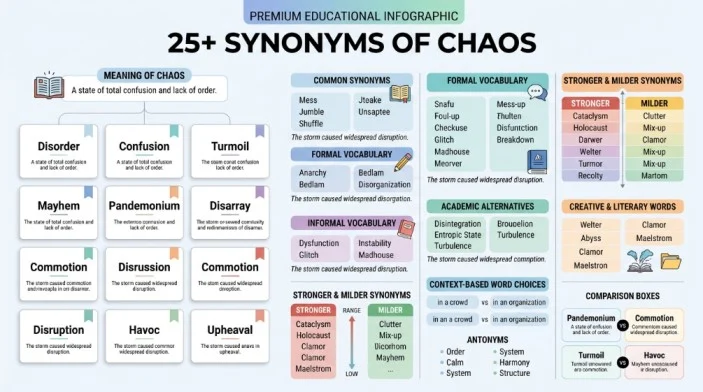
Synonyms of Chaos can help you describe disorder with much greater precision. “Chaos” is a broad word, but the situation may actually involve confusion, turmoil, disorder, upheaval, or complete disorganization. Choosing the right alternative depends on the intensity, context, and tone you want to convey.
In everyday English, Synonyms of Chaos can make your writing more specific and natural. A workplace may experience disarray, a crowded scene may fall into confusion, while a violent or rapidly changing situation may be described as turmoil or upheaval. These words overlap with chaos, but they are not always interchangeable.
This guide explains the most useful alternatives with clear meanings, tone differences, and practical examples. Whether you are writing an essay, improving vocabulary, creating professional content, or looking for a stronger word, understanding these distinctions can help you communicate disorder more accurately and confidently.
What Are the Best Synonyms of “Chaos”?
The best synonyms of chaos include disorder, confusion, turmoil, mayhem, havoc, pandemonium, commotion, disarray, and upheaval. For formal writing, use disorder or disarray. For academic writing, instability or disorganization can work well. Casual speech often favors mess or mayhem, while creative writing can use pandemonium, turmoil, or havoc for stronger imagery.
Meaning, Tone, and Context
Simple Definition
Chaos describes a state of extreme confusion, disorder, or lack of control. It can refer to physical spaces, social situations, emotions, events, organizations, or systems that are difficult to manage or understand.
For example:
“The airport descended into chaos after hundreds of flights were canceled.”
The sentence suggests more than simple untidiness. It implies that normal order or control has broken down.
Part of Speech
Chaos is primarily a noun.
It is usually used as an uncountable noun:
“The office was in chaos.”
“The sudden announcement caused chaos.”
The adjective chaotic is the most common related form:
“Traffic became chaotic after the accident.”
Overall Tone
The tone of chaos is generally negative because it describes disorder, confusion, instability, or a loss of control.
However, the word can sometimes be used humorously or lightly:
“My kitchen was pure chaos while I prepared dinner for twelve people.”
Here, chaos does not necessarily suggest danger. It can simply emphasize how difficult and disorderly the situation felt.
Formality Level
Chaos is a neutral word that works in formal, professional, academic, and casual English.
It is common in:
- News writing
- Business communication
- Academic discussions
- Everyday conversation
- Fiction
- Social media
- Personal writing
The surrounding synonym determines the level of formality. Disorder tends to sound more formal and analytical, while mess is much more conversational.
Common Uses
Native English speakers commonly use chaos to describe:
- Traffic
- Crowds
- Political situations
- Workplaces
- Homes
- Events
- Emergencies
- Financial markets
- Confusing situations
- Disorganized projects
- Emotional situations
- Natural disasters
- Public disturbances
Word Forms
| Form | Word | Example |
|---|---|---|
| Noun | Chaos | “The office was in chaos.” |
| Adjective | Chaotic | “The schedule became chaotic.” |
The noun chaos describes the condition itself, while chaotic describes something characterized by disorder.
When and How to Use “Chaos”
Choose chaos when you want to communicate that normal order or control has broken down. It is especially effective when many confusing or uncontrolled things are happening at the same time.
Professional
“Without a clear project plan, the development process could quickly descend into chaos.”
Academic
“The sudden policy change created chaos within several administrative departments.”
Workplace
“The office was in chaos after the computer system stopped working.”
Personal
“My house was complete chaos before the family reunion.”
“Please confirm the updated schedule so we can avoid confusion and unnecessary chaos.”
Resume
A resume usually does not benefit from simply saying that a workplace was chaotic. A stronger approach is to show how you handled disorder:
“Implemented new procedures that reduced operational chaos and improved workflow.”
Social Media
“Moving day was absolute chaos, but somehow everything worked out in the end.”
Best Synonyms of “Chaos”
No synonym for chaos carries exactly the same meaning in every sentence. The best choice depends on whether you want to emphasize confusion, physical disorder, emotional disturbance, destructive activity, or a lack of organization.
Professional Writing: Disorder
Disorder is one of the safest alternatives in professional and formal writing.
“The department experienced significant disorder after the restructuring.”
It sounds objective and focuses on the absence of organization.
Academic Writing: Disorganization
Disorganization works particularly well when discussing systems, processes, institutions, or structures that lack proper organization.
“Poor planning contributed to disorganization within the research team.”
It is more precise than chaos when the problem specifically involves poor organization.
Business Communication: Turmoil
Turmoil is useful when a company, market, organization, or group is experiencing serious instability.
“The company faced considerable turmoil following the leadership change.”
It suggests disruption that may involve uncertainty, conflict, or emotional tension.
Casual Conversation: Mess
Mess is a natural everyday alternative.
“My room is such a mess right now.”
It is much less dramatic than chaos and usually works best for physical spaces or relatively ordinary problems.
Emotional Writing: Turmoil
When disorder is mainly emotional or psychological, turmoil is often more accurate.
“She struggled with emotional turmoil after the loss.”
Creative Writing: Pandemonium
Pandemonium creates a vivid sense of loud, uncontrolled confusion.
“Pandemonium erupted when the gates finally opened.”
It is particularly effective in storytelling and descriptive writing.
Resume Writing: Disruption
Disruption is often better than chaos on a resume because it sounds professional and focuses on the effect of a problem.
“Managed operational disruption while maintaining customer service standards.”
Workplace Communication: Disorder
For workplace situations, disorder, confusion, and disorganization are usually more professional than chaos.
“The new process created unnecessary confusion among team members.”
Stronger Meaning: Mayhem
Mayhem suggests wild confusion, disorder, and often destructive or uncontrolled activity.
“The unexpected announcement caused mayhem throughout the venue.”
Softer Meaning: Confusion
Confusion is a milder alternative when the main issue is uncertainty or a lack of understanding.
“There was some confusion about the meeting time.”
When Not to Use “Chaos”
Although chaos is flexible, it can sometimes be too broad. A more precise synonym can tell readers exactly what went wrong.
When “Chaos” Is Too General
Less precise:
“The meeting was chaos.”
Better:
“The meeting was filled with confusion because no one knew who was responsible for each task.”
Why:
The real problem is uncertainty about responsibilities, so confusion communicates the problem more accurately.
When “Chaos” Is Too Vague
Less precise:
“The project descended into chaos.”
Better:
“The project suffered from severe disorganization after the deadlines were changed.”
Why:
Disorganization identifies the specific type of problem.
When a More Formal Word Is Needed
Less suitable:
“The department was complete chaos.”
Better:
“The department experienced significant disorder during the transition.”
Why:
Disorder sounds more objective in formal reports.
When a Casual Word Is Better
Less natural:
“My desk is in a state of chaos.”
Better:
“My desk is a mess.”
Why:
Mess sounds more natural for an ordinary conversation about a cluttered desk.
When “Chaos” Is Too Weak
If the situation includes serious destruction or uncontrolled behavior, chaos may not fully communicate the intensity.
Less strong:
“The crowd caused chaos outside the stadium.”
Better:
“The crowd caused mayhem outside the stadium.”
Why:
Mayhem conveys a more intense and uncontrolled situation.
When “Chaos” Is Too Strong
Sometimes a situation is merely unclear rather than completely disorganized.
Too dramatic:
“There was chaos when the meeting time changed.”
Better:
“There was some confusion when the meeting time changed.”
Why:
Confusion accurately describes uncertainty without exaggerating the situation.
Words Commonly Confused With “Chaos”
| Word | Difference | When to Use It | Example |
|---|---|---|---|
| Confusion | Focuses on uncertainty or lack of understanding. | When people do not know what is happening. | “There was confusion about the new policy.” |
| Disorder | Focuses on a lack of order or organization. | When a system, place, or situation lacks structure. | “The files were left in disorder.” |
| Turmoil | Suggests serious instability, conflict, or emotional disturbance. | Politics, organizations, relationships, or emotions. | “The company went through months of turmoil.” |
| Mayhem | Suggests wild, uncontrolled, and often destructive activity. | Crowds, emergencies, or violent disturbances. | “The announcement caused mayhem.” |
| Commotion | Refers to noisy or excited activity. | Crowded public or social situations. | “A sudden commotion broke out outside.” |
| Disarray | Describes something poorly organized or untidy. | Rooms, documents, plans, or systems. | “The office was left in disarray.” |
Best Synonyms of “Chaos” by Context
| Context | Best Synonym | Why It Works | Example |
|---|---|---|---|
| Formal writing | Disorder | Objective and precise | “The transition created organizational disorder.” |
| Academic writing | Disorganization | Focuses on structural problems | “Disorganization affected the research process.” |
| Professional communication | Disorder | Neutral and professional | “The department experienced temporary disorder.” |
| Business emails | Confusion | Useful for unclear information | “The revised schedule caused confusion.” |
| Resume writing | Disruption | Shows a professional response to problems | “Managed operational disruption effectively.” |
| Workplace communication | Disorganization | Identifies poor structure | “Disorganization delayed the project.” |
| Casual conversation | Mess | Natural and simple | “The kitchen is a mess.” |
| Everyday speaking | Confusion | Common and easy to understand | “There was confusion about the address.” |
| Creative writing | Pandemonium | Creates vivid imagery | “Pandemonium swept through the streets.” |
| Storytelling | Mayhem | Adds intensity | “The festival quickly turned into mayhem.” |
| Emotional writing | Turmoil | Expresses inner disturbance | “He was experiencing emotional turmoil.” |
| Strong emphasis | Mayhem | Suggests extreme disorder | “The storm caused mayhem across the city.” |
| Mild tone | Confusion | Less dramatic | “There was some confusion at first.” |
| Social media captions | Mess | Casual and relatable | “Moving day was a complete mess.” |
| American English | Chaos | Very common and natural | “The roads were absolute chaos.” |
| British English | Chaos | Also widely understood and used | “The station was complete chaos.” |
How to Choose the Best Synonym of “Chaos”
The easiest way to choose the right synonym is to identify what kind of disorder you are describing.
If People Do Not Understand What Is Happening
Choose confusion.
“There was confusion about the new instructions.”
If Something Is Poorly Organized
Choose disorganization or disarray.
“The records were in complete disarray.”
If a Group or Organization Is Experiencing Instability
Choose turmoil.
“The company has been in turmoil since the merger.”
If There Is Loud Activity
Choose commotion.
“The announcement caused a commotion in the hallway.”
If the Situation Is Extremely Uncontrolled
Choose mayhem or pandemonium.
“The sudden evacuation created pandemonium.”
If You Are Talking Casually About Untidiness
Choose mess.
“The kids left the living room a mess.”
If You Need an Objective Professional Term
Choose disorder, disruption, or disorganization, depending on the exact meaning.
The goal is not to find the fanciest synonym. The goal is to choose the word that communicates the situation most accurately.
Real Life Examples of “Chaos”
School
Original:
“The classroom was chaos after the substitute teacher arrived.”
Stronger:
“The classroom descended into disorder after the substitute teacher arrived.”
The second version sounds more descriptive and formal.
College
Original:
“Poor planning caused chaos during the event.”
Improved:
“Poor planning caused significant disorganization during the event.”
This version clearly identifies the problem.
Workplace
Original:
“The new software caused chaos in the office.”
Improved:
“The new software caused considerable confusion among employees.”
Here, confusion is better if employees simply did not understand how to use the system.
Business
Original:
“The leadership change created chaos.”
Improved:
“The leadership change created considerable turmoil within the organization.”
Turmoil emphasizes instability and uncertainty.
Original:
“The changes have caused chaos for our team.”
Improved:
“The changes have caused significant disruption to our team’s workflow.”
This sounds more professional and identifies the effect.
Resume
Original:
“Handled chaos during a major system failure.”
Improved:
“Managed significant operational disruption during a major system failure.”
The improved version presents the situation professionally and emphasizes the ability to respond.
Conversation
Original:
“The store was chaos after the sale started.”
Natural:
“The store was complete mayhem after the sale started.”
The stronger word works naturally in casual speech when the situation was extremely busy and uncontrolled.
Storytelling
Original:
“The town became chaos when the storm arrived.”
Improved:
“Pandemonium swept through the town as the storm approached.”
The alternative creates a stronger visual and emotional effect.
Blogging
Original:
“Without a content plan, your blog can become chaos.”
Improved:
“Without a content plan, your blog can fall into disorganization.”
The second version is more specific and professional.
Social Media
Original:
“Traveling with three kids is chaos.”
Alternative:
“Traveling with three kids is beautiful chaos.”
Here, chaos can be used playfully rather than negatively.
25 Best Synonyms of “Chaos”
| Synonym | Simple Meaning | Best Used For | Example Sentence |
|---|---|---|---|
| Disorder | Lack of order or organization | Formal and professional writing | “The records were left in disorder.” |
| Confusion | Lack of understanding or clarity | Everyday and workplace situations | “The announcement caused confusion among employees.” |
| Turmoil | Serious disturbance or instability | Emotional, political, and organizational situations | “The company experienced months of turmoil.” |
| Mayhem | Wild and uncontrolled disorder | Crowds and disruptive situations | “The unexpected closure caused mayhem at the station.” |
| Pandemonium | Extreme noisy confusion | Creative writing and dramatic events | “Pandemonium erupted when the doors opened.” |
| Commotion | Noisy or excited activity | Public and social situations | “A commotion outside drew everyone’s attention.” |
| Disarray | A state of poor organization | Rooms, files, plans, and systems | “The documents were scattered in disarray.” |
| Disorganization | Lack of proper structure | Academic and professional writing | “Disorganization slowed the team’s progress.” |
| Havoc | Widespread damage or disruption | Disasters and destructive events | “The storm wreaked havoc on local roads.” |
| Upheaval | Major change and disruption | Society, politics, and organizations | “The industry underwent major upheaval.” |
| Confusion | Uncertainty about what is happening | Instructions and communication | “The conflicting messages created confusion.” |
| Mess | Untidy or poorly organized condition | Casual conversation | “The garage is a complete mess.” |
| Clutter | Too many scattered objects | Physical spaces | “The desk was covered in clutter.” |
| Anarchy | Lack of authority or control | Political and social contexts | “The collapse of government led to fears of anarchy.” |
| Instability | Lack of steadiness or security | Markets, politics, systems | “Economic instability affected investment.” |
| Disturbance | Something that interrupts normal order | Public or workplace situations | “The disturbance interrupted the meeting.” |
| Disruption | An interruption to normal activity | Business and professional settings | “The outage caused major disruption.” |
| Disarray | Lack of arrangement or organization | Documents and environments | “The files were in complete disarray.” |
| Turbulence | A period of instability or disturbance | Politics, business, and figurative writing | “The company faced financial turbulence.” |
| Disorganization | Poor planning or structure | Workplaces and projects | “Disorganization affected productivity.” |
| Clamor | Loud, confused noise | Crowds and public scenes | “The clamor outside made conversation difficult.” |
| Frenzy | Wild excitement or uncontrolled activity | Crowds, media, shopping | “Fans rushed into a frenzy after the announcement.” |
| Bedlam | Extremely noisy confusion | Informal and literary writing | “The emergency room became bedlam.” |
| Tumult | Loud disorder or emotional disturbance | Literary and formal writing | “The decision sparked political tumult.” |
| Jumble | Confused mixture or arrangement | Ideas, objects, and information | “The report was a jumble of unrelated ideas.” |
Important usage note: Some words above overlap with chaos without being interchangeable in every sentence. For example, clutter specifically concerns accumulated objects, while havoc emphasizes damage or disruption. This distinction matters when selecting a precise synonym.
Synonyms of “Chaos” by Usage
Professional vs Personal Synonyms
Professional writing benefits from words that explain the type of problem without sounding emotional.
Use:
- Disorder
- Disorganization
- Disruption
- Instability
- Turmoil
Personal conversations allow more expressive words.
Use:
- Mess
- Mayhem
- Chaos
- Frenzy
- Confusion
Professional:
“The software update caused significant disruption to our operations.”
Personal:
“The software update turned the whole office into chaos.”
Both sentences communicate disorder, but the first is more suitable for a formal workplace message.
Formal vs Conversational Synonyms
Reports
Use disorder, instability, or disorganization.
Essays
Use disorder, turmoil, instability, or disorganization, depending on the subject.
Business Writing
Use disruption, instability, or disorder.
Presentations
Use confusion, disruption, or turmoil when they accurately describe the issue.
Emails
Use confusion or disruption for most professional situations.
Casual Conversations
Use chaos, mess, mayhem, or commotion.
Texting
Informal words such as mess, chaos, and mayhem sound natural.
Academic Synonyms
Academic writing should favor precise terms over dramatic expressions.
Disorganization
Use this when discussing poorly structured systems, teams, or processes.
“Administrative disorganization affected the efficiency of the program.”
Instability
Use this when discussing systems that are unpredictable or insecure.
“Economic instability influenced consumer behavior.”
Disorder
Use this when discussing the breakdown of order or structure.
“Social disorder increased during the period of political unrest.”
Turmoil
Use this when a situation involves serious conflict or instability.
“The country experienced considerable political turmoil.”
Upheaval
Use this when discussing major changes that disturb an existing system.
“Technological developments caused significant upheaval in the industry.”
These terms sound more analytical because each one identifies a particular type of disorder.
Professional and Business Synonyms
Resumes
Avoid writing:
“Worked well in chaos.”
A stronger resume statement is:
“Maintained productivity during periods of operational disruption.”
This focuses on your ability rather than simply labeling the workplace.
Interviews
Use pressure, disruption, or uncertainty when describing difficult situations.
“I remained organized during periods of significant operational disruption.”
Meetings
Use confusion when people lack clarity.
“There was some confusion about the responsibilities assigned to each department.”
Presentations
Use disruption when describing interruptions.
“The technical failure caused a brief disruption to the presentation.”
Performance Reviews
Use professional terms that describe the problem and your response.
“Successfully improved workflow during a period of organizational instability.”
Client Communication
Avoid unnecessarily dramatic words such as mayhem or bedlam.
Instead, use:
- Disruption
- Delay
- Confusion
- Instability
Business Emails
“We apologize for the confusion caused by the schedule change.”
This is usually better than saying:
“We apologize for the chaos.”
The first version sounds controlled and professional.
Creative and Literary Synonyms
Creative writing gives you more freedom to choose expressive words.
Pandemonium
Best for loud, uncontrolled scenes.
“Pandemonium filled the square as the crowd rushed toward the stage.”
Mayhem
Useful when disorder becomes wild or destructive.
“The overturned tables were evidence of the mayhem that had followed.”
Tumult
A more literary choice for emotional or social disturbance.
“Amid the tumult, she searched for a familiar face.”
Havoc
Effective when emphasizing destruction.
“The storm had wreaked havoc across the coastal village.”
Turmoil
Ideal for internal emotional conflict.
“Behind his calm expression, a storm of turmoil continued to grow.”
These words should support the mood of the story rather than simply replace chaos for variety.
Slang or Modern Synonyms
There is no single slang word that perfectly replaces chaos in every context. Informal English instead uses expressions such as a mess, a madhouse, or a total mess.
A Mess
Meaning: A situation that is disorganized or difficult to manage.
Acceptable in:
- Conversations
- Text messages
- Social media
- Informal writing
Avoid in:
- Academic papers
- Formal reports
- Official business documents
“The office was a total mess after the event.”
A Madhouse
Meaning: An extremely busy, noisy, or difficult environment.
Acceptable in casual conversation.
“The store was a madhouse during the holiday sale.”
Avoid using it when a professional or neutral tone is required.
Strongest to Mildest Synonyms
There is no universal intensity ranking because context changes the strength of a word. Still, the following scale provides a useful general guide.
Mild
- Confusion
- Clutter
- Disorganization
- Disarray
These words can describe manageable problems.
Moderate
- Disorder
- Commotion
- Disturbance
- Disruption
- Instability
These suggest a more noticeable breakdown of normal order.
Strong
- Turmoil
- Upheaval
- Frenzy
- Havoc
- Mayhem
These words suggest significant disruption or emotional intensity.
Very Strong
- Pandemonium
- Bedlam
- Anarchy
These can suggest extreme confusion, uncontrolled activity, or the breakdown of authority.
The best word is not necessarily the strongest one. If the situation is minor, choosing an extreme synonym can make your writing sound exaggerated.
Emotional vs Neutral Synonyms
Emotional Synonyms
Use these when you want readers to feel the intensity of the situation.
- Mayhem
- Pandemonium
- Turmoil
- Frenzy
- Bedlam
- Tumult
Example:
“Pandemonium erupted when the crowd realized the concert had been canceled.”
Neutral Synonyms
Use these when you want to describe the situation objectively.
- Disorder
- Disorganization
- Confusion
- Disruption
- Instability
- Disarray
Example:
“The schedule change caused confusion among employees.”
For academic, business, and professional writing, neutral alternatives are usually safer. Emotional words are more effective in storytelling, opinion writing, and informal communication.
Antonyms of “Chaos”
| Antonym | Meaning | Example Sentence |
|---|---|---|
| Order | A well organized condition | “The manager restored order to the department.” |
| Organization | Proper arrangement and structure | “Good organization keeps the project on schedule.” |
| Stability | A steady and secure condition | “The company needs financial stability.” |
| Control | The ability to manage a situation | “The team quickly regained control.” |
| Peace | A calm condition without disturbance | “The neighborhood returned to peace.” |
| Calm | A state without agitation | “The room became calm after the announcement.” |
| Harmony | A condition of agreement and balance | “The team worked together in harmony.” |
| Structure | An organized arrangement | “The course provides enough structure for students.” |
| Coordination | Organized cooperation between people or activities | “Better coordination improved the event.” |
| Clarity | A condition of being easy to understand | “The revised instructions provided clarity.” |
| System | An organized method or arrangement | “The company introduced a better filing system.” |
| Routine | A regular and predictable pattern | “A consistent routine helped the children settle.” |
| Discipline | Controlled and orderly behavior | “The team showed impressive discipline.” |
| Balance | A stable and well proportioned condition | “The new schedule created a better balance.” |
| Tranquility | A peaceful and undisturbed condition | “The garden offered a sense of tranquility.” |
Comparison: “Chaos” vs Similar Words
Chaos vs Confusion
Main Difference
Chaos describes widespread disorder or lack of control. Confusion specifically describes uncertainty or difficulty understanding what is happening.
Which Is Stronger?
Chaos is generally stronger.
Which Is More Formal?
Both are neutral, but confusion is often more suitable for professional communication.
When to Use Each
Use confusion when information is unclear. Use chaos when the entire situation has become difficult to control.
Examples
Chaos:
“The evacuation caused chaos at the station.”
Confusion:
“The conflicting announcements caused confusion among passengers.”
Chaos vs Disorder
Main Difference
Disorder focuses on a lack of organization or arrangement. Chaos suggests a broader breakdown of order and control.
Which Is Stronger?
Chaos generally sounds stronger.
Which Is More Formal?
Disorder is often more formal.
When to Use Each
Use disorder in analytical or professional writing. Use chaos when you want a broader or more vivid description.
Examples
Chaos:
“The entire event descended into chaos.”
Disorder:
“The files were stored in disorder.”
Chaos vs Turmoil
Main Difference
Turmoil emphasizes serious disturbance, instability, or emotional conflict. Chaos focuses more broadly on disorder and lack of control.
Which Is Stronger?
Neither is always stronger. The difference is mainly in meaning.
Which Is More Formal?
Turmoil can sound more formal or literary.
When to Use Each
Use turmoil for politics, organizations, relationships, and emotions.
Examples
Chaos:
“The sudden cancellation caused chaos.”
Turmoil:
“The leadership dispute created months of turmoil.”
Chaos vs Mayhem
Main Difference
Mayhem suggests wild confusion and often destructive or uncontrolled behavior.
Which Is Stronger?
Mayhem usually sounds stronger and more dramatic.
Which Is More Formal?
Chaos is more neutral. Mayhem is more expressive.
When to Use Each
Use mayhem when a situation is particularly wild or disruptive.
Examples
Chaos:
“The delay caused chaos at the airport.”
Mayhem:
“The unexpected evacuation caused mayhem.”
Chaos vs Commotion
Main Difference
Commotion focuses on noisy, excited, or disturbed activity. It does not necessarily mean that everything has become completely disorganized.
Which Is Stronger?
Chaos generally suggests a more serious breakdown of order.
Which Is More Formal?
Both are neutral, although commotion is especially common in everyday descriptions.
When to Use Each
Use commotion when noise and activity are the main features.
Examples
Chaos:
“The power outage created chaos throughout the building.”
Commotion:
“A sudden commotion broke out near the entrance.”
Chaos vs Disarray
Main Difference
Disarray usually describes something that is untidy, scattered, or poorly arranged. Chaos can describe much broader situations.
Which Is Stronger?
Chaos generally has broader and stronger implications.
Which Is More Formal?
Disarray can sound slightly more formal.
When to Use Each
Use disarray for rooms, documents, plans, or organizational systems.
Examples
Chaos:
“The office descended into chaos after the system failed.”
Disarray:
“The files were left in complete disarray.”
Common Phrases and Expressions with “Chaos”
Chaos Theory
Meaning: A concept associated with systems in which small changes can produce complex and unpredictable results.
Example Sentence:
“She became interested in chaos theory while studying complex systems.”
Absolute Chaos
Meaning: A very strong way to describe extreme disorder.
Example Sentence:
“The stadium was absolute chaos after the final whistle.”
Complete Chaos
Meaning: A situation with almost no order or control.
Example Sentence:
“The office was in complete chaos after the unexpected inspection.”
Utter Chaos
Meaning: Extreme and total disorder.
Example Sentence:
“The sudden storm left the streets in utter chaos.”
Create Chaos
Meaning: To cause serious disorder or confusion.
Example Sentence:
“The faulty announcement created chaos among travelers.”
Cause Chaos
Meaning: To produce disorder or disruption.
Example Sentence:
“The technical problem caused chaos during the event.”
Descend Into Chaos
Meaning: To gradually become increasingly disorganized or uncontrolled.
Example Sentence:
“The peaceful demonstration eventually descended into chaos.”
Bring Chaos
Meaning: To introduce disorder into an otherwise organized situation.
Example Sentence:
“The unexpected rule change brought chaos to the tournament schedule.”
Common Mistakes to Avoid
1. Using “Chaos” When You Mean “Confusion”
Incorrect:
“There was chaos about the new meeting location.”
Better:
“There was confusion about the new meeting location.”
Why:
The problem is uncertainty, not necessarily a complete breakdown of order.
2. Using an Informal Word in Formal Writing
Incorrect:
“The department was a mess after the restructuring.”
Better:
“The department experienced significant disorganization after the restructuring.”
Why:
Disorganization is more appropriate for formal workplace writing.
3. Choosing an Overly Dramatic Synonym
Incorrect:
“The students caused pandemonium because the teacher changed the homework deadline.”
Better:
“The change caused some confusion among the students.”
Why:
Pandemonium is too strong for a relatively ordinary misunderstanding.
4. Treating Every Synonym as Interchangeable
Incorrect:
“The files were in turmoil.”
Better:
“The files were in disarray.”
Why:
Turmoil usually describes serious instability or emotional disturbance, while disarray naturally describes poorly organized files.
5. Repeating “Chaos” Too Often
Incorrect:
“The traffic was chaos. The office was chaos. The schedule was chaos.”
Better:
“The traffic was mayhem, the office was disorganized, and the schedule was a mess.”
Why:
Specific alternatives create variety while giving each situation its own meaning.
6. Using “Havoc” Without Damage or Disruption
Incorrect:
“The unclear instructions caused havoc among the students.”
Better:
“The unclear instructions caused confusion among the students.”
Why:
Havoc strongly suggests damage, disruption, or serious negative effects.
7. Using Slang in Academic Writing
Incorrect:
“The research process was a total mess.”
Better:
“The research process suffered from significant disorganization.”
Why:
Academic writing generally requires precise and objective language.
Frequently Asked Questions
What is a synonym for chaos?
Common synonyms for chaos include disorder, confusion, turmoil, mayhem, upheaval, and pandemonium.
What is another word for chaos?
Another word for chaos can be disorder, especially when describing a lack of organization or control.
What are the synonyms of chaos?
Useful synonyms of chaos include disorder, confusion, turmoil, havoc, mayhem, pandemonium, and anarchy.
What does a chaos thesaurus include?
A chaos thesaurus typically lists related words such as disorder, confusion, turmoil, havoc, mayhem, and disarray, with subtle differences in meaning and tone.
What are the synonyms for chaos in formal writing?
For formal writing, disorder, confusion, instability, turmoil, and disarray can be suitable alternatives, depending on the context.
What does “sinonim chaos” mean?
“Sinonim chaos” means “synonym for chaos.” It refers to words with a similar meaning, such as disorder, confusion, or turmoil.
What are the antonyms of chaos?
Common chaos antonyms include order, organization, harmony, stability, structure, and calm.
What is a synonym of chaos in a sentence?
A synonym of chaos depends on the context. For example, “The office was in chaos” can become “The office was in complete disorder.”
What are the best synonyms of “chaos”?
The best synonyms of chaos include disorder, confusion, turmoil, mayhem, pandemonium, disarray, commotion, disorganization, havoc, and upheaval. The best choice depends on whether you mean confusion, instability, untidiness, noise, or destructive disorder.
What are the best formal synonyms of “chaos”?
The best formal alternatives include disorder, disorganization, instability, disruption, upheaval, and turmoil. These words work well in academic papers, reports, professional communication, and analytical writing because they can describe specific types of disorder.
What are common informal synonyms of “chaos”?
Common informal alternatives include mess, mayhem, commotion, frenzy, and madhouse. These words work well in conversations, texting, social media, and casual writing, but some may sound too expressive for professional or academic contexts.
What is another word for “chaos” in professional writing?
Disorder, disorganization, and disruption are strong professional alternatives. Choose disorganization for poor structure, disruption for interrupted operations, and disorder for a broader lack of organization or control.
What is the difference between “chaos” and “confusion”?
Chaos describes widespread disorder or a lack of control, while confusion describes uncertainty or difficulty understanding something. A confusing situation may remain organized, so confusion is often the more precise choice.
What is the opposite of “chaos”?
Common opposites of chaos include order, organization, stability, control, calm, harmony, structure, and clarity. The best antonym depends on whether you want to emphasize physical order, emotional calm, organizational structure, or predictable conditions.
Conclusion
Chaos describes a condition of extreme confusion, disorder, or lack of control. The best synonyms of chaos depend on the specific situation. Use confusion for uncertainty, disorganization for poor structure, turmoil for serious instability, mayhem for wild disorder, and disarray for something poorly arranged.
There is no perfect replacement for chaos in every sentence. The strongest vocabulary choice depends on your audience, tone, purpose, and the exact type of disorder you want to describe.
For better vocabulary, do not simply replace a repeated word with another word that sounds impressive. First identify the meaning you need, then choose the synonym that communicates that meaning most naturally.
Read More Related Articles:
- Synonyms for Empty | Meaning, Examples, and Better Word …
- Synonyms for Creativity | Meaning, Examples, and Better …
- Synonyms for Pros and Cons | Meaning, Examples, and Better …