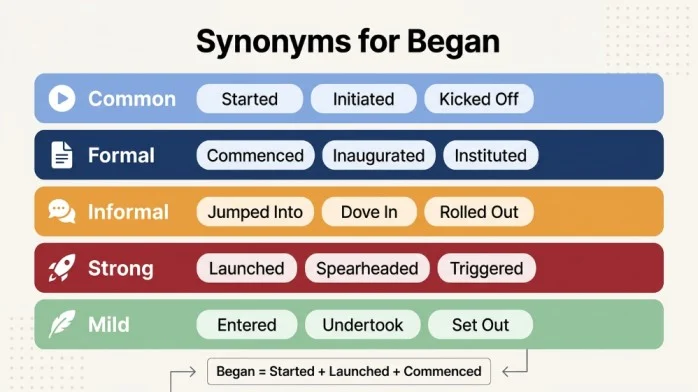
Finding the right word can completely change how a sentence feels. A simple word like “began” works well, but using different expressions can make your writing more vivid, polished, and engaging for any audience.
Many people search for synonyms for began when writing essays, emails, stories, or professional content. Choosing the best alternative helps avoid repetition, strengthens your message, and adds variety without changing the original meaning.
This guide explores the most useful synonyms for began, explains when each one fits best, and includes clear meanings and practical examples. As you explore the collection, you’ll discover natural word choices that make every sentence sound more confident and expressive.
Best Synonyms for Began
The best synonyms for began are started, commenced, initiated, launched, and embarked. The right choice depends on the tone, context, and intensity. For everyday conversation, started or got going often fits best. In formal writing, commenced or initiated may be more accurate. For creative writing, embarked or set out adds variety and depth.
What Does Began Mean?
Began means the past tense of begin. It indicates that something started or came into existence at a particular point in time.
It is used to describe the first stage of an action, event, process, or period.
Part of Speech: Verb (past tense of begin)
Common Uses:
As a verb describing the start of something:
The concert began at eight o’clock.
She began her career as a teacher.
As a verb describing the start of an action:
He began writing the report yesterday.
They began their journey early in the morning.
In everyday English, the word frequently appears when discussing timelines, events, projects, and personal experiences. It is one of the most common verbs in the English language.
Core Meaning of Began
At its heart, began represents the point at which something starts.
Sometimes the beginning is gradual, like a slow process unfolding over time. In other situations, the beginning is sudden and clear, such as a race starting or a speech beginning.
The word usually carries a neutral meaning. However, depending on the context, it can suggest excitement, formality, reluctance, or determination. That is why selecting the correct synonym matters. Some alternatives emphasize a formal start, while others highlight a bold or enthusiastic beginning.
Grammar and Usage Notes
Part of Speech: Verb (past tense)
Common Sentence Patterns:
- began + noun: She began her presentation.
- began + to + verb: He began to understand the problem.
- began + verb-ing: They began working on the project.
Common Collocations:
- began his career
- began her journey
- began the process
- began to realize
- began working
- began speaking
- began writing
- began the day
- began the meeting
- began the project
When “Began” Sounds Natural:
Use began when describing the start of something in a neutral or straightforward way. Examples include:
- Historical events
- Personal experiences
- Business projects
- Academic work
- Daily routines
- Conversations
- Journeys and travel
When Another Word Works Better:
Sometimes a synonym sounds more precise.
- Commenced fits formal writing and official contexts.
- Initiated works when someone takes deliberate action to begin something.
- Launched suggests a bold or ambitious start.
- Started is best for everyday conversation.
- Embarked adds a sense of journey or adventure.
Matching the synonym to the situation makes your writing clearer and more natural.
Best Synonyms for Began
| Synonym | Meaning | Tone | Best Use Case | Example Sentence |
|---|---|---|---|---|
| Started | Past tense of start | Neutral | Everyday writing, conversation | She started her new job last week. |
| Commenced | Formally began | Formal | Official events, ceremonies | The ceremony commenced at noon. |
| Initiated | Deliberately began | Formal | Projects, policies, processes | He initiated the new training program. |
| Launched | Boldly began | Positive | Products, campaigns, careers | They launched their business in 2015. |
| Embarked | Began a journey or project | Literary | Travel, adventures, new phases | She embarked on a new career path. |
| Set out | Began with a purpose | Neutral to literary | Journeys, goals, plans | They set out on their journey at dawn. |
| Got going | Started moving or acting | Casual | Everyday conversation | We got going early in the morning. |
| Kicked off | Started with energy | Casual | Events, campaigns | The festival kicked off with a parade. |
| Originated | Came into existence | Formal | History, ideas, traditions | The tradition originated in ancient times. |
| Established | Began and set up | Formal | Organizations, rules | They established the company in 1998. |
Common Synonyms for Began
These are the alternatives most people use in everyday English. While they all relate to beginning, each has a slightly different meaning.
Started
Meaning: Past tense of start; began to happen or do something.
Best Context: General writing, conversation, everyday situations.
Example:
He started his new job on Monday.
Commenced
Meaning: Formally began.
Best Context: Official events, ceremonies, formal writing.
Example:
The meeting commenced with a welcome speech.
Initiated
Meaning: Deliberately caused something to begin.
Best Context: Projects, policies, processes, formal contexts.
Example:
The manager initiated the new safety protocol.
Launched
Meaning: Began something with energy or ambition.
Best Context: Products, campaigns, careers, bold beginnings.
Example:
The company launched its new product line.
Embarked
Meaning: Began a journey, project, or new phase.
Best Context: Travel, adventures, significant life changes.
Example:
She embarked on a new chapter in her life.
Set Out
Meaning: Began a journey or task with a clear purpose.
Best Context: Travel, goals, plans, adventures.
Example:
They set out to explore the unknown territory.
Formal Synonyms for Began
Formal alternatives are useful in academic papers, business communication, legal documents, reports, speeches, and professional writing. These words often sound more precise than began and fit serious contexts.
Commenced
Best for: Official events, ceremonies, formal writing
Commenced means to formally begin. It is often used in legal, academic, and official contexts where a formal tone is appropriate.
Example:
The court proceedings commenced at nine in the morning.
The conference commenced with an opening address.
Initiated
Best for: Policies, projects, processes, formal decisions
Initiated means to deliberately cause something to begin. It suggests that someone took active steps to start something.
Example:
The board initiated a review of company policies.
She initiated the new research project.
Originated
Best for: History, traditions, ideas, cultural contexts
Originated means to come into existence or begin in a particular place or way.
Example:
The tradition originated in ancient Greece.
The theory originated from earlier research.
Established
Best for: Organizations, rules, systems, institutions
Established means to set up or begin something that continues over time.
Example:
They established the foundation in 1985.
The rules were established to ensure fairness.
Launched
Best for: Professional contexts, products, campaigns
Launched has a positive, ambitious tone. It works well in business and marketing contexts.
Example:
The organization launched a new sustainability initiative.
She launched her own consulting firm.
Informal Synonyms for Began
Casual writing and everyday conversation often call for simpler words. These alternatives sound natural without being overly formal.
Started
Tone: Friendly and conversational
Started is the most common everyday replacement for began.
Example:
We started the project last month.
She started learning Spanish.
Got Going
Tone: Casual and encouraging
Got going suggests beginning with energy or after a delay.
Example:
We finally got going after the rain stopped.
He got going on his homework early.
Kicked Off
Tone: Energetic and casual
Kicked off suggests beginning with excitement or enthusiasm.
Example:
The party kicked off at eight o’clock.
The campaign kicked off with a rally.
Set Out
Tone: Neutral to casual
Set out suggests beginning with a clear purpose.
Example:
We set out for the beach at sunrise.
He set out to fix the problem himself.
Took Off
Tone: Informal and energetic
Took off suggests starting with speed or success.
Example:
The project really took off after the initial meeting.
His career took off after that performance.
Strong Synonyms for Began
Some alternatives express greater significance, boldness, or emotional weight. These words should be used carefully because they create a stronger impact.
Launched
Best Use: Ambitious beginnings, products, careers, initiatives
Launched suggests a bold, intentional start with energy and purpose.
Example:
She launched her campaign with great enthusiasm.
The company launched a major new product.
Embarked
Best Use: Journeys, adventures, major life changes
Embarked suggests beginning a significant or risky endeavor.
Example:
He embarked on a new career path with courage.
The explorers embarked on a dangerous journey.
Originated
Best Use: Historical or cultural beginnings
Originated suggests a beginning that continues to have importance.
Example:
The tradition originated over a thousand years ago.
When Strong Synonyms May Be Too Much:
Words like launched, embarked, and originated can make ordinary beginnings sound dramatic.
Example:
❌ I embarked on making breakfast.
✔ I started making breakfast.
Choose stronger alternatives only when the situation truly involves a significant beginning.
Mild Synonyms for Began
Sometimes softer wording makes your writing sound more balanced. Mild alternatives reduce emotional intensity while keeping the original meaning clear.
Started
Tone: Neutral and gentle
Started is the safest, most neutral choice for most situations.
Example:
We started working on the project.
Got Going
Tone: Casual and mild
Got going suggests beginning without drama.
Example:
Let’s get going on this task.
Set Out
Tone: Neutral to gentle
Set Out suggests beginning with a purpose but without drama.
Example:
They set out on their trip.
Began
Tone: Neutral
Began itself is neutral and appropriate for most situations.
Example:
She began her speech.
Why Mild Synonyms Matter:
Not every beginning is dramatic or significant. If the start is ordinary or expected, a softer synonym often sounds more natural.
Compare these examples:
❌ She launched her presentation.
✔ She started her presentation.
Synonyms for Began by Context
Different situations call for different word choices. The best synonym depends on what kind of beginning you are describing.
Everyday Conversation
For casual speech, choose words that sound simple and familiar.
Recommended synonyms:
- Started
- Got going
- Kicked off
- Set out
Example:
We started the meeting at nine.
Professional Writing
Business communication benefits from precise and neutral language.
Recommended synonyms:
- Commenced
- Initiated
- Launched
- Established
Example:
The company launched its new product line.
Academic Writing
Academic writing values clarity and precision.
Recommended synonyms:
- Commenced
- Initiated
- Originated
- Established
Example:
The research project commenced in 2020.
Historical Writing
Historical writing often requires formal vocabulary.
Recommended synonyms:
- Originated
- Established
- Commenced
Example:
The civilization originated in the river valley.
Creative Writing
Stories often require variety and emotional depth.
Recommended synonyms:
- Embarked
- Set out
- Launched
- Started
Example:
He embarked on his adventure with hope.
Travel Writing
Travel writing benefits from vivid, adventurous vocabulary.
Recommended synonyms:
- Embarked
- Set out
- Started
Example:
We set out on our journey at sunrise.
Personal Communication
Friendly messages usually sound best with natural, everyday vocabulary.
Recommended synonyms:
- Started
- Got going
Example:
I started my new hobby this weekend.
Another Word for Began in a Sentence
These examples show how different synonyms fit naturally into real writing.
- The meeting commenced with a brief introduction.
- She started her new job last Monday.
- The company launched its new product line in June.
- He initiated the project without hesitation.
- They embarked on their journey at dawn.
- The tradition originated in ancient times.
- We set out on our hike early in the morning.
- The festival kicked off with a parade.
- She established her business in 2010.
- The concert started promptly at eight.
- He commenced his speech with a joke.
- We got going after the rain stopped.
- The campaign launched with great enthusiasm.
- They initiated the new policy last year.
- She embarked on her new career with excitement.
Began Synonyms Compared
| Synonym | Meaning | Tone | Intensity | Best Use |
|---|---|---|---|---|
| Started | Past tense of start | Neutral | Low | Everyday writing |
| Commenced | Formally began | Formal | Medium | Official events |
| Initiated | Deliberately began | Formal | Medium | Projects, policies |
| Launched | Boldly began | Positive | High | Products, careers |
| Embarked | Began a journey | Literary | High | Travel, adventures |
| Set out | Began with purpose | Neutral | Medium | Journeys, goals |
| Got going | Started moving | Casual | Low | Everyday conversation |
| Kicked off | Started with energy | Casual | Medium | Events, campaigns |
| Originated | Came into existence | Formal | High | History, traditions |
| Established | Began and set up | Formal | High | Organizations, rules |
Words Similar to Began
Some words belong to the same semantic field as began, but they are not exact synonyms. They share related ideas such as starting, creating, or introducing, yet they cannot replace began in every sentence.
| Related Word | Why It’s Related | Why It’s Not an Exact Synonym |
|---|---|---|
| Created | Brought something into existence | Focuses on making, not just starting |
| Founded | Established something | Usually used for organizations or institutions |
| Introduced | Brought something into use | Often about new ideas or concepts |
| Opened | Began or made accessible | Often used for physical or formal starts |
| Triggered | Caused something to start | Suggests a sudden or accidental start |
| Instigated | Caused something to begin | Often has negative connotations |
| Pioneered | Began something new | Implies being the first to do something |
| Sparked | Caused a sudden start | Suggests a sudden or intense beginning |
These words enrich your vocabulary, but always check whether they preserve the original meaning of your sentence before replacing began.
Antonyms of Began
Antonyms describe ideas that oppose starting something.
| Antonym | Meaning | Example Sentence |
|---|---|---|
| Ended | Came to a finish | The concert ended at midnight. |
| Finished | Completed | She finished her work early. |
| Stopped | Ceased to continue | The rain stopped suddenly. |
| Concluded | Brought to an end | He concluded his presentation. |
| Ceased | Came to an end | The noise ceased after midnight. |
| Halted | Came to a stop | The project halted unexpectedly. |
Understanding antonyms can also improve your writing because they help you choose words that clearly express the opposite idea when needed.
How to Choose the Right Synonym for Began
Not every synonym fits every situation. The best choice depends on what you’re trying to communicate.
Match the Context
Think about where the sentence will appear.
- Academic writing often works better with commenced, initiated, or originated.
- Everyday conversation usually sounds more natural with started or got going.
- Creative writing often benefits from embarked or set out.
- Business writing often requires launched or established.
Match the Tone
Choose a word that matches the emotional style of your writing.
For example:
- Started sounds neutral.
- Launched sounds energetic.
- Commenced sounds formal.
- Embarked sounds adventurous.
- Initiated sounds deliberate.
Check the Intensity
Ask yourself how significant the beginning really is.
- Starting a small task needs mild words like started.
- Starting a major project needs stronger words like launched or initiated.
- Starting a journey needs adventurous words like embarked or set out.
Think About the Reader
- Business readers often expect clear and precise language.
- Academic readers expect formal vocabulary like commenced or initiated.
- Friends and family usually respond better to simple, familiar vocabulary.
Make Sure the Meaning Matches
Some related words describe specific types of beginnings, not general ones.
For example:
- “She launched her new business.” ✔
- “She launched her homework.” ✘
Although both involve starting, the meanings are different.
Keep the Sentence Natural
Always read the sentence aloud.
If the replacement sounds forced or overly dramatic, choose a simpler synonym.
Common Mistakes When Using Synonyms for Began
Even experienced writers sometimes choose the wrong alternative. Avoid these common errors.
Using a Word That Is Too Strong
Not every beginning is a launch or an embarkation.
❌ I embarked on my morning coffee.
✔ I started my morning coffee.
Using Formal Language in Casual Writing
Formal words can make simple sentences sound unnatural.
❌ We commenced dinner at six.
✔ We started dinner at six.
Using Casual Language in Professional Writing
Business documents usually require more precise vocabulary.
❌ The project got going last month.
✔ The project commenced last month.
Treating Related Words as Exact Synonyms
Words such as created, founded, and introduced are related to began but cannot replace it in every sentence.
Always consider the exact meaning before making a substitution.
Ignoring Context
A synonym that works in one sentence may sound awkward in another.
Compare these examples:
✔ The company launched its new product.
✔ She started her new job.
Although both involve beginning, the meanings are different.
Using Began for Different Time Frames
Began is past tense. For present or future, use begin or will begin instead of trying to use synonyms for began.
Quick Synonym List for Began
Common Synonyms
- Started
- Commenced
- Initiated
- Launched
- Set out
Formal Synonyms
- Commenced
- Initiated
- Originated
- Established
- Launched
Informal Synonyms
- Started
- Got going
- Kicked off
- Set out
- Took off
Strong Synonyms
- Launched
- Embarked
- Originated
- Initiated
- Established
Mild Synonyms
- Started
- Got going
- Set out
Related Words
- Created
- Founded
- Introduced
- Opened
- Triggered
FAQs
What is the best synonym for began?
The best synonym depends on context. Started, commenced, initiated, and launched are among the most accurate choices for different situations.
What is another word for began in a formal document?
Commenced, initiated, originated, and established are excellent formal alternatives commonly used in academic, legal, and professional writing.
What is an informal synonym for began?
For everyday conversation, started, got going, kicked off, and set out are the most natural choices.
What is a stronger word for began?
Launched, embarked, originated, and initiated express greater intensity and should be reserved for significant beginnings.
What is a milder word for began?
Started and got going provide softer alternatives that work well when the beginning is minor or ordinary.
What words are similar to began but not exact synonyms?
Related words include created, founded, introduced, opened, and triggered. These words are connected in meaning but are not always direct replacements.
What is the opposite of began?
Common antonyms include ended, finished, stopped, concluded, ceased, and halted.
Conclusion
Learning the best synonyms for began helps you write with greater clarity and precision. While words like started, commenced, initiated, launched, and embarked all relate to beginning, each carries its own tone, level of formality, and emotional weight.
Before replacing began, think about your audience, the context, and the intensity of the situation. A carefully chosen synonym can make your writing sound more natural, persuasive, and accurate. you’re writing an essay, a business report, a creative story, or everyday messages, selecting the right word will help your ideas connect more effectively with readers.
Read More Related Articles:
Synonyms for Supported | Meaning, Examples, and Better …
Synonyms for Supported | Meaning, Examples, and Better …











4 thoughts on “Synonyms for Began |Best Alternatives for Every Writing Style”