A simple word like go appears in conversations, emails, stories, and professional writing every single day. Yet using the same word repeatedly can make even well-written sentences feel flat. That’s why many writers, students, and professionals search for synonyms for go when they want their message to sound more natural, precise, or engaging. Choosing the right alternative can instantly change the tone, whether you’re describing movement, progress, departure, or taking action.
Finding the best synonyms for go is about more than expanding your vocabulary. The right word helps your ideas flow better, strengthens your writing, and makes your communication clearer in every situation. Some alternatives work perfectly in formal documents, while others fit casual conversations or creative storytelling. The collection below explores carefully selected synonyms, explains their meanings, and includes practical examples so you can confidently choose the word that matches your exact context.
Best Synonyms for Go
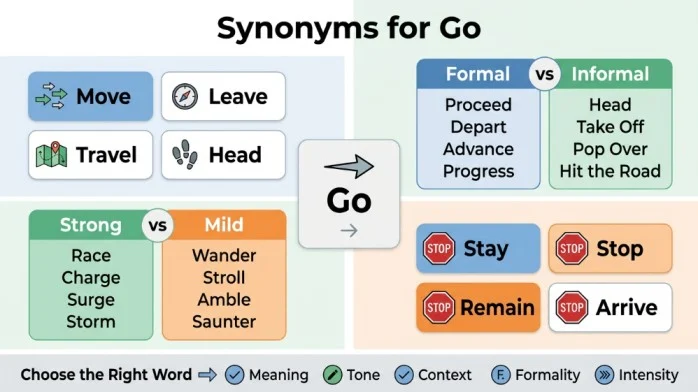
The best synonyms for go are move, proceed, travel, leave, depart, advance, and progress. The right choice depends on the tone, context, and intensity. For formal writing, proceed or depart often fits best. In casual conversation, head, take off, or pop over may be more natural.
What Does Go Mean?
Go means to move from one place to another, to proceed toward a destination, or to take action toward achieving something.
It can also mean to function, to continue, to leave, or to engage in an activity.
Part of Speech
Verb
Noun
Common Uses
As a verb:
- She will go to the store later.
- The train goes to the city center.
- Everything seems to go well.
As a noun:
- He had a go at solving the puzzle.
- It’s your turn—give it a go.
In everyday English, the word frequently expresses movement, action, direction, effort, or continuation.
Core Meaning of Go
At its heart, go represents movement, action, or change from one state to another.
Sometimes the movement is physical, such as walking to a destination. In other situations, it may involve progress, decision-making, or even functioning properly.
The word usually carries a neutral or positive meaning depending on context. However, it can also describe leaving, disappearing, or ceasing to function.
That versatility is why selecting the correct synonym matters. Some alternatives emphasize movement, while others highlight departure, progress, or action.
Grammar and Usage Notes
Part of Speech
Verb
Noun
Common Sentence Patterns
- go to somewhere
- go from somewhere
- go for something
- go on doing something
- go through something
- go with someone
- go for a walk
- go to work
Common Collocations
- go ahead
- go back
- go forward
- go away
- go out
- go up
- go down
- go through
- go over
- go on
When “Go” Sounds Natural
Use go when someone moves, proceeds, or takes action in a general or neutral way.
Examples include:
- Daily commuting
- Travel plans
- Starting activities
- Giving directions
- Describing progress
- Expressing intention
When Another Word Works Better
Sometimes a synonym sounds more precise.
Proceed fits formal writing.
Depart works when leaving is emphasized.
Travel highlights journey rather than movement.
Move suggests changing position or location.
Advance focuses on forward progress.
Head is better for casual conversation.
Matching the synonym to the situation makes your writing clearer and more natural.
Best Synonyms for Go
| Synonym | Meaning | Tone | Best Use Case | Example Sentence |
|---|---|---|---|---|
| Move | Change position or location | Neutral | Everyday movement | She moved to a new city for work. |
| Proceed | Continue forward | Formal | Professional writing | Please proceed to the next section. |
| Travel | Journey to a destination | Neutral | Trips and journeys | They travel to Europe every summer. |
| Leave | Go away from a place | Neutral | Departure situations | He left the office at 5 PM. |
| Depart | Leave, especially on a journey | Formal | Travel and transport | The flight departs at noon. |
| Advance | Move forward or progress | Formal | Career, military, progress | She advanced in her career quickly. |
| Head | Move in a direction | Casual | Everyday conversation | Let’s head to the beach. |
| Proceed | Continue after a pause | Formal | Instructions, procedures | Proceed with caution. |
| Progress | Move forward gradually | Neutral | Development, improvement | The project is progressing well. |
| Venture | Go somewhere risky | Literary | Adventure, exploration | They ventured into the unknown. |
Common Synonyms for Go
These are the alternatives most people use in everyday English. While they all relate to going or moving, each has a slightly different meaning.
Move
Meaning: Change position or location.
Best Context: Physical movement, relocation.
Example:
She moved to a new apartment downtown.
Proceed
Meaning: Continue forward, especially after stopping.
Best Context: Formal instructions, professional writing.
Example:
Please proceed to the checkout counter.
Travel
Meaning: Journey to a destination.
Best Context: Trips, vacations, exploration.
Example:
He travels frequently for his job.
Leave
Meaning: Go away from a person or place.
Best Context: Departure, separation.
Example:
They left the party early.
Depart
Meaning: Leave, especially on a journey.
Best Context: Travel, transport, formal announcements.
Example:
The bus departs from the station every hour.
Advance
Meaning: Move forward or make progress.
Best Context: Career, military, technology, ideas.
Example:
Science continues to advance every year.
Head
Meaning: Move in a specified direction.
Best Context: Casual conversation, directions.
Example:
Let’s head toward the mountains.
Progress
Meaning: Move forward gradually.
Best Context: Development, learning, growth.
Example:
The students are progressing well with their studies.
Formal Synonyms for Go
Formal alternatives are useful in academic papers, business communication, legal documents, reports, speeches, and professional writing. These words often sound more precise than go and fit serious contexts.
Proceed
Best for: Instructions, procedures, formal writing
Proceed means to continue forward, especially after a pause or interruption.
Example:
Proceed to the next stage of the application process.
The committee proceeded with the investigation.
Depart
Best for: Travel, transport, formal announcements
Depart means to leave, especially on a journey.
Example:
The train departs from platform three.
She departed for London this morning.
Advance
Best for: Career, military, progress, formal contexts
Advance means to move forward or make progress.
Example:
The troops advanced toward the border.
She advanced to the position of director.
Progress
Best for: Development, academic, professional growth
Progress means moving forward gradually.
Example:
The construction project is progressing on schedule.
He progressed through the ranks quickly.
Venture
Best for: Exploration, adventure, business risks
Venture means to go somewhere dangerous or unknown.
Example:
The explorers ventured into the jungle.
He ventured into a new business field.
Informal Synonyms for Go
Casual writing and everyday conversation often call for simpler words. These alternatives sound natural without being overly formal.
Head
Tone: Friendly and conversational
Head means to move in a particular direction.
Example:
Let’s head to the park.
We’re heading home now.
Take Off
Tone: Casual and lively
Take off means to leave quickly.
Example:
We took off before sunrise.
She took off without saying goodbye.
Pop Over
Tone: Very casual and friendly
Pop over means to visit briefly.
Example:
I’ll pop over to your place later.
She popped over for a quick chat.
Drop By
Tone: Relaxed and informal
Drop by means to visit without planning.
Example:
Feel free to drop by anytime.
They dropped by to say hello.
Scram
Tone: Very informal, slang
Scram means to leave quickly.
Example:
We need to scram before they arrive.
The kids scrambled out of the room.
Hit the Road
Tone: Informal, idiomatic
Hit the road means to begin a journey.
Example:
Let’s hit the road before traffic gets bad.
We hit the road at dawn.
Strong Synonyms for Go
Some alternatives express greater urgency, determination, or intensity. These words should be used carefully because they create a stronger impact.
Surge
Surge suggests moving forward suddenly and powerfully.
Best Use:
- Emotional writing
- Crowds or forces
- Powerful movements
Example:
The crowd surged forward toward the stage.
Race
Race implies moving quickly or competing.
Example:
He raced to catch the last train.
She raced through the project.
Charge
Charge suggests moving aggressively or energetically.
Example:
The soldiers charged toward the enemy.
She charged through her work.
Rush
Rush means moving quickly because of urgency.
Example:
They rushed to the hospital.
She rushed through her speech.
Accelerate
Accelerate means to move faster.
Example:
The car accelerated down the highway.
The company accelerated its growth strategy.
Storm
Storm means to move forcefully and aggressively.
Example:
He stormed out of the meeting.
The protesters stormed the building.
When Strong Synonyms May Be Too Much
Words like storm, surge, and charge can make ordinary situations sound dramatic.
For example:
❌ She stormed into the grocery store.
✔ She walked into the grocery store.
Choose stronger alternatives only when the situation truly involves urgency, intensity, or strong emotion.
Mild Synonyms for Go
Sometimes softer wording makes your writing sound more balanced. Mild alternatives reduce intensity while keeping the original meaning clear.
Wander
Wander means walking without a specific purpose.
Example:
He wandered through the old town.
She wandered around the park.
Stroll
Stroll means walking slowly and casually.
Example:
They strolled along the beach.
She strolled through the market.
Mosey
Mosey means moving slowly and lazily.
Example:
We moseyed down the street.
He moseyed over to the cafe.
Saunter
Saunter means walking in a relaxed way.
Example:
She sauntered through the garden.
He sauntered into the room.
Amble
Amble means walking at a gentle, easy pace.
Example:
They ambled through the countryside.
We ambled toward the picnic area.
Cruise
Cruise means moving smoothly at a steady speed.
Example:
The car cruised along the highway.
She cruised through her exam.
Why Mild Synonyms Matter
Not every movement involves urgency or speed. If the action is relaxed or unhurried, softer synonyms often sound more appropriate.
Compare these examples:
She went down the street. (neutral)
She strolled down the street. (more relaxed and descriptive)
Synonyms for Go by Context
Different situations call for different word choices. The best synonym depends on what is being described.
Everyday Conversation
For casual speech, choose words that sound simple and familiar.
Recommended synonyms:
- Head
- Move
- Leave
- Pop over
- Drop by
Example:
I’ll head home after work.
Professional Writing
Business communication benefits from precise and neutral language.
Recommended synonyms:
- Proceed
- Advance
- Progress
- Depart
Example:
Please proceed with the next phase of the project.
Academic Writing
Academic writing values clarity and precision.
Recommended synonyms:
- Proceed
- Advance
- Progress
- Travel
Example:
The research progressed steadily over several years.
Creative Writing
Stories often require descriptive alternatives. Stronger alternatives help create vivid imagery.
Recommended synonyms:
- Wander
- Stroll
- Race
- Surge
- Venture
Example:
The adventurer ventured deep into the forest.
Travel Writing
Travel content benefits from engaging vocabulary.
Recommended synonyms:
- Travel
- Journey
- Explore
- Wander
- Cruise
Example:
They journeyed across the continent.
Giving Directions
Directions should be clear and easy to follow.
Recommended synonyms:
- Head
- Move
- Continue
- Proceed
Example:
Head straight for two blocks, then turn left.
Another Word for Go in a Sentence
These examples show how different synonyms fit naturally into real writing.
She moved to a new city for her career.
The team proceeded with the plan despite the challenges.
They traveled across Europe for three months.
He left the office early to avoid traffic.
The flight departs from terminal two.
She advanced quickly in her profession.
Let’s head toward the coast this weekend.
The project is progressing smoothly.
They wandered through the ancient streets.
He strolled along the beach at sunset.
The car raced down the highway.
We ventured into unknown territory.
She ambled through the botanical gardens.
The crowd surged toward the stage.
He stormed out of the building.
Go Synonyms Compared
| Synonym | Meaning | Tone | Intensity | Best Use |
|---|---|---|---|---|
| Go | General movement | Neutral | Low | Everyday use |
| Move | Change position | Neutral | Low | Physical movement |
| Proceed | Continue forward | Formal | Medium | Professional writing |
| Travel | Journey somewhere | Neutral | Medium | Trips and vacations |
| Leave | Go away | Neutral | Low | Departure |
| Depart | Leave formally | Formal | Medium | Travel, transport |
| Advance | Move forward | Formal | Medium | Career, progress |
| Head | Move in direction | Casual | Low | Everyday talk |
| Progress | Develop gradually | Neutral | Low | Growth, improvement |
| Wander | Walk aimlessly | Relaxed | Low | Casual movement |
| Stroll | Walk casually | Relaxed | Low | Relaxed outings |
| Race | Move quickly | Intense | High | Urgent situations |
| Surge | Move powerfully | Strong | High | Crowds, forces |
| Venture | Go boldly | Literary | Medium | Adventure |
Words Similar to Go
Some words belong to the same semantic field as go, but they are not exact synonyms. They share related ideas such as movement, action, or departure, yet they cannot replace go in every sentence.
| Related Word | Why It’s Related | Why It’s Not an Exact Synonym |
|---|---|---|
| Walk | Form of movement | Describes specific pace, not all forms of going |
| Run | Fast movement | Focuses on speed, not general movement |
| Drive | Vehicle movement | Specific to vehicles |
| Fly | Air travel | Specific to aircraft |
| Sail | Sea travel | Specific to ships |
| Journey | Travel experience | Emphasizes the experience, not just movement |
| Navigate | Finding direction | Focuses on guidance |
| Explore | Discovery-focused travel | Emphasizes discovering new places |
These words enrich your vocabulary, but always check whether they preserve the original meaning of your sentence before replacing go.
Antonyms of Go
Antonyms describe ideas that oppose movement, progression, or departure.
| Antonym | Meaning | Example Sentence |
|---|---|---|
| Stay | Remain in place | She decided to stay home. |
| Stop | Cease moving | The car stopped at the red light. |
| Remain | Continue to be in a place | They remained at the hotel. |
| Wait | Stay in place | Please wait for me. |
| Pause | Stop temporarily | She paused to catch her breath. |
| Halt | Stop moving | The march came to a halt. |
| Arrive | Reach a destination | They arrived at noon. |
| Return | Come back | He returned home safely. |
Understanding antonyms can also improve your writing because they help you choose words that clearly express the opposite idea when needed.
How to Choose the Right Synonym for Go
Not every synonym fits every situation. The best choice depends on what you’re trying to communicate.
Match the Context
Think about where the sentence will appear.
- Academic writing often works better with proceed, advance, or progress.
- Everyday conversation usually sounds more natural with head, move, or leave.
- Travel writing often benefits from travel, journey, or wander.
- Professional contexts suit proceed, depart, or advance.
Match the Tone
Choose a word that matches the emotional style of your writing.
For example:
- Head sounds relaxed and friendly.
- Proceed sounds formal and professional.
- Race sounds urgent and intense.
- Stroll sounds calm and unhurried.
Check the Intensity
Ask yourself how significant the movement or action really is.
- Going to the store is different from racing to an emergency.
- Stronger words should be reserved for meaningful situations.
Think About the Reader
- Business readers often expect clear and precise language.
- Friends and family usually respond better to simple, familiar vocabulary.
Make Sure the Meaning Matches
Some related words describe specific types of movement rather than general going.
For example:
“She walked to work.” ✔ (specific pace)
“She went to work.” ✔ (general movement)
Although both words describe movement, they express different levels of detail.
Keep the Sentence Natural
Always read the sentence aloud.
If the replacement sounds forced or overly dramatic, choose a simpler synonym.
Common Mistakes When Using Synonyms for Go
Even experienced writers sometimes choose the wrong alternative. Avoid these common errors.
Using a Word That Is Too Formal
Not every situation requires formal language.
❌ I shall proceed to the grocery store.
✔ I will go to the grocery store.
Using Casual Language in Professional Writing
Business documents usually require more precise vocabulary.
❌ We need to head toward the next phase.
✔ We need to proceed toward the next phase.
Ignoring Context
A synonym that works in one sentence may sound awkward in another.
Compare these examples:
✔ The train departed at noon.
✔ She wandered through the garden.
Although both involve movement, the meanings are different.
Treating Related Words as Exact Synonyms
Words such as walk, run, and drive are related to go but cannot replace it in every sentence.
Always consider the exact meaning before making a substitution.
Forgetting the Emotional Weight
Go often carries a neutral tone. Replacing it with a stronger word may add unnecessary intensity.
Quick Synonym List for Go
Common Synonyms
- Move
- Leave
- Travel
- Head
- Proceed
- Progress
Formal Synonyms
- Proceed
- Depart
- Advance
- Progress
- Venture
Informal Synonyms
- Head
- Take off
- Pop over
- Drop by
- Hit the road
- Scram
Strong Synonyms
- Race
- Charge
- Surge
- Storm
- Rush
Mild Synonyms
- Wander
- Stroll
- Amble
- Saunter
- Mosey
Travel-Specific Synonyms
- Journey
- Tour
- Explore
- Cruise
- Trek
- Voyage
FAQs
What is the best synonym for go?
The best synonym depends on context. Move, proceed, travel, leave, and head are among the most accurate choices for different situations.
What is another word for go?
Another word for go could be move, proceed, travel, depart, advance, or head, depending on the meaning you want to express.
What is a formal synonym for go?
Proceed, depart, advance, and progress are excellent formal alternatives commonly used in academic, legal, and professional writing.
What is an informal synonym for go?
For everyday conversation, head, take off, pop over, and hit the road are the most natural choices.
What is a stronger word for go?
Race, charge, surge, and storm express greater intensity and should be reserved for urgent or dramatic situations.
What is a milder word for go?
Wander, stroll, amble, and saunter provide softer alternatives that work well when the movement is relaxed.
What words are similar to go?
Related words include move, travel, journey, walk, run, drive, and navigate. These words are connected in meaning but are not always direct replacements.
What is the opposite of go?
Common antonyms include stay, stop, remain, wait, pause, halt, and arrive.
Conclusion
Learning the best synonyms for go helps you write with greater clarity and precision. While words like move, proceed, leave, depart, advance, and travel all relate to going, each carries its own tone, level of formality, and emotional weight.
Before replacing go, think about your audience, the context, and the intensity of the situation. A carefully chosen synonym can make your writing sound more natural, persuasive, and accurate. Whether you’re writing an essay, a business report, a speech, or everyday messages, selecting the right word will help your ideas connect more effectively with readers.
Read More Related Articles:
Synonyms for Regret | Meaning, Examples, and Better Word …
Synonyms for Context | Meaning, Examples, and Better Word …