Choosing the right word can completely change how a sentence sounds. A simple term like false may work in some situations, but in others, words such as incorrect, fake, untrue, or deceptive express the meaning more clearly. That is why many writers, students, and professionals search for synonyms for false when they want their message to be accurate, natural, and engaging.
Understanding synonyms for false does more than expand your vocabulary it helps you match the right word to the right context. you’re writing an essay, editing a report, or creating online content, selecting a precise alternative improves clarity and impact. The sections ahead explore the best synonym choices, their meanings, practical examples, and when each one works best.
Best Synonyms for False
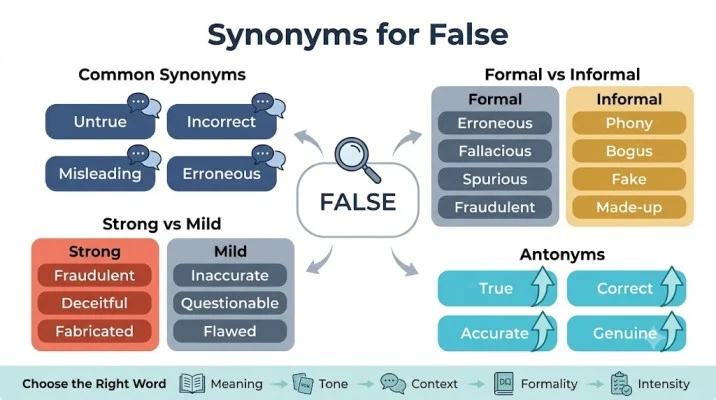
The best synonyms for false are incorrect, untrue, inaccurate, erroneous, misleading, and deceptive. The right choice depends on the tone, context, and intensity. For factual errors, incorrect or inaccurate often fits best. In formal writing, erroneous or fallacious may be more appropriate. For deliberate deception, deceptive or fraudulent are stronger choices.
What Does False Mean?
False means not true, not correct, or not genuine. It can describe statements, information, appearances, actions, or people.
It usually involves a lack of truthfulness, accuracy, or authenticity. False can be unintentional (like a mistake) or deliberate (like a lie).
Part of Speech: Adjective
Common Uses:
As an adjective describing statements:
His claim was completely false.
The report contained false information.
As an adjective describing appearances:
She gave a false impression of confidence.
The painting turned out to be false.
As an adjective describing actions:
He made a false accusation against his colleague.
The company used false advertising.
In everyday English, the word frequently appears in legal, academic, professional, and personal contexts. It is often used when discussing facts, evidence, claims, appearances, and honesty.
Core Meaning of False
At its heart, false represents a deviation from truth, accuracy, or authenticity.
Sometimes the falseness is unintentional, such as an honest mistake or a misunderstanding. In other situations, it may be deliberate, such as a lie, deception, or fraud.
The word usually carries a negative meaning because it suggests dishonesty, error, or inauthenticity. However, depending on the context, it can range from a simple factual mistake to a serious deception. That deeper meaning is why selecting the correct synonym matters. Some alternatives emphasize factual error, while others highlight deliberate dishonesty or misleading appearances.
Grammar and Usage Notes
Part of Speech: Adjective
Common Sentence Patterns:
- false + noun: false claim, false statement, false information
- be + false: The accusation was false.
- prove + false: The theory proved false.
- false + preposition: false to someone, false about something
Common Collocations:
- false claim
- false statement
- false information
- false impression
- false accusation
- false assumption
- false belief
- false positive
- false alarm
- false identity
- false advertising
- false hope
When “False” Sounds Natural:
Use false when describing something that is not true, correct, or genuine. Examples include:
- Legal and judicial contexts
- Academic and scientific writing
- News and journalism
- Personal relationships
- Advertising and marketing
- Identity and security
- Medical testing
When Another Word Works Better:
Sometimes a synonym sounds more precise.
- Incorrect works best for factual errors.
- Untrue fits statements that are not factual.
- Inaccurate works for imprecise information.
- Erroneous fits formal or technical errors.
- Misleading works for deceptive but not necessarily false information.
- Deceptive fits deliberate attempts to mislead.
Matching the synonym to the situation makes your writing clearer and more natural.
Best Synonyms for False
| Synonym | Meaning | Tone | Best Use Case | Example Sentence |
|---|---|---|---|---|
| Incorrect | Not correct or accurate | Neutral | Factual errors | The answer was incorrect. |
| Untrue | Not in accordance with fact | Neutral | Statements, claims | His accusation was untrue. |
| Inaccurate | Not exact or precise | Neutral | Data, measurements | The report contained inaccurate figures. |
| Erroneous | Containing error | Formal | Academic, technical | The assumption was erroneous. |
| Misleading | Giving the wrong impression | Neutral | Advertising, explanations | The advertisement was misleading. |
| Deceptive | Intended to deceive | Serious | Deliberate dishonesty | The company used deceptive practices. |
| Fallacious | Based on false reasoning | Formal | Logic, arguments | The argument was fallacious. |
| Fraudulent | Intended to deceive for gain | Strong | Legal, financial | The transaction was fraudulent. |
| Fake | Not genuine | Casual | Products, people | The watch was fake. |
| Bogus | Not genuine or true | Informal | Claims, products | The evidence was bogus. |
Common Synonyms for False
These are the alternatives most people use in everyday English. While they all relate to falsehood, each has a slightly different meaning.
Incorrect
Meaning: Not correct or accurate.
Best Context: Factual errors, answers, data.
Example:
The answer you gave was incorrect.
Untrue
Meaning: Not in accordance with fact.
Best Context: Statements, claims, rumors.
Example:
The rumor about her departure was untrue.
Inaccurate
Meaning: Not exact or precise.
Best Context: Data, measurements, reports.
Example:
The weather forecast was inaccurate.
Wrong
Meaning: Not correct.
Best Context: Everyday conversation, answers, actions.
Example:
You have the wrong information.
Misleading
Meaning: Giving the wrong impression.
Best Context: Advertising, explanations, statements.
Example:
The advertisement was misleading.
Fake
Meaning: Not genuine.
Best Context: Products, people, documents.
Example:
The designer bag was fake.
Bogus
Meaning: Not genuine or true.
Best Context: Claims, products, evidence.
Example:
The evidence was completely bogus.
Formal Synonyms for False
Formal alternatives are useful in academic papers, business communication, legal documents, reports, speeches, and professional writing. These words often sound more precise than false and fit serious contexts.
Erroneous
Best for: Academic, technical, and formal writing
Erroneous means containing error or based on wrong information. It is commonly used in academic and professional contexts to describe mistakes in reasoning, data, or assumptions.
Example:
The researcher’s conclusion was based on erroneous data.
The erroneous belief persisted for decades.
Fallacious
Best for: Logic, arguments, and reasoning
Fallacious means based on false reasoning or a mistake in logic. It is often used in academic and philosophical writing.
Example:
The argument was fallacious and unconvincing.
His reasoning was fallacious from the start.
Fraudulent
Best for: Legal, financial, and serious writing
Fraudulent means intended to deceive, especially for financial or personal gain. It carries a strong negative tone.
Example:
The company engaged in fraudulent business practices.
He was charged with fraudulent activity.
Deceptive
Best for: Legal, professional, and serious contexts
Deceptive means intended to make someone believe something that is not true. It often involves deliberate misrepresentation.
Example:
The company used deceptive advertising techniques.
Her calm appearance was deceptive.
Spurious
Best for: Academic, scientific, and formal writing
Spurious means not genuine or true, often because of being based on false reasoning or incomplete evidence.
Example:
The study was based on spurious correlations.
His claim was spurious and unsupported.
Fictitious
Best for: Legal, creative, and formal writing
Fictitious means invented or not real. It is often used to describe false names, characters, or information.
Example:
He used a fictitious name to avoid detection.
The story was entirely fictitious.
Informal Synonyms for False
Casual writing and everyday conversation often call for simpler words. These alternatives sound natural without being overly formal.
Fake
Tone: Casual and conversational
Fake is the most common everyday replacement for false, especially for objects.
Example:
That designer bag is fake.
She gave a fake smile.
Bogus
Tone: Very casual and conversational
Bogus is a common informal word for false or fake.
Example:
The information he gave was completely bogus.
That’s a bogus excuse.
Wrong
Tone: Friendly and conversational
Wrong is a simple everyday word for incorrect.
Example:
You have the wrong address.
That answer is wrong.
Off
Tone: Casual and conversational
Off is a simple way to say something is not accurate or not quite right.
Example:
His calculations were off by a lot.
Something about this situation feels off.
Phony
Tone: Very casual and slightly dismissive
Phony means not genuine or pretending to be something else.
Example:
He’s a phony. I don’t trust him.
She gave a phony excuse.
Fishy
Tone: Very casual and suspicious
Fishy means suspicious or not quite right, often suggesting falsehood.
Example:
Something about his story seems fishy.
That explanation sounds fishy.
Strong Synonyms for False
Some alternatives express greater seriousness, deceit, or intensity. These words should be used carefully because they create a stronger impact.
Fraudulent
Best Use: Legal, financial, serious situations
Fraudulent suggests deliberate deception for gain, often with legal implications.
Example:
The fraudulent transaction was discovered by the bank.
Deceptive
Best Use: Serious situations involving deliberate misrepresentation
Deceptive suggests intentional misleading.
Example:
The deceptive marketing campaign misled thousands of customers.
Fallacious
Best Use: Academic arguments, reasoning
Fallacious suggests false reasoning or logic.
Example:
The fallacious argument collapsed under scrutiny.
Spurious
Best Use: Academic, scientific, formal writing
Spurious suggests false or fake, often with a sense of illegitimacy.
Example:
The spurious claim was quickly debunked.
Fabricated
Best Use: False information, lies, stories
Fabricated suggests deliberately invented falsehood.
Example:
The evidence was entirely fabricated.
Forged
Best Use: Documents, signatures, art
Forged suggests false copies or counterfeits.
Example:
The signature on the document was forged.
When Strong Synonyms May Be Too Much:
Words like fraudulent, fabricated, and forged can make ordinary situations sound extremely serious.
Example:
❌ The weather forecast was fraudulent.
✔ The weather forecast was inaccurate.
Choose stronger alternatives only when the situation truly involves deliberate deception or serious falsehood.
Mild Synonyms for False
Sometimes softer wording makes your writing sound more balanced. Mild alternatives reduce intensity while keeping the original meaning clear.
Incorrect
Tone: Neutral and factual
Incorrect is the safest, most neutral choice for most situations.
Example:
The answer was incorrect.
Inaccurate
Tone: Neutral and factual
Inaccurate suggests a lack of precision rather than deliberate falsehood.
Example:
The measurements were slightly inaccurate.
Wrong
Tone: Friendly and conversational
Wrong is a simple everyday word for false.
Example:
I was wrong about the date.
Untrue
Tone: Neutral
Untrue suggests not in accordance with fact.
Example:
The statement was untrue.
Misleading
Tone: Neutral to negative
Misleading suggests giving the wrong impression without necessarily being completely false.
Example:
The headline was slightly misleading.
Off
Tone: Casual and mild
Off is a gentle way to say something is not quite right.
Example:
The numbers are off by a small amount.
Why Mild Synonyms Matter:
Not every situation involves deliberate deception. If the falsehood is a simple mistake or minor error, a softer synonym often sounds more natural.
Compare these examples:
❌ The answer was fraudulent.
✔ The answer was incorrect.
Synonyms for False by Context
Different situations call for different word choices. The best synonym depends on what kind of falsehood you are describing.
Everyday Conversation
For casual speech, choose words that sound simple and familiar.
Recommended synonyms:
- Wrong
- Fake
- Off
- Bogus
Example:
That information is totally wrong.
Professional Writing
Business communication benefits from precise and neutral language.
Recommended synonyms:
- Incorrect
- Inaccurate
- Misleading
- False
Example:
The report contained inaccurate financial data.
Academic Writing
Academic writing values clarity and precision.
Recommended synonyms:
- Erroneous
- Fallacious
- Spurious
- Incorrect
Example:
The researcher’s conclusion was based on erroneous data.
Legal Writing
Legal writing requires precise and serious vocabulary.
Recommended synonyms:
- Fraudulent
- Deceptive
- False
- Fabricated
Example:
The court found the evidence to be fabricated.
Scientific Writing
Scientific writing values accuracy and neutrality.
Recommended synonyms:
- Inaccurate
- Erroneous
- Spurious
- Incorrect
Example:
The experimental results were inaccurate.
Journalism
Journalism requires clarity and fairness.
Recommended synonyms:
- Untrue
- Misleading
- False
- Inaccurate
Example:
The statement was found to be untrue.
Personal Relationships
Personal writing benefits from honest but gentle language.
Recommended synonyms:
- Untrue
- Wrong
- Misleading
- Fake
Example:
I was wrong about what happened.
Another Word for False in a Sentence
These examples show how different synonyms fit naturally into real writing.
- The newspaper printed incorrect information.
- The rumor about her resignation was untrue.
- The weather forecast proved inaccurate.
- The scientist corrected an erroneous assumption.
- The advertisement was misleading and unfair.
- The company used deceptive marketing strategies.
- The argument was fallacious and weak.
- He was convicted of fraudulent activity.
- The designer bag was completely fake.
- The evidence was dismissed as bogus.
- You have the wrong address.
- His calculations were off by several points.
- She used a fictitious name to apply.
- The signature was forged.
- The explanation sounded fishy.
False Synonyms Compared
| Synonym | Meaning | Tone | Intensity | Best Use |
|---|---|---|---|---|
| Incorrect | Not correct | Neutral | Low | Factual errors |
| Untrue | Not factual | Neutral | Low | Statements, claims |
| Inaccurate | Not precise | Neutral | Low | Data, measurements |
| Erroneous | Containing error | Formal | Medium | Academic, technical |
| Misleading | Giving wrong impression | Neutral | Medium | Advertising, explanations |
| Deceptive | Intended to deceive | Serious | High | Deliberate dishonesty |
| Fallacious | False reasoning | Formal | Medium | Logic, arguments |
| Fraudulent | Deceitful for gain | Strong | High | Legal, financial |
| Fake | Not genuine | Casual | Medium | Products, people |
| Bogus | Not genuine or true | Informal | Medium | Claims, products |
Words Similar to False
Some words belong to the same semantic field as false, but they are not exact synonyms. They share related ideas such as dishonesty, error, or inauthenticity, yet they cannot replace false in every sentence.
| Related Word | Why It’s Related | Why It’s Not an Exact Synonym |
|---|---|---|
| Dishonest | Lacking honesty | Focuses on character, not truth |
| Untrustworthy | Not reliable | Describes people, not facts |
| Inconsistent | Not staying the same | Focuses on contradiction, not falsehood |
| Flawed | Having imperfections | Not necessarily false |
| Doubtful | Uncertain | Suggests uncertainty, not falsehood |
| Suspect | Possibly false | Suggests suspicion, not certainty |
| Unreliable | Not dependable | Describes sources, not facts |
| Counterfeit | Made to look real | Specific to objects, not statements |
These words enrich your vocabulary, but always check whether they preserve the original meaning of your sentence before replacing false.
Antonyms of False
Antonyms describe ideas that oppose falsehood.
| Antonym | Meaning | Example Sentence |
|---|---|---|
| True | In accordance with fact | The statement was completely true. |
| Correct | Accurate and right | The answer was correct. |
| Accurate | Exactly right | The data was accurate. |
| Factual | Based on facts | The report was factual. |
| Honest | Truthful and sincere | She gave an honest account. |
| Authentic | Genuine and real | The painting was authentic. |
| Valid | Well-founded and sound | His argument was valid. |
| Truthful | Telling the truth | He was truthful about his past. |
| Genuine | Real and sincere | Her apology was genuine. |
Understanding antonyms can also improve your writing because they help you choose words that clearly express the opposite idea when needed.
How to Choose the Right Synonym for False
Not every synonym fits every situation. The best choice depends on what you’re trying to communicate.
Match the Context
Think about where the sentence will appear.
- Academic writing often works better with erroneous, fallacious, or spurious.
- Everyday conversation usually sounds more natural with wrong, fake, or off.
- Legal writing often requires fraudulent, deceptive, or fabricated.
- Business writing often benefits from inaccurate, misleading, or incorrect.
Match the Tone
Choose a word that matches the emotional style of your writing.
For example:
- Incorrect sounds neutral and factual.
- Fake sounds casual.
- Fraudulent sounds serious and accusatory.
- Erroneous sounds formal and academic.
- Misleading sounds critical but not accusatory.
Check the Intensity
Ask yourself how serious the falsehood really is.
- Minor errors need milder words like incorrect or inaccurate.
- Deliberate deception needs stronger words like deceptive or fraudulent.
- Logical errors need words like fallacious or erroneous.
Think About the Reader
- Academic readers expect formal vocabulary like erroneous or spurious.
- Legal readers expect precise terms like fraudulent or forged.
- Friends and family usually respond better to simple, familiar vocabulary.
Make Sure the Meaning Matches
Some related words describe specific types of falsehood, not general ones.
For example:
- “The data was inaccurate.” ✔
- “The data was fake.” ✘
Although both words suggest falsehood, they express different ideas.
Keep the Sentence Natural
Always read the sentence aloud.
If the replacement sounds forced or overly dramatic, choose a simpler synonym.
Common Mistakes When Using Synonyms for False
Even experienced writers sometimes choose the wrong alternative. Avoid these common errors.
Using a Word That Is Too Strong
Not every false statement is fraudulent or fabricated.
❌ The typo was fraudulent.
✔ The typo was incorrect.
Using Formal Language in Casual Writing
Formal words can make simple sentences sound unnatural.
❌ The movie was fallacious.
✔ The movie was fake.
Using Casual Language in Professional Writing
Professional documents usually require more precise vocabulary.
❌ The data was off.
✔ The data was inaccurate.
Treating Related Words as Exact Synonyms
Words such as dishonest, unreliable, and suspect are related to false but cannot replace it in every sentence.
Always consider the exact meaning before making a substitution.
Ignoring Context
A synonym that works in one sentence may sound awkward in another.
Compare these examples:
✔ The signature was forged.
✔ The forecast was inaccurate.
Although both involve falsehood, the meanings are different.
Forgetting the Range of Meanings
False can describe factual errors, deliberate lies, or inauthentic objects. Choosing a word that implies deliberate deception for a simple factual error can confuse the reader.
Quick Synonym List for False
Common Synonyms
- Incorrect
- Untrue
- Inaccurate
- Wrong
- Misleading
Formal Synonyms
- Erroneous
- Fallacious
- Spurious
- Fictitious
- Fraudulent
Informal Synonyms
- Fake
- Bogus
- Phony
- Off
- Fishy
Strong Synonyms
- Fraudulent
- Deceptive
- Fabricated
- Forged
- Fallacious
Mild Synonyms
- Incorrect
- Inaccurate
- Untrue
- Wrong
- Off
Related Words
- Dishonest
- Unreliable
- Inconsistent
- Flawed
- Suspect
FAQs
What is the best synonym for false?
The best synonym depends on context. Incorrect, untrue, inaccurate, erroneous, misleading, and deceptive are among the most accurate choices for different situations.
What is another word for false in a formal document?
Erroneous, fallacious, spurious, fraudulent, and fictitious are excellent formal alternatives commonly used in academic, legal, and professional writing.
What is an informal synonym for false?
For everyday conversation, fake, bogus, wrong, off, and phony are the most natural choices.
What is a stronger word for false?
Fraudulent, deceptive, fabricated, forged, and fallacious express greater intensity and should be reserved for serious situations.
What is a milder word for false?
Incorrect, inaccurate, untrue, wrong, and off provide softer alternatives that work well when the falsehood is minor.
What words are similar to false but not exact synonyms?
Related words include dishonest, unreliable, inconsistent, flawed, and suspect. These words are connected in meaning but are not always direct replacements.
What is the opposite of false?
Common antonyms include true, correct, accurate, factual, honest, authentic, and genuine.
How do I choose the right synonym for false?
First, decide what kind of falsehood you mean (factual error, deliberate deception, or inauthentic object). Then match the word to your context, tone, and audience. When unsure, use “false” itself.
Is “wrong” the same as “false”?
Mostly, but “wrong” is often used for moral or behavioral errors too. “False” is more specifically about truthfulness or accuracy.
Can “false” be used for objects?
Yes, “false” can describe inauthentic objects, though “fake” or “counterfeit” is often more common in everyday speech.
Conclusion
Learning the best synonyms for false helps you write with greater clarity and precision. While words like untrue, incorrect, fabricated, erroneous, and deceptive all relate to falseness, each carries its own tone, level of formality, and intensity.
Before replacing false, think about your audience, the context, and the seriousness of the situation. A carefully chosen synonym can make your writing sound more natural, persuasive, and accurate. you’re writing an essay, a business report, a legal document, or everyday messages, selecting the right word will help your ideas connect more effectively with readers.
Read More Related Articles:
Synonyms for Regret | Meaning, Examples, and Better Word …
Synonyms for Context | Meaning, Examples, and Better Word …