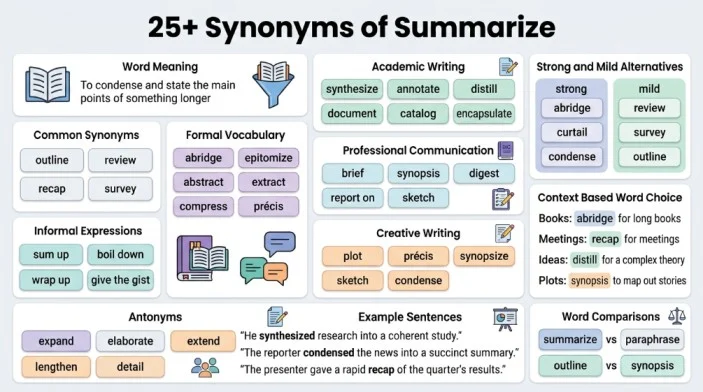
Writers often notice the same problem when preparing essays, emails, reports, captions, or blog posts: the word summarize keeps appearing again and again. Searching for a synonym of summarize can help you avoid repetition, but the best alternative depends on whether you mean shortening information, reviewing key points, explaining briefly, or giving an overview.
Words such as condense, abridge, recap, outline, and review can all relate to summarizing, but they are not interchangeable in every situation. Understanding their differences helps students, professionals, and content creators choose vocabulary that sounds natural, precise, and appropriate for the audience.
What Are the Best Synonyms of “Summarize”?
The best synonym of summarize depends on the context. Condense works well when shortening information, recap suits casual or spoken communication, outline highlights the main points, and abridge fits formal writing. For academic and professional contexts, summarize, condense, and outline are usually the safest choices.
Meaning, Tone, and Context
Simple Definition
Summarize means to give the main points of something in a shorter form while leaving out unnecessary details. You can summarize a book, article, speech, meeting, report, conversation, or set of findings.
For example:
“Please summarize the article in three paragraphs.”
The request means to present the article’s central ideas without reproducing all of its details.
Part of Speech
Summarize is a verb.
Overall Tone
The word is generally neutral. It does not inherently express positive or negative emotion.
Formality Level
Summarize is a neutral to semi formal word. It works naturally in everyday conversation as well as academic, professional, and business writing.
Common Uses
Native English speakers commonly use summarize when discussing:
- Articles
- Books
- Research papers
- Meetings
- Presentations
- Reports
- Conversations
- Speeches
- News stories
- Arguments
- Data and findings
- Long explanations
Word Forms
| Word Form | Example |
|---|---|
| Verb | summarize |
| Noun | summary |
| Adjective | summarized |
| Related adjective | summarizing |
| Related noun | summarization |
In American English, summarize is spelled with z. British English commonly uses summarise.
When and How to Use “Summarize”
Use summarize when you want someone to present the essential information from a longer source in a shorter and more manageable form.
Professional
“Could you summarize the client’s main concerns before the meeting?”
This is natural in workplace communication because the request focuses on the central points.
Academic
“Students should summarize the research article before evaluating its conclusions.”
Here, summarize refers to presenting the main ideas without adding unnecessary detail.
Workplace
“Please summarize today’s meeting and share the notes with the team.”
The word clearly communicates the need for a concise record of the discussion.
Personal
“Can you summarize what happened while I was away?”
In conversation, summarize can refer to briefly explaining a sequence of events.
“Could you summarize the changes discussed during yesterday’s call?”
This works well when requesting a concise explanation of a longer discussion.
Resume
“Summarized quarterly sales results for senior management.”
In a resume, summarized can describe a responsibility involving reports, data, or findings.
Social Media
“Here’s a quick post to summarize the main lessons from the conference.”
The word works naturally when presenting the central ideas from a longer event or discussion.
Best Synonyms of “Summarize”
No synonym of summarize has exactly the same meaning in every context. Some alternatives emphasize brevity, while others focus on reviewing, organizing, shortening, or presenting major points.
Professional Writing: Condense
Condense is an excellent professional alternative when information is being made shorter while preserving its essential meaning.
“Please condense the report into a one page briefing.”
It is especially useful when the original material is too long for a particular format.
Academic Writing: Outline
Outline works well when you want to present the main ideas or structure of a topic without explaining every detail.
“The introduction outlines the study’s main objectives.”
It is useful when structure matters as much as brevity.
Business Communication: Recap
Recap is useful for briefly reviewing what was previously discussed.
“Let me recap the main decisions from today’s meeting.”
It is particularly natural in meetings, presentations, and business conversations.
Casual Conversation: Recap
Recap is more conversational than summarize.
“Can you recap what I missed?”
It sounds relaxed and natural in everyday speech.
Emotional Writing: Reflect On
When writing about an experience, reflect on may be more suitable than simply summarizing because it allows room for personal meaning and interpretation.
“The final section reflects on the lessons learned during the journey.”
Creative Writing: Retell Briefly
For stories, retell can work when the goal is to present the events again in a shorter form.
“The final chapter briefly retells the events that shaped the character.”
Resume Writing: Condense
Condense works well when describing the process of turning detailed information into a shorter format.
“Condensed complex research findings into executive summaries.”
Workplace Communication: Recap
Recap is particularly useful after meetings, calls, presentations, or discussions.
“I’ll recap the action items in an email.”
Stronger Meaning: Condense
Condense can emphasize the actual process of reducing length while retaining important content.
“The editor condensed the 40 page report into a concise briefing.”
Softer Meaning: Review
Review can be a gentler alternative when the goal is to go over information rather than create a formal summary.
“Let’s review the main points before we finish.”
When Not to Use “Summarize”
Although summarize is versatile, it is not always the most precise choice.
When You Mean “Make Shorter”
Summarize and condense are related, but condense focuses more directly on reducing length.
Less precise:
“Please summarize this 20 page document into two pages.”
Better:
“Please condense this 20 page document into two pages.”
Why: The second sentence clearly emphasizes reducing the document’s length.
When You Mean “Review Again”
Using summarize can be misleading if you simply want someone to revisit previously discussed information.
Less precise:
“Let’s summarize the agenda.”
Better:
“Let’s review the agenda.”
Why: Review can mean examining information again, while summarize means presenting its main points briefly.
When You Mean “List the Main Points”
Less precise:
“The speaker summarized the plan.”
Better:
“The speaker outlined the plan.”
Why: Outline emphasizes the structure or major points.
When You Mean “Repeat What Happened”
Less precise:
“She summarized the story to her friend.”
Better:
“She recapped the story for her friend.”
Why: Recap sounds more natural when informally going over something that has already happened.
When You Mean “Shorten a Literary Work”
Less precise:
“The publisher summarized the novel.”
Better:
“The publisher abridged the novel.”
Why: Abridge specifically refers to shortening a work while retaining its main substance.
Words Commonly Confused With “Summarize”
Condense
Difference: To condense something is to make it shorter or more compact while retaining its important content.
When to Use It: Use it when reducing the length of writing, data, or information.
Example:
“The editor condensed the report for the board.”
Outline
Difference: To outline something is to present its main points or structure, often in an organized sequence.
When to Use It: Use it for essays, plans, arguments, presentations, and projects.
Example:
“The professor outlined the key arguments in the lecture.”
Recap
Difference: To recap means to briefly review something that has already been discussed or experienced.
When to Use It: Use it in conversations, meetings, presentations, and informal writing.
Example:
“I’ll recap the decisions at the end of the meeting.”
Abridge
Difference: To abridge means to shorten a written work by removing some material while retaining its main substance.
When to Use It: Use it for books, speeches, legal texts, and other substantial works.
Example:
“The publisher released an abridged edition of the classic novel.”
Review
Difference: To review means to examine, discuss, or go over information again. It does not necessarily mean making it shorter.
When to Use It: Use it when revisiting information, checking material, or evaluating something.
Example:
“Let’s review the findings before making a decision.”
Paraphrase
Difference: To paraphrase means to express someone else’s ideas in different words, usually while keeping roughly the same level of detail.
When to Use It: Use it when rewriting an idea rather than substantially shortening it.
Example:
“The student paraphrased the author’s argument in her own words.”
Best Synonyms of “Summarize” by Context
| Context | Best Synonym | Why It Works | Example |
|---|---|---|---|
| Formal writing | Abridge | Signals deliberate shortening of a substantial work. | “The text was abridged for younger readers.” |
| Academic writing | Outline | Clearly presents major ideas and structure. | “The paper outlines the main findings.” |
| Professional communication | Condense | Emphasizes concise presentation. | “Please condense the report.” |
| Business emails | Recap | Sounds natural when reviewing previous discussions. | “I’ll recap our decisions below.” |
| Resume writing | Condense | Useful for reducing detailed information. | “Condensed research into executive summaries.” |
| Workplace communication | Recap | Fits meetings and team discussions. | “Let me recap today’s action items.” |
| Casual conversation | Recap | Natural and conversational. | “Can you recap what happened?” |
| Everyday speaking | Sum up | Short, familiar expression. | “Can you sum up the story?” |
| Creative writing | Retell | Works when presenting a story again briefly. | “The narrator retells the event from another perspective.” |
| Storytelling | Recap | Quickly revisits earlier events. | “The narrator recaps the previous chapter.” |
| Emotional writing | Reflect on | Adds personal interpretation rather than mere compression. | “She reflects on the lessons from the experience.” |
| Strong emphasis | Condense | Highlights substantial reduction. | “The editor condensed the lengthy report.” |
| Mild tone | Review | Suggests going over information without implying major reduction. | “Let’s review the main points.” |
| Social media captions | Sum up | Short, accessible, and conversational. | “This caption sums up the weekend perfectly.” |
| American English | Summarize | Standard American spelling and usage. | “Please summarize the article.” |
| British English | Summarise | Common British spelling. | “Please summarise the article.” |
How to Choose the Best Synonym of “Summarize”
Choosing another word becomes easier when you identify exactly what you want to communicate.
If You Mean “Make It Shorter”
Choose condense.
“The editor condensed the article.”
If You Mean “Give the Main Structure”
Choose outline.
“The introduction outlines the main argument.”
If You Mean “Review Previous Information”
Choose recap.
“Let’s recap what we agreed on.”
If You Mean “Shorten a Published Work”
Choose abridge.
“The publisher abridged the novel.”
If You Mean “Go Over Something Again”
Choose review.
“Let’s review the presentation.”
If You Mean “Use Different Words”
Choose paraphrase.
“Please paraphrase the author’s explanation.”
If You Want Everyday Language
Choose sum up or recap.
These expressions sound natural in casual conversations and less formal messages.
If You Want Academic Precision
Choose summarize, outline, or condense, depending on the task.
The best word is the one that communicates your intended action rather than simply replacing the original word.
Real Life Examples of “Summarize”
School
Instead of:
“Summarize the chapter.”
A more specific instruction could be:
“Outline the chapter’s main arguments and supporting ideas.”
College
“Students were asked to summarize the research article before discussing its methodology.”
Here, summarize is appropriate because students need to communicate the central ideas briefly.
Workplace
“Could you recap the decisions we made during the meeting?”
Recap sounds natural because the team is reviewing a previous discussion.
Business
“The analyst condensed the quarterly report into a two page executive briefing.”
Condensed emphasizes reducing a long document.
“To keep everyone aligned, I’ll recap the main action items below.”
This sounds concise and professional.
Resume
“Condensed technical research into clear summaries for senior leadership.”
This demonstrates an ability to simplify complex information.
Conversation
“Can you sum up what happened?”
Sum up is more conversational than the formal summarize.
Storytelling
“The narrator briefly recaps the events from the previous chapter.”
The phrase naturally signals a brief review of earlier events.
Blogging
“The final section summarizes the main lessons from the article.”
This is a standard and natural use in online writing.
Social Media
“This photo caption sums up an unforgettable weekend.”
Sums up works well because it is short and conversational.
25 Best Synonyms of “Summarize”
| Synonym | Simple Meaning | Best Used For | Example Sentence |
|---|---|---|---|
| Summarize | Give the main points briefly | General use | “Please summarize the article.” |
| Condense | Make shorter while retaining key information | Reports and documents | “She condensed the report for executives.” |
| Recap | Briefly review something already discussed | Meetings and conversations | “Let’s recap the main decisions.” |
| Outline | Present the main points or structure | Essays and presentations | “The introduction outlines the study.” |
| Abridge | Shorten a substantial written work | Books and formal texts | “The novel was abridged for students.” |
| Review | Go over information again | Meetings and study | “Let’s review the findings.” |
| Paraphrase | Express an idea in different words | Academic writing | “The student paraphrased the passage.” |
| Sum up | Give the main idea briefly | Casual conversation | “Can you sum up the article?” |
| Abstract | Give a concise account of a work | Academic contexts | “The paper abstracts the main findings.” |
| Digest | Reduce information into an accessible form | News and information | “The newsletter digests major industry news.” |
| Synopsize | Give a brief account | Formal and literary contexts | “The editor synopsized the novel.” |
| Capsule | Present something in a very concise form | Informal or descriptive writing | “The article capsules the debate.” |
| Characterize | Describe the essential features | Literary and analytical writing | “The essay characterizes the central argument.” |
| Recapitulate | Restate the main points | Formal and academic writing | “The conclusion recapitulates the key findings.” |
| Review briefly | Go over key information | Education and meetings | “The teacher briefly reviewed the lesson.” |
| Give an overview | Present the general picture | Reports and presentations | “The speaker gave an overview of the project.” |
| Give a synopsis | Present a short account | Books and films | “The website gives a synopsis of the film.” |
| Present the gist | State the essential idea | Conversation | “He presented the gist of the proposal.” |
| Boil down | Reduce to the essential point | Informal communication | “The manager boiled the proposal down to three points.” |
| Distill | Extract the most important ideas | Academic and professional writing | “The report distills years of research.” |
| Abstract | Extract the central content | Technical writing | “The researcher abstracted the main conclusions.” |
| Shorten | Reduce length | General writing | “The editor shortened the article.” |
| Retell briefly | Tell something again in shorter form | Stories and events | “She retold the story briefly.” |
| Recount briefly | Give a short account of events | Narratives | “He briefly recounted the events.” |
| Synthesize | Combine key ideas into a coherent whole | Academic and analytical writing | “The paper synthesizes several studies.” |
Usage note: Some entries above are close alternatives rather than perfect replacements in every sentence. In particular, paraphrase, review, synthesize, characterize, and distill perform distinct language tasks. They should be selected according to the intended meaning.
Synonyms of “Summarize” by Usage
Professional vs Personal Synonyms
In professional settings, condense, outline, recap, and distill are useful because they describe specific ways of handling information.
In personal conversation, recap, sum up, and boil down sound more relaxed.
Professional:
“Please distill the findings into three recommendations.”
Personal:
“Can you sum up what happened?”
The first sentence emphasizes extracting useful conclusions. The second simply asks for a brief explanation.
Formal vs Conversational Synonyms
For reports and essays, prefer summarize, condense, outline, abridge, or recapitulate when the meaning fits.
For presentations, emails, conversations, and texting, recap, sum up, and boil down can sound more natural.
Avoid using a highly formal word such as recapitulate in a casual text unless you intentionally want a formal tone.
Academic Synonyms
Academic writing requires careful distinctions between summarizing and related activities.
Summarize
Use when presenting the main ideas of a source without unnecessary detail.
Outline
Use when emphasizing the structure or principal points.
Condense
Use when reducing a larger body of material into a shorter form.
Paraphrase
Use when restating a particular passage in your own words without necessarily making it much shorter.
Synthesize
Use when combining ideas from multiple sources to create a broader understanding.
For example:
“The researcher synthesized findings from five previous studies.”
This does more than summarize each study separately. It combines their ideas into a unified discussion.
Professional and Business Synonyms
Resumes
Use condense, distill, or outline when describing the ability to simplify complex information.
“Distilled complex market research into actionable insights.”
Interviews
Sum up may be appropriate in conversational interview answers.
“To sum up, my experience prepared me for this role.”
Meetings
Recap is highly natural.
“Before we close, I’ll recap the action items.”
Presentations
Outline works well when introducing the structure.
“I’ll first outline the three main challenges.”
Performance Reviews
Summarize and highlight are useful when discussing accomplishments.
“The report summarizes my contributions over the past year.”
Client Communication
Recap works when confirming previous discussions.
“To recap our conversation, the campaign will launch next month.”
Business Emails
Summarize, recap, and outline are usually the safest choices.
“Below, I’ve summarized the key changes.”
Creative and Literary Synonyms
Creative writing gives you more freedom, but precision still matters.
Retell
Use when presenting a story or event again.
“The novel retells the legend from a child’s perspective.”
Recap
Useful for briefly revisiting earlier plot events.
“The opening paragraph recaps the previous chapter.”
Recount
Works when describing events, especially from a narrative perspective.
“She recounted the journey in vivid detail.”
Synopsize
A formal literary term for creating a brief account of a work.
“The publisher asked the writer to synopsize the novel.”
Reflect On
This is not a direct synonym, but it can be useful when summarizing an experience while adding personal interpretation.
“The final chapter reflects on the consequences of the decision.”
Slang or Modern Synonyms
There is no single slang word that perfectly replaces summarize.
However, informal English commonly uses expressions such as sum up, boil down, and give me the gist.
“Sum Up”
Meaning: State the main point briefly.
Acceptable in conversations, messages, and casual online writing.
“Can you sum it up in one sentence?”
“Boil Down”
Meaning: Reduce something complicated to its essential idea.
Useful in informal and semi formal communication.
“Can you boil the proposal down to the main issue?”
“Give Me the Gist”
Meaning: Give the general idea without all the details.
Natural in casual speech.
“I haven’t read the article, so just give me the gist.”
Avoid these expressions in highly formal academic or legal writing unless they are part of quoted or intentionally conversational material.
Strongest to Mildest Synonyms
The synonyms of summarize are not really arranged by emotional strength because the verb itself is not strongly emotional. A more useful scale is based on how specifically the alternative describes the process.
| Level | Word or Expression | Main Emphasis |
|---|---|---|
| Mild | Review | Going over information |
| Mild | Recap | Briefly revisiting information |
| Moderate | Summarize | Giving central points |
| Moderate | Outline | Showing main points or structure |
| Strong | Condense | Significantly reducing length |
| Strong | Abridge | Shortening a substantial work |
| Strong | Distill | Extracting the most valuable ideas |
This distinction is more accurate than treating one synonym as emotionally “stronger” than another.
Emotional vs Neutral Synonyms
Emotional Synonyms and Expressions
Most direct synonyms of summarize are neutral rather than emotional. However, narrative expressions can introduce a more personal tone.
- Recount
- Retell
- Reflect on
- Sum up
- Give the gist
These can work well in personal essays, storytelling, conversations, and reflective writing.
Neutral Synonyms
These are better when the goal is objective information:
- Summarize
- Condense
- Outline
- Abridge
- Recap
- Review
- Abstract
- Distill
- Synthesize
Academic and professional writing generally benefits from these neutral choices because they communicate the task without adding unnecessary emotion.
Antonyms of “Summarize”
There are no perfect one word opposites for summarize in every context. However, the following verbs represent contrasting actions, such as expanding, elaborating, or giving extensive detail.
| Antonym | Meaning | Example Sentence |
|---|---|---|
| Elaborate | Add more explanation or detail | “Could you elaborate on this point?” |
| Expand | Make an idea more detailed or extensive | “The writer expanded the discussion.” |
| Detail | Give specific information | “The report details every stage of the process.” |
| Explain | Make something clear through information | “The teacher explained the concept.” |
| Develop | Add ideas and supporting information | “The author developed the argument further.” |
| Amplify | Increase or emphasize something | “The article amplified concerns about the policy.” |
| Lengthen | Make something longer | “The editor lengthened the introduction.” |
| Extend | Add material or scope | “The researcher extended the discussion.” |
| Specify | State something precisely | “The contract specifies the responsibilities.” |
| Enumerate | List items individually | “The report enumerates the project’s requirements.” |
| Describe | Give details about something | “The witness described the event.” |
| Expound | Explain an idea in detail | “The professor expounded on the theory.” |
| Clarify | Make an idea easier to understand | “The manager clarified the new procedure.” |
| Illustrate | Explain through examples or details | “The author illustrated the argument with examples.” |
| Analyze | Examine something in detail | “The paper analyzes the causes of the problem.” |
Comparison: “Summarize” vs Similar Words
Summarize vs Condense
Main Difference:
Summarize focuses on presenting the main ideas. Condense emphasizes reducing the length or volume of the material.
Which Is Stronger?
Neither is inherently stronger. Condense is more specific about shortening.
Which Is More Formal?
Both work well in formal writing.
When to Use Each:
Use summarize for the main points. Use condense when the goal is a shorter version.
Examples:
Summarize:
“Please summarize the research paper.”
Condense:
“Please condense the research paper into two pages.”
Summarize vs Outline
Main Difference:
Summarize gives the essential content. Outline presents the major points or structure.
Which Is Stronger?
Neither.
Which Is More Formal?
Both are appropriate for academic and professional writing.
When to Use Each:
Use outline when structure matters.
Examples:
Summarize:
“The article summarizes the author’s position.”
Outline:
“The introduction outlines the author’s main position.”
Summarize vs Recap
Main Difference:
Recap usually revisits something already discussed, while summarize can refer to new or previously presented information.
Which Is Stronger?
Neither.
Which Is More Formal?
Summarize is more formal and versatile.
When to Use Each:
Use recap for meetings, conversations, and previous events.
Examples:
Summarize:
“She summarized the report.”
Recap:
“She recapped what happened during the meeting.”
Summarize vs Review
Main Difference:
Review means examining information again. Summarize means presenting its central ideas briefly.
Which Is Stronger?
Neither.
Which Is More Formal?
Both are neutral.
When to Use Each:
Use review when revisiting or evaluating information.
Examples:
Summarize:
“Please summarize the chapter.”
Review:
“Please review the chapter before class.”
Summarize vs Paraphrase
Main Difference:
A summary is shorter and focuses on key ideas. A paraphrase restates an idea in different wording and can be similar in length to the original.
Which Is Stronger?
Neither.
Which Is More Formal?
Both are common in academic writing.
When to Use Each:
Use paraphrase when changing wording. Use summarize when reducing content.
Examples:
Summarize:
“The student summarized the article in one paragraph.”
Paraphrase:
“The student paraphrased the author’s explanation.”
Summarize vs Synthesize
Main Difference:
Summarize presents the key points of a source. Synthesize combines information from multiple sources or ideas into a unified understanding.
Which Is Stronger?
Synthesize involves a more complex analytical task.
Which Is More Formal?
Both are particularly common in academic writing.
When to Use Each:
Use synthesize when connecting several sources.
Examples:
Summarize:
“The student summarized each study.”
Synthesize:
“The student synthesized the findings from all five studies.”
Common Phrases and Expressions with “Summarize”
“Summarize the Main Points”
Meaning: Present the most important ideas without unnecessary details.
Example:
“Please summarize the main points of the presentation.”
“Summarize the Findings”
Meaning: Give a concise account of research or investigation results.
Example:
“The conclusion summarizes the findings of the study.”
“Summarize the Results”
Meaning: Present results briefly.
Example:
“The final section summarizes the results.”
“Summarize the Key Ideas”
Meaning: Identify and present the central concepts.
Example:
“Students should summarize the key ideas after reading the chapter.”
“Summarize in a Few Sentences”
Meaning: Give a short version using only a small number of sentences.
Example:
“Can you summarize the proposal in a few sentences?”
“Summarize in Your Own Words”
Meaning: Explain the central information without copying the original wording.
Example:
“Summarize the article in your own words.”
“Briefly Summarize”
Meaning: Give a particularly concise account.
Example:
“Briefly summarize the author’s main argument.”
“Summarize the Discussion”
Meaning: Present the key points from a conversation, debate, or meeting.
Example:
“The manager summarized the discussion before moving to the next topic.”
Common Mistakes to Avoid
1. Treating Every Related Word as a Perfect Synonym
Incorrect:
“I paraphrased the entire book into two paragraphs.”
Better:
“I summarized the entire book in two paragraphs.”
Why: Paraphrase changes wording, while summarize reduces the amount of information.
2. Confusing Summarize With Review
Incorrect:
“I reviewed the article into three sentences.”
Better:
“I summarized the article in three sentences.”
Why: Review does not normally mean reducing information to a shorter form.
3. Using Informal Expressions in Academic Writing
Incorrect:
“The researcher boiled down the results.”
Better:
“The researcher summarized the results.”
Why: Boiled down is conversational and may sound too informal for formal academic prose.
4. Using “Abridge” for Any Shortening
Incorrect:
“I abridged my email to three sentences.”
Better:
“I condensed my email to three sentences.”
Why: Abridge is generally associated with shortening substantial written works.
5. Confusing Summary With Analysis
Incorrect:
“My paragraph summarizes why the author’s argument is wrong.”
Better:
“My paragraph analyzes why the author’s argument is flawed.”
Why: Analysis examines and interprets information. A summary primarily reports its main ideas.
6. Repeating “Summarize” Too Often
Incorrect:
“First, summarize the article. Then summarize the findings. Finally, summarize the conclusion.”
Better:
“First, summarize the article. Then outline the findings and review the conclusion.”
Why: Appropriate variation improves readability while preserving the intended meaning.
7. Using “Synthesize” When You Only Mean “Summarize”
Incorrect:
“The student synthesized one paragraph from the article.”
Better:
“The student summarized the article in one paragraph.”
Why: Synthesize usually involves combining ideas from multiple sources or elements.
Frequently Asked Questions
1. What is the best synonym of “summarize”?
The best synonym of summarize depends on the intended meaning. Condense is ideal for shortening content, outline for presenting main points, recap for reviewing previous information, and abridge for shortening substantial written works.
2. What are the best formal synonyms of “summarize”?
Formal alternatives include condense, outline, abridge, recapitulate, abstract, and distill. For most academic and professional writing, however, summarize itself remains clear, natural, and appropriately neutral.
3. What are common informal synonyms of “summarize”?
Common informal alternatives include recap, sum up, boil down, and give the gist. These expressions work especially well in conversations, casual emails, presentations, and informal online communication.
4. What is another word for “summarize” in professional writing?
Condense, outline, recap, and distill are useful professional alternatives. Choose condense when reducing length, outline for structure, recap for meetings, and distill when extracting the most useful ideas.
5. What is the difference between “summarize” and “paraphrase”?
To summarize means to shorten information and focus on its main ideas. To paraphrase means to restate an idea in different words, often without significantly reducing its length or level of detail.
6. What is the opposite of “summarize”?
There is no single perfect opposite of summarize, but useful contrasting verbs include elaborate, expand, detail, develop, and explain. These words generally involve adding information rather than reducing it.
Conclusion
Summarize means to present the main ideas of something in a shorter form. Depending on your purpose, you can use condense for shortening, outline for structure, recap for reviewing previous information, abridge for shortening substantial works, or paraphrase when changing the wording without necessarily reducing the content.
No synonym of summarize works perfectly in every situation. The strongest choice depends on the meaning you want, your audience, your level of formality, and whether you are shortening, reviewing, organizing, or interpreting information.
A useful vocabulary habit is to identify the exact action you want to describe before replacing a word. That small step helps you choose more precise alternatives and avoid synonyms that only look similar.
Read More Related Articles:
- Synonyms for Empty | Meaning, Examples, and Better Word …
- Synonyms for Creativity | Meaning, Examples, and Better …
- Synonyms for Pros and Cons | Meaning, Examples, and Better …