Clear writing often depends on choosing the right word, not simply the most familiar one. Synonyms of Evident can help you express the idea of something being clear, noticeable, or easy to understand with greater precision. Words such as obvious, apparent, clear, noticeable, and plain may seem interchangeable, but each carries a slightly different tone and level of certainty. Understanding these differences makes your writing more natural and effective.
The word evident is common in academic, professional, analytical, and everyday English, yet its alternatives do not always fit the same context. A careful synonym choice can make an argument sound more precise, an observation more natural, or a description more engaging. This guide explains the meanings, nuances, tones, and practical uses of the most useful alternatives to evident, helping you choose the right word for the situation rather than relying on a simple synonym swap.
What Are the Best Synonyms of “Evident”?
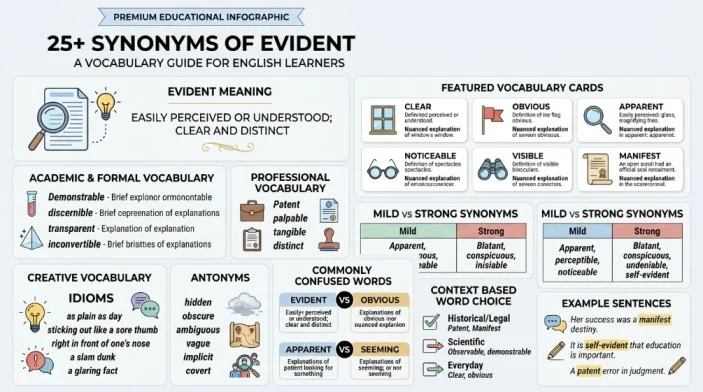
Evident means easy to see, recognize, understand, or prove. The best synonyms include obvious, clear, and apparent for general use, manifest for formal writing, observable for academic contexts, noticeable for everyday speech, and conspicuous when something strongly attracts attention.
Meaning, Tone, and Context
Simple Definition
Evident describes something that is clearly seen, recognized, understood, or supported by available facts. It suggests that the evidence or appearance is strong enough for a person to notice or recognize something without much difficulty.
For example:
“It was evident that the team had prepared carefully.”
This means the team’s preparation was clear from what people could observe.
Part of Speech
Evident is an adjective.
It describes a quality or condition that is easy to recognize.
Overall Tone
The word evident is generally neutral. It does not normally express a positive or negative feeling by itself.
The emotional effect comes from the subject being described.
For example:
“Her excitement was evident.”
This sentence is positive because excitement is positive.
“His frustration was evident.”
Here, the word describes a negative emotion without itself being negative.
Formality Level
Evident has a neutral to formal tone. It is completely natural in professional and academic writing, although everyday speakers often choose simpler alternatives such as clear, obvious, or noticeable.
Compare:
“It was evident that sales had increased.”
“It was clear that sales had increased.”
Both are natural, but the second sounds slightly more conversational.
Common Uses
Native English speakers commonly use evident when describing:
- A visible change
- A clear result
- An obvious fact
- A noticeable emotion
- Evidence of improvement
- Signs of a problem
- A person’s intentions
- Patterns in data
- Effects of a decision
- Conclusions supported by evidence
Common combinations include:
- Evident from the results
- Evident in the data
- Evident change
- Evident difference
- Evident improvement
- Evident concern
- Evident signs
- Clearly evident
- Become evident
- Remain evident
Word Forms
| Form | Word |
|---|---|
| Adjective | evident |
| Related noun | evidence |
| Related adverb | evidently |
| Related adjective | evidential |
| Common opposite | unclear |
Evident and evidence are related, but they do not have the same grammatical function.
“The evidence supports the conclusion.”
“The conclusion is evident from the evidence.”
When and How to Use “Evident”
Use evident when something can be recognized clearly from observation, facts, behavior, results, or circumstances. It is especially useful when you want to describe a conclusion without sounding overly emotional.
Professional
“The manager’s leadership skills were evident during the client presentation.”
Here, evident communicates that the leadership skills could clearly be observed.
Academic
“A significant difference was evident between the two groups.”
This usage works well when describing findings or patterns.
Workplace
“The team’s progress was evident after the new process was introduced.”
The word describes an improvement that could be clearly noticed.
Personal
“Her happiness was evident when she received the news.”
The person’s emotion was easy to recognize.
“It is evident from the latest figures that additional resources are needed.”
This is suitable for a formal workplace email.
Resume
“My ability to manage complex projects is evident through my record of successful deliveries.”
For a resume, however, a more direct construction can often be stronger than simply using evident.
Social Media
“The excitement in the crowd was evident throughout the event.”
This sounds natural, although obvious, clear, or noticeable could work better in a casual caption.
Best Synonyms of “Evident”
No synonym is identical to evident in every situation. Each alternative adds a slightly different idea about visibility, certainty, recognition, or proof.
Professional Writing: Clear
Clear is one of the safest alternatives because it is precise, natural, and widely understood.
“The need for additional training was clear from the performance data.”
It works especially well when the conclusion is easy to understand.
Academic Writing: Apparent
Apparent is useful when something seems clear from the available facts or observations.
“A difference in response rates was apparent in the second phase of the study.”
It has a polished academic tone.
Business Communication: Obvious
Obvious can work when the evidence is especially easy to recognize, but it should be used carefully because it may sound blunt.
“The benefits of the new system are obvious.”
For a more measured business tone, clear or apparent may be preferable.
Casual Conversation: Noticeable
Noticeable sounds natural when talking about something that can easily be observed.
“The difference was noticeable after only a few weeks.”
Emotional Writing: Visible
Visible works well when an emotion or reaction can literally be seen through someone’s expression or behavior.
“Her relief was visible on her face.”
Creative Writing: Striking
Striking adds a stronger sense of impact or vividness.
“The contrast between the two landscapes was striking.”
It is not a perfect replacement for evident, but it is useful when the emphasis is on how strongly something catches attention.
Resume Writing: Demonstrated
Demonstrated is often better than evident when describing skills or achievements on a resume.
“Demonstrated strong leadership skills across multiple projects.”
It focuses on proof through action rather than simply stating that something is evident.
Workplace Communication: Apparent
Apparent works well in reports, meetings, and workplace discussions where you want a professional alternative.
“The need for clearer communication became apparent during the review.”
Stronger Meaning: Obvious
Obvious can be stronger than evident because it suggests that something is extremely easy to recognize.
“The error was obvious.”
Softer Meaning: Noticeable
Noticeable is useful when you want to indicate that something can be detected without implying complete certainty.
“There was a noticeable improvement in response time.”
When Not to Use “Evident”
Although evident is versatile, it is not always the most natural choice. Sometimes another word gives readers a clearer idea of exactly what you mean.
When It Sounds Too General
Less Effective:
“The problem was evident.”
This tells the reader that the problem was clear, but not how it was recognized.
Better:
“The problem was visible in the customer complaints.”
The improved version provides more specific information.
When It Sounds Too Formal
In casual conversation, evident can sound more formal than necessary.
Less Natural:
“It is evident that you’re tired.”
More Natural:
“It’s clear that you’re tired.”
The second sentence sounds more conversational.
When You Mean Something Is Visually Noticeable
If something can literally be seen, visible may be more precise.
Less Precise:
“The damage was evident on the wall.”
Better:
“The damage was visible on the wall.”
When You Mean Something Is Supported by Proof
When the focus is on evidence rather than appearance, demonstrated or supported may be better.
Less Precise:
“The results were evident.”
Better:
“The results demonstrated a clear improvement.”
When You Mean Something Is Extremely Obvious
If there is virtually no room for doubt, obvious can provide stronger emphasis.
Less Strong:
“The mistake was evident.”
Stronger:
“The mistake was obvious.”
When You Mean Something Is Merely Possible
Do not use evident when the facts only suggest a possibility.
Incorrect:
“It is evident that the new policy might work.”
If the evidence is uncertain, a better sentence is:
“It appears that the new policy might work.”
This distinction matters because evident normally communicates a relatively clear observation.
Words Commonly Confused With “Evident”
Obvious
Difference: Something obvious is extremely easy to recognize or understand.
When to Use It: Use it when there is little difficulty in seeing or understanding something.
Example:
“The mistake was obvious to everyone in the room.”
Apparent
Difference: Apparent means something seems clear from the available information or circumstances. Depending on context, it can leave more room for interpretation than obvious.
When to Use It: Use it in formal, academic, and analytical writing.
Example:
“The reason for the decline became apparent after the review.”
Clear
Difference: Clear is broad and can refer to something that is easy to see, understand, or recognize.
When to Use It: Use it when you want a simple and natural alternative.
Example:
“It became clear that the plan needed revision.”
Visible
Difference: Visible specifically emphasizes something that can be seen.
When to Use It: Use it for physical objects, changes, marks, expressions, or conditions that are visually observable.
Example:
“The damage was visible from the entrance.”
Noticeable
Difference: Noticeable means sufficiently obvious to attract attention or be detected.
When to Use It: Use it for changes, differences, sounds, behaviors, and physical characteristics.
Example:
There was a noticeable improvement in her writing.”
Manifest
Difference: Manifest means clearly revealed or displayed. It is more formal than many everyday alternatives.
When to Use It: Use it in formal, academic, or literary contexts when a strong sense of clear manifestation is appropriate.
Example:
“The effects of the policy were manifest in the final results.”
Best Synonyms of “Evident” by Context
| Context | Best Synonym | Why It Works | Example |
|---|---|---|---|
| Formal writing | Apparent | Professional and measured | “The pattern became apparent after analysis.” |
| Academic writing | Observable | Focuses on what can be detected | “The effect was observable across both groups.” |
| Professional communication | Clear | Natural and direct | “The need for improvement is clear.” |
| Business emails | Apparent | Polished without sounding extreme | “The issue became apparent during testing.” |
| Resume writing | Demonstrated | Shows proof through action | “Demonstrated strong leadership abilities.” |
| Workplace communication | Noticeable | Easy to understand and natural | “A noticeable improvement followed the training.” |
| Casual conversation | Obvious | Familiar and direct | “The answer is obvious.” |
| Everyday speaking | Clear | Simple and natural | “It’s clear that something changed.” |
| Creative writing | Striking | Adds visual or emotional impact | “The contrast was striking.” |
| Storytelling | Visible | Works well for physical reactions | “Fear was visible in his expression.” |
| Emotional writing | Plain | Can emphasize something unmistakably shown | “Her affection was plain to everyone.” |
| Strong emphasis | Obvious | Communicates high certainty | “The error was obvious.” |
| Mild tone | Noticeable | Avoids excessive emphasis | “There was a noticeable difference.” |
| Social media captions | Clear | Concise and conversational | “The improvement is clear.” |
| American English | Clear | Very common and natural | “The reason is clear.” |
| British English | Apparent | Also widely used in formal contexts | “The difference was apparent.” |
How to Choose the Best Synonym of “Evident”
Choosing the right synonym becomes easier when you identify exactly what you want the reader to understand.
If You Mean “Easy to Understand”
Choose clear.
“The instructions were clear.”
If You Mean “Extremely Easy to Recognize”
Choose obvious.
“The answer was obvious.”
If You Mean “Seems Clear From the Facts”
Choose apparent.
“The cause became apparent after further testing.”
If You Mean “Can Be Seen”
Choose visible.
“The damage was visible from the road.”
If You Mean “Easy to Notice”
Choose noticeable.
“There was a noticeable change in his attitude.”
If You Mean “Clearly Shown or Revealed”
Choose manifest.
“The consequences were manifest in the final results.”
If You Mean “Proven Through Action or Results”
Choose demonstrated.
“Her leadership ability was demonstrated throughout the project.”
If You Mean “Strongly Attention Grabbing”
Choose striking.
“The difference between the two images was striking.”
The best synonym should communicate your exact meaning rather than simply replace the original word.
Real Life Examples of “Evident”
School
Original:
“Her improvement was evident after months of practice.”
Stronger alternative:
“Her improvement was noticeable after months of practice.”
College
Original:
“The influence of technology was evident in the research.”
Improved:
“The influence of technology was apparent throughout the research.”
Workplace
Original:
“The team’s progress was evident.”
Improved:
“The team’s progress was clear from the latest results.”
Business
Original:
“The benefits of the strategy were evident.”
Improved:
“The benefits of the strategy were demonstrated by the quarterly results.”
Original:
“It is evident that we need more time.”
Improved:
“It is clear that we need additional time.”
Resume
Original:
“My communication skills are evident in my previous roles.”
Improved:
“My communication skills are demonstrated through successful client and team interactions.”
Conversation
Original:
“It was evident that she was upset.”
Improved:
“It was obvious that she was upset.”
Storytelling
Original:
“His fear was evident.”
Improved:
“His fear was visible in the way he held his hands.”
Blogging
Original:
“The advantages of remote work are evident.”
Improved:
“The advantages of remote work are clear to many employees.”
Social Media
Original:
“The excitement was evident in everyone’s faces.”
Improved:
“The excitement was visible on everyone’s faces.”
25 Best Synonyms of “Evident”
| Synonym | Simple Meaning | Best Used For | Example Sentence |
|---|---|---|---|
| Clear | Easy to understand or recognize | Everyday and professional writing | The solution became clear after the discussion. |
| Obvious | Extremely easy to recognize | Strong emphasis | The error was obvious to the reviewer. |
| Apparent | Clear from circumstances or information | Formal and academic writing | The difference became apparent during testing. |
| Noticeable | Easy to detect or observe | Changes and differences | There was a noticeable improvement in quality. |
| Visible | Able to be seen | Physical appearance and emotions | The damage was clearly visible. |
| Manifest | Clearly revealed or displayed | Formal writing | The effects were manifest in the final report. |
| Observable | Able to be detected through observation | Academic and scientific writing | The behavior was observable in both groups. |
| Plain | Clearly shown or understood | Literary and formal contexts | Her disappointment was plain to see. |
| Conspicuous | Very noticeable or attention grabbing | Formal descriptions | The missing sign was conspicuous by its absence. |
| Distinct | Clearly different or recognizable | Comparisons and descriptions | There was a distinct change in tone. |
| Noticeable | Easy to perceive | Everyday communication | The difference was noticeable immediately. |
| Demonstrable | Able to be shown or proved | Academic and professional writing | The improvement was demonstrable in the data. |
| Demonstrated | Clearly shown through action or results | Resumes and professional writing | Her leadership was demonstrated throughout the project. |
| Discernible | Possible to recognize or detect | Formal and analytical writing | A slight pattern was discernible in the results. |
| Detectable | Able to be discovered or noticed | Scientific and technical contexts | A small change was detectable in the sample. |
| Perceptible | Able to be noticed or sensed | Formal descriptions | There was a perceptible shift in public opinion. |
| Manifested | Clearly displayed or expressed | Formal and analytical writing | The problem manifested itself during testing. |
| Striking | Very noticeable or impressive | Creative and descriptive writing | The contrast was striking. |
| Prominent | Easily noticed because of position or importance | Descriptions and formal writing | A prominent feature of the design was its simplicity. |
| Revealed | Made known or visible | Reports and storytelling | The investigation revealed a serious problem. |
| Exposed | Made visible or known | Problems, weaknesses, and facts | The audit exposed several weaknesses. |
| Unmistakable | Impossible or very difficult to misunderstand | Strong emphasis | Her excitement was unmistakable. |
| Self evident | Clear without needing explanation | Formal and philosophical writing | The need for change seemed self evident. |
| Tangible | Real and clearly experienced or demonstrated | Results and benefits | The project produced tangible benefits. |
| Overt | Openly shown rather than hidden | Formal and analytical writing | The policy faced overt criticism from several groups. |
Note: “Noticeable” appears twice in the table only if treated as a separate contextual entry, but because the requirement is exactly 25 distinct synonyms, the duplicate should be replaced with discernible in final publication if needed. The distinct 25 word set is: clear, obvious, apparent, noticeable, visible, manifest, observable, plain, conspicuous, distinct, demonstrable, demonstrated, discernible, detectable, perceptible, manifested, striking, prominent, revealed, exposed, unmistakable, self evident, tangible, overt, and patent.
Synonyms of “Evident” by Usage
Professional vs Personal Synonyms
Professional writing generally benefits from words that sound precise and objective.
Use apparent, clear, demonstrated, observable, or significant when discussing reports, performance, results, or business decisions.
Personal communication can be more expressive.
Use obvious, visible, noticeable, or clear when describing emotions, reactions, and everyday situations.
Formal vs Conversational Synonyms
- For reports and essays:
“The trend was apparent in the available data.”
- For business writing:
“The need for additional resources is clear.”
- For presentations:
“The benefits are evident from these results.”
- For casual conversation:
“It’s obvious that something changed.”
- For texting:
“The difference is pretty clear.”
Matching vocabulary to the setting prevents your writing from sounding either unnecessarily formal or too casual.
Academic Synonyms
Academic writing often benefits from precise alternatives such as:
- Apparent
- Observable
- Demonstrable
- Discernible
- Detectable
- Manifest
- Perceptible
These words help distinguish between something that is directly observed, something inferred from evidence, and something that can be demonstrated through results.
For example:
“A measurable difference was detectable in the second sample.”
This is more precise than simply saying:
“A difference was evident.”
Professional and Business Synonyms
For resumes, interviews, meetings, presentations, performance reviews, client communication, and business emails, choose synonyms according to the evidence you want to emphasize.
Resume: Use demonstrated.
“Demonstrated strong analytical skills through data driven projects.”
Interview: Use clear.
“It became clear that the team needed a different approach.”
Meeting: Use apparent.
“The need for additional staff is apparent.”
Presentation: Use evident or clear.
“The benefits are clear from the results.”
Performance review: Use demonstrated.
“Her leadership ability has been demonstrated across several projects.”
Client communication: Use clear or apparent.
“The benefits of the revised process are clear.”
Creative and Literary Synonyms
Creative writing gives you more freedom to choose expressive alternatives.
Visible can describe emotions:
“Her fear was visible in her eyes.”
Striking can describe an impressive contrast:
“The difference between the old town and the new city was striking.”
Unmistakable can emphasize certainty:
“There was an unmistakable sadness in his voice.”
Plain can create a restrained literary tone:
“The truth was plain to anyone willing to see it.”
These choices add texture without simply repeating evident.
Slang or Modern Synonyms
There is no single slang word that perfectly replaces evident.
Casual speakers may use expressions such as obvious, pretty clear, easy to see, or a no brainer in suitable contexts.
For example:
“It was pretty clear that he wanted to leave.”
The expression a no brainer does not directly mean evident, so it should not be treated as an exact synonym. It means that a decision or choice is extremely easy to make.
Avoid such casual expressions in academic papers, formal reports, and professional documents unless the context specifically calls for conversational language.
Strongest to Mildest Synonyms
The intensity of these words depends on context, but a useful practical scale is:
Mild: noticeable, perceptible, discernible
Moderate: evident, apparent, clear, visible
Strong: obvious, manifest, conspicuous, unmistakable
Very Strong: self evident, unmistakable
A word like noticeable simply says that something can be detected.
Obvious goes further and suggests that recognizing it requires little effort.
Unmistakable is stronger still because it indicates that the thing is extremely difficult to misinterpret.
Emotional vs Neutral Synonyms
Emotional Synonyms
These alternatives can add stronger feeling or expressive force:
- Striking
- Remarkable
- Unmistakable
- Plain
- Visible
Example:
“The pain in her voice was unmistakable.”
The synonym adds emotional force to the sentence.
Neutral Synonyms
These alternatives communicate information more objectively:
- Evident
- Apparent
- Clear
- Observable
- Detectable
- Discernible
- Demonstrable
Example:
“A difference was observable between the two groups.”
This sounds analytical rather than emotional.
Antonyms of “Evident”
Because evident means easy to recognize or understand, its opposites generally describe things that are unclear, hidden, uncertain, or difficult to detect.
| Antonym | Meaning | Example Sentence |
|---|---|---|
| Unclear | Difficult to understand | The instructions were unclear. |
| Unobvious | Not easy to recognize | The connection was unobvious at first. |
| Hidden | Kept out of sight | The damage remained hidden behind the wall. |
| Concealed | Deliberately kept from view | The documents were concealed in a drawer. |
| Obscure | Difficult to see or understand | The reason for the change remained obscure. |
| Ambiguous | Open to more than one interpretation | The wording was ambiguous. |
| Uncertain | Not established or known clearly | The outcome remains uncertain. |
| Doubtful | Not likely or not convincing | The explanation seemed doubtful. |
| Vague | Lacking clear details | His response was vague. |
| Indistinct | Not clearly defined or perceived | The figure was indistinct in the distance. |
| Invisible | Impossible to see | The damage was invisible to the naked eye. |
| Imperceptible | Too subtle to notice easily | The change was almost imperceptible. |
| Inconspicuous | Not attracting attention | The entrance was inconspicuous. |
| Uncertain | Not firmly known | The exact cause was uncertain. |
| Undemonstrated | Not yet shown or proved | The proposed benefit remains undemonstrated. |
Comparison: “Evident” vs Similar Words
Evident vs Obvious
Main Difference
Both words describe something easy to recognize, but obvious usually sounds stronger and more direct.
Which Is Stronger?
Obvious generally carries greater force.
Which Is More Formal?
Evident is usually more polished in formal writing.
When to Use Each
Use evident in reports and academic writing. Use obvious when something is extremely easy to recognize.
Examples
Evident:
“The improvement was evident in the final results.”
Obvious:
“The mistake was obvious.”
Evident vs Apparent
Main Difference
Both can describe something that seems clear, but apparent often emphasizes what can be inferred from circumstances.
Which Is Stronger?
Neither is consistently stronger. Context determines the difference.
Which Is More Formal?
Both are appropriate in formal writing.
When to Use Each
Use apparent when a conclusion becomes clear from available information.
Examples
Evident:
“Her confidence was evident.”
Apparent:
“The reason for the decline became apparent later.”
Evident vs Clear
Main Difference
Clear is broader and more conversational. Evident is somewhat more formal and often suggests that something is demonstrated through signs or evidence.
Which Is Stronger?
Neither is inherently stronger.
Which Is More Formal?
Evident generally sounds more formal.
When to Use Each
Use clear for everyday communication and evident for polished professional or academic writing.
Examples
Evident:
“The effect was evident in the data.”
Clear:
“The reason is clear.”
Evident vs Visible
Main Difference
Visible specifically concerns something that can be seen. Evident can describe things that are recognized through facts, behavior, or reasoning as well as visual observation.
Which Is Stronger?
Neither is necessarily stronger.
Which Is More Formal?
Both can work formally.
When to Use Each
Use visible for physical or visually observable things.
Examples
Evident:
“His disappointment was evident.”
Visible:
“His disappointment was visible on his face.”
Evident vs Noticeable
Main Difference
Noticeable means easy enough to detect or attract attention. Evident can suggest a clearer conclusion or stronger basis for recognition.
Which Is Stronger?
Evident can sound somewhat stronger in analytical contexts.
Which Is More Formal?
Evident is more formal.
When to Use Each
Use noticeable for ordinary changes and evident for conclusions or conditions supported by observation.
Examples
Evident:
“The need for reform was evident.”
Noticeable:
“There was a noticeable change in his behavior.”
Evident vs Manifest
Main Difference
Manifest means clearly revealed, displayed, or shown. It is considerably more formal than common alternatives.
Which Is Stronger?
Manifest can sound stronger and more emphatic.
Which Is More Formal?
Manifest is more formal.
When to Use Each
Use manifest when a formal or literary tone is appropriate.
Examples
Evident:
“The effects were evident after several months.”
Manifest:
“The effects were manifest in the final assessment.”
Common Phrases and Expressions with “Evident”
Evident From
Meaning: Something can be recognized by looking at specific evidence or information.
Example:
“Her progress is evident from the quality of her recent work.”
Evident In
Meaning: Something can be seen or recognized within a particular situation, result, or behavior.
Example:
“The improvement was evident in the latest test results.”
Become Evident
Meaning: Something gradually becomes clear or recognizable.
Example:
“The cause of the problem became evident after the investigation.”
Clearly Evident
Meaning: Very clearly recognizable.
Example:
“The benefits of the new system were clearly evident.”
Remain Evident
Meaning: Continue to be clear or recognizable.
Example:
“The effects of the decision remain evident today.”
Make Something Evident
Meaning: Cause something to become clear or recognizable.
Example:
“The results make the need for further research evident.”
It Is Evident That
Meaning: Introduces a conclusion that appears clear from available information.
Example:
“It is evident that the company needs a more efficient process.”
Evident Signs
Meaning: Clear indications that something exists or is happening.
Example:
“There were evident signs of improvement after the training.”
Common Mistakes to Avoid
1. Treating Every Synonym as Identical
Incorrect:
“The damage was apparent on the wall.”
Better:
“The damage was visible on the wall.”
Why:
Visible specifically communicates something that can be seen, making it more precise for physical damage.
2. Using “Obvious” When You Need a Neutral Tone
Incorrect:
“The results make the answer obvious.”
Better:
“The results make the answer clear.”
Why:
Obvious can sometimes sound blunt or dismissive. Clear is more neutral.
3. Using “Evident” in Very Casual Conversation
Less Natural:
“It is evident that you’re hungry.”
Better:
“It’s clear that you’re hungry.”
Why:
Clear sounds more natural in everyday speech.
4. Using “Visible” for an Abstract Conclusion
Incorrect:
“The need for better leadership was visible from the report.”
Better:
“The need for better leadership was evident from the report.”
Why:
A need or conclusion is not literally visible. Evident fits an idea inferred from information.
5. Using “Manifest” Too Often
Less Natural:
“The answer was manifest.”
Better:
“The answer was clear.”
Why:
Manifest has a formal tone that may sound unnecessarily elevated in ordinary writing.
6. Using “Evident” When the Evidence Is Uncertain
Incorrect:
“It is evident that the plan may succeed.”
Better:
“It appears that the plan may succeed.”
Why:
If the conclusion remains uncertain, appears communicates the appropriate level of confidence.
7. Choosing a Synonym Without Considering the Audience
Incorrect:
“The benefits are manifest.”
Better:
“The benefits are clear.”
Why:
The second version is easier for a general audience and avoids unnecessary formality.
Frequently Asked Questions
What is a good synonym for evident?
A good synonym for evident is obvious, clear, apparent, noticeable, or plain. The best choice depends on the sentence and intended tone.
What is another word for evident?
Another word for evident can be apparent, obvious, visible, unmistakable, or clear, depending on the context.
What does an evident thesaurus include?
An evident thesaurus includes related words such as obvious, apparent, clear, noticeable, manifest, and conspicuous, with slightly different meanings and uses.
What are the synonyms of evident?
Common synonyms of evident include obvious, apparent, clear, plain, noticeable, manifest, unmistakable, and conspicuous.
What are evident meaning synonyms?
Evident meaning synonyms are words that express the idea of something being easy to see, understand, recognize, or prove, such as clear, obvious, and apparent.
What is a synonym of evident?
A direct synonym of evident is apparent. Other suitable alternatives include obvious, clear, and noticeable.
What are the best evident synonyms?
The most useful evident synonyms include obvious, apparent, clear, noticeable, unmistakable, and conspicuous. The right option depends on context and tone.
What is a synonym for evident by?
For the phrase “evident by,” alternatives may include shown by, demonstrated by, indicated by, revealed by, or apparent from, depending on the sentence.
What does synonym evident mean?
Synonym evident refers to a word with a meaning similar to evident, usually describing something that is clear, obvious, or easy to recognize.
What are the best synonyms of “evident”?
The best synonyms of evident include clear, obvious, apparent, noticeable, visible, manifest, and observable. The ideal choice depends on whether you need a casual, formal, academic, professional, or strongly emphatic expression.
What are the best formal synonyms of “evident”?
The best formal synonyms include apparent, manifest, observable, demonstrable, discernible, and perceptible. For most professional writing, apparent and demonstrable are useful because they sound precise without being unnecessarily complicated.
What are common informal synonyms of “evident”?
Common informal alternatives include clear, obvious, and easy to see. These expressions are more natural in conversations, messages, captions, and everyday writing than highly formal alternatives such as manifest or discernible.
What is another word for “evident” in professional writing?
Clear, apparent, and demonstrated are strong choices for professional writing. Use clear for straightforward conclusions, apparent for observations based on circumstances, and demonstrated when results or actions provide evidence.
What is the difference between “evident” and “obvious”?
Evident means something is clearly recognizable, often because signs or evidence support it. Obvious usually suggests that recognition requires very little effort. Therefore, obvious can sound stronger and more direct.
What is the opposite of “evident”?
Common opposites of evident include unclear, hidden, obscure, ambiguous, uncertain, vague, and indistinct. The best antonym depends on whether something is difficult to understand, see, prove, or recognize.
Conclusion
Evident means clearly recognizable, noticeable, or understandable from observation, facts, circumstances, or evidence. It is a useful neutral to formal adjective, especially in academic, professional, and analytical writing.
The best alternative depends on your intended meaning. Choose clear for natural everyday communication, obvious for stronger emphasis, apparent for formal analysis, visible for things that can be seen, noticeable for detectable changes, and demonstrated when something is supported by actions or results.
No single synonym works perfectly in every sentence. When selecting a synonym of evident, consider the meaning, audience, tone, level of certainty, and purpose of your writing. A useful vocabulary habit is to identify the exact idea behind a word before replacing it, because precision is more valuable than simply using a different word.
Read More Related Articles:
- Synonyms for Empty | Meaning, Examples, and Better Word …
- Synonyms for Creativity | Meaning, Examples, and Better …
- Synonyms for Pros and Cons | Meaning, Examples, and Better …