The word pirate can describe more than a person who attacks ships. It may refer to a sea raider, a buccaneer, a privateer, or, in modern usage, someone who illegally copies or distributes digital content. Because the meaning changes with context, choosing the right synonym matters. A strong alternative should match the historical period, tone, and intended meaning rather than simply replace the word.
This guide to synonyms of pirate explores accurate alternatives used in historical, literary, informal, and modern contexts. Words such as buccaneer, corsair, sea raider, marauder, privateer, and freebooter can carry different meanings and levels of formality. Understanding these distinctions helps students, writers, and English learners select a word that sounds natural and communicates the intended idea clearly.
What Is the Best Synonym of “Pirate”?
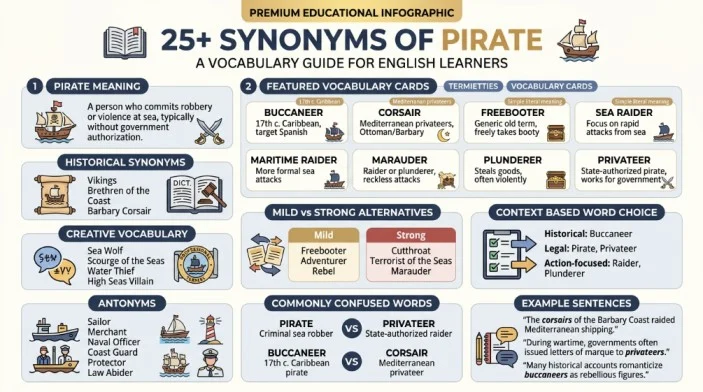
A pirate is a person who attacks or robs ships at sea, usually for personal gain. Common synonyms include buccaneer, corsair, freebooter, sea robber, marauder, raider, and plunderer. For historical writing, buccaneer or corsair may be more precise, while sea robber works as a clear general alternative.
Meaning, Tone, and Context
Simple Definition
A pirate is traditionally a person who attacks ships or coastal locations to steal goods, money, or other valuable property. The word is most strongly associated with maritime robbery and seafaring criminals.
The term can also be used as a verb. To pirate something can mean to copy, distribute, or use copyrighted material without legal permission.
Part of Speech
Pirate can function as both a noun and a verb.
As a noun:
The pirate boarded the merchant ship.
As a verb:
The company was accused of pirating copyrighted software.
Overall Tone
The tone of pirate depends heavily on context.
When describing historical criminals, it is generally neutral or negative.
In fiction, entertainment, and popular culture, it can have a more adventurous, dramatic, or romantic tone.
When used for copyright infringement, it has a clearly negative and legal implication.
Formality Level
Pirate is a neutral word that works in casual, professional, educational, and historical writing.
More specialized terms such as corsair, privateer, or freebooter may be appropriate when historical distinctions matter.
Common Uses
Native English speakers commonly use pirate in contexts involving:
- Maritime history
- Ships and naval conflict
- Historical fiction
- Adventure stories
- Movies and video games
- Treasure hunting
- Coastal raids
- Copyright infringement
- Illegal copying of software, music, books, or movies
Word Forms
| Form | Example |
|---|---|
| Noun | The pirate attacked the ship. |
| Verb | They were accused of pirating the software. |
| Adjective | The novel features a pirate crew. |
| Related noun | Piracy is illegal in many contexts. |
| Related adjective | The story has a piratical atmosphere. |
When and How to Use “Pirate”
Choose pirate when you need a clear, widely understood word for a person involved in maritime robbery or unlawful copying.
The word is especially useful when the historical or fictional context does not require a more specialized term.
Professional Context
The report examines the economic impact of modern maritime piracy.
Here, piracy is more appropriate than a colorful term such as buccaneering because the subject is formal and factual.
Academic Context
Historians have studied how pirates affected trade routes in the Caribbean.
The word is clear and suitable for general historical discussion.
Workplace Context
The company strengthened its security measures after discovering that employees were using pirated software.
Here, pirated refers to unauthorized software rather than maritime crime.
Personal Context
My son has been fascinated by pirates since he watched his first adventure movie.
The word sounds natural in everyday conversation.
Email Context
Please make sure that all software installed on company computers is properly licensed and not pirated.
This usage is appropriate for workplace communication.
Resume Context
The word pirate itself is rarely appropriate on a resume unless the position involves historical research, entertainment, themed events, or maritime studies.
For example:
Researched historical pirate communities for a museum exhibition.
Social Media Context
Spending the weekend exploring a pirate themed festival with the family.
In social media, pirate can be playful and informal.
Best Synonyms of “Pirate”
No synonym of pirate works perfectly in every sentence. Some alternatives refer specifically to historical seafarers, while others emphasize robbery, raiding, or unlawful behavior.
Professional Writing: Maritime Raider
Maritime raider is useful when you need a factual description of someone who conducts attacks at sea.
The museum exhibit examines the activities of maritime raiders in the region.
Academic Writing: Corsair
Corsair is appropriate when discussing historical seaborne raiders, especially in contexts where the term has a specific historical meaning.
The book examines the role of corsairs in Mediterranean conflicts.
Historical Writing: Buccaneer
Buccaneer is strongly associated with historical pirates, particularly those active in the Caribbean.
The novel follows a young sailor who joins a band of buccaneers.
Casual Conversation: Sea Robber
Sea robber is immediately understandable and clearly communicates the basic idea of a pirate.
The children’s story features a clever sea robber searching for treasure.
Stronger Meaning: Marauder
Marauder emphasizes violent or aggressive raiding.
The coastal village was attacked by marauders.
It is broader than pirate because marauders do not have to operate at sea.
Softer or More Descriptive Meaning: Sea Raider
Sea raider provides a straightforward description without the dramatic associations that pirate can sometimes carry.
The documentary describes how sea raiders disrupted regional trade.
Creative Writing: Freebooter
Freebooter has an old fashioned, adventurous quality and works particularly well in historical fiction.
The wandering freebooter searched the coast for his next opportunity.
Legal or Copyright Context: Infringer
When pirate refers to someone who illegally copies copyrighted material, infringer may be more precise in legal or formal writing.
The copyright holder filed a claim against the alleged infringer.
When Not to Use “Pirate”
Although pirate is widely understood, there are situations where a more specific word communicates the idea better.
When the Word Is Too General
Less precise:
The pirate attacked the vessel.
More specific:
The maritime raider attacked the vessel.
Use maritime raider when the emphasis is on the military or strategic nature of the attack.
When Historical Precision Matters
Less precise:
The pirate operated with government permission.
Better:
The privateer operated with government authorization.
A privateer should not automatically be treated as a synonym of pirate. Privateers historically operated under government authorization, while pirates generally acted without such authorization.
When You Mean Illegal Copying
Less precise:
The pirate copied the software.
Better:
The copyright infringer copied the software without authorization.
The second sentence makes the legal meaning clearer.
When the Word Sounds Too Dramatic
Less effective:
The company was attacked by pirates during a commercial dispute.
Better:
The company reported an attack by maritime criminals.
A neutral phrase may be preferable in formal reporting.
When You Need a Historical Label
If the subject belongs to a specific historical tradition, a term such as corsair or buccaneer can communicate more information than the broad word pirate.
Words Commonly Confused With “Pirate”
Buccaneer
Difference: A buccaneer is a historical term strongly associated with seafaring raiders, particularly in the Caribbean.
When to use it: Historical writing, adventure fiction, and discussions of Caribbean history.
Example:
The buccaneers established a reputation as dangerous raiders.
Corsair
Difference: Corsair refers to a seaborne raider, particularly in historical Mediterranean contexts, and the term can carry specific historical associations.
When to use it: Historical and academic writing.
Example:
The corsair fleet controlled important maritime routes.
Privateer
Difference: A privateer historically had government authorization to attack enemy shipping, which distinguishes the term from ordinary piracy.
When to use it: Historical discussions involving naval warfare and state authorization.
Example:
The privateer captured enemy merchant ships during the conflict.
Raider
Difference: Raider is broader than pirate. A raider can attack by land or sea and does not necessarily steal from ships.
When to use it: Military history, journalism, and general descriptions of attacks.
Example:
The raiders struck the coastal settlement before retreating.
Marauder
Difference: Marauder emphasizes violent or destructive attacks and does not specifically refer to the sea.
When to use it: Historical writing, fiction, and descriptions of destructive groups.
Example:
The marauders looted several villages.
Bandit
Difference: Bandit usually refers to a robber or outlaw operating on land.
When to use it: Stories, crime writing, and historical discussions of land based robbery.
Example:
The bandits ambushed travelers along the mountain road.
Best Synonyms of “Pirate” by Context
| Context | Best Synonym | Why It Works | Example |
|---|---|---|---|
| Formal writing | Maritime raider | Sounds factual and descriptive. | The report examines maritime raiders. |
| Academic writing | Corsair | Fits specialized historical discussion. | Researchers studied Mediterranean corsairs. |
| Professional communication | Maritime criminal | Clear and neutral. | Authorities investigated maritime criminals. |
| Business emails | Unauthorized copier | Clarifies copyright misuse. | The company identified an unauthorized copier. |
| Resume writing | Historical researcher | More professional than describing someone as a pirate. | Researched historical pirate communities. |
| Workplace communication | Copyright infringer | Appropriate for intellectual property issues. | The company reported a copyright infringer. |
| Casual conversation | Pirate | Simple and familiar. | The movie follows a pirate crew. |
| Everyday speaking | Sea robber | Immediately understandable. | The story is about a sea robber. |
| Creative writing | Buccaneer | Creates historical atmosphere. | The buccaneer sailed toward the island. |
| Storytelling | Freebooter | Adds an old fashioned adventure feel. | The freebooter disappeared into the fog. |
| Emotional writing | Marauder | Conveys aggression and danger. | The marauders left the village in ruins. |
| Strong emphasis | Marauder | Highlights destructive behavior. | The marauders attacked without warning. |
| Mild tone | Sea raider | Descriptive without strong dramatic coloring. | The sea raiders targeted trading ships. |
| Social media captions | Pirate | Short, familiar, and recognizable. | Living like a pirate for the weekend. |
| American English | Pirate | The standard general term. | The story features a famous pirate. |
| British English | Pirate | Also the standard general term. | The museum displays pirate artifacts. |
How to Choose the Best Synonym of “Pirate”
Choosing the right word starts with identifying exactly what you mean.
Consider the Meaning
- If you mean a person who robs ships, pirate, sea robber, and sea raider can work.
- If you are describing a historical Caribbean figure, buccaneer may be more appropriate.
- If you mean unauthorized copying, words such as copyright infringer or unauthorized copier are more precise.
Consider the Tone
- For neutral writing, choose pirate, raider, or maritime criminal.
- For historical fiction, buccaneer, corsair, and freebooter can create a stronger period atmosphere.
- For dramatic writing, marauder can emphasize danger and destruction.
Consider Your Audience
A general audience will immediately understand pirate.
An academic audience may benefit from a historically specific term when the context supports it.
Consider Emotional Strength
Pirate is relatively neutral.
Raider emphasizes attacking.
Marauder suggests aggression and destruction.
Plunderer focuses on stealing valuable property.
Consider Writing Purpose
- For a school essay, use pirate unless a more precise historical term is relevant.
- For a historical novel, buccaneer, corsair, or freebooter can add texture.
- For legal writing about copyright, use infringer or another precise legal description rather than relying on pirate.
Choose Natural Usage
The strongest synonym is not necessarily the most unusual one. A familiar word that accurately communicates the intended meaning is usually better than a rare term inserted only to avoid repetition.
Real Life Examples of “Pirate”
School
Students learned how pirates affected maritime trade during the colonial period.
A more specific historical version could use buccaneers if the lesson concerns the relevant Caribbean groups.
College
The research paper examines piracy and its effects on international shipping.
This formal noun, piracy, is more suitable than repeatedly using pirate.
Workplace
Employees were reminded not to install pirated software on company devices.
Here, pirated clearly refers to unauthorized software.
Business
The company introduced new security measures to reduce the risk of maritime piracy.
This is more professional than using colorful historical terms.
Please remove any pirated software from company computers and contact the IT department if you need licensed alternatives.
The wording is direct and appropriate for professional communication.
Resume
Conducted archival research on pirate activity and maritime trade in the Caribbean.
The word fits because the resume specifically describes historical research.
Conversation
I watched a great pirate movie last night.
This is a natural everyday use.
Storytelling
The old captain warned the crew that a group of buccaneers was approaching the harbor.
Buccaneers adds historical and literary flavor.
Blogging
Pirates played a complicated role in the history of Atlantic trade.
The simple word works well because the audience can understand it immediately.
Social Media
A pirate themed weekend turned the harbor into a colorful adventure.
The familiar term works naturally in an informal caption.
25 Best Synonyms of “Pirate”
Some alternatives below are direct synonyms, while others are context specific descriptive substitutes. Historical terms such as privateer require special care because they are not interchangeable with pirate in every historical context.
| Synonym | Simple Meaning | Best Used For | Example Sentence |
|---|---|---|---|
| Buccaneer | Historical seafaring raider | Caribbean history and fiction | The buccaneer sailed toward the distant island. |
| Corsair | Historical maritime raider | Mediterranean history | The corsair captured several enemy vessels. |
| Freebooter | Independent adventurer or raider | Historical and literary writing | The freebooter sought fortune beyond the known coast. |
| Sea robber | Person who robs at sea | General explanations | The legend tells of a notorious sea robber. |
| Sea raider | Person who attacks from the sea | Historical and descriptive writing | The sea raider targeted merchant vessels. |
| Maritime raider | Raider operating at sea | Formal writing | The study examines maritime raiders in the region. |
| Maritime robber | Robber who operates at sea | Explanatory writing | The coastal patrol was created to stop maritime robbers. |
| Raider | Person who attacks or steals | General and historical contexts | The raiders attacked the port before dawn. |
| Marauder | Violent attacker or plunderer | Dramatic and historical writing | The marauders frightened the coastal residents. |
| Plunderer | Person who steals valuable property | Descriptive writing | The plunderers took everything they could carry. |
| Pillager | Person who takes property by force | Historical writing | The pillagers left the settlement devastated. |
| Robber | Person who steals from others | General language | The robber escaped before the authorities arrived. |
| Looter | Person who steals during disorder | News and historical contexts | The looters took supplies from abandoned buildings. |
| Bandit | Outlaw who robs people | Land based crime and fiction | The bandit hid in the forest. |
| Outlaw | Person who operates outside the law | Fiction and historical writing | The outlaw became a legend among local sailors. |
| Rover | Wandering person, especially in older usage | Literary and historical writing | The sea rover traveled from port to port. |
| Sea rover | Wandering seafarer or raider | Historical fiction | The sea rover disappeared beyond the horizon. |
| Raiding seafarer | Seafarer who conducts attacks | Explanatory writing | The raiding seafarers disrupted coastal commerce. |
| Maritime criminal | Criminal operating at sea | Modern formal writing | Authorities arrested several suspected maritime criminals. |
| Sea criminal | Criminal involved in offenses at sea | General explanation | The novel portrays him as a dangerous sea criminal. |
| Coastal raider | Attacker targeting coastal areas | Historical writing | Coastal raiders threatened several settlements. |
| Ship raider | Person who attacks ships | Descriptive writing | The ship raiders boarded the merchant vessel. |
| Plunderer at sea | Person who steals from maritime targets | Explanatory writing | The story follows a notorious plunderer at sea. |
| Maritime plunderer | Person who steals at sea | Formal descriptive writing | The records describe the group as maritime plunderers. |
| Sea bandit | Bandit operating at sea | Fiction and informal description | The sea bandit became the subject of countless legends. |
Synonyms of “Pirate” by Usage
Professional vs Personal Synonyms
In professional writing, maritime raider, maritime criminal, and copyright infringer are often clearer than colorful historical vocabulary.
In personal or creative conversation, pirate, buccaneer, and sea robber are more accessible and expressive.
Formal vs Conversational Synonyms
For reports and academic essays, prefer precise terms such as maritime raider, corsair, or piracy, depending on the subject.
For presentations and general emails, pirate is usually sufficient.
In casual conversations and texting, pirate is by far the most natural choice.
Academic Synonyms
Academic writing should favor precision over novelty.
Corsair can be useful when discussing particular historical traditions.
Buccaneer is appropriate when the historical context specifically supports the term.
Maritime raider works when you need a neutral descriptive phrase.
Piracy is often preferable when discussing the broader activity rather than individual people.
For example:
Researchers examined the economic effects of maritime piracy on regional trade.
This sounds more academic than repeatedly writing:
Researchers examined how pirates affected trade.
Both sentences are understandable, but the first is more concise and topic focused.
Professional and Business Synonyms
Professional vocabulary should be selected according to meaning.
- For maritime security, use terms such as maritime criminal, sea raider, or maritime raider.
- For copyright issues, use copyright infringer, unauthorized copier, or another precise legal description.
- For a resume involving history, pirate may be appropriate when it describes the subject of research.
For example:
Analyzed historical records concerning pirate activity and maritime commerce.
This is clearer and more professional than trying to replace pirate with an obscure synonym.
Creative and Literary Synonyms
Creative writing gives you more freedom to choose atmospheric vocabulary.
Buccaneer
Creates a strong historical adventure feeling.
The buccaneer raised his flag as the storm approached.
Freebooter
Adds an old fashioned, wandering quality.
The freebooter laughed as the crew prepared to leave the harbor.
Corsair
Works especially well in historical settings.
The corsair watched the Mediterranean horizon from the deck.
Sea Rover
Creates an adventurous image of a wandering sailor.
The legendary sea rover had visited every port along the coast.
Marauder
Adds danger and aggression.
The marauders emerged from the fog and surrounded the village.
Slang or Modern Synonyms
There is no single modern slang word that perfectly replaces pirate in every context.
Informal expressions such as sea dog can describe an experienced sailor, but sea dog is not a true synonym for pirate. Likewise, swashbuckler describes a flamboyant or adventurous character and should not automatically be used to mean a pirate.
For modern copyright discussions, casual speakers may still use pirate, as in:
Someone pirated the movie.
In formal communication, however, copyright infringement is more precise.
Strongest to Mildest Synonyms
The intensity of a pirate synonym depends on what aspect of the word you want to emphasize.
| Level | Words | Main Emphasis |
|---|---|---|
| Mild | Sea raider, rover | Maritime movement or attacking |
| Moderate | Pirate, buccaneer, corsair | General or historical piracy |
| Strong | Raider, plunderer, pillager | Attack and theft |
| Very Strong | Marauder, maritime criminal | Aggression, violence, or criminality |
A word such as marauder can sound more threatening than pirate because it emphasizes violent or destructive behavior.
Emotional vs Neutral Synonyms
Emotional Synonyms
These words can create stronger imagery:
- Marauder
- Buccaneer
- Freebooter
- Sea rover
- Plunderer
- Pillager
They work well in fiction, storytelling, and historical narratives where atmosphere matters.
Neutral Synonyms
These alternatives are more factual:
- Pirate
- Raider
- Sea raider
- Maritime raider
- Maritime criminal
- Maritime robber
Neutral vocabulary is generally preferable in academic, professional, and informational writing.
Antonyms of “Pirate”
Because pirate can have several meanings, its exact opposite depends on context. The following words represent genuine contrasts in roles, behavior, or legality rather than claiming that every word is a direct dictionary opposite.
| Antonym | Meaning | Example Sentence |
|---|---|---|
| Law-abiding sailor | Sailor who follows the law | The law-abiding sailor reported the suspicious vessel. |
| Licensed sailor | Sailor operating with required authorization | The licensed sailor completed the voyage legally. |
| Authorized operator | Person acting with official permission | The authorized operator had all required documents. |
| Legitimate trader | Lawful person engaged in trade | The legitimate trader transported goods between ports. |
| Merchant | Person involved in lawful commercial trade | The merchant delivered valuable cargo to the port. |
| Legal shipowner | Lawful owner of a vessel | The legal shipowner provided the vessel records. |
| Naval officer | Official military officer serving at sea | The naval officer organized the patrol. |
| Coast guard officer | Official responsible for maritime security | The coast guard officer inspected the vessel. |
| Sailor | Person who works or travels on a ship | The sailor returned home after a long voyage. |
| Navigator | Person who plans and directs a voyage | The navigator carefully studied the charts. |
| Captain | Person commanding a vessel | The captain guided the ship into the harbor. |
| Private citizen | Person acting without criminal maritime activity | The private citizen reported the incident. |
| Authorized privateer | Historically authorized maritime raider | The authorized privateer operated under official permission. |
| Lawful carrier | Person or company legally transporting goods | The lawful carrier delivered the cargo safely. |
| Honest trader | Trader who conducts business lawfully | The honest trader refused to handle stolen goods. |
Comparison: “Pirate” vs Similar Words
Pirate vs Buccaneer
Main Difference:
A pirate is a broad term for someone involved in maritime robbery. Buccaneer is a historical term associated particularly with Caribbean seafarers and raiders.
Which Is Stronger?
Neither is inherently stronger. Buccaneer adds historical flavor.
Which Is More Formal?
Buccaneer can sound more specialized and historical.
When to Use Each:
Use pirate for general audiences. Use buccaneer when the historical context supports it.
Examples:
Pirate:
The pirate attacked a merchant ship.
Buccaneer:
The buccaneer sailed through the Caribbean.
Pirate vs Corsair
Main Difference:
Corsair is a historical term associated with maritime raiders, especially in Mediterranean contexts.
Which Is Stronger?
Neither is automatically stronger.
Which Is More Formal?
Corsair is more specialized.
When to Use Each:
Use corsair when historical precision matters.
Examples:
Pirate:
The pirate captured the ship.
Corsair:
The corsair fleet controlled important sea routes.
Pirate vs Privateer
Main Difference:
A privateer historically operated under government authorization, while a pirate generally did not.
Which Is Stronger?
Neither is stronger, but the legal status is different.
Which Is More Formal?
Privateer is more historically specific.
When to Use Each:
Use privateer only when the historical context supports government authorization.
Examples:
Pirate:
The pirate attacked the merchant vessel independently.
Privateer:
The privateer captured an enemy vessel under government authorization.
Pirate vs Raider
Main Difference:
A pirate specifically suggests maritime robbery, while a raider can operate on land or sea.
Which Is Stronger?
Raider can sound more aggressive because it emphasizes attacking.
Which Is More Formal?
Both can work in formal writing.
When to Use Each:
Use pirate for maritime robbery. Use raider when the attacking behavior matters more than the setting.
Examples:
Pirate:
The pirate stole cargo from the ship.
Raider:
The raider attacked the coastal settlement.
Pirate vs Marauder
Main Difference:
Marauder emphasizes violent or destructive raiding and does not necessarily involve the sea.
Which Is Stronger?
Marauder often sounds more threatening.
Which Is More Formal?
Both can appear in historical writing, but marauder is broader.
When to Use Each:
Use pirate for maritime robbery. Use marauder for destructive attacks more generally.
Examples:
Pirate:
The pirate boarded the vessel.
Marauder:
The marauders looted the village.
Pirate vs Bandit
Main Difference:
A pirate usually operates at sea, while a bandit generally commits robbery on land.
Which Is Stronger?
Neither is inherently stronger.
Which Is More Formal?
Both are neutral words, though context determines suitability.
When to Use Each:
Use bandit for land based robbery and pirate for maritime robbery.
Examples:
Pirate:
The pirate disappeared beyond the harbor.
Bandit:
The bandit stopped travelers on the mountain road.
Common Phrases and Expressions with “Pirate”
Pirate Ship
Meaning:
A ship associated with pirates, especially in historical fiction or entertainment.
Example:
The children explored a replica pirate ship at the museum.
Pirate Crew
Meaning:
A group of pirates working together aboard a vessel.
Example:
The pirate crew prepared the ship for another voyage.
Pirate Captain
Meaning:
The person who commands a pirate crew or ship.
Example:
The pirate captain studied the map before giving the order to sail.
Pirate Treasure
Meaning:
Valuable goods associated with pirates, especially in stories and legends.
Example:
The children searched the island for hidden pirate treasure.
Pirate Attack
Meaning:
An attack carried out by pirates.
Example:
The novel begins with a dramatic pirate attack.
Pirate Flag
Meaning:
A flag associated with pirates, often represented in popular culture by a skull and crossbones design.
Example:
The children raised a pirate flag over their backyard fort.
Pirate Crew
Meaning:
The sailors serving together on a pirate vessel.
Example:
The pirate crew divided the supplies after returning to port.
Common Mistakes to Avoid
1. Treating “Privateer” as an Exact Synonym
Incorrect:
Every privateer was a pirate.
Better:
Privateers and pirates were both maritime raiders, but privateers operated under government authorization.
Why:
The historical distinction is important.
2. Using “Buccaneer” for Every Pirate
Incorrect:
The ancient Mediterranean pirate was a buccaneer.
Better:
The ancient Mediterranean sailor was a pirate or maritime raider.
Why:
Buccaneer has particular historical associations and should not be used for every maritime raider.
3. Using “Bandit” for a Sea Robber
Incorrect:
The bandits boarded the merchant ship.
Better:
The pirates boarded the merchant ship.
Why:
Bandit normally suggests land based robbery.
4. Using an Overly Dramatic Word
Incorrect:
The marauders sailed peacefully into the harbor.
Better:
The pirates sailed peacefully into the harbor.
Why:
Marauder emphasizes aggressive or destructive behavior and may conflict with the sentence.
5. Using “Pirate” When You Mean Copyright Infringer
Incorrect:
The pirate violated the company’s copyright.
Better:
The copyright infringer violated the company’s intellectual property rights.
Why:
The second version is clearer and more appropriate for formal or legal communication.
6. Repeating “Pirate” Too Often
Incorrect:
The pirate met another pirate while the pirate ship followed a pirate captain.
Better:
The pirate met another buccaneer while the ship followed its captain.
Why:
Careful variation improves readability without forcing obscure vocabulary.
7. Choosing a Synonym Only Because It Sounds Unusual
Incorrect:
The freebooter purchased groceries at the local store.
Better:
The pirate purchased groceries at the local store.
Why:
Freebooter has a historical or literary flavor that is unnecessary in an ordinary modern sentence.
Frequently Asked Questions
What is a good synonym for pirate?
Depending on context, alternatives include buccaneer, raider, privateer, corsair, and sea robber.
What is another word for pirate?
Buccaneer is a common alternative, while raider or corsair may fit specific historical contexts.
What are the most common pirate synonyms?
Common pirate synonyms include buccaneer, corsair, marauder, raider, and sea rover.
What is a synonym for pirating?
For illegal copying or distribution, pirating can be replaced with copyright infringement, illegal copying, or unauthorized distribution.
What does pirate mean in different contexts?
Pirate can refer to a sea raider, someone who illegally copies or distributes content, or a person who uses unauthorized versions of something.
What does a pirate thesaurus include?
A pirate thesaurus may list related words such as buccaneer, corsair, raider, marauder, and privateer, depending on the intended meaning.
What are synonyms for pirates?
For historical sea raiders, buccaneers, corsairs, raiders, privateers, and marauders can be used, although their meanings are not always identical.
What are the best synonyms of “pirate”?
The best synonyms of pirate include buccaneer, corsair, freebooter, sea robber, sea raider, maritime raider, and maritime robber. The best choice depends on historical context, tone, and whether the meaning involves maritime robbery or copyright infringement.
What are the best formal synonyms of “pirate”?
Formal alternatives include maritime raider, maritime criminal, sea raider, maritime robber, and copyright infringer. For historical writing, corsair or buccaneer may be more precise when the context supports those terms.
What are common informal synonyms of “pirate”?
In everyday English, pirate itself is usually the most natural choice. Sea robber, sea bandit, and sea rover can work in storytelling, but they are less common in ordinary modern conversation.
What is another word for “pirate” in professional writing?
For maritime security, maritime raider or maritime criminal can provide a more neutral professional description. For unauthorized copying, copyright infringer is generally more precise than pirate.
What is the difference between “pirate” and “privateer”?
A pirate generally operates independently and unlawfully, while a privateer historically operated with government authorization to attack enemy vessels. Therefore, privateer should not be treated as an exact synonym of pirate.
What is the opposite of “pirate”?
There is no single perfect opposite in every context. Depending on meaning, useful contrasts include law abiding sailor, legitimate trader, authorized operator, merchant, naval officer, and licensed sailor.
Conclusion
A pirate is generally a person who commits robbery or attacks at sea, although the word can also describe unauthorized copying of protected material. The most useful alternatives depend on the exact meaning you want to communicate.
For historical writing, buccaneer, corsair, and freebooter can provide useful specificity. For neutral descriptions, sea raider, maritime raider, and maritime criminal may work better. In creative writing, marauder, plunderer, or sea rover can add atmosphere, while copyright discussions often benefit from precise terms such as copyright infringer.
No synonym of pirate is perfect in every context. Before replacing the word, consider the meaning, historical setting, audience, emotional intensity, and level of formality. A useful vocabulary habit is to identify the exact idea behind a word first, then choose the alternative that expresses that idea most accurately.
Read More Related Articles:
- Synonyms for Empty | Meaning, Examples, and Better Word …
- Synonyms for Creativity | Meaning, Examples, and Better …
- Synonyms for Pros and Cons | Meaning, Examples, and Better …