Finding the best synonyms for moist is not as simple as replacing one word with another. While words like damp, humid, dewy, and slightly wet often have similar meanings, each carries a different tone and works best in specific situations. Choosing the right synonym depends on what you are describing, how wet something is, and whether your writing is formal, casual, descriptive, or technical.
The word moist appears in everyday conversations, recipes, weather reports, gardening guides, health articles, and creative writing. Because it can describe food, soil, skin, air, clothing, and many other things, no single replacement fits every sentence. Understanding these small differences helps your writing sound more natural and precise.
This guide explores the meaning of moist, explains how it is commonly used, compares its closest synonyms, and shows when each alternative is the best choice. By the end, you’ll know exactly which word fits your sentence and why.
Best Synonyms for Moist
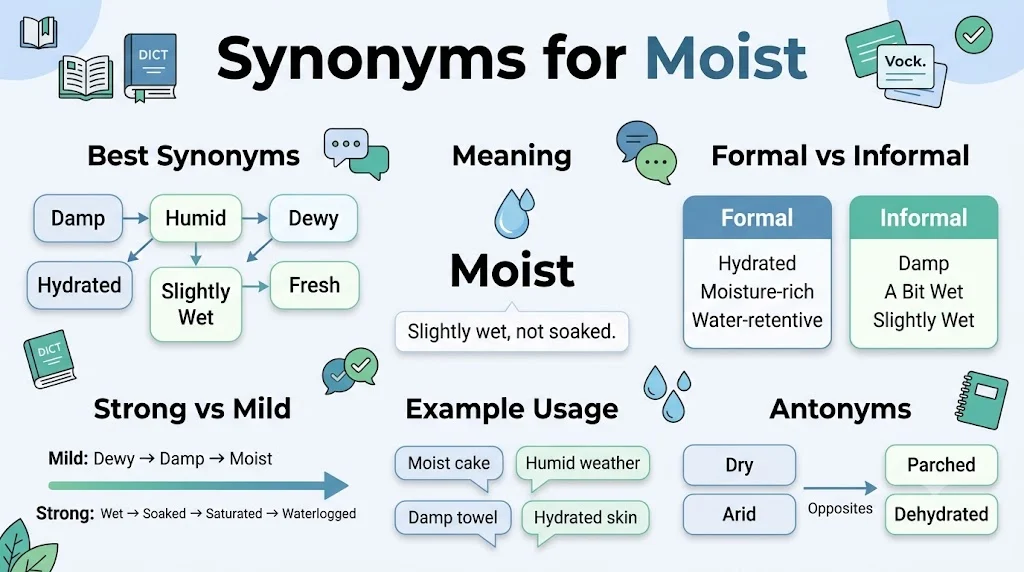
The best synonyms for moist are damp, humid, dewy, and slightly wet. The right choice depends on tone, context, and intensity. For example, damp works well for clothing or weather, humid describes moisture in the air, dewy creates a fresh and natural image, while slightly wet is a simple everyday alternative.
What Does Moist Mean?
Moist means slightly wet or containing a small amount of moisture without being soaked or dripping. It describes something that has enough water to feel soft, fresh, or hydrated but not completely saturated.
It is commonly used as an adjective.
People use the word to describe:
- Freshly baked cakes
- Soil in a garden
- Skin after using lotion
- Warm air containing water vapor
- Towels that have not fully dried
- Leaves covered with morning dew
Example Sentences
- The chocolate cake stayed moist even after two days.
- Keep the soil moist so the young plants can grow properly.
In most situations, moist suggests a pleasant or useful amount of water rather than excessive wetness.
Core Meaning of Moist
At its core, moist describes a balanced level of moisture. It falls between completely dry and fully wet.
Think of it as a middle point.
- Dry skin needs moisturizer.
- Wet skin has visible water.
- Moist skin has enough hydration to feel smooth.
The same idea applies to many objects and environments.
A moist sponge contains water but is not dripping. Moist soil supports healthy plant growth without becoming muddy. Moist air contains water vapor that can make the environment feel warm or sticky.
Because of this balanced meaning, moist often has positive associations when describing food, skincare, gardening, and nature. A moist cake sounds delicious, moist soil sounds healthy, and moist skin usually suggests proper hydration.
However, context matters. Saying that someone’s socks are moist may sound unpleasant because the situation itself is uncomfortable, not because of the word.
Understanding this difference helps you choose a synonym that matches both the object and the feeling you want to create.
Grammar and Usage Notes
Part of Speech
Moist is an adjective.
It describes the condition of a noun.
Examples:
- moist soil
- moist towel
- moist air
- moist cake
- moist skin
Common Sentence Patterns
The word appears naturally in patterns such as:
- keep something moist
- remain moist
- feel moist
- become moist
- slightly moist
- warm and moist
- cool and moist
Examples:
- Keep the towel moist during cleaning.
- The bread remained moist overnight.
- Her skin feels moist after applying lotion.
Common Collocations
Native English speakers often pair moist with these nouns:
Food
- moist cake
- moist bread
- moist muffins
- moist chicken
Nature
- moist soil
- moist ground
- moist forest
- moist climate
Weather
- moist air
- moist breeze
- moist atmosphere
Health & Beauty
- moist skin
- moist lips
- moist eyes
Household
- moist cloth
- moist towel
- moist sponge
Using these natural combinations helps your writing sound fluent.
When Moist Sounds Natural
The word fits naturally when describing:
- food texture
- gardening
- weather
- skincare
- cleaning
- environmental conditions
Examples:
- The cookies stayed moist inside.
- The garden needs moist soil.
- The room felt warm and moist.
When Another Synonym Works Better
Sometimes another word communicates your meaning more clearly.
- Use damp when something feels lightly wet after rain or washing.
- Use humid when discussing weather or air conditions.
- Use dewy when describing plants or nature in a fresh, poetic way.
- Use soggy when something contains too much water and has become unpleasant.
- Use wet when something has visible water on it.
- Choosing the correct synonym makes your writing more accurate and more engaging.
Best Synonyms for Moist
| Synonym | Meaning | Tone | Best Use Case | Example Sentence |
|---|---|---|---|---|
| Damp | Slightly wet | Neutral | Clothing, towels, weather | The jacket was still damp after the rain. |
| Humid | Full of moisture in the air | Neutral | Climate and weather | The air became humid before the storm. |
| Dewy | Covered with tiny drops of water | Descriptive | Plants, skin, mornings | The grass looked dewy at sunrise. |
| Slightly Wet | A little wet | Everyday | General conversation | The floor is slightly wet near the sink. |
| Fresh | Lightly moist and healthy | Positive | Produce, flowers, skincare | Fresh herbs stay moist when refrigerated. |
| Hydrated | Containing enough moisture | Professional | Health and skincare | Drinking water keeps your skin hydrated. |
| Supple | Soft because of proper moisture | Positive | Skin and leather | The lotion kept her skin supple. |
| Saturated* | Completely filled with water | Strong | Technical or scientific writing | The sponge became saturated after soaking. |
*Note: Saturated is related but is stronger than moist and should not always be used as a direct replacement.
Common Synonyms for Moist
These are the everyday alternatives people use most often. Although they share similarities with moist, each has its own meaning and best context.
Damp
Meaning: Slightly wet but not soaked.
Best Context: Clothing, towels, walls, weather, basements, and outdoor surfaces.
Example Sentence:
The towel was still damp after hanging outside for an hour.
Humid
Meaning: Filled with moisture in the air.
Best Context: Weather reports, climate descriptions, and environmental discussions.
Example Sentence:
Summer afternoons are often hot and humid.
Dewy
Meaning: Lightly covered with tiny drops of moisture.
Best Context: Plants, flowers, landscapes, makeup, and healthy-looking skin.
Example Sentence:
The roses looked dewy in the early morning sunlight.
Slightly Wet
Meaning: A small amount of water is present.
Best Context: Everyday conversation when a simple description is enough.
Example Sentence:
Be careful because the kitchen floor is slightly wet.
Fresh
Meaning: Naturally hydrated or full of life.
Best Context: Fruits, vegetables, flowers, herbs, and natural settings.
Example Sentence:
Keep the lettuce fresh by storing it in a sealed container.
Hydrated
Meaning: Having enough moisture to stay healthy.
Best Context: Skincare, health, beauty, and wellness.
Example Sentence:
A good moisturizer helps keep your skin hydrated throughout the day.
Supple
Meaning: Soft, flexible, and maintained by proper moisture.
Best Context: Skin, leather products, and descriptive writing.
Example Sentence:
The conditioner left her hair soft and supple.
Wet
Meaning: Covered with or containing water.
Best Context: General situations where something has visible moisture.
Example Sentence:
His shoes were wet after walking through the puddles.
The words above are the closest everyday synonyms for moist, but they are not always interchangeable. The object being described, the amount of moisture involved, and the tone of your writing all influence which word sounds the most natural. In the next part of this guide, we’ll explore formal, informal, strong, and mild alternatives, along with context-specific word choices and practical examples.
Formal Synonyms for Moist
Formal alternatives are useful in academic papers, business documents, scientific writing, technical manuals, and professional communication. These words often sound more precise than moist and may describe specific types of moisture.
Humid
Meaning: Containing a high level of moisture in the air.
Best for: Weather reports, climate studies, environmental science, and geography.
Example:
The region experiences a humid climate throughout most of the summer.
Hydrated
Meaning: Containing enough water to maintain a healthy condition.
Best for: Medical writing, skincare guides, nutrition, and health-related content.
Example:
Proper hydration helps keep the skin hydrated and healthy.
Moisturized
Meaning: Treated with products that add or retain moisture.
Best for: Beauty, skincare, and cosmetic writing.
Example:
Apply lotion daily to keep your hands moisturized.
Well-Hydrated
Meaning: Having an appropriate amount of moisture.
Best for: Professional health and fitness discussions.
Example:
Well-hydrated skin usually appears smoother and more elastic.
Water-Retentive
Meaning: Able to hold moisture effectively.
Best for: Gardening, agriculture, and soil science.
Example:
Organic compost creates water-retentive soil for healthier plants.
Moisture-Rich
Meaning: Rich in moisture or hydration.
Best for: Product descriptions and beauty marketing.
Example:
The moisturizer contains moisture-rich ingredients for dry skin.
These formal alternatives often sound more specific than moist. Choose them when accuracy and professionalism matter.
Informal Synonyms for Moist
Casual conversations usually call for simpler words that sound natural and easy to understand.
Damp
Tone: Neutral and conversational.
Best Use: Clothing, weather, towels, walls, and outdoor conditions.
Example:
My socks are still damp after the hike.
A Bit Wet
Tone: Friendly and informal.
Best Use: Everyday speech.
Example:
The bench is a bit wet from the rain.
Slightly Wet
Tone: Simple and clear.
Best Use: Daily conversation and instructions.
Example:
The countertop is slightly wet.
Fresh
Tone: Positive and natural.
Best Use: Food, flowers, and produce.
Example:
These herbs stay fresh for several days.
Dewy
Tone: Pleasant and descriptive.
Best Use: Nature, beauty, and photography.
Example:
The grass looked dewy before sunrise.
Informal synonyms are perfect for conversations, blog posts, social media captions, and friendly messages because they sound natural without being overly technical.
Strong Synonyms for Moist
Sometimes you need a word that expresses much more moisture than moist. These stronger alternatives add emphasis but should be used carefully because they often describe a wetter condition.
Soaked
Meaning: Completely filled with water.
Best Context: Heavy rain, clothing, towels, and fabrics.
Example:
His jacket was soaked after walking through the storm.
Saturated
Meaning: Filled to its maximum capacity with moisture.
Best Context: Science, engineering, gardening, and technical writing.
Example:
The soil became saturated after several hours of rain.
Waterlogged
Meaning: Holding too much water.
Best Context: Fields, gardens, and landscapes.
Example:
The garden remained waterlogged for several days.
Soggy
Meaning: Too wet and unpleasant.
Best Context: Food, paper, cardboard, and soft materials.
Example:
The cereal became soggy after sitting in the milk.
Dripping
Meaning: Water is actively falling from something.
Best Context: Clothing, umbrellas, hair, or objects.
Example:
The umbrella was dripping onto the floor.
When to Use Strong Synonyms
Use these words only when something is much wetter than moist. Replacing moist with soaked or soggy changes the meaning significantly and may exaggerate the situation.
Mild Synonyms for Moist
These softer alternatives suggest only a light amount of moisture. They are excellent when you want your writing to sound gentle or subtle.
Slightly Wet
A safe choice for everyday situations.
Example:
The cloth is slightly wet.
Damp
Suggests only a little moisture.
Example:
The pavement remained damp after sunrise.
Dewy
Creates a fresh, delicate image.
Example:
Morning flowers looked dewy and bright.
Soft
Sometimes moisture creates softness rather than visible wetness.
Example:
The freshly baked bread stayed soft for hours.
Fresh
Often implies natural moisture without directly mentioning water.
Example:
Fresh vegetables keep their crisp texture longer.
Mild wording is especially useful when describing food, beauty, gardening, and creative writing because it sounds pleasant instead of excessive.
Synonyms for Moist by Context
The best synonym depends on what you’re describing. A word that sounds perfect in a weather report may sound awkward in a recipe or skincare guide.
Everyday Conversation
In casual speech, readers expect simple and familiar words.
Good choices include:
- damp
- slightly wet
- a bit wet
- fresh
Examples
- The towel is still damp.
- The floor is slightly wet.
- These berries taste fresh.
These words are easy to understand and fit naturally into everyday conversations.
Professional Writing
Professional documents benefit from precise vocabulary.
Recommended synonyms include:
- humid
- hydrated
- moisture-rich
- water-retentive
Examples
- The region has a humid climate.
- The cream keeps skin hydrated.
- Compost improves water-retentive soil.
These choices sound accurate without becoming overly technical.
Academic Writing
Academic writing values clarity and precision.
Suitable alternatives include:
- humid
- hydrated
- saturated
- moisture-containing
Examples
- Humid environments support different plant species.
- The sample remained saturated throughout testing.
Use these words only when they accurately describe the scientific situation.
Creative Writing
Creative writing often benefits from descriptive vocabulary that creates vivid imagery.
Excellent choices include:
- dewy
- fresh
- glistening
- misty
Examples
- Dewy petals reflected the morning sunlight.
- Fresh moss covered the old stone wall.
These words help readers picture the scene more clearly.
Gardening and Nature
Gardening requires words that describe soil and environmental conditions accurately.
Best options include:
- damp
- moist
- humid
- water-retentive
Examples
- Keep the soil moist during germination.
- Damp conditions encourage seed growth.
Avoid stronger words like waterlogged unless the soil actually contains too much water.
Food and Cooking
When describing food, the goal is usually to suggest tenderness and freshness.
Best synonyms include:
- tender
- juicy
- soft
- fresh
Examples
- The brownies stayed soft overnight.
- The chicken remained juicy after roasting.
Although juicy and tender are not exact synonyms, they often communicate the desired texture better than moist depending on the food.
Skincare and Beauty
Beauty writing often focuses on healthy hydration.
Common alternatives include:
- hydrated
- moisturized
- supple
- dewy
Examples
- The serum leaves skin hydrated.
- Her complexion looked dewy after applying the cream.
These words create a more polished and professional tone than repeatedly using moist.
Another Word for Moist in a Sentence
Here are natural examples showing how different synonyms can replace moist depending on the context.
- The towel remained damp after drying outside.
- Summer afternoons are often humid near the coast.
- The flowers looked dewy at sunrise.
- Keep the soil hydrated during hot weather.
- The moisturizer keeps your skin supple all day.
- The kitchen floor is slightly wet, so walk carefully.
- Fresh herbs stay fresh when stored correctly.
- Heavy rain left the field waterlogged.
- The sponge became saturated after soaking in water.
- His shoes were soaked by the sudden downpour.
- The sandwich became soggy after sitting too long.
- The conditioner left her hair soft and moisturized.
- The morning breeze felt warm and humid.
- The bread stayed soft because it was stored properly.
- Dew-covered grass sparkled across the dewy meadow.
These examples show that choosing the right synonym depends on the object, the amount of moisture, and the tone you want to create.
Moist Synonyms Compared
Some synonyms appear similar but have important differences. The table below highlights when each word works best.
| Word | Meaning | Tone | Intensity | Best Use Case |
|---|---|---|---|---|
| Moist | Slightly wet | Neutral | Low | General description |
| Damp | Lightly wet | Neutral | Low | Clothing, walls, towels |
| Humid | Moist air | Neutral | Medium | Weather and climate |
| Dewy | Covered with tiny droplets | Positive | Low | Nature, beauty, plants |
| Hydrated | Contains enough moisture | Professional | Low | Health and skincare |
| Supple | Soft because of moisture | Positive | Low | Skin and leather |
| Saturated | Completely filled with water | Technical | High | Science, soil, materials |
| Soaked | Extremely wet | Everyday | Very High | Clothing and rain |
| Waterlogged | Excessively wet | Technical | Very High | Gardens and fields |
| Soggy | Too wet and unpleasant | Negative | Very High | Food and paper |
The comparison makes one thing clear: although these words belong to the same semantic field, they are not interchangeable. Matching the synonym to the situation helps your writing sound accurate, natural, and engaging.
Words Similar to Moist
Some words are closely related to moist, but they are not exact synonyms. They belong to the same semantic field because they describe water, hydration, texture, or environmental conditions. However, they cannot always replace moist in a sentence.
| Related Word | Why It’s Related | Why It’s Not Always an Exact Synonym | Best Use Case |
|---|---|---|---|
| Wet | Describes the presence of water | Usually suggests more water than moist | General descriptions |
| Dry | The opposite condition | Not a synonym | Comparing moisture levels |
| Humidity | Refers to moisture in the air | A noun, not an adjective | Weather and climate |
| Hydration | Means the process or state of adding water | A noun rather than a replacement | Health and skincare |
| Fresh | Can imply natural moisture | Focuses on quality rather than moisture alone | Food and plants |
| Juicy | Contains plenty of liquid | Used mainly for food and fruit | Cooking and recipes |
| Tender | Soft because of proper moisture | Describes texture instead of moisture itself | Meat and baked goods |
| Soft | May result from moisture | Refers to texture | Food, fabric, and materials |
| Glistening | Appears shiny because of moisture | Describes appearance | Creative writing |
| Misty | Filled with tiny water droplets | Describes weather rather than objects | Nature and weather |
These related words expand your vocabulary, but always check whether they preserve the original meaning before replacing moist.
Antonyms of Moist
Antonyms describe the opposite condition—having little or no moisture.
| Antonym | Meaning | Example Sentence |
|---|---|---|
| Dry | Without moisture | The soil became dry after several sunny days. |
| Arid | Extremely dry | Cacti grow well in arid regions. |
| Parched | Very dry because of heat | The grass looked parched after the heatwave. |
| Dehydrated | Lacking enough water | Dehydrated skin often feels rough. |
| Brittle | Dry and easy to break | The old leaves became brittle during winter. |
| Crispy | Dry enough to become crisp | The chips stayed crispy in the sealed bag. |
Knowing antonyms helps you choose words more precisely when comparing different levels of moisture.
How to Choose the Right Synonym for Moist
Choosing the best synonym is about more than finding another word. Consider the meaning, audience, and context before making a replacement.
Match the Context
Think about what you’re describing.
- Food: tender, juicy, soft
- Weather: humid
- Gardening: damp, moist
- Skincare: hydrated, moisturized
- Nature: dewy
Match the Tone
Formal writing benefits from precise words such as hydrated or humid.
Casual conversations often sound better with damp or slightly wet.
Creative writing may call for descriptive words like dewy or glistening.
Check the Intensity
Not every synonym describes the same amount of moisture.
- Moist → light moisture
- Damp → slightly wet
- Wet → noticeable moisture
- Soaked → completely wet
- Waterlogged → excessive moisture
Using a stronger word than intended can completely change your message.
Think About Your Reader
Choose familiar words when writing for a general audience. Specialized terms are helpful only when readers expect technical language.
Check Whether the Word Is an Exact Synonym
Some words are only related, not interchangeable.
For example:
- Juicy works for fruit but not for weather.
- Humid describes air, not cake.
- Supple describes skin or leather rather than soil.
Keep the Sentence Natural
Always read your sentence aloud after replacing a word. If it sounds awkward, another synonym may fit better.
Prefer Clarity
Simple language is often the strongest choice. If damp communicates your meaning more clearly than a longer alternative, use it.
Common Mistakes When Using Synonyms for Moist
Even experienced writers sometimes choose the wrong alternative. Avoid these common mistakes.
Using a Stronger Word Than Intended
Incorrect:
- The cake was soaked.
Correct:
- The cake was moist.
Soaked suggests too much liquid, which changes the meaning completely.
Confusing Humid with Moist
Incorrect:
- The bread was humid.
Correct:
- The bread was moist.
Humid describes air, not food.
Treating Related Words as Exact Synonyms
Words like fresh, soft, and juicy are related but cannot replace moist in every sentence.
Always check whether the new word keeps the original meaning.
Using Formal Words in Casual Writing
Instead of saying:
- My towel is hydrated.
Say:
- My towel is damp.
The second sentence sounds much more natural.
Using Casual Words in Professional Writing
Scientific or technical documents often require greater precision.
Instead of writing:
- The air felt kind of wet.
Use:
- The air was humid.
Ignoring Context
A synonym that works in gardening may not work in cooking.
Always consider what is being described before choosing a replacement.
Making the Sentence Sound Unnatural
Avoid replacing every occurrence of moist just to add variety. If moist is already the most accurate word, keep it.
Natural writing is always more effective than forced variation.
Quick Synonym List for Moist
Common Synonyms
- Damp
- Wet
- Humid
- Dewy
- Slightly wet
Formal Synonyms
- Hydrated
- Moisturized
- Water-retentive
- Moisture-rich
- Well-hydrated
Informal Synonyms
- A bit wet
- Damp
- Fresh
- Slightly wet
Strong Synonyms
- Soaked
- Saturated
- Waterlogged
- Soggy
- Dripping
Mild Synonyms
- Dewy
- Soft
- Fresh
- Damp
- Slightly wet
Related Words
- Wet
- Hydration
- Humidity
- Tender
- Juicy
- Soft
- Glistening
- Misty
FAQs
What is the best synonym for moist?
The best synonym depends on the context. For most situations, damp, humid, dewy, and slightly wet are the closest alternatives. Each fits a different type of writing or subject.
What is another word for moist?
Another word for moist is damp. Other useful choices include humid, dewy, hydrated, and slightly wet, depending on what you’re describing.
What is a formal synonym for moist?
Hydrated is one of the best formal synonyms. In scientific or environmental writing, humid, moisture-rich, and water-retentive are also appropriate.
What is an informal synonym for moist?
Damp is the most common informal alternative. Everyday expressions such as a bit wet or slightly wet also sound natural in conversation.
What is a stronger word for moist?
Soaked, saturated, and waterlogged are stronger alternatives. They describe much higher levels of moisture than moist.
What is a milder word for moist?
Dewy, soft, and slightly wet suggest gentle or minimal moisture and often create a softer tone.
What words are similar to moist?
Related words include wet, humid, hydrated, fresh, juicy, soft, glistening, and misty. Some are exact synonyms, while others are only related in meaning.
What is the opposite of moist?
Dry is the direct opposite of moist. Other antonyms include arid, parched, dehydrated, and brittle, depending on the context.
How do I choose the right synonym for moist?
Choose a synonym based on context, tone, and intensity. Consider what you’re describing, who your audience is, and whether the replacement preserves the original meaning.
Conclusion
Choosing the right synonyms for moist is about understanding more than just vocabulary. While words like damp, humid, dewy, and hydrated all relate to moisture, each has its own meaning, tone, and ideal context.
you’re writing about food, weather, gardening, skincare, or creative scenes, selecting the most accurate word makes your writing clearer and more engaging. Some alternatives are formal, others are conversational, and a few describe much stronger or milder levels of moisture.
When in doubt, focus on the exact meaning you want to express. Matching the synonym to the situation will help your writing sound natural, professional, and easy to understand.
Read More Related Articles:
Synonyms for Regret | Meaning, Examples, and Better Word …
Synonyms for Empty | Meaning, Examples, and Better Word …