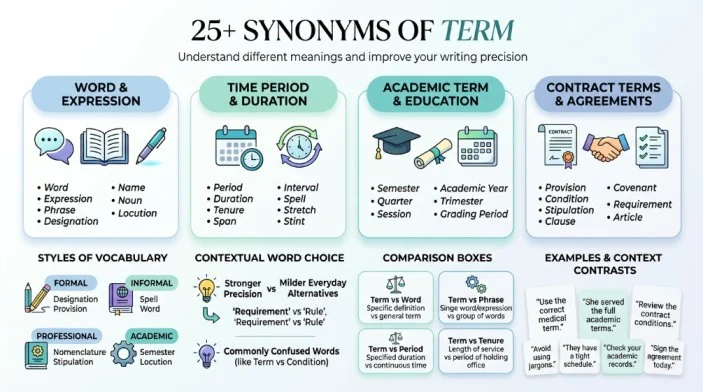
When writing an essay, email, report, blog post, or school assignment, you may notice that the word term does not always express exactly what you mean. In one sentence, it can refer to a technical word. In another, it can describe a period of time, a condition in an agreement, or a mathematical expression. That is why searching for a synonym of term requires attention to context.
The best alternative depends on the sense of the word. Word, expression, and phrase work well when term means a word or expression. Period, duration, and tenure fit time related meanings, while condition, provision, and stipulation work better when discussing agreements. Understanding these differences helps you choose a word that sounds natural, precise, and appropriate for your audience.
What Is the Best Synonym of “Term”?
A term can mean a word or expression used for a particular idea, a period of time, or a condition in an agreement. The best synonym depends on the meaning: use word or expression for language, period or duration for time, and condition or provision for contracts.
For formal and academic writing, expression, designation, phrase, and period can be useful depending on the context. In everyday conversation, word, name, or phrase usually sounds more natural. Professional and legal writing may require more precise alternatives such as provision, condition, stipulation, or tenure.
Meaning, Tone, and Context
Simple Definition
The word term has several meanings in American English. Most commonly, it can refer to a particular word or expression, a fixed period of time, a part of an academic year, or a condition that forms part of an agreement. It also has specialized meanings in mathematics and other fields.
For example:
“Sustainable development is a common term in environmental studies.”
Here, term means a word or expression associated with a particular subject.
In another sentence:
“She served a four year term as president.”
Here, term means a period during which someone holds a position.
The meaning changes with the surrounding words, so replacing term without checking the context can produce an inaccurate sentence.
Part of Speech
Term can function as:
- A noun
- A verb
As a noun, it can refer to a word, period, condition, relationship, mathematical element, or other specialized concept.
As a verb, term means to call or describe something by a particular name. For example:
“Researchers termed the process a major breakthrough.”
Merriam Webster lists call and name among the synonyms for the verb term.
Overall Tone
The tone of term is generally neutral.
It is appropriate in:
- Academic writing
- Professional communication
- Technical writing
- Business documents
- Legal writing
- Everyday conversation
- Educational materials
It does not normally communicate positive or negative emotion by itself.
Formality Level
Term is a neutral word that can work in both formal and informal contexts.
For example:
“What is the correct term for this?”
This sounds natural in everyday speech.
In academic writing:
“The term is commonly used in psychological research.”
In business writing:
“The contract includes several financial terms.”
The surrounding context determines whether a more specialized synonym would be preferable.
Common Uses
Native American English speakers use term in several common ways.
A Word or Expression
“What is the technical term for this process?”
A Period of Time
“The president began a second term.”
A School Period
“The fall term begins in August.”
A Contractual Condition
“Both parties agreed to the terms of the contract.”
A Mathematical Element
“The equation contains three terms.”
A Relationship
The plural terms can describe a relationship or level of agreement.
“They remain on good terms.”
These meanings are established dictionary senses rather than interchangeable uses.
Word Forms
| Form | Use | Example |
|---|---|---|
| Term | Noun | “That is a technical term.” |
| Terms | Plural noun | “Read the terms carefully.” |
| Term | Verb | “Scientists termed the process successful.” |
| Termed | Past tense | “The project was termed a success.” |
| Terming | Present participle | “They are terming the approach innovative.” |
When and How to Use “Term”
Use term when the surrounding context clearly communicates which meaning you intend. The word is particularly useful when discussing specialized vocabulary, official periods, agreements, or technical concepts.
Professional
“The company extended her term as chief financial officer for another year.”
Here, term refers to the period during which someone holds a position.
Academic
“The researcher defines the term before discussing its theoretical implications.”
Here, term refers to a word or concept used within a field of study.
Workplace
“Please review the terms of your employment agreement.”
Here, terms refers to conditions within an agreement.
Personal
“They have remained on good terms since college.”
Here, terms refers to the nature of their relationship.
“Please review the payment terms before approving the invoice.”
Here, terms means conditions governing the transaction.
Resume
“Served a three year term as department coordinator.”
Here, term describes a period of service.
Social Media
“The phrase has become a common term among younger users.”
Here, term refers to a word or expression.
Best Synonyms of “Term”
There is no single replacement that works in every sentence because term has multiple meanings. The best synonym depends on whether you are discussing language, time, agreements, mathematics, or relationships.
Professional Writing: Expression
Use expression when term means a word or phrase used to communicate a particular idea.
“The expression is commonly used in financial reporting.”
This is useful when you want a professional alternative without making the sentence unnecessarily technical.
Academic Writing: Designation
Designation works well when a word or name formally identifies something.
“The official designation was adopted by the research committee.”
It is more formal than term and works especially well when discussing classification or naming.
Business Communication: Provision
When term refers to a specific part of an agreement, provision can be more precise.
“The contract contains a provision covering early termination.”
Use it when discussing a specific contractual requirement rather than the agreement as a whole.
Casual Conversation: Word
When term simply means a word, word is usually the most natural choice.
“I don’t know the word for that.”
There is no need to use the more formal term when ordinary language is sufficient.
Emotional Writing: Name
Name can replace term when discussing what someone or something is called.
“That name carries a lot of meaning for the family.”
It is warmer and more personal than designation.
Creative Writing: Phrase
Phrase is useful when the expression consists of multiple words.
“The phrase became a symbol of the movement.”
It should not be used when term specifically refers to a single technical word unless the context supports it.
Resume Writing: Tenure
When term describes someone’s period in a position, tenure can be an effective professional alternative.
“Her tenure as director lasted six years.”
However, tenure can carry additional implications, especially in education, so it should not automatically replace every use of term.
Workplace Communication: Period
Period works well when term refers broadly to a length or section of time.
“The review period ends on Friday.”
It is especially useful when the focus is on elapsed time rather than an elected or appointed position.
Stronger Meaning: Crucial or Specific
There is no inherently stronger synonym for term because term itself does not express intensity. Instead, precision is the goal.
For example:
“The term used in the report is unclear.”
can become:
“The technical expression used in the report is unclear.”
The second sentence gives readers more information about the type of language being discussed.
Softer Meaning: Word
When you want a simple, accessible alternative, word is often better than term.
“What is the correct word for this?”
This sounds less technical and is suitable for everyday conversation.
When Not to Use “Term”
Although term is flexible, it is sometimes too broad. A more specific word can make the sentence clearer.
When “Term” Is Too General
Less precise:
“The term of the project was six months.”
Better:
“The duration of the project was six months.”
Why:
Duration directly identifies the length of time.
When “Term” Is Too Vague
Less precise:
“The contract contains several terms.”
Better:
“The contract contains several conditions governing payment.”
Why:
Conditions tells readers what kind of contractual terms are being discussed.
When “Term” Is Too Technical
Less natural for general readers:
“What is the appropriate term for this object?”
More conversational:
“What is the right word for this object?”
Why:
Word is simpler and more accessible.
When “Term” Is Too Formal
Less natural in casual speech:
“What term do you use for that?”
More natural:
“What do you call that?”
Why:
Call is more conversational.
When “Term” Is Too Weakly Specific
Less precise:
“The company changed a term in the agreement.”
Better:
“The company changed a provision in the agreement.”
Why:
Provision identifies a specific contractual part.
When “Term” Could Cause Confusion
Ambiguous:
“His term ended last year.”
Clearer:
“His tenure as mayor ended last year.”
Why:
Adding as mayor makes the intended meaning immediately clear.
Words Commonly Confused With “Term”
Word
Difference:
Word is a broad language unit, while term often suggests a word or expression associated with a particular subject.
When to Use It:
Use word when specialized context is not important.
Example:
“I can’t remember the word she used.”
Phrase
Difference:
A phrase consists of multiple words functioning together. A term can be one word or several words.
When to Use It:
Use phrase when the expression itself is made up of multiple words.
Example:
“The phrase ‘customer experience’ appears throughout the report.”
Expression
Difference:
Expression is broader than term. It can refer to a word group, saying, or way of expressing an idea.
When to Use It:
Use it when focusing on language rather than specialized terminology.
Example:
“That expression is common in American English.”
Name
Difference:
A name identifies a person, place, object, or concept. A term can describe a specialized word without functioning as a proper name.
When to Use It:
Use name when identifying something.
Example:
“What is the name of this device?”
Designation
Difference:
Designation emphasizes an official or formal identifying label.
When to Use It:
Use it for classifications, titles, categories, or official names.
Example:
“The product received an official designation.”
Condition
Difference:
A condition is a requirement or circumstance that must be met. It is only a synonym for term when term refers to an agreement’s conditions.
When to Use It:
Use it when discussing requirements in contracts or agreements.
Example:
“One condition of the agreement is timely payment.”
Best Synonyms of “Term” by Context
| Context | Best Synonym | Why It Works | Example |
|---|---|---|---|
| Formal writing | Designation | Highlights formal naming | “The official designation was approved.” |
| Academic writing | Expression | Works naturally for specialized language | “The expression appears in several studies.” |
| Professional communication | Term | Often already precise enough | “The term is used throughout the report.” |
| Business emails | Provision | Useful for specific contract details | “Please review this provision.” |
| Resume writing | Tenure | Describes time in a position | “Her tenure as manager lasted five years.” |
| Workplace communication | Period | Clearly describes a time span | “The review period ends Friday.” |
| Casual conversation | Word | Simple and natural | “What’s the word for that?” |
| Everyday speaking | Name | Natural for identification | “What’s the name of this tool?” |
| Creative writing | Phrase | Useful for memorable wording | “The phrase echoed through the story.” |
| Storytelling | Name | Personal and accessible | “The old name still carried meaning.” |
| Emotional writing | Name | Can carry personal significance | “Her mother’s name meant everything to her.” |
| Strong emphasis | Specific term | Adds precision rather than intensity | “Use the specific term for accuracy.” |
| Mild tone | Word | Simple and neutral | “That’s just another word for it.” |
| Social media captions | Phrase | Natural for slogans or expressions | “That phrase says it perfectly.” |
| American English | Term | Standard for specialized vocabulary | “That’s a common legal term.” |
| British English | Term | Also standard, though school terminology can vary | “The autumn term begins in September.” |
How to Choose the Best Synonym of “Term”
Choosing an alternative starts with identifying which meaning of term you are using.
Step 1: Identify the Meaning
Ask whether term means:
- A word or expression
- A period of time
- A school period
- A contractual condition
- A mathematical element
- A relationship or agreement
Once you identify the sense, the appropriate alternatives become much easier to find.
Step 2: Consider Your Audience
For general readers, word, phrase, and period are usually easy to understand.
For specialists, designation, provision, tenure, or another field specific word may provide greater precision.
Step 3: Match the Formality
- Use word in casual conversation.
- Use expression or designation in more formal language.
- Use provision or stipulation in legal and business contexts when appropriate.
Step 4: Check Emotional Meaning
Most alternatives for term are neutral.
Words such as name, nickname, or moniker can add a personal or informal quality.
Step 5: Check the Exact Meaning
Do not replace term simply because another word looks similar.
For example:
“The term of the contract is two years.”
The best alternative is:
“The duration of the contract is two years.”
Replacing term with word would completely change the meaning.
Step 6: Choose Natural English
The most sophisticated synonym is not always the best one.
“What is the correct designation for this?”
may sound overly formal in casual conversation.
“What is the right word for this?”
is usually more natural.
Real Life Examples of “Term”
School
“The fall term begins in late August.”
Here, term refers to a division of the academic year.
College
“Students must register before the new term begins.”
The word fits naturally in an educational context.
Workplace
“Her term as department chair ends in June.”
Here, term refers to the period of service in a role.
Business
“The contract terms require payment within thirty days.”
Here, terms refers to contractual conditions.
“Please review the payment terms before signing the agreement.”
Payment terms is a standard business expression.
Resume
“Completed a four year term as operations manager.”
In a resume, a more specific construction may often be better:
“Served as operations manager for four years.”
The second version is more direct because it focuses on the actual experience.
Conversation
“What’s the term for someone who studies insects?”
Here, term naturally refers to specialized vocabulary.
Storytelling
“The old phrase had become a familiar term in the village.”
The word works because the story is discussing language used by a community.
Blogging
“The term ‘search intent’ appears frequently in SEO discussions.”
Here, term identifies specialized vocabulary.
Social Media
“That phrase has become a popular term online.”
This is natural when discussing language and online culture.
25 Best Synonyms of “Term”
Because term has several dictionary senses, the following table groups accurate alternatives according to the particular meaning they can replace. Not every word below can replace term in every sentence. Context determines which alternative is accurate. Merriam Webster and Cambridge Dictionary both distinguish several major senses of term, including word or expression, time period, school period, contractual conditions, and mathematical usage.
| Synonym | Simple Meaning | Best Used For | Example Sentence |
|---|---|---|---|
| Word | A unit of language | General language | “What word describes this process?” |
| Expression | A word or group of words conveying an idea | Language and writing | “The expression is common in academic writing.” |
| Phrase | A group of words used together | Multiword language | “That phrase appears in the article.” |
| Name | A word used to identify something | Identification | “What is the name of this device?” |
| Designation | An official identifying name | Formal contexts | “The product received a new designation.” |
| Label | A word or phrase identifying something | Categories and descriptions | “The label accurately describes the product.” |
| Appellation | A name or title | Formal or literary writing | “The city earned the appellation ‘The Emerald City.'” |
| Title | A name identifying a work, role, or position | Roles and publications | “The title reflects the article’s main subject.” |
| Wording | The particular language used | Written communication | “The wording of the agreement needs revision.” |
| Locution | A particular expression or style of saying something | Linguistics and formal writing | “The unusual locution appears throughout the text.” |
| Moniker | An informal name | Casual writing | “The athlete earned the moniker ‘The Rocket.'” |
| Nickname | An informal alternative name | People and places | “The city has a popular nickname.” |
| Epithet | A descriptive name or title | Literature and history | “The king was remembered by a famous epithet.” |
| Denomination | An identifying name or category | Formal classification | “The denomination appears on the official document.” |
| Identifier | Something used to identify | Technical contexts | “The system assigns each record a unique identifier.” |
| Period | A length or division of time | Time | “The study covered a five year period.” |
| Duration | The length of time something lasts | Formal time descriptions | “The duration of the agreement is two years.” |
| Tenure | The period someone holds a position | Employment and office | “Her tenure as director was successful.” |
| Stint | A period spent doing a particular activity | Informal time descriptions | “He completed a two year stint abroad.” |
| Span | The total length of time or extent | Time and range | “The project had a short development span.” |
| Interval | A period between events | Time | “The machine was tested at regular intervals.” |
| Semester | One half of an academic year | U.S. education | “The course is offered next semester.” |
| Quarter | One fourth of an academic or financial year | U.S. education and business | “Sales increased during the final quarter.” |
| Condition | A requirement in an agreement | Contracts | “One condition requires written approval.” |
| Provision | A specific part of an agreement | Legal and business writing | “The contract includes a provision for refunds.” |
Synonyms of “Term” by Usage
Professional vs Personal Synonyms
In professional contexts, designation, provision, tenure, period, and expression may be more precise than general alternatives.
In personal conversation, word, name, phrase, and nickname are usually more natural.
For example:
Professional: “The official designation has changed.”
Personal: “What’s the new name for it?”
Both sentences discuss identification, but the vocabulary matches the setting.
Formal vs Conversational Synonyms
Formal writing may use:
- Designation
- Expression
- Provision
- Stipulation
- Duration
- Tenure
Conversational English usually favors:
- Word
- Name
- Phrase
- Period
- Time
Compare:
Formal: “The duration of the agreement is twelve months.”
Conversational: “The agreement lasts for a year.”
The second sentence is simpler without losing the essential meaning.
Academic Synonyms
Academic writing often requires precise language.
Useful alternatives include:
- Expression
- Designation
- Phrase
- Period
- Duration
- Semester
- Quarter
- When discussing terminology:
“The term is frequently used in sociological research.”
- When focusing on the language itself:
“The expression appears in several theoretical frameworks.”
- When discussing time:
“The study covered a six month period.”
Precision matters more than using a complicated synonym.
Professional and Business Synonyms
Business writing frequently uses terms when discussing agreements.
For resumes:
“Served as project manager for three years.”
is usually more direct than:
“Completed a three year term as project manager.”
For contracts:
“The agreement includes a payment provision.”
may be more precise than:
“The agreement includes a payment term.”
For client communication:
“Please review the payment conditions.”
can be clearer when the reader needs to understand specific requirements.
Creative and Literary Synonyms
Creative writing allows more expressive alternatives.
Name can emphasize identity.
Nickname can reveal character relationships.
Epithet can create a historical or literary feeling.
Phrase can highlight memorable language.
Locution can draw attention to unusual speech.
Example:
“The villagers still whispered the old nickname.”
This is more vivid than repeatedly using the general word term.
Slang or Modern Synonyms
There is no single modern slang equivalent that universally replaces term.
For informal naming, moniker can work:
“The artist picked up the moniker ‘The Voice.'”
For social media and casual conversation, name, nickname, and handle may be useful when discussing online identities.
However, these words are narrower than term. A handle is an online name, while a nickname is an informal personal name.
Strongest to Mildest Synonyms
Unlike words such as important or angry, term does not naturally have an intensity scale. Its synonyms vary mainly by specificity, formality, and meaning, not emotional strength.
A useful precision scale is:
General: word, name, term
More specific: phrase, expression, label, designation
Highly specific: provision, stipulation, tenure, semester, quarter
For example:
“The term is unclear.”
- is broad.
“The technical expression is unclear.”
- is more specific.
“The contractual provision is unclear.”
- is highly specific because it identifies the legal or business sense.
Emotional vs Neutral Synonyms
Emotional Synonyms
Some alternatives can carry additional personal or stylistic associations.
- Name
- Nickname
- Moniker
- Epithet
- Appellation
For example:
“His nickname reminded everyone of his childhood.”
The word nickname adds a personal dimension.
Neutral Synonyms
These alternatives are generally objective:
- Word
- Expression
- Phrase
- Period
- Duration
- Designation
- Provision
- Condition
- Semester
Use neutral alternatives in academic papers, reports, business documents, and informational content when you want clarity without emotional coloring.
Antonyms of “Term”
The word term does not have one clear opposite because it has several unrelated meanings. A word meaning “a specialized expression” cannot have the same antonym as a word meaning “a period of time” or “a contractual condition.” Major dictionaries likewise treat these as separate senses.
For accuracy, it would be misleading to invent 15 supposed antonyms. Instead, the following are useful contrasting words by sense, not strict antonyms:
| Contrast Word | Meaning | Example |
|---|---|---|
| Indefinite | Without a fixed limit | “The agreement has an indefinite duration.” |
| Permanent | Continuing without a planned end | “She accepted a permanent position.” |
| Temporary | Existing for a limited time | “The position is temporary.” |
| General language | Nontechnical communication | “The article avoids specialized language.” |
| Informal language | Casual communication | “The message uses informal language.” |
| Unspecified | Not clearly identified | “The duration remains unspecified.” |
| Unlimited | Without a defined boundary | “The service offers unlimited access.” |
| Continuous | Continuing without interruption | “The process operates continuously.” |
| Unconditional | Not dependent on a condition | “The offer was unconditional.” |
| Optional | Not required | “Attendance is optional.” |
| Unrestricted | Without imposed limits | “The account provides unrestricted access.” |
| Permanent status | A status without a fixed term | “The employee received permanent status.” |
| Open ended | Having no stated endpoint | “The discussion remained open ended.” |
| Nontechnical wording | Language without specialized terminology | “The guide uses nontechnical wording.” |
| Freedom from conditions | Absence of contractual requirements | “The arrangement provides greater freedom from conditions.” |
These are contextual contrasts, not dictionary antonyms. Treating them as direct antonyms would create inaccurate vocabulary guidance.
Comparison: “Term” vs Similar Words
Term vs Word
Main Difference
Term can mean a word, but it often suggests that the word has a particular meaning within a subject or context. Word is much broader.
Which Is Stronger?
Neither is stronger. Term is more specific when discussing specialized language.
Which Is More Formal?
Term can sound more technical, while word is neutral and broadly accessible.
When to Use Each
Use term for technical or subject specific vocabulary.
Use word for general language.
Examples
Term:
“Photosynthesis is a scientific term.”
Word:
“I forgot the word she used.”
Term vs Expression
Main Difference
An expression can be any way of expressing an idea, while a term often identifies specialized vocabulary.
Which Is Stronger?
Neither.
Which Is More Formal?
Both can work in formal writing.
When to Use Each
Use expression when focusing on language or phrasing. Use term when the expression belongs to a specific field.
Examples
Term:
“The term is common in economics.”
Expression:
“The expression sounds unusual in this context.”
Term vs Phrase
Main Difference
A phrase is a group of words. A term may consist of one word or multiple words.
Which Is Stronger?
Neither.
Which Is More Formal?
Both are neutral.
When to Use Each
Use phrase when the grammatical or linguistic structure matters.
Examples
Term:
“Inflation is an economic term.”
Phrase:
“The phrase ‘cost of living’ appears throughout the report.”
Term vs Period
Main Difference
Term can refer to a fixed period, while period broadly refers to a length or division of time.
Which Is Stronger?
Neither.
Which Is More Formal?
Both are suitable for formal writing.
When to Use Each
Use term for elected office, academic periods, or other defined durations. Use period for general lengths of time.
Examples
Term:
“She began her second term in office.”
Period:
“The study lasted for a six month period.”
Term vs Tenure
Main Difference
Tenure specifically focuses on the time someone holds a position, especially a job or office. Term is broader.
Which Is Stronger?
Neither.
Which Is More Formal?
Tenure often sounds more formal and professional.
When to Use Each
Use tenure when the person’s time in a position is the main point.
Examples
Term:
“His term as mayor ends in December.”
Tenure:
“His tenure as mayor lasted eight years.”
Term vs Condition
Main Difference
A condition is a requirement or circumstance. A term can refer to a condition when discussing an agreement.
Which Is Stronger?
Neither.
Which Is More Formal?
Both work in business and legal writing.
When to Use Each
Use condition when emphasizing what must happen or be satisfied.
Examples
Term:
“The contract contains several terms.”
Condition:
“One condition requires payment in advance.”
Common Phrases and Expressions with “Term”
Long Term
Meaning: A period extending far into the future.
Example:
“We are making this investment with long term growth in mind.”
Short Term
Meaning: A relatively near period of time.
Example:
“The decision may reduce costs in the short term.”
Term of Office
Meaning: The period during which someone holds an elected or appointed position.
Example:
“Her term of office ends next January.”
School Term
Meaning: A division of the academic year.
Example:
“Students return at the beginning of the fall term.”
Terms of the Agreement
Meaning: The conditions and provisions governing an agreement.
Example:
“Both parties accepted the terms of the agreement.”
On Good Terms
Meaning: Having a friendly or positive relationship.
Example:
“They remained on good terms after leaving the company.”
Come to Terms
Meaning: To reach agreement or accept a difficult situation, depending on context.
Example:
“After several meetings, the two sides finally came to terms.”
In Simple Terms
Meaning: Explained in an easier or less technical way.
Example:
“In simple terms, the system stores the information securely.”
Common Mistakes to Avoid
1. Treating Every Synonym as Interchangeable
Incorrect:
“The word ‘duration’ is a synonym of term in every situation.”
Better:
“Duration can replace term when the meaning involves length of time.”
Why:
Synonyms are often context dependent. Duration cannot replace term when term means a technical word.
2. Confusing “Term” With “Word”
Incorrect:
“The contract contains several words that control payment.”
Better:
“The contract contains several terms that control payment.”
Why:
Here, terms refers to contractual conditions, not ordinary vocabulary.
3. Using “Tenure” for Every Time Period
Incorrect:
“The tenure of the project was six months.”
Better:
“The duration of the project was six months.”
Why:
Tenure normally focuses on someone’s period in a position or role.
4. Using “Phrase” for a Single Technical Word
Incorrect:
“Photosynthesis is a scientific phrase.”
Better:
“Photosynthesis is a scientific term.”
Why:
A phrase normally consists of multiple words, while term can refer to a single specialized word.
5. Using “Designation” in Casual Conversation
Incorrect:
“What is the designation of this?”
Better:
“What is the name of this?”
Why:
Designation can sound unnecessarily formal in everyday conversation.
6. Using Informal Alternatives in Legal Writing
Incorrect:
“The deal has a few names about payment.”
Better:
“The agreement contains several provisions concerning payment.”
Why:
Legal and business writing requires precise terminology.
7. Ignoring the Meaning of “Term”
Incorrect:
“The term lasted five years.”
Better:
“The contract period lasted five years.”
Why:
The original sentence is grammatically possible but ambiguous. Adding the relevant context improves clarity.
Frequently Asked Questions
1. What is the best synonym of “term”?
The best synonym of term depends on its meaning. Use word or expression for specialized language, period or duration for time, and condition or provision for agreements.
2. What are the best formal synonyms of “term”?
Formal alternatives include designation, expression, provision, stipulation, duration, and tenure. Choose based on meaning rather than formality alone, because these words apply to different senses of term.
3. What are common informal synonyms of “term”?
For the language sense, common alternatives include word, name, and phrase. For naming a person informally, nickname or moniker may work, although each has a narrower meaning.
4. What is another word for “term” in professional writing?
Professional alternatives include expression, designation, period, tenure, provision, and condition. The best choice depends on whether you mean terminology, time, employment, or contractual requirements.
5. What is the difference between “term” and “word”?
A word is a general unit of language, while a term often refers to a word or expression associated with a particular subject or specialized meaning. For example, photosynthesis is a scientific term.
6. What is the opposite of “term”?
There is no single direct opposite of term because the word has several unrelated meanings. Depending on context, contrasting ideas may include indefinite, permanent, unrestricted, or unspecified, but these are not universal antonyms.
Conclusion
The best synonym of term depends entirely on what term means in a particular sentence. When it refers to language, word, expression, phrase, and designation can be useful. When it describes time, period, duration, tenure, and stint may be more accurate. For agreements, condition, provision, and stipulation can provide greater precision.
The most effective vocabulary choice is not necessarily the most formal word. Choose the alternative that preserves the original meaning, fits your audience, and sounds natural in the sentence. A useful vocabulary habit is to identify the exact sense of a word before searching for its replacement. That one step prevents many synonym mistakes and makes your writing clearer.
Read More Related Articles:
- Synonyms for Empty | Meaning, Examples, and Better Word …
- Synonyms for Creativity | Meaning, Examples, and Better …
- Synonyms for Pros and Cons | Meaning, Examples, and Better …










2 thoughts on “25+ Synonyms of Term | Meanings, Uses, Examples, and Best Alternatives”