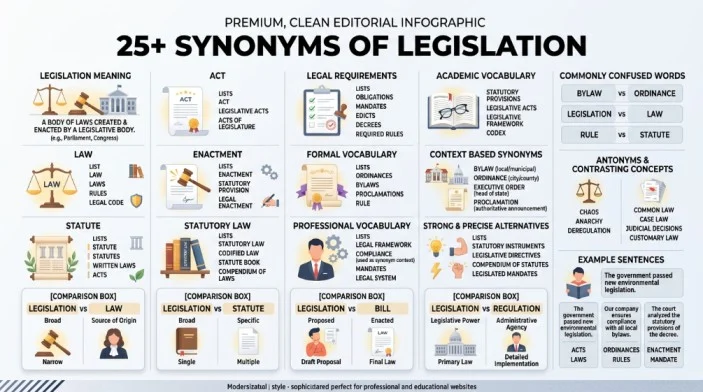
Synonyms of Legislation can make legal, academic, political, and professional writing more precise and easier to understand. The right alternative depends on what you mean by legislation. In some contexts, words such as law, statute, bill, act, regulation, or legal measure may work, but they are not always interchangeable. Understanding these differences helps you choose a word that accurately matches the stage, authority, and purpose of a legal rule.
Strong vocabulary matters when writing about government decisions, proposed laws, public policy, or legal frameworks. Synonyms of Legislation are especially useful for avoiding repetition while keeping your meaning accurate. This guide focuses on practical usage, tone, and context so you can select alternatives confidently in essays, reports, articles, legal discussions, and professional communication.
What Are the Best Synonyms of “Legislation”?
Legislation generally means laws made by a legislative body, or the process and collection of laws created through legislation. The most useful alternatives are law, statute, act, enactment, statutory law, and legislative measures. For formal writing, statute and enactment are precise, while law is the most natural everyday alternative.
Meaning, Tone, and Context
Simple Definition
Legislation refers to laws created or passed by a legislative body. It can also refer collectively to laws dealing with a particular subject, such as environmental legislation, tax legislation, or labor legislation.
The word can therefore describe either individual legal measures or a broader body of laws, depending on context.
Part of Speech
Legislation is a noun.
It is generally used as an uncountable noun when referring to lawmaking or a body of laws:
“The government introduced new legislation.”
When referring to individual pieces of legislation, English commonly uses expressions such as a law, a statute, an act, or a piece of legislation.
Overall Tone
Legislation has a neutral and formal tone. It is not inherently positive or negative.
The emotional effect depends on the subject being discussed:
“The legislation protects consumers.”
- Here, the word appears in a positive context.
“The legislation created additional reporting requirements.”
- Here, it is neutral.
“Critics argued that the legislation would restrict access to services.”
- Here, the surrounding language creates a negative context.
Formality Level
Legislation is primarily formal or semi formal vocabulary.
It is common in:
- Government documents
- Legal writing
- News reporting
- Academic research
- Policy analysis
- Business communication
- Political discussions
- Public administration
- Regulatory writing
In casual conversation, people often use law instead.
Common Uses
Native English speakers commonly use legislation when discussing:
- New laws
- Proposed legal changes
- Government policy
- Public regulation
- Tax rules
- Environmental protection
- Employment rights
- Consumer protection
- Health and safety requirements
- Criminal justice
- Financial regulation
- Immigration policy
Word Forms
| Form | Word | Example |
|---|---|---|
| Noun | legislation | “The legislation was approved.” |
| Related noun | legislator | “The legislator supported the proposal.” |
| Related noun | legislature | “The legislature debated the measure.” |
| Verb | legislate | “Congress can legislate on the issue.” |
| Adjective | legislative | “The committee began its legislative work.” |
A useful distinction is that legislation refers to laws or lawmaking, while legislature refers to the institution or body responsible for making laws.
When and How to Use “Legislation”
Use legislation when discussing laws as a category, the process of creating laws, or a specific legislative measure in a formal context. It is particularly useful when the legal or governmental setting matters.
Professional
“The company reviewed the new legislation before updating its compliance procedures.”
Here, legislation fits because the sentence concerns legal requirements affecting an organization.
Academic
“The study examines how environmental legislation has influenced corporate behavior.”
The term works well in academic writing because it refers broadly to laws concerning environmental policy.
Workplace
“Employees should understand the legislation governing workplace safety.”
This usage emphasizes the legal framework surrounding workplace practices.
Personal
“The new legislation could affect how families access childcare services.”
Although law could also work, legislation gives the sentence a more formal public policy tone.
“We are monitoring the new legislation and will update our procedures if necessary.”
This is appropriate for a professional email involving legal or regulatory developments.
Resume
“Monitored changes in employment legislation and advised management on compliance requirements.”
The word demonstrates familiarity with legal and regulatory responsibilities.
Social Media
“The new legislation could have a major impact on small businesses.”
For casual social media, law may sound more conversational, but legislation is appropriate when discussing public policy.
Best Synonyms of “Legislation”
There is no single synonym that works perfectly in every sentence. Law is the broadest and most natural alternative, while statute, act, and enactment are more specific legal terms.
Professional Writing: Statutory Law
Statutory law is useful when you need to distinguish laws created by a legislature from other sources of law, such as court decisions.
“The policy must comply with applicable statutory law.”
Academic Writing: Legislation
Sometimes the best alternative is actually to retain legislation because it is precise and widely accepted in academic discussions of law and public policy.
“The research evaluates the effects of environmental legislation.”
Business Communication: Legal Requirements
Legal requirements can be better than legislation when the practical obligations imposed on a business matter more than the lawmaking process.
“The company updated its procedures to meet new legal requirements.”
Casual Conversation: Law
Law is usually the most natural choice in everyday English.
“The new law changes how drivers are licensed.”
Emotional Writing: Law
Even in emotional writing, law is usually more natural than an elaborate legal synonym.
“The new law gave families greater protection.”
Creative Writing: Decree
Decree can work in historical or fictional writing when referring to an authoritative official order. It should not be treated as a universal synonym for modern legislation.
“The king issued a decree protecting the village.”
Resume Writing: Regulatory Requirements
Regulatory requirements can be useful on a resume when the writer wants to show practical compliance experience.
“Ensured operations complied with changing regulatory requirements.”
Workplace Communication: Legal Requirements
This phrase is often clearer when employees need to understand what they must do.
“Managers must follow all applicable legal requirements.”
Stronger Meaning: Enactment
Enactment emphasizes the formal creation or passage of a law.
“The enactment of the new measure changed the regulatory framework.”
Softer or Broader Meaning: Legal Framework
Legal framework is broader and less focused on individual laws.
“The legal framework provides guidance for businesses operating in the sector.”
When Not to Use “Legislation”
When “Law” Is Simpler
Legislation can sound unnecessarily formal in ordinary conversation.
Less natural:
“You must obey the relevant legislation.”
More natural:
“You must obey the law.”
The second sentence is simpler and more conversational.
When You Mean One Specific Statute
If you are discussing a particular written law, statute or act may be more precise.
Less precise:
“The legislation was passed in 1990.”
More precise:
“The statute was enacted in 1990.”
The second version signals that the writer is referring to a specific statutory law.
When You Mean a Proposed Bill
A bill is not the same thing as enacted legislation.
Less accurate:
“The legislation is still being debated in Congress.”
If the measure has not yet become law, a better choice may be:
“The bill is still being debated in Congress.”
This distinction is especially important in legal and political writing.
When You Mean a Court Decision
A court decision is not legislation.
Incorrect:
“The court created new legislation in its ruling.”
Better:
“The court issued a ruling that changed the interpretation of the law.”
Legislatures create legislation, while courts issue decisions and interpret laws.
When You Mean a Regulation
Regulation can refer to rules created by an administrative agency under authority granted by law. It may be related to legislation, but it is not always interchangeable with it.
Less precise:
“Congress passed a new regulation.”
Better:
“The agency issued a new regulation.”
When You Mean the Lawmaking Process
Sometimes lawmaking is more accurate than legislation.
“The committee plays an important role in the lawmaking process.”
Here, the focus is on the activity of creating laws rather than the laws themselves.
Words Commonly Confused With “Legislation”
Law
Difference:
Law is the broadest everyday term for rules recognized and enforced by a legal system.
When to Use It:
Use it for general audiences and everyday communication.
Example:
“The law protects consumers from deceptive business practices.”
Statute
Difference:
A statute is a specific written law enacted by a legislature.
When to Use It:
Use it when discussing a particular legislative law.
Example:
“The statute establishes new reporting requirements.”
Bill
Difference:
A bill is a proposed law that has not necessarily been enacted.
When to Use It:
Use it when discussing proposed legislation before passage.
Example:
“The bill is currently under consideration by lawmakers.”
Regulation
Difference:
A regulation is generally a rule issued by an authorized administrative agency.
When to Use It:
Use it when discussing detailed rules governing conduct or industries.
Example:
“The agency introduced new regulations for financial institutions.”
Policy
Difference:
A policy is a plan, principle, or approach, and it does not necessarily have the force of law.
When to Use It:
Use it when discussing organizational or governmental goals and approaches.
Example:
“The government introduced a new policy on renewable energy.”
Decree
Difference:
A decree is an official order issued by an authority, particularly in certain governmental or historical systems.
When to Use It:
Use it when the legal or historical context specifically involves an authoritative decree.
Example:
“The ruler issued a decree banning the practice.”
Best Synonyms of “Legislation” by Context
| Context | Best Synonym | Why It Works | Example |
|---|---|---|---|
| Formal writing | Statute | Precisely identifies a written law. | “The statute established new protections.” |
| Academic writing | Legislative measures | Useful for discussing legal actions collectively. | “Several legislative measures addressed the issue.” |
| Professional communication | Legal requirements | Focuses on practical obligations. | “The company must meet legal requirements.” |
| Business emails | New law | Clear and accessible. | “The new law may affect our operations.” |
| Resume writing | Regulatory requirements | Highlights compliance experience. | “Managed compliance with regulatory requirements.” |
| Workplace communication | Legal requirements | Makes employee obligations clear. | “Staff must follow applicable legal requirements.” |
| Casual conversation | Law | Natural and familiar. | “The new law starts next month.” |
| Everyday speaking | Law | Easier to understand than technical alternatives. | “That law applies to everyone.” |
| Creative writing | Decree | Works in historical or fictional settings. | “The decree changed the kingdom’s rules.” |
| Storytelling | Act | Useful when referring to a named law. | “The Act changed the lives of thousands.” |
| Emotional writing | Law | Keeps the language direct and human. | “The law finally gave them protection.” |
| Strong emphasis | Statutory requirements | Highlights legally binding obligations. | “Businesses must meet statutory requirements.” |
| Mild tone | Legal framework | Broader and less forceful. | “The legal framework supports investment.” |
| Social media captions | Law | Short, familiar, and accessible. | “The new law takes effect soon.” |
| American English | Law, statute, act | These are standard U.S. legal terms. | “The statute was enacted by the legislature.” |
| British English | Law, legislation, Act | These are also common in British legal contexts. | “Parliament passed the Act.” |
How to Choose the Best Synonym of “Legislation”
The easiest way to select the right word is to identify exactly what you are describing.
If You Mean Laws Generally
Choose law.
“The law protects workers.”
If You Mean One Specific Written Law
Choose statute or act.
“The statute requires employers to provide notice.”
If You Mean a Proposed Law
Choose bill.
“The bill is awaiting a vote.”
If You Mean Rules Created by an Agency
Choose regulation.
“The agency issued new regulations.”
If You Mean Legal Obligations
Choose legal requirements or statutory requirements.
“Businesses must meet statutory requirements.”
If You Mean the Broader Legal System
Choose legal framework.
“The legal framework provides protection for investors.”
If You Mean the Process of Creating Laws
Choose lawmaking.
“The committee participates in the lawmaking process.”
Consider Your Audience
For a general audience, law is usually easiest.
For lawyers, researchers, or policy professionals, more precise terms such as statute, enactment, statutory provisions, and legislative measures may communicate the intended meaning more accurately.
Consider the Stage of the Law
This is one of the most important distinctions:
Proposed: bill
Passed by legislature: enacted law or act, depending on the legal system
Existing body of law: legislation or statutory law
Administrative rules: regulations
Judicial interpretation: court decision or ruling
Using the correct term makes legal and policy writing much clearer.
Real Life Examples of “Legislation”
School
Instead of:
“The legislation is important for students.”
Try:
“Education legislation can directly affect school funding and student services.”
College
Instead of:
“The legislation changed university policies.”
Try:
“New legislation changed the legal requirements governing university programs.”
Workplace
“The company reviewed new workplace legislation before changing its employee handbook.”
Business
“Changes in tax legislation may influence the company’s financial planning.”
“We are reviewing the new legislation and will provide updated guidance to staff next week.”
Resume
“Monitored employment legislation and supported compliance with changing legal requirements.”
Conversation
“The new law could affect how people use the service.”
Storytelling
“The new act transformed the rules that had governed the town for decades.”
Blogging
“Recent environmental legislation has created new responsibilities for manufacturers.”
Social Media
“The new law could change how small businesses operate.”
25 Best Synonyms of “Legislation”
Strictly speaking, not all alternatives below are interchangeable in every legal context. Some are contextual equivalents that refer to legislation from a particular angle. This distinction matters because legal vocabulary is more precise than ordinary synonym lists suggest.
| Synonym or Contextual Alternative | Simple Meaning | Best Used For | Example Sentence |
|---|---|---|---|
| Law | A rule recognized and enforced by a legal system | Everyday and general writing | “The new law protects consumers.” |
| Statute | A written law enacted by a legislature | Specific laws | “The statute establishes new standards.” |
| Act | A formally enacted piece of legislation | Named laws | “The Act introduced new protections.” |
| Enactment | The formal creation or passage of a law | Legal and academic writing | “The enactment changed the regulatory system.” |
| Statutory law | Law created through legislative enactment | Legal writing | “The rule is based on statutory law.” |
| Legislative measures | Actions or laws adopted through a legislature | Policy analysis | “Several legislative measures addressed the problem.” |
| Legislative enactments | Laws formally adopted by lawmakers | Formal legal writing | “The court reviewed earlier legislative enactments.” |
| Legal provisions | Specific rules or requirements contained in law | Contracts and legal analysis | “The legal provisions protect employees.” |
| Statutory provisions | Specific rules contained in statutes | Legal writing | “The statutory provisions require disclosure.” |
| Body of laws | A collection of laws on a subject | General explanation | “The body of laws has evolved over time.” |
| Body of statutes | A collection of enacted statutes | Formal legal writing | “The body of statutes covers consumer protection.” |
| Legal framework | The broader structure of applicable law | Policy and business writing | “The legal framework supports fair competition.” |
| Statutory framework | The structure created by statutes | Academic and legal writing | “The statutory framework governs the program.” |
| Legal measures | Actions taken through legal authority | General formal writing | “The government adopted legal measures.” |
| Legislative framework | The laws and legislative structure governing an issue | Policy analysis | “The legislative framework requires regular reporting.” |
| Legislative action | Action taken by a legislature | Political reporting | “The legislature took legislative action on the issue.” |
| Lawmaking | The process of creating laws | Education and policy writing | “Public debate can influence lawmaking.” |
| Lawmaking measures | Steps or measures involved in creating laws | Formal discussion | “The committee proposed several lawmaking measures.” |
| Public law | Law concerning government and public interests | Legal classification | “The dispute involves principles of public law.” |
| Regulatory law | Laws and legal rules concerning regulation | Regulatory discussions | “Regulatory law affects financial institutions.” |
| Tax legislation | Laws dealing specifically with taxation | Tax discussions | “New tax legislation affects small businesses.” |
| Labor legislation | Laws concerning employment and labor | Workplace policy | “Labor legislation protects certain employee rights.” |
| Environmental legislation | Laws concerning environmental matters | Environmental policy | “Environmental legislation sets pollution standards.” |
| Criminal legislation | Laws dealing with criminal offenses | Criminal law discussions | “Criminal legislation defines prohibited conduct.” |
| Domestic legislation | Laws applicable within a particular country | International comparisons | “The treaty must be implemented through domestic legislation.” |
Synonyms of “Legislation” by Usage
Professional vs Personal Synonyms
In professional settings, precision is more valuable than simply replacing a repeated word.
Use:
- Statutory requirements
- Legal requirements
- Regulatory requirements
- Legislative measures
- Statutory provisions
In personal conversations, simpler language is usually better:
- Law
- New law
- Rules, when the context genuinely refers to rules rather than legislation itself
For example, a compliance officer might write:
“The organization must comply with the applicable statutory requirements.”
A friend might simply say:
“The new law changes the rules.”
Formal vs Conversational Synonyms
- For reports and academic papers, statute, enactment, legislative measures, and statutory provisions can provide greater precision.
- For business emails, law, legal requirements, or new legislation are often clearer.
- For casual conversation and texting, law is usually the most natural option.
Academic Synonyms
Academic writing benefits from terms that identify the legal concept accurately.
Useful choices include:
- Statutory law
- Legislative measures
- Legislative enactments
- Statutory provisions
- Legal framework
- Legislative framework
- Enactment
These alternatives help distinguish between the law itself, individual legal provisions, the legislative process, and the wider legal structure.
Professional and Business Synonyms
Resumes
Use regulatory requirements, statutory requirements, or employment legislation when describing compliance responsibilities.
“Advised management on changes in employment legislation.”
Interviews
Use legal requirements when explaining how you ensured compliance.
“I monitored legal requirements and helped the team update its procedures.”
Meetings
Use new legislation or regulatory requirements depending on the subject.
Presentations
Use legislation, law, or statutory requirements to keep technical information understandable.
Performance Reviews
“Demonstrated strong knowledge of regulatory requirements.”
Client Communication
“The new legislation may affect your reporting obligations.”
Business Emails
“We are reviewing the legislation and will communicate any changes that affect your operations.”
Creative and Literary Synonyms
Creative writing rarely needs technical legal terminology unless the subject is legal or political.
Useful choices include:
- Act
- Decree
- Law
- Edict
- Proclamation
These words are not interchangeable. Decree, edict, and proclamation are particularly context dependent and often work best in historical or fictional settings.
Slang or Modern Synonyms
There is no reliable slang synonym for legislation that should be recommended across professional or academic writing.
In casual English, people usually simplify the word to law:
“The new law starts next month.”
Expressions such as the rules may sometimes refer to legal requirements in casual speech, but rules is broader than legislation and should not be treated as an exact synonym.
Strongest to Mildest Synonyms
Because legislation is largely a neutral legal term, it does not have a simple emotional intensity scale like adjectives such as happy or angry. The alternatives differ mainly in precision, legal specificity, and scope.
Mild or Broad
Law, legal framework
These terms can communicate the general concept without focusing on a particular legislative act.
Moderate
Legislation, legislative measures, legal provisions
These provide more formal or specific descriptions.
Stronger or More Precise
Statute, statutory provisions, statutory requirements
These terms narrow the meaning and often point to specific legal authority or obligations.
Very Specific
Enactment, act
These can identify a formally enacted legislative measure, especially when referring to a particular law.
The distinction is not about emotional strength. It is about legal specificity.
Emotional vs Neutral Synonyms
Emotional Synonyms
Legislation itself is neutral, but certain alternatives can create a stronger rhetorical effect depending on context.
Decree, edict, and proclamation can sound authoritative or historical.
For example:
“The ruler issued a decree that changed the kingdom.”
This is more evocative than:
“The government introduced legislation.”
Neutral Synonyms
For objective communication, prefer:
- Law
- Legislation
- Statute
- Act
- Enactment
- Statutory law
- Legislative measures
- Legal provisions
These terms communicate legal information without adding unnecessary emotional language.
Antonyms of “Legislation”
Unlike words such as important or happy, legislation does not have 15 genuine dictionary antonyms. It is a noun referring to laws or the lawmaking process, so there is no single natural opposite word that reverses its meaning.
It would be misleading to present unrelated concepts such as court decision, policy, or custom as exact antonyms. They are different sources or types of rules, not opposites of legislation.
However, depending on the intended meaning, contrasting concepts may include:
| Contrasting Concept | Meaning | Example |
|---|---|---|
| Lawlessness | Absence or disregard of law | “The region struggled with lawlessness.” |
| Deregulation | Removal or reduction of regulatory controls | “The government pursued deregulation of the industry.” |
| Repeal | Formal removal of an existing law | “The legislature voted for repeal.” |
| Nonlegislative action | Action taken outside the legislative process | “The agency used nonlegislative action to address the issue.” |
| Informal practice | A practice not established through legislation | “The practice developed informally over time.” |
These are contrasting concepts, not strict antonyms. This distinction is important for accurate vocabulary work.
Comparison: “Legislation” vs Similar Words
Legislation vs Law
Main Difference
Legislation commonly refers to laws collectively or to laws created through a legislative process. Law is broader and can refer to the legal system, individual rules, or a specific legal requirement.
Which Is Stronger?
Neither is inherently stronger.
Which Is More Formal?
Legislation generally sounds more formal.
When to Use Each
Use law for general audiences. Use legislation when discussing laws in a governmental, policy, or formal context.
Examples
Legislation:
“The legislation introduced new environmental standards.”
Law:
“The new law protects rivers from pollution.”
Legislation vs Statute
Main Difference
A statute usually refers to a specific written law enacted by a legislature. Legislation can refer more broadly to laws or legislative activity.
Which Is Stronger?
Neither is stronger, but statute is more specific.
Which Is More Formal?
Statute is more technical.
When to Use Each
Use statute when identifying a particular written law.
Examples
Legislation:
“The legislation addresses workplace safety.”
Statute:
“The statute requires employers to maintain safety records.”
Legislation vs Bill
Main Difference
A bill is a proposed piece of legislation. It does not necessarily become law.
Which Is Stronger?
Neither.
Which Is More Formal?
Both are appropriate in legal and political writing.
When to Use Each
Use bill before a proposed measure has become law.
Examples
Legislation:
“The legislation was enacted last year.”
Bill:
“The bill is currently being debated.”
Legislation vs Regulation
Main Difference
Legislation is generally enacted by a legislature. Regulations are generally issued by authorized administrative agencies under legal authority.
Which Is Stronger?
Neither.
Which Is More Formal?
Both are formal legal terms.
When to Use Each
Use regulation when referring specifically to agency rules.
Examples
Legislation:
“Congress passed legislation concerning workplace safety.”
Regulation:
“The agency issued regulations explaining the safety requirements.”
Legislation vs Policy
Main Difference
A policy expresses an approach, goal, or plan. It does not necessarily have the force of law.
Which Is Stronger?
Legislation generally carries legal force when enacted, while policy may not.
Which Is More Formal?
Both can be formal, depending on context.
When to Use Each
Use policy when discussing goals or strategies rather than enacted law.
Examples
Legislation:
“The legislation requires companies to disclose certain information.”
Policy:
“The company adopted a policy requiring additional disclosure.”
Legislation vs Decree
Main Difference
A decree is an authoritative official order, particularly associated with certain governmental or historical systems. It is not a universal synonym for legislation.
Which Is Stronger?
A decree can sound more authoritative or unilateral, depending on context.
Which Is More Formal?
Both are formal, but they belong to different legal or governmental contexts.
When to Use Each
Use decree only when the specific governmental system or historical setting supports it.
Examples
Legislation:
“The legislature passed new legislation.”
Decree:
“The ruler issued a decree.”
Common Phrases and Expressions with “Legislation”
New Legislation
Meaning: Recently proposed or enacted laws.
Example:
“Businesses are preparing for new legislation affecting data protection.”
Proposed Legislation
Meaning: A legislative measure that has been proposed but is not necessarily law.
Example:
“The committee discussed proposed legislation on housing.”
Existing Legislation
Meaning: Laws that are currently in force or already established.
Example:
“The agency must operate within existing legislation.”
Federal Legislation
Meaning: Legislation enacted at the federal level in a federal system.
Example:
“Federal legislation established national standards.”
State Legislation
Meaning: Legislation enacted by a state legislature in the United States.
Example:
“State legislation varies considerably across the country.”
Environmental Legislation
Meaning: Laws concerning environmental protection.
Example:
“Environmental legislation has introduced stricter pollution standards.”
Employment Legislation
Meaning: Laws concerning employment and workplace matters.
Example:
“Employers must understand applicable employment legislation.”
Under Existing Legislation
Meaning: According to laws already in force.
Example:
“The agency has authority to act under existing legislation.”
Common Mistakes to Avoid
1. Treating “Bill” and “Legislation” as Exact Synonyms
Incorrect:
“The legislation is waiting for a vote.”
Better:
“The bill is waiting for a vote.”
Why:
A bill is a proposal. Once the measure is enacted, it becomes law or legislation in the relevant sense.
2. Treating Every Regulation as Legislation
Incorrect:
“Congress passed the regulation.”
Better:
“The agency issued the regulation.”
Why:
Legislatures enact laws, while agencies generally issue regulations under delegated authority.
3. Using “Legislation” When “Law” Is More Natural
Incorrect:
“You need to understand the legislation before driving.”
Better:
“You need to understand the law before driving.”
Why:
Law is more natural for ordinary conversation.
4. Using “Legislation” for a Court Decision
Incorrect:
“The court passed new legislation.”
Better:
“The court issued a ruling interpreting the law.”
Why:
Courts decide cases and interpret laws. Legislatures enact legislation.
5. Confusing Legislation With Policy
Incorrect:
“The company’s legislation requires employees to work remotely.”
Better:
“The company’s policy requires employees to work remotely.”
Why:
An internal company rule is normally a policy, not legislation.
6. Using an Overly Technical Word for a General Audience
Incorrect:
“The statutory provisions require everyone to register.”
Better:
“The law requires everyone to register.”
Why:
The second version is easier for a general audience while preserving the basic meaning.
7. Using a Historical Term in Modern Legal Writing
Incorrect:
“The federal government issued an edict.”
Better:
“The federal government enacted legislation.”
Why:
Edict has a specialized historical and governmental sense and is not a general modern synonym for legislation.
Frequently Asked Questions
What is a synonym of legislation?
Common synonyms include law, statute, act, regulation, legal measure, and enactment, depending on context.
What is another word for legislation?
Law is the simplest and most common alternative. Statute and enactment are more formal choices.
What are the main legislation synonyms?
Useful legislation synonyms include law, statute, act, regulation, rule, and enactment.
What is a synonym for legal framework?
Depending on context, alternatives include legal system, regulatory framework, legal structure, and body of law.
What is another word for legal framework?
Legal system is a common alternative, while regulatory framework works well when discussing rules governing a specific area.
What are the synonyms of legislation?
The synonyms of legislation vary by meaning, but common options include law, statute, act, regulation, and enactment.
What are the antonyms of legislation?
There is no single exact antonym. Depending on context, lawlessness, deregulation, nonregulation, or absence of legal rules may express the opposite idea.
What is a legislation thesaurus?
A legislation thesaurus provides related words and alternatives such as law, statute, act, regulation, and enactment, helping writers choose precise wording.
What are the best synonyms of “legislation”?
The best alternatives depend on context. Law is the broadest everyday choice, while statute, act, and enactment are more specific. Legal requirements works well when discussing obligations imposed by law.
What are the best formal synonyms of “legislation”?
Formal alternatives include statute, enactment, statutory law, legislative measures, legislative enactments, and statutory provisions. These terms are particularly useful in legal, academic, governmental, and policy writing.
What are common informal synonyms of “legislation”?
Law is the most natural informal alternative. In some casual contexts, people may say the rules, but that expression is broader and should not be treated as an exact synonym for legislation.
What is another word for “legislation” in professional writing?
Statutory law, legal requirements, regulatory requirements, legislative measures, and statutory provisions can work well. The best choice depends on whether you mean laws generally, obligations, or specific legal provisions.
What is the difference between “legislation” and “law”?
Law is a broader and more familiar term, while legislation often emphasizes laws created through a legislative process or a body of laws concerning a subject. In everyday English, law is usually simpler.
What is the opposite of “legislation”?
There is no single exact antonym for legislation. Depending on context, contrasting concepts can include lawlessness, deregulation, repeal, and nonlegislative action, but these are not strict dictionary opposites.
Conclusion
Legislation refers to laws created through a legislative process and can also describe a body of laws dealing with a particular subject. The best alternative depends on exactly what you want to communicate.
Use law for clear everyday writing, statute for a specific written law, act for a formally named enacted measure, bill for a proposed law, and regulation for rules issued by an authorized agency. In professional and academic contexts, terms such as statutory law, legislative measures, and legal provisions can provide greater precision.
There is no perfect synonym of legislation for every sentence. Before replacing the word, identify whether you mean a proposed measure, an enacted law, a legal requirement, an administrative rule, or the broader lawmaking process. That small distinction can make your writing much more accurate.
A useful vocabulary habit is to learn synonyms together with their specific contexts rather than memorizing isolated word lists.
Read More Related Articles:
- Synonyms for Empty | Meaning, Examples, and Better Word …
- Synonyms for Creativity | Meaning, Examples, and Better …
- Synonyms for Pros and Cons | Meaning, Examples, and Better …