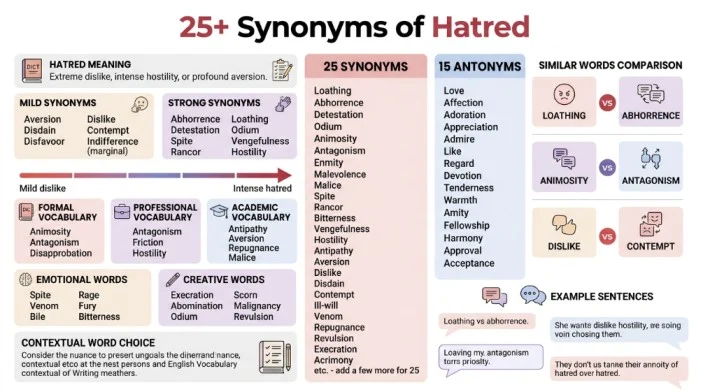
Strong emotions need precise words. Synonyms of hatred can help you describe intense dislike without repeating the same expression. Words such as hostility, loathing, resentment, animosity, and detestation may seem similar, but each carries a different level of emotional strength and context.
Choosing the right alternative depends on what you want to express. Some words describe deep personal dislike, while others suggest anger, conflict, bitterness, or long-term resentment. The level of formality also matters. A word that works naturally in everyday conversation may sound too strong in academic writing or professional communication. This guide explores synonyms of hatred with clear meanings, practical examples, tone differences, and context-based recommendations. You will learn which alternatives sound mild, strong, formal, emotional, or conversational, so you can choose a word that communicates your exact meaning with greater clarity and confidence.
What Are the Best Synonyms of “Hatred”?
A strong synonym of hatred can be loathing, abhorrence, detestation, or enmity, depending on context. Animosity and hostility work well for conflict, while antipathy and aversion describe strong dislike. For formal writing, abhorrence or detestation can be effective. In emotional and creative writing, loathing, revulsion, and enmity often create stronger impact.
Meaning, Tone, and Context
Simple Definition
Hatred is an intense feeling of strong dislike, hostility, or opposition toward someone or something. It is much stronger than ordinary dislike and can describe an emotional reaction, a lasting attitude, or serious hostility.
For example:
“She felt hatred toward the character who betrayed her.”
The word can describe hatred toward a person, group, behavior, idea, institution, or situation.
Part of Speech
Hatred is a noun.
The related verb is hate, while the adjective is hateful.
Overall Tone
Hatred has a strongly negative and emotional tone. It communicates an intense rejection or dislike rather than a neutral opinion.
The emotional strength can vary according to context. A person may use hatred seriously to describe deep hostility, while a writer may use it dramatically to create emotional tension.
Formality Level
Hatred is a neutral to formal word that works in everyday speech, journalism, academic discussion, literature, and professional contexts when the subject genuinely involves intense hostility.
However, some alternatives sound more formal or literary.
For example:
- Everyday: “He felt hatred toward his former rival.”
- Formal: “The speech expressed deep animosity toward the opposing group.”
- Literary: “She was consumed by loathing.”
Common Uses
Native English speakers commonly use hatred when discussing:
- Personal conflicts
- Political hostility
- Social prejudice
- Historical conflicts
- Relationships
- Moral opposition
- Fictional characters
- Strong personal feelings
- Violence or discrimination
- Deep opposition to an idea or behavior
Common phrases include deep hatred, intense hatred, feelings of hatred, hatred toward someone, hatred of something, and burning hatred.
Word Forms
| Form | Word | Example |
|---|---|---|
| Noun | hatred | His hatred was obvious. |
| Verb | hate | She hates dishonesty. |
| Adjective | hateful | The comment was hateful. |
| Adjective | hated | He was a hated ruler. |
| Adverb | hatefully | The character spoke hatefully. |
The noun hatred is the main focus when looking for synonyms such as loathing, abhorrence, and detestation.
When and How to Use “Hatred”
Use hatred when you need to communicate a feeling that goes substantially beyond ordinary dislike. It is particularly appropriate when the emotional reaction is deep, intense, persistent, or connected to serious hostility.
Professional
“Workplace policies should address behavior that creates hostility or hatred between employees.”
Here, hatred describes a serious emotional problem rather than an ordinary disagreement.
Academic
“The novel explores how hatred can influence individual decisions.”
This use works well because the word identifies a major emotional theme.
Workplace
“Years of unresolved conflict can sometimes develop into deep hatred.”
The sentence describes an intense emotional development.
Personal
“I felt a deep sense of hatred after learning what had happened.”
The word communicates a very strong personal reaction.
“Your message appeared to express hatred toward the organization.”
This wording is appropriate when the communication genuinely contains intense hostility.
Resume
Because hatred is highly negative, it rarely belongs on a resume. Instead, describe constructive goals or professional preferences.
Better:
“I strongly oppose discriminatory workplace practices.”
Social Media
“Hatred has no place in a conversation about difficult social issues.”
This use is natural when discussing strong hostility or prejudice.
Best Synonyms of “Hatred”
No single synonym works perfectly in every sentence. The best alternative depends on whether you want to emphasize intense dislike, hostility, disgust, contempt, opposition, or long lasting conflict.
Professional Writing: Animosity
Animosity is a strong feeling of hostility or ill will toward someone.
Example:
“The negotiations continued despite considerable animosity between the two sides.”
It works well in professional and formal contexts because it focuses on hostility rather than raw emotional hatred.
Academic Writing: Abhorrence
Abhorrence expresses an intense feeling of hatred, disgust, or moral rejection.
Example:
“The author expresses abhorrence toward political violence.”
It is particularly useful when the hatred is connected to strong moral opposition.
Business Communication: Hostility
Hostility emphasizes unfriendly or aggressive behavior rather than private emotion.
Example:
“The meeting became unproductive because of growing hostility between the departments.”
It is useful when describing conflict in an objective way.
Casual Conversation: Hate
Hate is the most natural everyday alternative because it is the basic verb associated with hatred.
Example:
“I hate dishonesty.”
It is simple, direct, and widely understood.
Emotional Writing: Loathing
Loathing expresses extremely strong dislike combined with disgust.
Example:
“He looked at the corrupt official with complete loathing.”
It creates a powerful emotional effect.
Creative Writing: Detestation
Detestation communicates intense hatred and strong disapproval.
Example:
“Her detestation of betrayal shaped every decision she made.”
It has a formal and literary quality that can work well in fiction.
Resume Writing: Strong Opposition
Directly using hatred or loathing is generally inappropriate in a resume. Professional writing should describe values or positions without unnecessarily emotional language.
Better:
“Strong advocate for ethical and inclusive workplace practices.”
Workplace Communication: Animosity
Animosity is usually more appropriate than hatred when describing interpersonal workplace conflict.
Example:
“Open communication can help reduce animosity among team members.”
Stronger Meaning: Loathing
Loathing is one of the strongest natural alternatives because it combines intense dislike with a sense of disgust.
Softer Meaning: Antipathy
Antipathy can describe a strong natural dislike, but it often sounds less emotionally explosive than hatred.
Example:
“She had a strong antipathy toward dishonest behavior.”
When Not to Use “Hatred”
When the Feeling Is Only Mild Dislike
Using hatred for a small preference can sound exaggerated.
Less Effective:
“I have hatred for rainy weather.”
Better:
“I have an aversion to rainy weather.”
Why:
Aversion describes a strong dislike without suggesting intense hostility.
When You Mean Hostile Behavior
If the focus is someone’s aggressive attitude rather than their private feelings, hostility may be more precise.
Less Effective:
“There was hatred between the two teams during the negotiations.”
Better:
“There was hostility between the two teams during the negotiations.”
When You Mean Moral Rejection
If someone strongly rejects something because they consider it morally wrong, abhorrence can communicate the idea more precisely.
Less Effective:
“She expressed hatred of cruelty.”
Better:
“She expressed abhorrence of cruelty.”
When You Mean Disgust
Hatred and disgust overlap, but they are not identical.
Less Effective:
“He felt hatred when he saw the spoiled food.”
Better:
“He felt revulsion when he saw the spoiled food.”
When You Mean Contempt
If the emotion involves looking down on someone as inferior or unworthy, contempt is more accurate.
Less Effective:
“She showed hatred for his poor decisions.”
Better:
“She showed contempt for his poor decisions.”
When the Situation Is Neutral
In academic or professional writing, hatred may sound overly emotional if the evidence only demonstrates disagreement.
Less Effective:
“The two researchers had hatred for each other’s theories.”
Better:
“The two researchers had strong disagreement about each other’s theories.”
Words Commonly Confused With “Hatred”
Animosity
Difference: Animosity emphasizes hostility or ill will between people or groups.
When to Use It: Use it for ongoing interpersonal or group conflict.
Example:
“The two executives have shown considerable animosity toward each other.”
Hostility
Difference: Hostility focuses on unfriendly, aggressive, or antagonistic behavior.
When to Use It: Use it when conflict is visible through words or actions.
Example:
“The discussion ended after the conversation became openly hostile.”
Disgust
Difference: Disgust is a strong feeling of physical or moral revulsion. It does not necessarily involve hatred.
When to Use It: Use it when something causes strong rejection or revulsion.
Example:
“She reacted with disgust to the cruel treatment of the animals.”
Contempt
Difference: Contempt involves viewing someone or something as inferior, unworthy, or beneath respect.
When to Use It: Use it when the central emotion is disrespect rather than simple hatred.
Example:
“He spoke about the dishonest scheme with contempt.”
Resentment
Difference: Resentment is lingering anger or bitterness caused by perceived unfairness or mistreatment.
When to Use It: Use it when negative feelings have developed over time.
Example:
“Years of unfair treatment left him with deep resentment.”
Aversion
Difference: Aversion means a strong dislike or reluctance toward something, but it usually carries less emotional intensity than hatred.
When to Use It: Use it for strong preferences against an activity, object, behavior, or situation.
Example:
“She has a strong aversion to unnecessary conflict.”
Best Synonyms of “Hatred” by Context
| Context | Best Synonym | Why It Works | Example |
|---|---|---|---|
| Formal writing | Abhorrence | Expresses intense moral rejection. | “He expressed abhorrence toward corruption.” |
| Academic writing | Antipathy | Sounds analytical and measured. | “The study examines public antipathy toward the policy.” |
| Professional communication | Animosity | Describes serious interpersonal hostility. | “Animosity affected team cooperation.” |
| Business emails | Hostility | Focuses on observable conflict. | “The exchange showed unnecessary hostility.” |
| Resume writing | Strong opposition | Communicates a position professionally. | “Strong opposition to discriminatory practices.” |
| Workplace communication | Animosity | Fits ongoing employee conflict. | “Animosity between departments reduced cooperation.” |
| Casual conversation | Hate | Natural and direct. | “I hate unfair treatment.” |
| Everyday speaking | Dislike | Softer and more conversational. | “I really dislike dishonest behavior.” |
| Creative writing | Loathing | Creates powerful emotional imagery. | “Loathing filled his voice.” |
| Storytelling | Detestation | Gives the narration a formal, dramatic tone. | “Her detestation of betrayal was obvious.” |
| Emotional writing | Loathing | Conveys intense personal emotion. | “He felt deep loathing for the corrupt leader.” |
| Strong emphasis | Abhorrence | Suggests intense rejection and disgust. | “She felt abhorrence toward cruelty.” |
| Mild tone | Aversion | Expresses strong dislike without extreme hostility. | “He has an aversion to confrontation.” |
| Social media captions | Hate | Short, familiar, and direct. | “Hate should never replace honest discussion.” |
| American English | Hatred | Common and natural across contexts. | “The story explores hatred and forgiveness.” |
| British English | Animosity | Natural in formal descriptions of conflict. | “There was considerable animosity between the groups.” |
How to Choose the Best Synonym of “Hatred”
Choosing a synonym becomes easier when you identify the exact feeling you want to communicate.
If You Mean Extreme Dislike
Choose loathing, detestation, or abhorrence.
These words work when the emotion is exceptionally strong.
If You Mean Hostility
Choose animosity, hostility, or enmity.
These are especially useful when two people or groups are in conflict.
If You Mean Disgust
Choose revulsion, disgust, or abhorrence.
These words are better when the reaction involves strong rejection or moral disgust.
If You Mean Disrespect
Choose contempt or scorn.
These words suggest that someone considers another person or idea inferior or unworthy of respect.
If You Mean Mild Dislike
Choose antipathy, aversion, or dislike.
These alternatives allow you to reduce the emotional intensity.
Consider Your Audience
A formal essay may benefit from abhorrence or antipathy, while a casual conversation usually sounds more natural with hate or dislike.
Consider Emotional Strength
Do not use loathing when you only mean dislike. Strong vocabulary is most effective when the intensity matches the situation.
Consider Your Purpose
A professional report should usually describe conflict objectively. A novel, personal essay, or speech can use more emotionally powerful vocabulary.
Choose Natural English
The most sophisticated synonym is not always the best choice. A familiar word that communicates the idea clearly is usually better than an unnecessarily complicated alternative.
Real Life Examples of “Hatred”
School
Basic:
“The story shows the character’s hatred of injustice.”
Stronger:
“The story reveals the character’s deep abhorrence of injustice.”
College
Basic:
“The novel explores hatred between rival families.”
Improved:
“The novel explores enmity between two rival families.”
Workplace
Basic:
“Hatred between coworkers can damage productivity.”
Improved:
“Persistent animosity between coworkers can damage productivity.”
Business
Basic:
“The campaign was criticized for encouraging hatred.”
Improved:
“The campaign was criticized for encouraging hostility.”
Basic:
“Your message contains hatred toward the other team.”
Improved:
“Your message appears to contain strong hostility toward the other team.”
Resume
Basic:
“I have a hatred of unfair treatment.”
Improved:
“I am committed to promoting fair and inclusive workplace practices.”
Conversation
Basic:
“I hate dishonest people.”
Alternative:
“I have a strong aversion to dishonesty.”
Storytelling
Basic:
“His hatred grew every year.”
Improved:
“His resentment deepened with every passing year.”
Blogging
Basic:
“Hatred can damage online communities.”
Improved:
“Online hostility can damage healthy community discussions.”
Social Media
Basic:
“Hatred should not control public conversations.”
Improved:
“Public conversations become more productive when hostility gives way to respectful disagreement.”
25 Best Synonyms of “Hatred”
Some words below are close synonyms rather than perfect substitutes in every sentence. Their inclusion reflects the different ways English expresses intense dislike, hostility, disgust, and deep opposition.
| Synonym | Simple Meaning | Best Used For | Example Sentence |
|---|---|---|---|
| Loathing | Extremely strong dislike | Emotional writing | She felt deep loathing for the corrupt official. |
| Abhorrence | Intense hatred and moral rejection | Formal writing | He expressed abhorrence toward cruelty. |
| Detestation | Intense hatred or dislike | Literary writing | Her detestation of betrayal was obvious. |
| Animosity | Strong hostility or ill will | Workplace conflict | Years of animosity divided the two departments. |
| Hostility | Unfriendly or aggressive opposition | Professional contexts | The discussion was marked by growing hostility. |
| Enmity | Deep hostility between opposing sides | Formal or historical writing | The two families had a long history of enmity. |
| Antipathy | Strong natural dislike | Academic writing | She felt immediate antipathy toward the proposal. |
| Aversion | Strong dislike or reluctance | Everyday and formal use | He has an aversion to unnecessary confrontation. |
| Revulsion | Intense disgust or rejection | Emotional writing | She felt revulsion at the cruel treatment. |
| Disgust | Strong feeling of rejection | Everyday speech | The story filled him with disgust. |
| Contempt | Strong disrespect or scorn | Formal and emotional writing | She regarded the dishonest scheme with contempt. |
| Scorn | Open contempt or disdain | Literary and rhetorical writing | He dismissed the accusation with scorn. |
| Disdain | Strong lack of respect | Formal communication | She showed disdain for dishonest tactics. |
| Odium | Intense hatred or public detestation | Formal or literary writing | The scandal brought widespread odium upon the organization. |
| Execration | Extreme hatred or condemnation | Literary and formal writing | His actions became the subject of public execration. |
| Abomination | Something regarded with extreme disgust or hatred | Moral or religious contexts | The practice was described as an abomination. |
| Antagonism | Active opposition or hostility | Academic and professional writing | Political antagonism made cooperation difficult. |
| Resentment | Lingering bitterness or anger | Personal relationships | Years of neglect created deep resentment. |
| Repugnance | Strong disgust or moral rejection | Formal writing | He expressed repugnance toward the violent act. |
| Loathsomeness | The quality of being extremely unpleasant or hateful | Descriptive writing | The character’s loathsomeness was central to the story. |
| Dislike | A feeling of not liking someone or something | Mild everyday contexts | Her dislike of unfair criticism was clear. |
| Hostility | Strong opposition or unfriendly feeling | Conflict descriptions | The negotiations were affected by mutual hostility. |
| Hatred | Intense dislike or hostility | General use | The novel examines how hatred can destroy relationships. |
| Ill will | Unfriendly or hostile feeling | Formal and everyday use | There was no ill will between the former colleagues. |
| Malice | Desire to cause harm | Legal and formal contexts | The accusation was made without evidence of malice. |
Usage note: Some entries, such as malice, resentment, contempt, and disdain, overlap with hatred but add a specific meaning. They should not be substituted mechanically in every sentence.
Synonyms of “Hatred” by Usage
Professional vs Personal Synonyms
Professional writing usually benefits from objective words such as animosity, hostility, and antagonism. These describe conflict without making the writing sound excessively emotional.
Personal writing can use stronger words such as loathing, detestation, or hatred when the emotional intensity is genuinely important.
Professional:
“The dispute created significant hostility between the teams.”
Personal:
“I could barely hide my loathing for his betrayal.”
Formal vs Conversational Synonyms
Formal writing can use abhorrence, detestation, enmity, antipathy, and animosity.
Conversational English usually favors hate, dislike, or can’t stand.
For example:
Formal:
“The organization expressed abhorrence of discriminatory practices.”
Conversational:
“I can’t stand dishonest behavior.”
Academic Synonyms
Academic writing benefits from precise vocabulary.
Good choices include:
- Antipathy
- Animosity
- Hostility
- Antagonism
- Abhorrence
- Enmity
These words help distinguish emotional dislike from social, political, or interpersonal conflict.
Example:
“The study examines public antipathy toward institutional change.”
This sounds more analytical than simply saying:
“The study examines hatred of institutional change.”
Professional and Business Synonyms
For resumes, interviews, meetings, performance reviews, client communication, and business emails, avoid unnecessarily emotional language.
Use:
- Hostility
- Animosity
- Antagonism
- Opposition
- Disagreement
For example:
Instead of:
“I hate the company’s current policy.”
Use:
“I have serious concerns about the company’s current policy.”
This approach sounds constructive and professional.
Creative and Literary Synonyms
Creative writing offers more freedom to use emotionally vivid words.
Strong choices include:
- Loathing
- Detestation
- Enmity
- Revulsion
- Abhorrence
- Scorn
- Contempt
Example:
“Years of betrayal had transformed his disappointment into bitter loathing.”
The word loathing adds more emotional force than simply repeating hatred.
Slang or Modern Synonyms
There is no single slang word that perfectly replaces hatred.
Casual expressions such as can’t stand, hate, and really dislike are common in modern American English.
Meaning:
“Can’t stand” means strongly dislike.
Acceptable:
“I can’t stand dishonest behavior.”
Avoid in:
Academic papers, formal reports, and professional documents.
Strongest to Mildest Synonyms
The emotional intensity of these words varies significantly.
| Level | Words | Typical Meaning |
|---|---|---|
| Mild | Dislike, aversion | Strong preference against something |
| Moderate | Antipathy, resentment | Deeper negative feeling |
| Strong | Animosity, hostility, contempt | Serious negative attitude or conflict |
| Very Strong | Hatred, detestation, loathing | Intense emotional rejection |
| Extremely Strong | Abhorrence, execration | Extreme hatred or moral rejection |
This scale is approximate because context can change the perceived strength of a word.
For example, contempt may sound stronger than hatred when the writer wants to emphasize disrespect rather than emotional anger.
Emotional vs Neutral Synonyms
Emotional Synonyms
These words carry stronger feelings:
- Loathing
- Hatred
- Detestation
- Abhorrence
- Revulsion
- Contempt
- Scorn
They are useful in literature, personal writing, speeches, and emotionally charged discussions.
Neutral Synonyms
These alternatives can describe conflict more objectively:
- Antipathy
- Animosity
- Hostility
- Antagonism
- Aversion
- Dislike
They work particularly well in academic and professional writing.
Antonyms of “Hatred”
| Antonym | Meaning | Example Sentence |
|---|---|---|
| Love | Deep affection or care | Their love remained strong despite the disagreement. |
| Affection | Warm personal feeling | She felt genuine affection for her former teacher. |
| Fondness | Warm liking or attachment | He developed a fondness for the old neighborhood. |
| Liking | Positive feeling toward someone or something | Her liking for the new manager grew over time. |
| Admiration | Respect and approval | She expressed admiration for the scientist’s work. |
| Respect | High regard for someone or something | They treated their opponents with respect. |
| Friendship | Close relationship based on mutual care | Their friendship survived the difficult period. |
| Goodwill | Friendly and cooperative attitude | The agreement was reached in a spirit of goodwill. |
| Kindness | Caring and considerate behavior | Her kindness changed the way others viewed her. |
| Sympathy | Concern for another person’s difficulties | He showed sympathy for the injured worker. |
| Compassion | Deep concern for another’s suffering | Compassion guided her response to the crisis. |
| Acceptance | Willingness to recognize or tolerate something | The community promoted acceptance of differences. |
| Approval | Positive judgment or agreement | The proposal received widespread approval. |
| Appreciation | Recognition of value or quality | The team expressed appreciation for her effort. |
| Harmony | Peaceful agreement or cooperation | The families eventually lived together in harmony. |
Comparison: “Hatred” vs Similar Words
Hatred vs Dislike
Main Difference:
Hatred expresses intense negative feeling, while dislike usually describes a less intense negative preference.
Which Is Stronger?
Hatred is much stronger.
Which Is More Formal?
Both are neutral, but dislike often sounds less emotionally charged.
When to Use Each:
Use hatred for deep hostility. Use dislike for ordinary negative preferences.
Examples:
Hatred:
“His hatred of corruption shaped his political career.”
Dislike:
“She has a strong dislike of crowded places.”
Hatred vs Loathing
Main Difference:
Both express intense dislike. Loathing often adds a strong sense of disgust.
Which Is Stronger?
Both are very strong, but loathing can feel especially personal and visceral.
Which Is More Formal?
Both can appear in formal and literary writing.
When to Use Each:
Use hatred for broad hostility. Use loathing when disgust is part of the emotion.
Examples:
Hatred:
“The conflict created lasting hatred.”
Loathing:
“She spoke about the corrupt official with loathing.”
Hatred vs Animosity
Main Difference:
Hatred emphasizes intense negative emotion. Animosity focuses more on hostility and ill will between people or groups.
Which Is Stronger?
Hatred generally conveys stronger personal emotion.
Which Is More Formal?
Animosity is often more suitable for professional or analytical writing.
When to Use Each:
Use animosity for ongoing conflict. Use hatred for intense emotional rejection.
Examples:
Hatred:
“The betrayal created deep hatred.”
Animosity:
“Animosity between the teams prevented cooperation.”
Hatred vs Contempt
Main Difference:
Hatred means intense dislike. Contempt involves regarding someone or something as inferior or unworthy of respect.
Which Is Stronger?
Neither is always stronger. The emotional focus is different.
Which Is More Formal?
Contempt often works particularly well in formal descriptions.
When to Use Each:
Use contempt when disrespect is central.
Examples:
Hatred:
“He felt hatred toward his former enemy.”
Contempt:
“She regarded the dishonest scheme with contempt.”
Hatred vs Resentment
Main Difference:
Resentment is lingering bitterness caused by perceived unfairness, mistreatment, or disappointment.
Which Is Stronger?
Hatred generally describes a more intense emotion.
Which Is More Formal?
Both are appropriate in formal writing.
When to Use Each:
Use resentment when negative feelings have developed gradually.
Examples:
Hatred:
“Years of conflict created hatred between the families.”
Resentment:
“Repeated criticism created resentment among employees.”
Hatred vs Hostility
Main Difference:
Hatred describes an intense feeling. Hostility can describe both an attitude and outward behavior.
Which Is Stronger?
Hatred is often more emotionally intense.
Which Is More Formal?
Hostility is highly useful in professional and academic writing.
When to Use Each:
Use hostility when the conflict is observable.
Examples:
Hatred:
“His hatred was deeply personal.”
Hostility:
“The negotiations were disrupted by open hostility.”
Common Phrases and Expressions with “Hatred”
Deep Hatred
Meaning:
A very intense and lasting feeling of hatred.
Example:
“Years of conflict left behind deep hatred.”
Intense Hatred
Meaning:
Extremely strong negative emotion.
Example:
“The character’s intense hatred drives the plot.”
Hatred Toward Someone
Meaning:
A strong negative feeling directed at a particular person.
Example:
“His hatred toward his former rival gradually faded.”
Hatred of Something
Meaning:
Strong dislike or rejection of a thing, behavior, or idea.
Example:
“Her hatred of dishonesty was obvious.”
Feelings of Hatred
Meaning:
Emotional experiences involving intense dislike or hostility.
Example:
“The story explores feelings of hatred and forgiveness.”
Burning Hatred
Meaning:
A vivid expression for extremely intense and passionate hatred.
Example:
“His burning hatred consumed his judgment.”
Mutual Hatred
Meaning:
A situation where two people or groups strongly dislike each other.
Example:
“Their mutual hatred made cooperation nearly impossible.”
Hatred and Resentment
Meaning:
A combination of intense dislike and lingering bitterness.
Example:
“The novel explores how hatred and resentment can damage families.”
Common Mistakes to Avoid
1. Treating Every Negative Feeling as Hatred
Incorrect:
“I have hatred for spinach because I don’t enjoy its taste.”
Better:
“I have an aversion to spinach.”
Why:
A food preference usually does not involve the extreme emotion implied by hatred.
2. Confusing Hatred With Hostility
Incorrect:
“The manager’s hatred was obvious because he refused to smile.”
Better:
“The manager’s hostility was obvious during the meeting.”
Why:
The sentence describes outward behavior rather than necessarily proving intense private hatred.
3. Using Informal Language in Formal Writing
Incorrect:
“I can’t stand the company’s policy.”
Better:
“I strongly oppose the company’s policy.”
Why:
Oppose communicates disagreement in a more professional manner.
4. Choosing an Overly Dramatic Synonym
Incorrect:
“She felt loathing toward a minor inconvenience.”
Better:
“She felt frustrated by the inconvenience.”
Why:
Loathing suggests an extremely strong emotional reaction.
5. Repeating Hatred Throughout a Paragraph
Incorrect:
“The character felt hatred. His hatred grew, and his hatred eventually changed his life.”
Better:
“The character felt deep resentment. Over time, that bitterness developed into loathing.”
Why:
Using contextually appropriate alternatives improves flow and avoids repetition.
6. Confusing Hatred With Contempt
Incorrect:
“She hated the manager because she thought he was beneath her.”
Better:
“She regarded the manager with contempt because she considered him beneath her.”
Why:
The key emotion is disrespect and perceived superiority, which contempt expresses more precisely.
7. Using Slang in Academic Writing
Incorrect:
“The researcher can’t stand the opposing theory.”
Better:
“The researcher expressed strong antipathy toward the opposing theory.”
Why:
The second version better matches the formal academic setting.
Frequently Asked Questions
What is a strong synonym for hatred?
Strong synonyms for hatred include loathing, detestation, abhorrence, disgust, and animosity. The best choice depends on the intensity and context.
What are the common synonyms of hatred?
Common synonyms of hatred include dislike, hostility, resentment, animosity, loathing, and aversion.
What is another word for hatred?
Loathing is a strong another word for hatred, while hostility and animosity work well when describing conflict or unfriendly feelings.
What is the hatred opposite word?
The most direct hatred opposite word is love. Other opposites include affection, fondness, kindness, and goodwill.
What are the antonyms of hatred?
Common hatred antonyms include love, affection, admiration, compassion, kindness, and friendship.
What are the best synonyms of “hatred”?
The best synonym of hatred depends on meaning and intensity. Strong choices include loathing, abhorrence, detestation, animosity, hostility, enmity, antipathy, and aversion.
What are the best formal synonyms of “hatred”?
The strongest formal alternatives include abhorrence, detestation, enmity, animosity, antipathy, and repugnance. The best option depends on whether you mean hostility, disgust, moral rejection, or intense dislike.
What are common informal synonyms of “hatred”?
In casual American English, hate, dislike, and can’t stand are common ways to express negative feelings. Their intensity varies, with hate being much stronger than ordinary dislike.
What is another word for “hatred” in professional writing?
Animosity or hostility often works well in professional writing because these words describe conflict objectively. For a formal moral rejection, abhorrence may be more precise.
What is the difference between “hatred” and “dislike”?
Hatred describes an intense negative feeling, while dislike usually indicates a weaker negative preference. For example, someone may dislike a food without feeling hatred toward it.
What is the opposite of “hatred”?
The clearest opposite of hatred is love. Depending on context, other positive alternatives include affection, fondness, admiration, respect, compassion, acceptance, and goodwill.
Conclusion
Hatred describes an intense feeling of dislike, hostility, or rejection. Its best alternatives depend on the specific emotion involved. Loathing and detestation express powerful dislike, abhorrence emphasizes moral rejection, animosity describes hostility, and antipathy offers a more measured expression of strong dislike.
No synonym works perfectly in every situation. The most effective word depends on your audience, tone, purpose, and the exact emotion you want to communicate. When writing, identify the feeling first, then choose the word that expresses its intensity most accurately.
A useful vocabulary habit is to replace a repeated word only after checking its precise meaning. This helps you learn not just more words, but better words, which is the real value of understanding a synonym of hatred.
Read More Related Articles:
- Synonyms for Empty | Meaning, Examples, and Better Word …
- Synonyms for Creativity | Meaning, Examples, and Better …
- Synonyms for Pros and Cons | Meaning, Examples, and Better …