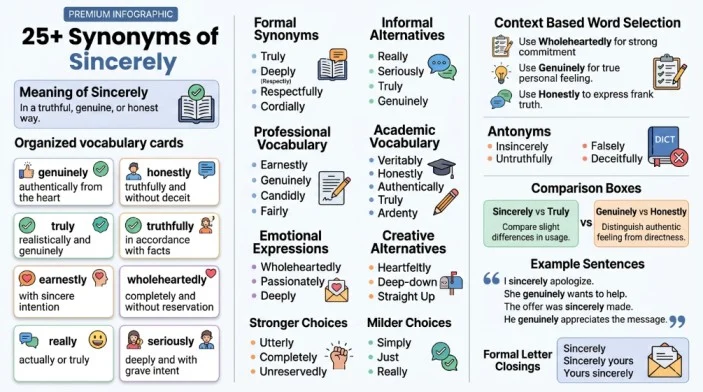
When writing an email, essay, apology, thank you note, or professional message, repeating sincerely can make your language feel predictable. Finding the right synonym of sincerely can help you express honesty, warmth, seriousness, or genuine emotion without changing the meaning you intend to communicate.
The best alternative depends on context. Genuinely emphasizes authenticity, honestly focuses on truthfulness, earnestly adds seriousness, and wholeheartedly expresses strong personal feeling. In formal letters, however, sincerely can also function as a closing rather than an ordinary adverb, so not every synonym can replace it naturally.
What Is the Best Synonym of “Sincerely”?
The best synonym of sincerely depends on your meaning. Use genuinely, honestly, or truthfully when emphasizing honesty; earnestly or wholeheartedly for strong feeling; and really or truly for natural everyday language. In formal letter closings, alternatives such as Sincerely yours, Yours sincerely, or Best regards depend on the style and regional convention.
Meaning, Tone, and Context
Simple Definition
Sincerely is an adverb that generally means in an honest, genuine, or earnest way, without pretending or deliberately presenting false feelings. For example, in “I sincerely apologize,” the speaker is emphasizing that the apology is genuine.
Cambridge also identifies a second important use. Sincerely can appear as a formal closing in a letter or email, particularly when addressing a specific person. In American English, Sincerely and Sincerely yours are established formal closings.
Part of Speech
Sincerely is an adverb.
It usually modifies a verb, especially a verb connected with feelings, beliefs, intentions, apologies, thanks, or communication.
Examples:
- “I sincerely appreciate your help.”
- “She sincerely apologized.”
- “They sincerely believe the plan will work.”
- “We sincerely hope you understand.”
Overall Tone
The ordinary meaning of sincerely is generally positive or neutral. It communicates honesty, authenticity, seriousness, or genuine feeling.
Its tone becomes especially warm when it appears with expressions such as:
- sincerely appreciate
- sincerely apologize
- sincerely thank
- sincerely hope
- sincerely believe
- sincerely regret
Formality Level
Sincerely is a versatile word that works in both formal and everyday English.
Its letter closing function is distinctly formal. Cambridge lists Yours sincerely and Sincerely yours as formal ways to end letters.
In ordinary sentences, however, sincerely can sound natural in personal, professional, academic, and emotional contexts.
Common Uses
Native English speakers commonly use sincerely when expressing:
- Genuine gratitude
- Honest apologies
- Real concern
- Strong hopes
- Serious beliefs
- Personal regret
- Genuine appreciation
- Honest opinions
- Formal letter closings
Word Forms
| Form | Word |
|---|---|
| Adjective | sincere |
| Adverb | sincerely |
| Noun | sincerity |
| Opposite adjective | insincere |
| Opposite adverb | insincerely |
The adjective sincere describes a person, feeling, belief, statement, or action that is genuine rather than false or pretended. The noun sincerity refers to the quality of being sincere.
When and How to Use “Sincerely”
Use sincerely when you want to show that your words or feelings are genuine. It is particularly useful when the reader needs to understand that an apology, belief, hope, thanks, or expression of concern is not merely polite language.
Professional
“I sincerely appreciate your time and consideration.”
This works well in professional communication because it expresses genuine gratitude without sounding overly emotional.
Academic
“The researcher sincerely acknowledges the contributions of the participants.”
Here, the word adds a personal note of genuine appreciation.
Workplace
“I sincerely hope we can resolve this issue quickly.”
This communicates a serious and genuine desire for a positive outcome.
Personal
“I sincerely hope everything works out for you.”
The expression sounds warm and supportive without being overly dramatic.
“I sincerely apologize for the delay in responding.”
This is appropriate when you want to make an apology sound genuine and respectful.
Resume
“Supported community programs and sincerely advocated for improved access to educational resources.”
In a resume, however, sincerely should be used carefully. Action verbs and measurable achievements are usually more effective than emotional wording.
Social Media
“I sincerely appreciate everyone who supported this project.”
This works well when expressing genuine gratitude to an audience.
Best Synonyms of “Sincerely”
No single synonym works perfectly in every sentence. Sincerely can communicate several related ideas, including honesty, genuineness, seriousness, and heartfelt emotion, so the best replacement depends on which meaning you want to emphasize.
Professional Writing: Genuinely
Genuinely is an excellent professional alternative when you want to emphasize that a feeling, intention, or reaction is real.
Example:
“We are genuinely interested in learning more about your proposal.”
It sounds natural and focuses on authentic interest.
Academic Writing: Truthfully
Truthfully works well when the intended meaning involves honesty or accurate representation.
Example:
“The participants truthfully reported their experiences.”
It is especially useful when the writer wants to emphasize that information was given honestly.
Business Communication: Honestly
Honestly is useful when communicating an authentic opinion, reaction, or assessment.
Example:
“I honestly believe this approach will improve customer satisfaction.”
It is direct and understandable, although sincerely may sound more formal in some business messages.
Casual Conversation: Really
Really can replace sincerely in certain informal contexts when the intended meaning is genuinely or truly.
Example:
“I really hope everything goes well.”
This sounds more conversational than “I sincerely hope everything goes well.”
Emotional Writing: Wholeheartedly
Wholeheartedly is stronger and more emotional than ordinary sincerely.
Example:
“I wholeheartedly support your decision.”
It suggests complete and enthusiastic support.
Creative Writing: Earnestly
Earnestly adds seriousness and emotional commitment.
Example:
“She earnestly begged him to reconsider.”
It can create a more serious literary tone.
Resume Writing: Genuinely
Genuinely can work when describing authentic motivation, but resumes should generally focus more on evidence than emotional claims.
Example:
“Genuinely committed to improving customer experience through data driven solutions.”
Even here, a stronger resume version would usually replace the phrase with a specific achievement.
Workplace Communication: Truly
Truly is a flexible alternative that can express genuine appreciation, regret, or belief.
Example:
“We truly appreciate your flexibility during the transition.”
Stronger Meaning: Wholeheartedly
Use wholeheartedly when you want to communicate complete emotional commitment rather than simple sincerity.
Example:
“We wholeheartedly support the team’s recommendation.”
Softer Meaning: Genuinely
Genuinely can provide a natural and less formal alternative when you want to show that something is real without adding intense emotion.
Example:
“I genuinely appreciate your help.”
When Not to Use “Sincerely”
Although sincerely is useful, it is not always the most precise word.
When It Sounds Too General
Sincerely tells readers that something is genuine, but it does not always explain the exact quality of the feeling.
Less precise:
“I sincerely support the idea.”
More specific:
“I wholeheartedly support the idea.”
Why:
Wholeheartedly communicates a stronger level of commitment.
When It Sounds Too Formal
In casual conversation, sincerely can sometimes sound more formal than necessary.
Less natural for casual speech:
“I sincerely hope you have a good weekend.”
More conversational:
“I really hope you have a good weekend.”
Why:
Really sounds more relaxed in everyday American conversation.
When You Mean Truthfulness
If your main point is that information is accurate or honest, truthfully may be more precise.
Less precise:
“She answered the question sincerely.”
More precise:
“She answered the question truthfully.”
Why:
Truthfully directly emphasizes the truth of the answer.
When You Mean Seriousness
If someone is making a serious request rather than simply expressing genuine emotion, earnestly may work better.
Less precise:
“He sincerely asked her to reconsider.”
More precise:
“He earnestly asked her to reconsider.”
Why:
Earnestly emphasizes serious intent.
When You Mean Enthusiastic Support
Sincerely does not necessarily imply enthusiasm.
Less specific:
“She sincerely supported the campaign.”
More expressive:
“She wholeheartedly supported the campaign.”
Why:
Wholeheartedly suggests complete and enthusiastic support.
When a Letter Closing Is Intended
You should not automatically replace Sincerely with an ordinary adverb such as genuinely or honestly.
Correct formal closing:
“Sincerely,
Jordan Lee”
Not a natural replacement:
“Genuinely,
Jordan Lee”
The word is functioning as a conventional letter closing in the first example, not simply as an adverb modifying a verb.
Words Commonly Confused With “Sincerely”
Genuinely
Difference:
Genuinely focuses strongly on whether something is real or authentic.
When to Use It:
Use it when describing authentic feelings, reactions, interest, or intentions.
Example:
“She was genuinely pleased with the result.”
Honestly
Difference:
Honestly emphasizes truthfulness and freedom from deception.
When to Use It:
Use it when giving an honest opinion, answer, or assessment.
Example:
“I honestly don’t know what happened.”
Truthfully
Difference:
Truthfully focuses specifically on saying or presenting what is true.
When to Use It:
Use it for answers, reports, statements, and accounts.
Example:
“He truthfully described what he had seen.”
Earnestly
Difference:
Earnestly emphasizes seriousness, determination, or a deeply felt request.
When to Use It:
Use it when someone strongly and seriously wants something to happen.
Example:
“She earnestly asked for another opportunity.”
Wholeheartedly
Difference:
Wholeheartedly adds complete emotional commitment or enthusiastic support.
When to Use It:
Use it for strong support, agreement, acceptance, or dedication.
Example:
“I wholeheartedly support the team’s decision.”
Seriously
Difference:
Seriously can mean genuinely rather than jokingly, but it has several other meanings unrelated to sincerity.
When to Use It:
Use it when you want to clarify that a statement or intention is meant seriously.
Example:
“I seriously want to help.”
Cambridge’s thesaurus specifically groups really, genuinely, honestly, truly, truthfully, earnestly, seriously, and wholeheartedly with sincerely, while also listing direct antonyms such as insincerely, falsely, dishonestly, deceptively, untruthfully, and deceitfully.
Best Synonyms of “Sincerely” by Context
| Context | Best Synonym | Why It Works | Example |
|---|---|---|---|
| Formal writing | Genuinely | Professional and clear | “We genuinely value your contribution.” |
| Academic writing | Truthfully | Emphasizes accurate reporting | “Students truthfully described their experiences.” |
| Professional communication | Honestly | Direct and transparent | “I honestly believe this is the best option.” |
| Business emails | Truly | Polite and natural | “We truly appreciate your patience.” |
| Resume writing | Genuinely | Shows authentic motivation | “Genuinely committed to client success.” |
| Workplace communication | Honestly | Natural for opinions | “I honestly think we should reconsider.” |
| Casual conversation | Really | Relaxed and common | “I really hope you feel better.” |
| Everyday speaking | Truly | Natural and expressive | “I truly understand your concern.” |
| Creative writing | Earnestly | Adds seriousness | “He earnestly pleaded for forgiveness.” |
| Storytelling | Wholeheartedly | Adds emotional depth | “She wholeheartedly accepted the challenge.” |
| Emotional writing | From the heart | Strong personal feeling | “I am speaking from the heart.” |
| Strong emphasis | Wholeheartedly | Signals complete commitment | “I wholeheartedly agree.” |
| Mild tone | Genuinely | Warm without excessive intensity | “I genuinely appreciate your help.” |
| Social media captions | Truly | Short and expressive | “Truly grateful for this opportunity.” |
| American English | Sincerely | Standard formal closing | “Sincerely, Alex Morgan” |
| British English | Yours sincerely | Standard formal closing when the recipient is named | “Yours sincerely, Alex Morgan” |
Cambridge notes that Yours sincerely is used at the end of formal letters when the writer knows the recipient’s name, while American English commonly uses Sincerely or Sincerely yours.
How to Choose the Best Synonym of “Sincerely”
Choosing the right synonym starts with identifying what you actually mean.
If You Mean “Without Pretending”
Choose genuinely, authentically, or unfeignedly.
Example:
“I genuinely care about the outcome.”
If You Mean “Honestly”
Choose honestly or truthfully.
Example:
“She answered the question honestly.”
If You Mean “With Serious Feeling”
Choose earnestly.
Example:
“He earnestly requested another chance.”
If You Mean “With Complete Commitment”
Choose wholeheartedly.
Example:
“They wholeheartedly supported the proposal.”
If You Mean “In a Casual Way”
Choose really or truly, depending on the sentence.
Example:
“I really hope you get the job.”
If You Mean “As a Formal Letter Closing”
Keep Sincerely, Sincerely yours, or, in British usage, Yours sincerely, depending on the convention you are following.
Consider Your Audience
A business client may respond better to genuinely, truly, or sincerely.
A close friend may find really or from the heart more natural.
An academic paper may require truthfully when discussing the accuracy of information.
Consider Emotional Strength
Use a simple progression:
Mild: genuinely, truly
Moderate: sincerely, honestly, earnestly
Strong: wholeheartedly, from the heart
The scale is not absolute because each word emphasizes a different aspect of sincerity.
Consider Formality
For formal correspondence:
“Thank you sincerely for your consideration.”
For everyday conversation:
“I really appreciate it.”
Both express genuine appreciation, but the second is more relaxed.
Consider Natural Usage
Do not replace sincerely simply because another word appears in a thesaurus. A synonym is useful only when it preserves the intended meaning and sounds natural in the sentence.
Real Life Examples of “Sincerely”
School
Basic:
“I sincerely appreciate my teacher’s support.”
More specific:
“I genuinely appreciate my teacher’s detailed feedback.”
The second sentence makes the feeling sound natural while emphasizing authenticity.
College
Basic:
“I sincerely hope to contribute to the research project.”
Alternative:
“I genuinely hope to contribute to the research project.”
Genuinely emphasizes real interest.
Workplace
Basic:
“I sincerely apologize for missing the meeting.”
Alternative:
“I sincerely apologize for missing the meeting and appreciate your understanding.”
In a workplace apology, sincerely is often preferable because it sounds respectful without being overly casual.
Business
Basic:
“We sincerely value your partnership.”
Alternative:
“We genuinely value your partnership.”
Genuinely can make the statement sound slightly more personal and authentic.
Basic:
“I sincerely appreciate your quick response.”
Alternative:
“I truly appreciate your quick response.”
Both are natural, although truly can sound slightly warmer.
Resume
Basic:
“I sincerely care about helping customers.”
Better:
“Improved customer satisfaction by 18 percent through faster response times.”
For resumes, evidence is usually more persuasive than an emotional claim. Instead of relying heavily on sincerely, show genuine commitment through accomplishments.
Conversation
Basic:
“I sincerely hope you feel better soon.”
Natural alternative:
“I really hope you feel better soon.”
The second version is more conversational.
Storytelling
Basic:
“He sincerely regretted his decision.”
More expressive:
“He earnestly regretted the choice that changed everything.”
Earnestly adds seriousness and emotional weight.
Blogging
Basic:
“I sincerely believe readers deserve clear information.”
Alternative:
“I genuinely believe readers deserve clear information.”
The alternative sounds natural while maintaining a professional tone.
Social Media
Basic:
“I sincerely thank everyone who supported me.”
Alternative:
“Truly grateful to everyone who supported me.”
The second version is shorter and more natural for a social media caption.
25 Best Synonyms of “Sincerely”
Some entries below are direct synonyms, while others are established close alternatives or phrases that express a particular aspect of sincerity. This distinction matters because sincerely has more than one use. Cambridge’s thesaurus directly lists really, genuinely, honestly, truly, truthfully, earnestly, seriously, and wholeheartedly as synonyms, while other established thesauri provide additional context specific alternatives and expressions.
| Synonym or Expression | Simple Meaning | Best Used For | Example Sentence |
|---|---|---|---|
| Genuinely | In a real and authentic way | Professional and personal writing | “I genuinely appreciate your support.” |
| Honestly | In a truthful way | Opinions and answers | “I honestly believe you made the right choice.” |
| Truly | In a real or genuine way | Formal and everyday English | “We truly value your feedback.” |
| Truthfully | In accordance with the truth | Statements and reports | “She truthfully explained what happened.” |
| Earnestly | With serious and sincere feeling | Requests and emotional writing | “He earnestly asked for forgiveness.” |
| Really | In a genuine or actual way | Casual conversation | “I really hope everything works out.” |
| Seriously | Genuinely, not jokingly | Informal statements | “I seriously want to help.” |
| Wholeheartedly | With complete feeling or commitment | Strong support | “I wholeheartedly support this decision.” |
| Faithfully | With loyalty or sincere adherence | Beliefs and commitments | “She faithfully followed the agreed plan.” |
| Frankly | In an open and direct way | Honest opinions | “Frankly, I think we need more time.” |
| Candidly | In an open and honest manner | Professional discussion | “He candidly discussed the project’s problems.” |
| Openly | Without hiding feelings or opinions | Personal and workplace communication | “She openly expressed her concerns.” |
| Forthrightly | Directly and honestly | Formal professional writing | “The manager forthrightly addressed the complaint.” |
| Authentically | In a genuine and natural way | Creative and personal writing | “She spoke authentically about her experience.” |
| Unreservedly | Without holding anything back | Strong praise or support | “We unreservedly recommend the service.” |
| Unfeignedly | Without pretending | Literary writing | “He was unfeignedly delighted by the news.” |
| Heartily | With genuine warmth or enthusiasm | Gratitude and agreement | “I heartily congratulate you on the achievement.” |
| Openheartedly | With genuine openness and feeling | Emotional writing | “She openheartedly shared her experience.” |
| In good faith | With honest intentions | Legal, professional, and formal contexts | “Both parties negotiated in good faith.” |
| In earnest | Seriously and sincerely | Formal or literary writing | “She began working in earnest after the decision.” |
| In all honesty | Speaking truthfully | Conversation and opinions | “In all honesty, I expected a different result.” |
| In all sincerity | With complete sincerity | Formal or emotional writing | “In all sincerity, I hope you succeed.” |
| From the heart | With genuine personal feeling | Emotional writing | “Her message came from the heart.” |
| From the bottom of your heart | With very deep feeling | Strong emotional expression | “Thank them from the bottom of your heart.” |
| With genuine feeling | With authentic emotion | Personal and creative writing | “He spoke with genuine feeling about his loss.” |
Important usage note: Unfeignedly is accurate but literary or old fashioned, so it is rarely the best choice for ordinary modern American communication. Cambridge specifically labels it literary or old fashioned.
Synonyms of “Sincerely” by Usage
Professional vs Personal Synonyms
Professional writing usually benefits from controlled and precise language.
Best professional choices:
- genuinely
- sincerely
- honestly
- truly
- candidly
- in good faith
- forthrightly
Personal communication can use warmer alternatives:
- really
- wholeheartedly
- from the heart
- openheartedly
- in all honesty
Professional example:
“We genuinely appreciate your continued partnership.”
Personal example:
“I really appreciate everything you’ve done for me.”
Formal vs Conversational Synonyms
- For reports and formal correspondence, choose sincerely, truthfully, genuinely, earnestly, or in good faith when the meaning fits.
- For presentations, emails, and workplace communication, truly, honestly, and genuinely are flexible choices.
- For casual conversation and texting, really is usually more natural.
Academic Synonyms
Academic writing requires precision. The best alternative depends on what the sentence is trying to say.
- Use truthfully when discussing whether information was reported accurately.
- Use genuinely when discussing authentic motivation or reactions.
- Use earnestly when describing serious intentions or requests.
Avoid using highly emotional phrases such as from the bottom of your heart in formal academic analysis unless the subject itself requires emotional language.
Professional and Business Synonyms
For resumes, interviews, meetings, presentations, performance reviews, client communication, and business emails, consider:
Genuinely: authentic interest or commitment.
Honestly: direct personal assessment.
Truly: professional appreciation.
Candidly: open discussion of problems.
Forthrightly: direct communication about difficult issues.
In good faith: honest intentions during negotiations or agreements.
For example:
“We negotiated in good faith to reach an agreement.”
This is more precise than:
“We negotiated sincerely to reach an agreement.”
Creative and Literary Synonyms
Creative writing gives you more freedom to emphasize emotion and character.
Useful choices include:
- earnestly
- wholeheartedly
- heartily
- unfeignedly
- openheartedly
- from the heart
- from the bottom of your heart
Example:
“She spoke from the heart, without rehearsing a single word.”
This creates more emotional imagery than simply saying:
“She spoke sincerely.”
Slang or Modern Synonyms
There is no single slang word that perfectly replaces sincerely.
In casual American English, really is often the most natural substitute.
For example:
“I really appreciate you.”
Another casual expression is for real, but it is not interchangeable with sincerely in every sentence.
Casual:
“I really mean it.”
More formal:
“I sincerely mean what I said.”
Avoid casual expressions such as for real in academic papers, formal business correspondence, and official documents.
Strongest to Mildest Synonyms
Because sincerity can involve both honesty and emotional intensity, there is no single universal ranking. A practical scale can still help you select a word based on the strength of feeling.
| Level | Useful Choices | Typical Effect |
|---|---|---|
| Mild | Really, genuinely, truly | Natural and relatively restrained |
| Moderate | Sincerely, honestly, truthfully | Clear sense of authenticity |
| Strong | Earnestly, heartily | Greater seriousness or warmth |
| Very Strong | Wholeheartedly, from the heart | Deep emotional commitment |
Mild
“I really appreciate your help.”
This is natural and conversational.
Moderate
“I sincerely appreciate your help.”
This sounds more formal and deliberate.
Strong
“I earnestly appreciate your efforts.”
This gives the statement greater seriousness.
Very Strong
“I wholeheartedly appreciate everything you’ve done.”
This communicates deep emotional commitment.
Emotional vs Neutral Synonyms
Emotional Synonyms
These alternatives add warmth, depth, or personal feeling:
- wholeheartedly
- heartily
- openheartedly
- from the heart
- from the bottom of your heart
- in all sincerity
Example:
“She thanked her parents from the heart.”
Neutral Synonyms
These focus more on honesty and authenticity than emotion:
- genuinely
- honestly
- truthfully
- truly
- sincerely
- candidly
- forthrightly
Example:
“The manager candidly explained the reasons for the change.”
For professional or academic writing, neutral alternatives are usually safer because they communicate the intended meaning without adding unnecessary emotional intensity.
Antonyms of “Sincerely”
The strongest opposites of sincerely describe speech, feelings, or actions that are false, deceptive, pretended, or lacking genuine intention. Cambridge lists insincerely, falsely, dishonestly, deceptively, untruthfully, and deceitfully as direct antonyms.
| Antonym | Meaning | Example Sentence |
|---|---|---|
| Insincerely | In a way that is not genuine | “He apologized insincerely and continued the same behavior.” |
| Falsely | In a false or untrue manner | “She falsely claimed to support the proposal.” |
| Dishonestly | In a deliberately untruthful manner | “He answered the question dishonestly.” |
| Deceptively | In a way intended to mislead | “The information was presented deceptively.” |
| Untruthfully | In a way that does not tell the truth | “The witness spoke untruthfully about the event.” |
| Deceitfully | In a deliberately deceptive manner | “They acted deceitfully to gain an advantage.” |
| Hypocritically | In a way that pretends to have beliefs or feelings not actually held | “He hypocritically criticized others for behavior he practiced himself.” |
| Disingenuously | In a way that appears innocent or sincere but is not | “She disingenuously claimed that she had never heard the complaint.” |
| Fraudulently | In a dishonest manner intended to deceive for gain | “The documents were fraudulently altered.” |
| Feignedly | In a pretended or artificial manner | “He feignedly expressed concern about the issue.” |
| Affectedly | In an artificial or deliberately performed manner | “She spoke affectedly to impress the audience.” |
| Pretentiously | In a manner designed to appear more impressive than genuine | “He pretentiously praised the work without understanding it.” |
| Artificially | In an unnatural or manufactured manner | “The enthusiasm felt artificially produced.” |
| Superficially | Without genuine depth or feeling | “He superficially apologized without accepting responsibility.” |
| Perfunctorily | In a routine way without genuine care or interest | “She perfunctorily thanked the staff before leaving.” |
The last several entries are contextual opposites rather than perfect dictionary equivalents in every sentence. They are useful when sincerely means genuine emotional involvement rather than simply truthfulness.
Comparison: “Sincerely” vs Similar Words
Sincerely vs Genuinely
Main Difference
Sincerely emphasizes honest or genuine feeling, while genuinely strongly emphasizes that something is real rather than artificial or pretended.
Which Is Stronger?
Neither is automatically stronger. Wholeheartedly is usually better when you need to emphasize intense emotional commitment.
Which Is More Formal?
Sincerely often sounds more formal, particularly in correspondence.
When to Use Each
Use sincerely for apologies, appreciation, hopes, beliefs, and formal closings.
Use genuinely for authentic interest, reactions, feelings, or motivation.
Examples
Sincerely:
“I sincerely apologize for the confusion.”
Genuinely:
“I am genuinely interested in your proposal.”
Sincerely vs Honestly
Main Difference
Sincerely focuses on genuine feeling or intention. Honestly focuses more directly on truthfulness.
Which Is Stronger?
Neither is universally stronger.
Which Is More Formal?
Sincerely often sounds more polished in formal correspondence.
When to Use Each
Use honestly for opinions and truthful answers.
Use sincerely for apologies, appreciation, hopes, and genuine intentions.
Examples
Sincerely:
“I sincerely regret the mistake.”
Honestly:
“Honestly, I don’t know what happened.”
Sincerely vs Truthfully
Main Difference
Truthfully specifically emphasizes telling or representing the truth.
Which Is Stronger?
Neither is stronger. They emphasize different aspects of honesty.
Which Is More Formal?
Both can work in formal writing.
When to Use Each
Use truthfully when accuracy or truth is central.
Use sincerely when genuine feeling or intention is central.
Examples
Sincerely:
“I sincerely hope you understand.”
Truthfully:
“He truthfully answered every question.”
Sincerely vs Earnestly
Main Difference
Earnestly adds seriousness and determination to the idea of sincerity.
Which Is Stronger?
Earnestly can sound stronger when the sentence involves a serious request or belief.
Which Is More Formal?
Both can sound formal, although earnestly can feel more literary.
When to Use Each
Use earnestly for serious requests, efforts, or hopes.
Use sincerely for a wider range of genuine feelings.
Examples
Sincerely:
“I sincerely hope you recover soon.”
Earnestly:
“She earnestly asked him to reconsider.”
Sincerely vs Wholeheartedly
Main Difference
Wholeheartedly suggests complete emotional commitment, while sincerely simply establishes genuineness.
Which Is Stronger?
Wholeheartedly is usually stronger emotionally.
Which Is More Formal?
Both can work in formal writing, but sincerely is more neutral.
When to Use Each
Use wholeheartedly for strong support, agreement, or commitment.
Use sincerely for general expressions of genuine feeling.
Examples
Sincerely:
“I sincerely appreciate your help.”
Wholeheartedly:
“I wholeheartedly support your decision.”
Sincerely vs Truly
Main Difference
Truly can mean genuinely, really, or in a way that is true. It is broader and often more flexible in everyday English.
Which Is Stronger?
Neither is automatically stronger.
Which Is More Formal?
Both can work in formal contexts.
When to Use Each
Use truly when you want a warm, natural expression of genuine feeling.
Use sincerely when you want a more deliberate or formal expression.
Examples
Sincerely:
“We sincerely thank you for your assistance.”
Truly:
“We truly appreciate your support.”
Common Phrases and Expressions with “Sincerely”
Sincerely Yours
Meaning
A formal letter closing used to express polite respect. In American English, Sincerely yours is an established closing.
Example Sentence
“Sincerely yours,
Morgan Davis”
Yours Sincerely
Meaning
A common British English formal closing when the recipient has been addressed by name.
Example Sentence
“Yours sincerely,
Emma Carter”
Sincerely Apologize
Meaning
To apologize genuinely rather than simply offering a routine expression of regret.
Example Sentence
“I sincerely apologize for the inconvenience.”
Sincerely Appreciate
Meaning
To express genuine gratitude.
Example Sentence
“We sincerely appreciate your continued support.”
Sincerely Hope
Meaning
To strongly and genuinely wish for a particular outcome.
Example Sentence
“I sincerely hope you find the opportunity you’re looking for.”
Sincerely Believe
Meaning
To hold a belief genuinely.
Example Sentence
“She sincerely believes that education can change lives.”
Sincerely Regret
Meaning
To feel genuine regret about something.
Example Sentence
“We sincerely regret the error in the original report.”
Sincerely Thank
Meaning
To express genuine gratitude.
Example Sentence
“I sincerely thank everyone who contributed to the project.”
Common Mistakes to Avoid
Mistake 1: Treating Every Synonym as Identical
Incorrect
“I sincerely support the proposal.”
Better
“I wholeheartedly support the proposal.”
Why
If you want to communicate complete commitment, wholeheartedly is more precise than sincerely.
Mistake 2: Using “Honestly” When You Mean Emotional Sincerity
Incorrect
“I honestly apologize for hurting you.”
Better
“I sincerely apologize for hurting you.”
Why
Honestly can work, but sincerely more naturally emphasizes genuine regret.
Mistake 3: Using “Sincerely” in Casual Conversation Too Often
Incorrect
“I sincerely appreciate you bringing me coffee.”
Better
“I really appreciate you bringing me coffee.”
Why
The second sentence sounds more natural in relaxed everyday American English.
Mistake 4: Using “Genuinely” When Accuracy Is the Main Point
Incorrect
“The witness genuinely described what happened.”
Better
“The witness truthfully described what happened.”
Why
Truthfully directly communicates that the account was truthful.
Mistake 5: Using “Sincerely” as a Letter Closing in Every Situation
Incorrect
“Sincerely,
Best friend”
Better
“Take care,
Alex”
Why
A formal closing may sound unnecessarily distant in a casual personal message.
Mistake 6: Using “Unfeignedly” in Ordinary Business Writing
Incorrect
“We unfeignedly appreciate your continued partnership.”
Better
“We genuinely appreciate your continued partnership.”
Why
Unfeignedly is recognized as literary or old fashioned, so genuinely is much more natural in modern professional English.
Mistake 7: Replacing “Sincerely” Without Checking the Intended Meaning
Incorrect
“I sincerely answered the question.”
Better
“I truthfully answered the question.”
Why
If the main idea is that the answer was truthful, truthfully communicates the intended meaning more directly.
Frequently Asked Questions
What are the best synonyms of “sincerely”?
The best synonyms of sincerely include genuinely, honestly, truly, truthfully, earnestly, really, seriously, and wholeheartedly. Choose based on whether you want to emphasize authenticity, truthfulness, seriousness, or strong emotion.
What are the best formal synonyms of “sincerely”?
Formal alternatives include genuinely, truthfully, earnestly, wholeheartedly, and in good faith, depending on context. For formal letter closings, keep Sincerely or use the appropriate regional form such as Yours sincerely.
What are common informal synonyms of “sincerely”?
Common informal alternatives include really, truly, honestly, and from the heart. Really is especially natural in everyday American conversation, while from the heart adds stronger emotional warmth.
What is another word for “sincerely” in professional writing?
Genuinely is often an effective professional alternative when you want to emphasize authentic interest or appreciation. Honestly, truly, candidly, and in good faith may work better when the intended meaning involves truthfulness or honest intentions.
What is the difference between “sincerely” and “genuinely”?
Sincerely emphasizes genuine feelings, intentions, or communication. Genuinely emphasizes that something is real and not artificial or pretended. They overlap closely, but genuinely often sounds more natural when describing authentic interest or reactions.
What is the opposite of “sincerely”?
The clearest opposite is insincerely, meaning in a way that is not genuine. Other contextual antonyms include falsely, dishonestly, deceptively, untruthfully, deceitfully, hypocritically, and disingenuously.
Conclusion
Sincerely means expressing something in a genuine, honest, or earnest way. It is especially useful for apologies, appreciation, hopes, beliefs, and formal correspondence. In formal letter writing, it also serves as a conventional closing, with regional differences such as Sincerely in American English and Yours sincerely in British English.
The best synonym depends on the message you want to communicate. Choose genuinely for authenticity, honestly for truthfulness, truthfully for accurate statements, earnestly for seriousness, wholeheartedly for strong commitment, and really for casual conversation.
No synonym works perfectly in every situation. When choosing a synonym of sincerely, consider the audience, tone, emotional strength, and purpose of the sentence first. A useful vocabulary habit is to identify the exact quality you want to express before replacing a familiar word with a synonym.
Read More Related Articles:
25+ Synonyms, Meanings, Uses, Examples, and Best …
Meaning, Uses, Examples, and the Best Synonym of Complain
25+ Synonyms of Frequency | Meanings, Uses, Examples …











2 thoughts on “25+ Synonyms of Sincerely | Meanings, Uses, Examples, and Best Alternatives”