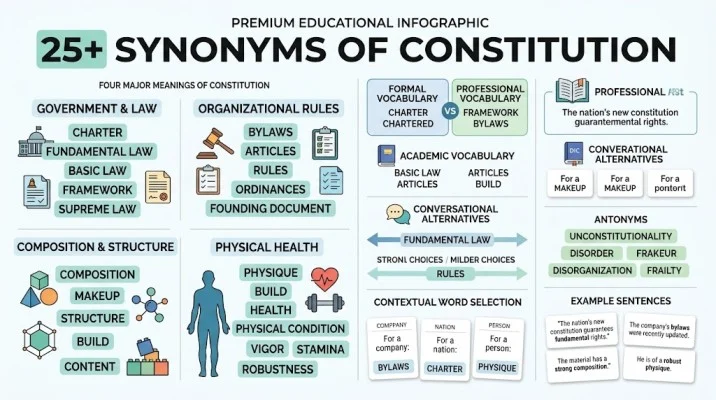
A writer may use the word constitution several times while working on a history essay, government report, legal document, school assignment, or article about health. The phrase synonym of constitution can be confusing because the best alternative changes completely depending on what constitution means in the sentence.
In government and law, constitution can refer to the fundamental rules or principles governing a country or organization. In other contexts, it can describe the way something is made up, or a person’s general physical condition.
That is why replacing constitution with a random word from a thesaurus can produce an inaccurate sentence. Words such as charter, fundamental law, framework, composition, structure, build, and physical condition each fit different meanings. Choosing the right alternative makes your writing more precise, natural, and easier to understand.
What Are the Best Synonyms of “Constitution”?
The best synonym of constitution depends on its meaning. For a country’s governing document, use charter, fundamental law, or basic law. For an organization’s rules, bylaws or governing document may fit. Composition, use makeup or structure. Physical health, physical condition, physique, or build can work.
Meaning, Tone, and Context
Simple Definition
Constitution is a noun with several meanings.
In government and law, it refers to the fundamental principles, rules, or written document that establishes how a country or organization is governed. In the United States, for example, the Constitution refers specifically to the nation’s foundational governing document. Cambridge also identifies a health sense and a composition sense.
The word can also describe how something is formed from different parts. For example, the constitution of a committee refers to the way its members are made up or arranged.
In another common sense, a person’s constitution refers to their general physical condition or ability to remain healthy and strong.
Part of Speech
Constitution is primarily a noun.
It is usually countable when referring to a particular governing document or organizational constitution.
Examples:
- “The country adopted a new constitution.”
- “The club’s constitution was amended.”
- “He has a strong constitution.”
Overall Tone
The tone of constitution is generally neutral, but the word often sounds formal because it appears frequently in law, government, politics, academic writing, and organizational documents.
Its tone changes with context.
- Legal: formal
- Political: formal
- Academic: formal or semi formal
- Organizational: formal
- Health: neutral to formal
- Composition: neutral
- Everyday conversation: less common than simpler alternatives
Formality Level
Constitution is primarily a formal or neutral word.
It is natural in sentences such as:
“Congress operates within the limits established by the Constitution.”
It is less natural when a casual speaker simply means the way something is made.
For example, in everyday language, “the makeup of the team” will usually sound more natural than “the constitution of the team.”
Common Uses
Native English speakers commonly use constitution in several areas.
Government and politics
- national constitution
- written constitution
- constitutional rights
- constitutional government
- amend the constitution
Organizations
- club constitution
- company constitution
- organizational constitution
- adopt a constitution
- amend the constitution
Composition
- constitution of a committee
- constitution of society
- chemical constitution
Health
- strong constitution
- weak constitution
- physical constitution
Cambridge specifically recognizes government, health, and composition as established senses of the noun.
Word Forms
Noun: constitution
Plural noun: constitutions
Adjective: constitutional
Adverb: constitutionally
Opposite adjective: unconstitutional
The adjective constitutional generally means related to, allowed by, or contained in a constitution. It can also relate to someone’s general state of health.
When and How to Use “Constitution”
Use constitution when you need to describe foundational rules, governing principles, the composition of something, or a person’s physical constitution.
The important point is context. A constitution that governs a country is not the same thing as a person’s physical constitution, so the best synonym changes with the meaning.
Professional
“The organization adopted a new constitution to clarify the responsibilities of its board.”
Here, governing document or charter could replace constitution.
Academic
“The constitution of the committee influenced the direction of the study.”
Here, composition or makeup may be more precise.
Workplace
“The company’s constitution establishes the authority of its governing body.”
Here, governing framework may work depending on the organization’s structure.
Personal
“Despite his age, he has a remarkably strong constitution.”
Here, physical condition or robustness may communicate the health meaning.
“Please review the proposed amendments to the association’s constitution.”
Here, governing document could be used if the audience may not understand the technical term.
Resume
“Provided research support for constitutional law projects.”
In this context, constitutional is appropriate because the work concerns constitutional law.
Social Media
“Learning about the Constitution helped me understand how the American government is structured.”
Because Constitution is being used as a specific proper noun in U.S. history and government, replacing it with a general synonym such as framework would reduce precision.
Best Synonyms of “Constitution”
No single synonym works for every meaning of constitution. A legal constitution, an organization’s governing document, a person’s physical constitution, and the composition of a group require different alternatives.
Professional Writing: Governing Framework
Governing framework is useful when discussing the rules and principles that organize an institution or system.
Example:
“The country’s governing framework defines the powers of each branch of government.”
This phrase is particularly useful when you want to explain the function of a constitution without implying that the document itself is identical to another legal instrument.
Academic Writing: Fundamental Law
Fundamental law is a strong academic alternative when constitution refers to the foundational legal principles of a state.
Example:
“The fundamental law establishes limits on governmental authority.”
It sounds formal and precise, making it suitable for political science, history, and legal studies.
Business Communication: Governing Document
Governing document works well when discussing the rules that establish how an organization operates.
Example:
“The board approved revisions to the organization’s governing document.”
This alternative is especially useful when the document may not technically be called a constitution.
Casual Conversation: Rules
In casual conversation, rules can be a simpler alternative when constitution refers to an organization’s governing requirements.
Example:
“The club’s rules explain how members can vote.”
This is much easier to understand than constitution for a general audience.
Emotional Writing: Physical Condition
When constitution refers to someone’s physical strength or health, physical condition is a clear alternative.
Example:
“Despite the difficult journey, his physical condition remained strong.”
Creative Writing: Build
Build can work naturally in descriptions of someone’s physical constitution.
Example:
“Her strong build helped her endure the long journey.”
It is more conversational and visual than the formal phrase physical constitution.
Resume Writing: Framework
Framework can be useful when describing the system of principles or rules behind an institution or process.
Example:
“Analyzed the legal framework governing public agencies.”
It is concise and professional, although it should not replace constitution when the specific constitutional document is the subject.
Workplace Communication: Bylaws
For an association, club, or similar organization, bylaws may be appropriate when the constitution establishes organizational rules.
Example:
“The board reviewed the bylaws before approving the proposal.”
The words are related but not universally interchangeable. The organization’s own terminology should determine which term is most accurate.
Stronger Meaning: Fundamental Law
When you want to emphasize foundational legal authority, fundamental law is often stronger and more specific than a general word such as framework.
Example:
“The fundamental law protects the separation of governmental powers.”
Softer Meaning: Framework
Framework is useful when you want to describe the general system or structure without making a strict claim that it is a formal constitution.
Example:
“The agreement provides a framework for cooperation.”
When Not to Use “Constitution”
When You Mean Simple Rules
Constitution can sound unnecessarily formal when you are talking about ordinary instructions.
Less natural:
“The team’s constitution says everyone must arrive on time.”
Better:
“The team’s rules say everyone must arrive on time.”
The word rules is clearer for an informal group.
When You Mean Composition
If you are describing the members or parts that make up something, composition may be more precise.
Less precise:
“The constitution of the committee changed.”
Better:
“The composition of the committee changed.”
This makes it immediately clear that the sentence concerns who or what makes up the committee.
When You Mean Physical Appearance
Constitution is not normally the best everyday word for physical appearance.
Less natural:
“He has an athletic constitution.”
Better:
“He has an athletic build.”
Build is much more natural when describing someone’s physical form.
When You Mean General Health
Constitution can describe physical health, but it may sound somewhat formal.
Formal:
“She has a strong constitution.”
More direct:
“She is in good health.”
The best choice depends on whether you want to emphasize physical resilience or general health.
When You Mean a General System
Framework may be more appropriate when you are discussing a broad system rather than a specific constitutional document.
Less precise:
“The constitution for our marketing strategy needs improvement.”
Better:
“The framework for our marketing strategy needs improvement.”
When the Specific Legal Document Matters
Do not replace Constitution with a generic synonym when the specific U.S. document is the subject.
Less precise:
“The framework protects freedom of speech.”
More precise:
“The U.S. Constitution protects freedom of speech.”
In legal and historical writing, precision matters more than variation.
Words Commonly Confused With “Constitution”
Charter
Difference: A charter is a formal document that establishes or grants authority to an organization, institution, or sometimes a city.
When to Use It: Use charter when the document itself creates or authorizes an organization or defines its powers.
Example:
“The university operates under a charter granted by the state.”
Law
Difference: Law is a broad term for rules recognized and enforced by a legal system. A constitution establishes fundamental legal principles but is not simply interchangeable with every law.
When to Use It: Use law when discussing statutes, legal requirements, or enforceable rules generally.
Example:
“The new law regulates workplace safety.”
Bylaws
Difference: Bylaws are rules governing the internal operation of an organization. They can overlap with an organizational constitution but are not automatically identical.
When to Use It: Use bylaws when discussing internal procedures, membership, elections, meetings, and organizational administration.
Example:
“The association revised its bylaws before the annual meeting.”
Framework
Difference: A framework is a general structure or system for organizing ideas, activities, rules, or processes.
When to Use It: Use framework when the emphasis is on an organizing structure rather than a specific legal document.
Example:
“The policy provides a framework for responsible data use.”
Structure
Difference: Structure focuses on how parts are organized or connected.
When to Use It: Use it when discussing the arrangement of an organization, system, committee, or physical object.
Example:
“The structure of the organization changed after the merger.”
Composition
Difference: Composition focuses on what something consists of and how its parts are represented.
When to Use It: Use it when describing the members, ingredients, elements, or components that make up something.
Example:
“The composition of the committee reflects several professional backgrounds.”
Best Synonyms of “Constitution” by Context
| Context | Best Synonym | Why It Works | Example |
|---|---|---|---|
| Formal writing | Fundamental law | Emphasizes foundational legal principles | “The fundamental law limits government power.” |
| Academic writing | Fundamental law | Fits legal and political analysis | “The fundamental law shaped the country’s institutions.” |
| Professional communication | Governing document | Clearly describes an organization’s formal rules | “The governing document outlines board responsibilities.” |
| Business emails | Governing document | Easy for a broad professional audience | “Please review the governing document before the meeting.” |
| Resume writing | Framework | Concise and professional for systems and policy work | “Analyzed the legal framework for public programs.” |
| Workplace communication | Bylaws | Useful for internal organizational rules | “The bylaws establish voting procedures.” |
| Casual conversation | Rules | Simple and familiar | “The club’s rules explain how members vote.” |
| Everyday speaking | Makeup | Natural for composition | “The makeup of the group has changed.” |
| Creative writing | Build | Natural for physical constitution | “His sturdy build helped him survive the journey.” |
| Storytelling | Physical condition | Clear when discussing health | “Her physical condition improved after months of rest.” |
| Emotional writing | Health | Direct and accessible | “His health remained strong despite the hardship.” |
| Strong emphasis | Fundamental law | Highlights foundational authority | “The fundamental law protects individual rights.” |
| Mild tone | Framework | Broad and less legally specific | “The framework supports cooperation.” |
| Social media captions | Rules | Simple and accessible | “Our community rules keep discussions respectful.” |
| American English | Constitution | Most precise when referring to the U.S. document | “The Constitution establishes the federal system.” |
| British English | Constitution | Standard term for constitutional arrangements | “The constitution shapes the relationship between institutions.” |
How to Choose the Best Synonym of “Constitution”
The first step is to identify which meaning of constitution you are using.
If You Mean a Country’s Governing Document
Choose:
Constitution, fundamental law, basic law, or organic law.
Use Constitution when the specific document matters. Use fundamental law when you are discussing its foundational legal role.
If You Mean an Organization’s Governing Rules
Choose:
Charter, governing document, bylaws, or rules.
The choice depends on the organization’s terminology and the exact function of the document.
If You Mean How Something Is Made Up
Choose:
Composition, makeup, structure, formation, or arrangement.
For example:
“The constitution of the committee”
can often become:
“The composition of the committee.”
If You Mean Physical Health
Choose:
Physical condition, health, build, physique, or robustness, depending on the sentence.
For example:
“He has a strong constitution.”
could become:
“He has a strong physical constitution.”
Or, in more natural everyday language:
“He is in excellent health.”
If You Mean Physical Form
Choose:
Build, physique, frame, or physical makeup.
Example:
“His athletic build helped him perform well.”
Consider Your Audience
Academic readers may expect fundamental law, constitutional framework, or composition.
General readers may understand rules, structure, makeup, or health more quickly.
Consider Formality
Use formal vocabulary when writing legal documents, academic papers, or government reports.
Use simpler alternatives when writing for a general audience.
Consider Emotional Strength
Constitution itself is usually neutral. Words such as fundamental law can emphasize legal authority, while robustness can emphasize physical strength.
Consider Natural Usage
Do not change a word simply to avoid repetition. If constitution is the exact and clearest word, keeping it is often better than forcing an unfamiliar synonym.
Real Life Examples of “Constitution”
School
Original:
“Students studied the Constitution in their history class.”
Alternative:
“Students studied the nation’s foundational governing document in their history class.”
The original is usually better because Constitution is the established name of the U.S. document.
College
Original:
“The paper examines the constitution of modern political institutions.”
Improved:
“The paper examines the structure of modern political institutions.”
Here, structure may be clearer if the paper focuses on how institutions are organized.
Workplace
Original:
“The association’s constitution explains how members elect officers.”
Alternative:
“The association’s governing document explains how members elect officers.”
This works when the audience is unfamiliar with the organization’s terminology.
Business
Original:
“The constitution of the committee was changed after the merger.”
Improved:
“The composition of the committee changed after the merger.”
Composition clearly indicates that the members or representation changed.
Original:
“Please read the association’s constitution before submitting your proposal.”
Alternative:
“Please read the association’s governing document before submitting your proposal.”
The second version can be useful for a general audience.
Resume
Original:
“Reviewed constitutional documents during legal research.”
Improved:
“Reviewed foundational legal documents during constitutional law research.”
The second version provides more descriptive context, although constitutional should remain when the work specifically involved constitutional law.
Conversation
Original:
“He has a strong constitution.”
Alternative:
“He’s in excellent health.”
The alternative is more straightforward in everyday conversation.
Storytelling
Original:
“His strong constitution allowed him to continue the journey.”
Alternative:
“His sturdy build and physical resilience helped him continue the journey.”
The alternative creates a more descriptive narrative.
Blogging
Original:
“The constitution of the community has changed over time.”
Improved:
“The makeup of the community has changed over time.”
Makeup is more accessible for general readers.
Social Media
Original:
“The Constitution remains central to the discussion.”
Alternative:
“The nation’s foundational legal document remains central to the discussion.”
The alternative can help readers who may not immediately understand the reference.
25 Best Synonyms of “Constitution”
Because constitution has multiple meanings, the following list groups genuine alternatives by sense rather than pretending that every word can replace it in every sentence.
| Synonym | Simple Meaning | Best Used For | Example Sentence |
|---|---|---|---|
| Charter | Formal document establishing authority or organization | Government, institutions, organizations | “The city operates under a charter granted by the state.” |
| Fundamental law | Foundational legal rules of a state | Constitutional law, academic writing | “The fundamental law defines the limits of government power.” |
| Basic law | Core legal principles governing a state | Government and legal writing | “The basic law establishes citizens’ fundamental rights.” |
| Organic law | Foundational law establishing government structure | Legal and academic writing | “The organic law defines the powers of the national institutions.” |
| Governing document | Formal document containing organizational rules | Associations and institutions | “The governing document sets out the board’s responsibilities.” |
| Founding document | Document establishing foundational principles | History and civics | “The founding document shaped the country’s political system.” |
| Governing framework | System of principles that organizes authority | Academic and professional writing | “The governing framework separates institutional responsibilities.” |
| Legal framework | System of laws and principles | Law, policy, business | “The legal framework protects individual rights.” |
| Code | Organized set of rules or principles | Rules and regulations | “The organization follows a strict code of conduct.” |
| Bylaws | Internal rules governing an organization | Clubs, associations, nonprofits | “The bylaws explain how board members are elected.” |
| Rules | Instructions or requirements that guide behavior | Casual and organizational use | “The group’s rules apply to every member.” |
| Regulations | Official rules controlling conduct or activity | Government and business | “The regulations establish safety requirements.” |
| Structure | The way parts are organized | Organizations and systems | “The structure of the institution changed after reform.” |
| Composition | The parts or members that make something up | Committees, groups, substances | “The composition of the committee changed significantly.” |
| Makeup | The combination of parts or people | Everyday and general writing | “The makeup of the team reflects several departments.” |
| Formation | The process or result of forming something | Groups, institutions, systems | “The formation of the new committee took several months.” |
| Arrangement | The way parts are positioned or organized | Groups and systems | “The arrangement of the governing bodies was revised.” |
| Build | A person’s physical form or body type | Health and description | “His strong build helped him handle the physical demands of the job.” |
| Physique | A person’s physical structure and appearance | Health, fitness, descriptive writing | “Her athletic physique reflected years of training.” |
| Physical makeup | A person’s physical characteristics | Health and descriptive writing | “His physical makeup allowed him to tolerate demanding conditions.” |
| Physical condition | General state of physical health | Health | “Her physical condition improved after treatment.” |
| Health | State of physical well being | Everyday health discussions | “His health remained stable throughout the recovery.” |
| Stamina | Ability to continue physical or mental effort | Physical strength and endurance | “The athlete’s stamina helped him finish the race.” |
| Vigor | Physical or mental energy and strength | Formal and descriptive writing | “His vigor remained impressive despite his age.” |
| Robustness | Strength and resistance to weakness | Health and systems | “Her physical robustness helped her recover quickly.” |
Synonyms of “Constitution” by Usage
Professional vs Personal Synonyms
In professional settings, the best alternative depends on whether you mean a legal document, organizational rules, or structural arrangement.
Use governing document, charter, framework, or bylaws for organizational and institutional contexts.
In personal contexts, constitution often refers to physical health or strength. Words such as health, physical condition, build, and physique are more natural.
Formal vs Conversational Synonyms
For reports and essays, consider:
- fundamental law
- basic law
- organic law
- legal framework
- governing framework
- composition
For casual conversation, consider:
- rules
- makeup
- build
- health
- structure
For texting, simple words usually work better than highly technical alternatives.
Instead of:
“The constitution of the group has changed.”
A casual speaker might say:
“The makeup of the group has changed.”
Academic Synonyms
Academic writing requires careful distinctions.
For political science and constitutional studies:
- fundamental law
- basic law
- organic law
- legal framework
- governing framework
For sociology or organizational studies:
- composition
- structure
- makeup
- formation
For health related academic writing:
- physical condition
- physique
- physical makeup
Choose the word that describes the exact concept rather than selecting the most formal sounding alternative.
Professional and Business Synonyms
For resumes:
- legal framework
- governing framework
- organizational structure
- governing document
For interviews:
- framework
- structure
- rules
For meetings:
- bylaws
- governing document
- organizational structure
For presentations:
- framework
- structure
- governing principles
For performance reviews:
- organizational structure
- governing framework
For client communication:
- governing document
- rules
- framework
For business emails:
- governing document
- bylaws
- organizational rules
Creative and Literary Synonyms
Creative writing can use more descriptive alternatives when constitution refers to physical characteristics.
Build gives a visual impression.
“His powerful build made him appear stronger than he felt.”
Physique sounds more descriptive and polished.
“Years of training had transformed his physique.”
Physical condition emphasizes health.
“Her physical condition had deteriorated during the winter.”
For composition, makeup can make prose more accessible.
“The makeup of the village had changed dramatically.”
Slang or Modern Synonyms
There is no widely accepted slang synonym for constitution that works across its different meanings.
However, casual English may use:
Big build: large or strong physical body.
Good shape: good physical condition.
Rules: organizational requirements.
For example:
“He’s in great shape.”
This can replace a health related use of constitution in casual conversation, but it is not a direct synonym in legal or political contexts.
Avoid these casual expressions in legal documents, academic papers, and formal reports.
Strongest to Mildest Synonyms
There is no universal intensity scale for constitution because its meanings are too different. Legal authority and physical strength cannot be measured on exactly the same scale.
Still, within specific meanings, the following guide can help.
Legal and Government Sense
Mild or broad:
Framework
Moderate:
Governing framework
Strong and foundational:
Basic law
Very strong and foundational:
Fundamental law
Organizational Sense
Mild:
Rules
Moderate:
Bylaws
Strong:
Governing document
Foundational:
Charter
Physical Health Sense
General:
Health
Moderate:
Physical condition
Stronger emphasis on physical strength:
Vigor
Strong emphasis on resilience:
Robustness
The key principle is to avoid treating these categories as interchangeable. Fundamental law expresses legal authority, while robustness expresses strength or resilience.
Emotional vs Neutral Synonyms
Emotional Synonyms
Words such as vigor, robustness, and strong build can create a more expressive description when discussing physical qualities.
Example:
“His remarkable vigor kept him active well into old age.”
These words add a stronger descriptive quality than simply saying:
“He was healthy.”
Neutral Synonyms
For objective writing, choose:
- structure
- composition
- framework
- physical condition
- health
- governing document
- basic law
Example:
“The composition of the committee changed after the election.”
This sentence communicates information without adding emotional emphasis.
Antonyms of “Constitution”
There is no single universal antonym for constitution because the word has several meanings. The following are contextual opposites. They apply to specific senses rather than functioning as direct opposites in every sentence.
| Antonym | Meaning | Example Sentence |
|---|---|---|
| Anarchy | Absence of effective governing authority | “The collapse of central authority created a period of anarchy.” |
| Lawlessness | Lack of respect for or enforcement of law | “The region experienced prolonged lawlessness.” |
| Disorder | Lack of organized structure or control | “The institution fell into disorder after the leadership crisis.” |
| Disorganization | Lack of effective arrangement | “Disorganization made the committee difficult to manage.” |
| Instability | Lack of dependable order or strength | “Political instability weakened the institution.” |
| Fragmentation | Breaking into separate parts | “Fragmentation made coordinated action difficult.” |
| Disunity | Lack of unity among members or groups | “Disunity prevented the organization from reaching an agreement.” |
| Disintegration | Breakdown into separate or weakened parts | “The alliance faced gradual disintegration.” |
| Formlessness | Lack of clear structure or shape | “The proposal lacked structure and seemed almost formless.” |
| Weakness | Lack of physical or structural strength | “His weakness made the long journey difficult.” |
| Frailty | Physical weakness or delicacy | “Age had increased her physical frailty.” |
| Debility | Reduced physical strength or ability | “The illness caused prolonged debility.” |
| Infirmity | Physical weakness or illness | “The patient’s infirmity limited his mobility.” |
| Poor health | Unsatisfactory physical condition | “Years of poor health affected his ability to work.” |
| Sickness | State of being ill | “The prolonged sickness left him physically exhausted.” |
These contextual opposites should not be forced into sentences where constitution has a different meaning.
Comparison: “Constitution” vs Similar Words
Constitution vs Charter
Main Difference
A constitution establishes fundamental governing principles, while a charter generally establishes or authorizes an institution, organization, or governmental body.
Which Is Stronger?
Neither is universally stronger. Their functions differ.
Which Is More Formal?
Both are formal terms.
When to Use Each
Use constitution for foundational governing principles. Use charter when the document establishes authority or creates an institution.
Examples
Constitution:
“The Constitution establishes the basic structure of government.”
Charter:
“The university received its charter from the state.”
Constitution vs Law
Main Difference
Law is a broad category of legally enforceable rules. A constitution establishes fundamental rules and principles within a legal system.
Which Is Stronger?
Neither is automatically stronger, but constitutional rules generally occupy a foundational position within a legal system.
Which Is More Formal?
Both are standard formal terms.
When to Use Each
Use law when referring generally to statutes and legal requirements. Use constitution when referring to foundational governing principles or the constitutional document.
Examples
Constitution:
“The Constitution limits governmental authority.”
Law:
“The new law regulates workplace safety.”
Constitution vs Bylaws
Main Difference
Bylaws usually govern the internal operation of an organization. A constitution can provide broader foundational principles.
Which Is Stronger?
A constitution may be more foundational, but the relationship depends on the organization.
Which Is More Formal?
Both are formal organizational terms.
When to Use Each
Use bylaws for internal procedures, elections, meetings, and administrative rules.
Examples
Constitution:
“The association’s constitution establishes its main objectives.”
Bylaws:
“The bylaws explain how officers are elected.”
Constitution vs Framework
Main Difference
A constitution is often a specific foundational document or set of principles. A framework is a broader organizing structure.
Which Is Stronger?
Constitution is more specific when referring to formal governing principles.
Which Is More Formal?
Both can be formal, but constitution has stronger legal associations.
When to Use Each
Use framework when discussing a general system of organization.
Examples
Constitution:
“The constitution defines the powers of government.”
Framework:
“The framework provides a basis for cooperation.”
Constitution vs Structure
Main Difference
Structure focuses on how parts are organized. Constitution can refer to the principles governing a system or the way something is composed.
Which Is Stronger?
Neither. They emphasize different concepts.
Which Is More Formal?
Both are neutral to formal depending on context.
When to Use Each
Use structure when the arrangement of parts is the main focus.
Examples
Constitution:
“The constitution establishes the government’s basic principles.”
Structure:
“The structure of the organization changed after the merger.”
Constitution vs Composition
Main Difference
Composition specifically focuses on the parts or members that make up something.
Which Is Stronger?
Neither is stronger.
Which Is More Formal?
Both are suitable for academic writing.
When to Use Each
Use composition when discussing the membership or components of a group, substance, or system.
Examples
Constitution:
“The constitution of the committee was discussed during the meeting.”
Composition:
“The composition of the committee changed after the election.”
Common Phrases and Expressions with “Constitution”
Adopt a Constitution
Meaning: Formally accept a constitution for a country or organization.
Example Sentence:
“The association voted to adopt a new constitution.”
Draft a Constitution
Meaning: Prepare a proposed constitution.
Example Sentence:
“The committee was formed to draft a constitution for the new organization.”
Amend the Constitution
Meaning: Formally change part of a constitution.
Example Sentence:
“The legislature proposed an amendment to the constitution.”
Under the Constitution
Meaning: According to the rules or principles established by a constitution.
Example Sentence:
“Citizens have certain protections under the Constitution.”
Constitutional Rights
Meaning: Rights protected or recognized by a constitution.
Example Sentence:
“The court examined whether the policy violated constitutional rights.”
Constitutional Amendment
Meaning: A formal change to a constitution.
Example Sentence:
“The proposed constitutional amendment generated significant public discussion.”
Written Constitution
Meaning: A constitution recorded in a formal written document.
Example Sentence:
“The country operates under a written constitution.”
Strong Constitution
Meaning: A person’s strong physical health or resilience.
Example Sentence:
“Despite the demanding conditions, he had a strong constitution.”
Common Mistakes to Avoid
Mistake 1: Treating Every Synonym as Interchangeable
Incorrect:
“The country’s bylaws protect fundamental rights.”
Better:
“The country’s Constitution protects fundamental rights.”
Why:
Bylaws normally refer to internal organizational rules, while the sentence concerns a country’s foundational governing document.
Mistake 2: Using “Charter” for Every Constitution
Incorrect:
“The Constitution and charter are always the same thing.”
Better:
“A charter and a constitution can serve related but different functions.”
Why:
A charter may establish or authorize an organization, while a constitution establishes foundational governing principles.
Mistake 3: Using a Legal Synonym for Composition
Incorrect:
“The fundamental law of the committee changed after the election.”
Better:
“The composition of the committee changed after the election.”
Why:
The sentence concerns the members who make up the committee, not its governing rules.
Mistake 4: Using “Constitution” When You Mean Appearance
Incorrect:
“He has an impressive constitution.”
Better:
“He has an impressive physique.”
Why:
Physique is more natural when discussing physical form or appearance.
Mistake 5: Using an Informal Word in Legal Writing
Incorrect:
“The country’s rules protect freedom of speech.”
Better:
“The country’s Constitution protects freedom of speech.”
Why:
The specific legal document should be named when it is the subject of the sentence.
Mistake 6: Using “Framework” as a Perfect Replacement
Incorrect:
“The framework was amended by the legislature.”
Better:
“The Constitution was amended by the legislature.”
Why:
A framework can describe a system generally, but a formal constitutional amendment concerns the constitution itself.
Mistake 7: Confusing Physical Constitution With General Health
Incorrect:
“The doctor examined his constitution and found a minor infection.”
Better:
“The doctor examined his health and found a minor infection.”
Why:
Health is more natural when discussing a person’s medical condition. Constitution usually emphasizes general physical resilience or constitution.
Frequently Asked Questions
What is the best synonym of constitution?
The best synonym of constitution depends on meaning. Charter, fundamental law, and basic law work for government. Bylaws fit organizations, while composition, structure, build, and physical condition fit other meanings.
What are the best formal synonyms of constitution?
Formal synonyms include fundamental law, basic law, organic law, charter, governing framework, and governing document. The correct choice depends on whether constitution refers to government, an organization, or a system’s structure.
What are common informal synonyms of constitution?
There is no single informal synonym for every meaning. For composition, makeup and structure are natural. For physical constitution, health, build, and shape may work in casual conversation.
What is another word for constitution in professional writing?
In professional writing, useful alternatives include governing document, framework, charter, bylaws, legal framework, and structure. Choose based on whether you mean formal rules, organizational authority, or the arrangement of parts.
What is the difference between constitution and charter?
A constitution generally establishes fundamental governing principles, while a charter commonly establishes or authorizes an organization, institution, or governmental body. They can overlap, but they should not automatically be treated as identical.
What is the opposite of constitution?
There is no single direct opposite of constitution across all meanings. In the governing sense, contextual opposites include anarchy, lawlessness, and disorder. For physical constitution, frailty, debility, and poor health may serve as opposites.
Conclusion
The word constitution has several distinct meanings, so the best alternative depends heavily on context. In government and law, charter, fundamental law, basic law, and organic law can be useful. For organizations, governing document and bylaws may fit, while composition, makeup, and structure work when the focus is on how something is formed. For physical health, physical condition, health, build, and physique can be more natural.
The most useful synonym of constitution is therefore not simply the most formal word. It is the word that preserves the original meaning while matching the audience, tone, and purpose of the sentence.
Read More Related Articles:
50+ Synonyms of Love | Powerful Words to Express Every …
Synonyms for Thus | Meaning, Examples, and Better Word …
50+ Synonyms of Nice | Meanings, Uses, Examples, and Best …









1 thought on “25+ Synonyms of Constitution | Meanings, Uses, Examples, and the Right Synonym of Constitution”