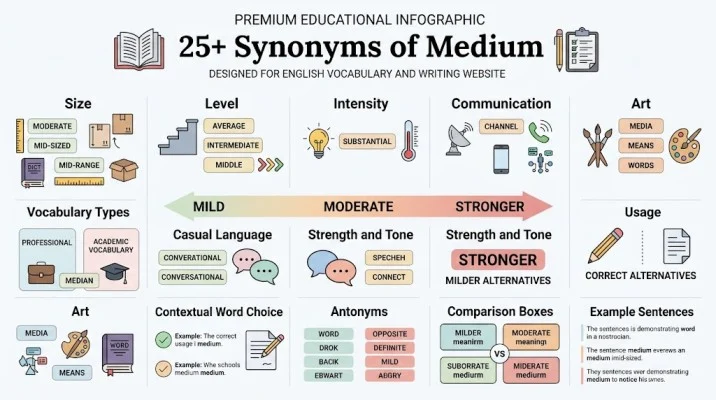
Writers often use the word medium when describing size, intensity, level, or a method of communication. In an email, essay, product description, or everyday conversation, however, the same word can become repetitive or unclear. Searching for the right synonym of medium can help you express exactly what you mean instead of relying on one general word.
The challenge is that medium has several meanings. It can describe something that is neither small nor large, an amount that is neither low nor high, a channel used to communicate, or a material used by an artist. The best alternative therefore depends on context. Words such as moderate, average, intermediate, middle, channel, method, material, and means can work in different situations, but they are not interchangeable in every sentence.
What Are the Best Synonyms of “Medium”?
The best synonym of medium depends on its meaning. For size or level, use moderate, average, intermediate, middling, or middle. Communication, channel, method, means, or vehicle may fit. For art, material or artistic material is more accurate. In casual English, mid-sized or middle-sized can describe physical size naturally.
Meaning, Tone, and Context
Simple Definition
Medium has several common meanings in American English. Most often, it describes something that falls between two extremes, especially between small and large, low and high, weak and strong.
For example:
“She ordered a medium coffee.”
Here, medium describes a size that falls between smaller and larger options.
The word can also describe a method or channel through which something is communicated:
“Television is a powerful medium for reaching large audiences.”
In art, medium can refer to the material or technique an artist uses:
“Oil paint was his preferred medium.”
Because the word has multiple meanings, the correct synonym depends heavily on the sentence.
Part of Speech
Medium can function as both a noun and an adjective.
As an adjective, it describes something that is in the middle range:
“She bought a medium shirt.”
As a noun, it can refer to a means of communication, an artistic material, or something that occupies an intermediate position:
“Radio remains an influential medium.”
“Watercolor is her favorite medium.”
The plural form of the noun is usually media when referring to communication channels and mediums in some other senses, particularly when referring to people who claim to communicate with spirits.
Overall Tone
Medium is generally neutral. It does not automatically communicate positive or negative emotion.
Its tone changes according to context. In a restaurant, it may simply describe size or cooking level. In a business report, it may describe a moderate level of risk. it can have a technical meaning.
Formality Level
Medium is a neutral word that works in formal, semi-formal, and informal communication.
Examples include:
- “medium-sized company” in business writing
- “medium temperature” in instructions
- “medium difficulty” in educational content
- “medium coffee” in everyday conversation
- “digital medium” in academic or professional writing
More specialized alternatives may sound more precise in particular contexts.
Common Uses
Native English speakers commonly use medium for:
- Size
- Intensity
- Temperature
- Difficulty
- Risk
- Speed
- Strength
- Cooking levels
- Clothing sizes
- Food portions
- Businesses
- Communication channels
- Art materials
- Artistic techniques
- Advertising
- Technology
- Data transmission
Word Forms
| Form | Word | Example |
|---|---|---|
| Adjective | medium | “The box is medium in size.” |
| Noun | medium | “Radio is a communication medium.” |
| Plural noun | media | “Social media influence communication.” |
| Related adjective | medium-sized | “They operate a medium-sized business.” |
The exact plural depends on the meaning. Media is especially common when discussing communication, journalism, or mass communication.
When and How to Use “Medium”
Use medium when you want to describe something positioned between two extremes or when you are referring to a means, channel, or artistic material.
The following examples show how its meaning changes with context.
Professional
“The company is considered a medium-sized employer in the region.”
Here, medium-sized describes the organization’s scale.
Academic
“The experiment was conducted under medium light conditions.”
In this sentence, medium identifies an intermediate level of light.
Workplace
“Please set the printer to medium quality unless a higher resolution is required.”
Here, the word describes a middle level of quality.
Personal
“I usually wear a medium in this brand.”
In this everyday example, medium identifies a clothing size.
“We expect medium demand for the product during the first quarter.”
The word describes a level of demand that is neither especially low nor especially high.
Resume
“Created content for a medium-sized technology company.”
Here, medium-sized communicates the approximate scale of the employer.
Social Media
“This recipe works best over medium heat.”
In this context, medium describes an intermediate cooking temperature.
Best Synonyms of “Medium”
No synonym of medium works in every situation because the word itself has multiple meanings. A synonym that works for size may be completely wrong when medium refers to communication or art.
Professional Writing: Moderate
Moderate is a strong choice when medium describes a level, amount, degree, or intensity.
Example:
“The company experienced moderate growth during the quarter.”
Why it works: Moderate sounds precise and professional when discussing levels or degrees.
Academic Writing: Intermediate
Intermediate works well when something falls between two stages, levels, or extremes.
Example:
“The course is designed for intermediate learners.”
Why it works: It clearly identifies a position between beginner and advanced levels.
Business Communication: Mid-Sized
Mid-sized is useful when medium describes the size of a company, organization, or market.
Example:
“The software is designed for mid-sized businesses.”
Why it works: It gives a clearer sense of organizational size.
Casual Conversation: Middle
Middle can replace medium in some everyday contexts when something is positioned between two choices.
Example:
“I’ll take the middle size.”
Why it works: It sounds natural when choosing among several sizes or levels.
Emotional Writing: Moderate
When medium describes an emotional level, moderate can provide a calmer and more measured description.
Example:
“She felt a moderate sense of relief after hearing the news.”
Why it works: It avoids exaggeration and keeps the emotional description controlled.
Creative Writing: Middling
Middling can describe something that is neither especially good nor especially bad, although it often carries a slightly critical tone.
Example:
“The restaurant received middling reviews from local critics.”
Why it works: It adds judgment that the neutral word medium does not necessarily communicate.
Resume Writing: Mid-Sized
For a resume, mid-sized can be more specific than simply saying medium when describing an employer or market.
Example:
“Managed marketing campaigns for a mid-sized retail company.”
Why it works: It sounds natural in professional descriptions of organizations.
Workplace Communication: Moderate
Use moderate when discussing workload, risk, growth, demand, or other measurable levels.
Example:
“The project carries a moderate level of financial risk.”
Why it works: It sounds professional and clearly communicates an intermediate degree.
Stronger Meaning: Substantial
When you want to communicate that an amount is considerably large rather than merely medium, substantial may be more appropriate.
Example:
“The company made a substantial investment in new equipment.”
Why it works: It moves beyond the neutral middle range and emphasizes considerable size or value.
Softer Meaning: Average
When medium means ordinary or typical, average can be a useful alternative.
Example:
“The product received an average rating from customers.”
Why it works: Average communicates typical performance rather than simply middle size.
When Not to Use “Medium”
Although medium is flexible, there are situations where a more specific word makes the sentence clearer.
When the Meaning Is Too General
Medium can be vague when the reader needs a precise measurement.
Less effective:
“The company has a medium budget.”
Better:
“The company has a moderate budget of approximately $50,000.”
Why: The second sentence provides a clearer sense of the level.
When You Mean “Average”
If you mean typical or ordinary rather than middle-sized, average is usually better.
Less effective:
“He has medium intelligence.”
Better:
“His test results were close to average.”
Why: Average describes a typical level, while medium does not necessarily communicate statistical normality.
When You Mean “Moderate”
For levels of risk, growth, intensity, or activity, moderate may sound more precise.
Less effective:
“The project has medium risk.”
Better:
“The project carries moderate risk.”
Why: Moderate naturally describes degrees and intensity.
When You Mean a Communication Channel
If medium refers to a way of communicating, a different word may be more direct.
Less effective:
“Email is an effective medium for customer support.”
Better:
“Email is an effective channel for customer support.”
Why: Channel directly identifies a route through which communication occurs.
When You Mean Artistic Material
When discussing painting, sculpture, or other art forms, material may be clearer.
Less effective:
“Clay is her favorite medium.”
Better:
“Clay is her preferred artistic material.”
Why: Material makes the physical substance explicit.
When You Need a Stronger Meaning
If the intended meaning is clearly above average, substantial or considerable may be more appropriate.
Less effective:
“The company made a medium investment.”
Better:
“The company made a substantial investment.”
Why: The stronger word communicates that the investment was considerable.
Words Commonly Confused With “Medium”
Moderate
Difference: Moderate describes a level that is neither excessive nor extreme.
When to Use It: Use it for intensity, risk, growth, activity, or amounts.
Example:
“The treatment caused moderate discomfort.”
Average
Difference: Average means typical or close to the mathematical mean, depending on context.
When to Use It: Use it when discussing typical performance, results, or characteristics.
Example:
“The average household spends less during the winter.”
Intermediate
Difference: Intermediate describes a position between two stages or levels.
When to Use It: Use it for skill levels, stages, courses, and positions between beginner and advanced.
Example:
“She enrolled in an intermediate Spanish course.”
Middle
Difference: Middle refers to a central position between two sides, points, or extremes.
When to Use It: Use it when describing physical or conceptual position.
Example:
“Choose the middle option if you want a balanced choice.”
Mid-Sized
Difference: Mid-sized specifically describes something that falls between smaller and larger sizes.
When to Use It: It is especially useful for companies, organizations, markets, and products.
Example:
“The firm serves mid-sized businesses across the country.”
Means
Difference: Means can refer to a method or way of achieving something, while medium can refer to a communication channel or artistic material.
When to Use It: Use it when discussing methods or ways of accomplishing something.
Example:
“Education is an important means of improving opportunity.”
Best Synonyms of “Medium” by Context
| Context | Best Synonym | Why It Works | Example |
|---|---|---|---|
| Formal writing | Moderate | Describes an intermediate degree precisely. | “The region experienced moderate growth.” |
| Academic writing | Intermediate | Identifies a middle stage or level. | “The participants had intermediate skills.” |
| Professional communication | Moderate | Sounds measured and precise. | “The company faces moderate risk.” |
| Business emails | Mid-sized | Clearly describes organization size. | “We serve several mid-sized clients.” |
| Resume writing | Mid-sized | Naturally describes employers or companies. | “Worked with a mid-sized technology firm.” |
| Workplace communication | Moderate | Works well for workload, risk, and intensity. | “The team currently has a moderate workload.” |
| Casual conversation | Middle | Sounds natural when discussing positions or choices. | “I’ll choose the middle option.” |
| Everyday speaking | Average | Works when meaning typical or ordinary. | “The meal was about average.” |
| Creative writing | Middling | Adds a slightly critical sense of average quality. | “The performance was middling at best.” |
| Storytelling | Moderate | Gives controlled descriptions of intensity. | “A moderate breeze moved through the trees.” |
| Emotional writing | Moderate | Keeps emotional descriptions measured. | “He felt moderate anxiety before the interview.” |
| Strong emphasis | Substantial | Goes beyond the middle range. | “They made a substantial investment.” |
| Mild tone | Moderate | Avoids exaggeration. | “The changes had a moderate effect.” |
| Social media captions | Mid-Sized | Concise and natural for size. | “A cozy mid-sized apartment with plenty of light.” |
| American English | Medium | Standard everyday term for size and levels. | “I usually order a medium.” |
| British English | Medium | Also standard for size and intermediate levels. | “She bought a medium jacket.” |
How to Choose the Best Synonym of “Medium”
Choosing the right word begins with identifying what medium means in your sentence.
Step 1: Identify the Meaning
Ask whether medium refers to:
- Size
- Level
- Intensity
- Typical performance
- Communication
- Art material
- Position
- Stage or skill level
This first step eliminates many incorrect synonyms.
Step 2: Consider the Tone
- If the sentence needs neutral language, medium or moderate may work well.
- If you want a stronger sense of size or value, consider substantial or considerable.
- If you want a more critical sense of average quality, middling may be appropriate.
Step 3: Consider Your Audience
For professional readers, moderate, intermediate, and mid-sized can provide useful precision.
For casual readers, medium, middle, and average may sound more natural depending on the meaning.
Step 4: Consider Emotional Strength
Medium is emotionally neutral.
Moderate is also generally neutral.
Middling can suggest disappointment.
Substantial suggests a greater degree.
Choosing among them depends on how much judgment you want the sentence to communicate.
Step 5: Match the Writing Purpose
A research paper may favor moderate or intermediate.
A business report may use moderate, mid-sized, or substantial.
A casual conversation may simply use medium.
A creative description may benefit from a more specific phrase rather than a direct synonym.
Step 6: Choose Natural English
Do not replace medium automatically. A synonym is useful only when it makes the sentence clearer.
For example:
“I wear a medium.”
This is already natural. Replacing it with “I wear an intermediate” would be incorrect.
However:
“The company faces medium risk.”
can naturally become:
“The company faces moderate risk.”
The second version is more idiomatic because moderate commonly describes risk.
Real Life Examples of “Medium”
School
Original:
“The assignment has a medium difficulty level.”
Improved:
“The assignment has a moderate difficulty level.”
The second version is more natural for educational writing.
College
Original:
“Students with medium skills can take this course.”
Improved:
“Students with intermediate skills can take this course.”
Intermediate is more precise when describing academic ability.
Workplace
Original:
“We currently have a medium workload.”
Improved:
“We currently have a moderate workload.”
This sounds more natural in professional communication.
Business
Original:
“The company is a medium business.”
Improved:
“The company is a mid-sized business.”
Mid-sized clearly communicates organizational scale.
Original:
“We expect medium demand next month.”
Improved:
“We expect moderate demand next month.”
This version sounds more polished in business writing.
Resume
Original:
“Worked for a medium technology company.”
Improved:
“Worked for a mid-sized technology company.”
The revised wording gives a clearer professional description.
Conversation
Original:
“I’ll have a medium coffee.”
This sentence is already natural. There is no need to replace medium with a more formal synonym.
Storytelling
Original:
“A medium wind moved through the trees.”
Improved:
“A moderate breeze moved through the trees.”
The revised sentence creates a more natural and descriptive image.
Blogging
Original:
“This strategy requires a medium amount of effort.”
Improved:
“This strategy requires a moderate amount of effort.”
The alternative is more precise and avoids an awkward phrase.
Social Media
Original:
“I finally found a medium-sized desk for my office.”
Alternative:
“I finally found the perfect mid-sized desk for my office.”
The second version is shorter and more conversational.
25 Best Synonyms of “Medium”
Because medium has several meanings, the following list includes alternatives that genuinely match particular senses. They should not be treated as interchangeable in every sentence.
| Synonym | Simple Meaning | Best Used For | Example Sentence |
|---|---|---|---|
| Moderate | Neither low nor high | Levels and intensity | “The medication produced moderate relief.” |
| Average | Typical or ordinary | Typical results | “The product received an average rating.” |
| Intermediate | Between two levels | Skills and stages | “This is an intermediate writing course.” |
| Middle | Central or between two points | Position and choices | “Choose the middle seat.” |
| Mid-Sized | Between small and large | Companies and products | “The company serves mid-sized retailers.” |
| Middling | Average in quality | Evaluations | “The film received middling reviews.” |
| Moderate-Sized | Neither small nor large | Physical size | “They live in a moderate-sized home.” |
| Mid-Range | In the middle price or quality range | Products and pricing | “This is a reliable mid-range laptop.” |
| Median | Middle value in an ordered set | Statistics | “The median income increased slightly.” |
| Midpoint | Central point | Positions and measurements | “The trail reaches its midpoint here.” |
| Midway | Halfway between two points | Location or progress | “We stopped midway through the journey.” |
| Mid-Level | Between lower and higher levels | Jobs and skills | “She applied for a mid-level position.” |
| Midscale | In the middle range | Business and classification | “The hotel operates in the midscale market.” |
| Balanced | Neither extreme nor excessive | Approaches and choices | “She took a balanced approach.” |
| Measured | Controlled and moderate | Speech and responses | “He gave a measured response.” |
| Temperate | Moderate rather than extreme | Climate and behavior | “The region has a temperate climate.” |
| Mild | Not intense or severe | Conditions and sensations | “The patient experienced mild discomfort.” |
| Moderate-Level | At an intermediate degree | Levels and conditions | “The course has a moderate-level workload.” |
| Conventional | Typical or standard | Methods and approaches | “They chose a conventional solution.” |
| Standard | Common or usual | Products and specifications | “The package includes a standard size.” |
| Ordinary | Not unusual or exceptional | General descriptions | “It was an ordinary afternoon.” |
| Typical | Representative of the usual | Characteristics | “This is typical performance for the model.” |
| Equable | Even and not extreme | Temperament or conditions | “The region is known for its equable climate.” |
| Channel | A route for communication | Media and communication | “Email is an effective communication channel.” |
| Means | A method or way | Methods and communication | “Education is a means of improving opportunity.” |
Synonyms of “Medium” by Usage
Professional vs Personal Synonyms
Professional writing often benefits from greater precision. Personal communication can usually remain simpler.
For workplace discussions, moderate, mid-sized, intermediate, and mid-level are useful because they identify specific degrees or categories.
In everyday conversation, medium, middle, average, and big enough may sound more natural depending on what you are describing.
Compare:
“We serve medium businesses.”
with:
“We serve mid-sized businesses.”
The second sentence is more precise in a professional context.
Formal vs Conversational Synonyms
Formal writing often uses words such as:
- Moderate
- Intermediate
- Median
- Substantial
- Mid-level
- Mid-range
Conversational English commonly uses:
- Medium
- Middle
- Average
- Mid-sized
- Big enough
For example:
Formal:
“The study involved participants with intermediate language proficiency.”
Conversational:
“She’s at a middle level in the course.”
The first is more precise for academic communication.
Academic Synonyms
Academic writing requires careful distinctions.
Intermediate
Use intermediate for levels of knowledge, ability, development, or progression.
“Participants had intermediate reading skills.”
Moderate
Use moderate for levels of intensity, effect, risk, or degree.
“The treatment produced moderate improvement.”
Median
Use median when discussing the middle value in an ordered statistical data set.
“The median household income increased.”
Midpoint
Use midpoint for the central position in a range, journey, process, or measurement.
“The researchers evaluated the participants at the midpoint of the study.”
Academic writers should avoid using medium when a more technically precise word is available.
Professional and Business Synonyms
Resumes
For describing company size, use mid-sized.
“Developed marketing strategies for a mid-sized technology company.”
For job seniority, use mid-level.
“Managed a team of six in a mid-level operations role.”
Interviews
When discussing skill or experience, intermediate may be more precise.
“I have intermediate proficiency in Spanish.”
Meetings
For degrees of concern or risk, moderate is useful.
“We identified a moderate level of risk.”
Presentations
Use mid-range when comparing products or prices.
“Our mid-range model offers several premium features.”
Performance Reviews
Use moderate, average, or a more precise performance description rather than vague uses of medium.
Client Communication
Moderate, mid-sized, and mid-range can communicate specific business characteristics clearly.
Business Emails
Instead of:
“We anticipate medium demand.”
write:
“We anticipate moderate demand.”
The second phrasing is more natural and professional.
Creative and Literary Synonyms
Creative writing rarely benefits from repeatedly using medium when describing sensory details. A more specific word often creates a stronger image.
Instead of:
“A medium wind blew across the field.”
try:
“A moderate breeze swept across the field.”
Instead of:
“He felt medium fear.”
try:
“A mild sense of fear settled over him.”
Creative writing benefits from describing the actual quality, intensity, or effect rather than relying on a broad middle-range label.
Slang or Modern Synonyms
There is no single widely accepted slang synonym for medium across all meanings.
In casual American English, people may use phrases such as mid-sized, in the middle, or mid-range, depending on the situation.
For example:
“I’m looking for something mid-sized.”
This is natural in casual shopping conversations.
Expressions such as mid also occur in modern informal English, but mid usually has a different meaning. It can describe something as mediocre or unremarkable rather than simply medium in size.
For example:
“The movie was mid.”
This means the movie was mediocre, not that it had a medium size.
Avoid using mid as a direct replacement for medium in formal, academic, or professional writing.
Strongest to Mildest Synonyms
Because medium can describe different concepts, there is no universal intensity scale. A useful scale for degree or level is:
| Intensity | Suitable Word | Typical Meaning |
|---|---|---|
| Mild | Mild | Low intensity |
| Mild to Moderate | Measured | Controlled level |
| Moderate | Moderate | Middle or reasonable level |
| Moderate | Medium | Neutral middle range |
| Moderate to Strong | Substantial | Considerably large |
| Strong | Considerable | Large or significant |
| Very Strong | Extensive | Broad or large in scope |
This scale applies to amount, effect, or intensity, not to every meaning of medium.
For example, channel cannot be placed on an intensity scale because it describes a communication route rather than a degree.
Emotional vs Neutral Synonyms
Emotional Synonyms
Some alternatives add judgment or feeling.
Middling can suggest disappointment.
“The restaurant received middling reviews.”
Substantial can communicate a sense of considerable size or value.
“The family made a substantial contribution.”
Remarkable is not a direct synonym for every sense of medium, but it can replace neutral descriptions when the writer wants to emphasize exceptional quality. It should therefore be used only when the original sentence supports that meaning.
Neutral Synonyms
These words usually communicate information without adding strong emotion:
- Moderate
- Intermediate
- Average
- Middle
- Mid-sized
- Mid-range
- Median
- Mid-level
Neutral vocabulary is generally best for academic, technical, and professional communication.
Antonyms of “Medium”
Because medium has multiple meanings, its opposite changes according to context. The following words represent genuine opposites for specific senses of medium.
| Antonym | Meaning | Example Sentence |
|---|---|---|
| Small | Below medium in physical size | “She chose the small shirt instead.” |
| Large | Above medium in physical size | “He ordered the large portion.” |
| Tiny | Extremely small | “The device has a tiny screen.” |
| Huge | Extremely large | “The company operates from a huge facility.” |
| Low | Below a medium level | “The system is operating at low power.” |
| High | Above a medium level | “The machine is running at high speed.” |
| Minimal | Very small in amount or degree | “The project requires minimal effort.” |
| Maximum | The highest possible level | “The device is operating at maximum capacity.” |
| Minimum | The lowest possible level | “Keep the volume at the minimum setting.” |
| Extreme | Far from the middle | “The region experienced extreme temperatures.” |
| Beginner | At the starting level rather than intermediate | “The class is designed for beginners.” |
| Advanced | Beyond an intermediate level | “She enrolled in an advanced course.” |
| Narrow | Limited in width compared with medium | “The road becomes narrow near the bridge.” |
| Broad | Wide in scope or size | “The company has a broad customer base.” |
| Unusual | Outside the typical range | “The results were unusual for this population.” |
Comparison: “Medium” vs Similar Words
Medium vs Moderate
Main Difference
Medium commonly identifies a middle size or level. Moderate usually describes a reasonable degree that is neither low nor extreme.
Which Is Stronger?
Neither is inherently stronger. Moderate often sounds more precise for intensity or degree.
Which Is More Formal?
Moderate is often more suitable for academic and professional writing when describing levels.
When to Use Each
Use medium for sizes, clothing, food portions, and general middle categories. Use moderate for risk, growth, intensity, and effects.
Examples
Medium:
“I ordered a medium pizza.”
Moderate:
“The treatment caused moderate discomfort.”
Medium vs Average
Main Difference
Medium can mean middle in size or level. Average means typical or representative of a group.
Which Is Stronger?
Neither is stronger.
Which Is More Formal?
Average is often more precise in statistical or performance contexts.
When to Use Each
Use medium for sizes and categories. Use average when discussing typical results or characteristics.
Examples
Medium:
“She wears a medium jacket.”
Average:
“His score was close to average.”
Medium vs Intermediate
Main Difference
Intermediate describes something between beginner and advanced or between two stages.
Which Is Stronger?
Neither is stronger.
Which Is More Formal?
Intermediate is especially useful in educational and technical contexts.
When to Use Each
Use intermediate for skills, courses, stages, and levels of development.
Examples
Medium:
“The difficulty is medium.”
Intermediate:
“This course is designed for intermediate students.”
Medium vs Middle
Main Difference
Middle emphasizes central position. Medium often emphasizes a middle size, level, or degree.
Which Is Stronger?
Neither is stronger.
Which Is More Formal?
Both are neutral, but their grammatical uses differ.
When to Use Each
Use middle for position and central location. Use medium for size, intensity, and categories.
Examples
Medium:
“I’ll take a medium shirt.”
Middle:
“I’ll take the middle seat.”
Medium vs Mid-Sized
Main Difference
Mid-sized specifically means between small and large in physical or organizational size.
Which Is Stronger?
Neither is stronger.
Which Is More Formal?
Mid-sized is particularly useful in business writing.
When to Use Each
Use mid-sized when describing companies, organizations, markets, or physical objects where size is the main issue.
Examples
Medium:
“They operate a medium business.”
Mid-Sized:
“They operate a mid-sized business.”
Medium vs Means
Main Difference
Means refers to a method or way of achieving something. Medium can refer to a communication channel or artistic material.
Which Is Stronger?
Neither is stronger.
Which Is More Formal?
Both can be formal, depending on the context.
When to Use Each
Use means for methods and ways of accomplishing goals. Use medium for channels of communication or artistic materials.
Examples
Medium:
“Television is a powerful medium.”
Means:
“Education is a valuable means of improving opportunity.”
Common Phrases and Expressions with “Medium”
Medium Size
Meaning: A size between smaller and larger options.
Example Sentence:
“Do you have this shirt in a medium size?”
Medium Sized
Meaning: Neither particularly small nor particularly large.
Example Sentence:
“They moved into a medium-sized apartment.”
Medium Heat
Meaning: A cooking temperature between low and high heat.
Example Sentence:
“Cook the vegetables over medium heat.”
Medium Rare
Meaning: A common steak preparation in which the center remains relatively red and warm.
Example Sentence:
“I’d like my steak medium rare.”
Medium Well
Meaning: A steak preparation that is more cooked than medium rare but not fully well done.
Example Sentence:
“He ordered the burger medium well.”
Medium Range
Meaning: A middle level of price, quality, distance, or performance.
Example Sentence:
“This phone offers several useful mid-range features.”
Medium Term
Meaning: A period between short-term and long-term time frames.
Example Sentence:
“The company has a medium-term growth strategy.”
Communication Medium
Meaning: A channel or form used to communicate information.
Example Sentence:
“Email remains a practical communication medium for many businesses.”
Common Mistakes to Avoid
1. Treating Every Synonym as Interchangeable
Incorrect
“The company faces an intermediate level of financial risk.”
Better
“The company faces a moderate level of financial risk.”
Why
Intermediate usually refers to a position between stages or levels, while moderate naturally describes the degree of risk.
2. Using “Average” for Physical Size
Incorrect
“I need an average shirt.”
Better
“I need a medium shirt.”
Why
Average describes what is typical, while medium is the standard term for a clothing size.
3. Using “Medium” for Statistical Meaning
Incorrect
“The medium income of the group was $60,000.”
Better
“The median income of the group was $60,000.”
Why
Median is the specific statistical term for the middle value in an ordered data set.
4. Using “Medium” When “Moderate” Is More Natural
Incorrect
“The patient experienced medium pain.”
Better
“The patient experienced moderate pain.”
Why
Moderate is the natural choice for describing degrees of pain or intensity.
5. Confusing “Mid” With “Medium”
Incorrect
“The box is mid in size.”
Better
“The box is medium-sized.”
Why
Mid does not normally function as a direct replacement for medium when describing ordinary physical size.
6. Using “Medium” When You Mean “Channel”
Incorrect
“Email is a useful medium for customer communication.”
Better
“Email is a useful channel for customer communication.”
Why
Both can work in some contexts, but channel is more direct when the focus is on the route used for communication.
7. Using Stronger Words Without Evidence
Incorrect
“The company made a substantial purchase of office supplies.”
Better
“The company made a moderate purchase of office supplies.”
Why
Substantial implies a considerable amount. Do not use a stronger synonym simply to make writing sound more impressive.
Frequently Asked Questions
What is the best synonym of “medium”?
The best synonym depends on the meaning. Moderate works for levels and intensity, intermediate for stages or skills, mid-sized for physical or business size, and channel for communication.
What are the best formal synonyms of “medium”?
Formal alternatives include moderate, intermediate, median, mid-level, mid-range, and mid-sized, depending on context. For academic writing, choose the word that describes the exact relationship you mean.
What are common informal synonyms of “medium”?
Common everyday alternatives include middle, average, mid-sized, and phrases such as in the middle. However, medium itself is already natural and widely used in casual American English.
What is another word for “medium” in professional writing?
In professional writing, moderate is often the best alternative for levels or intensity, while mid-sized works well for companies. For communication, channel may be more precise.
What is the difference between “medium” and “moderate”?
Medium commonly describes a middle size or category, while moderate describes a degree that is neither low nor extreme. For risk, intensity, growth, or pain, moderate is usually more natural.
What is the opposite of “medium”?
The opposite depends on the sense. For size, common opposites are small and large. level, low and high may work. For skill, beginner and advanced can represent opposite ends.
Conclusion
Medium is a flexible word that can describe size, degree, intensity, position, communication, or artistic material. Because its meaning changes with context, there is no single synonym that works in every sentence.
For levels and intensity, moderate is often the strongest choice. Skills and stages, intermediate is more precise. For businesses and physical size, mid-sized works naturally. For typical results, choose average, while channel or means may be better when medium refers to communication.
The best synonym of medium is always the word that preserves the intended meaning while making the sentence clearer and more natural. A useful vocabulary habit is to identify the exact sense of a word before replacing it, then choose the alternative that fits the context rather than simply choosing a more complicated word.
Read More Related Articles:
50+ Synonyms of Change | Meanings, Uses, Examples, and …
50+ Synonyms of Infinitive | Meanings, Uses, Examples, and …