Every sentence about what comes next can sound different when you choose the right word. The future may describe upcoming events, long-term possibilities, expected changes, or personal goals. Knowing the right future synonym helps you express these ideas with greater accuracy and confidence. In everyday and professional writing, synonyms for future can also change the tone from casual to formal.
This guide explores useful future synonyms and practical future alternative words for different situations. If you need a synonym for future, another word for future, or want to understand the most accurate synonyms of future, you will find clear explanations and examples here. We also cover terms for plans and goals, including a useful future plans synonym, along with options for formal writing. Whether you are a student, professional, writer, or English learner, these carefully explained choices can help you select the right words for every context.
What Are the Best Synonyms of “Future”?
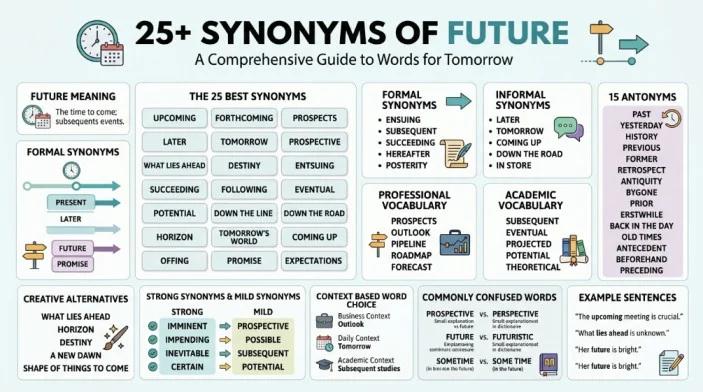
The word future refers to a time that has not happened yet or to events expected to happen later. Common alternatives include tomorrow, time ahead, days ahead, forthcoming, upcoming, later, prospects, outlook, destiny, and what lies ahead. Formal writing often favors forthcoming or prospects, while casual and creative writing may use tomorrow or what lies ahead.
Meaning, Tone, and Context
Simple Definition
Future refers to the time that comes after the present. It can describe a period that has not yet happened, an event expected later, or the possibilities and circumstances that may develop over time.
For example:
“We need to prepare for the future.”
Here, future means the time that comes after now.
The word can also refer to expected developments:
“The company’s future looks promising.”
In this sentence, future refers to the company’s expected condition or prospects.
Part of Speech
Future is mainly used as:
- A noun
- An adjective
As a noun, it refers to time or events that have not happened yet.
“No one knows exactly what the future will bring.”
As an adjective, it describes something relating to a later time.
“She met with her future employer.”
Overall Tone
Future has a neutral tone. It does not automatically express positive or negative feelings.
The surrounding words determine the emotional effect.
“A bright future awaits her.”
This creates a positive tone.
“The uncertain future worried investors.”
This creates a concerned or negative tone.
Formality Level
Future is a neutral word that works in almost every type of English communication.
It is appropriate for:
- Academic writing
- Business communication
- Professional documents
- Everyday conversations
- Personal writing
- Creative writing
- News writing
- Social media
Some alternatives, however, have more specific levels of formality.
For example, forthcoming is more formal than upcoming, while tomorrow is usually more conversational when it is used figuratively.
Common Uses
Native English speakers commonly use future when discussing:
- Future plans
- Future goals
- Future opportunities
- Future generations
- Future developments
- Future careers
- Future technology
- Future possibilities
- Future decisions
- Future growth
- Future success
- Future challenges
- Future events
- The future of a company
- The future of society
Word Forms
| Form | Example |
|---|---|
| Noun | “The future is uncertain.” |
| Adjective | “Our future plans are still developing.” |
| Related noun | “Her future looks promising.” |
| Related adjective | “The futuristic design attracted attention.” |
The related adjective futuristic describes something that seems connected with or characteristic of the future.
When and How to Use “Future”
Use future when you need a broad, neutral way to discuss time after the present. It is especially useful when the exact date or period is unknown or when you are discussing long term possibilities.
Professional
“Investing in employee development can strengthen the company’s future.”
This works well because the sentence discusses long term business development.
Academic
“Researchers are exploring how artificial intelligence may shape the future of education.”
Here, future refers to possible developments over time.
Workplace
“We should discuss our future priorities during the next meeting.”
The word naturally refers to priorities that will matter later.
Personal
“I am thinking carefully about my future career.”
This sentence describes plans and possibilities that have not happened yet.
“We appreciate your support and look forward to working with you in the future.”
This is a common and natural expression in professional email communication.
Resume
“I am seeking opportunities that support my long term future in technology.”
For a resume, a more specific phrase such as career development may sometimes sound stronger.
Social Media
“Excited to see what the future holds.”
This short expression works naturally in an optimistic social media caption.
Best Synonyms of “Future”
No single synonym can replace future in every sentence. The word may refer to time, upcoming events, possibilities, expectations, or a person’s likely direction in life.
Professional Writing: Forthcoming
Forthcoming is useful when referring to something that is expected or scheduled to happen soon.
“The company will announce its forthcoming product changes next month.”
It works particularly well in formal announcements and professional communication.
Academic Writing: Prospective
Prospective is useful when describing something expected, planned, or considered for the future.
“The researchers discussed prospective developments in the field.”
It is more specialized than future and should be used when the context supports its meaning.
Business Communication: Outlook
Outlook works well when discussing expected future conditions, especially in business, finance, employment, or planning.
“The company’s financial outlook remains positive.”
It does not simply mean future. It emphasizes expectations about what is likely to happen.
Casual Conversation: Tomorrow
Tomorrow can refer literally to the next day or figuratively to the time ahead.
“We have to think about tomorrow, not just today.”
It gives the sentence a more conversational feel.
Emotional Writing: What Lies Ahead
What lies ahead is a natural phrase for discussing an uncertain or emotionally meaningful future.
“She was nervous but excited about what lay ahead.”
It works particularly well in personal writing and speeches.
Creative Writing: Days Ahead
Days ahead creates a softer, more expressive way to refer to future time.
“He wondered what the days ahead would bring.”
It fits storytelling and reflective writing.
Resume Writing: Career Prospects
When discussing someone’s professional future, career prospects is more precise than simply saying future.
“The training program offers excellent career prospects.”
It tells the reader exactly what type of future is being discussed.
Workplace Communication: Upcoming
Upcoming works well when referring to an event, meeting, deadline, or activity that will happen soon.
“Please prepare for the upcoming staff meeting.”
It is more specific than future.
Stronger Meaning: Destiny
Destiny suggests a future believed to be shaped by fate or forces beyond ordinary control.
“She believed that education would change her destiny.”
It is much more emotional and philosophical than future, so it should not be used as a general replacement.
Softer Meaning: Later
Later is useful when you simply mean a time after now without emphasizing the entire future.
“We can discuss that later.”
It is simple and natural, especially in conversation.
When Not to Use “Future”
Although future is flexible, it can sometimes be too broad. A more precise alternative may communicate your meaning more effectively.
When “Future” Is Too General
Less precise:
“The company has a good future.”
Better:
“The company has strong growth prospects.”
Why:
Growth prospects specifically communicates expectations about development.
When You Mean an Upcoming Event
Less precise:
“Please prepare for the future meeting.”
Better:
“Please prepare for the upcoming meeting.”
Why:
Upcoming clearly indicates that the meeting is scheduled or expected soon.
When You Mean a Formal Announcement
Less precise:
“The future changes will be announced next week.”
Better:
“The forthcoming changes will be announced next week.”
Why:
Forthcoming is a natural choice for planned changes, announcements, publications, or events.
When You Mean Expected Business Conditions
Less precise:
“The future of the company looks strong.”
Better:
“The company’s outlook looks strong.”
Why:
Outlook specifically communicates expectations about future performance or conditions.
When You Mean Career Possibilities
Less precise:
“This degree has a good future.”
Better:
“This degree offers strong career prospects.”
Why:
The revised sentence tells the reader exactly what kind of future is being discussed.
When You Need a Casual Tone
Less natural:
“I am excited about my forthcoming.”
Better:
“I’m excited about what’s ahead.”
Why:
What’s ahead sounds natural and conversational when discussing personal plans or possibilities.
When You Mean a Specific Later Time
Less precise:
“We can discuss this in the future.”
Better:
“We can discuss this later.”
Why:
If you mean a relatively near or unspecified later point, later is simpler and more natural.
Words Commonly Confused With “Future”
Forthcoming
Difference:
Forthcoming usually describes something expected or scheduled to happen soon. It does not normally refer to the entire period after the present.
When to Use It:
Use it for announcements, events, publications, changes, or information that is expected soon.
Example:
“The company released details about its forthcoming product.”
Upcoming
Difference:
Upcoming refers to something approaching in time, especially an event or activity.
When to Use It:
Use it for meetings, holidays, elections, deadlines, events, and appointments.
Example:
“Please prepare for the upcoming conference.”
Prospects
Difference:
Prospects refers to possibilities or expected outcomes, especially future opportunities or success.
When to Use It:
Use it when discussing careers, businesses, investments, or opportunities.
Example:
“Graduates have strong employment prospects.”
Outlook
Difference:
Outlook describes expectations about what is likely to happen.
When to Use It:
Use it in business, economic, financial, and personal planning contexts.
Example:
“The economic outlook remains uncertain.”
Destiny
Difference:
Destiny suggests a future determined by fate or a predetermined course of events.
When to Use It:
Use it in philosophical, emotional, religious, literary, or dramatic contexts.
Example:
“He wondered whether his destiny had already been decided.”
Best Synonyms of “Future” by Context
| Context | Best Synonym | Why It Works | Example |
|---|---|---|---|
| Formal writing | Forthcoming | Sounds polished when referring to expected events | “The forthcoming report will provide additional details.” |
| Academic writing | Prospective | Fits discussions of planned or expected developments | “Prospective studies may provide more evidence.” |
| Professional communication | Upcoming | Clearly identifies something approaching | “Please review the upcoming changes.” |
| Business emails | Forthcoming | Works well for formal announcements | “We will share the forthcoming updates shortly.” |
| Resume writing | Career prospects | Specifically addresses professional opportunities | “The program offers excellent career prospects.” |
| Workplace communication | Upcoming | Natural for meetings and deadlines | “The upcoming review requires preparation.” |
| Casual conversation | Tomorrow | Conversationally represents time ahead | “Let’s focus on tomorrow.” |
| Everyday speaking | Later | Simple way to refer to a later time | “We can decide that later.” |
| Creative writing | Days ahead | Creates a reflective tone | “She wondered what the days ahead would bring.” |
| Storytelling | What lies ahead | Adds uncertainty and emotion | “No one knew what lay ahead.” |
| Emotional writing | What lies ahead | Expresses hope or uncertainty | “He felt ready for whatever lay ahead.” |
| Strong emphasis | Destiny | Adds a sense of fate | “She believed her destiny was calling.” |
| Mild tone | Later | Makes the reference less grand | “We’ll deal with it later.” |
| Social media captions | What’s ahead | Short and natural | “Excited for what’s ahead.” |
| American English | Upcoming | Common for approaching events | “Our upcoming trip starts Friday.” |
| British English | Forthcoming | Also common in formal British usage | “The forthcoming publication will address the issue.” |
How to Choose the Best Synonym of “Future”
Choosing an alternative becomes easier when you first identify exactly what you mean by future.
1. Consider the Meaning
- If you mean time after now, words such as later, tomorrow, and days ahead may work.
- If you mean an upcoming event, choose upcoming or forthcoming.
- If you mean expected success or opportunity, consider prospects.
- If you mean expected conditions, use outlook.
2. Consider the Tone
- For a neutral tone, simply keep future.
- For a formal tone, consider forthcoming or prospective.
- For a personal tone, use what lies ahead.
- For a dramatic or philosophical tone, destiny may work.
3. Consider Your Audience
A business audience may respond better to precise terms such as outlook or prospects.
Friends and social media followers are more likely to respond naturally to expressions such as what’s ahead or tomorrow.
4. Consider Emotional Strength
Compare these sentences:
“I am thinking about the future.”
“I am excited about what lies ahead.”
“I believe destiny has something better waiting.”
The first is neutral. The second is more emotional and hopeful. The third is much more philosophical.
5. Consider Your Writing Purpose
- For an essay, choose precise academic language.
- For a business report, use terms such as outlook, prospects, or forthcoming.
- For a resume, describe career prospects, professional growth, or long term goals rather than relying on the broad word future.
- For creative writing, phrases such as days ahead and what lies ahead can create a stronger sense of anticipation.
6. Consider Formality
| Formality | Useful Choices |
|---|---|
| Highly formal | Forthcoming, prospective |
| Professional | Outlook, prospects, forthcoming |
| Neutral | Future, later, upcoming |
| Conversational | Tomorrow, what’s ahead |
| Literary | Destiny, what lies ahead, days ahead |
7. Prioritize Natural Usage
The most sophisticated synonym is not always the best choice.
For example, saying:
“We will discuss the forthcoming tomorrow.”
sounds unnatural.
A native speaker would usually say:
“We’ll discuss it tomorrow.”
The goal is not to replace future with a more complicated word. The goal is to select the word that communicates your intended meaning naturally.
Real Life Examples of “Future”
School
Original:
“Education is important for the future.”
Improved:
“Education plays a major role in shaping a student’s future.”
The original is correct, while the revised version gives the sentence a clearer relationship between education and later life.
College
“College students often think about their future career prospects.”
Here, career prospects is more specific than simply saying future.
Workplace
“We need to consider the company’s long term outlook before making the decision.”
Outlook works because the sentence focuses on expected business conditions.
Business
“The new strategy could create better growth prospects for the company.”
Growth prospects is more precise than future because the sentence focuses specifically on expansion.
“Thank you for your continued support. We look forward to working with you in the future.”
This is a natural professional expression where future does not need to be replaced.
Resume
“The internship provided valuable experience and improved my career prospects.”
This is stronger than saying the internship improved the writer’s future.
Conversation
“I don’t know what the future holds, but I’m excited to find out.”
This is natural, personal, and conversational.
Storytelling
“She looked toward the horizon and wondered what lay ahead.”
The phrase lay ahead creates a more literary feeling than the simple word future.
Blogging
“Businesses that adapt to changing technology may have stronger long term prospects.”
The phrase gives the reader a more specific idea about expected business performance.
Social Media
“New chapter, new goals, and plenty to look forward to. Excited for what’s ahead.”
This sounds more natural and engaging than repeating future.
25 Best Synonyms of “Future”
Some entries below are direct alternatives in specific grammatical or contextual uses, while others are context based expressions. They should not be treated as interchangeable in every sentence.
| Synonym | Simple Meaning | Best Used For | Example Sentence |
|---|---|---|---|
| Forthcoming | Expected to happen soon | Formal writing | The forthcoming report will explain the new policy. |
| Upcoming | Happening soon | Events and schedules | We are preparing for the upcoming conference. |
| Prospects | Future possibilities or opportunities | Careers and business | Her career prospects look excellent. |
| Outlook | Expected future condition | Business and finance | The company’s outlook remains positive. |
| Later | At a time after now | Everyday speech | We can discuss the details later. |
| Tomorrow | The next day or future time | Casual and figurative writing | Tomorrow offers another opportunity to improve. |
| Thereafter | From that time onward | Formal writing | The agreement will remain effective thereafter. |
| Afterwards | At a later time | General writing | We can review the results afterwards. |
| Ahead | At a later point in time | Conversation and writing | There are several challenges ahead. |
| Days ahead | Future period | Personal and creative writing | She was excited about the days ahead. |
| Time ahead | Future period | General discussion | We need to prepare for the time ahead. |
| What lies ahead | Future events or circumstances | Emotional writing | No one knows what lies ahead. |
| What’s ahead | What will happen later | Casual communication | I’m excited about what’s ahead. |
| Coming time | Time that is approaching | General writing | We should prepare for the coming time of change. |
| Coming years | Years after the present | Long term planning | Technology will change significantly in the coming years. |
| Years ahead | Future years | Planning and forecasting | The investment could benefit us for years ahead. |
| Long term | Extending into the future | Business and planning | We need a long term strategy. |
| Later years | Years occurring afterward | Life and history | He spent his later years teaching. |
| Prospective | Expected or considered for the future | Academic and professional writing | The prospective changes require careful analysis. |
| Potential | Possible future development or success | Opportunities | The project has considerable potential. |
| Possibility | Something that may happen | General discussion | A career change is one possibility. |
| Expectation | Something believed likely to happen | Planning | Our expectation is that demand will increase. |
| Destiny | A future shaped by fate | Literary and philosophical writing | She wondered whether this was her destiny. |
| Fate | A future believed to be predetermined | Literary writing | He accepted whatever fate had planned. |
| Tomorrow’s world | The future world or society | Creative and technology writing | Artificial intelligence may transform tomorrow’s world. |
Synonyms of “Future” by Usage
Professional vs Personal Synonyms
Professional writing usually benefits from precise terms that identify the specific type of future being discussed.
- Use outlook for expected business conditions:
“The company’s financial outlook remains stable.”
- Use prospects for opportunities:
“The candidate has strong career prospects.”
- Use forthcoming for expected developments:
“The forthcoming changes will affect all departments.”
Personal writing can be warmer and less technical.
Use what lies ahead for uncertainty:
“I’m curious to see what lies ahead.”
Use tomorrow for a hopeful or conversational tone:
“Tomorrow is another chance to start fresh.”
Formal vs Conversational Synonyms
- For reports, essays, and business writing, consider:
- Forthcoming
- Prospective
- Outlook
- Prospects
- Thereafter
- For casual conversations and texting, consider:
- Tomorrow
- Later
- Ahead
- What’s ahead
- What lies ahead
- For example:
Formal:
“The prospective changes require further evaluation.”
Conversational:
“Let’s see what happens next.”
Both communicate a future idea, but they suit different audiences.
Academic Synonyms
Academic writing needs precision, so the best synonym depends on the specific idea.
Prospective
Use prospective when discussing future plans, expected developments, or studies designed to observe future outcomes.
“The researchers proposed a prospective study.”
Forthcoming
Use forthcoming for academic publications, papers, research, or information that is expected soon.
“The forthcoming article will examine the issue in greater detail.”
Thereafter
Use thereafter when describing what happens from a particular future point onward.
“The participants were monitored thereafter.”
Potential
Use potential when discussing possible future outcomes.
“The technology has significant potential for improving access to education.”
Academic alternatives should make the intended relationship with the future clearer rather than simply making the vocabulary more complicated.
Professional and Business Synonyms
Resumes
Instead of:
“I want to build a good future.”
Use:
“I am seeking opportunities for long term professional growth.”
This focuses on the actual career objective.
Interviews
Instead of:
“I see a good future here.”
Try:
“I see strong long term growth opportunities with the organization.”
Meetings
Instead of:
“We need to think about the future.”
Try:
“We need to consider our long term strategy.”
Presentations
Instead of:
“The future looks good for our company.”
Use:
“Our business outlook remains positive.”
Performance Reviews
Instead of:
“This will help my future.”
Use:
“This experience will support my professional development.”
Client Communication
Instead of:
“We hope to work with you in the future.”
You can write:
“We look forward to continuing our partnership.”
This sounds more direct and relationship focused.
Business Emails
Use forthcoming for planned announcements and upcoming for events.
“Please review the forthcoming policy changes.”
“We will discuss the issue during the upcoming meeting.”
Creative and Literary Synonyms
Creative writing gives you more freedom to use expressive alternatives.
What Lies Ahead
This phrase creates anticipation.
“She had no idea what lay ahead.”
Days Ahead
This creates a reflective mood.
“He spent the evening wondering about the days ahead.”
Destiny
This adds a philosophical or dramatic sense.
“He believed the journey had been written into his destiny.”
Fate
This can suggest forces beyond human control.
“She wondered whether fate had brought them together.”
Tomorrow’s World
This phrase works particularly well when imagining future society, technology, or culture.
“The novel presents a fascinating vision of tomorrow’s world.”
These expressions should be chosen for their emotional effect, not simply because they are alternatives to future.
Slang or Modern Synonyms
There is no single widely accepted slang word that directly replaces future in all situations.
Modern casual English more often uses phrases such as:
What’s Ahead
Meaning: What is going to happen later.
Acceptable in: Conversations, social media, personal writing.
Avoid in: Highly formal academic or legal writing.
“I’m excited to see what’s ahead.”
What’s Next
Meaning: The next event, stage, or development.
Acceptable in: Conversations, presentations, social media, business discussions.
Avoid in: Formal writing when a more precise term is available.
“We’re ready to see what’s next.”
Tomorrow
Meaning: The next day, sometimes used figuratively for the future.
Acceptable in: Everyday speech, creative writing, inspirational content.
Avoid in: Technical contexts where the exact future period needs to be identified.
“The choices we make today can shape tomorrow.”
Strongest to Mildest Synonyms
The intensity of a future related word depends heavily on context. Unlike synonyms for emotions, these words do not form a perfect strength scale, but they can be grouped by how strongly they emphasize uncertainty, expectation, or long term significance.
Mild
- Later
- Ahead
- Afterwards
These simply indicate a time after now.
Moderate
- Upcoming
- Forthcoming
- Coming years
- Days ahead
- Time ahead
These emphasize approaching or later time.
Strong
- Prospects
- Outlook
- Potential
- Long term
- Prospective
These focus more strongly on expected developments or possibilities.
Very Strong or Dramatic
- Destiny
- Fate
- Tomorrow’s world
- What lies ahead
These can create philosophical, emotional, or literary emphasis.
The strongest sounding word is not necessarily the best one. In professional writing, a neutral word such as outlook can be more effective than a dramatic word such as destiny.
Emotional vs Neutral Synonyms
Emotional Synonyms
These alternatives can add hope, uncertainty, excitement, or reflection.
- What lies ahead
- What’s ahead
- Days ahead
- Destiny
- Fate
- Tomorrow
- Tomorrow’s world
Example:
“She was nervous about what lay ahead, but she refused to give up.”
The phrase adds emotion that the simple word future does not necessarily provide.
Neutral Synonyms
These alternatives communicate future time or expectations more objectively.
- Future
- Upcoming
- Forthcoming
- Later
- Prospective
- Outlook
- Prospects
- Thereafter
- Coming years
Example:
“The company’s outlook remains stable for the coming years.”
These choices are generally better for reports, academic writing, and professional communication.
Antonyms of “Future”
The concept of future has no single perfect opposite in every context. The following words represent contrasting concepts involving the present, past, or completed time.
| Antonym | Meaning | Example Sentence |
|---|---|---|
| Past | Time that has already happened | We cannot change the past. |
| Present | The time happening now | We should focus on the present. |
| Current | Existing or happening now | The current situation requires attention. |
| Previous | Existing or occurring before now | The previous version had several problems. |
| Earlier | Happening before the current time | We discussed this earlier. |
| Former | Existing in the past | He is a former employee. |
| Prior | Occurring before something else | No prior experience was required. |
| Historical | Relating to past events | The museum preserves historical records. |
| Completed | Finished rather than still ahead | The completed project exceeded expectations. |
| Finished | Brought to an end | The work is finished. |
| Existing | Present now rather than later | We need to improve the existing system. |
| Immediate | Happening now or very soon | We need an immediate response. |
| Contemporary | Belonging to the present time | The gallery features contemporary art. |
| Retrospective | Looking back at the past | The exhibition provides a retrospective view of her career. |
| Yesterday | The day before today | Yesterday is already behind us. |
Comparison: “Future” vs Similar Words
Future vs Forthcoming
Main Difference:
Future refers broadly to time after the present. Forthcoming usually describes something expected or scheduled soon.
Which Is Stronger?
Neither is inherently stronger. Forthcoming is more specific about something approaching.
Which Is More Formal?
Forthcoming is more formal.
When to Use Each:
Use future for broad time references. Use forthcoming for expected announcements, events, publications, or changes.
Examples:
Future:
“We need to prepare for the future.”
Forthcoming:
“The forthcoming report will provide more information.”
Future vs Upcoming
Main Difference:
Upcoming usually refers to something approaching soon.
Which Is Stronger?
Neither is stronger.
Which Is More Formal?
Future is neutral. Upcoming is also neutral but often more conversational.
When to Use Each:
Use upcoming for scheduled events, meetings, holidays, and deadlines.
Examples:
Future:
“We are planning for the future.”
Upcoming:
“Please prepare for the upcoming meeting.”
Future vs Prospects
Main Difference:
Future refers to time or later events. Prospects refers to expected opportunities or likely outcomes.
Which Is Stronger?
Prospects is more specific.
Which Is More Formal?
Prospects is common in professional and academic contexts.
When to Use Each:
Use prospects for careers, businesses, investments, and opportunities.
Examples:
Future:
“She is thinking about her future.”
Prospects:
“She has excellent career prospects.”
Future vs Outlook
Main Difference:
Outlook refers to expectations about future conditions.
Which Is Stronger?
Neither is stronger.
Which Is More Formal?
Outlook is particularly useful in professional and business writing.
When to Use Each:
Use outlook when discussing forecasts or expected conditions.
Examples:
Future:
“The future of the industry is uncertain.”
Outlook:
“The industry’s economic outlook remains uncertain.”
Future vs Destiny
Main Difference:
Future refers to what will happen later. Destiny suggests that a person’s future is shaped by fate or a predetermined course.
Which Is Stronger?
Destiny is more emotionally and philosophically intense.
Which Is More Formal?
Neither is necessarily more formal. Destiny is more literary.
When to Use Each:
Use future for ordinary communication. Use destiny for philosophical, dramatic, or literary contexts.
Examples:
Future:
“She is planning her future.”
Destiny:
“He believed he had a special destiny.”
Future vs Tomorrow
Main Difference:
Future can refer to any time after now. Tomorrow literally refers to the day after today but can also represent the future figuratively.
Which Is Stronger?
Neither.
Which Is More Formal?
Future is more neutral and versatile.
When to Use Each:
Use tomorrow when referring to the next day or creating a conversational or inspirational tone.
Examples:
Future:
“We need to think about the future.”
Tomorrow:
“Tomorrow gives us another chance.”
Common Phrases and Expressions with “Future”
The Future Holds
Meaning:
Used when discussing unknown events or possibilities that will happen later.
Example:
“No one knows what the future holds.”
In the Future
Meaning:
At some time after the present.
Example:
“We may expand the business in the future.”
Future Plans
Meaning:
Plans for things expected to happen later.
Example:
“We discussed our future plans during dinner.”
Future Goals
Meaning:
Objectives someone hopes to achieve later.
Example:
“She wrote down her future goals for the next five years.”
Future Generations
Meaning:
People who will live in later generations.
Example:
“We should protect natural resources for future generations.”
Future Opportunities
Meaning:
Chances that may become available later.
Example:
“The internship could lead to future opportunities.”
Future Career
Meaning:
A career someone plans or expects to have later.
Example:
“He is exploring options for his future career.”
Future Prospects
Meaning:
Expected opportunities or possibilities for later success.
Example:
“The company has promising future prospects.”
Common Mistakes to Avoid
1. Treating Every Future Related Word as an Exact Synonym
Incorrect:
“The upcoming of the company is uncertain.”
Better:
“The future of the company is uncertain.”
Why:
Upcoming is normally an adjective describing something approaching, while future can function as a noun referring broadly to later time or circumstances.
2. Using “Forthcoming” for the Entire Future
Incorrect:
“I am worried about my forthcoming.”
Better:
“I am worried about my future.”
Why:
Forthcoming normally modifies something expected soon. It does not naturally function as a noun meaning the entire future.
3. Confusing “Prospects” With Time
Incorrect:
“The prospects will arrive next year.”
Better:
“The future will bring new opportunities.”
Why:
Prospects refers to possibilities or expected opportunities, not simply a period of time.
4. Using “Destiny” in Ordinary Professional Writing
Incorrect:
“Our company’s destiny depends on this quarterly report.”
Better:
“Our company’s future depends on this quarterly report.”
Why:
Destiny sounds dramatic and philosophical. Future is more natural in ordinary business communication.
5. Using “Upcoming” for Long Term Developments
Incorrect:
“Our upcoming career is important.”
Better:
“Our future career is important.”
Why:
Upcoming normally suggests something approaching soon. A career is usually discussed as a longer term possibility.
6. Replacing “Future” With a More Complicated Word
Incorrect:
“We must contemplate our prospective temporal circumstances.”
Better:
“We must consider our future.”
Why:
Advanced vocabulary does not automatically improve writing. Clear and natural language is usually more effective.
7. Using “Tomorrow” When the Time Period Is Much Longer
Incorrect:
“Technology will transform tomorrow over the next fifty years.”
Better:
“Technology will transform the future over the next fifty years.”
Why:
Tomorrow is normally associated with the next day or used figuratively. Future is more appropriate for a broad long term period.
Frequently Asked Questions
What is a good synonym for future?
Common options include tomorrow, coming time, prospect, outlook, destiny, and the years ahead, depending on the context.
What are some formal synonyms for future?
For formal writing, use prospect, forthcoming period, years ahead, or subsequent time, depending on the sentence.
What is another word for future plans?
Useful alternatives include forthcoming plans, long-term goals, upcoming objectives, and future goals.
What are the best future alternative words?
The best choice depends on meaning. Prospect suggests possibility, destiny suggests what may happen, and forthcoming refers to something expected soon.
What are the most common synonyms for future?
Common future synonyms include tomorrow, ahead, forthcoming, upcoming, prospect, and destiny.
What are the best synonyms of “future”?
The best synonyms of future depend on context. Upcoming and forthcoming work for approaching events, prospects for opportunities, outlook for expectations, and what lies ahead for emotional or creative writing.
What are the best formal synonyms of “future”?
Formal alternatives include forthcoming, prospective, outlook, prospects, and thereafter, depending on the sentence. For academic writing, prospective can be precise, while business writing often benefits from outlook or prospects.
What are common informal synonyms of “future”?
Common conversational alternatives include tomorrow, later, ahead, what’s ahead, and what’s next. These expressions sound natural in everyday speech, personal writing, texting, and social media, although they are not interchangeable in every context.
What is another word for “future” in professional writing?
In professional writing, outlook, prospects, forthcoming, and long term can replace future when their specific meanings fit. For example, business outlook is more precise than simply referring to a company’s future.
What is the difference between “future” and “forthcoming”?
Future refers broadly to time after the present, while forthcoming usually describes something expected or scheduled soon. You can discuss your future, but you would describe an upcoming report as forthcoming.
What is the opposite of “future”?
The most common conceptual opposites of future are past and present. Past refers to time that has already happened, while present describes the time happening now. The best choice depends on the sentence.
Conclusion
The word future is a flexible, neutral term for time and events that have not happened yet. However, the best alternative depends on the exact idea you want to communicate. Upcoming and forthcoming are useful for approaching events, prospects describes opportunities, outlook focuses on expected conditions, and what lies ahead adds a more personal or creative tone.
The most effective synonyms of future are not necessarily the most sophisticated ones. Strong writing comes from choosing a word that matches the meaning, audience, tone, and purpose of the sentence.
A useful vocabulary habit is to identify exactly what you mean by future before replacing it. Ask whether you mean a later time, an upcoming event, a possible opportunity, an expected outcome, or an emotional vision of what comes next. That small distinction can make your writing much more precise.
Read More Related Articles:
- 25+ Synonyms of Resume | Meanings, Uses, Examples, and …
- 25+ Synonyms of Bridge | Meanings, Uses, Examples, and …
- 25+ Synonyms of Sincerely | Meanings, Uses, Examples, and …










1 thought on “Synonyms of Future | 25+ Words to Describe What Lies Ahead 2026”