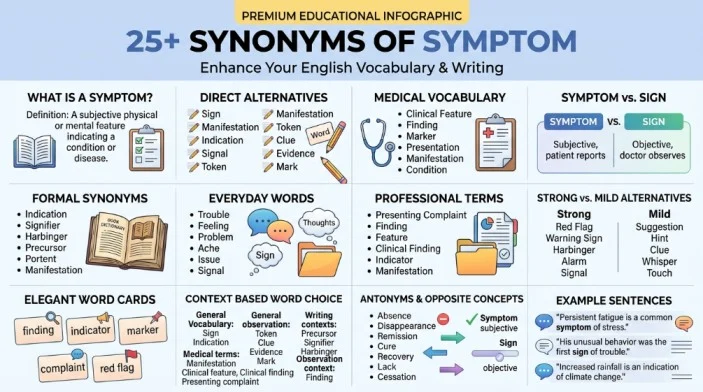
When writing a health article, school assignment, medical report, or everyday message, repeating the word symptom can quickly make your writing feel limited. Finding the right synonym of symptom can make a sentence more precise, especially when you need to describe a warning sign, patient complaint, clinical finding, or indication of a health problem.
The best alternative depends on what you actually mean. Words such as sign, indication, manifestation, complaint, and clinical feature can work in different contexts, but they are not always interchangeable. Understanding these differences helps writers avoid inaccurate medical language while making their communication clearer and more natural.
What Is the Best Synonym of “Symptom”?
A symptom is a change or problem experienced by a person that may indicate an illness or health condition. Common alternatives include sign, indication, manifestation, complaint, and clinical feature. In medical writing, choose carefully because some alternatives describe observable findings rather than experiences reported by a patient.
For formal writing, indication or manifestation may fit well. In clinical communication, complaint, clinical feature, or finding can be useful. In everyday English, sign or indication is often the most natural choice.
Meaning, Tone, and Context
Simple Definition
A symptom is a physical or mental change that a person experiences and that may be associated with an illness, injury, disorder, or other health condition.
For example, headache, nausea, fatigue, dizziness, and pain can be symptoms of different conditions. A symptom does not automatically identify a specific disease because the same symptom can occur for many different reasons.
Part of Speech
Symptom is a noun.
Example:
“Fatigue can be a symptom of several different conditions.”
Overall Tone
The word symptom is generally neutral. It does not automatically suggest that a condition is mild, serious, positive, or negative.
Its meaning depends on the surrounding context.
Formality Level
Symptom is a neutral word that works naturally in:
- Medical writing
- Health education
- Academic writing
- Professional communication
- News articles
- Everyday conversation
- Patient communication
- Health related websites
It is neither highly formal nor strongly informal.
Common Uses
Native English speakers commonly use symptom when discussing:
- Illness
- Disease
- Infection
- Mental health conditions
- Physical discomfort
- Medical diagnosis
- Treatment
- Medication effects
- Chronic conditions
- Temporary health problems
Examples include:
“Fever is a common symptom of some infections.”
“She reported several symptoms after starting the medication.”
“Stress can cause physical symptoms.”
Word Forms
| Form | Word |
|---|---|
| Singular noun | symptom |
| Plural noun | symptoms |
| Related noun | symptomatology |
| Related adjective | symptomatic |
| Opposite concept | asymptomatic |
Symptomatic means showing or experiencing symptoms.
Example:
“The patient remained symptomatic for several days.”
Asymptomatic means having a condition without noticeable symptoms.
Example:
“Some people can remain asymptomatic while carrying an infection.”
When and How to Use “Symptom”
Use symptom when you are referring to an experience or change that may indicate a health condition. The word is especially useful when describing what a patient notices or reports.
Professional
“The patient reported persistent fatigue as a primary symptom.”
This works in professional healthcare communication because it clearly identifies a reported health experience.
Academic
“Fatigue is a commonly reported symptom among participants with the condition.”
This wording fits research papers and academic discussions.
Workplace
“Employees should report any unusual symptoms before returning to work.”
The sentence uses the word naturally in a workplace health context.
Personal
“My headache was the first symptom I noticed.”
This is appropriate for everyday conversation.
“Please let me know if you experience any unusual symptoms after the procedure.”
The wording is professional and clear for patient communication.
Resume
“Reviewed patient reported symptoms and documented relevant clinical information.”
In a resume, symptoms works naturally when describing healthcare related responsibilities.
Social Media
“Learning to recognize early symptoms can help people know when to seek professional medical advice.”
This works for an educational health post without making a diagnosis.
Best Synonyms of “Symptom”
No single alternative perfectly replaces symptom in every sentence. This is especially important in medical writing because symptom can describe something experienced by a patient, while sign usually refers to something observed or measured by another person.
Professional Writing: Clinical Feature
Clinical feature is useful when discussing characteristics associated with a medical condition.
Example:
“Fatigue is a common clinical feature of the condition.”
It sounds professional and precise without suggesting that every feature is necessarily reported by the patient.
Academic Writing: Manifestation
Manifestation works well when describing how a disease, disorder, or condition appears or expresses itself.
Example:
“Skin irritation may be an early manifestation of the condition.”
It is especially useful when discussing different ways a condition can present.
Business Communication: Indication
Indication is appropriate when discussing evidence that suggests a particular situation or problem.
Example:
“The unusual result may be an indication of an underlying issue.”
It is broader than symptom and should not be used when you specifically mean a patient reported experience.
Casual Conversation: Sign
Sign is a common everyday alternative when the distinction between an observed sign and a reported symptom is not important.
Example:
“Feeling unusually tired can be a sign that something is wrong.”
In strict clinical writing, however, sign and symptom are not identical.
Emotional Writing: Warning Sign
Warning sign adds a sense of concern or urgency.
Example:
“Persistent exhaustion can be a warning sign that deserves attention.”
Use it when you want to emphasize that something should not be ignored.
Creative Writing: Indication
Indication can work in narrative writing when a physical or emotional change hints at a deeper problem.
Example:
“Her sudden silence was an indication that something had changed.”
Notice that this example uses indication in a broader sense, not specifically as a medical term.
Resume Writing: Patient Complaint
Patient complaint is useful in healthcare resumes when referring to information reported directly by a patient.
Example:
“Documented patient complaints and relevant clinical observations.”
It is more specific than simply saying symptoms.
Workplace Communication: Health Concern
Health concern can be appropriate when you want a broader, less clinical expression.
Example:
“Employees should discuss persistent health concerns with an appropriate professional.”
Stronger Meaning: Warning Sign
When you want to emphasize that a symptom may deserve urgent attention, warning sign creates more urgency than the neutral word symptom.
Example:
“Sudden confusion can be a warning sign that requires prompt medical evaluation.”
Softer Meaning: Indication
Indication can sound less direct and less alarming when the evidence is uncertain.
Example:
“The result may be an indication of a minor problem.”
When Not to Use “Symptom”
Although symptom is highly useful, there are situations where another word communicates your meaning more accurately.
When “Symptom” Is Too General
If you know exactly what kind of evidence you are describing, a more specific word can improve the sentence.
Less Precise:
“The test result was an important symptom.”
Better:
“The test result was an important finding.”
Why:
A test result is generally a finding or result, not a symptom experienced by a patient.
When “Symptom” Is Too Vague
If you mean something that suggests a problem but is not necessarily a medical symptom, indication may be better.
Less Precise:
“The drop in sales was a symptom of poor planning.”
Better:
“The drop in sales was an indication of poor planning.”
Why:
Here, symptom is being used metaphorically. Indication communicates the broader meaning more naturally.
When “Symptom” Is Too Technical
For general readers, sign of a problem may sometimes be easier to understand.
Less Technical:
“Persistent fatigue may be a symptom of another issue.”
More Accessible:
“Persistent fatigue may be a sign of another problem.”
Why:
The second version uses everyday language and may be easier for a general audience.
When “Symptom” Is Too Weak
If you want to emphasize urgency, warning sign or red flag may communicate the intended seriousness more clearly.
Less Forceful:
“Sudden weakness can be a symptom.”
Stronger:
“Sudden weakness can be a warning sign that needs prompt attention.”
When “Symptom” Is Too Strong
Sometimes a person has a general concern that has not been established as a medical symptom.
Less Appropriate:
“Difficulty concentrating is a symptom of the problem.”
Better:
“Difficulty concentrating may be an indication of the problem.”
Why:
Indication can express possibility without implying a confirmed medical interpretation.
When “Symptom” Is Out of Context
Do not automatically use symptom for every sign of a problem.
Less Natural:
“The cracked screen is a symptom of the phone problem.”
Better:
“The cracked screen is a sign of damage.”
Why:
Symptom is strongly associated with health and medical conditions. Sign works more broadly.
Words Commonly Confused With “Symptom”
| Word | Difference | When to Use It | Example |
|---|---|---|---|
| Sign | Usually something observed or measured rather than personally experienced. | Clinical observations and general indications. | “The doctor noticed a visible sign of infection.” |
| Indication | Something that suggests or points toward a condition or situation. | Formal and general writing. | “The result was an indication of a possible problem.” |
| Manifestation | A way a condition or problem appears or expresses itself. | Medical and academic writing. | “Skin irritation can be a manifestation of the condition.” |
| Complaint | A problem or symptom reported by a patient. | Healthcare documentation. | “The patient’s main complaint was persistent pain.” |
| Syndrome | A group of symptoms and signs that occur together. | Medical terminology. | “The syndrome includes several characteristic symptoms.” |
| Disease | A medical condition itself, not an individual symptom. | Diagnosis and health discussions. | “The disease can cause several different symptoms.” |
Best Synonyms of “Symptom” by Context
| Context | Best Synonym | Why It Works | Example |
|---|---|---|---|
| Formal writing | Indication | Broad and precise. | “The result was an indication of a possible issue.” |
| Academic writing | Manifestation | Describes how a condition appears. | “Fatigue may be a manifestation of the disorder.” |
| Professional communication | Clinical feature | Fits healthcare terminology. | “Pain is a common clinical feature.” |
| Business emails | Indication | Works for broader problems. | “The decline may be an indication of a larger issue.” |
| Resume writing | Patient complaint | Specific to reported patient problems. | “Documented patient complaints accurately.” |
| Workplace communication | Health concern | Accessible and less technical. | “Employees should report serious health concerns.” |
| Casual conversation | Sign | Natural in everyday speech. | “That can be a sign of stress.” |
| Everyday speaking | Sign | Simple and familiar. | “A cough can be a sign that you’re getting sick.” |
| Creative writing | Indication | Can suggest a deeper problem. | “Her silence was an indication of trouble.” |
| Storytelling | Sign | Natural for clues in a story. | “His expression was a sign that something was wrong.” |
| Emotional writing | Warning sign | Adds concern and urgency. | “Her exhaustion became a warning sign.” |
| Strong emphasis | Red flag | Signals potential concern. | “Repeated errors can be a red flag.” |
| Mild tone | Indication | Avoids unnecessary alarm. | “The change may be an indication of stress.” |
| Social media captions | Sign | Short and accessible. | “Fatigue can be a sign that you need rest.” |
| American English | Symptom, sign | Both are common, depending on meaning. | “A fever can be a symptom or a clinical sign, depending on context.” |
| British English | Symptom, sign | Usage is broadly similar to American English. | “The patient reported several symptoms.” |
How to Choose the Best Synonym of “Symptom”
Choosing the right alternative begins with identifying exactly what you are describing.
Choose “Sign” for Something Observable
Use sign when another person can observe or measure the change.
Example:
“The doctor noticed a sign of inflammation.”
Choose “Indication” for Evidence
Use indication when something suggests the presence of a problem but does not necessarily establish it.
Example:
“The unusual result may be an indication of an underlying issue.”
Choose “Manifestation” for How a Condition Appears
Use manifestation when describing an expression or presentation of a disease or condition.
Example:
“Skin changes can be a manifestation of the condition.”
Choose “Complaint” for Patient Report
Use complaint when referring specifically to a problem reported by a patient.
Example:
“Pain was the patient’s primary complaint.”
Choose “Clinical Feature” for Professional Medical Writing
Use clinical feature when writing for healthcare professionals or discussing characteristics of a condition.
Example:
“Fatigue is a common clinical feature of the disorder.”
Consider Your Audience
For general readers, sign and indication are usually easier to understand.
For healthcare professionals, clinical feature, manifestation, finding, and patient complaint may provide greater precision.
Consider Emotional Strength
- Use symptom for neutral communication.
- Use warning sign when you want to signal concern.
- Use red flag when the context calls for a strong warning, especially in informal or educational writing.
Consider Your Writing Purpose
- For an academic paper, choose precise terminology.
- For a patient information page, use accessible language.
- For a medical record, use terminology that accurately distinguishes patient reported symptoms from observed clinical signs.
The best word is the one that communicates the intended meaning without adding unnecessary certainty or alarm.
Real Life Examples of “Symptom”
School
Basic:
“Headaches can be a symptom of stress.”
More precise:
“Headaches can be an indication that a student is experiencing excessive stress.”
College
Basic:
“Fatigue was a common symptom reported by participants.”
Academic:
“Fatigue was a commonly reported manifestation among participants.”
The second version sounds more formal, but symptom may still be the more direct choice if participants personally experienced and reported the fatigue.
Workplace
Basic:
“Employees should report unusual symptoms.”
Alternative:
“Employees should report unusual health concerns.”
The second expression may sound less clinical in general workplace communication.
Business
Basic:
“The decline in customer retention was a symptom of a larger problem.”
Alternative:
“The decline in customer retention was an indication of a larger problem.”
Here, indication is more natural because the sentence describes a business issue rather than a medical condition.
Basic:
“Please contact the clinic if your symptoms become worse.”
Alternative:
“Please contact the clinic if your symptoms worsen or new concerns develop.”
The second version provides clearer communication without unnecessarily replacing symptoms.
Resume
Basic:
“Recorded patient symptoms during consultations.”
Alternative:
“Documented patient reported symptoms during consultations.”
The second version is more precise because it clarifies that the information came from the patient.
Conversation
Basic:
“Is a sore throat a symptom of a cold?”
Alternative:
“Can a sore throat be a sign of a cold?”
Both can sound natural in everyday conversation.
Storytelling
Basic:
“Her silence was a symptom of her fear.”
Better:
“Her silence was a sign of fear.”
The second sentence sounds more natural because the writer is describing behavior as evidence of an emotion rather than using a medical term metaphorically.
Blogging
Basic:
“Constant tiredness can be a symptom of poor sleep.”
Alternative:
“Constant tiredness can be a sign that your sleep habits need attention.”
The second version is more accessible for a general audience.
Social Media
Basic:
“Feeling exhausted all the time can be a symptom worth discussing with a professional.”
Alternative:
“Persistent exhaustion can be a warning sign worth discussing with a qualified professional.”
The second version adds urgency without claiming that a particular condition is present.
25 Best Synonyms and Contextual Alternatives of “Symptom”
A strict medical distinction matters here. Symptom has only a small number of true one word synonyms because it specifically refers to a health related experience or indication. The table therefore includes direct synonyms and established contextual alternatives that can replace symptom in appropriate sentences. They should not be treated as perfectly interchangeable.
| Synonym or Alternative | Simple Meaning | Best Used For | Example Sentence |
|---|---|---|---|
| Sign | Something that indicates a condition or problem | General and clinical communication | “A persistent cough can be a sign of illness.” |
| Indication | Something that suggests a particular condition | Formal writing | “The result was an indication of a possible problem.” |
| Manifestation | A way a condition appears or expresses itself | Academic and medical writing | “Fatigue can be a manifestation of the condition.” |
| Complaint | A problem reported by a patient | Clinical documentation | “Pain was the patient’s main complaint.” |
| Clinical feature | A characteristic associated with a condition | Professional medical writing | “Fever is a common clinical feature.” |
| Clinical manifestation | An expressed feature of a medical condition | Medical and academic writing | “Skin irritation was a clinical manifestation of the condition.” |
| Presenting feature | A feature present when someone seeks care | Clinical writing | “Chest discomfort was the patient’s presenting feature.” |
| Presenting complaint | The main problem reported at consultation | Medical records | “Headache was her presenting complaint.” |
| Indicator | Something that points toward a condition or issue | General and professional writing | “The result may be an indicator of an underlying issue.” |
| Marker | A feature or measurement associated with a condition | Medical and scientific writing | “The laboratory value can serve as a marker of inflammation.” |
| Signal | Something that alerts you to a possible problem | General communication | “Persistent fatigue can be a signal that something needs attention.” |
| Warning sign | A sign suggesting possible danger or concern | Health education | “Sudden confusion can be a warning sign.” |
| Warning signal | Something that alerts a person to possible trouble | General writing | “The recurring pain was a warning signal.” |
| Clue | A piece of information that helps identify a problem | Informal and educational writing | “The unusual rash gave the doctor another clue.” |
| Evidence | Information supporting the possibility of a condition | Academic writing | “The finding provided evidence of an underlying problem.” |
| Clinical finding | An observation or result identified during evaluation | Professional healthcare writing | “The examination revealed a significant clinical finding.” |
| Abnormal finding | A result or observation outside the expected range | Medical documentation | “The scan showed an abnormal finding.” |
| Reported problem | A health issue described by a patient | General healthcare writing | “The reported problem began several days earlier.” |
| Patient complaint | A health concern directly reported by a patient | Clinical communication | “The patient’s primary complaint was dizziness.” |
| Health complaint | A health problem described by a person | General health writing | “The patient presented with several health complaints.” |
| Health concern | Something about health that causes concern | Public and workplace communication | “Persistent fatigue can be a health concern.” |
| Problem | Something that is causing difficulty | General conversation | “The main problem was persistent pain.” |
| Abnormality | Something that differs from what is expected | Medical and scientific writing | “The test detected an abnormality.” |
| Presentation | The way a condition appears when evaluated | Clinical writing | “The patient’s presentation included fever and weakness.” |
| Red flag | A strong warning that something may be wrong | Informal health education | “Sudden severe pain can be a red flag.” |
Synonyms of “Symptom” by Usage
Professional vs Personal Synonyms
In professional healthcare writing, precision is more important than simply finding a word that sounds sophisticated.
Use clinical feature, clinical manifestation, patient complaint, or clinical finding when the context supports those meanings.
In personal conversations, symptom, sign, and problem are usually more natural.
Professional:
“The patient reported persistent dizziness as a presenting complaint.”
Personal:
“I’ve had dizziness all morning, and it’s starting to worry me.”
Formal vs Conversational Synonyms
For reports, research papers, and formal documents, consider:
- Indication
- Manifestation
- Clinical feature
- Clinical finding
- Presentation
For casual conversation, consider:
- Symptom
- Sign
- Problem
- Clue
- Warning sign
Avoid choosing a complicated word simply because it sounds more formal. Precision matters more than complexity.
Academic Synonyms
Academic writing benefits from vocabulary that distinguishes observation, evidence, experience, and interpretation.
Manifestation
Use manifestation when describing how a disease or condition appears.
Clinical Feature
Use clinical feature when discussing characteristic aspects of a condition.
Indicator
Use indicator when a variable or observation points toward a particular condition.
Marker
Use marker when referring to a measurable feature associated with a disease or biological process.
Finding
Use finding when discussing something discovered through examination, testing, imaging, or analysis.
These terms can make academic writing more precise, but they should not replace symptom when the intended meaning is specifically a patient’s subjective experience.
Professional and Business Synonyms
Resumes
For healthcare resumes, patient complaint, reported symptom, and clinical finding can be useful.
Example:
“Documented patient reported symptoms and maintained accurate clinical records.”
Interviews
When discussing healthcare experience in an interview, patient concerns or reported symptoms can sound natural and precise.
Meetings
For general business meetings, use indication, warning sign, or indicator when discussing problems metaphorically.
Example:
“The decline in engagement may be an indicator of a broader workplace issue.”
Presentations
Use clinical feature or manifestation when the presentation is medical or scientific.
Performance Reviews
Use indicator or sign when describing evidence of a workplace issue.
Client Communication
Use accessible terms such as sign, indication, or concern when writing for nonmedical audiences.
Business Emails
Avoid medical terminology unless the topic is genuinely medical.
Instead of:
“The decline is a symptom of poor planning.”
Consider:
“The decline is an indication that our planning process needs improvement.”
Creative and Literary Synonyms
Creative writers often use sign, clue, signal, or indication when describing symptoms metaphorically.
Storytelling
“A sudden silence was a sign that something had gone wrong.”
Fiction
“The trembling in his hands was a signal that his confidence was fading.”
Poetry
“Her fading smile became an indication of a sorrow she could not explain.”
Descriptive Writing
“The pale expression was a warning sign that the journey had taken its toll.”
Speeches
“These changes are a clear indication that our community needs support.”
Creative writing allows metaphorical use, but the chosen word should still fit the intended meaning.
Slang or Modern Synonyms
There is no widely accepted slang word that is a direct synonym for symptom in standard American English.
In casual health conversations, people may use phrases such as:
- Sign
- Warning sign
- Red flag
- Something feels off
- Something is wrong
These expressions are useful in informal communication, but they should not replace precise medical terminology in professional records.
Example:
Casual:
“Feeling dizzy can be a red flag.”
Professional:
“Dizziness was reported as a symptom.”
Strongest to Mildest Synonyms
Because these alternatives do not all have exactly the same meaning, they should not be treated as a strict intensity scale. Their strength depends on context.
| Level | Useful Terms | General Effect |
|---|---|---|
| Mild | Indication, clue, sign | Suggests something may be wrong. |
| Moderate | Symptom, manifestation, clinical feature | Clearly describes an associated health feature. |
| Strong | Warning sign, warning signal | Emphasizes concern. |
| Very Strong | Red flag | Strongly signals a potentially serious concern. |
A stronger term does not necessarily mean a more serious medical condition. It may simply communicate greater urgency.
Emotional vs Neutral Synonyms
Emotional Synonyms
These terms add concern, urgency, or emotional weight.
- Warning sign
- Warning signal
- Red flag
- Something is wrong
- Concerning sign
They work well in patient education, general health content, and informal communication.
Neutral Synonyms
These terms communicate information more objectively.
- Symptom
- Sign
- Indication
- Manifestation
- Clinical feature
- Clinical finding
- Indicator
- Marker
These are generally more appropriate for academic, scientific, and professional contexts.
Antonyms of “Symptom”
There is an important vocabulary limitation here. Symptom does not have 15 strict one word antonyms in standard English. The most accurate opposite concepts describe the absence of symptoms, normal health, or lack of abnormal findings.
Forcing unrelated words into an antonym list would create inaccurate vocabulary guidance. The following are therefore contextual opposites rather than 15 strict lexical antonyms.
| Opposite Concept | Meaning | Example Sentence |
|---|---|---|
| Asymptomatic | Showing no symptoms | “The patient remained asymptomatic.” |
| Symptom free | Having no noticeable symptoms | “She was symptom free after treatment.” |
| No symptoms | Absence of experienced symptoms | “He reported no symptoms during the visit.” |
| Absence of symptoms | A state in which symptoms are not present | “The absence of symptoms does not always rule out a condition.” |
| Normal health | A healthy state without noticeable illness | “The patient returned to normal health.” |
| Healthy state | A condition of good health | “Regular exercise supports a healthy state.” |
| Wellness | General state of good health | “Sleep plays an important role in wellness.” |
| Normal finding | An expected result rather than an abnormal one | “The examination produced a normal finding.” |
| No abnormality | Nothing unusual detected | “The scan showed no abnormality.” |
| Normal functioning | Body or system functioning as expected | “The test indicated normal functioning.” |
| Recovery | Return toward health after illness | “The patient continued to make a steady recovery.” |
| Resolution | Disappearance or improvement of a problem | “The resolution of symptoms occurred within several days.” |
| Remission | Reduction or disappearance of signs or symptoms of a disease | “The condition entered remission.” |
| No indication | No evidence suggesting a particular problem | “There was no indication of infection.” |
| No sign | No observable evidence of a condition | “There was no sign of inflammation.” |
Comparison: “Symptom” vs Similar Words
Symptom vs Sign
Main Difference
A symptom is generally something experienced and reported by the patient. A sign is generally something observed or measured by another person.
Which Is Stronger?
Neither is inherently stronger.
Which Is More Formal?
Both are standard medical terms.
When to Use Each
Use symptom for patient experience.
Use sign for observable or measurable evidence.
Examples
Symptom:
“The patient reported severe pain.”
Sign:
“The doctor observed swelling in the affected area.”
Symptom vs Indication
Main Difference
A symptom is specifically associated with a health experience. An indication is broader and means something that points toward a particular situation.
Which Is Stronger?
Neither is automatically stronger.
Which Is More Formal?
Indication often sounds more formal.
When to Use Each
Use symptom for health experiences and indication for broader evidence.
Examples
Symptom:
“Fatigue was one of her symptoms.”
Indication:
“The unusual result was an indication of a possible problem.”
Symptom vs Manifestation
Main Difference
A manifestation describes the way a condition expresses or appears. A symptom usually refers to what the patient experiences.
Which Is Stronger?
Neither.
Which Is More Formal?
Manifestation is generally more formal and technical.
When to Use Each
Use manifestation in academic or medical discussions about how conditions present.
Examples
Symptom:
“Headache was one of the reported symptoms.”
Manifestation:
“Headache may be a manifestation of the condition.”
Symptom vs Complaint
Main Difference
A complaint is something a patient reports as a problem. A symptom can be one type of patient complaint.
Which Is Stronger?
Neither.
Which Is More Formal?
Complaint is particularly common in clinical documentation.
When to Use Each
Use complaint when emphasizing what the patient reported during an encounter.
Examples
Symptom:
“She experienced nausea.”
Complaint:
“Nausea was her primary complaint.”
Symptom vs Syndrome
Main Difference
A symptom is an individual health experience. A syndrome is a recognizable group of signs and symptoms that occur together.
Which Is Stronger?
They describe different concepts rather than different levels of strength.
Which Is More Formal?
Syndrome is a technical medical term.
When to Use Each
Use symptom for individual experiences and syndrome for recognized patterns.
Examples
Symptom:
“Fatigue was one reported symptom.”
Syndrome:
“The syndrome involves several characteristic symptoms.”
Symptom vs Disease
Main Difference
A symptom is a possible feature of a health problem. A disease is the medical condition itself.
Which Is Stronger?
They are not levels of the same concept.
Which Is More Formal?
Both are standard terms.
When to Use Each
Use symptom for what may be experienced or observed and disease for the underlying condition.
Examples
Symptom:
“Fever can be a symptom.”
Disease:
“The disease can produce several symptoms.”
Common Phrases and Expressions with “Symptom”
“A symptom of”
Meaning: Something associated with or caused by a particular problem or condition.
Example:
“Fatigue can be a symptom of inadequate sleep.”
“Common symptom”
Meaning: A symptom frequently associated with a condition.
Example:
“Coughing is a common symptom of several respiratory illnesses.”
“Early symptom”
Meaning: A symptom that appears relatively early in a condition.
Example:
“The patient noticed an early symptom before seeking medical advice.”
“Severe symptom”
Meaning: A symptom that is especially intense or serious.
Example:
“Severe symptoms should be discussed with an appropriate healthcare professional.”
“Mild symptom”
Meaning: A symptom that is relatively limited in intensity.
Example:
“She experienced only mild symptoms.”
“Persistent symptom”
Meaning: A symptom that continues over time.
Example:
“Persistent symptoms may warrant professional evaluation.”
“Symptoms of”
Meaning: A phrase used to introduce signs or experiences associated with a condition.
Example:
“The article explains common symptoms of seasonal allergies.”
“Relieve symptoms”
Meaning: To reduce the intensity or discomfort caused by symptoms.
Example:
“The treatment may help relieve certain symptoms.”
Common Mistakes to Avoid
1. Treating “Symptom” and “Sign” as Identical
Incorrect:
“The doctor asked about the patient’s signs.”
Better:
“The doctor asked about the patient’s symptoms.”
Why:
When discussing what the patient personally experiences and reports, symptoms is usually more precise.
2. Calling a Disease a Symptom
Incorrect:
“Diabetes is a symptom of high blood sugar.”
Better:
“High blood sugar can be associated with diabetes.”
Why:
A disease is not a symptom. Symptoms are experiences or findings that may be associated with a condition.
3. Using “Symptom” for Every Type of Problem
Incorrect:
“The decline in sales is a symptom of the new pricing policy.”
Better:
“The decline in sales is an indication that the pricing policy may need review.”
Why:
Symptom can be used metaphorically, but indication is often clearer in business writing.
4. Using “Red Flag” in Formal Medical Documentation
Incorrect:
“The patient had a red flag.”
Better:
“The patient reported a symptom requiring further evaluation.”
Why:
Red flag is informal and emphasizes concern. Professional documentation generally benefits from precise terminology.
5. Using an Overly Technical Word
Incorrect:
“Her headache was a clinical manifestation.”
Better:
“She reported a headache as a symptom.”
Why:
The simpler word is more direct when the purpose is simply to report a patient experience.
6. Assuming a Symptom Proves a Diagnosis
Incorrect:
“His cough is a symptom of pneumonia.”
Better:
“His cough may be associated with several conditions and should be evaluated appropriately.”
Why:
A symptom can have multiple possible causes. Avoid presenting a symptom alone as proof of a diagnosis.
7. Using “Symptom” When You Mean a Test Result
Incorrect:
“The blood test was a symptom of the condition.”
Better:
“The blood test produced a finding associated with the condition.”
Why:
A laboratory result is a finding or test result, not something personally experienced by the patient.
Frequently Asked Questions
1. What is the best synonym of “symptom”?
The best synonym of symptom depends on context. Sign, indication, and manifestation are useful alternatives, while complaint and clinical feature provide greater precision in healthcare communication.
2. What are the best formal synonyms of “symptom”?
The strongest formal alternatives include indication, manifestation, clinical feature, clinical finding, and clinical manifestation. However, each has a slightly different meaning and should be selected according to the context.
3. What are common informal synonyms of “symptom”?
Common informal alternatives include sign, warning sign, clue, and something feels wrong. These expressions are useful in everyday conversation but should not replace precise terminology in formal medical records.
4. What is another word for “symptom” in professional writing?
In professional healthcare writing, clinical feature, clinical manifestation, patient complaint, presenting complaint, or clinical finding may work, depending on whether you mean an experience, observation, or documented result.
5. What is the difference between “symptom” and “sign”?
A symptom is generally experienced and reported by the patient, while a sign is generally observed or measured by another person. Both terms are common in medical communication but are not identical.
6. What is the opposite of “symptom”?
There is no single perfect lexical opposite of symptom. Depending on context, useful opposite concepts include asymptomatic, symptom free, absence of symptoms, normal finding, and normal functioning.
Conclusion
A symptom is a health related experience or change that may indicate an illness, condition, or other problem. Although words such as sign, indication, manifestation, complaint, and clinical feature can sometimes replace it, they are not interchangeable in every situation.
Use symptom when you mean something experienced or reported by a person. Choose sign for observable evidence, indication for something that suggests a problem, manifestation for the way a condition appears, and clinical feature for professional medical discussion.
The best synonym of symptom is always the word that matches your exact meaning, audience, and level of formality. A useful vocabulary habit is to identify whether you are describing an experience, an observation, evidence, or a warning before choosing an alternative.
Read More Related Articles:
Synonyms for Empty | Meaning, Examples, and Better Word …
Synonyms for Pros and Cons | Meaning, Examples, and Better …