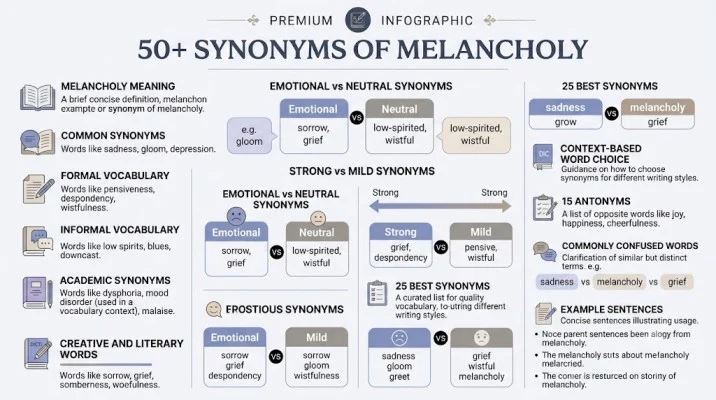
When the same word appears repeatedly in an essay, story, caption, or personal reflection, the writing can quickly lose some of its emotional depth. The synonyms of melancholy give writers more precise ways to describe sadness, quiet sorrow, emotional heaviness, wistfulness, or a reflective mood without making every sentence sound the same.
The best alternative depends on the feeling you want to express. Sadness is broad and neutral, sorrow often suggests deeper pain, gloom creates a darker atmosphere, and wistfulness adds a sense of longing. Understanding these differences helps you choose vocabulary that sounds natural in academic writing, professional communication, everyday conversation, and creative work.
What Are the Best Synonyms of “Melancholy”?
Melancholy describes a deep, often quiet or reflective sadness. The best alternatives include sadness for general use, sorrow for deeper emotional pain, gloom for a dark mood, dejection for low spirits, wistfulness for longing, and despondency for prolonged discouragement. Creative writing often benefits from mournfulness, pensiveness, or heartache.
Meaning, Tone, and Context
Simple Definition
Melancholy refers to a feeling or state of sadness that is often quiet, thoughtful, subdued, or reflective. Unlike a brief moment of disappointment, melancholy can describe a lingering emotional mood or an atmosphere that feels subdued and sorrowful.
For example:
“A sense of melancholy filled the room after everyone left.”
Here, the word does more than simply say that someone was sad. It creates an emotional atmosphere of quiet sadness and reflection.
Part of Speech
Melancholy can function primarily as both a noun and an adjective.
As a noun:
“A feeling of melancholy came over her.”
As an adjective:
“He listened to a melancholy song.”
Overall Tone
Melancholy usually has a negative emotional tone, but it is not necessarily harsh or intensely painful.
It often suggests sadness that is:
- Quiet
- Reflective
- Lingering
- Gentle
- Thoughtful
- Nostalgic
- Emotionally subdued
This is one reason melancholy is especially common in literature, poetry, music, photography, and descriptive writing.
Formality Level
Melancholy is generally neutral to somewhat literary.
It works in formal and academic writing, but it can sound more expressive or literary than simple words such as sadness.
For example:
“The poem conveys a sense of melancholy.”
This sounds natural in literary analysis.
In everyday conversation, someone might simply say:
“I’ve been feeling a little sad lately.”
Common Uses
Native English speakers commonly use melancholy when discussing:
- Moods
- Memories
- Music
- Poetry
- Art
- Literature
- Weather
- Personal reflection
- Nostalgia
- Loss
- Loneliness
- Quiet emotional sadness
- Atmospheres
Common combinations include:
- A feeling of melancholy
- A sense of melancholy
- A melancholy mood
- A melancholy song
- A melancholy expression
- A melancholy smile
- A melancholy atmosphere
- A melancholy tone
- A melancholy memory
- A melancholy reflection
Word Forms
| Form | Example |
|---|---|
| Noun | “She felt a sense of melancholy.” |
| Adjective | “The song had a melancholy quality.” |
| Related adjective | “The scene felt melancholic.” |
| Related noun | “His melancholy lasted throughout the evening.” |
Melancholic is a related adjective that means characterized by or expressing melancholy.
When and How to Use “Melancholy”
Use melancholy when you want to describe sadness that feels quiet, reflective, or emotionally subdued. It is particularly effective when ordinary words such as sad or unhappy do not fully capture the mood.
Professional Context
“The documentary presents a melancholy view of the town’s declining industry.”
Melancholy can work in professional writing when discussing art, culture, literature, media, or emotional themes. In routine business communication, however, simpler words are usually more natural.
Academic Context
“The novel develops a recurring sense of melancholy through its descriptions of isolation.”
This works particularly well in literary analysis because the word describes an emotional atmosphere rather than simply labeling a character as sad.
Workplace Context
“The farewell meeting had a melancholy atmosphere.”
Here, melancholy describes the emotional mood of the event.
Personal Context
“I felt a strange sense of melancholy after looking through my old photographs.”
The word works because the sadness is connected with reflection and memories.
Email Context
“The final message from the team carried a touch of melancholy as the project came to an end.”
This is suitable for a reflective or personal email, although sadness would usually be more direct in a routine professional message.
Resume Context
Melancholy is rarely appropriate for a resume because resumes generally focus on achievements, skills, responsibilities, and professional strengths.
Instead of trying to use melancholy on a resume, choose precise professional language related to the actual achievement.
Social Media Context
“Some evenings carry a quiet melancholy that is difficult to explain.”
This use feels natural in reflective captions, creative posts, and personal writing.
Best Synonyms of “Melancholy”
No synonym is identical to melancholy in every situation. Each alternative highlights a slightly different aspect of sadness, such as emotional pain, low spirits, darkness, longing, grief, or reflection.
Professional Writing: Sorrow
Sorrow works well when writing about serious emotional pain or loss. It is more direct than melancholy and usually carries greater emotional weight.
Example:
“The article explores the community’s sorrow following the tragedy.”
Academic Writing: Sadness
Sadness is a clear and widely understood choice for academic writing when the subject is emotional states.
Example:
“The character’s sadness becomes more apparent as the story progresses.”
Business Communication: Concern
Concern can be more appropriate than melancholy when the intended meaning involves worry rather than sadness.
Example:
“The results raised concerns among investors.”
Casual Conversation: Sadness
Sadness is much more common in everyday conversation.
Example:
“I could hear the sadness in her voice.”
Emotional Writing: Sorrow
Sorrow gives emotional writing greater depth and seriousness.
Example:
“Years later, he still carried the sorrow of that loss.”
Creative Writing: Wistfulness
Wistfulness is especially useful when sadness is mixed with longing or nostalgia.
Example:
“She looked back at the old house with quiet wistfulness.”
Resume Writing: No Direct Synonym Recommended
Melancholy and its direct emotional synonyms usually do not belong on a resume. Professional writing should describe observable skills, achievements, responsibilities, or outcomes rather than using emotional vocabulary without a clear purpose.
Workplace Communication: Concern
If you mean worry about a situation rather than sadness, concern is more appropriate.
Example:
“The team expressed concern about the delayed launch.”
Stronger Meaning: Despondency
Despondency suggests a deeper and more persistent loss of hope or confidence.
Example:
“Repeated failures left him in a state of despondency.”
Softer Meaning: Wistfulness
Wistfulness often describes a gentle sadness mixed with longing rather than severe emotional distress.
Example:
“She spoke with wistfulness about her childhood.”
When Not to Use “Melancholy”
Although melancholy is expressive and versatile, it is not always the clearest choice.
When “Melancholy” Sounds Too General
If you simply mean that someone is unhappy, sadness is more direct.
Less precise:
“The child showed signs of melancholy after losing the toy.”
Better:
“The child showed signs of sadness after losing the toy.”
Why:
The situation is simple and immediate, so the more common word communicates the idea clearly.
When “Melancholy” Sounds Too Literary
In everyday workplace communication, melancholy may sound unnecessarily poetic.
Less natural:
“The team experienced melancholy after the meeting was canceled.”
Better:
“The team was disappointed after the meeting was canceled.”
Why:
Disappointment better matches the practical situation.
When “Melancholy” Is Too Weak
If the context involves profound grief, melancholy may not communicate enough emotional weight.
Less precise:
“She felt melancholy after losing her parent.”
Better:
“She felt profound grief after losing her parent.”
Why:
Grief specifically describes deep sorrow associated with loss.
When “Melancholy” Is Too Strong
For a small disappointment, melancholy can sound exaggerated.
Less natural:
“I felt melancholy because my favorite restaurant was closed.”
Better:
“I felt disappointed because my favorite restaurant was closed.”
Why:
Disappointed accurately reflects the relatively minor setback.
When “Melancholy” Is Too Vague
If the real issue is worry rather than sadness, use concern.
Less precise:
“The manager felt melancholy about the declining sales.”
Better:
“The manager was concerned about the declining sales.”
Why:
The second sentence clearly communicates worry about a business problem.
When an Emotional Synonym Is Not Appropriate
Formal documents sometimes require objective language.
Less suitable:
“The report describes the company’s melancholy performance.”
Better:
“The report describes the company’s declining performance.”
Why:
Declining describes the measurable business condition rather than adding an unnecessary emotional judgment.
Words Commonly Confused With “Melancholy”
Sadness
Difference:
Sadness is the broadest and most general term. Melancholy often suggests a quieter, more reflective form of sadness.
When to Use It:
Use sadness when you simply need to describe an unhappy emotional state.
Example:
“Her sadness was obvious when she heard the news.”
Sorrow
Difference:
Sorrow generally suggests deeper emotional pain, especially following loss or serious disappointment.
When to Use It:
Use sorrow for serious emotional experiences.
Example:
“The family expressed their sorrow after the loss.”
Grief
Difference:
Grief is strongly associated with deep sorrow caused by loss, particularly the death of someone close.
When to Use It:
Use grief when the sadness is specifically connected to significant loss.
Example:
“He struggled with grief after his father’s death.”
Gloom
Difference:
Gloom emphasizes darkness, negativity, or an unpleasant atmosphere. Melancholy is often quieter and more reflective.
When to Use It:
Use gloom to describe a dark mood, atmosphere, or outlook.
Example:
“The gloomy weather matched her mood.”
Wistfulness
Difference:
Wistfulness combines gentle sadness with longing for something absent, lost, or unattainable.
When to Use It:
Use wistfulness for nostalgia and reflective longing.
Example:
“He spoke with wistfulness about his childhood.”
Despondency
Difference:
Despondency suggests a serious loss of hope or confidence. It is generally stronger than melancholy.
When to Use It:
Use despondency when sadness is connected with discouragement and hopelessness.
Example:
“Months of failure left him in deep despondency.”
Best Synonyms of “Melancholy” by Context
| Context | Best Synonym | Why It Works | Example |
|---|---|---|---|
| Formal writing | Sorrow | Serious and established emotional vocabulary | “The poem expresses sorrow after loss.” |
| Academic writing | Sadness | Clear and objective | “The character’s sadness develops gradually.” |
| Professional communication | Concern | Better for worry or unease | “The results caused concern among managers.” |
| Business emails | Concern | Direct and professional | “We have concerns about the revised schedule.” |
| Resume writing | No direct synonym | Emotional terms are usually inappropriate | Describe the actual achievement instead. |
| Workplace communication | Concern | Clearly communicates worry | “The delay is a concern for the team.” |
| Casual conversation | Sadness | Natural and familiar | “I felt some sadness after leaving.” |
| Everyday speaking | Sadness | Simple and direct | “There was sadness in his voice.” |
| Creative writing | Wistfulness | Adds longing and reflection | “She smiled with wistfulness.” |
| Storytelling | Sorrow | Adds emotional depth | “His face revealed years of sorrow.” |
| Emotional writing | Heartache | Conveys personal emotional pain | “She carried the heartache for years.” |
| Strong emphasis | Despondency | Suggests severe discouragement | “Failure pushed him toward despondency.” |
| Mild tone | Wistfulness | Gentle and reflective | “He felt a touch of wistfulness.” |
| Social media captions | Wistfulness | Short, expressive, and reflective | “A little wistfulness tonight.” |
| American English | Sadness | Most broadly understood | “The song captures a feeling of sadness.” |
| British English | Sadness | Also natural and widely understood | “The story carries a sense of sadness.” |
How to Choose the Best Synonym of “Melancholy”
Choosing the right word starts with identifying the exact feeling you want to communicate.
If You Mean General Sadness
Choose sadness.
It is the safest and most widely understood alternative.
“The story contains a strong sense of sadness.”
If You Mean Deep Emotional Pain
Choose sorrow.
“The character’s sorrow becomes central to the story.”
If You Mean Sadness From Loss
Choose grief.
“He struggled with grief after the loss.”
If You Mean Sadness Mixed With Longing
Choose wistfulness.
“She remembered the old days with wistfulness.”
If You Mean Low Spirits
Choose dejection.
“The disappointing result left the team in dejection.”
If You Mean Loss of Hope
Choose despondency.
“Repeated setbacks led to despondency.”
If You Mean a Dark Atmosphere
Choose gloom.
“A sense of gloom settled over the town.”
If You Mean Emotional Pain in a Personal Context
Choose heartache.
“The song reminded him of years of heartache.”
Consider Your Audience
- For students and general readers, sadness is usually the clearest option.
- For literary analysis, melancholy, wistfulness, and mournfulness may provide greater precision.
- For professional communication, use practical terms such as concern, disappointment, or difficulty when they accurately describe the situation.
Consider Emotional Strength
Do not automatically choose the strongest synonym.
A simple progression might look like this:
Wistfulness → Sadness → Sorrow → Despondency
The exact intensity depends on context, but this progression helps show how different words can communicate different emotional weights.
Real Life Examples of “Melancholy”
School
Original:
“The book has melancholy.”
Improved:
“The novel creates a strong sense of melancholy through its descriptions of loneliness.”
College
Original:
“The main character is sad.”
Improved:
“The main character experiences melancholy as she reflects on her lost relationship.”
Workplace
Original:
“The office felt melancholy after the announcement.”
Improved:
“The office had a subdued atmosphere after the announcement.”
Business
Original:
“The company was melancholy about its results.”
Improved:
“The company expressed concern about its disappointing results.”
Original:
“I feel melancholy about your departure.”
Improved:
“I feel a real sense of sadness about your departure.”
Resume
Original:
“I overcame melancholy during difficult projects.”
Improved:
“I remained resilient and productive during challenging projects.”
Conversation
Original:
“I have been feeling melancholy lately.”
Natural alternative:
“I’ve been feeling a little sad lately.”
Storytelling
Original:
“She was sad when she returned home.”
Improved:
“A quiet melancholy followed her as she returned to her childhood home.”
Blogging
Original:
“The old neighborhood made me sad.”
Improved:
“Walking through the old neighborhood filled me with wistfulness.”
Social Media
Original:
“I feel sad looking at these old photos.”
Improved:
“These old photographs bring a quiet sense of melancholy.”
25 Best Synonyms of “Melancholy”
| Synonym | Simple Meaning | Best Used For | Example Sentence |
|---|---|---|---|
| Sadness | An unhappy emotional state | General writing | “The character could not hide her sadness.” |
| Sorrow | Deep emotional sadness | Loss and serious emotion | “His sorrow was evident in his voice.” |
| Gloom | A dark or depressing mood | Atmosphere and mood | “A sense of gloom filled the room.” |
| Wistfulness | Gentle sadness mixed with longing | Nostalgia and reflection | “She looked at the photograph with wistfulness.” |
| Dejection | Low spirits after disappointment | Failure and setbacks | “The defeat left the players in dejection.” |
| Despondency | Deep discouragement or loss of hope | Serious emotional decline | “Repeated failures led to despondency.” |
| Grief | Deep sorrow caused by loss | Bereavement and major loss | “He was still working through his grief.” |
| Mournfulness | A sorrowful emotional quality | Literature and creative writing | “The song has a quiet mournfulness.” |
| Pensiveness | Thoughtful, reflective mood | Literary description | “She sat in quiet pensiveness by the window.” |
| Heartache | Deep personal emotional pain | Relationships and personal loss | “The breakup left him with lasting heartache.” |
| Unhappiness | Lack of happiness | General description | “Her unhappiness became increasingly noticeable.” |
| Cheerlessness | Lack of joy or warmth | Atmosphere and personality | “The room had an air of cheerlessness.” |
| Downheartedness | Feeling discouraged or sad | Personal emotion | “The setback caused considerable downheartedness.” |
| Forlornness | A lonely, abandoned feeling | Creative writing | “The empty house seemed to embody forlornness.” |
| Somberness | Serious, subdued emotional quality | Formal and descriptive writing | “The ceremony had an atmosphere of somberness.” |
| Gloominess | A state or quality of being gloomy | Mood and atmosphere | “The gloomy weather reinforced the character’s gloominess.” |
| Moroseness | Persistent bad temper or gloomy mood | Personality descriptions | “His moroseness made conversation difficult.” |
| Dolefulness | Deep sadness or mournful quality | Literary writing | “The poem carries a sense of dolefulness.” |
| Disconsolation | A state of being unable to feel comfort | Formal and literary contexts | “She remained in disconsolation after the loss.” |
| Desolation | Extreme loneliness or emotional emptiness | Strong emotional writing | “The abandoned town conveyed a feeling of desolation.” |
| Heaviness | Emotional weight or sadness | Figurative writing | “A heaviness settled over him after the news.” |
| Blues | A state of sadness | Informal conversation | “She was feeling the blues after moving away.” |
| Melancholic feeling | A sadness characterized by reflection | Literary discussion | “The painting creates a distinctly melancholic feeling.” |
| Mournfulness | Sorrowful emotional expression | Poetry and music | “Her voice carried a note of mournfulness.” |
| Low spirits | A state of sadness or discouragement | Everyday conversation | “He was in low spirits after the cancellation.” |
Synonyms of “Melancholy” by Usage
Professional vs Personal Synonyms
Professional writing should prioritize clarity over emotional decoration.
For example, if a manager is worried about falling sales, concern is more accurate than melancholy.
“The leadership team expressed concern about declining sales.”
In personal writing, however, emotional vocabulary can add depth.
“I felt a quiet melancholy when I returned to the place where I grew up.”
Formal vs Conversational Synonyms
Formal and literary alternatives include:
- Sorrow
- Despondency
- Disconsolation
- Mournfulness
- Somberness
Conversational alternatives include:
- Sadness
- The blues
- Low spirits
- Feeling down
For texting, feeling down is much more natural than experiencing melancholy.
Academic Synonyms
Academic writing should use precise vocabulary that reflects the exact emotional state being discussed.
Sadness
Use when describing a general emotional response.
“The character’s sadness is revealed through her interactions with others.”
Sorrow
Use when the emotional experience is deeper.
“The poem expresses sorrow following the speaker’s loss.”
Wistfulness
Use when sadness is connected with longing or nostalgia.
“The narrator’s wistfulness reflects her desire to return to the past.”
Despondency
Use when the character has lost hope or confidence.
“His repeated failures eventually produced a state of despondency.”
Gloom
Use when discussing a dark emotional atmosphere.
“The setting creates an atmosphere of gloom.”
These words are more useful than simply replacing melancholy with a random synonym because each communicates a specific emotional quality.
Professional and Business Synonyms
Melancholy is not commonly needed in routine business communication. The appropriate alternative depends on what you actually mean.
For Worry
Use concern.
“The department has concerns about the new deadline.”
For Disappointment
Use disappointment.
“The team expressed disappointment with the final result.”
For Serious Difficulty
Use difficulty or a more specific term.
“The company is facing significant financial difficulties.”
For a Negative Outlook
Use pessimism when the issue is a belief that future results will be poor.
“Investor pessimism increased after the announcement.”
For a Serious Atmosphere
Use somber when describing an event or atmosphere.
“The meeting had a somber tone after the announcement.”
Creative and Literary Synonyms
Creative writing gives melancholy more room because emotional atmosphere is often part of the purpose.
Wistfulness
Useful when the character longs for something from the past.
“A wistfulness entered her voice whenever she mentioned the old neighborhood.”
Mournfulness
Useful for music, poetry, voices, and visual scenes.
“The mournfulness of the violin filled the empty hall.”
Forlornness
Useful when emphasizing loneliness and abandonment.
“The deserted station radiated an unmistakable sense of forlornness.”
Heartache
Useful for personal emotional pain.
“Beneath his calm expression was years of heartache.”
Desolation
Useful for powerful descriptions of emotional or physical emptiness.
“The abandoned village seemed to mirror her own desolation.”
Slang or Modern Synonyms
There is no perfect slang equivalent for melancholy, but several informal expressions can communicate related feelings.
The Blues
Meaning:
A period or feeling of sadness.
Acceptable in:
Casual conversation, music discussions, personal writing, and social media.
Avoid in:
Formal academic and professional writing.
Example:
“I’ve got the blues today.”
Feeling Down
Meaning:
Feeling sad, discouraged, or emotionally low.
Acceptable in:
Everyday speech and informal messages.
Avoid in:
Formal reports and academic writing.
Example:
“She’s been feeling down since the move.”
A Big Downer
Meaning:
Something that causes disappointment or makes a situation feel unpleasant.
Acceptable in:
Very casual conversation.
Avoid in:
Professional and academic writing.
Example:
“Missing the concert was a real downer.”
Strongest to Mildest Synonyms
There is no universal emotional scale because context changes the strength of a word. Still, these groups provide a useful general guide.
Mild
- Wistfulness
- Pensiveness
- Low spirits
- Heaviness
These words can describe subdued emotional states without suggesting severe distress.
Moderate
- Sadness
- Melancholy
- Gloom
- Dejection
- Heartache
These words communicate clearer emotional discomfort.
Strong
- Sorrow
- Grief
- Mournfulness
- Desolation
- Despondency
These words generally suggest deeper emotional pain, loss, loneliness, or discouragement.
Very Strong
- Desolation
- Deep grief
- Severe despondency
These expressions should be used carefully because they imply significant emotional intensity.
Emotional vs Neutral Synonyms
Emotional Synonyms
These alternatives create stronger emotional imagery.
- Sorrow
- Heartache
- Wistfulness
- Mournfulness
- Desolation
- Forlornness
- Grief
Use them in personal essays, fiction, poetry, memoirs, and emotionally focused writing.
Neutral Synonyms
These alternatives communicate the idea more directly.
- Sadness
- Dejection
- Gloom
- Concern
- Low spirits
They are useful when emotional precision matters more than literary effect.
Antonyms of “Melancholy”
| Antonym | Meaning | Example Sentence |
|---|---|---|
| Happiness | A state of pleasure or contentment | “Her happiness was obvious throughout the celebration.” |
| Joy | Strong feeling of delight | “The children shouted with joy.” |
| Cheerfulness | A bright and positive mood | “His natural cheerfulness lifted the team.” |
| Gladness | Feeling pleased or happy | “She expressed her gladness at the news.” |
| Contentment | Peaceful satisfaction | “He found contentment in a simple routine.” |
| Optimism | Positive belief about the future | “Her optimism helped the team stay focused.” |
| Hope | Positive expectation for the future | “They continued to work with hope.” |
| Delight | Strong pleasure or enjoyment | “The surprise brought her great delight.” |
| Euphoria | Extremely intense happiness | “The victory produced a wave of euphoria.” |
| Excitement | Strong enthusiasm about something | “The announcement generated excitement.” |
| Elation | Very high spirits caused by success | “She felt elation after receiving the award.” |
| Enthusiasm | Energetic interest or eagerness | “His enthusiasm was contagious.” |
| Merriment | Lively enjoyment and amusement | “The festival was filled with merriment.” |
| Pleasure | A feeling of enjoyment or satisfaction | “She took pleasure in helping others.” |
| Cheer | A happy or encouraging mood | “The good news brought cheer to the office.” |
Comparison: “Melancholy” vs Similar Words
Melancholy vs Sadness
Main Difference:
Sadness is a broad emotional state. Melancholy often suggests a quieter, more reflective form of sadness.
Which Is Stronger?
Melancholy can feel more lingering or literary, but neither word is automatically stronger in every situation.
Which Is More Formal?
Melancholy sounds somewhat more literary, while sadness is completely neutral.
When to Use Each:
Use sadness for direct communication. Use melancholy when describing reflective emotional atmosphere.
Examples:
Melancholy:
“The old photographs filled her with melancholy.”
Sadness:
“The news caused deep sadness.”
Melancholy vs Sorrow
Main Difference:
Sorrow usually suggests deeper emotional pain, especially after loss.
Which Is Stronger?
Sorrow is generally stronger.
Which Is More Formal?
Both can work in formal writing, but sorrow has a serious emotional quality.
When to Use Each:
Use melancholy for quiet reflection. Use sorrow for profound emotional pain.
Examples:
Melancholy:
“The song created a feeling of melancholy.”
Sorrow:
“He struggled with sorrow after the loss.”
Melancholy vs Grief
Main Difference:
Grief specifically refers to deep sorrow, particularly following significant loss.
Which Is Stronger?
Grief is generally stronger.
Which Is More Formal?
Both are appropriate in formal contexts.
When to Use Each:
Use grief when loss is central. Use melancholy for broader reflective sadness.
Examples:
Melancholy:
“The painting evokes a quiet melancholy.”
Grief:
“She experienced profound grief after losing her mother.”
Melancholy vs Gloom
Main Difference:
Gloom emphasizes darkness or negativity, especially in an atmosphere or outlook.
Which Is Stronger?
Gloom can feel darker, while melancholy can feel softer and more reflective.
Which Is More Formal?
Both are acceptable, although melancholy has a more literary quality.
When to Use Each:
Use gloom for dark settings or moods. Use melancholy for thoughtful sadness.
Examples:
Melancholy:
“A sense of melancholy followed him home.”
Gloom:
“Gloom settled over the city as the storm approached.”
Melancholy vs Wistfulness
Main Difference:
Wistfulness combines sadness with longing or nostalgia.
Which Is Stronger?
Melancholy can describe broader or deeper sadness. Wistfulness is usually gentler.
Which Is More Formal?
Both are literary but natural in descriptive writing.
When to Use Each:
Use wistfulness when someone longs for something absent or lost.
Examples:
Melancholy:
“The evening left her with a feeling of melancholy.”
Wistfulness:
“He remembered his childhood with wistfulness.”
Melancholy vs Despondency
Main Difference:
Despondency emphasizes discouragement and loss of hope, while melancholy emphasizes sadness and reflection.
Which Is Stronger?
Despondency is generally stronger.
Which Is More Formal?
Despondency is more formal and less common in everyday conversation.
When to Use Each:
Use despondency when repeated failure or disappointment has caused serious discouragement.
Examples:
Melancholy:
“The quiet music brought a sense of melancholy.”
Despondency:
“Repeated rejection left him in deep despondency.”
Common Phrases and Expressions with “Melancholy”
A Touch of Melancholy
Meaning:
A small or subtle feeling of sadness.
Example:
“The ending has a touch of melancholy.”
A Sense of Melancholy
Meaning:
A noticeable emotional atmosphere of quiet sadness.
Example:
“The empty house created a sense of melancholy.”
A Feeling of Melancholy
Meaning:
An emotional experience characterized by subdued sadness.
Example:
“I felt a strange feeling of melancholy while looking through the old letters.”
A Melancholy Mood
Meaning:
A mood characterized by quiet sadness or reflection.
Example:
“The rainy afternoon put him in a melancholy mood.”
A Melancholy Tone
Meaning:
A style of speaking or writing that communicates sadness.
Example:
“The author’s melancholy tone remains throughout the final chapter.”
A Melancholy Smile
Meaning:
A smile that suggests sadness, nostalgia, or mixed emotions.
Example:
“She gave him a melancholy smile before leaving.”
Melancholy Music
Meaning:
Music that creates or expresses a subdued feeling of sadness.
Example:
“He prefers melancholy music on quiet evenings.”
Melancholy Memories
Meaning:
Memories that create sadness, nostalgia, or emotional reflection.
Example:
“Those photographs brought back melancholy memories.”
Common Mistakes to Avoid
Mistake 1: Treating Every Synonym as Identical
Incorrect:
“Melancholy and grief always mean exactly the same thing.”
Better:
“Melancholy can describe quiet sadness, while grief usually refers to deep sorrow connected with loss.”
Why:
Synonyms often overlap without being interchangeable in every context.
Mistake 2: Using “Melancholy” for Every Type of Sadness
Incorrect:
“The student felt melancholy after getting one question wrong.”
Better:
“The student felt disappointed after getting one question wrong.”
Why:
A minor setback does not necessarily create the reflective or lingering sadness associated with melancholy.
Mistake 3: Confusing Melancholy With Depression
Incorrect:
“Melancholy and depression are always the same condition.”
Better:
“Melancholy can describe a temporary or reflective sadness, while depression can refer to a serious mental health condition.”
Why:
The terms should not be treated as interchangeable. In general writing, melancholy describes an emotional mood, while depression can have a clinical meaning.
Mistake 4: Using “Wistfulness” Without Longing
Incorrect:
“She felt wistful about the broken printer.”
Better:
“She felt frustrated about the broken printer.”
Why:
Wistfulness usually involves longing, nostalgia, or a desire for something absent.
Mistake 5: Using “Gloom” When You Mean Grief
Incorrect:
“The family experienced gloom after the death.”
Better:
“The family experienced grief after the death.”
Why:
Grief directly communicates sorrow following loss, while gloom describes a darker mood or atmosphere.
Mistake 6: Using Literary Vocabulary in Routine Business Writing
Incorrect:
“The department was overwhelmed by melancholy after the project ended.”
Better:
“The department was disappointed that the project ended.”
Why:
The second version is clearer and more appropriate for ordinary workplace communication.
Mistake 7: Choosing a Stronger Word Just to Sound Sophisticated
Incorrect:
“The canceled meeting caused profound desolation.”
Better:
“The canceled meeting caused disappointment.”
Why:
Sophisticated vocabulary is useful only when it accurately communicates the intended meaning.
Frequently Asked Questions
1. What are the best synonyms of “melancholy”?
The best synonyms of melancholy include sadness, sorrow, gloom, wistfulness, dejection, despondency, mournfulness, heartache, grief, and low spirits. The ideal choice depends on emotional intensity and context.
2. What are the best formal synonyms of “melancholy”?
Formal alternatives include sorrow, despondency, disconsolation, mournfulness, dejection, and somberness. These work particularly well in literary analysis, formal descriptions, and serious discussions of emotional states.
3. What are common informal synonyms of “melancholy”?
Common informal alternatives include sadness, feeling down, the blues, and low spirits. These expressions are more natural in everyday conversations, texts, and casual social media posts.
4. What is another word for “melancholy” in professional writing?
In professional writing, the best alternative depends on the intended meaning. Concern works for worry, disappointment for an unwanted result, and somber for a serious atmosphere or tone.
5. What is the difference between “melancholy” and “sadness”?
Melancholy often describes quiet, reflective, or lingering sadness, while sadness is a broad term for an unhappy emotional state. Melancholy can therefore sound more literary and atmospheric than ordinary sadness.
6. What is the opposite of “melancholy”?
Common opposites include happiness, joy, cheerfulness, gladness, contentment, optimism, hope, delight, and elation. The best antonym depends on whether you mean the opposite of sadness, gloom, or emotional heaviness.
Conclusion
Melancholy describes a form of sadness that is often quiet, reflective, lingering, or connected with nostalgia. It can describe an emotion, an atmosphere, a tone, a memory, or a creative work, making it especially useful in descriptive and literary writing.
The best alternative depends on the exact meaning. Use sadness for general situations, sorrow for deeper emotional pain, grief for loss, gloom for a dark atmosphere, wistfulness for gentle longing, and despondency for serious discouragement.
No synonym works perfectly in every sentence. When choosing among the synonyms of melancholy, consider the audience, emotional strength, context, and purpose first. A useful vocabulary habit is to identify the exact feeling you want to communicate before choosing a replacement word.
Read More Related Articles:
50+ Synonyms of Love | Powerful Words to Express Every …
Synonyms for Thus | Meaning, Examples, and Better Word …
50+ Synonyms of Nice | Meanings, Uses, Examples, and Best …