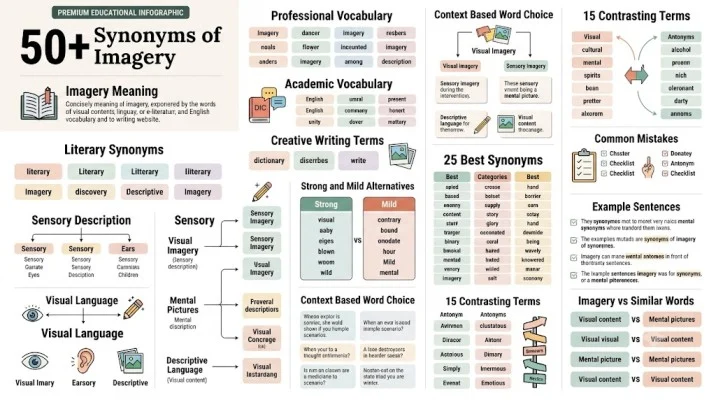
A writer may use the word imagery several times while explaining a poem, describing a story, or discussing vivid language. The same problem appears in essays, blogs, literary analysis, captions, and creative writing, where repeating one term can make otherwise strong writing feel predictable. Learning the synonyms of imagery gives you more precise ways to describe visual details, sensory language, mental pictures, and descriptive expression.
The best alternative depends on what you mean by imagery. In literary writing, terms such as sensory description, word picture, and descriptive language can be useful. In art or visual media, visual representation, depiction, and illustration may be more accurate. Understanding these differences helps you choose vocabulary that communicates your exact idea instead of replacing one word with another that only sounds similar.
What Are the Best Synonyms of “Imagery”?
Imagery refers to descriptive language or visual material that creates pictures, sensations, or impressions in the mind. Common alternatives include descriptive language, sensory description, word picture, visualization, depiction, representation, illustration, portrayal, and visual description, depending on whether the context is literary, academic, visual, or creative.
For literary analysis, sensory description and descriptive language are usually the safest choices. For visual media, depiction, representation, and illustration work better. In creative writing, word picture and visual description can emphasize the experience created for the reader.
Meaning, Tone, and Context
Simple Definition
Imagery is language or visual material that helps create a picture, sensation, scene, or impression in the mind. In literature, imagery often appeals to the senses by helping readers see, hear, smell, taste, touch, or emotionally experience what the writer describes.
For example:
“The warm bread filled the kitchen with a buttery aroma.”
This sentence uses sensory imagery because it gives the reader a clear experience of smell and taste.
The word can also refer to visual images collectively, especially in photography, advertising, design, film, and other visual fields.
Part of Speech
Imagery is primarily a noun.
Example:
“The poem uses vivid imagery to describe the changing seasons.”
The related adjective imagistic exists, although it is much less common in everyday English.
Other related words include:
Image: A picture, representation, or mental impression.
Imagine: To form a mental picture or concept.
Imaginative: Showing creativity or the ability to form original ideas and mental pictures.
Imagery: The descriptive or visual material that creates those pictures or impressions.
Overall Tone
Imagery is generally neutral.
It does not inherently express a positive or negative feeling. Its tone depends on the content being described.
For example:
“The poem contains beautiful imagery of a quiet forest.”
The imagery is positive and peaceful.
But:
“The novel uses disturbing imagery to describe the battlefield.”
Here, the imagery creates a darker emotional effect.
Formality Level
Imagery is generally neutral to formal.
It is especially common in:
- Literary analysis
- Academic essays
- Creative writing discussions
- Poetry criticism
- Film analysis
- Art criticism
- Advertising
- Photography
- Visual communication
In casual conversation, people may use simpler terms such as pictures, images, descriptions, or visuals, depending on the meaning.
Common Uses
Native English speakers commonly use imagery when discussing:
- Poetry
- Novels
- Short stories
- Speeches
- Advertising
- Photography
- Film
- Art
- Branding
- Descriptive writing
- Sensory language
- Mental pictures
- Visual communication
Examples include:
“The author uses nature imagery throughout the novel.”
“The advertisement relies on bright imagery.”
“The poem contains powerful sensory imagery.”
Important Meaning Difference
One of the most important points about imagery is that it does not always mean simply “pictures.”
In literary studies, imagery often refers to language that creates sensory experiences.
A sentence such as:
“Cold rain tapped against the window.”
contains imagery even though there is no actual picture attached to the sentence.
This distinction matters when selecting a synonym. Picture may work when referring to an actual or mental image, but sensory description is more accurate when discussing literary language.
When and How to Use “Imagery”
Use imagery when you want to describe language, descriptions, or visual elements that create a strong mental or sensory impression.
Professional
“The marketing campaign uses consistent visual imagery to reinforce the brand identity.”
In this context, imagery refers to visual material used in branding and marketing.
Academic
“The poet uses natural imagery to explore the relationship between humans and the environment.”
Here, imagery refers to recurring descriptive elements in a literary work.
Workplace
“The presentation could benefit from clearer visual imagery.”
In a workplace setting, the word can describe pictures, graphics, or visual elements.
Personal
“The imagery in the old photographs brought back memories of my childhood.”
Here, imagery refers to visual material that triggers memories.
“I attached the imagery we discussed for the upcoming campaign.”
In this context, imagery can refer to photographs, graphics, or other visual assets.
Resume
“Created original imagery for digital marketing campaigns.”
On a resume, imagery can describe visual content created for marketing or design purposes.
Social Media
“The imagery in this campaign gives the brand a warm and welcoming feel.”
Here, the word refers to the overall visual content and style.
Best Synonyms of “Imagery”
No synonym of imagery works perfectly in every situation because the word has several related meanings. The best alternative depends on whether you are discussing literary language, sensory experience, mental pictures, or actual visual material.
Professional Writing: Visual Representation
Visual representation works well when discussing images, graphics, photographs, or other visual content.
“The website uses clear visual representations of the product.”
It is more precise than imagery when the focus is specifically on how something is shown visually.
Academic Writing: Descriptive Language
Descriptive language is a strong choice when analyzing how a writer creates mental or sensory impressions.
“The author uses descriptive language to create a sense of isolation.”
It is especially useful in literary essays because it explains the function of the language rather than simply labeling it imagery.
Business Communication: Visual Content
Visual content is useful when discussing photographs, graphics, illustrations, and other material used in marketing.
“The campaign needs stronger visual content for social media.”
It sounds natural in modern business communication.
Casual Conversation: Pictures
Pictures is often the simplest choice when imagery means actual images.
“The article has some great pictures.”
This is much more natural than imagery in ordinary conversation.
Emotional Writing: Mental Picture
Mental picture works when the description creates an emotional or memorable scene in someone’s mind.
“Her words created a mental picture of the village she grew up in.”
The phrase emphasizes the reader’s or listener’s imagination.
Creative Writing: Word Picture
Word picture is useful when language creates a vivid scene without an actual photograph or illustration.
“The writer paints a detailed word picture of the city.”
It emphasizes the visual effect created through words.
Resume Writing: Visual Content
For design, marketing, photography, or content roles, visual content is often more specific than imagery.
“Produced visual content for multiple digital campaigns.”
It clearly communicates the type of work involved.
Workplace Communication: Visuals
Visuals is a concise choice for presentations, reports, and meetings.
“The presentation needs stronger visuals.”
It sounds natural and professional without being overly technical.
Stronger Meaning: Vivid Description
When you want to emphasize the powerful effect of descriptive language, vivid description is useful.
“The novel is known for its vivid description of rural life.”
It communicates intensity and clarity.
Softer Meaning: Description
When you simply mean language that explains what something looks or feels like, description may be enough.
“The description of the house is brief but effective.”
This is broader and less specialized than imagery.
When Not to Use “Imagery”
Although imagery is useful, it is not always the most precise word.
When You Mean an Actual Photograph
Less Effective:
“Please send me the imagery from the event.”
This is possible in professional marketing language, but it can sound vague.
Better:
“Please send me the photographs from the event.”
Why:
Photographs clearly identifies the type of visual material.
When You Mean a Simple Picture
Less Effective:
“I found some interesting imagery online.”
Better:
“I found some interesting pictures online.”
Why:
Pictures sounds more natural in everyday conversation.
When You Mean Literary Description
Less Effective:
“The writer uses imagery to explain the character’s emotions.”
Better:
“The writer uses sensory description to express the character’s emotions.”
Why:
The second version explains what the imagery actually does.
When You Mean a Graphic or Illustration
Less Effective:
“The designer created new imagery for the brochure.”
Better:
“The designer created new illustrations for the brochure.”
Why:
Illustrations identifies the specific visual format.
When You Mean a Mental Concept
Less Effective:
“The teacher asked students to create imagery of the process.”
Better:
“The teacher asked students to visualize the process.”
Why:
Visualize directly describes the mental act of forming a picture.
When the Word Becomes Too Vague
Less Effective:
“The campaign needs better imagery.”
Better:
“The campaign needs more engaging product photographs and graphics.”
Why:
The revised sentence tells the reader exactly what needs improvement.
Words Commonly Confused With “Imagery”
Image
Difference: An image is usually one picture, representation, or mental impression. Imagery generally refers to a collection, pattern, or use of images or descriptive material.
When to Use It: Use image when referring to one particular visual or mental picture.
Example:
“The photographer captured a striking image of the mountains.”
Description
Difference: A description explains what something is like. Imagery specifically emphasizes the mental or sensory experience created by language or visuals.
When to Use It: Use description when accuracy or explanation matters more than vividness.
Example:
“The description of the building includes its size and location.”
Visualization
Difference: Visualization focuses on forming or presenting a mental or visual representation. Imagery is broader and can include sensory language and visual material.
When to Use It: Use visualization when discussing the process of mentally picturing something or presenting information visually.
Example:
“The visualization helped students understand the complex process.”
Illustration
Difference: An illustration is a specific visual representation, often created to explain or decorate written content. Imagery can include much broader visual or descriptive material.
When to Use It: Use illustration for drawings, explanatory graphics, or artwork.
Example:
“The book includes an illustration of the human heart.”
Representation
Difference: Representation is a broad term for something that stands for or depicts something else. Imagery often focuses more strongly on visual or sensory effect.
When to Use It: Use representation in academic, artistic, political, or analytical contexts.
Example:
“The painting is a representation of rural life.”
Depiction
Difference: Depiction means the way something is shown or portrayed, especially through an image, artwork, film, or description.
When to Use It: Use it when analyzing how a person, event, or subject is presented.
Example:
“The film offers a realistic depiction of family life.”
Best Synonyms of “Imagery” by Context
| Context | Best Synonym | Why It Works | Example |
|---|---|---|---|
| Formal writing | Visual representation | Precise and professional | The report includes visual representations of the findings. |
| Academic writing | Descriptive language | Clearly identifies literary technique | The author uses descriptive language to build tension. |
| Professional communication | Visual content | Natural in modern business settings | The campaign requires stronger visual content. |
| Business emails | Visual assets | Specific to marketing and design materials | Please send the final visual assets by Friday. |
| Resume writing | Visual content | Clearly describes creative work | Developed visual content for digital campaigns. |
| Workplace communication | Visuals | Concise and natural | The presentation needs clearer visuals. |
| Casual conversation | Pictures | Simple and familiar | The website has some beautiful pictures. |
| Everyday speaking | Images | Common general term | I saved the images to my phone. |
| Creative writing | Word picture | Emphasizes language creating a scene | The poem creates a vivid word picture. |
| Storytelling | Vivid description | Highlights memorable detail | Her vivid description brought the setting to life. |
| Emotional writing | Mental picture | Emphasizes personal imagination | His story created a powerful mental picture. |
| Strong emphasis | Vivid imagery | Shows powerful descriptive effect | The novel contains vivid imagery of war. |
| Mild tone | Description | Neutral and broad | The description is simple but effective. |
| Social media captions | Visuals | Natural for digital content | The caption works well with the visuals. |
| American English | Imagery | Common in literary and creative contexts | The poem relies on natural imagery. |
| British English | Imagery | Also widely understood and used | The novel uses religious imagery throughout. |
How to Choose the Best Synonym of “Imagery”
The most useful way to choose a synonym is to identify exactly what imagery means in your sentence.
If You Mean Literary Language
Choose:
Descriptive language
Sensory description
Vivid description
Word picture
Example:
“The poet uses sensory description to make the scene feel real.”
If You Mean Actual Images
Choose:
Images
Pictures
Photographs
Visuals
Example:
“The article contains several photographs of the event.”
If You Mean Marketing Material
Choose:
Visual content
Visual assets
Creative assets
Example:
“The marketing team prepared new visual content for the campaign.”
If You Mean a Mental Picture
Choose:
Mental image
Mental picture
Visualization
Example:
“The explanation gave students a clear mental picture of the process.”
If You Mean Artwork
Choose:
Illustration
Depiction
Representation
Artwork
Example:
“The illustration provides a visual explanation of the concept.”
If You Want a Literary Effect
Choose:
Vivid description
Sensory detail
Descriptive language
Example:
“The author uses sensory detail to make the forest feel mysterious.”
Real Life Examples of “Imagery”
School
Basic:
“The poem uses imagery.”
Stronger:
“The poem uses sensory imagery to make the natural setting feel vivid.”
College
Basic:
“The writer uses imagery throughout the novel.”
Stronger:
“The writer uses recurring natural imagery to reinforce the novel’s central themes.”
Workplace
Basic:
“The presentation needs better imagery.”
Stronger:
“The presentation needs clearer visuals to support the main points.”
Business
Basic:
“The company updated its imagery.”
Stronger:
“The company updated its visual content to create a more consistent brand identity.”
Basic:
“Please review the imagery.”
Stronger:
“Please review the attached visual assets before the campaign goes live.”
Resume
Basic:
“Created imagery for marketing projects.”
Stronger:
“Created visual content for digital marketing campaigns and promotional materials.”
Conversation
Basic:
“The book has amazing imagery.”
Natural:
“The book creates such vivid pictures in your mind.”
Storytelling
Basic:
“The story has strong imagery.”
Stronger:
“The author’s vivid descriptions make the village feel almost real.”
Blogging
Basic:
“Good imagery makes a blog better.”
Stronger:
“Strong visual content can make a blog post easier to understand and more engaging.”
Social Media
Basic:
“The imagery looks great.”
Natural:
“The visuals look great and fit the brand perfectly.”
25 Best Synonyms of “Imagery”
The word imagery covers more than one sense, so these alternatives are presented according to the contexts in which they genuinely overlap with the original term.
| Synonym | Simple Meaning | Best Used For | Example Sentence |
|---|---|---|---|
| Descriptive language | Words that explain or portray something vividly | Literary analysis | The author uses descriptive language to establish the setting. |
| Sensory description | Language that appeals to the senses | Poetry and fiction | The sensory description makes the kitchen feel warm and inviting. |
| Vivid description | Detailed language that creates a strong impression | Creative writing | Her vivid description brought the crowded market to life. |
| Word picture | A scene created through words | Storytelling | The writer creates a beautiful word picture of the countryside. |
| Mental image | A picture formed in the mind | Reading and psychology | The passage creates a clear mental image of the old house. |
| Mental picture | An imagined picture or scene | Everyday explanation | His explanation gave me a mental picture of the process. |
| Visualization | The act or result of forming a mental or visual representation | Education and presentations | The visualization helped the students understand the concept. |
| Visual representation | Something that shows an idea visually | Academic and professional writing | The chart provides a visual representation of the data. |
| Visual description | Words or material describing appearance | Writing and analysis | The novel contains detailed visual descriptions of the city. |
| Visual content | Images and graphics used to communicate | Marketing and digital media | The website needs more engaging visual content. |
| Visuals | Pictures, graphics, or other visual elements | Presentations and casual speech | The designer updated the visuals for the presentation. |
| Image | A picture or mental representation | General usage | The poem creates a powerful image of winter. |
| Picture | A visual or mental representation | Everyday conversation | The description paints a clear picture of the setting. |
| Depiction | The way something is shown or portrayed | Art and film analysis | The movie offers a realistic depiction of rural life. |
| Portrayal | A representation of a person, subject, or idea | Literature and media | The novel gives a complex portrayal of friendship. |
| Representation | Something that stands for or shows something else | Academic and artistic contexts | The painting is a representation of modern life. |
| Illustration | A drawing or visual used to show something | Books and design | The illustration explains the process clearly. |
| Depiction | A visual or descriptive presentation of something | Art and storytelling | The artist’s depiction of the landscape is striking. |
| Portrayal | A particular presentation of a subject | Literature and film | Her portrayal of the character feels authentic. |
| Sensory detail | A detail that appeals to sight, sound, smell, taste, or touch | Creative writing | The sensory details make the scene more immersive. |
| Figurative description | Nonliteral descriptive language | Literary analysis | The poem relies on figurative description to express grief. |
| Descriptive detail | Specific information that makes a scene clearer | Essays and storytelling | The descriptive details make the setting believable. |
| Creative description | Original language used to create an impression | Creative writing | The author’s creative description gives the story its distinctive style. |
| Visual depiction | A visual presentation of something | Art and media | The visual depiction of the city dominates the poster. |
| Pictorial representation | A representation in picture form | Formal and artistic writing | The museum displayed a pictorial representation of the historical event. |
Important accuracy note: Not every word in this table is interchangeable with imagery in every sentence. Some describe a specific type of imagery, such as sensory detail, while others apply mainly to visual imagery, such as illustration, photograph, or visual representation. Context determines the best choice.
Synonyms of “Imagery” by Usage
Professional vs Personal Synonyms
Professional contexts usually require precise terminology.
Use visual content, visual assets, visual representation, or visuals when discussing marketing, presentations, websites, branding, or business materials.
Example:
“The team needs updated visual assets for the product launch.”
Personal communication is usually simpler.
Use pictures, images, photos, or mental pictures when talking casually.
Example:
“Those pictures brought back so many memories.”
Formal vs Conversational Synonyms
Formal writing may benefit from:
Descriptive language
Visual representation
Sensory description
Depiction
Representation
Conversational English usually favors:
Pictures
Images
Photos
Visuals
Example:
Formal:
“The author uses sensory description to establish the atmosphere.”
Conversational:
“The writer uses really vivid descriptions.”
Academic Synonyms
Academic writing requires precision, especially when analyzing literature.
Strong choices include:
Descriptive language
Sensory imagery
Sensory description
Figurative description
Visual representation
Depiction
Portrayal
Representation
Example:
“The recurring natural imagery reinforces the poem’s theme of renewal.”
When replacing imagery, be careful not to choose a broader word that loses the literary meaning.
For example, description is not always equivalent to imagery. A description may provide factual details without creating a sensory or mental experience.
Professional and Business Synonyms
For resumes, interviews, meetings, presentations, performance reviews, client communication, and business emails, the best alternative depends on the material being discussed.
Resumes: Visual content, visual assets
Interviews: Creative assets, visual content
Meetings: Visuals, graphics
Presentations: Visuals, visual aids
Client communication: Visual materials, visual assets
Business emails: Visual assets, images
Example:
“Developed visual content for email marketing campaigns.”
This is more specific than simply saying:
“Created imagery.”
Creative and Literary Synonyms
Creative writers can use:
Word picture
Vivid description
Sensory detail
Mental picture
Descriptive language
These alternatives help explain the effect created by writing.
Example:
“The author uses sensory detail to make the rain feel cold, heavy, and relentless.”
For literary analysis, however, imagery may still be the best technical term because it can cover several sensory categories at once.
Slang or Modern Synonyms
There is no single true slang synonym for imagery.
In casual digital communication, people may use pics, photos, visuals, or content, but these words do not always mean the same thing.
Pics means pictures and is highly informal.
“Send me the pics from the event.”
Visuals is casual to professional and commonly used for graphics, photographs, and presentation elements.
“The visuals for the campaign look great.”
Content is broader and can include text, video, audio, and images, so it should not automatically replace imagery.
Strongest to Mildest Synonyms
Because imagery itself is not an intensity word, the scale depends on the effect created by the descriptive language.
| Level | Suitable Term | Effect |
|---|---|---|
| Mild | Description | Gives basic information |
| Mild | Descriptive detail | Adds specific information |
| Moderate | Visual description | Helps readers picture something |
| Moderate | Sensory description | Appeals to one or more senses |
| Strong | Vivid description | Creates a particularly clear impression |
| Strong | Word picture | Builds a recognizable scene through language |
| Very Strong | Powerful imagery | Creates a memorable sensory or emotional experience |
A stronger term should not be chosen simply because it sounds impressive. If the writing is plain and factual, description may be more accurate than vivid imagery.
Emotional vs Neutral Synonyms
Emotional Synonyms
These expressions emphasize the effect that imagery has on feelings or imagination:
Mental picture
Word picture
Vivid description
Powerful imagery
Evocative description
Example:
“The author’s evocative description creates a feeling of loneliness.”
These choices work well in literary criticism and creative writing.
Neutral Synonyms
These terms communicate information without adding much emotional emphasis:
Description
Visual representation
Visual content
Image
Illustration
Representation
Example:
“The report includes a visual representation of the survey results.”
Neutral vocabulary is generally better for business reports, technical writing, and straightforward explanations.
Antonyms of “Imagery”
Unlike adjectives such as important or beautiful, imagery is a noun representing a type of language or visual material. It does not have one perfect direct antonym. The following terms represent genuine conceptual contrasts in contexts where imagery is being discussed.
| Antonym or Contrast Term | Meaning | Example Sentence |
|---|---|---|
| Literal language | Language expressing its direct meaning | The instructions use literal language rather than figurative imagery. |
| Plain language | Simple, direct wording | The report uses plain language instead of elaborate imagery. |
| Direct statement | A clear statement without descriptive framing | The author gives a direct statement about the problem. |
| Factual statement | Information presented as fact | The paragraph contains factual statements rather than sensory imagery. |
| Abstract wording | Language focused on ideas rather than concrete sensory details | The essay relies heavily on abstract wording. |
| Bare statement | A simple statement with little descriptive detail | The writer gives a bare statement of the event. |
| Literal description | Description without figurative or sensory emphasis | The manual uses literal description for clarity. |
| Plain expression | An uncomplicated way of stating something | The speaker chose a plain expression instead of poetic language. |
| Explicit statement | Something stated clearly and directly | The author makes an explicit statement about the character’s motives. |
| Nonfigurative language | Language without figurative imagery | The scientific report mainly uses nonfigurative language. |
| Analytical statement | Language focused on interpretation or reasoning | The paragraph uses analytical statements instead of descriptive imagery. |
| Objective statement | A statement presented without expressive detail | The article uses objective statements throughout. |
| Factual description | Description focused on observable facts | The manual provides factual descriptions of each component. |
| Literal expression | A phrase used in its direct sense | The instructions rely on literal expressions. |
| Concise statement | A brief and direct expression of an idea | The summary uses concise statements rather than elaborate descriptions. |
These are conceptual contrasts rather than perfect dictionary antonyms. In language analysis, imagery does not have a single opposite word that works across all of its meanings.
Comparison: “Imagery” vs Similar Words
Imagery vs Image
Main Difference
An image can be one picture or one mental impression. Imagery generally refers to a broader collection or use of visual or sensory material.
Which Is Stronger?
Neither is inherently stronger. They describe different scopes.
Which Is More Formal?
Imagery is more common in literary analysis.
When to Use Each
Use image for one picture or mental representation. Use imagery for a broader descriptive technique or visual style.
Examples
Imagery:
“The poem contains powerful natural imagery.”
Image:
“The poem creates a memorable image of the river.”
Imagery vs Description
Main Difference
Description explains what something is like. Imagery emphasizes the sensory or mental impression created through language or visuals.
Which Is Stronger?
Imagery often suggests a stronger imaginative effect.
Which Is More Formal?
Both can be formal, but imagery is more specialized in literary analysis.
When to Use Each
Use description for general explanation. Use imagery when discussing sensory or imaginative effect.
Examples
Imagery:
“The author uses imagery to make the forest seem mysterious.”
Description:
“The description explains where the forest is located.”
Imagery vs Visualization
Main Difference
Visualization focuses on forming or presenting a visual or mental representation. Imagery is broader and can include sensory language.
Which Is Stronger?
Neither is inherently stronger.
Which Is More Formal?
Both can be formal depending on the field.
When to Use Each
Use visualization when discussing mental processes, education, data displays, or visual planning.
Examples
Imagery:
“The poem uses sensory imagery.”
Visualization:
“The visualization makes the data easier to understand.”
Imagery vs Illustration
Main Difference
An illustration is a specific visual representation, usually a drawing, graphic, or artwork. Imagery may refer to language as well as visual material.
Which Is Stronger?
Neither.
Which Is More Formal?
Both are appropriate in formal writing.
When to Use Each
Use illustration when you mean a particular graphic or drawing.
Examples
Imagery:
“The story relies on dark imagery.”
Illustration:
“The book includes a detailed illustration of the castle.”
Imagery vs Depiction
Main Difference
Depiction refers to how a person, event, object, or idea is represented. Imagery focuses more on the collection or use of images and sensory impressions.
Which Is Stronger?
Neither is inherently stronger.
Which Is More Formal?
Depiction is common in formal literary, artistic, and media analysis.
When to Use Each
Use depiction when evaluating how something is portrayed.
Examples
Imagery:
“The novel uses violent imagery.”
Depiction:
“The film offers a realistic depiction of war.”
Imagery vs Representation
Main Difference
Representation is a broad term for something that stands for or depicts something else. Imagery is more closely associated with visual or sensory impressions.
Which Is Stronger?
Neither.
Which Is More Formal?
Representation is especially common in academic and analytical writing.
When to Use Each
Use representation when discussing how ideas, people, cultures, or objects are portrayed.
Examples
Imagery:
“The poem uses religious imagery.”
Representation:
“The novel explores the representation of identity.”
Common Phrases and Expressions with “Imagery”
Vivid Imagery
Meaning: Descriptive or visual material that creates a particularly clear impression.
Example:
“The poet uses vivid imagery to describe the changing seasons.”
Sensory Imagery
Meaning: Language that appeals to one or more of the five senses.
Example:
“The author uses sensory imagery to make the kitchen feel alive.”
Visual Imagery
Meaning: Language or visual material that creates or presents pictures.
Example:
“The poem contains strong visual imagery of the ocean.”
Natural Imagery
Meaning: Images or descriptions involving nature, landscapes, animals, weather, or the environment.
Example:
“Natural imagery appears throughout the novel.”
Religious Imagery
Meaning: Visual or descriptive elements connected with religion, faith, sacred traditions, or spiritual ideas.
Example:
“The painting contains religious imagery.”
Dark Imagery
Meaning: Imagery that creates disturbing, frightening, gloomy, or unsettling impressions.
Example:
“The author uses dark imagery to create suspense.”
Powerful Imagery
Meaning: Imagery that produces a strong emotional, sensory, or imaginative effect.
Example:
“The speech uses powerful imagery to communicate the effects of war.”
Imagery in Poetry
Meaning: The use of descriptive and sensory language in poems to create impressions or mental pictures.
Example:
“The imagery in the poem makes the winter landscape feel almost tangible.”
Common Mistakes to Avoid
Mistake 1: Treating “Imagery” as a Perfect Synonym for “Picture”
Incorrect:
“I uploaded three imagery to the website.”
Better:
“I uploaded three images to the website.”
Why:
Imagery is normally an uncountable noun when referring to visual or descriptive material generally. For individual files, images, pictures, or photographs are more appropriate.
Mistake 2: Using “Imagery” When You Mean “Description”
Incorrect:
“The manual uses imagery to explain how the machine works.”
Better:
“The manual uses clear descriptions to explain how the machine works.”
Why:
A technical manual usually prioritizes direct explanation rather than imaginative sensory language.
Mistake 3: Using “Visuals” for Literary Imagery
Incorrect:
“The poet uses visuals to describe the sunset.”
Better:
“The poet uses visual imagery to describe the sunset.”
Why:
Visuals usually refers to actual visual material, while visual imagery is an established literary concept.
Mistake 4: Confusing Imagery With Illustration
Incorrect:
“The author added imagery to the children’s book.”
Better:
“The illustrator added illustrations to the children’s book.”
Why:
An illustration is a specific visual artwork. Imagery is broader and may exist through words rather than pictures.
Mistake 5: Assuming All Imagery Is Visual
Incorrect:
“Imagery only describes what readers can see.”
Better:
“Imagery can appeal to sight, sound, smell, taste, and touch.”
Why:
Literary imagery often includes several senses, not only vision.
Mistake 6: Replacing “Imagery” With a Broad Word Without Checking Meaning
Incorrect:
“The poem uses representation to describe the sound of rain.”
Better:
“The poem uses auditory imagery to describe the sound of rain.”
Why:
Representation is too broad here. Auditory imagery directly identifies the sensory effect.
Mistake 7: Using Overly Technical Vocabulary in Simple Writing
Incorrect:
“The website requires enhanced pictorial representation.”
Better:
“The website needs better images.”
Why:
The first version is unnecessarily formal. The second is clearer and more natural for ordinary communication.
Frequently Asked Questions
1. What are the best synonyms of “imagery”?
The best synonyms of imagery depend on context. Useful alternatives include descriptive language, sensory description, visual representation, word picture, visual content, depiction, portrayal, illustration, and mental picture.
2. What are the best formal synonyms of “imagery”?
Formal alternatives include visual representation, descriptive language, sensory description, depiction, representation, portrayal, and pictorial representation. Academic writers should choose the term that matches the specific type of imagery being discussed.
3. What are common informal synonyms of “imagery”?
In casual English, people often use pictures, images, photos, visuals, or pictures in your mind instead of imagery. The best option depends on whether they mean actual images or mental impressions.
4. What is another word for “imagery” in professional writing?
In professional writing, useful alternatives include visual content, visual assets, visuals, visual materials, and visual representation. For marketing and design, visual content is often the most natural choice.
5. What is the difference between “imagery” and “description”?
Imagery emphasizes sensory or mental impressions created through language or visuals, while description is broader and simply explains what something is like. A description can be factual without creating strong imagery.
6. What is the opposite of “imagery”?
There is no single perfect antonym for imagery. Depending on context, contrasts include literal language, plain language, direct statements, factual description, objective statements, and nonfigurative language.
Conclusion
Imagery describes language or visual material that creates pictures, sensations, or impressions in the mind. In literature, it often refers to sensory and descriptive language, while in marketing, design, photography, and media, it can refer to visual material.
The best alternative depends on the context. Use sensory description or descriptive language for literary analysis, visual content or visual assets for business communication, pictures or images in casual conversation, and word picture or vivid description in creative writing.
No synonym works perfectly in every situation. The most effective vocabulary choice depends on your intended meaning, audience, tone, and purpose. A useful vocabulary habit is to identify the exact type of imagery you mean before choosing a replacement word. That small step makes your writing more precise and natural.
Read More Related Articles:
50+ Synonyms of Love | Powerful Words to Express Every …
Synonyms for Thus | Meaning, Examples, and Better Word …
50+ Synonyms of Nice | Meanings, Uses, Examples, and Best …