A writer may use the word perspective several times in an essay, email, article, or discussion without noticing how repetitive it becomes. The good news is that synonyms of perspective can make your writing more precise by showing whether you mean a viewpoint, attitude, interpretation, outlook, or particular way of seeing an issue.
Choosing the right alternative is not simply about replacing one word with another. Viewpoint may work for an opinion, while standpoint often emphasizes a person’s position, and lens can describe the way someone interprets an issue. Understanding these differences helps you communicate ideas more naturally in academic, professional, personal, and creative writing.
What Are the Best Synonyms of “Perspective”?
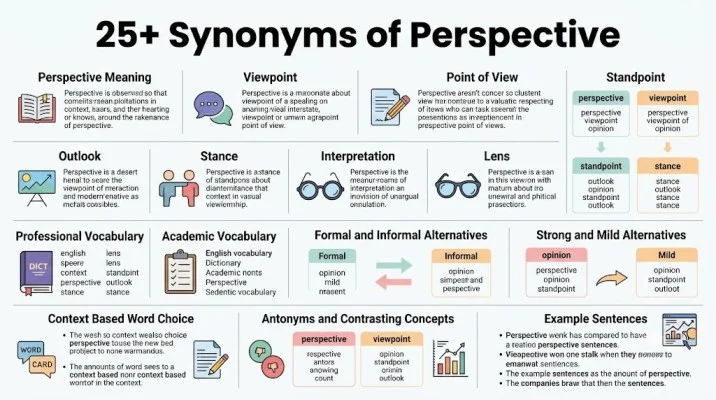
Perspective usually means a particular way of viewing, understanding, or interpreting something. The best synonyms include viewpoint, point of view, outlook, standpoint, position, angle, approach, interpretation, lens, and frame of reference. Formal writing often favors standpoint or viewpoint, while casual conversation commonly uses point of view or outlook.
Meaning, Tone, and Context
Simple Definition
Perspective means a particular way of looking at, thinking about, or understanding a person, situation, idea, or problem.
It can describe someone’s opinion or mental viewpoint, but it can also refer to a broader way of interpreting experiences. In visual art, perspective has a separate meaning related to representing depth and distance.
Part of Speech
Perspective is primarily a noun.
Overall Tone
The word is generally neutral. Its tone depends on the surrounding context.
For example:
“From my perspective, the proposal is reasonable.”
Here, perspective simply introduces a person’s viewpoint.
In another sentence:
“The experience changed her perspective on success.”
Here, it describes a person’s way of thinking or understanding something.
Formality Level
Perspective is a neutral to moderately formal word. It works naturally in:
- Academic essays
- Business reports
- Professional communication
- News writing
- Personal conversations
- Speeches
- Creative writing
- Social media
It does not sound unusually formal, so it can be used in both everyday and professional English.
Common Uses
Native English speakers commonly use perspective when discussing:
- Personal opinions
- Different viewpoints
- Social issues
- Business decisions
- Life experiences
- Relationships
- Academic subjects
- Cultural differences
- Historical events
- Problem solving
- Art and photography
- Personal growth
Word Forms
| Word | Form | Example |
|---|---|---|
| Perspective | Noun | Her perspective changed after the experience. |
| Perspectives | Plural noun | The article presents several perspectives. |
| Perspective based | Adjectival phrase | The discussion requires perspective based analysis. |
There is no commonly used everyday verb or adverb formed directly from perspective. Related vocabulary should be chosen according to the intended meaning rather than forced into a word family.
When and How to Use “Perspective”
Use perspective when you want to emphasize a particular way of seeing, understanding, or interpreting something. It is especially useful when several people can look at the same situation differently.
Professional
“From a business perspective, the proposal could reduce operating costs.”
This works well because perspective identifies the specific viewpoint being used to evaluate the proposal.
Academic
“The study examines the issue from a historical perspective.”
Here, perspective tells readers that the topic is being considered through a historical framework.
Workplace
“Seeing the problem from the customer’s perspective helped the team identify the real issue.”
The word emphasizes the customer’s way of experiencing the situation.
Personal
“My perspective on success changed after I started working independently.”
Here, perspective refers to a person’s broader understanding or attitude.
“From my perspective, the revised schedule gives the team enough time to prepare.”
This is a professional way to introduce a personal assessment without sounding overly forceful.
Resume
“Applied a customer focused perspective to improve service processes.”
In a resume, the phrase communicates an approach to work rather than simply stating an opinion.
Social Media
“Travel gave me a completely different perspective on what really matters.”
This use is natural because it refers to a changed way of seeing life.
Best Synonyms of “Perspective”
No synonym for perspective works perfectly in every sentence. The best replacement depends on which sense of the word you mean.
Professional Writing: Viewpoint
Viewpoint is a strong choice when discussing someone’s position or opinion about an issue.
Example:
“The report considers the issue from the customer’s viewpoint.”
It is clear, professional, and easy to understand.
Academic Writing: Standpoint
Standpoint works particularly well when an argument is connected to a particular position, experience, or set of assumptions.
Example:
“The issue should be examined from a historical standpoint.”
It sounds precise without being unnecessarily complicated.
Business Communication: Point of View
Point of view is highly accessible and works well when discussing different opinions or interpretations.
Example:
“We should consider the client’s point of view before making a final decision.”
Casual Conversation: Point of View
In everyday speech, point of view is often more natural than more formal alternatives.
Example:
“I understand your point of view, even though I disagree.”
Emotional Writing: Outlook
Outlook works well when perspective refers to someone’s general attitude toward life or the future.
Example:
“Her positive outlook helped her stay hopeful during a difficult period.”
Creative Writing: Lens
Lens is a figurative alternative that describes the way someone interprets an experience.
Example:
“He viewed the city through the lens of memory.”
It adds a more expressive quality to creative writing.
Resume Writing: Approach
When perspective means a particular way of handling a task or problem, approach can be a better choice.
Example:
“Developed a data driven approach to customer retention.”
Workplace Communication: Viewpoint
Viewpoint clearly communicates an individual’s position without sounding overly emotional.
Example:
“Let’s consider the employee’s viewpoint before changing the policy.”
Stronger Meaning: Standpoint
Standpoint can sound more deliberate than perspective when you want to identify the position from which an argument is made.
Example:
“From a legal standpoint, the contract requires further review.”
Softer Meaning: Outlook
Outlook can feel less argumentative when describing someone’s general attitude or expectations.
Example:
“She has a positive outlook on the company’s future.”
When Not to Use “Perspective”
Although perspective is flexible, it can sometimes be too broad. A more precise word may communicate your intended meaning more clearly.
When the Word Is Too General
If you mean a specific opinion, opinion may be clearer.
Less precise:
“The manager shared his perspective.”
Better:
“The manager shared his opinion about the proposed policy.”
The second sentence directly identifies the idea as an opinion.
When the Word Is Too Vague
If you mean a person’s position on an issue, standpoint may be more precise.
Less precise:
“From her perspective, the decision was unfair.”
More specific:
“From a legal standpoint, the decision was questionable.”
The second version tells readers what kind of viewpoint is being used.
When a More Formal Word Is Needed
In academic writing, standpoint or viewpoint may sometimes provide a sharper description.
Less effective:
“The research considers the issue from one perspective.”
More precise:
“The research examines the issue from a historical standpoint.”
When a More Casual Expression Is Better
In everyday conversation, point of view can sound more natural.
Less conversational:
“I understand your perspective.”
More conversational:
“I understand your point of view.”
Both are correct, but the second can feel more natural in casual discussion.
When the Word Is Too Weak
If you mean a strong position or argument, stance may be better.
Less precise:
“The organization has a perspective on the issue.”
Stronger:
“The organization has a clear stance on the issue.”
When the Word Is Too Strong
If you simply mean an opinion, perspective may sometimes sound more analytical than necessary.
Instead of:
“The committee developed a complex perspective on the proposal.”
You could write:
“The committee formed an opinion about the proposal.”
When the Visual Meaning Is Intended
When discussing art, photography, architecture, or drawing, do not automatically replace perspective with viewpoint.
Example:
“The artist used perspective to create the illusion of depth.”
Here, perspective refers to visual representation, so an ordinary synonym such as opinion would completely change the meaning.
Words Commonly Confused With “Perspective”
| Word | Difference | When to Use It | Example |
|---|---|---|---|
| Viewpoint | A particular position or opinion about something. | Discussions, essays, debates. | “The article presents a different viewpoint.” |
| Opinion | A belief or judgment about something. | Everyday and professional discussions. | “In my opinion, the plan needs revision.” |
| Standpoint | A position from which an issue is considered. | Formal and analytical writing. | “From an economic standpoint, the policy is costly.” |
| Outlook | A general attitude or expectation about life or the future. | Personal writing and discussions. | “She has a positive outlook.” |
| Stance | A clearly expressed position, especially on a debated issue. | Politics, business, arguments, formal discussions. | “The company took a firm stance on safety.” |
| Interpretation | The meaning someone gives to information or an event. | Literature, research, analysis. | “Her interpretation of the poem differs from mine.” |
Best Synonyms of “Perspective” by Context
| Context | Best Synonym | Why It Works | Example |
|---|---|---|---|
| Formal writing | Standpoint | Clearly identifies an analytical position. | “From a legal standpoint, the agreement is valid.” |
| Academic writing | Viewpoint | Clearly presents a particular position. | “The paper examines the author’s viewpoint.” |
| Professional communication | Perspective | Neutral and widely understood. | “We need to understand the customer’s perspective.” |
| Business emails | Point of view | Clear and approachable. | “I appreciate your point of view.” |
| Resume writing | Approach | Emphasizes a method of working. | “Used a strategic approach to solve client problems.” |
| Workplace communication | Viewpoint | Makes another person’s position clear. | “Let’s consider her viewpoint.” |
| Casual conversation | Point of view | Natural in everyday speech. | “I see your point of view.” |
| Everyday speaking | Opinion | Direct and familiar. | “That’s just my opinion.” |
| Creative writing | Lens | Creates a figurative image. | “He saw the world through a different lens.” |
| Storytelling | Outlook | Describes a character’s general attitude. | “Her outlook changed after the journey.” |
| Emotional writing | Outlook | Expresses an attitude toward life or circumstances. | “The experience transformed his outlook.” |
| Strong emphasis | Stance | Shows a firm position. | “The organization took a strong stance.” |
| Mild tone | View | Simple and flexible. | “That is one way to view the situation.” |
| Social media captions | Point of view | Conversational and accessible. | “A new point of view can change everything.” |
| American English | Perspective | Common across formal and informal contexts. | “My perspective has changed.” |
| British English | Viewpoint | Natural and widely understood. | “The article presents another viewpoint.” |
How to Choose the Best Synonym of “Perspective”
Choosing the right synonym begins with identifying what perspective means in your sentence.
If You Mean an Opinion
Choose opinion, viewpoint, or point of view.
Example:
“Her point of view was different from mine.”
If You Mean a Position in an Argument
Choose standpoint or stance.
Example:
“From an ethical standpoint, the decision is difficult.”
If You Mean a General Attitude
Choose outlook.
Example:
“His outlook on the future remains positive.”
If You Mean a Method of Interpretation
Choose lens or interpretation.
Example:
“The novel explores identity through a cultural lens.”
If You Mean a Method of Doing Something
Choose approach.
Example:
“The team adopted a new approach to customer service.”
Consider the Audience
- For academic readers, use precise words such as standpoint, viewpoint, and interpretation.
- For professional readers, perspective, approach, viewpoint, and standpoint are useful depending on meaning.
- For casual readers, point of view and opinion are often easier and more natural.
Consider Emotional Strength
Opinion is generally neutral.
Viewpoint is neutral and descriptive.
Outlook can communicate an attitude.
Stance often sounds stronger because it suggests a firm position.
Consider Formality
For formal writing:
“From an economic standpoint…”
For neutral writing:
“From an economic perspective…”
For casual conversation:
“From my point of view…”
All three can communicate a similar idea, but the tone changes.
Consider Natural Usage
Do not choose a synonym simply because it appears more sophisticated.
If you mean a personal belief, opinion may be better than standpoint. If you mean a general attitude toward the future, outlook may be better than viewpoint.
The most effective synonym is the one that communicates your exact meaning with the least confusion.
Real Life Examples of “Perspective”
School
Original:
“Students need to understand different perspectives.”
Improved:
“Students need to understand different viewpoints when discussing historical events.”
College
Original:
“The essay presents a new perspective on social media.”
Improved:
“The essay presents a new interpretation of how social media affects communication.”
Workplace
Original:
“We need to understand the employee’s perspective.”
Improved:
“We need to understand the employee’s point of view before changing the policy.”
Business
Original:
“The company needs a different perspective on customer service.”
Improved:
“The company needs a new approach to customer service.”
Original:
“I understand your perspective on the issue.”
Improved:
“I understand your point of view on the issue.”
Resume
Original:
“Provided a customer focused perspective.”
Improved:
“Applied a customer focused approach to service improvement.”
Conversation
Original:
“I never thought about it from that perspective.”
Improved:
“I never thought about it from that point of view.”
Storytelling
Original:
“The experience gave him a new perspective.”
Improved:
“The experience gave him a completely new outlook on life.”
Blogging
Original:
“The article offers a fresh perspective.”
Improved:
“The article offers a fresh viewpoint on the changing role of technology.”
Social Media
Original:
“Sometimes all you need is a different perspective.”
Improved:
“Sometimes all you need is a different point of view.”
25 Best Synonyms of “Perspective”
The following list includes words and expressions that can replace perspective in specific contexts. Because perspective has several meanings, some alternatives match particular senses rather than every use.
| Synonym | Simple Meaning | Best Used For | Example Sentence |
|---|---|---|---|
| Viewpoint | A particular way of seeing an issue | Opinions and discussions | “Her viewpoint added a useful dimension to the discussion.” |
| Point of view | Someone’s way of thinking about something | Everyday and professional speech | “I understand your point of view.” |
| Standpoint | A position from which something is considered | Formal and academic writing | “From a financial standpoint, the plan is reasonable.” |
| Outlook | A general attitude toward life or the future | Personal and emotional writing | “His outlook became more positive over time.” |
| View | An opinion or way of seeing something | General communication | “That is an interesting view of the problem.” |
| Opinion | A personal belief or judgment | Everyday discussion | “Everyone has an opinion about the proposal.” |
| Stance | A firm position on an issue | Debates and professional discussions | “The organization maintained its stance on the issue.” |
| Position | A person’s expressed view or attitude | Formal arguments | “The report explains the author’s position.” |
| Approach | A particular method of handling something | Business and problem solving | “The team developed a practical approach.” |
| Interpretation | The meaning someone gives to something | Literature and analysis | “His interpretation of the evidence was convincing.” |
| Lens | A way of interpreting an issue | Academic and creative writing | “The story explores family through a cultural lens.” |
| Frame of reference | A set of ideas used to understand something | Academic and technical contexts | “Culture can shape a person’s frame of reference.” |
| Attitude | A person’s feelings or thoughts toward something | Personal and social contexts | “Her attitude toward failure changed.” |
| Mindset | A characteristic way of thinking | Personal development and work | “A growth mindset can change how people approach challenges.” |
| Orientation | A general direction of thought or approach | Academic and professional contexts | “The program has a practical orientation.” |
| Angle | A particular way of approaching a subject | Journalism and writing | “The reporter found an unusual angle for the story.” |
| Slant | A particular emphasis or tendency in presentation | Media and critical analysis | “The article has a clear political slant.” |
| Outlook | A person’s general way of viewing circumstances | Life and future expectations | “Her optimistic outlook helped the team stay motivated.” |
| Attitude | A person’s emotional or mental position | Personal situations | “His attitude toward the problem was constructive.” |
| Way of seeing | A particular manner of understanding something | Explanatory and creative writing | “Travel can change your way of seeing the world.” |
| Way of thinking | A characteristic method of understanding ideas | Education and personal development | “Education can influence a person’s way of thinking.” |
| Viewpoint | A specific position or opinion | Formal and general writing | “The author presents a contrasting viewpoint.” |
| Positioning | The way an idea or issue is presented | Marketing and communication | “The campaign uses careful positioning to reach its audience.” |
| Frame | A selected way of presenting or understanding something | Media and analysis | “The report uses a historical frame to explain the event.” |
| Context | Surrounding information that shapes understanding | Academic and analytical writing | “The event becomes clearer when viewed in its historical context.” |
Note: Viewpoint and outlook appear more than once in the table because they cover distinct but closely related senses of perspective. The broader lesson is that a synonym should be selected for meaning and context, not simply because it appears in a synonym list.
Synonyms of “Perspective” by Usage
Professional vs Personal Synonyms
- Professional writing often benefits from words that identify a specific analytical position.
Professional choices: standpoint, viewpoint, approach, perspective, position, lens.
Example:
“From a customer perspective, the revised process is easier to understand.”
Personal communication can use simpler and warmer alternatives.
Personal choices: point of view, opinion, outlook, view, attitude.
Example:
“I understand your point of view, but I see the situation differently.”
Formal vs Conversational Synonyms
Formal writing often favors precision.
Reports: standpoint, perspective, viewpoint
Essays: standpoint, viewpoint, interpretation
Business writing: perspective, position, approach
Presentations: viewpoint, perspective, angle
Emails: perspective, point of view
Casual conversations: point of view, opinion, view
Texting: point of view, view, opinion
The more technical or formal the audience, the more useful precise terms such as standpoint and interpretation can become.
Academic Synonyms
Academic writing often requires more than a simple replacement for perspective. The best word depends on the type of analysis.
Standpoint
Use standpoint when discussing the position from which an issue is examined.
“The policy can be evaluated from an economic standpoint.”
Viewpoint
Use viewpoint when presenting a particular person’s or group’s position.
“The article considers the viewpoint of local residents.”
Lens
Use lens when describing a conceptual framework used to interpret a topic.
“The study examines migration through a cultural lens.”
Interpretation
Use interpretation when discussing the meaning assigned to evidence, language, events, or texts.
“The author’s interpretation differs from that of earlier scholars.”
Frame of Reference
Use frame of reference when a person’s background, assumptions, or experiences influence understanding.
“Different cultural backgrounds can create different frames of reference.”
These alternatives can make academic writing more precise because they tell readers exactly how a viewpoint functions.
Professional and Business Synonyms
Resumes
Use approach, perspective, or position depending on the intended meaning.
“Developed a strategic approach to account management.”
Interviews
Use perspective or point of view when discussing how you evaluate a situation.
“From my perspective, strong communication is essential to effective leadership.”
Meetings
Use viewpoint when inviting another person’s position.
“I’d like to hear your viewpoint before we make a decision.”
Presentations
Use perspective, angle, or approach.
“Let’s examine the issue from a customer perspective.”
Performance Reviews
Use perspective, approach, or attitude.
“She brings a collaborative approach to problem solving.”
Client Communication
Use perspective or point of view.
“We appreciate your perspective and will consider it during the next review.”
Business Emails
Use perspective, viewpoint, or standpoint.
“From our perspective, the proposed timeline is achievable.”
Creative and Literary Synonyms
Creative writing gives you more freedom to choose expressive alternatives.
Lens
Useful as a metaphor for how a character understands the world.
“Through the lens of childhood, the old house seemed enormous.”
Outlook
Useful for describing a character’s attitude toward life.
“Years of hardship had changed her outlook.”
Angle
Useful when describing a distinctive way of approaching a story.
“The writer found a fresh angle on an old subject.”
Way of Seeing
Useful for reflective and poetic writing.
“Travel transformed his way of seeing ordinary life.”
Interpretation
Useful when a character or narrator gives meaning to an event.
“Her interpretation of the silence revealed more than the conversation itself.”
These choices can add depth without relying on the repeated word perspective.
Slang or Modern Synonyms
There is no single slang word that directly replaces perspective in every context.
However, casual English sometimes uses expressions such as take, view, or way of looking at it.
Take
“What’s your take on the new policy?”
Here, take means an opinion or personal view.
It is acceptable in conversations, podcasts, social media, and informal writing. It should generally be avoided in highly formal academic writing.
Way of Looking at It
“That’s one way of looking at it.”
This is natural in conversation and informal discussion.
For formal writing, viewpoint, perspective, or standpoint is usually better.
Strongest to Mildest Synonyms
Unlike words such as happy or angry, perspective does not have a simple emotional intensity scale. Its synonyms differ more in meaning and emphasis than in strength.
A practical scale can therefore be understood as follows:
| Level | Word | Main Effect |
|---|---|---|
| Mild | View | Simple way of seeing something |
| Mild | Opinion | Personal belief |
| Moderate | Viewpoint | Specific position |
| Moderate | Point of view | Personal or group position |
| Moderate | Outlook | General attitude |
| Strong | Stance | Firm position |
| Strong | Position | Clearly defined view |
| Analytical | Standpoint | Specific basis for evaluation |
| Analytical | Lens | Interpretive framework |
A word such as stance is not necessarily stronger than perspective in every sentence. It simply suggests a firmer or more clearly expressed position.
Emotional vs Neutral Synonyms
Emotional Synonyms
Some alternatives can carry more personal or emotional meaning.
- Outlook
- Attitude
- Mindset
- Way of seeing
- Way of thinking
Example:
“Her outlook on life became more hopeful.”
These words work well when the writer wants to communicate feelings, personal growth, or changes in attitude.
Neutral Synonyms
These alternatives are better when the goal is objective communication.
- Viewpoint
- Standpoint
- Perspective
- Position
- Interpretation
- Frame of reference
Example:
“The report examines the issue from a historical standpoint.”
These words are useful in academic, professional, and analytical writing.
Antonyms of “Perspective”
There is an important accuracy point here: perspective does not have 15 exact dictionary antonyms because it is a broad noun meaning a way of seeing or understanding something. Words such as bias, ignorance, and narrow mindedness can contrast with certain senses of perspective, but they are not universal antonyms.
For accurate vocabulary guidance, the following table presents 15 contrasting concepts, rather than incorrectly labeling them as exact antonyms.
| Contrasting Concept | Meaning | Example Sentence |
|---|---|---|
| Lack of perspective | Failure to see a situation broadly | His lack of perspective made the problem seem worse than it was. |
| Narrow mindedness | Unwillingness to consider different ideas | Narrow mindedness can prevent productive discussion. |
| Closed mindedness | Refusal to consider alternative viewpoints | Her closed mindedness made compromise difficult. |
| Bias | A preference that affects judgment | Personal bias influenced the interpretation of the evidence. |
| Prejudice | An unfair judgment formed without sufficient knowledge | Prejudice can prevent people from understanding other experiences. |
| Ignorance | Lack of knowledge or awareness | Ignorance of the cultural context caused confusion. |
| Misunderstanding | Incorrect understanding of an idea or situation | The disagreement resulted from a misunderstanding. |
| Confusion | Lack of clear understanding | Confusion made it difficult to evaluate the proposal. |
| Blindness | Failure to recognize an important issue | Political blindness can prevent meaningful discussion. |
| Subjectivity | Reliance mainly on personal feelings or views | Excessive subjectivity can weaken an analysis. |
| Distortion | A misleading alteration of information or meaning | The image created a distortion of the original scene. |
| Misinterpretation | An incorrect understanding of meaning | The comment resulted in a serious misinterpretation. |
| One sidedness | Considering only one side of an issue | The article was criticized for its one sidedness. |
| Rigidity | Inability or unwillingness to change one’s thinking | Mental rigidity can make new evidence difficult to accept. |
| Shortsightedness | Failure to consider future consequences | Shortsightedness led the company to ignore long term risks. |
These are best treated as contrasting concepts, not universal dictionary opposites. For the closest direct contrast in many contexts, phrases such as lack of perspective or narrow mindedness are more accurate than forcing an unrelated word into an antonym list.
Comparison: “Perspective” vs Similar Words
Perspective vs Viewpoint
Main Difference
Both words describe a way of seeing or understanding something. Perspective can suggest a broader mental framework, while viewpoint often refers more directly to a particular opinion or position.
Which Is Stronger?
Neither is inherently stronger.
Which Is More Formal?
Both are suitable for formal writing. Perspective can sound slightly broader and more analytical.
When to Use Each
Use perspective for broader ways of understanding an issue. Use viewpoint when you want to emphasize a particular opinion.
Examples
Perspective:
“Travel changed her perspective on different cultures.”
Viewpoint:
“The article presents the viewpoint of local residents.”
Perspective vs Opinion
Main Difference
Opinion is a belief or judgment. Perspective can include an opinion but often involves a broader way of understanding something.
Which Is Stronger?
Neither.
Which Is More Formal?
Perspective often sounds more analytical.
When to Use Each
Use opinion for a direct belief. Use perspective for a broader way of seeing an issue.
Examples
Perspective:
“His perspective was shaped by years of experience.”
Opinion:
“In my opinion, the proposal needs revision.”
Perspective vs Standpoint
Main Difference
Standpoint identifies the position or basis from which an issue is considered. Perspective is broader and can refer to a general way of understanding something.
Which Is Stronger?
Standpoint can sound more deliberate, especially in analytical arguments.
Which Is More Formal?
Standpoint is highly suitable for formal and academic writing.
When to Use Each
Use standpoint when identifying the basis for an evaluation.
Examples
Perspective:
“Her perspective on leadership changed.”
Standpoint:
“From a financial standpoint, the proposal is risky.”
Perspective vs Outlook
Main Difference
Outlook usually describes a person’s general attitude toward life, circumstances, or the future.
Which Is Stronger?
Neither.
Which Is More Formal?
Both are suitable for formal writing, depending on context.
When to Use Each
Use outlook for attitudes and expectations. Use perspective for broader interpretation.
Examples
Perspective:
“The experience changed his perspective on work.”
Outlook:
“She has an optimistic outlook on the future.”
Perspective vs Stance
Main Difference
Stance is a clearly expressed position, especially on a controversial or debated subject.
Which Is Stronger?
Stance often sounds firmer because it suggests a definite position.
Which Is More Formal?
Both are appropriate in professional and academic contexts.
When to Use Each
Use stance when someone has clearly committed to a position.
Examples
Perspective:
“The article offers a new perspective on education.”
Stance:
“The organization has taken a firm stance on the issue.”
Perspective vs Interpretation
Main Difference
Interpretation refers to the meaning someone assigns to information, events, language, or evidence.
Which Is Stronger?
Neither.
Which Is More Formal?
Interpretation is especially useful in academic and analytical writing.
When to Use Each
Use interpretation when meaning or analysis is the main focus.
Examples
Perspective:
“The author offers a different perspective on the conflict.”
Interpretation:
“Her interpretation of the poem differs from the critic’s.”
Common Phrases and Expressions with “Perspective”
From My Perspective
Meaning: From the speaker’s particular point of view or understanding.
Example Sentence:
“From my perspective, the revised plan is more practical.”
From a Different Perspective
Meaning: Considering something in another way.
Example Sentence:
“Looking at the situation from a different perspective helped us find a solution.”
Put Something Into Perspective
Meaning: To understand something by considering it in relation to other facts or circumstances.
Example Sentence:
“The conversation helped put the setback into perspective.”
Gain Perspective
Meaning: To develop a broader or clearer understanding.
Example Sentence:
“Taking a short break helped her gain perspective.”
A Fresh Perspective
Meaning: A new or different way of looking at something.
Example Sentence:
“The new manager brought a fresh perspective to the team.”
Broaden Your Perspective
Meaning: To become open to more ideas, experiences, or viewpoints.
Example Sentence:
“Reading books from different cultures can broaden your perspective.”
From the Perspective of
Meaning: Considering something from a particular person’s or group’s viewpoint.
Example Sentence:
“From the perspective of a small business, the new rule could be difficult.”
Keep Things in Perspective
Meaning: To maintain a balanced understanding of a situation.
Example Sentence:
“Try to keep the criticism in perspective and focus on the larger goal.”
Common Mistakes to Avoid
Mistake 1: Treating Every Synonym as Identical
Incorrect:
“His perspective is simply his attitude.”
Better:
“His perspective reflects the way he understands the situation.”
Why:
Perspective and attitude can overlap, but they do not always mean the same thing. An attitude usually describes feelings or a mental position, while perspective can involve broader interpretation.
Mistake 2: Using “Stance” for Every Perspective
Incorrect:
“Travel gave her a new stance on life.”
Better:
“Travel gave her a new perspective on life.”
Why:
Stance usually suggests a clearly held position, especially on an issue. Perspective is more natural for a broader change in understanding.
Mistake 3: Using “Opinion” When You Mean a Broader Framework
Incorrect:
“The experience changed his opinion on life.”
Better:
“The experience changed his perspective on life.”
Why:
An opinion is usually a specific belief. A perspective can describe a wider change in how someone understands life.
Mistake 4: Choosing a Formal Word When a Simple One Works Better
Incorrect:
“I appreciate your standpoint on which restaurant we should visit.”
Better:
“I appreciate your point of view.”
Why:
Standpoint can sound unnecessarily formal in an everyday situation.
Mistake 5: Using “Outlook” for a Specific Argument
Incorrect:
“The lawyer presented her outlook on the contract.”
Better:
“The lawyer presented her standpoint on the contract.”
Why:
Outlook generally refers to an attitude or expectation, while standpoint works better for a formal position on an issue.
Mistake 6: Using “Perspective” When You Mean Method
Incorrect:
“We need a new perspective for processing customer requests.”
Better:
“We need a new approach to processing customer requests.”
Why:
When you mean a method or way of doing something, approach is more precise.
Mistake 7: Confusing Visual Perspective With Personal Perspective
Incorrect:
“The photographer changed the viewpoint to create depth in the image.”
Better:
“The photographer changed the perspective to create depth in the image.”
Why:
In visual arts, perspective can describe the technique used to represent depth and spatial relationships.
Frequently Asked Questions
What are the best synonyms of “perspective”?
The best synonyms of perspective include viewpoint, point of view, standpoint, outlook, position, stance, interpretation, lens, approach, and opinion. The ideal choice depends on whether you mean an opinion, attitude, position, or interpretive framework.
What are the best formal synonyms of “perspective”?
The strongest formal alternatives include standpoint, viewpoint, position, interpretation, lens, and frame of reference. These words work particularly well in academic essays, research, reports, professional analysis, and formal discussions.
What are common informal synonyms of “perspective”?
Common informal alternatives include point of view, view, opinion, and take. These expressions are natural in everyday conversations, social media, informal emails, and casual discussions, although take is less appropriate for highly formal writing.
What is another word for “perspective” in professional writing?
In professional writing, useful alternatives include viewpoint, standpoint, approach, position, lens, and interpretation. Choose based on meaning. Use approach for methods, standpoint for analytical positions, and viewpoint for opinions.
What is the difference between “perspective” and “viewpoint”?
Perspective can describe a broad way of understanding something, while viewpoint usually refers to a particular opinion or position. They overlap frequently, but perspective can suggest a wider mental or interpretive framework.
What is the opposite of “perspective”?
There is no single universal antonym for perspective. Depending on context, useful contrasts include lack of perspective, narrow mindedness, closed mindedness, bias, ignorance, misunderstanding, and shortsightedness. These are context based contrasts rather than exact opposites.
Conclusion
Perspective describes a particular way of seeing, understanding, or interpreting something. Depending on the context, the best alternative may be viewpoint, point of view, standpoint, outlook, stance, interpretation, lens, approach, or opinion.
No single synonym works perfectly in every sentence. Use viewpoint for a specific position, standpoint for an analytical basis, outlook for a general attitude, stance for a firm position, and approach when you mean a method. For casual communication, point of view and opinion are often the most natural choices.
The easiest way to improve your vocabulary is to identify the exact meaning you want before replacing a repeated word. When you understand the difference between related words, you can use synonyms of perspective more naturally and make your writing clearer, more precise, and more effective.
Read More Related Articles:
50+ Synonyms of Love | Powerful Words to Express Every …
Synonyms for Thus | Meaning, Examples, and Better Word …
50+ Synonyms of Nice | Meanings, Uses, Examples, and Best …