Writers often notice the same problem after finishing an email, essay, resume, or blog post: the word use appears in nearly every paragraph. Because it works in so many situations, it is easy to repeat without realizing how much it affects the quality and precision of your writing. Learning the synonyms of use can help you describe actions more specifically and make your sentences sound more natural.
The best alternative depends on what you mean. You might employ a method, utilize a resource, apply a skill, operate equipment, consume a product, or practice a technique. Understanding these differences helps you choose a word that matches your meaning, audience, and level of formality instead of replacing use with a synonym that does not quite fit.
What Are the Best Synonyms of “Use”?
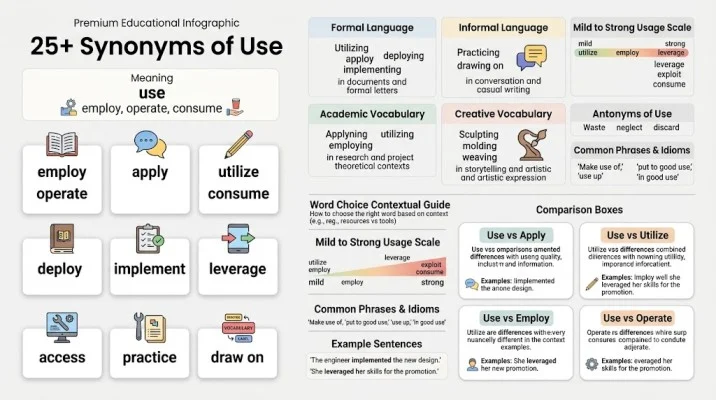
The best synonyms of use depend on its meaning. For formal writing, utilize, employ, and apply can work well. Professional writing often favors employ, deploy, and leverage. Casual English commonly uses handle, operate, or simply use, while academic writing often benefits from apply and employ. For consumption, consume is more precise.
Meaning, Tone, and Context
Simple Definition
Use generally means to do something with a person, object, method, resource, skill, or idea for a particular purpose. The exact meaning changes according to context.
For example, you can use a computer, use a strategy, use your knowledge, use a product, use someone’s advice, or use your time. These examples all involve putting something into action or benefiting from it, but the more precise synonym may differ in each case.
Part of Speech
Use can function as both a verb and a noun.
As a verb, it describes the action of putting something into action or taking advantage of something.
Example:
“She uses a digital calendar to organize her schedule.”
As a noun, use refers to the purpose, function, or act of using something.
Example:
“This tool has several practical uses.”
Overall Tone
Use has a neutral tone. It is neither strongly positive nor negative in most everyday contexts.
However, context can change its emotional meaning. For example, “use your time wisely” sounds positive, while “use someone for personal gain” can suggest manipulation.
Formality Level
Use is neutral and highly versatile. It is appropriate in:
- Everyday conversation
- Academic writing
- Professional communication
- Business emails
- Resumes
- Technical writing
- Social media
- Creative writing
Because it is so common, writers sometimes choose a more precise synonym when they want to make a sentence more specific.
Common Uses
Native English speakers commonly use use when talking about:
- Tools
- Technology
- Methods
- Skills
- Knowledge
- Resources
- Information
- Products
- Time
- Money
- Language
- Strategies
- Equipment
- Opportunities
- Services
Word Forms
| Form | Example |
|---|---|
| Verb | “We use this software every day.” |
| Noun | “The tool has many uses.” |
| Past tense | “She used the new system yesterday.” |
| Present participle | “They are using the equipment.” |
| Third person | “He uses the app regularly.” |
| Related noun | “The proper use of resources matters.” |
| Adjective form | “This is a useful tool.” |
| Opposite idea | “Avoid, misuse, or leave unused,” depending on context |
When and How to Use “Use”
Use is the safest general choice when you want to describe putting something into action without emphasizing a more specific aspect of the action.
The word works especially well when the object or method is already clear from context.
Professional
“Employees use the company platform to submit weekly reports.”
Academic
“Researchers use statistical methods to evaluate the results.”
Workplace
“Please use the updated template for your presentation.”
Personal
“I use this notebook to keep track of my goals.”
“Please use the attached form when submitting your request.”
Resume
“Used customer feedback to improve service processes.”
Social Media
“I use this simple routine to stay organized throughout the week.”
In each example, use is grammatically correct. However, a more specific synonym may sometimes communicate the action more precisely.
Best Synonyms of “Use”
No synonym of use works perfectly in every sentence because the word covers several different meanings. The best alternative depends on whether you mean putting something into action, applying a method, operating equipment, consuming something, taking advantage of an opportunity, or benefiting from a resource.
Professional Writing: Employ
Employ is a strong professional alternative when you mean using a method, technique, strategy, system, or resource for a particular purpose.
Example:
“The company employs advanced analytics to identify customer trends.”
It sounds polished without being excessively formal.
Academic Writing: Apply
Apply is especially useful when discussing knowledge, principles, theories, methods, or techniques.
Example:
“Students can apply these principles to real world problems.”
It is often more precise than use because it suggests putting knowledge or a method into practice.
Business Communication: Deploy
Deploy works well when an organization puts technology, resources, systems, or strategies into active operation.
Example:
“The company plans to deploy a new security system next quarter.”
It is particularly effective in business and technology contexts.
Casual Conversation: Handle
Handle can replace use when talking about operating or dealing with a physical object or situation.
Example:
“Do you know how to handle this camera?”
It sounds natural in everyday speech, although it does not replace use in every context.
Emotional Writing: Draw On
Draw on is useful when you mean relying on personal experience, memories, knowledge, or emotions.
Example:
“The author drew on her childhood experiences when writing the novel.”
It adds a more expressive meaning than the general word use.
Creative Writing: Employ
Employ can describe deliberately using a technique, image, style, or literary device.
Example:
“The writer employs vivid imagery to create a tense atmosphere.”
Resume Writing: Leverage
Leverage is common in professional and business contexts when describing how someone uses skills, experience, data, technology, or resources to achieve a result.
Example:
“Leveraged customer insights to improve marketing performance.”
Use it when there is a clear connection between the resource and the outcome.
Workplace Communication: Utilize
Utilize can be appropriate when emphasizing the practical use of an available resource, although plain use is often more natural.
Example:
“Employees can utilize the new scheduling system to manage shifts.”
For most ordinary sentences, however, “use the new scheduling system” is simpler and more direct.
Stronger Meaning: Exploit
Exploit can mean to use something fully or effectively, but it often carries a negative meaning when referring to people or vulnerable situations.
Example:
“The company exploited a gap in the market.”
Use this word carefully because its emotional meaning can be much stronger than use.
Softer or More Specific Meaning: Apply
Apply is a useful choice when you want a precise but neutral alternative to use.
Example:
“Apply the recommended method to solve the problem.”
It sounds clear and professional without adding unnecessary intensity.
When Not to Use “Use”
Although use is correct in many situations, it can sometimes be too broad. A more specific verb can tell the reader exactly what happened.
When “Use” Is Too General
Consider:
“The engineer used the machine.”
This sentence is correct, but it does not explain what the engineer did with it.
A more precise version is:
“The engineer operated the machine.”
Why it is better:
Operate specifically describes controlling or running equipment.
When “Use” Is Too Vague
Consider:
“The researcher used the data.”
A clearer alternative is:
“The researcher analyzed the data.”
Why it is better:
Analyze explains the actual action performed on the data.
When “Use” Is Too Weak
Consider:
“The company used a new strategy.”
If the company actively introduced the strategy into its operations, a stronger choice may be:
“The company implemented a new strategy.”
Why it is better:
Implemented communicates that the strategy was put into practical operation.
When “Use” Is Too Informal
The word itself is not normally informal, but a specialized context may call for more technical vocabulary.
Instead of:
“The laboratory used a special process.”
You might write:
“The laboratory employed a specialized process.”
Why it is better:
Employ can sound more suitable for formal technical descriptions.
When “Use” Could Suggest Consumption
Consider:
“She used all the medicine.”
If you mean that she consumed it, a clearer sentence is:
“She consumed the medication as directed.”
Why it is better:
Consume specifically indicates taking something into the body or using something up.
When “Use” Could Sound Manipulative
Consider:
“He used his friend to get the job.”
This sentence suggests taking advantage of the friend.
If that negative meaning is intended, exploited may be more direct:
“He exploited his friendship to get the job.”
If the negative meaning is not intended, rewrite the sentence to explain the relationship more clearly.
When “Use” Is Too Broad for Technology
Instead of:
“The team used the software.”
You could write:
“The team operated the software to create the final report.”
The second sentence provides more information about how the software was used.
Words Commonly Confused With “Use”
Employ
Difference:
Employ can mean use, especially when referring to methods, resources, or strategies. It can also mean hiring someone.
When to Use It:
Use it when describing a deliberate professional or formal action.
Example:
“The researchers employed several testing methods.”
Utilize
Difference:
Utilize generally means put something to practical use. It is often treated as a formal synonym of use, although it is not automatically better.
When to Use It:
Use it when the context emphasizes practical application or making use of an available resource.
Example:
“The team utilized the available data to improve its forecast.”
Apply
Difference:
Apply means putting knowledge, rules, methods, or techniques into practice. It is more specific than use in these situations.
When to Use It:
Use it for skills, theories, principles, methods, and techniques.
Example:
“Students applied the formula to solve the problem.”
Operate
Difference:
Operate means control or run a machine, system, or piece of equipment.
When to Use It:
Use it when the focus is on controlling equipment or technology.
Example:
“Only trained staff may operate the equipment.”
Consume
Difference:
Consume means eat, drink, spend, or use something up.
When to Use It:
Use it when something is being used as a resource or taken into the body.
Example:
“The device consumes less electricity than older models.”
Practice
Difference:
Practice means repeatedly performing an activity or skill to improve it.
When to Use It:
Use it for skills, behaviors, sports, music, and professional activities.
Example:
“She practices speaking English every evening.”
Best Synonyms of “Use” by Context
| Context | Best Synonym | Why It Works | Example |
|---|---|---|---|
| Formal writing | Employ | Sounds polished and deliberate. | “The study employs several analytical methods.” |
| Academic writing | Apply | Clearly describes putting knowledge into practice. | “Students apply the theory to practical cases.” |
| Professional communication | Employ | Works naturally with methods and resources. | “We employ a structured review process.” |
| Business emails | Utilize | Can emphasize available resources. | “Please utilize the updated form.” |
| Resume writing | Leverage | Connects skills or resources with results. | “Leveraged data to improve campaign performance.” |
| Workplace communication | Implement | Shows that a method or plan was put into action. | “The team implemented a new workflow.” |
| Casual conversation | Use | Simple and natural. | “I use this app every day.” |
| Everyday speaking | Handle | Useful for physical objects or situations. | “Can you handle this equipment?” |
| Creative writing | Employ | Describes deliberate writing techniques. | “The author employs symbolism throughout the story.” |
| Storytelling | Draw on | Shows reliance on memories or experience. | “She drew on her memories for the story.” |
| Emotional writing | Draw on | Works well with personal experiences. | “He drew on his emotions when writing the poem.” |
| Strong emphasis | Exploit | Suggests fully using an opportunity or resource, sometimes negatively. | “The company exploited a market opportunity.” |
| Mild tone | Use | Neutral and uncomplicated. | “Use the information as a general guide.” |
| Social media captions | Use | Short, familiar, and conversational. | “Use these tips to improve your routine.” |
| American English | Use | Most natural general choice. | “Use the form provided.” |
| British English | Use | Also standard and natural. | “Use the information carefully.” |
How to Choose the Best Synonym of “Use”
The best synonym is not necessarily the most sophisticated word. It is the word that communicates your exact meaning with the least confusion.
1. Identify What Is Being Used
First, look at the object.
- If you are talking about a machine, operate may be better.
- If you are talking about a method, employ or apply may work.
- If you are talking about food, medicine, or resources being consumed, consume may be more precise.
2. Identify the Action
Ask what the person actually did.
- “She used the computer” is broad.
- “She operated the computer system” focuses on control.
- “She accessed the database” focuses on obtaining information.
- “She analyzed the data” focuses on examining information.
3. Consider Your Audience
- For everyday readers, plain use is often the best choice.
- For academic readers, apply, employ, and utilize may fit specific contexts.
- For business audiences, deploy, implement, and leverage can communicate specialized actions more clearly.
4. Match the Tone
- Use neutral vocabulary when you want to sound straightforward.
- Use formal alternatives when writing a report or academic paper.
- Use expressive alternatives in creative writing.
5. Consider Emotional Strength
Use is usually neutral.
Leverage suggests strategic advantage.
Exploit can suggest aggressive or unfair use.
Draw on suggests drawing value from experience or knowledge.
The emotional meaning matters just as much as the dictionary meaning.
6. Think About the Purpose
A resume needs concise action words.
An academic essay needs precision.
A business email needs clarity.
A conversation usually benefits from simplicity.
Choose the word that serves the purpose instead of choosing the longest or most formal synonym.
7. Prefer Natural English
A synonym should never be inserted merely to avoid repetition.
For example:
“Please utilize this pen.”
is grammatically possible, but
“Please use this pen.”
is more natural because there is no special reason to replace use.
Good vocabulary is about precision, not unnecessary complexity.
Real Life Examples of “Use”
School
Basic:
“Students use online resources to complete their assignments.”
Improved:
“Students access online resources to complete their assignments.”
Here, access is more specific because the students are obtaining information from digital sources.
College
Basic:
“Students use what they learned in class.”
Improved:
“Students apply what they learned in class.”
Apply clearly communicates the movement from theory to practical action.
Workplace
Basic:
“The team used a new system.”
Improved:
“The team implemented a new system.”
Implemented shows that the system was introduced and put into operation.
Business
Basic:
“The company used customer data.”
Improved:
“The company analyzed customer data to identify buying patterns.”
The second version tells readers what the company actually did.
Basic:
“Please use the attached document.”
Improved:
“Please complete the attached document and return it by Friday.”
The improved version is stronger because it states the required action.
Resume
Basic:
“Used data to improve sales.”
Improved:
“Leveraged customer data to improve sales performance.”
The stronger verb connects the resource to the professional outcome.
Conversation
Basic:
“I use this app every day.”
This sentence is already natural. There is no need for a more complicated synonym.
Storytelling
Basic:
“She used her childhood memories in the novel.”
Improved:
“She drew on her childhood memories when writing the novel.”
Draw on creates a more natural literary expression.
Blogging
Basic:
“Use examples to make your article easier to understand.”
Improved:
“Include practical examples to make your article easier to understand.”
Include is better because the action involves adding examples to the article.
Social Media
Basic:
“Use these tips to improve your writing.”
Improved:
“Try these tips to make your writing clearer.”
In a casual social media context, try can sound more friendly and inviting.
25 Best Synonyms of “Use”
Because use has several meanings, these synonyms are organized according to the particular sense they can express. Not every word below replaces use in every sentence.
| Synonym | Simple Meaning | Best Used For | Example Sentence |
|---|---|---|---|
| Employ | Put something into action | Methods, strategies, resources | “The company employs several methods to improve quality.” |
| Utilize | Make practical use of something | Resources, systems, tools | “The team utilized the available space efficiently.” |
| Apply | Put knowledge or a method into practice | Skills, rules, theories | “She applied her training to the new position.” |
| Operate | Control or run something | Machines, equipment, systems | “Only trained workers can operate the machine.” |
| Consume | Use something up | Food, energy, resources | “The new appliance consumes less electricity.” |
| Practice | Repeatedly perform an activity | Skills, sports, techniques | “He practices speaking English every morning.” |
| Deploy | Put into active use | Technology, resources, strategies | “The company deployed new security software.” |
| Leverage | Use something to gain an advantage | Skills, data, resources | “She leveraged her experience to solve the problem.” |
| Implement | Put a plan into action | Policies, systems, strategies | “The school implemented a new attendance policy.” |
| Exploit | Make full use of something | Opportunities, resources | “The business exploited an opening in the market.” |
| Access | Obtain or reach something | Information, systems, files | “Employees can access the database remotely.” |
| Handle | Deal with or control something | Equipment, tasks, situations | “She knows how to handle the new equipment.” |
| Exercise | Put a right, power, or judgment into action | Rights, authority, caution | “Employees may exercise their legal rights.” |
| Adopt | Take and begin using something | Methods, systems, approaches | “The company adopted a more flexible schedule.” |
| Implement | Put an established plan into operation | Policies, procedures | “Managers implemented the updated procedure.” |
| Incorporate | Include something as part of a whole | Ideas, features, methods | “The designer incorporated user feedback into the product.” |
| Engage | Become involved with or operate something | Systems, audiences, activities | “Users engage with the platform every day.” |
| Draw on | Rely on a source for help or material | Experience, knowledge, memories | “The speaker drew on years of experience.” |
| Rely on | Depend on something for support | Information, people, resources | “The team relies on accurate data.” |
| Take advantage of | Make beneficial use of an opportunity | Opportunities, resources | “She took advantage of the training program.” |
| Exploit | Make effective use of an opportunity or resource | Opportunities, technology | “The company exploited new technology to improve efficiency.” |
| Access | Reach or obtain something | Digital information, services | “Customers can access their accounts online.” |
| Administer | Apply or manage something in an organized way | Medicine, programs, procedures | “Nurses administer medication according to instructions.” |
| Manipulate | Control or influence something skillfully | Objects, data, systems | “The technician manipulated the settings to improve performance.” |
| Wield | Use power, influence, or a tool effectively | Authority, influence, weapons, tools | “The leader wielded considerable influence over the committee.” |
Synonyms of “Use” by Usage
Professional vs Personal Synonyms
Professional writing benefits from specific verbs that explain what was actually done.
For example:
“Used customer data to improve sales.”
can become:
“Analyzed customer data to improve sales.”
or:
“Leveraged customer data to improve sales.”
The first version describes the analytical action. The second emphasizes strategic value.
Personal communication usually does not require such specialized vocabulary.
“I use this app to track my workouts.”
is already natural. Replacing use with utilize would make the sentence unnecessarily formal.
Formal vs Conversational Synonyms
Formal writing often favors words such as employ, apply, implement, and deploy when their meanings fit.
Conversational English usually prefers use, try, handle, or work with.
For example:
Formal:
“The researchers employed a controlled testing procedure.”
Conversational:
“We used a simple test.”
Both sentences are correct, but the vocabulary matches different audiences.
Academic Synonyms
Academic writing benefits from precise verbs rather than unnecessarily complicated words.
Apply is useful when students or researchers put theories and principles into practice.
Employ works well when researchers deliberately use methods or techniques.
Analyze is better when the action involves examining information.
Assess works when someone evaluates quality or performance.
Implement is useful when a policy, method, or plan is put into operation.
For example:
Weak:
“The researchers used a new method.”
More precise:
“The researchers employed a new method.”
Even better when the action is known:
“The researchers applied the new method to the collected data.”
Professional and Business Synonyms
Resumes
Use strong, specific verbs such as:
Leveraged
“Leveraged customer data to improve retention.”
Implemented
“Implemented a streamlined onboarding process.”
Deployed
“Deployed automated reporting tools.”
Applied
“Applied analytical skills to identify operational problems.”
Avoid replacing every occurrence of use with a formal synonym. The strongest resume writing describes an action and its result.
Interviews
In interviews, natural language usually works better than overly formal vocabulary.
Instead of:
“I utilized my leadership skills.”
say:
“I used my leadership skills to guide the team through the transition.”
The second version sounds more conversational and specific.
Meetings
Use discuss, review, analyze, apply, or consider when those words accurately describe the action.
Instead of:
“We used the report.”
say:
“We reviewed the report before making the decision.”
Presentations
Use include, present, highlight, or illustrate when describing presentation content.
Instead of:
“I used several charts.”
say:
“I included several charts to illustrate the results.”
Performance Reviews
Use precise action verbs such as applied, leveraged, implemented, and developed.
Instead of:
“Used technical knowledge to solve problems.”
say:
“Applied technical knowledge to resolve complex issues.”
Client Communication
Use straightforward language.
“Please use the attached form.”
is usually better than:
“Please utilize the attached form.”
Clarity matters more than formality.
Business Emails
Use use unless another verb communicates the action more precisely.
“Please use the updated template.”
is concise and professional.
Creative and Literary Synonyms
Creative writing often benefits from verbs that reveal how something is being used.
Draw on works well for memories and experiences.
“The novelist drew on her childhood memories.”
Employ works for literary techniques.
“The poet employs repetition to create rhythm.”
Wield can create a stronger image when someone uses influence or power.
“The politician wielded considerable influence.”
Manipulate can suggest deliberate control.
“The character manipulated the situation to his advantage.”
These alternatives add meaning instead of simply replacing a common word.
Slang or Modern Synonyms
There is no single modern slang word that universally replaces use.
Informal expressions such as work with, go with, or make use of may appear in conversational English, but they do not always have exactly the same meaning.
For example:
“I work with this software every day.”
sounds natural when discussing regular interaction with software.
In formal writing, however, use, operate, or employ may be more appropriate depending on the context.
Strongest to Mildest Synonyms
The intensity of use changes considerably depending on the synonym.
Mild
Use
Neutral and general.
Example:
“Use the information carefully.”
Moderate
Employ
Suggests deliberate use.
Example:
“The researcher employed a standard method.”
Strong
Leverage
Suggests using something strategically for an advantage.
Example:
“The company leveraged its customer data.”
Very Strong
Exploit
Can suggest taking full advantage of something and may carry a negative meaning.
Example:
“The company exploited a weakness in the system.”
The strongest word is not automatically the best word. Choose it only when the intended meaning supports that level of intensity.
Emotional vs Neutral Synonyms
Emotional Synonyms
Some alternatives carry stronger emotional or evaluative meanings.
Exploit can suggest unfair or aggressive use.
Manipulate can imply controlling something or someone for a particular purpose.
Wield can create a sense of power.
Take advantage of can be positive or negative depending on context.
Examples:
“The company exploited vulnerable workers.”
“The leader wielded considerable influence.”
“He took advantage of the training opportunity.”
Neutral Synonyms
These words usually communicate information without adding strong emotion.
Use
Apply
Employ
Operate
Access
Implement
Examples:
“The students applied the formula.”
“The technician operated the equipment.”
“The company implemented the policy.”
Neutral vocabulary is generally safer for academic and professional writing because it reduces unintended emotional meaning.
Antonyms of “Use”
Because use has several meanings, its opposite depends on the context. The following words represent genuine opposite ideas in specific senses of the verb or noun.
| Antonym | Meaning | Example Sentence |
|---|---|---|
| Avoid | Choose not to use or engage with something | “She avoids using unnecessary software.” |
| Abandon | Stop using or supporting something | “The company abandoned the old system.” |
| Ignore | Give no attention to something | “He ignored the instructions.” |
| Neglect | Fail to give proper attention or care | “They neglected the equipment for years.” |
| Discard | Throw something away instead of using it | “She discarded the damaged material.” |
| Reject | Refuse to accept or use something | “The committee rejected the proposed method.” |
| Waste | Use something carelessly or inefficiently | “Do not waste valuable resources.” |
| Conserve | Avoid unnecessary consumption | “The program encourages people to conserve energy.” |
| Preserve | Keep something protected rather than consuming or changing it | “The museum preserves historical materials.” |
| Save | Keep something for future use | “She saved the remaining supplies.” |
| Misuse | Use something incorrectly | “Employees must not misuse company equipment.” |
| Discontinue | Stop using something regularly | “The company discontinued the outdated software.” |
| Leave unused | Keep something without putting it into action | “The equipment remained unused for months.” |
| Withhold | Keep something from being given or used | “The organization withheld the funds temporarily.” |
| Forbid | Officially prevent use | “The policy forbids employees from using personal devices.” |
Comparison: “Use” vs Similar Words
Use vs Employ
Main Difference
Use is the broad, everyday term. Employ often suggests deliberate use of a method, strategy, resource, or technique.
Which Is Stronger?
Neither is inherently stronger. Employ can sound more deliberate or formal.
Which Is More Formal?
Employ is generally more formal.
When to Use Each
Use use for general communication.
Use employ in academic, professional, or technical writing when it fits naturally.
Examples
Use:
“The team used a new strategy.”
Employ:
“The team employed a new strategy.”
Use vs Utilize
Main Difference
Both can mean putting something into practical use. Use is more common and usually more direct, while utilize can emphasize practical use of an available resource.
Which Is Stronger?
Neither is inherently stronger.
Which Is More Formal?
Utilize generally sounds more formal.
When to Use Each
Use use for ordinary situations.
Use utilize when the context genuinely benefits from emphasizing practical resource use.
Examples
Use:
“We used the available space.”
Utilize:
“We utilized the available space efficiently.”
Use vs Apply
Main Difference
Apply specifically suggests putting knowledge, rules, principles, or methods into practice.
Which Is Stronger?
Apply is more specific than use in these contexts.
Which Is More Formal?
Apply is common in both professional and academic writing.
When to Use Each
Use apply for theories, skills, methods, principles, and techniques.
Examples
Use:
“She used her training.”
Apply:
“She applied her training to the new role.”
Use vs Operate
Main Difference
Operate means controlling or running equipment, machinery, or systems.
Which Is Stronger?
Neither is stronger. Operate is more precise.
Which Is More Formal?
Both are acceptable, but operate is more technical.
When to Use Each
Use operate when the focus is on controlling machinery or equipment.
Examples
Use:
“He used the machine.”
Operate:
“He operated the machine.”
Use vs Consume
Main Difference
Consume means use something up, eat, drink, or spend a resource.
Which Is Stronger?
Consume is more specific.
Which Is More Formal?
Both can be formal, depending on context.
When to Use Each
Use consume for food, energy, fuel, materials, time, and resources when the idea of being used up matters.
Examples
Use:
“The device uses electricity.”
Consume:
“The device consumes very little electricity.”
Use vs Practice
Main Difference
Practice means repeatedly performing an activity or skill, usually to improve ability.
Which Is Stronger?
Neither is stronger. They describe different actions.
Which Is More Formal?
Both are neutral.
When to Use Each
Use practice for skills, sports, music, language, and professional activities.
Examples
Use:
“She uses English at work.”
Practice:
“She practices English every evening.”
Common Phrases and Expressions with “Use”
Use Your Time Wisely
Meaning
This expression means managing your time in a productive or sensible way.
Example Sentence
“Use your time wisely while preparing for the final exam.”
Make Use Of
Meaning
This means to use something that is available, often with an emphasis on benefiting from it.
Example Sentence
“We made use of the extra space to create a study area.”
Put To Good Use
Meaning
This means using something in a productive or beneficial way.
Example Sentence
“Her technical skills were put to good use during the project.”
Be Of Use
Meaning
This means to be helpful or useful.
Example Sentence
“I hope this information will be of use to your team.”
Have No Use For
Meaning
This means to have no practical need or desire for something.
Example Sentence
“I have no use for an outdated device.”
Use As
Meaning
This expression means treating or using something for a particular purpose.
Example Sentence
“They use the spare room as a home office.”
Use Up
Meaning
This means consuming all of something so that none remains.
Example Sentence
“We used up the last of the printer paper.”
Use To
Meaning
In the expression “be used to,” it means being familiar or accustomed to something.
Example Sentence
“She is used to working under pressure.”
Common Mistakes to Avoid
Mistake 1: Replacing Every “Use” With “Utilize”
Incorrect
“Please utilize this pen to sign the form.”
Better
“Please use this pen to sign the form.”
Why
Use is shorter and more natural. A formal synonym does not automatically improve a sentence.
Mistake 2: Confusing “Use” With “Apply”
Incorrect
“She applied her phone to check the message.”
Better
“She used her phone to check the message.”
Why
Apply is appropriate for methods, knowledge, rules, and techniques, not ordinary physical objects such as phones.
Mistake 3: Using “Operate” Too Broadly
Incorrect
“I operate social media every day.”
Better
“I use social media every day.”
Why
Operate usually focuses on controlling equipment, machinery, or systems. It is not a general replacement for use.
Mistake 4: Using an Informal Expression in Formal Writing
Incorrect
“The researchers worked with a bunch of data.”
Better
“The researchers analyzed a large amount of data.”
Why
The improved sentence is more precise and appropriate for academic writing.
Mistake 5: Choosing an Overly Dramatic Synonym
Incorrect
“The student exploited a calculator to solve the equation.”
Better
“The student used a calculator to solve the equation.”
Why
Exploit often suggests taking full advantage of something and can carry a negative meaning. It is inappropriate for an ordinary calculator action.
Mistake 6: Ignoring the Meaning of “Consume”
Incorrect
“The old machine uses a lot of electricity.”
Better
“The old machine consumes a lot of electricity.”
Why
Both sentences can be correct, but consume emphasizes the amount of electricity being used.
Mistake 7: Repeating “Use” Without Explaining the Action
Incorrect
“The company used data, used software, and used new methods.”
Better
“The company analyzed data, implemented new software, and applied new methods.”
Why
The revised version tells readers exactly what the company did and creates more precise, engaging writing.
Frequently Asked Questions
What are the best synonyms of “use”?
The best synonyms of use include employ, apply, utilize, operate, consume, deploy, implement, and leverage. The best choice depends on whether you mean applying a method, controlling equipment, or consuming a resource.
What are the best formal synonyms of “use”?
The strongest formal alternatives include employ, apply, utilize, deploy, and implement. However, formal writing does not require replacing use every time. Plain language is often clearer when no more precise verb is needed.
What are common informal synonyms of “use”?
Common conversational alternatives include use, try, work with, handle, and make use of, depending on the sentence. Everyday English usually favors simple wording rather than highly formal alternatives such as utilize.
What is another word for “use” in professional writing?
Professional alternatives include employ, apply, implement, deploy, and leverage. Choose according to meaning. For example, use apply for skills, implement for plans, deploy for technology, and leverage for strategic resources.
What is the difference between “use” and “utilize”?
Use is the broad, natural word for putting something into action. Utilize can emphasize practical use of an available resource, but it often adds formality without adding meaning, so use is frequently the better choice.
What is the opposite of “use”?
The opposite depends on context. Common opposites include avoid, abandon, discard, save, preserve, ignore, and leave unused. Misuse is different because it means using something incorrectly rather than not using it.
Conclusion
The word use is extremely flexible, which makes it useful in almost every area of English. However, its broad meaning can sometimes hide the exact action you want to describe. The best synonyms of use include employ, apply, operate, consume, implement, deploy, and leverage, but each one works in a different context.
For academic writing, apply and employ can provide greater precision. Professional writing may benefit from implement, deploy, or leverage, while everyday communication usually sounds best with the simple word use. Creative writing can benefit from alternatives such as draw on, wield, or employ when they express a more specific idea.
There is no need to replace every occurrence of use. Before choosing an alternative, identify the exact action, consider your audience, and select the simplest word that communicates the intended meaning clearly.
Read More Related Articles:
What Does OFC Mean| Complete Meaning, Origin, Usage …
What Does TBH Mean| Complete Meaning, Origin, Usage …