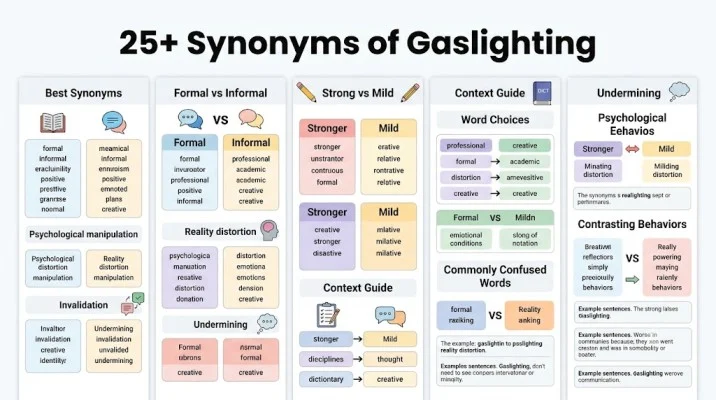
When someone repeatedly makes you doubt your memory, feelings, or understanding of what happened, choosing the right word can make a big difference. Synonyms of Gaslighting can help you describe these situations more precisely, but not every similar term carries the same meaning or emotional weight. Words such as manipulation, deception, invalidation, distortion, and psychological manipulation may overlap with gaslighting in certain contexts, yet each has its own use. Understanding these differences helps writers, students, professionals, and everyday speakers communicate sensitive situations without exaggerating or mislabeling them.
The term gaslighting has a specific meaning rooted in a pattern of psychological manipulation that causes someone to question their perception or judgment. This guide examines accurate alternatives, their meanings, tones, and practical uses. It also explains when a related word works better than Synonyms of Gaslighting, giving you clearer choices for conversations, writing, workplace communication, and everyday descriptions.
What Are the Best Synonyms of “Gaslighting”?
The best synonyms of gaslighting include psychological manipulation, reality distortion, emotional manipulation, deliberate deception, invalidation, denial, and undermining. In academic writing, psychological manipulation and reality distortion are useful. In everyday language, emotional manipulation or making someone doubt themselves may be clearer.
Meaning, Tone, and Context
Simple Definition
Gaslighting refers to a form of psychological manipulation in which a person repeatedly attempts to make someone question their own memory, perception, judgment, or understanding of events.
The term is often used when the manipulation is persistent and involves denying, twisting, minimizing, or reframing events in ways that cause another person to doubt their own experience.
Not every lie, disagreement, criticism, or mistake is gaslighting. The word is most useful when the behavior involves a pattern of manipulation that affects another person’s confidence in their perception or judgment.
Part of Speech
Gaslighting is commonly used as a noun or as a present participle form of the verb gaslight.
Examples:
Noun:
“She recognized the pattern of gaslighting.”
Verb:
“He tried to gaslight her by denying what had happened.”
Overall Tone
The word gaslighting has a strongly negative tone.
It describes behavior that can undermine another person’s confidence, perception, or sense of reality. Because the term carries a serious implication, writers should use it carefully and distinguish it from ordinary disagreement or accidental misunderstanding.
Formality Level
Gaslighting is generally considered neutral to moderately informal in everyday usage, but it is also widely used in journalism, psychology related discussions, workplace discussions, and academic writing.
In highly formal writing, especially when precision matters, terms such as psychological manipulation, reality distortion, emotional manipulation, or a detailed description of the behavior may be more appropriate.
Common Uses
Native English speakers commonly use gaslighting when discussing:
- Relationships
- Family conflicts
- Workplace behavior
- Emotional manipulation
- Psychological abuse
- Communication problems
- Social dynamics
- Public statements
- Media discussions
- Manipulative behavior
Word Forms
| Form | Example |
|---|---|
| Verb | gaslight |
| Present participle | gaslighting |
| Past tense | gaslighted |
| Related noun | gaslighting |
| Person performing the behavior | gaslighter |
When and How to Use “Gaslighting”
Use gaslighting when you need to describe a repeated or deliberate pattern of manipulation that causes someone to doubt their own perception, memory, judgment, or understanding.
The word should not automatically be used for every disagreement. A person remembering an event differently, making an honest mistake, or disagreeing about an opinion does not necessarily mean they are gaslighting someone.
Professional Context
“Repeatedly denying documented conversations can create a pattern that employees may describe as gaslighting.”
This wording is appropriate when discussing workplace communication while avoiding an unsupported accusation about someone’s intentions.
Academic Context
“Researchers may examine gaslighting as a form of interpersonal manipulation that can affect a person’s confidence in their own perceptions.”
This version uses a more analytical style.
Workplace Context
“Constantly dismissing an employee’s concerns without addressing the evidence can feel like gaslighting.”
The phrase can feel like is useful because it describes the experience without automatically claiming a proven motive.
Personal Context
“She felt that his repeated denial of events was a form of gaslighting.”
This is natural in personal communication.
Email Context
“I would like to clarify the timeline because the recent explanation does not match the records I have.”
This is often better than directly accusing someone of gaslighting in a professional email.
Resume Context
The word gaslighting is rarely appropriate on a conventional resume. A resume should describe measurable skills and professional responsibilities rather than personal accusations.
Instead of writing:
“I dealt with gaslighting at work.”
A professional document might say:
“Managed difficult workplace communication while maintaining accurate documentation and professional boundaries.”
Social Media Context
“Repeatedly denying someone’s documented experience can be a form of emotional manipulation.”
This wording may be clearer and more measured than simply labeling behavior as gaslighting.
Best Synonyms of “Gaslighting”
No synonym is identical to gaslighting in every context. The best alternative depends on the exact behavior you want to describe.
Professional Writing: Psychological Manipulation
Psychological manipulation is one of the strongest formal alternatives because it describes behavior intended to influence another person’s thoughts, feelings, or perceptions.
Example:
“The report examined patterns of psychological manipulation in interpersonal communication.”
Academic Writing: Reality Distortion
Reality distortion can work well when the focus is on attempts to alter another person’s understanding of events.
Example:
“The study discusses how repeated reality distortion may affect confidence in personal judgment.”
Business Communication: Undermining
Undermining is useful when someone’s actions gradually weaken another person’s confidence, credibility, or authority.
Example:
“Repeatedly dismissing her contributions began to undermine her confidence at work.”
Casual Conversation: Manipulation
Manipulation is broader and easier to understand in everyday conversation.
Example:
“I think he was manipulating her by making her doubt what she remembered.”
Emotional Writing: Emotional Manipulation
Emotional manipulation focuses on attempts to control someone’s emotions or responses.
Example:
“Constant guilt and denial can become forms of emotional manipulation.”
Creative Writing: Reality Distortion
For creative writing, reality distortion can create a strong sense of uncertainty without repeatedly using the word gaslighting.
Example:
“His calm denials slowly created a world in which she no longer trusted her own memories.”
Resume Writing: Undermining
If a professional context genuinely requires the idea, undermining is usually more appropriate than gaslighting.
Example:
“Addressed workplace behavior that undermined team confidence and communication.”
Workplace Communication: Invalidation
Invalidation works when someone dismisses another person’s feelings, concerns, or experiences as unreasonable or unimportant.
Example:
“Repeated invalidation of employee concerns can damage trust.”
Stronger Meaning: Psychological Manipulation
When you need a formal phrase emphasizing intentional influence over perception or thinking, psychological manipulation is more precise than simply saying someone was difficult or dishonest.
Softer Meaning: Dismissal
Dismissal is useful when the evidence does not establish deliberate manipulation and you only want to describe someone ignoring or minimizing a concern.
Example:
“Her concerns were met with repeated dismissal.”
When Not to Use “Gaslighting”
When You Mean an Ordinary Disagreement
A disagreement does not automatically qualify as gaslighting.
Less Precise:
“My friend disagreed with my memory, so she was gaslighting me.”
Better:
“My friend remembered the event differently.”
The second sentence describes the situation without assigning a serious label that may not fit.
When You Mean a Simple Lie
A lie and gaslighting are related but not identical.
Less Precise:
“He lied about where he had been, so he was gaslighting me.”
Better:
“He lied about where he had been.”
Gaslighting generally involves a broader pattern of manipulating another person’s confidence in their perception.
When You Mean Criticism
Negative feedback is not necessarily manipulation.
Less Precise:
“My manager criticized my report, so I was being gaslighted.”
Better:
“My manager criticized several parts of my report.”
The second statement avoids confusing criticism with psychological manipulation.
When the Behavior Is Only Vague
If you cannot identify what happened, gaslighting may be too general.
Less Precise:
“That conversation was gaslighting.”
Better:
“He repeatedly denied making statements that were documented in our previous emails.”
Specific language makes the claim easier to understand.
When You Need a Formal Academic Term
In academic writing, the word may sound less precise if the author does not explain the behavior.
Less Precise:
“The participant experienced gaslighting.”
Better:
“The participant reported repeated attempts to make them doubt their recollection of events.”
The second sentence explains the behavior directly.
When You Need a Softer Description
If intention has not been established, a softer term may be safer.
Less Precise:
“He deliberately gaslighted his colleague.”
Better:
“His repeated dismissal of his colleague’s concerns created confusion and mistrust.”
The revised version focuses on observable behavior rather than assuming intent.
When the Word Sounds Too Strong
Because gaslighting has a serious negative meaning, using it casually can make a statement sound exaggerated.
Less Precise:
“My friend forgot our conversation, so she gaslighted me.”
Better:
“My friend seems to remember our conversation differently.”
Words Commonly Confused With “Gaslighting”
Manipulation
Difference:
Manipulation is a broad term for influencing or controlling another person, sometimes unfairly. Gaslighting is a more specific type of manipulation involving a person’s confidence in their perception or memory.
When to Use It:
Use manipulation when the exact form of influence is broader than reality distortion.
Example:
“He used emotional manipulation to pressure her into agreeing.”
Deception
Difference:
Deception involves deliberately misleading someone. It does not necessarily involve making that person question their own memory or perception.
When to Use It:
Use deception when the central behavior is lying, hiding information, or misleading someone.
Example:
“The company was accused of deliberately using deception in its advertising.”
Invalidation
Difference:
Invalidation involves dismissing or rejecting someone’s feelings, concerns, experiences, or perspective. It may occur without an attempt to make someone doubt reality.
When to Use It:
Use invalidation when emotional dismissal is the main issue.
Example:
“Her concerns were met with repeated emotional invalidation.”
Denial
Difference:
Denial means refusing to acknowledge something. Gaslighting can involve denial, but repeated denial alone does not always constitute gaslighting.
When to Use It:
Use denial when someone simply refuses to admit or accept something.
Example:
“His denial of the conversation contradicted the written record.”
Undermining
Difference:
Undermining means weakening someone’s confidence, position, authority, or effectiveness. It may involve manipulation, but it does not necessarily involve reality distortion.
When to Use It:
Use undermining for workplace, social, or professional situations where someone’s credibility or confidence is being weakened.
Example:
“Repeated interruptions began undermining her authority during meetings.”
Emotional Manipulation
Difference:
Emotional manipulation specifically involves using feelings such as guilt, fear, shame, or affection to influence someone.
When to Use It:
Use this term when emotions are the primary tool of influence.
Example:
“He relied on emotional manipulation to make her feel responsible for his decisions.”
Best Synonyms of “Gaslighting” by Context
| Context | Best Synonym | Why It Works | Example |
|---|---|---|---|
| Formal writing | Psychological manipulation | Precise and professional | “The behavior involved psychological manipulation.” |
| Academic writing | Reality distortion | Focuses on altered perception | “The study examined reality distortion.” |
| Professional communication | Undermining | Fits workplace behavior | “The comments were undermining her credibility.” |
| Business emails | Dismissal | Measured and neutral | “Repeated dismissal of concerns affected communication.” |
| Resume writing | Undermining | Describes workplace impact professionally | “Addressed behavior that undermined team effectiveness.” |
| Workplace communication | Invalidation | Useful for dismissed concerns | “Employee concerns should not face repeated invalidation.” |
| Casual conversation | Manipulation | Familiar and broad | “That sounds like manipulation.” |
| Everyday speaking | Making someone doubt themselves | Very clear and accessible | “He kept making her doubt herself.” |
| Creative writing | Reality distortion | Creates a strong descriptive effect | “The repeated denials created a sense of reality distortion.” |
| Storytelling | Psychological manipulation | Explains the behavior clearly | “The story explores psychological manipulation.” |
| Emotional writing | Emotional manipulation | Highlights emotional control | “She recognized the emotional manipulation.” |
| Strong emphasis | Psychological manipulation | Clearly signals serious behavior | “The pattern involved sustained psychological manipulation.” |
| Mild tone | Dismissal | Avoids overstatement | “His response felt dismissive.” |
| Social media captions | Manipulation | Short and understandable | “Manipulation can make people question themselves.” |
| American English | Gaslighting | Commonly understood modern term | “The article discusses gaslighting in relationships.” |
How to Choose the Best Synonym of “Gaslighting”
1. Focus on the Exact Behavior
First identify what actually happened.
- If someone lied, deception may be enough.
- If someone dismissed feelings, invalidation may be more accurate.
- If someone repeatedly tried to make another person doubt their perception, gaslighting may be appropriate.
2. Consider Your Audience
- For general readers, manipulation is easy to understand.
- For academic readers, psychological manipulation or reality distortion may be more suitable.
- For workplace readers, undermining or dismissal can describe the behavior without sounding unnecessarily accusatory.
3. Consider Emotional Strength
Dismissal is relatively mild.
Manipulation is stronger.
Psychological manipulation communicates a more serious pattern.
Use the strongest word only when the facts support it.
4. Consider Your Writing Purpose
A personal story may benefit from gaslighting or emotional manipulation.
An academic essay may benefit from psychological manipulation.
A workplace report may benefit from describing the specific behavior rather than applying a psychological label.
5. Consider Formality
Use gaslighting in general discussion when the term is clearly understood.
Use psychological manipulation, reality distortion, or a specific behavioral description in formal contexts when precision matters.
6. Consider Natural Usage
A synonym should sound natural in the sentence.
For example:
“She experienced psychological manipulation.”
sounds more natural in a formal report than:
“She experienced a big deal of gaslighting.”
The goal is not to replace every occurrence of gaslighting. The goal is to communicate the intended meaning accurately.
Real Life Examples of “Gaslighting”
School
Original:
“The student felt that the repeated denial of documented events was confusing.”
Improved:
“The student described the repeated denials as a form of gaslighting.”
The term works when the context establishes a repeated pattern of reality distortion.
College
Original:
“The discussion involved attempts to make the participant question their memory.”
Improved:
“The discussion involved psychological manipulation that challenged the participant’s confidence in their memory.”
The second version is more suitable for academic writing.
Workplace
Original:
“The manager repeatedly dismissed the employee’s documented concerns.”
Improved:
“The manager’s repeated dismissal of documented concerns began undermining the employee’s confidence.”
The revised wording focuses on observable workplace effects.
Business
Original:
“The company denied information that had previously been provided.”
Improved:
“The conflicting statements created an impression of deception and damaged customer trust.”
This is more appropriate when discussing business communication.
Original:
“You’re gaslighting me about what happened in our meeting.”
Improved:
“Your description of the meeting does not match the written notes I have, so I would like to clarify the record.”
The revised email is more professional because it focuses on evidence.
Resume
Original:
“Experienced gaslighting at work.”
Improved:
“Maintained accurate documentation and professional communication during complex workplace situations.”
The revised version communicates a professional skill rather than making a personal accusation.
Conversation
Original:
“I think you’re gaslighting me.”
Alternative:
“I feel like you’re making me question what I remember.”
The second version may be clearer when the speaker wants to describe the experience rather than apply a label.
Storytelling
Original:
“His denials were confusing.”
Improved:
“His repeated denials slowly created a sense of reality distortion, leaving her uncertain about what she remembered.”
The revised version adds descriptive detail.
Blogging
Original:
“Gaslighting can affect relationships.”
Improved:
“Repeated psychological manipulation can damage trust and make healthy communication more difficult.”
The second version gives readers more specific information.
Social Media
Original:
“Gaslighting is bad.”
Improved:
“Repeatedly making someone doubt their own experiences can be a damaging form of emotional manipulation.”
The improved version explains the concept instead of relying on a broad statement.
25 Best Synonyms of “Gaslighting”
Because gaslighting is a specific form of manipulation, not every related word is an exact replacement. The following alternatives are selected because they can accurately describe gaslighting itself or a clearly defined part of the behavior.
| Synonym | Simple Meaning | Best Used For | Example Sentence |
|---|---|---|---|
| Psychological manipulation | Influencing someone’s thoughts or perceptions unfairly | Formal writing | “The behavior showed signs of psychological manipulation.” |
| Reality distortion | Altering or challenging someone’s understanding of events | Academic writing | “Repeated denials contributed to reality distortion.” |
| Emotional manipulation | Using emotions to influence another person | Relationships | “The conversation involved emotional manipulation.” |
| Manipulation | Unfairly influencing another person’s thoughts or actions | General use | “She recognized the pattern as manipulation.” |
| Undermining | Weakening someone’s confidence or credibility | Workplace writing | “His comments were undermining her confidence.” |
| Invalidation | Dismissing someone’s feelings or experiences | Emotional contexts | “Repeated invalidation damaged their communication.” |
| Denial | Refusing to acknowledge something | Specific incidents | “His denial contradicted the written evidence.” |
| Deception | Deliberately misleading someone | Formal and general writing | “The investigation uncovered deliberate deception.” |
| Misrepresentation | Presenting something inaccurately | Business and formal writing | “The statement was a serious misrepresentation of events.” |
| Distortion | Changing something so it appears different from reality | Academic writing | “The repeated distortion of facts created confusion.” |
| Dismissal | Treating a concern as unimportant or invalid | Workplace communication | “Her concerns received repeated dismissal.” |
| Discrediting | Trying to make someone appear unreliable | Professional contexts | “The campaign focused on discrediting his account.” |
| Belittling | Making someone feel unimportant or inferior | Personal communication | “Constant belittling can weaken a person’s confidence.” |
| Minimization | Making a problem seem less serious than it is | Emotional writing | “Her experience was met with repeated minimization.” |
| Psychological coercion | Pressuring someone through psychological means | Formal discussions | “The behavior raised concerns about psychological coercion.” |
| Emotional coercion | Using emotional pressure to control someone | Relationship discussions | “The threats created a pattern of emotional coercion.” |
| Misinformation | Giving false or inaccurate information | Public communication | “The repeated claims created confusion and misinformation.” |
| Reality manipulation | Attempting to reshape another person’s perception of events | Analytical writing | “The pattern involved repeated reality manipulation.” |
| Perceptual manipulation | Influencing how someone interprets experiences | Academic contexts | “The study explored perceptual manipulation.” |
| Credibility undermining | Weakening someone’s trustworthiness or authority | Workplace contexts | “The repeated accusations amounted to credibility undermining.” |
| Psychological undermining | Gradually weakening confidence or judgment | Formal writing | “The behavior resulted in psychological undermining.” |
| Emotional invalidation | Rejecting or dismissing someone’s emotional experience | Relationships | “Repeated emotional invalidation affected their trust.” |
| Interpersonal manipulation | Manipulating another person within a relationship | Academic and professional writing | “The article examines interpersonal manipulation.” |
| Manipulative denial | Using denial as a tool of manipulation | Specific examples | “The repeated statements appeared to involve manipulative denial.” |
Synonyms of “Gaslighting” by Usage
Professional vs Personal Synonyms
Professional contexts usually require careful, evidence based wording. Terms such as undermining, dismissal, discrediting, psychological manipulation, and misrepresentation can be more useful than making a direct accusation of gaslighting.
Personal conversations may use gaslighting, manipulation, emotional manipulation, or making someone doubt themselves because these expressions are easier to understand.
For professional communication, describe the behavior first and apply a label only when the context supports it.
Formal vs Conversational Synonyms
Reports
Use psychological manipulation, misrepresentation, or reality distortion.
Essays
Use psychological manipulation, reality distortion, invalidation, or interpersonal manipulation.
Business Writing
Use misrepresentation, deception, undermining, or dismissal.
Presentations
Use manipulation, psychological manipulation, or reality distortion, depending on the subject.
Emails
Describe the specific behavior instead of using an emotionally charged label.
Casual Conversations
Use gaslighting, manipulation, or making someone doubt themselves.
Texting
Simple language is usually best:
“That feels manipulative.”
or:
“You’re making me question what happened.”
Academic Synonyms
Academic writing benefits from precision. Gaslighting can be used, but it should be defined and supported by a clear description of the behavior.
Psychological Manipulation
This is useful when discussing attempts to influence another person’s thoughts, judgments, or perceptions.
Reality Distortion
This term focuses on how repeated manipulation can affect a person’s interpretation of events.
Interpersonal Manipulation
This phrase is useful when the discussion focuses on behavior between people.
Emotional Invalidation
Use this term when the main issue is dismissal of feelings or personal experiences.
Perceptual Manipulation
This can be appropriate when discussing attempts to influence how someone interprets an experience.
These alternatives can make academic writing more precise because they identify the specific aspect of the behavior being discussed.
Professional and Business Synonyms
Resumes
Avoid labeling workplace experiences as gaslighting on a resume. Instead, describe skills such as documentation, conflict resolution, communication, or maintaining professional boundaries.
Interviews
If discussing a difficult workplace experience, focus on what you did and what you learned.
Meetings
Use neutral descriptions such as dismissal, misrepresentation, or undermining when appropriate.
Presentations
Define gaslighting before using it if the audience may interpret the term broadly.
Performance Reviews
Describe observable behaviors rather than making unsupported psychological claims.
Client Communication
Use factual language such as:
“The information provided differs from the documentation available.”
This is more professional than directly accusing a client of gaslighting.
Business Emails
When conflict occurs, document facts, dates, records, and requested actions. Precise language is usually more effective than emotionally charged labels.
Creative and Literary Synonyms
Creative writing gives you more freedom to describe the experience rather than naming it directly.
Reality Distortion
Useful for creating uncertainty.
Psychological Manipulation
Useful for darker or analytical narratives.
Emotional Manipulation
Useful for relationship focused stories.
Undermining
Useful when a character’s confidence gradually decreases.
Invalidation
Useful for portraying repeated dismissal of feelings.
Example
Instead of:
“She was gaslighting him.”
A literary version could be:
“Each denial made him less certain of what he had seen, until even his clearest memories felt unreliable.”
This approach shows the effect rather than simply naming the behavior.
Slang or Modern Synonyms
There is no universally accepted slang word that perfectly replaces gaslighting.
In informal American English, people may use expressions such as:
Making someone doubt themselves
This is clear and conversational.
Messing with someone’s head
This is informal and can describe psychological manipulation, but it is broader than gaslighting.
Playing mind games
This expression is also broader and may describe manipulation that does not involve reality distortion.
These expressions are suitable for casual conversation but should generally be avoided in academic papers, formal reports, resumes, and professional documents.
Strongest to Mildest Synonyms
There is no universally fixed intensity scale because the words emphasize different aspects of manipulation. A practical scale can still help writers choose an appropriate level of force.
| Level | Useful Terms | General Effect |
|---|---|---|
| Mild | Dismissal, minimization | Describes reduced acknowledgment |
| Moderate | Invalidation, undermining | Highlights damage to confidence or feelings |
| Strong | Manipulation, emotional manipulation | Indicates deliberate influence |
| Very Strong | Psychological manipulation, reality distortion | Emphasizes serious influence over perception |
The strongest term is not always the best term. Accuracy matters more than intensity.
Emotional vs Neutral Synonyms
Emotional Synonyms
These words can carry stronger emotional weight:
- Gaslighting
- Emotional manipulation
- Belittling
- Invalidation
- Manipulation
- Making someone doubt themselves
They are useful in personal writing, relationship discussions, and emotional storytelling.
Neutral Synonyms
These alternatives are generally more measured:
- Dismissal
- Misrepresentation
- Deception
- Undermining
- Distortion
- Psychological manipulation
- Interpersonal manipulation
Use neutral language when writing reports, essays, workplace documents, or other situations where careful wording matters.
Antonyms of “Gaslighting”
Because gaslighting describes a pattern of manipulation rather than a simple physical or descriptive quality, it does not have 15 perfect dictionary opposites. The following terms represent genuine contrasting behaviors, especially behaviors based on honesty, acknowledgment, validation, and transparent communication.
| Antonym or Contrast | Meaning | Example Sentence |
|---|---|---|
| Honesty | Communicating truthfully | “She responded with honesty about what happened.” |
| Truthfulness | Commitment to accurate statements | “Truthfulness helped rebuild trust.” |
| Transparency | Openly sharing relevant information | “The manager encouraged transparency during the review.” |
| Validation | Recognizing another person’s feelings or experience | “Her response offered validation rather than dismissal.” |
| Acknowledgment | Accepting or recognizing something as real or valid | “His acknowledgment of the mistake improved communication.” |
| Accountability | Accepting responsibility for one’s actions | “Taking accountability helped resolve the conflict.” |
| Candor | Honest and direct communication | “She appreciated his candor during the discussion.” |
| Openness | Willingness to communicate honestly | “Their openness made the conversation easier.” |
| Empathy | Understanding another person’s feelings | “Empathy allowed them to discuss the disagreement respectfully.” |
| Respect | Treating another person’s perspective with consideration | “They handled the disagreement with mutual respect.” |
| Affirmation | Expressing support or confirmation | “Her affirmation helped restore his confidence.” |
| Reassurance | Providing confidence or comfort | “His reassurance helped reduce her uncertainty.” |
| Trust | Confidence in another person’s honesty or reliability | “Open communication strengthened their trust.” |
| Direct communication | Clearly expressing facts or concerns | “Direct communication prevented unnecessary confusion.” |
| Reality based communication | Discussing events according to available evidence | “Reality based communication helped both sides resolve the dispute.” |
Comparison: “Gaslighting” vs Similar Words
Gaslighting vs Manipulation
Main Difference
Manipulation is the broader concept. Gaslighting is a more specific form involving attempts to make someone doubt their perception, memory, or judgment.
Which Is Stronger?
Gaslighting is more specific, while manipulation covers a much wider range of behavior.
Which Is More Formal?
Psychological manipulation is more formal than the everyday word gaslighting.
When to Use Each
Use manipulation when the method is broad or unclear.
Use gaslighting when reality perception or personal judgment is specifically being undermined.
Examples
Gaslighting:
“He repeatedly denied events that she clearly remembered.”
Manipulation:
“He used guilt and pressure to influence her decision.”
Gaslighting vs Lying
Main Difference
Lying means intentionally giving false information. Gaslighting involves a broader pattern in which someone may use denial or false information to make another person question their own perception.
Which Is Stronger?
Gaslighting generally describes a more specific pattern.
Which Is More Formal?
Deception is often more suitable than either term in formal writing.
When to Use Each
Use lying when the central issue is a false statement.
Use gaslighting when repeated manipulation affects confidence in memory or perception.
Examples
Gaslighting:
“He repeatedly insisted the conversation never happened.”
Lying:
“He lied about where he had been.”
Gaslighting vs Invalidation
Main Difference
Invalidation involves dismissing feelings or experiences. Gaslighting can include invalidation but typically goes further by affecting confidence in one’s own perception.
Which Is Stronger?
Gaslighting usually carries a stronger implication.
Which Is More Formal?
Both can be used in formal discussions when clearly defined.
When to Use Each
Use invalidation when emotional dismissal is the main issue.
Examples
Gaslighting:
“She repeatedly denied events that were documented.”
Invalidation:
“He told her that her feelings were unreasonable.”
Gaslighting vs Denial
Main Difference
Denial is simply refusing to acknowledge something. Gaslighting can involve denial as part of a larger manipulative pattern.
Which Is Stronger?
Gaslighting is generally more specific and more serious.
Which Is More Formal?
Denial is neutral and broadly appropriate.
When to Use Each
Use denial when you can describe the refusal to acknowledge something without establishing a wider pattern.
Examples
Gaslighting:
“He repeatedly denied statements that appeared in the written record.”
Denial:
“His denial was inconsistent with the available evidence.”
Gaslighting vs Emotional Manipulation
Main Difference
Emotional manipulation uses feelings to influence someone. Gaslighting specifically concerns confidence in perception, memory, or judgment.
Which Is Stronger?
Neither is automatically stronger. They describe different mechanisms.
Which Is More Formal?
Emotional manipulation is often clearer in formal writing.
When to Use Each
Use emotional manipulation when guilt, fear, shame, affection, or other emotions are being used as tools of influence.
Examples
Gaslighting:
“He made her question whether the event had happened.”
Emotional manipulation:
“He used guilt to pressure her into changing her decision.”
Gaslighting vs Undermining
Main Difference
Undermining means weakening someone’s confidence, position, credibility, or authority. Gaslighting specifically concerns a person’s perception or judgment.
Which Is Stronger?
Gaslighting is more specific. Undermining can be subtle and may occur without reality distortion.
Which Is More Formal?
Undermining is often easier to use in professional writing.
When to Use Each
Use undermining when describing workplace or social behavior that weakens someone’s confidence or credibility.
Examples
Gaslighting:
“He repeatedly told her that she remembered the incident incorrectly.”
Undermining:
“His repeated criticism undermined her confidence during meetings.”
Common Phrases and Expressions with “Gaslighting”
Phrase: Gaslighting someone
Meaning:
Trying to make someone question their memory, perception, or judgment.
Example Sentence:
“Repeatedly denying documented events can be perceived as gaslighting someone.”
Phrase: A pattern of gaslighting
Meaning:
A repeated series of behaviors that undermine another person’s confidence in their perception.
Example Sentence:
“The writer described a pattern of gaslighting rather than a single disagreement.”
Phrase: Gaslighting behavior
Meaning:
Actions that may cause another person to question their own understanding of events.
Example Sentence:
“The article examines gaslighting behavior in interpersonal relationships.”
Phrase: Gaslighting tactics
Meaning:
Methods used to deny, distort, minimize, or manipulate another person’s understanding.
Example Sentence:
“The discussion focused on common gaslighting tactics.”
Phrase: Experience gaslighting
Meaning:
To experience behavior that causes someone to question their own perceptions or memories.
Example Sentence:
“Some people describe experiencing gaslighting in difficult relationships.”
Phrase: Accused of gaslighting
Meaning:
Being described by another person as engaging in gaslighting.
Example Sentence:
“The manager was accused of gaslighting employees during the dispute.”
Phrase: Recognize gaslighting
Meaning:
Identify a pattern of behavior that may undermine confidence in one’s perception.
Example Sentence:
“Learning to recognize gaslighting can help people describe unhealthy communication patterns.”
Phrase: Gaslighting in relationships
Meaning:
Gaslighting behavior occurring between romantic partners, friends, or family members.
Example Sentence:
“The article explores how gaslighting in relationships can affect communication.”
Common Mistakes to Avoid
1. Treating Every Disagreement as Gaslighting
Incorrect:
“My sister remembered the event differently, so she was gaslighting me.”
Better:
“My sister remembered the event differently from me.”
Why:
Different memories do not automatically establish manipulation.
2. Confusing Gaslighting With Lying
Incorrect:
“He lied once, so he was gaslighting me.”
Better:
“He lied about what happened.”
Why:
A lie can occur without the broader pattern associated with gaslighting.
3. Using Gaslighting in Formal Writing Without Explanation
Incorrect:
“The employee experienced gaslighting.”
Better:
“The employee reported repeated attempts to make them doubt their recollection of workplace events.”
Why:
The revised sentence explains the behavior and is easier to evaluate objectively.
4. Using Informal Language in Academic Writing
Incorrect:
“The speaker was messing with the participant’s head.”
Better:
“The speaker appeared to use psychological manipulation.”
Why:
The second version is more appropriate for academic analysis.
5. Choosing an Overly Dramatic Synonym
Incorrect:
“His disagreement was psychological coercion.”
Better:
“His disagreement reflected a different interpretation of the issue.”
Why:
Strong terminology should be supported by the behavior being described.
6. Repeating “Gaslighting” Too Often
Incorrect:
“The article discusses gaslighting. Gaslighting can affect communication, and gaslighting may damage trust.”
Better:
“The article discusses gaslighting, a form of psychological manipulation that can damage trust and communication.”
Why:
Using a precise related term improves readability without changing the meaning.
7. Using a Synonym With the Wrong Emotional Tone
Incorrect:
“Her manager’s response was manipulative” when the evidence only shows that the manager dismissed a concern.
Better:
“Her manager’s response was dismissive.”
Why:
Dismissive describes the observable behavior without automatically implying intentional manipulation.
Frequently Asked Questions
What is the meaning of gaslighting?
Gaslighting is a form of psychological manipulation in which someone repeatedly makes another person doubt their memory, perception, or understanding of events.
What is another word for gaslighting?
Depending on context, alternatives include manipulation, psychological manipulation, deception, denial, and reality distortion.
What is a gaslight synonym?
A close gaslight synonym is manipulate, although the exact replacement depends on whether you mean the verb or the broader behavior.
What are some synonyms for gaslighting?
Common alternatives include manipulation, deception, denial, reality distortion, and psychological manipulation.
Is there another name for gaslighting?
Yes. It can be described as psychological manipulation or reality manipulation, though these terms may have broader meanings.
What are gaslighting synonyms in everyday language?
Words such as manipulation, lying, denying, deceiving, and twisting the truth may describe related behavior, but they are not always exact equivalents.
Are “gas lighter synonyms” the same as gaslighting synonyms?
If you mean synonyms for the person or behavior associated with gaslighting, terms such as manipulator or deceiver may fit depending on the context.
What are the best synonyms of “gaslighting”?
The best synonyms of gaslighting include psychological manipulation, reality distortion, emotional manipulation, invalidation, undermining, deception, and manipulation. The most accurate choice depends on whether the focus is perception, emotions, denial, or credibility.
What are the best formal synonyms of “gaslighting”?
The strongest formal alternatives include psychological manipulation, reality distortion, interpersonal manipulation, perceptual manipulation, and misrepresentation. These terms can be more precise in academic, professional, or analytical writing when the specific behavior is explained.
What are common informal synonyms of “gaslighting”?
Common informal alternatives include manipulation, making someone doubt themselves, messing with someone’s head, and playing mind games. These expressions are easier to understand conversationally, but they do not all carry the exact meaning of gaslighting.
What is another word for “gaslighting” in professional writing?
In professional writing, psychological manipulation, undermining, dismissal, or misrepresentation may be more appropriate. The best term depends on the behavior, and describing specific actions is often more professional than applying a broad label.
What is the difference between “gaslighting” and “manipulation”?
Gaslighting is a specific form of manipulation involving a person’s perception, memory, or judgment. Manipulation is broader and can include emotional pressure, deception, guilt, persuasion, or other methods of influencing someone’s behavior.
What is the opposite of “gaslighting”?
There is no single perfect antonym for gaslighting, but contrasting behaviors include honesty, transparency, validation, acknowledgment, accountability, empathy, openness, and direct communication. These approaches recognize rather than undermine another person’s perception or experience.
Conclusion
Gaslighting describes a specific form of psychological manipulation that can cause someone to question their memory, perception, judgment, or understanding of events. Although related words such as manipulation, invalidation, denial, deception, undermining, and reality distortion overlap with the concept, each emphasizes a different part of the behavior.
The best synonyms of gaslighting depend on the context. Psychological manipulation works well in formal writing, reality distortion can suit academic analysis, undermining fits many workplace situations, and emotional manipulation is useful when feelings are being used to influence another person.
No synonym should be chosen simply because it sounds stronger. The most effective vocabulary identifies what actually happened, considers the audience, and matches the seriousness of the evidence. A useful vocabulary habit is to describe the specific behavior first, then choose the word that captures that behavior most accurately.
Read More Related Articles:
- Synonyms for Thus | Meaning, Examples, and Better Word …
- 50+ Synonyms of Nice | Meanings, Uses, Examples, and Best …