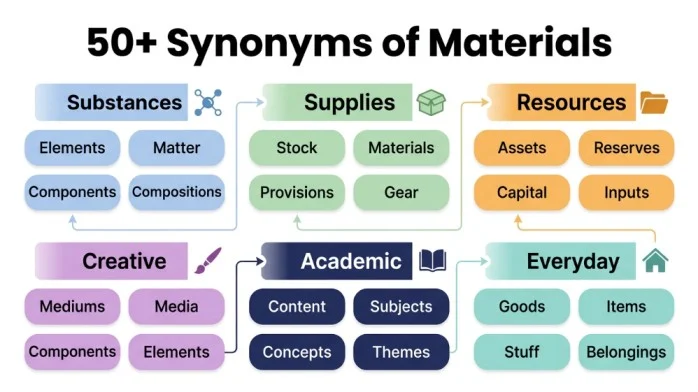
Materials are the building blocks behind countless ideas, products, projects, and everyday objects, but repeating the same word can make writing feel flat. Finding the right synonyms of materials can add precision, variety, and clarity while helping you describe physical substances, resources, supplies, or components more effectively. The best alternative depends on what you mean and the context in which you are writing.
You need a formal term for academic writing, a professional alternative for business content, or a simple word for everyday communication, choosing carefully can make your message stronger. This guide to synonyms of materials explores accurate alternatives, their meanings, differences, and practical examples so you can select words that fit your intended tone, purpose, and context naturally.
What Are the Best Synonyms of “Materials”?
Materials refer to the substances, supplies, or resources used to create, build, or complete something. The best synonyms depend on context. Physical substances, use substances, elements, or components. For supplies, use resources, provisions, or stock. Academic or research contexts, use data or sources. For creative work, use media or implements.
Meaning, Tone, and Context
Understanding the word materials is the first step to using it effectively.
Simple Definition:
Materials are the physical substances, supplies, or resources used to make something or perform a task. They can be raw, processed, natural, or synthetic.
Part of Speech:
Noun (plural). The singular form is material.
Overall Tone:
Neutral. Materials is a practical, functional word.
Formality Level:
Neutral. Materials works in formal, semi-formal, and informal contexts.
Common Uses:
Native English speakers use materials to describe building supplies, research sources, art supplies, educational resources, manufacturing inputs, and physical substances.
Word Forms:
- Noun: material (singular), materials (plural)
- Adjective: material (relating to physical matter, as in “material evidence”)
- Adverb: materially (significantly)
Opposite Forms:
Immaterial, spiritual, non-physical.
When and How to Use “Materials”
The word materials is versatile and widely understood, but overusing it can make your writing feel vague.
Professional Context:
The construction team ordered all necessary materials for the project.
Academic Context:
The researcher gathered materials from multiple archives and databases.
Workplace Context:
Please ensure all materials are organized before the presentation.
Personal Context:
She bought art materials for her painting class.
Email Context:
I have attached the materials you requested for the meeting.
Resume Context:
Managed inventory of materials and supplies for a manufacturing facility.
Social Media Context:
Gathered all the materials I need for my DIY weekend project.
Best Synonyms of “Materials”
No single synonym works perfectly in every situation. The best choice depends on what you are describing and your audience.
For Physical Substances:
Use substances, elements, or matter. These words emphasize the physical nature of what you are describing.
For Supplies and Resources:
Use resources, supplies, provisions, or stock. These words emphasize availability and usability.
For Academic Research:
Use sources, data, references, or documentation. These words emphasize information and evidence.
For Creative Work:
Use media, implements, tools, or supplies. These words emphasize artistic or craft-related items.
For Manufacturing and Industry:
Use feedstock, ingredients, components, or parts. These words emphasize production and assembly.
For General Use:
Use stuff, items, or goods. These words are casual and everyday.
For Professional Writing:
Use resources, supplies, or components. These words sound precise and businesslike.
For Creative Writing:
Use media, matter, or substances. These words add depth and variety.
When Not to Use “Materials”
Even though materials is a useful word, there are times when it is not the best choice.
When the Word Sounds Too General:
Materials is vague when you need to specify what you are describing.
Original:
The materials for the experiment were prepared.
Better Recommendation:
Use reagents, samples, or equipment.
Rewritten Sentence:
The reagents for the experiment were prepared.
When the Word Sounds Too Informal:
In formal academic writing, materials can sound casual.
Original:
The researcher collected materials from various libraries.
Better Recommendation:
Use sources or archival documents.
Rewritten Sentence:
The researcher collected sources from various libraries.
When the Word Sounds Too Technical:
Materials can sound overly technical in creative contexts.
Original:
The artist used various materials for the sculpture.
Better Recommendation:
Use media or implements.
Rewritten Sentence:
The artist used various media for the sculpture.
When the Word Is Redundant:
Sometimes materials is unnecessary.
Original:
The materials needed for the task are listed below.
Better Recommendation:
List the items directly.
Rewritten Sentence:
The items needed for the task are listed below.
Words Commonly Confused With “Materials”
Several words are often confused with materials because they share similar meanings.
- Materials vs Substances
- Difference: Substances emphasize chemical or physical composition. Materials emphasize practical use.
- When to Use It: Use substances for chemistry or science. Use materials for practical applications.
- Example: The lab tested various substances for purity. / The construction crew ordered building materials.
- Materials vs Supplies
- Difference: Supplies emphasize availability for use. Materials emphasize the substance itself.
- When to Use It: Use supplies for everyday items. Use materials for substances used in making things.
- Example: The office supplies were restocked. / The manufacturing materials arrived yesterday.
- Materials vs Resources
- Difference: Resources can be non-physical, like money or time. Materials are physical.
- When to Use It: Use resources for anything useful. Use materials for physical items.
- Example: The company invested resources in training. / The factory needed raw materials.
- Materials vs Equipment
- Difference: Equipment is tools or machinery. Materials are substances or supplies.
- When to Use It: Use equipment for tools. Use materials for the substances used with tools.
- Example: The lab equipment was expensive. / The lab materials were organized on shelves.
- Materials vs Components
- Difference: Components are parts of a larger whole. Materials are the substances used to make those parts.
- When to Use It: Use components for assembled parts. Use materials for raw substances.
- Example: The computer components were assembled. / The semiconductor materials were processed.
- Materials vs Media
- Difference: Media can refer to communication channels or artistic materials. Materials is broader.
- When to Use It: Use media for artistic or communication contexts. Use materials for general substances.
- Example: The artist worked in mixed media. / The artist gathered all necessary materials.
Best Synonyms of “Materials” by Context
| Context | Best Synonym | Why It Works | Example |
|---|---|---|---|
| Formal Writing | Resources | Sounds professional and precise | The organization allocated resources for the project. |
| Academic Writing | Sources | Emphasizes research evidence | The scholar consulted primary sources for the study. |
| Professional Communication | Supplies | Clear and businesslike | The office supplies were delivered this morning. |
| Business Emails | Documentation | Professional and thorough | Please review the documentation before the meeting. |
| Resume Writing | Inventory | Demonstrates management skills | Managed inventory of materials for production. |
| Workplace Communication | Stock | Emphasizes availability | We need to check our stock before ordering more. |
| Casual Conversation | Stuff | Friendly and natural | I left my stuff in the meeting room. |
| Everyday Speaking | Items | Clear and simple | We need a few items for the party. |
| Creative Writing | Media | Artistic and expressive | The painter experimented with different media. |
| Storytelling | Substance | Adds depth and imagery | The substance of the clay was smooth and cool. |
| Emotional Writing | Elements | Emphasizes fundamental parts | The elements of her life were scattered. |
| Strong Emphasis | Components | Sounds precise and organized | Every component was carefully inspected. |
| Mild Tone | Goods | Simple and neutral | The goods were packed and shipped. |
| Social Media Captions | Supplies | Relatable and trendy | Got my supplies ready for the weekend project. |
How to Choose the Best Synonym of “Materials”
Choosing the right synonym depends on several factors. Use this practical guide to make the best decision.
Meaning:
What does materials refer to in your sentence? Is it physical substances, supplies, research sources, or creative implements? Choose a synonym that matches the specific meaning.
Tone:
Do you want to sound formal, casual, or creative? Formal words like components fit professional writing. Creative words like media fit artistic contexts.
Audience:
Who is reading your writing? Business executives expect precise language. Friends expect natural language. Academic readers expect formal vocabulary.
Emotional Strength:
Do you want to emphasize importance or usefulness? Strong words like components suggest essential parts.
Writing Purpose:
Are you writing a report, an email, a story, or a social media post? Match your synonym to the purpose.
Level of Formality:
Consider the formality of your situation. Academic papers require formal synonyms like sources or resources. Texting and social media allow casual language.
Natural Sounding Usage:
Always read your sentence aloud. If the synonym sounds forced or awkward, choose a different word.
Real Life Examples of “Materials”
School Context:
The teacher distributed materials for the science experiment.
Stronger Version:
The teacher distributed supplies for the science experiment.
College Context:
The student gathered materials from the university library.
Stronger Version:
The student gathered sources from the university library.
Workplace Context:
We need to order more materials before the end of the week.
Stronger Version:
We need to order more supplies before the end of the week.
Business Context:
The company invested in high-quality materials for production.
Stronger Version:
The company invested in high-quality resources for production.
Email Context:
I have attached the materials for the upcoming presentation.
Stronger Version:
I have attached the documentation for the upcoming presentation.
Resume Context:
Coordinated the delivery of materials to multiple job sites.
Stronger Version:
Coordinated the delivery of supplies to multiple job sites.
Conversation Context:
I picked up the materials for the project this morning.
Stronger Version:
I picked up the stuff for the project this morning.
Storytelling Context:
He gathered materials from the forest to build his shelter.
Stronger Version:
He gathered resources from the forest to build his shelter.
Blogging Context:
Here are the materials you need to start this DIY project.
Stronger Version:
Here are the supplies you need to start this DIY project.
Social Media Context:
All my art materials are ready for the weekend.
Stronger Version:
All my art supplies are ready for the weekend.
25 Best Synonyms of “Materials”
| Synonym | Simple Meaning | Best Used For | Example Sentence |
|---|---|---|---|
| Resources | Available assets | Professional writing | The company invested in new resources. |
| Supplies | Items available for use | Everyday contexts | The office supplies were restocked. |
| Substances | Physical matter | Scientific contexts | The lab tested various substances. |
| Components | Parts of a whole | Manufacturing | The components were assembled carefully. |
| Elements | Fundamental parts | Science, writing | The elements of the design were harmonious. |
| Sources | Origin or reference | Academic research | The scholar cited primary sources. |
| Documentation | Written evidence | Professional writing | The documentation was thoroughly reviewed. |
| Stock | Available inventory | Business contexts | The stock was sufficient for the order. |
| Equipment | Tools and machinery | Workplace contexts | The equipment was properly maintained. |
| Tools | Instruments for work | Creative, professional | The tools were organized on the bench. |
| Implements | Tools or instruments | Creative writing | The painter’s implements were neatly arranged. |
| Media | Artistic materials | Creative contexts | The artist worked in mixed media. |
| Matter | Physical substance | Scientific, philosophical | The matter was examined carefully. |
| Goods | Products or items | Business, casual | The goods were shipped yesterday. |
| Items | Individual objects | Everyday contexts | The items were packed in boxes. |
| Stuff | Unspecified items | Casual conversation | I left my stuff in the car. |
| Provisions | Supplies for a purpose | Formal contexts | The provisions were distributed to the team. |
| Feedstock | Raw materials for industry | Manufacturing | The feedstock was processed at the plant. |
| Ingredients | Components of a mixture | Cooking, chemistry | The ingredients were measured carefully. |
| Wares | Goods for sale | Business, commerce | The wares were displayed in the shop window. |
| Merchandise | Goods for sale | Business contexts | The merchandise was delivered to the store. |
| Accouterments | Additional items | Formal, descriptive | The soldier’s accouterments were inspected. |
| Paraphernalia | Equipment for an activity | Casual, descriptive | The camping paraphernalia was packed. |
| Endowments | Natural resources or gifts | Formal, academic | The country’s endowments include oil and gas. |
| Commodities | Raw materials for trade | Economics, business | The commodities market was volatile. |
Synonyms of “Materials” by Usage
Professional vs Personal Synonyms
Professional Synonyms:
Resources, supplies, components, stock, equipment, documentation.
Why They Work:
These words sound precise and organized. They fit reports, emails, and professional communication.
Personal Synonyms:
Stuff, items, supplies, tools, media.
Why They Work:
These words feel natural in conversation, personal writing, and creative contexts. They focus on everyday needs.
Formal vs Conversational Synonyms
Formal Synonyms:
Resources, components, documentation, substances, provisions.
Why They Fit:
These words sound authoritative and precise. They work in academic papers, business reports, and official documents.
Conversational Synonyms:
Stuff, items, goods, supplies, tools.
Why They Fit:
These words feel natural in everyday speech, texting, and casual writing.
Academic Synonyms
Recommended Words:
Sources, resources, documentation, substances, elements.
Why They Work:
These words sound precise and scholarly. They show attention to detail and accurate communication.
Professional and Business Synonyms
Recommended Words:
Resources, supplies, components, stock, equipment, documentation.
Why They Fit:
These words are specific and professional. They fit business emails, reports, and presentations.
Creative and Literary Synonyms
Recommended Words:
Media, implements, accouterments, paraphernalia, substances.
Why They Fit:
These words add imagery, variety, and artistic depth to storytelling, poetry, and descriptive writing.
Modern English Synonyms
Recommended Words:
Supplies, resources, items, stuff, tools.
These words are widely used in modern American English. They are clear, direct, and easy to understand.
Strongest to Mildest Synonyms
Mild (Everyday Items):
Stuff, items, goods.
Moderate (Practical Supplies):
Supplies, tools, equipment, stock.
Strong (Professional Contexts):
Resources, components, documentation.
Very Strong (Formal and Academic):
Sources, substances, provisions, elements.
Emotional vs Neutral Synonyms
Emotional Synonyms:
Substances, elements, matter.
When to Use Emotional Synonyms:
Use them in creative writing, philosophical contexts, and situations where physical presence or fundamental nature matters.
Neutral Synonyms:
Resources, supplies, items, stock, goods.
When to Use Neutral Synonyms:
Use them in professional writing, academic papers, and factual communication.
Antonyms of “Materials”
| Antonym | Meaning | Example Sentence |
|---|---|---|
| Immaterial | Not physical | The evidence was immaterial to the case. |
| Spiritual | Not physical | Spiritual growth is just as important. |
| Nonphysical | Not physical | The idea was nonphysical in nature. |
| Intangible | Cannot be touched | Trust is an intangible quality. |
| Abstract | Not concrete | The concept was abstract. |
| Disembodied | Without physical form | The voice was disembodied. |
| Ethereal | Extremely light and delicate | The ethereal beauty of the landscape was stunning. |
| Impalpable | Cannot be felt | The distinction was impalpable. |
| Imperceptible | Cannot be noticed | The change was imperceptible. |
| Insubstantial | Lacking substance | The argument was insubstantial. |
| Unearthly | Not of this world | The light had an unearthly quality. |
| Transcendent | Beyond physical existence | The experience was transcendent. |
| Metaphysical | Beyond physical | The discussion was metaphysical. |
| Supernatural | Beyond natural laws | The event was supernatural. |
| Incorporeal | Without a body | The ghost was incorporeal. |
Comparison: “Materials” vs Similar Words
Materials vs Substances
Main Difference:
Substances emphasize chemical or physical composition. Materials emphasize practical use.
Which Is Stronger?
Substances is more scientific. Materials is more practical.
Which Is More Formal?
Substances is formal. Materials is neutral.
When to Use Each:
Use substances for chemistry or science. Use materials for practical applications.
Examples:
Materials: The construction materials were delivered.
Substances: The lab tested various chemical substances.
Materials vs Supplies
Main Difference:
Supplies emphasize availability for use. Materials emphasize the substance itself.
Which Is Stronger?
Supplies is more action-oriented.
Which Is More Formal?
Both are neutral.
When to Use Each:
Use supplies for everyday items. Use materials for substances used in making things.
Examples:
Materials: The raw materials were processed.
Supplies: The office supplies were restocked.
Materials vs Resources
Main Difference:
Resources can be non-physical, like money or time. Materials are physical.
Which Is Stronger?
Resources is broader and more comprehensive.
Which Is More Formal?
Resources is more formal and professional.
When to Use Each:
Use resources for anything useful. Use materials for physical items.
Examples:
Materials: The building materials were expensive.
Resources: The company invested in human resources.
Materials vs Equipment
Main Difference:
Equipment is tools or machinery. Materials are substances or supplies.
Which Is Stronger?
Equipment is more specific.
Which Is More Formal?
Both are neutral.
When to Use Each:
Use equipment for tools. Use materials for the substances used with tools.
Examples:
Materials: The lab materials were organized.
Equipment: The lab equipment was calibrated.
Materials vs Components
Main Difference:
Components are parts of a larger whole. Materials are the substances used to make those parts.
Which Is Stronger?
Components implies assembly and structure.
Which Is More Formal?
Components is more technical.
When to Use Each:
Use components for assembled parts. Use materials for raw substances.
Examples:
Materials: The semiconductor materials were imported.
Components: The electronic components were soldered.
Materials vs Media
Main Difference:
Media can refer to communication channels or artistic materials. Materials is broader.
Which Is Stronger?
Media is more specific to art and communication.
Which Is More Formal?
Media is neutral.
When to Use Each:
Use media for artistic or communication contexts. Use materials for general substances.
Examples:
Materials: The artist prepared all materials.
Media: The artist worked in mixed media.
Common Phrases and Expressions with “Materials”
| Phrase | Meaning | Example Sentence |
|---|---|---|
| Raw materials | Unprocessed substances | The factory imports raw materials. |
| Teaching materials | Educational resources | The teacher prepared teaching materials. |
| Building materials | Construction supplies | The building materials were delivered. |
| Reference materials | Sources for information | The library has extensive reference materials. |
| Promotional materials | Marketing items | The promotional materials were distributed. |
| Source materials | Original documents | The historian examined source materials. |
| Hazardous materials | Dangerous substances | The team disposed of hazardous materials. |
| Art materials | Creative supplies | The art materials were organized on the shelf. |
Common Mistakes to Avoid
Choosing a Vague Synonym Instead of a Precise One
Incorrect:
The materials were on the table.
Better:
The supplies were on the table.
Why:
Supplies is more specific about practical use.
Confusing “Materials” With “Equipment”
Incorrect:
The lab materials included microscopes.
Better:
The lab equipment included microscopes.
Why:
Equipment is for tools. Materials is for substances.
Using an Informal Synonym in Formal Writing
Incorrect:
The stuff was analyzed in the lab.
Better:
The materials were analyzed in the lab.
Why:
Stuff is too casual for professional writing.
Selecting an Overly Technical Synonym
Incorrect:
The artist used various reagents for the painting.
Better:
The artist used various media for the painting.
Why:
Reagents is scientific. Media is artistic.
Repeating the Same Word Too Often
Incorrect:
The materials were delivered, and the materials were organized.
Better:
The supplies were delivered, and the resources were organized.
Why:
Using different synonyms improves flow.
Choosing a Word With the Wrong Emotional Tone
Incorrect:
The substances of the building were strong.
Better:
The materials of the building were strong.
Why:
Substances sounds scientific. Materials sounds practical.
Frequently Asked Questions
What are the best synonyms of “materials”?
The best synonyms of materials depend on context. For physical substances, use substances or elements. Supplies, use resources or stock. For research, use sources or documentation. Creative work, use media or implements.
What are the best formal synonyms of “materials”?
The best formal synonyms of materials are resources, components, documentation, and provisions. These words sound precise and professional. They fit academic papers, business reports, and official communications.
What are common informal synonyms of “materials”?
Common informal synonyms of materials include stuff, items, and supplies. These words are used in casual conversations, texting, and friendly writing. They are simple and natural.
What is another word for “materials” in professional writing?
In professional writing, use resources, supplies, or components. These words are specific, clear, and organized. They fit reports, emails, and presentations perfectly.
What is the difference between “materials” and “substances”?
Materials emphasize practical use. Substances emphasize chemical or physical composition. Use materials for building or manufacturing. Use substances for scientific or chemical contexts.
What is the opposite of “materials”?
The opposite of materials is immaterial. Other antonyms include spiritual, nonphysical, intangible, and abstract. These words describe things that are not physical or tangible.
Conclusion
Materials is a useful and versatile word, but using the same term repeatedly makes your writing feel repetitive. The best synonyms of materials help you communicate clearly, match the right tone, and keep your writing engaging. you write a business report, an academic paper, a creative story, or a social media post, there is a perfect synonym for every situation.
Remember that no synonym works perfectly in every context. Choose words based on your audience, your purpose, and the specific type of materials you are describing. Use supplies for everyday items. Use resources for professional contexts. Substances for scientific contexts. Use media for creative work.
The more you practice choosing the right synonym, the more natural and confident your writing will become. A strong vocabulary helps you connect with readers, express your ideas clearly, and make a lasting impression.
Definitions, meanings, and usage recommendations should be verified with trusted language references before publication. Recommended sources include Cambridge Dictionary, Oxford English Dictionary, Merriam Webster, Collins Dictionary, and Britannica.
Read More Related Articles:
Synonyms for Pros and Cons | Meaning, Examples, and Better …
Synonyms for Thus | Meaning, Examples, and Better Word …