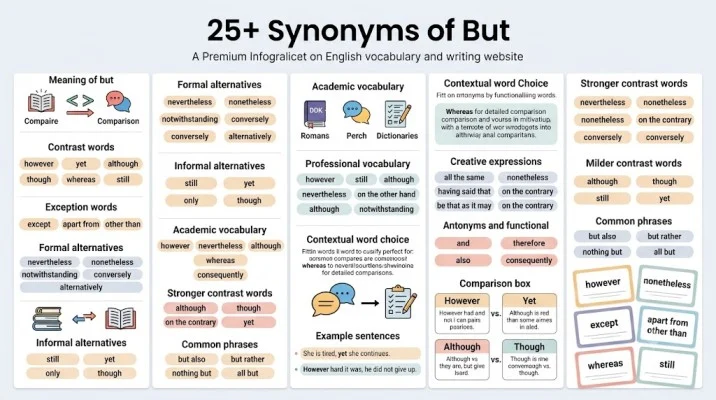
When writing an essay, email, caption, or professional message, repeating but can make your sentences feel predictable. The best synonyms of but depend on what you are trying to express, because this small word can introduce contrast, show an exception, limit a statement, or connect two opposing ideas.
Words such as however, although, though, yet, nevertheless, and except can sometimes replace but, but they do not all work in the same grammatical position. Choosing the right alternative improves sentence flow, makes your meaning clearer, and helps your writing sound more natural in academic, professional, creative, and everyday situations.
What Are the Best Synonyms of “But”?
The best synonyms of but depend on its meaning and grammatical role. For contrast, use however, yet, although, though, nevertheless, or nonetheless. For exceptions, use except, apart from, other than, or barring. In formal writing, however and nevertheless work well, while though and yet are natural in everyday English.
Meaning, Tone, and Context
Simple Definition
But is a versatile English word commonly used to introduce a contrast, exception, limitation, or opposing idea. It can connect two statements that differ in meaning or indicate that something does not apply in a particular situation.
Compare these examples:
“The apartment is small, but it is comfortable.”
Here, but introduces a contrast.
“Everyone but Sarah attended the meeting.”
Here, but means except.
Because but has more than one function, there is no single replacement that works in every sentence.
Part of Speech
But can function as several parts of speech depending on how it is used.
It is most commonly a conjunction, especially when connecting contrasting ideas.
“I wanted to go, but I was too tired.”
It can also function as a preposition meaning “except.”
“Everyone but James agreed.”
In some constructions, it can function as an adverb with a meaning similar to “only” or “merely.”
“It was but a small mistake.”
This use is formal or literary and is less common in everyday American English.
Overall Tone
But is generally neutral. It is neither strongly positive nor negative.
It is one of the most common contrast words in English and works naturally in casual conversation, professional communication, academic writing, and general prose.
Formality Level
But is primarily neutral and can be used in both formal and informal writing.
However, writers sometimes choose alternatives such as however, nevertheless, or nonetheless when they want a more formal or polished transition.
Common Uses
Native English speakers commonly use but to:
- Contrast two ideas
- Introduce an unexpected result
- Limit a previous statement
- Correct or qualify an idea
- Introduce an exception
- Express disagreement
- Connect opposing descriptions
- Add a condition or qualification
Word Forms
Unlike many vocabulary words, but does not have a large family of related forms.
| Form | Example |
|---|---|
| Conjunction | I called, but nobody answered. |
| Preposition | Everyone but Maria left. |
| Adverb | It was but a moment. |
| Noun | There are no buts about the decision. |
The noun form but usually appears in the expression “no ifs, ands, or buts”, which refers to excuses, objections, or conditions.
When and How to Use “But”
Use but when you want to connect two ideas that contrast with each other. It is usually the simplest and most natural choice when the relationship between the ideas is clear.
Professional
“The proposal is ambitious, but it is achievable.”
This works well because the sentence presents a limitation without sounding overly formal.
Academic
“The sample size was relatively small, but the results provide useful evidence.”
Here, but introduces a qualification about the research.
Workplace
“I understand the concern, but we need more information before making a decision.”
This creates a clear contrast between acknowledging a concern and explaining the next step.
Personal
“I wanted to join you, but I had other plans.”
The simple conjunction sounds natural in personal communication.
“Thank you for the offer, but I have decided to pursue another opportunity.”
This is direct and polite.
Resume
The word but is usually less useful on a resume because resumes favor concise, positive statements.
Instead of:
“Managed a small team, but delivered strong results.”
Write:
“Managed a small team and delivered strong results.”
Removing unnecessary contrast makes the achievement sound more confident.
Social Media
“The trip was exhausting, but completely worth it.”
This conversational structure works naturally in a caption.
Best Synonyms of “But”
No alternative to but works perfectly in every sentence. Some alternatives express contrast, while others express exceptions or qualifications, so the correct choice depends on the meaning you need.
Professional Writing: However
However is one of the most useful formal alternatives when you want to contrast two statements.
“The plan is expensive. However, it could produce significant long term benefits.”
It is especially useful when you want a clear transition between sentences or independent clauses.
Academic Writing: However
However works particularly well in essays, reports, and analytical writing because it clearly signals a change or contrast in reasoning.
“The evidence appears convincing. However, several limitations should be considered.”
Business Communication: Nevertheless
Nevertheless emphasizes that the second point remains true despite the first point.
“The project faced several delays. Nevertheless, the team completed the main objectives.”
It is more formal than everyday but.
Casual Conversation: Though
Though is a natural alternative in conversational English, especially when placed at the end of a sentence.
“The restaurant was expensive. The food was great, though.”
This sounds relaxed and natural.
Emotional Writing: Yet
Yet can create a stronger emotional contrast.
“She was exhausted, yet she continued helping others.”
It is concise and often has a slightly more expressive quality than but.
Creative Writing: Nevertheless
Nevertheless can emphasize persistence or an unexpected continuation.
“The road was dangerous. Nevertheless, he continued toward the village.”
Resume Writing: However
On a resume, contrast words should be used sparingly. However may be appropriate when describing a challenge followed by a successful result.
“The department faced declining sales; however, targeted campaigns improved quarterly revenue.”
Workplace Communication: Yet
Yet can be useful when describing two contrasting workplace conditions.
“The system is relatively new, yet employees have adapted quickly.”
Stronger Meaning: Nevertheless
Nevertheless can create a stronger sense of persistence despite an obstacle.
“The task was difficult. Nevertheless, the team completed it on schedule.”
Softer Meaning: Though
Though often creates a softer, more conversational contrast.
“The presentation was long, though the information was useful.”
When Not to Use “But”
Although but is highly versatile, replacing it can sometimes make a sentence more precise or appropriate for its context.
When “But” Sounds Too General
If your writing is highly formal or analytical, repeatedly using but can make transitions feel basic.
Less Precise:
“The results were promising, but more research is needed.”
Alternative:
“The results were promising. However, more research is needed.”
Why:
However creates a clearer formal transition between the two ideas.
When You Need a More Formal Transition
In academic or professional writing, nevertheless or nonetheless can emphasize that a conclusion remains true despite an earlier point.
Basic:
“The method has limitations, but it remains useful.”
More Formal:
“The method has limitations. Nevertheless, it remains useful.”
When You Mean “Except”
Do not replace but with a contrast word when it means except.
Correct:
“Everyone but John attended.”
Better Alternative:
“Everyone except John attended.”
Using however here would change the meaning and make the sentence incorrect.
When You Need a Softer Contrast
Though can make a contrast feel less abrupt.
Direct:
“The product is expensive, but it is durable.”
Softer:
“The product is expensive, though it is durable.”
When You Need to Show a Strong Contrast
Yet can emphasize the unexpected relationship between two ideas.
General:
“He was tired, but he continued.”
Stronger Contrast:
“He was tired, yet he continued.”
When “But” Becomes Repetitive
If several sentences use but, vary the structure instead of replacing every occurrence with another transition.
Repetitive:
“The course was difficult, but useful. The assignments were long, but helpful. The exams were stressful, but fair.”
Improved:
“The course was difficult yet useful. Although the assignments were long, they were helpful. The exams were stressful; nevertheless, they were fair.”
Variation improves rhythm and prevents repetitive sentence patterns.
Words Commonly Confused With “But”
However
Difference:
However expresses contrast, but it usually functions as a transition rather than a coordinating conjunction.
When to Use It:
Use it between sentences or in structures where a transitional adverb is grammatically appropriate.
Example:
“The idea is interesting. However, it needs more testing.”
Although
Difference:
Although introduces a dependent clause and means that one fact is true despite another fact.
When to Use It:
Use it when you want to make one idea subordinate to another.
Example:
“Although the task was difficult, we finished it.”
Though
Difference:
Though has a similar meaning to although but is generally more conversational.
When to Use It:
Use it in everyday communication or when you want a less formal tone.
Example:
“Though the weather was cold, we went outside.”
Yet
Difference:
Yet can express contrast while often emphasizing that the second idea is surprising or unexpected.
When to Use It:
Use it when you want a concise, slightly stronger contrast.
Example:
“The instructions were simple, yet many people made mistakes.”
Except
Difference:
Except usually identifies something that is excluded, rather than contrasting two ideas.
When to Use It:
Use it when but means “excluding” or “with the exception of.”
Example:
“Everyone agreed except Mark.”
Nevertheless
Difference:
Nevertheless means that something remains true despite a previous fact or obstacle.
When to Use It:
Use it in formal and professional writing when emphasizing persistence or continuation.
Example:
“The evidence was limited. Nevertheless, the findings were useful.”
Best Synonyms of “But” by Context
| Context | Best Alternative | Why It Works | Example |
|---|---|---|---|
| Formal writing | However | Creates a polished contrast | The proposal is promising. However, it requires revision. |
| Academic writing | However | Clearly signals a qualification | The theory is useful. However, further evidence is needed. |
| Professional communication | Nevertheless | Shows persistence despite difficulty | The deadline was tight. Nevertheless, we finished on time. |
| Business emails | However | Sounds professional and direct | We appreciate the offer. However, we need more details. |
| Resume writing | However | Helps introduce a challenge and result | Sales declined; however, new campaigns restored growth. |
| Workplace communication | Yet | Creates concise contrast | The process is complex, yet effective. |
| Casual conversation | Though | Sounds natural and relaxed | It was expensive, though. |
| Everyday speaking | Yet | Easy to use in conversation | I was tired, yet I went anyway. |
| Creative writing | Yet | Adds dramatic contrast | The night was dark, yet she felt hopeful. |
| Storytelling | Nevertheless | Highlights persistence | The path was difficult. Nevertheless, they continued. |
| Emotional writing | Yet | Creates expressive contrast | She was afraid, yet she stayed. |
| Strong emphasis | Nevertheless | Stresses continuation despite obstacles | He failed twice. Nevertheless, he tried again. |
| Mild tone | Though | Makes contrast feel softer | The room is small, though comfortable. |
| Social media captions | Though | Conversational and flexible | Long day, though worth it. |
| American English | But, however, though, yet | All are natural when grammatically appropriate | The task was hard, but we finished. |
| British English | But, however, though, yet | These forms are also standard in British English | It was difficult, but we managed. |
How to Choose the Best Synonym of “But”
The best alternative depends first on what but means in your sentence.
If You Mean Contrast
Choose:
however, yet, though, although, nevertheless, nonetheless
Example:
“The plan is risky, but it could succeed.”
Possible alternatives:
“The plan is risky. However, it could succeed.”
“The plan is risky, yet it could succeed.”
“Although the plan is risky, it could succeed.”
If You Mean Exception
Choose:
except, except for, apart from, other than, barring, excluding
Example:
“Everyone but David attended.”
Better alternative:
“Everyone except David attended.”
If You Want Formality
Choose however, nevertheless, or nonetheless.
These alternatives are particularly useful in essays, reports, presentations, and professional communication.
If You Want a Conversational Tone
Choose though or yet, depending on sentence structure.
“It’s expensive, though.”
This is especially natural in everyday speech.
If You Want Stronger Contrast
Choose yet or nevertheless.
“The task was difficult, yet she completed it.”
If You Want a Softer Contrast
Choose though or although.
“Although the process takes time, it produces reliable results.”
If You Need an Exception
Do not use however, yet, or nevertheless. Choose except or another exclusion word.
This distinction is one of the most important points when selecting among words similar to but.
Real Life Examples of “But”
School
Basic:
“The assignment was difficult, but I finished it.”
Improved:
“Although the assignment was difficult, I finished it.”
Why it works:
The dependent clause creates a smoother academic sentence.
College
Basic:
“The study had limitations, but the findings were useful.”
Improved:
“The study had limitations. Nevertheless, the findings were useful.”
Why it works:
The transition sounds appropriate for academic discussion.
Workplace
Basic:
“The software is complicated, but employees learned it quickly.”
Improved:
“The software is complicated, yet employees learned it quickly.”
Why it works:
Yet highlights the unexpected result.
Business
Basic:
“The product is expensive, but customers continue buying it.”
Improved:
“The product is expensive. However, customers continue buying it.”
Why it works:
The structure sounds polished in business writing.
Basic:
“We appreciate your proposal, but we need additional information.”
Improved:
“We appreciate your proposal. However, we need additional information.”
Why it works:
The transition is professional and direct.
Resume
Basic:
“The department was understaffed, but I improved response times.”
Improved:
“The department was understaffed; however, I improved response times.”
Why it works:
The sentence emphasizes achievement despite a workplace challenge.
Conversation
Basic:
“I don’t usually drink coffee, but I needed some this morning.”
Alternative:
“I don’t usually drink coffee, yet I needed some this morning.”
Why it works:
Yet emphasizes the unexpected choice.
Storytelling
Basic:
“The road was dangerous, but they continued.”
Improved:
“The road was dangerous, yet they continued.”
Why it works:
Yet adds a stronger sense of determination.
Blogging
Basic:
“The strategy takes time, but it can produce lasting results.”
Improved:
“The strategy takes time. Nevertheless, it can produce lasting results.”
Why it works:
The formal transition fits explanatory content.
Social Media
Basic:
“The day was exhausting, but completely worth it.”
Alternative:
“The day was exhausting, though completely worth it.”
Why it works:
Though keeps the sentence casual and conversational.
25 Best Synonyms and Alternatives for “But”
Because but has several grammatical meanings, the following list includes context based alternatives rather than pretending that every word can replace but in every sentence.
| Synonym or Alternative | Simple Meaning | Best Used For | Example Sentence |
|---|---|---|---|
| However | In contrast | Formal and academic writing | The plan looks promising; however, it needs testing. |
| Yet | Despite that | Contrast and unexpected results | The task was difficult, yet she completed it. |
| Although | Despite the fact that | Formal and academic clauses | Although it was late, we continued working. |
| Though | Although, despite that | Conversational English | Though the room was small, it felt comfortable. |
| Nevertheless | Despite that | Formal writing | The evidence was limited. Nevertheless, it was useful. |
| Nonetheless | Despite that | Formal and professional writing | The project was costly. Nonetheless, it delivered results. |
| Still | Even so | Conversational and general writing | It was difficult. Still, we managed to finish. |
| Even so | Despite that fact | Contrast and qualification | The price was high. Even so, customers bought it. |
| All the same | Despite that | Conversational emphasis | It was risky, but I would do it all the same. |
| That said | Acknowledging a different point | Professional and online writing | The plan has flaws. That said, it has potential. |
| Despite that | In spite of that | Explicit contrast | The forecast was poor. Despite that, the event continued. |
| In contrast | Showing an opposing idea | Academic and analytical writing | Sales increased in June. In contrast, July was weaker. |
| By contrast | Compared with an opposing case | Formal comparison | The first model is inexpensive. By contrast, the second is premium. |
| On the other hand | Introducing another side | Balanced discussion | The job pays well. On the other hand, the hours are long. |
| Whereas | While showing contrast | Formal comparison | The first plan is flexible, whereas the second is cheaper. |
| While | Although or whereas | Formal and general writing | While the process is slow, it is reliable. |
| Except | Excluding | Exceptions | Everyone except Tom attended. |
| Except for | Excluding one thing or person | Exceptions | The room was empty except for two chairs. |
| Apart from | Other than | Exceptions and qualifications | Apart from one error, the report was excellent. |
| Other than | Except for | Everyday and professional English | No one other than Maria knew the answer. |
| Save | Except for | Formal or literary writing | Everyone save the manager agreed. |
| Barring | Unless something prevents it | Formal writing | Barring unexpected delays, we will finish Friday. |
| Excluding | Leaving something out | Business and technical writing | The price is $500, excluding tax. |
| Only | Except in a particular case | Restriction or limitation | You can attend, only you must register first. |
| Just | Merely or only | Informal or literary contexts | It was just a small misunderstanding. |
Synonyms of “But” by Usage
Professional vs Personal Synonyms
Professional writing usually benefits from precise transitions such as however, nevertheless, nonetheless, and yet.
“The proposal is expensive. However, it offers several long term advantages.”
Personal communication can remain simpler.
“I wanted to go, but I was too tired.”
For professional writing, avoid replacing every but with an elaborate transition. A simple but is often more natural than an unnecessarily formal alternative.
Formal vs Conversational Synonyms
Formal writing commonly uses:
- However
- Nevertheless
- Nonetheless
- Although
- Whereas
- By contrast
- In contrast
Conversational English commonly uses:
- But
- Though
- Yet
- Still
- Even so
Reports
“The results were promising. However, additional testing is necessary.”
Essays
“Although the theory has limitations, it remains useful.”
Business Writing
“The proposal is attractive. Nevertheless, several financial concerns remain.”
Presentations
“The first option is cheaper. However, the second offers greater flexibility.”
Emails
“We appreciate your response. However, we need clarification on the final cost.”
Casual Conversations
“I liked it, though.”
Texting
“I was going to come, but I’m exhausted.”
Natural communication matters more than replacing a common word simply to sound sophisticated.
Academic Synonyms
Academic writing often needs clear relationships between ideas.
However
Use however to introduce a contrasting point.
“The sample was relatively small. However, the results were consistent.”
Although
Use although to make a concession.
“Although the study had limitations, it provided useful evidence.”
Whereas
Use whereas to directly compare two different conditions.
“The first group received training, whereas the second group did not.”
Nevertheless
Use nevertheless when the second point remains valid despite the first.
“The study was limited in scope. Nevertheless, it provides useful insights.”
In Contrast
Use in contrast when clearly comparing two different findings or situations.
“Urban populations increased. In contrast, rural populations declined.”
These alternatives make academic relationships between ideas easier to follow.
Professional and Business Synonyms
Resumes
Use however sparingly. Resumes usually sound stronger when challenges and achievements are presented directly.
Instead of:
“The team was small, but I completed major projects.”
Use:
“Led major projects within a small team.”
Interviews
Yet can work naturally when explaining an unexpected result.
“The role was challenging, yet it taught me valuable skills.”
Meetings
However helps introduce a concern.
“The proposal is strong. However, we need to review the budget.”
Presentations
On the other hand can introduce another perspective.
“Option A is faster. On the other hand, Option B is more affordable.”
Performance Reviews
Nevertheless can describe progress despite obstacles.
“The department experienced staffing challenges. Nevertheless, performance targets were met.”
Client Communication
However is often the safest formal alternative.
“We can make the requested changes. However, the revised timeline will require additional approval.”
Business Emails
Use although when you want to acknowledge one fact before presenting another.
“Although the current price is higher, the package includes additional support.”
Creative and Literary Synonyms
Creative writing benefits from contrast because opposing ideas can create tension and emotional depth.
Yet
“The storm was fierce, yet the little house remained standing.”
Though
“She smiled, though her eyes revealed her worry.”
Nevertheless
“The village was isolated. Nevertheless, he returned every winter.”
Although
“Although he feared the journey, he knew he had to leave.”
On the Other Hand
This can work in narrative reflection.
“The journey promised freedom. On the other hand, it meant leaving everything familiar behind.”
In creative writing, the goal is not to use the most formal synonym. The best choice is the one that matches the narrator’s voice and emotional effect.
Slang or Modern Synonyms
There is no single modern slang word that directly replaces but in every situation.
Casual expressions such as though, still, and even so are common in informal speech, but they are not slang.
For example:
“It was expensive, though.”
“I didn’t want to go. Still, I had fun.”
Expressions such as but yeah can appear in casual speech, but they are not appropriate substitutes in formal writing.
Strongest to Mildest Synonyms
Unlike adjectives such as important, contrast words do not have a simple intensity scale. Their effect depends on the relationship they create between ideas.
| Level | Alternative | Typical Effect |
|---|---|---|
| Mild | Though | Soft, conversational contrast |
| Mild | While | Balanced contrast |
| Moderate | But | Direct, neutral contrast |
| Moderate | Yet | Noticeable or unexpected contrast |
| Moderate | However | Clear formal contrast |
| Strong | Even so | Emphasizes contradiction |
| Strong | Nevertheless | Emphasizes persistence |
| Strong | Nonetheless | Formal emphasis on continuation |
| Strong | Despite that | Explicitly highlights opposition |
A stronger contrast does not necessarily mean a more formal word. Yet can sound more expressive, while nevertheless mainly adds formal emphasis.
Emotional vs Neutral Synonyms
Emotional Synonyms
Some alternatives can create a stronger sense of surprise, tension, or persistence.
Yet
“She was terrified, yet she stepped forward.”
Nevertheless
“He had every reason to quit. Nevertheless, he continued.”
Even so
“The journey was painful. Even so, she remembered it fondly.”
Neutral Synonyms
These alternatives communicate contrast without adding much emotional weight.
But
“The room was small, but comfortable.”
However
“The room was small. However, it was comfortable.”
Although
“Although the room was small, it was comfortable.”
For neutral communication, choose the structure that communicates the relationship most clearly.
Antonyms of “But”
Because but is primarily a conjunction, it does not have traditional antonyms in the same way that adjectives do. However, when but expresses contrast, words and conjunctions that connect similar or additive ideas can serve as functional opposites.
| Functional Opposite | Meaning | Example Sentence |
|---|---|---|
| And | Adds a similar idea | She studied and completed the assignment. |
| Also | Adds information | He works full time and also studies. |
| Furthermore | Adds supporting information | The plan is affordable. Furthermore, it is flexible. |
| Moreover | Adds another supporting point | The course is useful. Moreover, it is affordable. |
| Likewise | Shows similarity | Sarah enjoyed the course. Likewise, Tom found it helpful. |
| Similarly | Shows a similar relationship | Sales increased. Similarly, customer satisfaction improved. |
| Additionally | Adds another point | The service is affordable. Additionally, it is reliable. |
| As well | Adds similar information | She speaks Spanish as well. |
| Too | Adds information | I enjoyed the movie too. |
| Plus | Adds another advantage | The apartment is affordable, plus it is close to work. |
| And also | Adds another idea | He completed the course and also earned a certificate. |
| In addition | Adds supporting information | The plan is efficient. In addition, it saves money. |
| Along with | Adds another element | The package includes training along with technical support. |
| Together with | Indicates combination | The manager, together with the team, approved the plan. |
| Combined with | Shows two things working together | Experience, combined with training, improved performance. |
These are functional opposites rather than strict dictionary antonyms because but is a grammatical connector, not a word with a conventional opposite.
Comparison: “But” vs Similar Words
“But” vs “However”
Main Difference
But is usually a conjunction that directly joins contrasting clauses. However is a transitional adverb and often connects separate sentences or clauses.
Which Is Stronger?
Neither is inherently stronger. However can sound more formal.
Which Is More Formal?
However is generally more formal.
When to Use Each
Use but for direct, natural connections. Use however for polished transitions, especially in formal writing.
Examples
But:
“The plan is expensive, but it may succeed.”
However:
“The plan is expensive. However, it may succeed.”
“But” vs “Although”
Main Difference
But joins contrasting ideas. Although introduces a dependent clause that presents a concession.
Which Is Stronger?
Neither is inherently stronger.
Which Is More Formal?
Although often sounds slightly more formal.
When to Use Each
Use although when you want to make one idea subordinate to another.
Examples
But:
“The task was difficult, but we finished it.”
Although:
“Although the task was difficult, we finished it.”
“But” vs “Though”
Main Difference
Though can work similarly to although and can also appear at the end of a sentence.
Which Is Stronger?
Neither is stronger, but though often sounds softer and more conversational.
Which Is More Formal?
But and although are generally more neutral or formal than sentence final though.
When to Use Each
Use though for relaxed conversations and informal writing.
Examples
But:
“The restaurant was expensive, but the food was good.”
Though:
“The restaurant was expensive. The food was good, though.”
“But” vs “Yet”
Main Difference
Both can express contrast, but yet often highlights an unexpected result.
Which Is Stronger?
Yet can create a stronger sense of surprise.
Which Is More Formal?
Both are acceptable in formal writing.
When to Use Each
Use yet when the second idea seems surprising given the first.
Examples
But:
“He was tired, but he continued.”
Yet:
“He was tired, yet he continued.”
“But” vs “Except”
Main Difference
But can mean except when identifying an excluded person or thing. In that usage, except is usually clearer.
Which Is Stronger?
Neither.
Which Is More Formal?
Except is more explicit when describing exclusion.
When to Use Each
Use except when the intended meaning is “excluding.”
Examples
But:
“Everyone but Sarah agreed.”
Except:
“Everyone except Sarah agreed.”
“But” vs “Nevertheless”
Main Difference
Nevertheless means that something remains true despite an earlier fact.
Which Is Stronger?
Nevertheless often creates stronger emphasis on persistence.
Which Is More Formal?
Nevertheless is more formal.
When to Use Each
Use nevertheless in formal writing when the second idea continues despite an obstacle.
Examples
But:
“The project was difficult, but we finished it.”
Nevertheless:
“The project was difficult. Nevertheless, we finished it.”
Common Phrases and Expressions with “But”
“But I…”
This structure often introduces a personal reason or objection.
Meaning: Introduces a contrasting personal response.
Example:
“I understand your point, but I need more time.”
“But still”
Meaning: Emphasizes that something remains true despite another fact.
Example:
“The trip was expensive, but still worth it.”
“But then”
Meaning: Introduces a change, interruption, or unexpected development.
Example:
“I planned to stay home, but then my friend called.”
“But also”
Meaning: Usually appears in the structure “not only… but also.”
Example:
“The course is not only affordable but also practical.”
“But rather”
Meaning: Corrects or replaces a previous idea.
Example:
“The goal was not to criticize, but rather to improve the process.”
“But for”
Meaning: Indicates that something would have happened without another factor.
Example:
“But for your help, I would not have finished the project.”
“Nothing but”
Meaning: Means only or nothing other than.
Example:
“The box contained nothing but old photographs.”
“No buts”
Meaning: No objections, excuses, or conditions are accepted.
Example:
“Finish the assignment by Friday, no buts.”
Common Mistakes to Avoid
Mistake 1: Replacing Every “But” With “However”
Incorrect:
“I wanted to go, however I was tired.”
Better:
“I wanted to go, but I was tired.”
Or:
“I wanted to go. However, I was tired.”
Why:
However does not function exactly like the coordinating conjunction but. Punctuation and sentence structure matter.
Mistake 2: Using “However” When You Mean “Except”
Incorrect:
“Everyone however John attended.”
Better:
“Everyone except John attended.”
Why:
Here, but means exclusion, not contrast.
Mistake 3: Using “Although” With “But” in the Same Clause
Incorrect:
“Although the project was difficult, but we finished it.”
Better:
“Although the project was difficult, we finished it.”
Or:
“The project was difficult, but we finished it.”
Why:
Standard English normally does not require both although and but to introduce the same contrast.
Mistake 4: Using an Overly Formal Alternative
Incorrect:
“I was hungry. Nevertheless, I ate lunch.”
Better:
“I was hungry, so I ate lunch.”
Why:
Nevertheless is unnecessary when there is no contrast. A transition should reflect the actual relationship between ideas.
Mistake 5: Using “Yet” Without a Real Contrast
Incorrect:
“She studied hard, yet she passed the exam.”
Better:
“She studied hard, and she passed the exam.”
Why:
Passing after studying hard is not an unexpected contrast. Yet suggests a contrasting or surprising relationship.
Mistake 6: Choosing a Synonym Without Checking Grammar
Incorrect:
“The project was difficult, however we finished it.”
Better:
“The project was difficult, but we finished it.”
Or:
“The project was difficult. However, we finished it.”
Why:
The grammatical roles of but and however are different.
Mistake 7: Using Slang or Casual Expressions in Formal Writing
Incorrect:
“The plan is expensive, but still pretty cool.”
Better:
“The plan is expensive; nevertheless, it offers several advantages.”
Why:
The second version better matches a formal or professional context.
Frequently Asked Questions
What are the best synonyms of “but”?
The best synonyms of but include however, yet, though, although, nevertheless, nonetheless, and still for contrast. When but means “except,” use except, apart from, other than, or barring.
What are the best formal synonyms of “but”?
The strongest formal alternatives include however, nevertheless, nonetheless, although, whereas, in contrast, and by contrast. These choices work particularly well in academic papers, reports, professional communication, and analytical writing.
What are common informal synonyms of “but”?
Common conversational alternatives include though, yet, still, and even so. However, but itself remains extremely natural in informal English, so replacing it is not always necessary.
What is another word for “but” in professional writing?
However is often the most useful professional alternative when expressing contrast. Nevertheless, nonetheless, and although are also effective when their grammatical structure and meaning fit the sentence.
What is the difference between “but” and “however”?
But is normally a conjunction that joins contrasting clauses, while however is a transitional adverb. For example, “It was difficult, but we succeeded” differs structurally from “It was difficult. However, we succeeded.”
What is the opposite of “but”?
Because but is a conjunction, it does not have one standard antonym. When it expresses contrast, additive connectors such as and, also, furthermore, and in addition can provide an opposing function by joining compatible ideas.
Conclusion
The word but is short, common, and extremely flexible. It can express contrast, introduce an exception, qualify a statement, or connect two opposing ideas. Because its grammatical role changes with context, there is no single alternative that can replace it everywhere.
For formal and academic writing, however, although, nevertheless, nonetheless, and whereas are useful choices. For everyday conversation, though, yet, and still often sound natural. When but means “except,” choose except, apart from, or other than instead.
The key to using synonyms of but effectively is to identify the relationship between your ideas before choosing a replacement. A useful vocabulary habit is to ask whether you are showing contrast, making an exception, adding a qualification, or simply connecting ideas. That small check can make your writing clearer and more precise.
Read More Related Articles:
50+ Synonyms of Love | Powerful Words to Express Every …
Synonyms for Thus | Meaning, Examples, and Better Word …