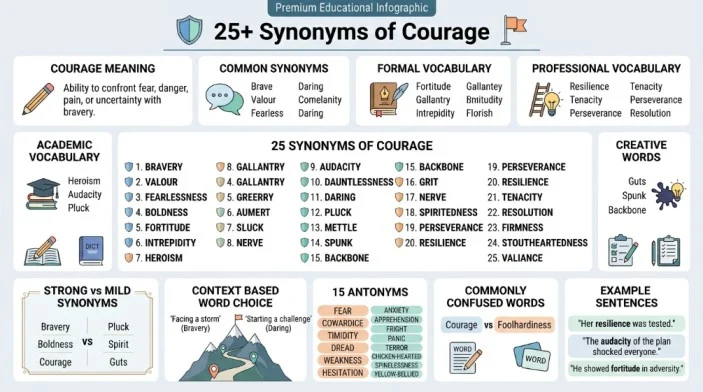
When writing an essay, resume, email, caption, or personal story, repeating the word courage can make your vocabulary feel limited. Finding the right synonym of courage gives you more ways to describe bravery, determination, confidence in difficult situations, and the strength to act despite fear.
The best alternative depends on what kind of courage you mean. Bravery is natural and widely understood, valor suits heroic situations, fortitude emphasizes endurance, and boldness highlights a willingness to take risks. Understanding these differences helps you choose words that sound natural, precise, and appropriate for your audience.
What Is the Best Synonym of “Courage”?
A strong synonym of courage is bravery, which works in most everyday situations. Other useful alternatives include valor for heroic action, fortitude for endurance during hardship, boldness for confident risk taking, fearlessness for acting without apparent fear, and resolve when courage involves determination.
Meaning, Tone, and Context
Simple Definition
Courage is the ability to face fear, difficulty, danger, pain, or uncertainty and continue to act despite it. Courage does not always mean feeling no fear. In many situations, it means moving forward even when fear is present.
For example, someone may show courage by speaking honestly during a difficult meeting, defending another person, starting over after failure, or facing a dangerous situation.
Part of Speech
Courage is primarily a noun.
Example:
“Her courage inspired everyone on the team.”
The adjective courageous describes someone who demonstrates courage.
Example:
“He made a courageous decision.”
Overall Tone
Courage has a strongly positive tone in most contexts. It usually communicates admiration, strength, bravery, or moral conviction.
However, the exact emotional effect changes depending on the synonym. Audacity, for example, can suggest excessive boldness, while valor often suggests admirable bravery in a dangerous situation.
Formality Level
Courage is a neutral word that works in formal, professional, academic, literary, and everyday English.
It is suitable for:
- Essays
- Speeches
- Resumes
- Business communication
- Personal conversations
- Social media
- Stories
- Biographies
- Inspirational writing
Common Uses
Native English speakers commonly use courage when discussing:
- Facing fear
- Overcoming hardship
- Defending others
- Making difficult decisions
- Speaking the truth
- Taking risks
- Recovering from failure
- Standing up for a principle
- Handling uncertainty
- Facing danger
Word Forms
| Word | Part of Speech | Example |
|---|---|---|
| Courage | Noun | “She showed great courage.” |
| Courageous | Adjective | “It was a courageous decision.” |
| Courageously | Adverb | “He acted courageously.” |
| Courageousness | Noun | “Her courageousness impressed the team.” |
| Encourage | Verb | “Her friends encouraged her to continue.” |
The words encourage and courageous are related to courage, but they do not function as direct synonyms.
When and How to Use “Courage”
Use courage when you want to describe the strength required to face fear, adversity, danger, or an uncomfortable situation. It works especially well when the person experiences difficulty but chooses to continue.
Professional
“It takes courage to challenge an established process when you believe there is a better solution.”
Here, courage refers to professional confidence and willingness to speak up.
Academic
“The character demonstrates courage by defending her principles despite strong opposition.”
This usage works well when analyzing literature, history, or social behavior.
Workplace
“The manager showed courage by accepting responsibility for the mistake.”
The word emphasizes accountability rather than physical bravery.
Personal
“It took courage to begin again after such a difficult experience.”
Here, courage refers to emotional strength.
“I admire your courage in raising this issue with the leadership team.”
This sounds respectful and professional.
Resume
“Demonstrated courage and sound judgment while managing complex client concerns.”
For a resume, however, a more specific phrase such as decisive leadership or calm decision making may sometimes communicate the skill more clearly.
Social Media
“It takes courage to follow your own path when everyone else expects something different.”
This use gives the word an inspirational and personal tone.
Best Synonyms of “Courage”
No synonym matches courage perfectly in every situation. The best choice depends on whether you want to emphasize bravery, endurance, risk taking, determination, heroism, or emotional strength.
Professional Writing: Fortitude
Fortitude emphasizes mental and emotional strength during hardship.
“Her fortitude helped the team remain focused during the crisis.”
It works especially well when courage involves enduring pressure rather than confronting immediate danger.
Academic Writing: Bravery
Bravery is clear, familiar, and easy to understand. It works well in essays discussing characters, historical figures, social behavior, or difficult decisions.
“The character’s bravery becomes clear when she protects her family.”
Business Communication: Resolve
Resolve emphasizes firm determination to continue despite obstacles.
“The company showed resolve by continuing its recovery plan during a difficult quarter.”
Casual Conversation: Nerve
Nerve is an informal alternative that often describes the confidence required to do something difficult or frightening.
“She had the nerve to speak up in front of everyone.”
Emotional Writing: Inner Strength
Inner strength focuses on emotional resilience and personal endurance.
“His inner strength helped him recover from the setback.”
Creative Writing: Valor
Valor has a heroic, literary quality and is especially appropriate for stories involving danger or noble action.
“The soldier was remembered for his valor.”
Resume Writing: Boldness
Boldness can work when describing willingness to take initiative or make unconventional decisions.
“Demonstrated boldness in developing new approaches to customer engagement.”
For most resumes, however, a concrete achievement is stronger than simply claiming courage.
Workplace Communication: Confidence
Confidence can overlap with courage when the situation involves speaking, leading, or making decisions. It should not replace courage when fear or danger is central to the meaning.
“She had the confidence to present the proposal to senior leadership.”
Stronger Meaning: Fearlessness
Fearlessness suggests an absence of visible fear or a willingness to confront something intimidating.
“His fearlessness allowed him to enter the dangerous area.”
Because fearlessness can sound extreme, it should be used when the situation genuinely calls for it.
Softer Meaning: Determination
Determination is a milder alternative when the main idea is persistence rather than bravery.
“Her determination helped her finish the project.”
When Not to Use “Courage”
Although courage is flexible, there are situations where another word communicates the intended meaning more precisely.
When “Courage” Is Too General
If you mean a person’s ability to continue working toward a goal, determination may be more accurate.
Less Precise:
“Her courage helped her finish the assignment.”
Better:
“Her determination helped her finish the assignment.”
When “Courage” Is Too Vague
If the situation involves making a risky decision, boldness may explain the behavior more clearly.
Less Precise:
“The company showed courage by entering the new market.”
Better:
“The company showed boldness by entering the new market.”
When “Courage” Is Too Formal
In a casual conversation, courage may sound slightly serious depending on the situation.
More Casual:
“You had some nerve telling him that!”
Here, nerve sounds more conversational.
When “Courage” Is Too Informal
The expression guts can mean courage in casual American English, but it is unsuitable for many formal contexts.
Informal:
“She had the guts to challenge the decision.”
Professional:
“She had the resolve to challenge the decision.”
When “Courage” Is Too Weak
If you want to emphasize exceptional bravery, valor or heroism may be stronger.
Less Strong:
“The firefighter showed courage.”
Stronger:
“The firefighter displayed remarkable valor.”
When “Courage” Is Too Strong
If someone simply worked hard through a difficult task, calling the behavior courage may overstate the situation.
Too Strong:
“He showed courage by finishing the report.”
Better:
“He showed determination by finishing the report.”
When an Older or Literary Word Is Unnecessary
Words such as valor, intrepidity, and gallantry can sound literary or elevated. They are useful in the right context but may feel unnatural in ordinary workplace writing.
For example, a simple business sentence usually sounds better as:
“The team showed remarkable courage during the crisis.”
rather than:
“The team demonstrated extraordinary intrepidity during the crisis.”
Words Commonly Confused With “Courage”
| Word | Difference | When to Use It | Example |
|---|---|---|---|
| Confidence | Belief in your ability, not necessarily the ability to face fear. | Presentations, leadership, social situations. | “She spoke with confidence during the meeting.” |
| Bravery | Directly refers to courageous behavior, especially when facing fear or danger. | Everyday and general writing. | “His bravery saved several people.” |
| Boldness | Emphasizes willingness to take risks or act confidently. | Business, leadership, creative decisions. | “Her boldness helped the company try a new strategy.” |
| Determination | Focuses on persistence and commitment rather than fear. | Goals, work, education, recovery. | “His determination kept him moving forward.” |
| Fearlessness | Suggests little or no apparent fear. | Dangerous or intimidating situations. | “Her fearlessness impressed the entire team.” |
| Fortitude | Emphasizes endurance through suffering or adversity. | Serious hardship and emotional challenges. | “He showed great fortitude during the recovery.” |
Best Synonyms of “Courage” by Context
| Context | Best Synonym | Why It Works | Example |
|---|---|---|---|
| Formal writing | Fortitude | Sounds precise and dignified. | “Her fortitude was evident throughout the crisis.” |
| Academic writing | Bravery | Clear and widely understood. | “The novel explores bravery under pressure.” |
| Professional communication | Resolve | Emphasizes determination. | “The team demonstrated resolve.” |
| Business emails | Courage | Natural and respectful. | “I appreciate your courage in raising this concern.” |
| Resume writing | Boldness | Highlights willingness to take initiative. | “Applied boldness to product development.” |
| Workplace communication | Resolve | Suggests persistence under pressure. | “Her resolve kept the project on track.” |
| Casual conversation | Nerve | Sounds natural and informal. | “You had the nerve to say that!” |
| Everyday speaking | Bravery | Simple and familiar. | “That took a lot of bravery.” |
| Creative writing | Valor | Adds a heroic quality. | “His valor became part of the legend.” |
| Storytelling | Heroism | Emphasizes admirable courageous action. | “The story celebrates ordinary acts of heroism.” |
| Emotional writing | Inner strength | Highlights emotional resilience. | “Her inner strength carried her through the loss.” |
| Strong emphasis | Fearlessness | Suggests exceptional absence of fear. | “His fearlessness amazed everyone.” |
| Mild tone | Determination | Focuses on persistence instead of bravery. | “Her determination helped her succeed.” |
| Social media captions | Bravery | Easy to understand and emotionally direct. | “Choose bravery even when the path feels uncertain.” |
| American English | Courage | Standard and natural in all major contexts. | “It takes courage to admit a mistake.” |
| British English | Bravery | Common natural alternative. | “Her bravery was widely admired.” |
How to Choose the Best Synonym of “Courage”
Choosing the right alternative becomes easier when you identify the exact quality you want to describe.
Choose Bravery for General Courage
Use bravery when you want a simple, direct replacement.
“The child showed bravery during the emergency.”
Choose Fortitude for Endurance
Use fortitude when someone remains strong during prolonged difficulty.
“She demonstrated remarkable fortitude during the recovery.”
Choose Boldness for Risk Taking
Use boldness when the person takes an unusual or risky action.
“His boldness changed the direction of the company.”
Choose Resolve for Determination
Use resolve when someone refuses to give up.
“Her resolve helped the team overcome repeated setbacks.”
Choose Valor for Heroic Action
Use valor when courage involves danger, especially in heroic or historical contexts.
“The award recognized his valor.”
Choose Nerve for Casual Situations
Use nerve in informal conversations when someone does something difficult or daring.
“I don’t know how she had the nerve to ask.”
Choose Inner Strength for Emotional Challenges
Use inner strength when courage involves coping with emotional pain or personal hardship.
“His inner strength helped him rebuild his life.”
Real Life Examples of “Courage”
School
Basic:
“It took courage to speak in front of the class.”
Stronger:
“It took confidence and bravery to present the project to the entire class.”
College
Basic:
“She showed courage by defending her opinion.”
Improved:
“She showed conviction and courage by defending her position during the debate.”
Workplace
Basic:
“It took courage to admit the mistake.”
Improved:
“It took professional courage to accept responsibility and propose a solution.”
Business
Basic:
“The company showed courage by entering a new market.”
Improved:
“The company demonstrated strategic boldness by entering a competitive new market.”
Basic:
“I appreciate your courage in bringing this matter to my attention.”
Improved:
“I appreciate your willingness to raise this sensitive issue.”
Resume
Basic:
“Showed courage while leading the team.”
Improved:
“Demonstrated decisive leadership while guiding the team through a major transition.”
Conversation
Basic:
“That took courage.”
Natural:
“That took a lot of nerve.”
The second version is more casual and conversational.
Storytelling
Basic:
“The hero showed courage when the village was threatened.”
Creative:
“The hero summoned the courage to face the danger alone.”
Blogging
Basic:
“Starting a business takes courage.”
Improved:
“Starting a business requires courage, persistence, and a willingness to face uncertainty.”
Social Media
Basic:
“Courage means facing your fears.”
Improved:
“Real bravery often begins when you decide to move forward despite uncertainty.”
25 Best Synonyms of “Courage”
| Synonym | Simple Meaning | Best Used For | Example Sentence |
|---|---|---|---|
| Bravery | Ability to face fear or danger | Everyday writing | “Her bravery inspired the entire group.” |
| Valor | Heroic courage | Military, heroic, literary contexts | “The soldier was honored for his valor.” |
| Fortitude | Strength during hardship | Formal and emotional writing | “His fortitude helped him endure the difficult period.” |
| Boldness | Willingness to take risks | Business and leadership | “Her boldness led to a creative solution.” |
| Fearlessness | Lack of visible fear | Extreme challenges | “His fearlessness impressed his teammates.” |
| Nerve | Confidence to do something difficult | Casual conversation | “She had the nerve to challenge the decision.” |
| Guts | Informal courage | Casual American English | “He had the guts to start over.” |
| Daring | Willingness to take risks | Adventure and creative writing | “Her daring approach changed the competition.” |
| Audacity | Boldness that may seem shocking | Risky or unconventional behavior | “His audacity surprised the entire board.” |
| Heroism | Exceptional courageous action | Stories and history | “The rescue was an act of heroism.” |
| Gallantry | Brave and noble behavior | Literary and historical contexts | “The story celebrates his gallantry.” |
| Intrepidity | Exceptional fearlessness | Formal and literary writing | “The explorers were admired for their intrepidity.” |
| Dauntlessness | Refusal to be intimidated | Formal and descriptive writing | “Her dauntlessness became legendary.” |
| Pluck | Spirited courage | Informal and literary contexts | “The young athlete showed remarkable pluck.” |
| Mettle | Strength of character under pressure | Challenges and competition | “The final round tested her mettle.” |
| Gumption | Courage combined with initiative | Informal and professional contexts | “It took real gumption to launch the project alone.” |
| Backbone | Strength to stand firm | Informal and workplace speech | “She showed backbone when the pressure increased.” |
| Heart | Courage and spirit | Informal and emotional writing | “The player showed plenty of heart.” |
| Determination | Firmness in pursuing a goal | Work and education | “His determination helped him recover from failure.” |
| Resolve | Firm decision to continue | Professional and formal writing | “The team showed resolve after the setback.” |
| Fearlessness | Willingness to confront fear | Strong emphasis | “Her fearlessness encouraged others to act.” |
| Braveness | Quality of being brave | Simple descriptive writing | “His braveness was recognized by the community.” |
| Heroic spirit | Willingness to act bravely | Inspirational and creative writing | “Her heroic spirit motivated the volunteers.” |
| Fighting spirit | Determination to keep going | Sports and adversity | “The team never lost its fighting spirit.” |
| Inner strength | Emotional strength during difficulty | Personal and emotional writing | “Her inner strength helped her face the loss.” |
Synonyms of “Courage” by Usage
Professional vs Personal Synonyms
Professional writing usually benefits from precise terms such as resolve, fortitude, boldness, and decisiveness.
Personal writing can use warmer expressions such as bravery, inner strength, heart, and fighting spirit.
For example, a performance review might say:
“She demonstrated resolve during a challenging transition.”
A personal message might say:
“Your inner strength has been incredible.”
Both communicate strength, but their tones are different.
Formal vs Conversational Synonyms
Formal writing favors words that sound precise and controlled.
Reports: Fortitude, resolve, valor
Essays: Bravery, courage, fortitude
Business writing: Resolve, boldness, determination
Presentations: Courage, confidence, resolve
Emails: Courage, bravery, willingness
Casual conversations: Nerve, guts, heart
Texting: Nerve, guts, bravery
Expressions such as guts and nerve can sound natural in conversation but should generally be avoided in formal academic writing.
Academic Synonyms
Academic writing often requires precision. Bravery, fortitude, valor, determination, and resolve can be useful depending on the subject.
- Use bravery when discussing direct acts of courage.
“The character’s bravery influences the development of the story.”
- Use fortitude when discussing endurance.
“The memoir emphasizes her fortitude during prolonged hardship.”
- Use resolve when courage is closely connected to determination.
“His resolve remained strong despite repeated opposition.”
Professional and Business Synonyms
Different professional situations call for different alternatives.
Resumes: Boldness, resolve, determination
Interviews: Confidence, courage, composure
Meetings: Confidence, nerve, resolve
Presentations: Confidence, boldness
Performance reviews: Resolve, fortitude, determination
Client communication: Confidence, professionalism, composure
Business emails: Courage, resolve, willingness
In professional writing, it is often better to demonstrate courage through a specific achievement rather than simply label yourself courageous.
Instead of:
“I am courageous.”
Use:
“Led the team through a major transition while maintaining service quality.”
The second statement gives evidence rather than making a broad claim.
Creative and Literary Synonyms
Creative writing allows more expressive alternatives.
Valor creates a heroic tone.
Gallantry can suggest noble or traditional bravery.
Heroism emphasizes exceptional courageous action.
Dauntlessness suggests someone who refuses to be intimidated.
Mettle highlights how a person performs under pressure.
Heart gives a story a warmer, more emotional quality.
For example:
“When the storm arrived, her courage remained.”
could become:
“When the storm arrived, her dauntlessness never wavered.”
The second version creates a more dramatic literary effect.
Slang or Modern Synonyms
There are no perfect slang equivalents for courage, but several informal expressions are common in American English.
Guts
Guts means courage or boldness in casual speech.
“It took guts to quit his secure job and start a business.”
Use it in conversations, informal writing, and some social media content.
Avoid it in academic papers, formal reports, and professional documents.
Nerve
Nerve can describe the confidence needed to do something difficult or daring.
“She had the nerve to ask for another opportunity.”
It is natural in casual conversation but less suitable for formal writing.
Big Heart
Big heart can suggest kindness, generosity, and emotional courage, although it is not a direct synonym in every context.
“She has a big heart and always stands up for people who need help.”
Strongest to Mildest Synonyms
Courage does not have one fixed intensity scale because different synonyms emphasize different qualities. Still, the following guide can help when choosing vocabulary.
| Level | Useful Words | Main Emphasis |
|---|---|---|
| Mild | Determination, resolve | Persistence |
| Moderate | Bravery, boldness, nerve | Facing difficulty |
| Strong | Fortitude, valor, fearlessness | Serious courage |
| Very Strong | Heroism, dauntlessness, intrepidity | Exceptional bravery |
Determination may describe someone who keeps working without necessarily facing fear.
Bravery directly communicates courage.
Fortitude adds endurance.
Fearlessness suggests extreme confidence in the face of danger.
Heroism usually describes unusually admirable courageous action.
Emotional vs Neutral Synonyms
Emotional Synonyms
These words create stronger feelings or imagery:
- Heroism
- Valor
- Inner strength
- Heart
- Fighting spirit
- Gallantry
- Fearlessness
They work well in speeches, stories, inspirational writing, tributes, and personal messages.
Neutral Synonyms
These alternatives communicate the concept more objectively:
- Courage
- Bravery
- Determination
- Resolve
- Fortitude
- Boldness
They are useful for essays, reports, workplace communication, and general explanations.
Antonyms of “Courage”
| Antonym | Meaning | Example Sentence |
|---|---|---|
| Cowardice | Lack of courage when facing fear or danger | “His cowardice prevented him from helping.” |
| Timidity | Lack of confidence or boldness | “Her timidity made public speaking difficult.” |
| Fearfulness | A strong tendency to feel afraid | “Fearfulness kept him from taking the opportunity.” |
| Cowardliness | Behavior showing cowardice | “The story portrays cowardliness as a serious weakness.” |
| Faintheartedness | Lack of courage or determination | “Faintheartedness made the difficult decision even harder.” |
| Timorousness | Excessive nervousness or fear | “His timorousness prevented him from speaking up.” |
| Cravenness | Extreme cowardice | “The character’s cravenness was obvious under pressure.” |
| Spinelessness | Lack of strength or courage to resist pressure | “His spinelessness disappointed his colleagues.” |
| Gutlessness | Informal lack of courage | “His friends criticized his gutlessness.” |
| Pusillanimity | Extreme lack of courage | “The leader was criticized for his pusillanimity.” |
| Chickenheartedness | Cowardly behavior | “His chickenheartedness became a running joke among friends.” |
| Irresolution | Inability to make a firm decision | “Her irresolution delayed the project.” |
| Hesitancy | Uncertainty that prevents action | “His hesitancy caused him to miss the opportunity.” |
| Fear | Emotional response that can prevent action | “Fear stopped him from entering the building.” |
| Lack of confidence | Uncertainty about one’s ability | “A lack of confidence kept her from applying.” |
Comparison: “Courage” vs Similar Words
Courage vs Bravery
Main Difference
Courage and bravery are very close in meaning. Both describe the ability to face fear, difficulty, or danger.
Which Is Stronger?
Neither is consistently stronger. They can often be substituted for each other.
Which Is More Formal?
Both are neutral and appropriate for formal and informal contexts.
When to Use Each
Use courage for a broad concept. Use bravery when describing a specific courageous act.
Examples
Courage:
“It takes courage to admit when you are wrong.”
Bravery:
“The firefighter’s bravery saved lives.”
Courage vs Confidence
Main Difference
Confidence means belief in your ability. Courage means acting despite fear or difficulty.
Which Is Stronger?
Neither is stronger because they describe different qualities.
Which Is More Formal?
Both are neutral.
When to Use Each
Use confidence for self assurance. Use courage when facing fear or adversity.
Examples
Courage:
“She showed courage by reporting the problem.”
Confidence:
“She spoke with confidence during the presentation.”
Courage vs Boldness
Main Difference
Boldness emphasizes risk taking or unconventional behavior. Courage emphasizes facing fear or difficulty.
Which Is Stronger?
Boldness can sometimes sound more aggressive, while courage often carries a more positive moral tone.
Which Is More Formal?
Both can work professionally.
When to Use Each
Use boldness for ambitious decisions. Use courage for difficult or frightening situations.
Examples
Courage:
“He had the courage to tell the truth.”
Boldness:
“The company showed boldness by entering the new market.”
Courage vs Determination
Main Difference
Determination focuses on persistence. Courage focuses on facing fear, danger, or difficulty.
Which Is Stronger?
Neither is inherently stronger.
Which Is More Formal?
Both are appropriate for professional and academic writing.
When to Use Each
Use determination when someone keeps pursuing a goal. Use courage when fear or adversity is central.
Examples
Courage:
“It took courage to confront the problem.”
Determination:
“Her determination helped her complete the program.”
Courage vs Fortitude
Main Difference
Fortitude emphasizes endurance during prolonged hardship. Courage can describe both immediate and long term challenges.
Which Is Stronger?
Fortitude can sound stronger when describing sustained hardship.
Which Is More Formal?
Fortitude is more formal and literary.
When to Use Each
Use fortitude for serious adversity. Use courage for general situations.
Examples
Courage:
“He showed courage during the emergency.”
Fortitude:
“She showed remarkable fortitude throughout her recovery.”
Courage vs Fearlessness
Main Difference
Fearlessness suggests an absence of fear. Courage can exist even when a person is afraid.
Which Is Stronger?
Fearlessness often sounds stronger.
Which Is More Formal?
Both can be used formally, although fearlessness may sound more dramatic.
When to Use Each
Use courage when someone acts despite fear. Use fearlessness when emphasizing exceptional lack of hesitation.
Examples
Courage:
“She found the courage to speak.”
Fearlessness:
“His fearlessness impressed everyone.”
Common Phrases and Expressions with “Courage”
Courage to Face Something
Meaning: The strength required to confront a difficult situation.
Example:
“She found the courage to face her fears.”
Have the Courage to Do Something
Meaning: Be brave enough to take a difficult action.
Example:
“He had the courage to admit his mistake.”
Show Courage
Meaning: Demonstrate bravery through actions.
Example:
“The student showed courage by defending her classmate.”
Take Courage
Meaning: Become more confident or hopeful.
Example:
“Take courage from the progress you have already made.”
Find the Courage
Meaning: Develop enough confidence to do something difficult.
Example:
“She finally found the courage to start over.”
Great Courage
Meaning: A high level of bravery or emotional strength.
Example:
“It took great courage to speak openly about the experience.”
Moral Courage
Meaning: The willingness to defend what you believe is right, even when doing so is difficult.
Example:
“The whistleblower demonstrated moral courage by reporting the misconduct.”
Courage Under Pressure
Meaning: The ability to remain brave and effective during stressful circumstances.
Example:
“The leader showed courage under pressure.”
Common Mistakes to Avoid
Choosing a Vague Synonym Instead of a Precise One
Incorrect:
“She showed courage by continuing to study every evening.”
Better:
“She showed determination by continuing to study every evening.”
Why:
The sentence describes persistence more than fear or danger, so determination is more precise.
Confusing Courage With Confidence
Incorrect:
“His courage helped him deliver a routine presentation.”
Better:
“His confidence helped him deliver a routine presentation.”
Why:
A presentation may require confidence without involving fear or serious adversity.
Using an Informal Synonym in Formal Writing
Incorrect:
“The researcher had the guts to challenge the accepted theory.”
Better:
“The researcher had the courage to challenge the accepted theory.”
Why:
Guts is conversational and can sound too informal for academic writing.
Choosing an Overly Dramatic Synonym
Incorrect:
“She demonstrated heroic courage by answering a difficult email.”
Better:
“She showed confidence by addressing the difficult email.”
Why:
Heroic vocabulary should be reserved for genuinely exceptional situations.
Repeating the Same Word
Incorrect:
“His courage gave her courage, and her courage inspired the team.”
Better:
“His courage gave her confidence, and her bravery inspired the team.”
Why:
Strategic variation improves flow without changing the meaning.
Choosing the Wrong Emotional Tone
Incorrect:
“The employee’s audacity helped her handle the sensitive situation.”
Better:
“The employee’s composure helped her handle the sensitive situation.”
Why:
Audacity can suggest excessive or even disrespectful boldness, while composure emphasizes calm control.
Using Slang in Academic or Professional Writing
Incorrect:
“The leader had the guts to challenge the policy.”
Better:
“The leader had the resolve to challenge the policy.”
Why:
Resolve is more suitable for formal professional communication.
Frequently Asked Questions
What is the best synonym of courage?
The best synonym of courage is bravery because it is clear, natural, and widely understood. For specific contexts, fortitude, valor, boldness, resolve, and fearlessness can communicate more precise shades of meaning.
What are the best formal synonyms of courage?
The best formal synonyms of courage include fortitude, valor, resolve, intrepidity, and dauntlessness. The right choice depends on whether you want to emphasize endurance, heroic action, determination, or exceptional fearlessness.
What are common informal synonyms of courage?
Common informal alternatives include nerve, guts, heart, and pluck. These words can sound natural in conversation, but some are too casual for academic papers, formal reports, and professional documents.
What is another word for courage in professional writing?
In professional writing, useful alternatives include resolve, fortitude, boldness, and determination. Choose the word based on the situation. Resolve emphasizes persistence, while boldness highlights risk taking.
What is the difference between courage and bravery?
Courage and bravery have nearly the same basic meaning. Courage often describes the broader quality of facing fear or difficulty, while bravery frequently describes a particular courageous action or behavior.
What is the opposite of courage?
The clearest opposite of courage is cowardice, which describes a lack of courage when facing fear, danger, or difficulty. Other related opposites include timidity, fearfulness, faintheartedness, and spinelessness.
Conclusion
Courage describes the strength to face fear, danger, difficulty, or uncertainty and act despite those challenges. The best alternative depends on the exact quality you want to emphasize.
Use bravery for a natural general synonym, fortitude for endurance, valor for heroic action, boldness for risk taking, resolve for determination, and inner strength for emotional resilience. No synonym works perfectly in every sentence, so consider your audience, purpose, tone, and intended meaning before choosing a replacement.
A simple vocabulary habit can make your writing stronger: whenever you use courage, identify exactly what the person is demonstrating, then choose the word that names that quality most precisely. This approach will help you use every synonym of courage more naturally and confidently.
Read More Related Articles:
Synonyms for Empty | Meaning, Examples, and Better Word …
Synonyms for Creativity | Meaning, Examples, and Better …