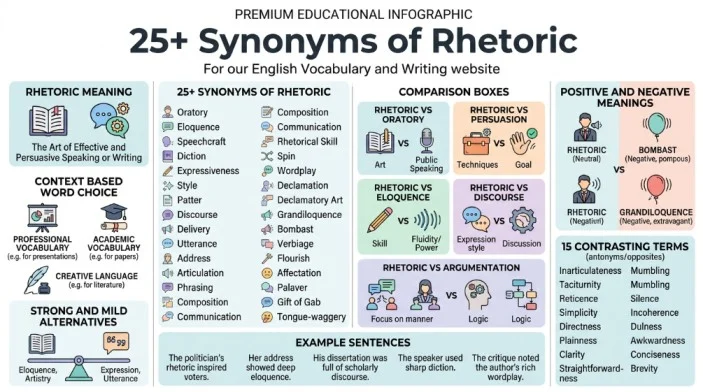
A writer may use the word rhetoric several times in an essay, article, speech, or political discussion and then realize that the word does not always express the intended idea. The search for a synonym of rhetoric becomes especially useful when you need a more precise word for persuasive language, public speaking, argument, style, or language that sounds impressive without offering much substance.
The best alternative depends heavily on context. Oratory works well for skilled public speaking, persuasion focuses on influencing an audience, eloquence emphasizes expressive skill, while bombast suggests inflated or overly grand language. Understanding these differences helps you choose a word that communicates your exact meaning instead of simply replacing rhetoric with a word that sounds similar.
What Is the Best Synonym of “Rhetoric”?
A synonym of rhetoric depends on which meaning you intend. Oratory is best for public speaking, persuasion for influencing an audience, eloquence for expressive speech, discourse for organized communication, and argumentation for structured reasoning. For negative meanings, bombast, grandiloquence, and empty language can describe rhetoric that sounds impressive but lacks substance.
Meaning, Tone, and Context
Simple Definition
Rhetoric generally refers to the art or practice of using language effectively to inform, persuade, influence, or move an audience. It can describe speech and writing techniques, but it can also have a negative meaning when someone uses impressive language without offering meaningful ideas.
For example:
“The speaker used powerful rhetoric to persuade the audience.”
Here, rhetoric refers to persuasive language and communication techniques.
In a negative context:
“The campaign’s rhetoric sounded impressive, but it contained few specific proposals.”
Here, rhetoric suggests language that may sound powerful but lacks practical substance.
Part of Speech
Rhetoric is primarily a noun.
Example:
“The professor analyzed the rhetoric of the speech.”
Overall Tone
The tone of rhetoric depends on context.
It can be neutral when discussing communication techniques, positive when referring to effective persuasion or eloquence, and negative when criticizing exaggerated, manipulative, or empty language.
Formality Level
Rhetoric is generally formal or neutral. It appears frequently in academic writing, political commentary, journalism, literary criticism, public speaking, and professional discussions.
It is less common in very casual conversation unless someone is discussing politics, debate, communication, or writing.
Common Uses
Native English speakers commonly use rhetoric when discussing:
- Political speeches
- Public speaking
- Persuasive writing
- Advertising
- Debate
- Academic communication
- Political messaging
- Literary analysis
- Social commentary
- Argumentation
- Communication strategies
- Language designed to influence an audience
Word Forms
| Form | Example |
|---|---|
| Noun | rhetoric |
| Adjective | rhetorical |
| Related noun | rhetorician |
| Related concept | rhetorical question |
The adjective rhetorical describes something connected with rhetoric or language used for persuasive effect.
Example:
“The writer uses a rhetorical question to challenge the reader.”
When and How to Use “Rhetoric”
Use rhetoric when you are discussing how language is used to persuade, influence, impress, or communicate an argument. It is particularly useful when the focus is on language and communication rather than only on the underlying facts or ideas.
Professional
“The company’s marketing rhetoric emphasizes innovation and customer trust.”
Here, rhetoric refers to the language and messaging used by the company.
Academic
“The essay examines the political rhetoric surrounding immigration policy.”
This usage is appropriate when analyzing language, arguments, or persuasive strategies.
Workplace
“The manager’s rhetoric about collaboration needs to be supported by practical changes.”
Here, the word can suggest that the manager talks about an idea without necessarily putting it into practice.
Personal
“His emotional rhetoric made the conversation more intense.”
The word describes emotionally charged language.
“The proposal contains persuasive rhetoric, but the financial details need more explanation.”
This usage evaluates the persuasive language in a professional document.
Resume
“Avoid vague rhetoric when describing your professional achievements.”
In this context, rhetoric refers to language that may sound impressive but lacks specific evidence.
Social Media
“The post relied more on political rhetoric than on detailed information.”
This is a natural use when discussing persuasive or politically charged online language.
Best Synonyms of “Rhetoric”
No single synonym replaces rhetoric perfectly because the word has several meanings. Some alternatives describe persuasive communication, while others focus on public speaking, argument, style, or language that lacks substance.
Best for Professional Writing: Discourse
Discourse works well when discussing organized communication about a particular subject.
“The report examines corporate discourse surrounding sustainability.”
It sounds professional and analytical without automatically suggesting manipulation.
Best for Academic Writing: Argumentation
Argumentation is useful when the focus is on reasoning, claims, evidence, and logical structure.
“The study examines the argumentation used in the debate.”
It is more specific than rhetoric when logical reasoning is the central concern.
Best for Business Communication: Messaging
Messaging works well when discussing the language and ideas a company deliberately communicates to customers, employees, or the public.
“The company’s messaging focuses on reliability and transparency.”
Best for Casual Conversation: Talk
Talk is much simpler and more conversational.
“There was a lot of talk about change, but nothing happened.”
It is useful when you want to avoid the formal tone of rhetoric.
Best for Emotional Writing: Eloquence
Eloquence emphasizes graceful, expressive, and powerful language.
“Her eloquence moved everyone in the room.”
It is more positive and appreciative than rhetoric.
Best for Creative Writing: Expression
Expression focuses on how thoughts or feelings are communicated.
“The poem’s expression of grief is remarkably powerful.”
Best for Resume Writing: Communication
For resumes, communication is often more practical than rhetoric.
“Demonstrated strong written and verbal communication skills.”
A resume should emphasize useful abilities rather than simply describing language as rhetorical.
Best for Workplace Communication: Persuasion
Persuasion is appropriate when the goal is to influence someone’s opinion, decision, or behavior.
“Effective persuasion helped the team gain support for the proposal.”
Stronger Negative Meaning: Bombast
Bombast describes language that sounds grand, impressive, or important but may contain little real substance.
“The speech was full of bombast but offered few practical solutions.”
Softer Alternative: Language
Language is a neutral alternative when you simply want to refer to the words or style being used.
“The company’s language about sustainability has changed.”
When Not to Use “Rhetoric”
Although rhetoric is useful, it can sometimes be too broad or carry an unintended negative meaning.
When the Meaning Is Too General
If you simply mean someone’s ability to speak well, rhetoric may be less precise.
Less precise:
“Her rhetoric impressed the audience.”
Better:
“Her eloquence impressed the audience.”
Why:
Eloquence specifically highlights expressive and effective speech.
When You Mean Public Speaking
Rhetoric and oratory are related, but they are not identical.
Less precise:
“His rhetoric was admired by the audience.”
Better:
“His oratory was admired by the audience.”
Why:
Oratory specifically refers to skilled public speaking.
When You Mean Logical Reasoning
If your focus is on the structure of an argument, argumentation may be better.
Less precise:
“The paper has strong rhetoric.”
Better:
“The paper uses strong argumentation.”
Why:
Argumentation focuses more directly on reasoning and claims.
When You Mean Empty or Inflated Language
If you want to criticize language for being exaggerated, rhetoric may not be negative enough.
Less precise:
“The speech contained political rhetoric.”
Stronger:
“The speech contained political bombast.”
Why:
Bombast clearly communicates the idea of inflated or grand language.
When You Mean Everyday Conversation
Rhetoric can sound unnecessarily formal in a casual discussion.
Less natural:
“I disagree with your rhetoric about the problem.”
More natural:
“I disagree with what you’re saying about the problem.”
Why:
Everyday English generally favors simpler vocabulary.
When You Mean a Company’s Public Position
Messaging can be more precise than rhetoric.
Less precise:
“The company’s rhetoric has changed.”
Better:
“The company’s messaging has changed.”
Why:
Messaging naturally refers to the ideas and language an organization deliberately communicates.
Words Commonly Confused With “Rhetoric”
| Word | Difference | When to Use It | Example |
|---|---|---|---|
| Oratory | Skilled or formal public speaking. | Speeches and public presentations. | “Her oratory captivated the audience.” |
| Persuasion | The act of influencing someone’s beliefs or actions. | Marketing, debate, negotiation. | “Persuasion was central to his campaign.” |
| Eloquence | Expressive and graceful use of language. | Speeches, writing, emotional expression. | “His eloquence made the speech memorable.” |
| Discourse | Organized communication about a subject. | Academic, political, and professional analysis. | “The article examines political discourse.” |
| Argumentation | The process of developing and supporting arguments. | Academic writing and debate. | “The essay uses clear argumentation.” |
| Propaganda | Information or messaging designed to influence people, often with a strong political or ideological purpose. | Political or historical analysis. | “The government used propaganda during the conflict.” |
Best Synonyms of “Rhetoric” by Context
| Context | Best Synonym | Why It Works | Example |
|---|---|---|---|
| Formal writing | Discourse | Sounds analytical and precise. | “The discourse surrounding the issue has changed.” |
| Academic writing | Argumentation | Focuses on reasoning and claims. | “The argumentation is supported by evidence.” |
| Professional communication | Messaging | Describes deliberate organizational communication. | “The new messaging targets younger customers.” |
| Business emails | Language | Neutral and easy to understand. | “The language of the proposal should be more direct.” |
| Resume writing | Communication | Emphasizes a practical professional skill. | “Strong written communication skills.” |
| Workplace communication | Persuasion | Highlights influence and decision making. | “Persuasion helped secure team support.” |
| Casual conversation | Talk | Natural and informal. | “There was plenty of talk about reform.” |
| Everyday speaking | Words | Simple and direct. | “His words had a strong effect.” |
| Creative writing | Expression | Highlights artistic communication. | “The poem’s expression is deeply emotional.” |
| Storytelling | Oratory | Works when the focus is spoken performance. | “His oratory brought the story to life.” |
| Emotional writing | Eloquence | Emphasizes expressive language. | “Her eloquence conveyed the character’s grief.” |
| Strong criticism | Bombast | Suggests inflated and empty language. | “The speech was mostly bombast.” |
| Mild tone | Language | Neutral without strong judgment. | “The language of the statement was careful.” |
| Social media captions | Messaging | Fits public communication and branding. | “The brand’s messaging feels authentic.” |
| American English | Rhetoric | Common and natural in political and academic contexts. | “The candidate’s rhetoric attracted attention.” |
| British English | Rhetoric | Also standard and widely understood. | “The article criticized the politician’s rhetoric.” |
How to Choose the Best Synonym of “Rhetoric”
Choosing the right word starts with identifying what rhetoric means in your sentence.
If You Mean Persuasion
Choose persuasion.
“The advertisement relies on emotional persuasion.”
If You Mean Public Speaking
Choose oratory.
“The politician was known for powerful oratory.”
If You Mean Graceful Speech
Choose eloquence.
“Her eloquence made the presentation memorable.”
If You Mean Organized Communication
Choose discourse.
“The study explores public discourse about education.”
If You Mean Logical Reasoning
Choose argumentation.
“The student’s argumentation was supported by strong evidence.”
If You Mean Corporate Communication
Choose messaging.
“The company’s messaging focuses on customer trust.”
If You Mean Inflated Language
Choose bombast.
“The article criticized the speech as political bombast.”
If You Mean Simple Language
Choose words or language.
“His words were more powerful than his formal presentation.”
The best synonym should communicate your intended meaning without adding an unintended judgment.
Real Life Examples of “Rhetoric”
School
Instead of:
“The student’s rhetoric was effective.”
A more precise sentence might be:
“The student’s argumentation was effective because each claim was supported with evidence.”
College
“The professor asked students to analyze the political rhetoric used in the speech.”
This works because the assignment focuses on persuasive language.
Workplace
“The manager’s messaging about the new policy was clear and consistent.”
Business
“The company’s messaging emphasizes affordability and reliability.”
“The proposal uses persuasive language to explain the benefits of the new service.”
Resume
“Demonstrated strong communication skills through client presentations and written reports.”
Conversation
“There was a lot of talk about changing the schedule, but no final decision was made.”
Storytelling
“The speaker’s eloquence made the personal story especially moving.”
Blogging
“The article examines the political rhetoric surrounding climate policy.”
Social Media
“The campaign’s messaging became more focused after the audience responded negatively to its original posts.”
25 Best Synonyms of “Rhetoric”
Because rhetoric has both neutral and negative meanings, these alternatives should be chosen according to context. Some are close substitutes, while others match one particular sense of the word more precisely.
| Synonym | Simple Meaning | Best Used For | Example Sentence |
|---|---|---|---|
| Persuasion | Influencing someone’s thoughts or actions. | Marketing and debate. | “The campaign relied on emotional persuasion.” |
| Oratory | Skilled public speaking. | Speeches and presentations. | “His oratory attracted a large audience.” |
| Eloquence | Powerful and graceful expression. | Speeches and literary writing. | “Her eloquence impressed the judges.” |
| Discourse | Organized communication about a subject. | Academic and political writing. | “The study analyzes public discourse.” |
| Argumentation | Development and support of arguments. | Essays and debates. | “The essay’s argumentation was convincing.” |
| Expression | Communication of thoughts or feelings. | Creative writing and art. | “The poem offers a moving expression of grief.” |
| Language | Words and style used to communicate. | General writing. | “The language of the statement was carefully chosen.” |
| Communication | Exchange of information or ideas. | Professional contexts. | “Clear communication improves teamwork.” |
| Messaging | Deliberate public communication. | Business and politics. | “The company’s messaging focuses on trust.” |
| Speech | Spoken communication. | Public speaking and conversation. | “The speech addressed several concerns.” |
| Talk | Informal spoken discussion. | Casual conversation. | “There was a lot of talk about reform.” |
| Verbiage | The words used to express something. | Critical or technical contexts. | “The contract contains unnecessary verbiage.” |
| Bombast | Grand language lacking substance. | Negative criticism. | “The speech was filled with bombast.” |
| Grandiloquence | Overly grand or elaborate language. | Literary criticism. | “The essay’s grandiloquence weakened its message.” |
| Sophistry | Clever but misleading reasoning. | Arguments and debate. | “The critic accused him of sophistry.” |
| Polemic | Strongly argumentative communication. | Political and intellectual debate. | “The article became a heated polemic.” |
| Declamation | Forceful public speaking or delivery. | Formal speeches and performance. | “His declamation drew attention from the crowd.” |
| Advocacy | Public support for a cause or position. | Social issues and policy. | “Her advocacy influenced the public discussion.” |
| Appeal | A request or attempt to influence someone. | Persuasion and public communication. | “The speaker made an emotional appeal.” |
| Reasoning | Logical thinking used to reach a conclusion. | Academic writing and debate. | “Her reasoning was supported by clear evidence.” |
| Presentation | Organized delivery of information or ideas. | Business and education. | “The presentation explained the proposal clearly.” |
| Narrative | A particular way of presenting a story or interpretation. | Media and public communication. | “The campaign created a hopeful narrative.” |
| Framing | The way an issue is presented or interpreted. | Journalism and politics. | “The framing of the issue influenced public opinion.” |
| Advocacy language | Language used to support a cause. | Campaigns and public policy. | “The report uses strong advocacy language.” |
| Verbal expression | Communication through words. | Writing and speaking. | “His verbal expression was clear and confident.” |
Synonyms of “Rhetoric” by Usage
Professional vs Personal Synonyms
Professional contexts usually require precise words such as messaging, communication, discourse, and persuasion.
Personal conversations generally sound more natural with talk, words, expression, or speech.
For example:
Professional: “The company’s messaging needs to be more consistent.”
Personal: “I didn’t like the way he talked about the issue.”
Formal vs Conversational Synonyms
Use discourse, argumentation, oratory, and eloquence in formal or academic settings when their meanings fit.
Use talk, words, and language when communicating informally.
A formal sentence might say:
“The study examines political discourse.”
A conversational version might say:
“The article looks at how politicians talk about the issue.”
Academic Synonyms
Academic writing benefits from precision. Instead of automatically replacing rhetoric, select a term that identifies the exact feature being analyzed.
Argumentation is useful for logical claims and evidence.
Discourse works when examining communication around a broader subject.
Persuasion is appropriate when the goal is influencing an audience.
Rhetorical strategy remains the best choice when analyzing deliberate techniques such as repetition, contrast, rhetorical questions, or emotional appeals.
Example:
“The author uses repetition as a rhetorical strategy to reinforce the central argument.”
Professional and Business Synonyms
Resumes
Use communication rather than rhetoric when describing a professional skill.
“Demonstrated excellent written and verbal communication skills.”
Interviews
Use persuasion when discussing your ability to influence clients or stakeholders.
“My persuasion skills helped secure support for the proposal.”
Meetings
Use communication or presentation when describing the delivery of ideas.
“The presentation clearly explained the proposed changes.”
Performance Reviews
Use communication when discussing workplace effectiveness.
“Consistently demonstrated clear communication with team members.”
Client Communication
Use messaging when discussing the language presented to customers.
“We need to refine our messaging before launching the campaign.”
Business Emails
Use language when commenting on the wording of a message.
“The language of the email should remain professional and direct.”
Creative and Literary Synonyms
Creative writing often benefits from alternatives that emphasize expression, style, and emotional impact.
Expression
Best when discussing how an idea or feeling is communicated.
Eloquence
Best when language is graceful, powerful, or moving.
Narrative
Useful when discussing the way a story or interpretation is constructed.
Voice
Useful for an author’s distinctive style and personality.
Oratory
Useful when a creative work focuses on dramatic spoken delivery.
Example:
“The character’s eloquence revealed a deep sense of loss.”
Slang or Modern Synonyms
There is no single slang word that accurately replaces rhetoric in every context.
In casual American English, people may use expressions such as talk, spin, or big talk, but these are not exact synonyms.
Talk
Talk is a casual substitute when referring to what someone says.
“There was plenty of talk about reform.”
- Spin
- Spin refers to presenting information in a way that makes it appear more favorable.
“The company put a positive spin on the disappointing results.”
- Spin should generally be avoided in formal academic writing unless you are specifically analyzing the concept.
Big Talk
Big talk suggests confident or ambitious claims, sometimes without enough action behind them.
“There was a lot of big talk, but little progress.”
It is suitable for informal conversation, not formal reports.
Strongest to Mildest Synonyms
The intensity of a synonym depends on whether you are describing neutral communication, persuasive language, or negative speech.
Mild
Language, expression, communication
These words are relatively neutral.
Moderate
Discourse, messaging, persuasion, presentation
These identify a particular communication purpose.
Strong
Oratory, eloquence, advocacy, polemic
These can emphasize skill, force, or strong commitment.
Very Strong Negative Meaning
Bombast, grandiloquence, sophistry
These carry clear negative implications when describing inflated, misleading, or overly elaborate language.
Emotional vs Neutral Synonyms
Emotional Synonyms
These words can carry stronger feelings or judgments:
- Eloquence
- Bombast
- Grandiloquence
- Polemic
- Advocacy
- Sophistry
For example:
“The speech was full of bombast.”
This sentence clearly expresses criticism.
Neutral Synonyms
These alternatives usually communicate information without strong judgment:
- Language
- Discourse
- Communication
- Expression
- Messaging
- Presentation
- Argumentation
For example:
“The study analyzes political discourse.”
This sentence is analytical rather than openly critical.
Antonyms of “Rhetoric”
There is no perfect opposite of rhetoric because rhetoric can mean either effective communication or persuasive language. When the intended meaning is language that emphasizes persuasion or style rather than straightforward information, the following concepts can serve as contextual opposites.
| Antonym | Meaning | Example Sentence |
|---|---|---|
| Plain speech | Direct language without elaborate persuasive style. | “The report uses plain speech instead of political slogans.” |
| Directness | Clear communication without unnecessary rhetorical devices. | “Her directness made the message easy to understand.” |
| Literalness | Communication focused on exact meaning. | “The contract requires literalness rather than interpretation.” |
| Objectivity | Presenting information without persuasive bias. | “The report aims for objectivity.” |
| Factuality | Emphasis on factual information. | “The article focuses on factuality rather than emotional claims.” |
| Clarity | Easy and straightforward communication. | “Clarity matters more than elaborate wording.” |
| Simplicity | Use of uncomplicated language. | “The presentation benefits from simplicity.” |
| Transparency | Open communication without concealment. | “The organization promised greater transparency.” |
| Plain language | Simple wording that readers can easily understand. | “The government document was rewritten in plain language.” |
| Evidence | Information used to support a claim. | “The researcher presented evidence instead of making broad claims.” |
| Data | Collected facts or measurements. | “The report relies on data rather than speculation.” |
| Silence | Absence of spoken or written communication. | “His silence said more than any speech could.” |
| Conciseness | Expressing an idea with few unnecessary words. | “The editor valued conciseness in the report.” |
| Literal statement | A direct statement without figurative or persuasive framing. | “The writer replaced the slogan with a literal statement.” |
| Straightforward communication | Clear expression without unnecessary rhetorical complexity. | “Straightforward communication reduced confusion.” |
Comparison: “Rhetoric” vs Similar Words
Rhetoric vs Oratory
Main Difference
Rhetoric concerns the use of language and persuasive techniques. Oratory specifically refers to skilled public speaking.
Which Is Stronger?
Neither is automatically stronger. They emphasize different aspects of communication.
Which Is More Formal?
Both are formal, but oratory is especially associated with speeches and public speaking.
When to Use Each
Use rhetoric when analyzing persuasive language. Use oratory when praising or examining someone’s speaking ability.
Examples
Rhetoric:
“The speech used emotional rhetoric.”
Oratory:
“Her oratory impressed the audience.”
Rhetoric vs Persuasion
Main Difference
Rhetoric can describe techniques used to communicate persuasively. Persuasion focuses specifically on influencing someone’s beliefs, decisions, or behavior.
Which Is Stronger?
Neither is inherently stronger.
Which Is More Formal?
Both are suitable for formal writing.
When to Use Each
Use persuasion when the intended result is influence.
Examples
Rhetoric:
“The candidate’s rhetoric appealed to younger voters.”
Persuasion:
“The campaign relied on emotional persuasion.”
Rhetoric vs Eloquence
Main Difference
Rhetoric focuses on communication techniques. Eloquence emphasizes graceful, powerful, or expressive language.
Which Is Stronger?
Eloquence generally carries a more positive evaluation.
Which Is More Formal?
Both are formal vocabulary.
When to Use Each
Use eloquence when praising someone’s communication ability.
Examples
Rhetoric:
“His rhetoric was carefully designed to influence voters.”
Eloquence:
“His eloquence made the speech memorable.”
Rhetoric vs Discourse
Main Difference
Rhetoric often focuses on persuasive language. Discourse refers more broadly to communication about a particular subject.
Which Is Stronger?
Neither.
Which Is More Formal?
Discourse is especially common in academic and analytical writing.
When to Use Each
Use discourse when analyzing broader conversations or systems of communication.
Examples
Rhetoric:
“The candidate’s rhetoric was highly emotional.”
Discourse:
“Political discourse has changed significantly.”
Rhetoric vs Argumentation
Main Difference
Argumentation focuses on claims, reasoning, evidence, and logical support. Rhetoric can include these elements but also covers emotional and stylistic techniques.
Which Is Stronger?
Neither.
Which Is More Formal?
Argumentation is especially useful in academic writing.
When to Use Each
Use argumentation when analyzing how an argument is constructed.
Examples
Rhetoric:
“The speaker used emotional rhetoric.”
Argumentation:
“The writer’s argumentation relies on statistical evidence.”
Rhetoric vs Propaganda
Main Difference
Rhetoric is not inherently deceptive or manipulative. Propaganda usually refers to communication intended to influence people, often through selective or biased information.
Which Is Stronger?
Propaganda carries a stronger negative implication.
Which Is More Formal?
Both appear in academic and political analysis.
When to Use Each
Use propaganda only when the communication fits that specific concept.
Examples
Rhetoric:
“The politician’s rhetoric focused on national unity.”
Propaganda:
“The poster was used as wartime propaganda.”
Common Phrases and Expressions with “Rhetoric”
Political Rhetoric
Meaning: Language used by politicians or political groups to influence public opinion.
Example:
“The candidate’s political rhetoric focused heavily on economic reform.”
Political Rhetoric About Something
Meaning: Persuasive political language surrounding a specific issue.
Example:
“The political rhetoric about immigration became increasingly intense.”
Rhetorical Question
Meaning: A question asked for effect rather than to receive a literal answer.
Example:
“The speaker asked a rhetorical question to make the audience reconsider its assumptions.”
Rhetorical Device
Meaning: A technique used to make communication more persuasive, memorable, or effective.
Example:
“Repetition is a common rhetorical device in political speeches.”
Rhetorical Strategy
Meaning: A deliberate communication technique used to influence an audience.
Example:
“The writer uses contrast as a rhetorical strategy.”
Empty Rhetoric
Meaning: Language that sounds meaningful but contains little substance.
Example:
“The proposal was criticized as empty rhetoric because it contained no specific actions.”
Heated Rhetoric
Meaning: Strong, emotional, or aggressive language.
Example:
“The debate became increasingly hostile as both sides exchanged heated rhetoric.”
Political Rhetoric
Meaning: Persuasive language associated with political communication.
Example:
“The article analyzes how political rhetoric shapes public opinion.”
Common Mistakes to Avoid
1. Treating Every Use of “Rhetoric” as Negative
Incorrect:
“Rhetoric always means dishonest language.”
Better:
“Rhetoric can describe persuasive communication, but it can also refer negatively to empty or exaggerated language.”
Why:
The word has both neutral and negative uses.
2. Using “Oratory” for Written Language
Incorrect:
“The article’s oratory was persuasive.”
Better:
“The article’s rhetoric was persuasive.”
Why:
Oratory specifically relates to public speaking.
3. Using “Propaganda” as a General Synonym
Incorrect:
“The professor analyzed the rhetoric of the essay, which was propaganda.”
Better:
“The professor analyzed the rhetoric of the essay.”
Why:
Propaganda carries a specific meaning involving persuasive information, often associated with bias or political influence.
4. Using “Bombast” as a Positive Synonym
Incorrect:
“The speaker’s bombast inspired everyone.”
Better:
“The speaker’s eloquence inspired everyone.”
Why:
Bombast is generally negative and suggests inflated language.
5. Confusing Rhetoric With Argumentation
Incorrect:
“The writer’s rhetoric was based entirely on evidence.”
Better:
“The writer’s argumentation was based entirely on evidence.”
Why:
Argumentation specifically emphasizes reasoning and supporting evidence.
6. Using Formal Vocabulary in Casual Conversation
Incorrect:
“I disagree with your rhetorical discourse about dinner.”
Better:
“I disagree with what you’re saying about dinner.”
Why:
Simple language sounds much more natural in everyday conversation.
7. Using “Rhetoric” When You Mean Communication Skills
Incorrect:
“My rhetoric skills helped me work with clients.”
Better:
“My communication skills helped me work with clients.”
Why:
Communication skills is the standard professional expression for a resume or interview.
Frequently Asked Questions
1. What are the best synonyms of “rhetoric”?
The best synonyms of rhetoric depend on context. Use oratory for public speaking, persuasion for influence, eloquence for expressive language, discourse for organized communication, and bombast for inflated or empty language.
2. What are the best formal synonyms of “rhetoric”?
Formal alternatives include oratory, eloquence, discourse, argumentation, persuasion, and declamation. The best choice depends on whether you are discussing public speaking, reasoning, persuasive techniques, or communication style.
3. What are common informal synonyms of “rhetoric”?
Informal alternatives include talk, words, language, and sometimes big talk. These expressions are more natural in casual conversation, although they do not capture every meaning of rhetoric.
4. What is another word for “rhetoric” in professional writing?
In professional writing, messaging, communication, language, discourse, and persuasion can replace rhetoric when their specific meanings fit. Messaging is particularly useful for discussing corporate or public communication.
5. What is the difference between “rhetoric” and “oratory”?
Rhetoric concerns language and persuasive communication techniques, while oratory specifically refers to skilled public speaking. A speech can contain rhetoric, while its delivery may demonstrate strong oratory.
6. What is the opposite of “rhetoric”?
There is no single exact opposite of rhetoric. Depending on the intended meaning, useful contrasting concepts include plain language, directness, objectivity, factuality, clarity, and straightforward communication.
Conclusion
The word rhetoric can describe persuasive language, communication techniques, public discourse, or, in a negative context, language that sounds impressive without offering much substance. Because its meaning changes with context, the best alternative depends on exactly what you want to communicate.
Use oratory for public speaking, persuasion for influencing an audience, eloquence for graceful expression, discourse for broader communication, argumentation for structured reasoning, and bombast when criticizing inflated language. For professional writing, messaging and communication are often more natural choices.
There is no single perfect synonym of rhetoric for every sentence. A useful vocabulary habit is to identify the exact idea behind a word before replacing it. Ask whether you mean persuasion, public speaking, reasoning, expression, communication, or empty language, then choose the word that communicates that specific idea most clearly.
Read More Related Articles:
Synonyms for Empty | Meaning, Examples, and Better Word …
Synonyms for Pros and Cons | Meaning, Examples, and Better …