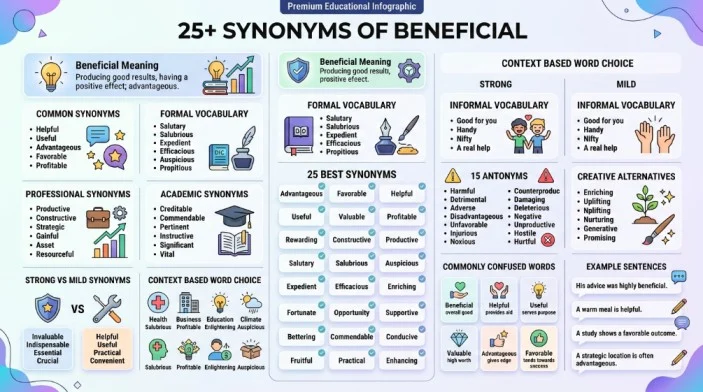
The right word can make a simple sentence sound clearer, stronger, and more professional. Synonym of Beneficial is useful when you want to replace “beneficial” without changing the main idea of your writing. Depending on the context, words such as advantageous, helpful, valuable, useful, favorable, and rewarding can communicate slightly different meanings. Choosing the closest alternative matters because tone and context can change how a sentence is understood.
In everyday writing, academic work, business communication, resumes, and professional content, precise vocabulary makes your message easier to understand. A good synonym should fit the situation, not simply act as a replacement. This guide explores accurate alternatives to Synonym of Beneficial, explains their meanings and tones, and shows how to use them naturally through practical examples. The goal is to help you choose clearer, more effective word choices with confidence.
What Are the Best Synonyms of “Beneficial”?
The best synonyms of beneficial include helpful, advantageous, useful, valuable, favorable, positive, constructive, and worthwhile. Use advantageous for formal writing, helpful for everyday communication, valuable for skills or resources, constructive for feedback, and positive when describing generally good results.
Meaning, Tone, and Context
Simple Definition
Beneficial describes something that produces a good result, provides an advantage, improves a situation, or contributes positively to someone’s health, development, success, or well being.
For example:
Regular exercise is beneficial to your health.
The sentence means that exercise has a positive effect on health.
The word usually focuses on the result or advantage that something provides rather than simply saying that something is pleasant or enjoyable.
Part of Speech
Beneficial is an adjective.
It normally describes a person, action, situation, treatment, decision, change, habit, relationship, or other thing that produces a positive effect.
Examples:
The training was beneficial to the new employees.
A balanced diet can be beneficial for overall health.
Overall Tone
The word beneficial has a positive and generally neutral tone.
It does not usually express strong emotion. Instead, it objectively communicates that something has a useful, favorable, or helpful effect.
Formality Level
Beneficial is neutral to moderately formal.
It works naturally in:
- Academic writing
- Professional reports
- Business communication
- Health related writing
- Educational material
- Everyday conversation
- Essays
- Workplace communication
In casual conversation, simpler words such as helpful or good for may sound more natural.
Common Uses
Native English speakers commonly use beneficial when discussing:
- Health
- Education
- Exercise
- Business decisions
- Workplace training
- Technology
- Relationships
- Policies
- Investments
- Habits
- Environmental practices
- Learning
- Personal development
- Professional skills
Examples:
Meditation can be beneficial for reducing everyday stress.
The partnership was beneficial to both companies.
Reading regularly is beneficial for language development.
Common Grammar Patterns
The most common patterns include:
- beneficial to + noun
The change was beneficial to employees.
- beneficial for + noun
Exercise is beneficial for your heart.
- beneficial in + gerund or context
The program was beneficial in improving workplace communication.
- beneficial effects
The treatment produced beneficial effects.
Related Word Forms
The main related noun is benefit.
Examples:
The new policy provides several benefits.
Employees benefited from the additional training.
Other related forms include beneficially, although this adverb is relatively uncommon in everyday English.
The opposite idea can be expressed with words such as harmful, detrimental, or disadvantageous, depending on context.
When and How to Use “Beneficial”
Use beneficial when you want to emphasize that something produces an advantage or positive effect. It is especially useful when the benefit is practical, measurable, useful, or connected to improvement.
Professional
The new training program has been beneficial to employee performance.
Academic
Regular feedback can be beneficial to student learning.
Workplace
Flexible scheduling may be beneficial for employee productivity.
Personal
Spending more time outdoors has been beneficial for my overall well being.
I believe this adjustment will be beneficial to both teams.
Resume
Developed beneficial partnerships with regional clients.
For a resume, however, a more specific word can often communicate the achievement better:
Developed valuable partnerships with regional clients.
Social Media
Taking regular breaks from work can be beneficial for creativity and focus.
Best Synonyms of “Beneficial”
No synonym perfectly replaces beneficial in every sentence. The word you choose should reflect the specific kind of advantage, usefulness, improvement, or positive effect you want to communicate.
Professional Writing: Advantageous
Advantageous is an excellent choice when describing a situation, decision, strategy, or condition that provides an advantage.
The revised agreement is advantageous for both parties.
It sounds polished and professional, making it useful in business reports, negotiations, and formal communication.
Academic Writing: Valuable
Valuable works well when discussing knowledge, research, experience, resources, or contributions that provide meaningful value.
The study provides valuable information for future researchers.
Business Communication: Favorable
Favorable is useful when describing conditions, outcomes, decisions, or circumstances that produce a positive result.
The company reached a favorable agreement with its supplier.
Casual Conversation: Helpful
Helpful is usually more natural than beneficial in everyday speech.
Your advice was really helpful.
It is simple, familiar, and easy to understand.
Emotional Writing: Meaningful
Meaningful is better when the benefit involves emotional value or personal significance.
Her support was meaningful during a difficult period.
Creative Writing: Rewarding
Rewarding works when an experience produces satisfaction, fulfillment, or a sense of achievement.
Volunteering can be a rewarding experience.
Resume Writing: Valuable
Valuable is particularly effective for describing skills, contributions, relationships, knowledge, or experience.
Built valuable relationships with key clients.
Workplace Communication: Constructive
Constructive works especially well for feedback, criticism, discussion, or suggestions that help improve something.
The manager provided constructive feedback after the presentation.
Stronger Meaning: Advantageous
When you want to emphasize a clear advantage rather than general helpfulness, advantageous is often stronger and more precise.
The location is advantageous for international business.
Softer Meaning: Helpful
When you simply want to say that something assists someone without making a strong claim, helpful is the safest option.
These instructions should be helpful for new users.
When Not to Use “Beneficial”
Although beneficial is flexible, it is not always the most natural choice.
When It Sounds Too General
If you know exactly what kind of benefit something provides, a more specific synonym can improve the sentence.
Less precise:
The course was beneficial.
More precise:
The course provided valuable practical skills.
The second sentence tells the reader what made the course useful.
When It Sounds Too Formal
In casual conversation, beneficial can sometimes sound more formal than necessary.
Formal:
Drinking enough water is beneficial for your health.
More conversational:
Drinking enough water is good for your health.
When It Sounds Too Weak
If something provides a major advantage, beneficial may not communicate enough strength.
Less forceful:
The new strategy was beneficial to the company.
Stronger:
The new strategy was highly advantageous to the company.
When You Need to Emphasize Help
If someone directly assists another person, helpful is often more natural.
Less natural:
My friend was beneficial when I was struggling.
Better:
My friend was helpful when I was struggling.
Beneficial usually describes an effect or advantage. Helpful can describe direct assistance.
When You Mean Emotional Value
If something matters because of its personal or emotional significance, meaningful may be a better choice.
Less precise:
The conversation was beneficial to me.
More expressive:
The conversation was meaningful to me.
When You Mean Financial Gain
If the benefit specifically involves money or profit, choose a more precise word.
General:
The investment was beneficial.
More specific:
The investment was profitable.
Words Commonly Confused With “Beneficial”
Helpful
Difference: Helpful means providing assistance or making something easier.
When to Use It: Use it when a person, action, resource, or piece of information directly assists someone.
Example:
The customer service representative was very helpful.
Advantageous
Difference: Advantageous emphasizes a favorable position or clear advantage.
When to Use It: Use it for strategies, circumstances, decisions, agreements, and opportunities.
Example:
The new location is advantageous for the company.
Useful
Difference: Useful means something has practical value or can be used effectively.
When to Use It: Use it for tools, information, skills, resources, and objects.
Example:
This guide contains useful information for new employees.
Valuable
Difference: Valuable focuses on worth, importance, usefulness, or contribution.
When to Use It: Use it for experience, knowledge, advice, skills, relationships, and resources.
Example:
Her experience was valuable to the entire team.
Favorable
Difference: Favorable describes something that creates good conditions or an agreeable outcome.
When to Use It: Use it for circumstances, decisions, conditions, reviews, and outcomes.
Example:
The company received favorable feedback from customers.
Constructive
Difference: Constructive describes something that helps develop, improve, or correct a situation.
When to Use It: Use it especially for criticism, feedback, suggestions, and conversations.
Example:
The editor offered constructive suggestions for improving the article.
Best Synonyms of “Beneficial” by Context
| Context | Best Synonym | Why It Works | Example |
|---|---|---|---|
| Formal writing | Advantageous | Clearly communicates an advantage. | The agreement was advantageous to both organizations. |
| Academic writing | Valuable | Highlights useful knowledge or contribution. | The research provides valuable evidence. |
| Professional communication | Advantageous | Sounds precise and business appropriate. | The arrangement is advantageous for the company. |
| Business emails | Helpful | Natural and polite in direct communication. | I hope these details are helpful. |
| Resume writing | Valuable | Highlights contribution and worth. | Developed valuable client relationships. |
| Workplace communication | Constructive | Suggests useful improvement. | She gave constructive feedback. |
| Casual conversation | Helpful | Sounds natural and familiar. | Your advice was helpful. |
| Everyday speaking | Useful | Simple and practical. | This app is useful for tracking expenses. |
| Creative writing | Rewarding | Adds emotional or experiential meaning. | Teaching was a rewarding experience. |
| Storytelling | Meaningful | Emphasizes personal significance. | Their conversation became meaningful. |
| Emotional writing | Meaningful | Focuses on personal value. | Her message was deeply meaningful. |
| Strong emphasis | Advantageous | Highlights a clear benefit or advantage. | The location is highly advantageous. |
| Mild tone | Helpful | Communicates assistance without exaggeration. | The information was helpful. |
| Social media captions | Positive | Short, familiar, and broadly understandable. | Small changes can create positive results. |
| American English | Beneficial | Common and natural in formal and neutral contexts. | The change was beneficial for employees. |
How to Choose the Best Synonym of “Beneficial”
Choosing the right synonym becomes easier when you identify the exact kind of benefit.
If Something Gives an Advantage
Choose advantageous.
The timing was advantageous for the company.
If Something Provides Assistance
Choose helpful.
The instructions were helpful.
If Something Has Practical Use
Choose useful.
This tool is useful for organizing files.
If Something Has High Value
Choose valuable.
Her professional experience was valuable.
If Something Produces a Positive Result
Choose positive.
The campaign had a positive effect on sales.
If Something Improves a Situation
Choose constructive.
The discussion was constructive.
If Something Creates Satisfaction
Choose rewarding.
Working with young students was rewarding.
If Something Is Good for Health
Choose healthful or healthy, depending on the sentence.
Regular exercise is beneficial to your health.
Regular exercise is healthy.
Consider Your Audience
- For academic readers, valuable, advantageous, and positive often work well.
- For business readers, advantageous, valuable, and favorable can sound precise and professional.
- For everyday readers, helpful, useful, and good for are often more natural.
Consider Emotional Strength
- Use helpful for mild emphasis.
- Use valuable when the benefit has greater worth.
- Use advantageous when there is a clear competitive or practical advantage.
- Use rewarding when the benefit involves personal satisfaction.
Consider Natural Usage
Do not replace beneficial simply to avoid repetition. A synonym should improve the sentence, not merely make it different.
For example:
The information was beneficial.
The information was useful.
The second sentence works well because information is something people can practically use.
Real Life Examples of “Beneficial”
School
Reading every day is beneficial for students who want to strengthen their vocabulary.
A stronger alternative:
Reading every day is valuable for students who want to strengthen their vocabulary.
College
Study groups can be beneficial for college students preparing for difficult exams.
A more precise version:
Study groups can be helpful for college students preparing for difficult exams.
Workplace
Regular training is beneficial for employees learning new software.
A stronger professional version:
Regular training is essential for employees learning new software.
Business
The partnership was beneficial to both companies.
A more precise version:
The partnership was advantageous to both companies.
I hope the attached document is beneficial to your planning process.
A more natural email version:
I hope the attached document is helpful for your planning process.
Resume
Created beneficial relationships with customers.
A stronger resume version:
Built valuable relationships with long term customers.
Conversation
Your advice was beneficial.
A more natural conversational version:
Your advice was helpful.
Storytelling
The experience was beneficial to her personal growth.
A more expressive version:
The experience was transformative for her personal growth.
Blogging
Using clear headings can be beneficial for readers.
A more direct version:
Using clear headings can be helpful for readers.
Social Media
Taking a short break from your phone can be beneficial.
A more conversational version:
Taking a short break from your phone can be good for your focus.
25 Best Synonyms of “Beneficial”
| Synonym | Simple Meaning | Best Used For | Example Sentence |
|---|---|---|---|
| Advantageous | Providing an advantage | Formal and business writing | The new location is advantageous for the company. |
| Helpful | Providing assistance | Everyday communication | Your explanation was extremely helpful. |
| Useful | Having practical value | Tools and information | This feature is useful for managing tasks. |
| Valuable | Having significant worth | Skills, knowledge, and experience | Her advice was valuable to the team. |
| Favorable | Producing a positive condition or result | Business and formal writing | The company reached a favorable agreement. |
| Positive | Producing a good effect | General and professional writing | The changes had a positive effect on morale. |
| Constructive | Helping improve something | Feedback and discussion | The manager gave constructive feedback. |
| Rewarding | Providing satisfaction or fulfillment | Experiences and activities | Volunteering can be a rewarding experience. |
| Worthwhile | Worth the time, effort, or cost | Activities and decisions | The training program was worthwhile. |
| Productive | Producing useful results | Work and activities | The meeting was productive. |
| Fruitful | Producing good or useful results | Discussions and efforts | The conversation led to a fruitful partnership. |
| Profitable | Producing financial gain | Business and investments | The company entered a profitable market. |
| Gainful | Providing financial benefit or employment | Work and income | She found gainful employment after graduation. |
| Effective | Producing the intended result | Methods and strategies | The new approach was effective. |
| Conducive | Helping create a particular condition | Formal and academic writing | A quiet room is conducive to concentration. |
| Salutary | Producing a beneficial or corrective effect | Formal writing | The experience had a salutary effect on his attitude. |
| Healthful | Promoting health | Health and lifestyle | Fresh foods can form part of a healthful diet. |
| Wholesome | Promoting health or well being | Food and lifestyle | The family prepared a wholesome meal. |
| Therapeutic | Helping healing or recovery | Health and emotional contexts | Gardening can be therapeutic for some people. |
| Serviceable | Adequate and useful for a purpose | Objects and practical use | The old laptop is still serviceable. |
| Productive | Producing useful results | Work and learning | The discussion was productive. |
| Supportive | Providing help or encouragement | Relationships and workplaces | Her manager was supportive during the transition. |
| Advantageous | Giving a useful benefit or favorable position | Formal communication | The flexible schedule was advantageous for employees. |
| Improving | Making a condition better | Health and development | The treatment produced improving results over time. |
| Favoring | Creating conditions that support success | Formal contexts | The policy created conditions favoring small businesses. |
Synonyms of “Beneficial” by Usage
- Professional vs Personal Synonyms
- Professional settings usually require precise language.
- Professional choices:
- Advantageous
- Valuable
- Favorable
- Constructive
- Effective
- Productive
Personal choices:
- Helpful
- Meaningful
- Rewarding
- Useful
- Positive
- Supportive
For example:
The manager provided constructive feedback.
sounds more professional than:
The manager provided helpful feedback.
Both are correct, but constructive more clearly suggests feedback intended to improve performance.
Formal vs Conversational Synonyms
Formal writing often benefits from precise vocabulary.
Reports
Use advantageous, significant, effective, or favorable.
Essays
Use valuable, conducive, advantageous, or effective when appropriate.
Business Writing
Use advantageous, valuable, favorable, or productive.
Presentations
Use valuable, effective, or positive.
Emails
Use helpful, useful, or valuable.
Casual Conversations
Use helpful, useful, good for, or positive.
Texting
Simple language is usually best:
That was really helpful.
rather than:
That was extremely beneficial.
The second sentence is grammatically correct but may sound unnecessarily formal in a casual text.
Academic Synonyms
Academic writing benefits from words that explain exactly what kind of positive effect is being discussed.
Valuable
Use valuable for information, evidence, research, knowledge, or contributions.
The findings provide valuable insight into student behavior.
Conducive
Use conducive when something creates conditions that help another activity happen.
A quiet environment is conducive to focused study.
Advantageous
Use advantageous when a particular condition provides an academic or practical advantage.
Early preparation is advantageous when completing a complex research project.
Effective
Use effective when a method successfully produces its intended result.
The intervention was effective in improving attendance.
Productive
Use productive for activities that generate useful progress or results.
The researchers held a productive discussion about the findings.
Professional and Business Synonyms
Resumes
Use valuable, strategic, productive, or effective where the context supports them.
Instead of:
Created beneficial client relationships.
Write:
Built valuable client relationships.
Interviews
Use valuable when describing experience or skills.
My previous role gave me valuable experience in customer service.
Meetings
Use productive when a meeting produces progress or useful outcomes.
We had a productive meeting with the marketing team.
Presentations
Use valuable or useful when describing information.
The presentation provided valuable insights into customer behavior.
Performance Reviews
Use effective or productive to describe work that achieves results.
She developed an effective system for tracking customer requests.
Client Communication
Use helpful, valuable, or useful.
I hope these recommendations are helpful.
Business Emails
Use beneficial itself when discussing mutual advantage.
We believe this arrangement will be beneficial to both organizations.
Creative and Literary Synonyms
Creative writing often needs more expressive vocabulary than business or academic writing.
Rewarding
Use rewarding for experiences that provide emotional satisfaction.
Teaching children was one of the most rewarding experiences of his life.
Meaningful
Use meaningful for emotionally significant experiences.
Their final conversation was deeply meaningful.
Transformative
Use transformative when an experience produces a major change in someone.
The journey was transformative.
Healing
Use healing when something helps emotional recovery or personal restoration.
Writing became a healing process after the loss.
Wholesome
Use wholesome when describing something healthy, positive, or morally uplifting.
The story offered a wholesome message about friendship.
These words can create more emotional depth than simply repeating beneficial.
Slang or Modern Synonyms
There is no single slang word that perfectly replaces beneficial in every situation.
However, informal expressions can communicate the same general idea.
Good for You
Meaning: Something produces a positive effect.
Acceptable: Casual conversation and social media.
Avoid: Academic papers and highly formal business documents.
Getting enough sleep is really good for you.
A Plus
Meaning: An additional advantage.
Acceptable: Casual and conversational contexts.
Avoid: Formal reports.
Having previous experience is a big plus.
Helpful
Although not slang, helpful is the most natural everyday alternative in many situations.
The tutorial was really helpful.
Strongest to Mildest Synonyms
The strength of a synonym depends on context. Some words describe simple usefulness, while others suggest a major advantage or substantial improvement.
Mild
- Helpful
- Useful
- Positive
- Serviceable
These words usually communicate a modest benefit.
Moderate
- Valuable
- Favorable
- Productive
- Constructive
- Rewarding
- Worthwhile
These suggest a more noticeable advantage or positive result.
Strong
- Advantageous
- Effective
- Fruitful
- Profitable
- Therapeutic
These words can indicate a substantial or clearly identifiable benefit.
Very Strong or Highly Specific
- Transformative
- Salutary
- Indispensable
These words should be used carefully because they communicate a more specific or substantial effect.
Emotional vs Neutral Synonyms
Emotional Synonyms
These alternatives add personal feeling or emotional significance:
- Meaningful
- Rewarding
- Healing
- Wholesome
- Transformative
- Supportive
Example:
Volunteering was a meaningful experience for her.
Neutral Synonyms
These communicate benefit without adding much emotion:
- Beneficial
- Useful
- Effective
- Advantageous
- Valuable
- Favorable
- Productive
Example:
The new system was effective at reducing processing time.
Use emotional vocabulary when personal experience matters. Use neutral vocabulary for reports, research, instructions, and objective explanations.
Antonyms of “Beneficial”
| Antonym | Meaning | Example Sentence |
|---|---|---|
| Harmful | Causing damage or negative effects | Excessive exposure can be harmful to your skin. |
| Detrimental | Causing harm or disadvantage | The delay was detrimental to the project. |
| Disadvantageous | Creating a disadvantage | The arrangement was disadvantageous for smaller companies. |
| Damaging | Causing harm or deterioration | The criticism had a damaging effect on morale. |
| Adverse | Producing an unfavorable result | The medication caused adverse effects. |
| Negative | Producing an undesirable result | The decision had a negative impact on sales. |
| Unhelpful | Providing little or no assistance | His response was unhelpful. |
| Useless | Having no practical value | The broken tool was useless. |
| Ineffective | Failing to produce the desired result | The original method was ineffective. |
| Counterproductive | Producing the opposite of the desired result | The new rule proved counterproductive. |
| Unproductive | Failing to generate useful progress | The meeting became unproductive. |
| Injurious | Causing physical or other harm | The substance can be injurious to health. |
| Detrimental | Having a harmful effect | Poor planning can be detrimental to business growth. |
| Unfavorable | Producing a negative condition or result | The company faced unfavorable market conditions. |
| Destructive | Causing serious damage | The storm had a destructive impact on the region. |
Comparison: “Beneficial” vs Similar Words
Beneficial vs Helpful
Main Difference
Beneficial emphasizes a positive effect or advantage. Helpful emphasizes assistance.
Which Is Stronger?
Neither is automatically stronger. They describe different kinds of usefulness.
Which Is More Formal?
Beneficial is generally more formal.
When to Use Each
Use beneficial for effects, outcomes, conditions, and health. Use helpful for people, advice, instructions, and direct assistance.
Examples
Beneficial:
Exercise is beneficial for overall health.
Helpful:
Your advice was helpful.
Beneficial vs Useful
Main Difference
Useful focuses on practical value. Beneficial focuses on a positive effect or advantage.
Which Is Stronger?
Beneficial can sound broader, while useful is more practical.
Which Is More Formal?
Beneficial is more formal.
When to Use Each
Use useful for tools, information, skills, and resources. Use beneficial for broader outcomes.
Examples
Beneficial:
The program was beneficial to students.
Useful:
The program provided useful study materials.
Beneficial vs Advantageous
Main Difference
Advantageous specifically emphasizes an advantage. Beneficial has a broader meaning.
Which Is Stronger?
Advantageous can sound stronger when a clear competitive or practical advantage exists.
Which Is More Formal?
Advantageous is highly suitable for formal and professional writing.
When to Use Each
Use advantageous for decisions, circumstances, agreements, and strategies.
Examples
Beneficial:
The change was beneficial to employees.
Advantageous:
The flexible schedule was advantageous to employees with children.
Beneficial vs Valuable
Main Difference
Valuable emphasizes worth. Beneficial emphasizes positive effect.
Which Is Stronger?
Neither is inherently stronger.
Which Is More Formal?
Both work well in formal writing.
When to Use Each
Use valuable for knowledge, experience, skills, advice, and resources.
Examples
Beneficial:
The training was beneficial to employees.
Valuable:
The training provided valuable practical experience.
Beneficial vs Favorable
Main Difference
Favorable describes conditions or outcomes that support a positive result.
Which Is Stronger?
They are similar in general strength.
Which Is More Formal?
Both are appropriate in formal communication.
When to Use Each
Use favorable for circumstances, decisions, reviews, agreements, and conditions.
Examples
Beneficial:
The partnership was beneficial to both companies.
Favorable:
The companies reached a favorable agreement.
Beneficial vs Positive
Main Difference
Positive is broader and can describe good results, attitudes, reactions, effects, or changes. Beneficial specifically emphasizes advantage or usefulness.
Which Is Stronger?
Neither is inherently stronger.
Which Is More Formal?
Both are widely used in professional and academic contexts.
When to Use Each
Use positive for general good results. Use beneficial when you want to emphasize practical advantage.
Examples
Beneficial:
The policy was beneficial to local businesses.
Positive:
The policy had a positive effect on local businesses.
Common Phrases and Expressions with “Beneficial”
Beneficial Effects
Meaning: Positive results produced by something.
Example:
Exercise can have beneficial effects on physical and mental well being.
Beneficial Impact
Meaning: A positive influence on a person, group, or situation.
Example:
The program had a beneficial impact on local students.
Beneficial to Health
Meaning: Helpful for maintaining or improving health.
Example:
Regular physical activity is beneficial to health.
Beneficial for Students
Meaning: Providing advantages to learners.
Example:
Smaller study groups can be beneficial for students.
Mutually Beneficial
Meaning: Providing advantages to all parties involved.
Example:
The two organizations created a mutually beneficial partnership.
Beneficial Relationship
Meaning: A relationship that provides positive value or advantages.
Example:
The companies developed a beneficial relationship over several years.
Beneficial Change
Meaning: A change that produces a positive result.
Example:
The new policy represents a beneficial change for employees.
Beneficial Results
Meaning: Outcomes that produce advantages or improvements.
Example:
The treatment produced beneficial results for many participants.
Common Mistakes to Avoid
Mistake 1: Treating Every Synonym as Identical
Incorrect:
The broken chair was beneficial.
Better:
The new chair was useful.
Why:
Beneficial generally describes a positive effect. Useful is more natural for an object that serves a practical purpose.
Mistake 2: Using Beneficial for Direct Assistance
Incorrect:
My teacher was beneficial when I needed help.
Better:
My teacher was helpful when I needed help.
Why:
Helpful naturally describes someone who provides assistance.
Mistake 3: Using Informal Language in Formal Writing
Incorrect:
The new policy is really good for the company.
Better:
The new policy is beneficial to the company.
Why:
The second version is more suitable for formal business communication.
Mistake 4: Using an Overly Strong Synonym
Incorrect:
Drinking one glass of water was transformative.
Better:
Drinking enough water is beneficial for your health.
Why:
Transformative suggests a major change. It is too strong for a minor or ordinary benefit.
Mistake 5: Confusing Beneficial With Profitable
Incorrect:
The educational program was profitable for students.
Better:
The educational program was beneficial for students.
Why:
Profitable specifically refers to financial gain. Beneficial can refer to many types of positive effects.
Mistake 6: Using Beneficial When Constructive Is More Precise
Incorrect:
The criticism was beneficial.
Better:
The criticism was constructive.
Why:
Constructive specifically communicates criticism that helps someone improve.
Mistake 7: Repeating the Same Word Too Often
Incorrect:
Exercise is beneficial. Healthy food is beneficial. Sleep is beneficial too.
Better:
Exercise is beneficial. Healthy food is valuable, while adequate sleep is essential for recovery.
Why:
Careful variation improves style while preserving the meaning.
Frequently Asked Questions
What is a good synonym for beneficial?
Useful, advantageous, helpful, favorable, valuable, and profitable can all work depending on the context.
What is another word for beneficial?
Advantageous is a strong general alternative to beneficial. Other options include helpful, useful, valuable, and favorable.
What are the synonyms of beneficial?
Common beneficial synonyms include advantageous, helpful, useful, valuable, favorable, profitable, and constructive.
What is a beneficial other term for formal writing?
For formal writing, advantageous, favorable, valuable, constructive, or profitable may be suitable alternatives.
What does beneficial mean in a thesaurus?
A beneficial thesaurus entry typically includes words that express a positive effect, advantage, usefulness, or improvement, such as helpful and advantageous.
Which synonym of beneficial is best for academic writing?
Advantageous, favorable, valuable, and constructive are often suitable for academic contexts, depending on the sentence.
What are the best synonyms of “beneficial”?
The best synonyms of beneficial include helpful, useful, advantageous, valuable, favorable, positive, constructive, and worthwhile. The ideal choice depends on whether you mean practical usefulness, assistance, advantage, or positive results.
What are the best formal synonyms of “beneficial”?
The strongest formal alternatives include advantageous, favorable, valuable, constructive, conducive, and salutary. For academic or business writing, choose the word that most precisely describes the type of benefit.
What are common informal synonyms of “beneficial”?
Common informal alternatives include helpful, useful, and good for. These expressions are often more natural than beneficial in everyday conversations, texts, and casual social media posts.
What is another word for “beneficial” in professional writing?
Advantageous, valuable, effective, favorable, and constructive are strong professional alternatives. Choose advantageous for clear benefits, valuable for contributions, and constructive for feedback or improvement.
What is the difference between “beneficial” and “helpful”?
Beneficial usually describes a positive effect or advantage, while helpful commonly describes direct assistance. For example, exercise can be beneficial to health, while a friend’s advice can be helpful.
What is the opposite of “beneficial”?
Common opposites include harmful, detrimental, disadvantageous, adverse, damaging, ineffective, counterproductive, and negative. The best antonym depends on whether you mean harm, disadvantage, lack of usefulness, or poor results.
Conclusion
Beneficial describes something that provides an advantage, creates a positive effect, or contributes to improvement. Its best alternatives depend on the exact meaning you want to express. Helpful works naturally for direct assistance, useful emphasizes practical value, valuable highlights worth, advantageous stresses an advantage, and constructive focuses on improvement.
There is no single perfect synonym for every sentence. The strongest choice depends on your audience, tone, purpose, and the type of benefit you want to describe.
A useful vocabulary habit is to ask yourself what kind of benefit you mean before replacing the word. That small step will help you choose a more precise synonym of beneficial instead of simply selecting a different word.
Read More Related Articles:
- Synonyms for Empty | Meaning, Examples, and Better Word …
- Synonyms for Pros and Cons | Meaning, Examples, and Better …