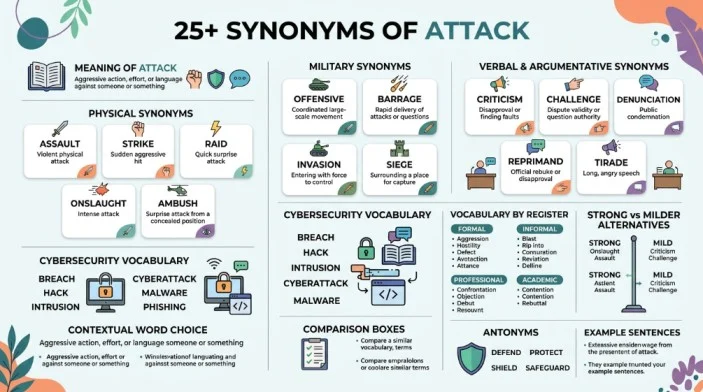
When writing an email, essay, news caption, resume, blog post, or social media update, repeating the word attack can make your language sound predictable. Finding the right synonym of attack can make your message more precise because attack can describe physical violence, military action, criticism, cybersecurity incidents, or a forceful attempt to damage something.
The best alternative depends on what you actually mean. Words such as assault, strike, raid, onslaught, criticize, and ambush are not interchangeable in every situation. Understanding their differences helps you choose vocabulary that communicates the exact action, level of force, and tone you intend.
What Are the Best Synonyms of “Attack”?
The best synonym of attack depends on context. Assault works well for a physical attack, strike for a sudden action, raid for a surprise military or police operation, onslaught for an intense sustained attack, and criticize for a verbal attack. In professional or academic writing, choose the alternative that most precisely describes the action.
Meaning, Tone, and Context
Simple Definition
The word attack generally means to use force, words, actions, or technology against a person, group, place, system, or idea.
It can describe a physical action, a military operation, harsh criticism, a cybersecurity incident, or a sudden medical condition. Because it has several meanings, its best synonym changes according to context.
Part of Speech
Attack can function as both a noun and a verb.
As a noun:
“The city experienced a sudden attack.”
As a verb:
“The soldiers attacked the position.”
Overall Tone
The tone of attack is usually negative because it commonly involves harm, conflict, aggression, criticism, or danger.
However, its emotional intensity depends on the context. A cybersecurity report may use attack in a neutral technical sense, while a sentence about a violent assault carries a much stronger emotional meaning.
Formality Level
Attack is a neutral English word. It is appropriate in casual conversation, journalism, academic writing, professional reports, military discussions, and technical communication.
Some alternatives are more specialized or formal.
For example:
- attack is neutral
- assault can sound more specific or legal
- onslaught is more dramatic
- incursion is often formal and military
- criticism is more appropriate when discussing verbal attacks
Common Uses
Native English speakers commonly use attack when discussing:
- Physical violence
- Military operations
- Cybersecurity incidents
- Verbal criticism
- Political criticism
- Sports strategies
- Animal behavior
- Disease or medical symptoms
- Attacks on buildings or infrastructure
- Attacks against ideas or arguments
Word Forms
| Word Form | Example |
|---|---|
| Verb | attack |
| Noun | attack |
| Third Person Verb | attacks |
| Past Tense | attacked |
| Present Participle | attacking |
| Related Noun | attacker |
| Related Noun | aggression |
| Related Adjective | aggressive |
When and How to Use “Attack”
Use attack when you need a broad word for an aggressive action directed toward someone or something. It is especially useful when the exact type of attack is not the main focus or when the context already makes the meaning clear.
Professional
“The company detected an attack on its internal network.”
Here, attack refers to a cybersecurity incident. More technical alternatives may be appropriate when the specific method is known.
Academic
“The article examines how political leaders respond to personal attacks.”
In academic writing, attack can describe hostile criticism as well as physical or military action.
Workplace
“The security team responded quickly to the cyberattack.”
The word is natural in workplace discussions about digital security.
Personal
“The dog suddenly attacked the stranger.”
Here, attack clearly describes aggressive physical behavior.
“We are investigating the attack that affected several company systems.”
The neutral wording works well in professional communication.
Resume
“Developed security measures to prevent network attacks.”
A resume can use attack when describing cybersecurity responsibilities or technical achievements.
Social Media
“The team launched an aggressive attack in the second half.”
In sports, attack can describe an offensive strategy rather than physical violence.
Best Synonyms of “Attack”
No single synonym perfectly replaces attack in every sentence. The right word depends on the type of action, its intensity, whether it is physical or verbal, and the level of formality you need.
Professional Writing: Assault or Incident
For professional writing, assault can be appropriate when discussing a physical attack, while incident may be better when the emphasis is on the event rather than aggression.
“The employee reported an assault to building security.”
Academic Writing: Criticism or Assault
For academic discussions, criticism is usually more precise when attack refers to challenging an argument or position.
“The theory received criticism from several researchers.”
Business Communication: Cyberattack or Breach
In business and technology contexts, cyberattack or breach may communicate more information than the broad word attack.
“The company suffered a major data breach.”
Casual Conversation: Hit or Strike
In everyday speech, hit can describe a physical action, while strike can sound more deliberate or forceful.
“The player struck the ball with incredible speed.”
Emotional Writing: Onslaught
Onslaught is useful when describing an overwhelming or emotionally intense attack.
“She faced an onslaught of criticism after the announcement.”
Creative Writing: Ambush
Ambush adds a sense of surprise and danger to a scene.
“The travelers walked into an ambush before sunset.”
Resume Writing: Counter
When describing defensive or strategic work, counter can be more specific than attack.
“Designed systems to counter emerging cybersecurity threats.”
Workplace Communication: Challenge
When discussing disagreement rather than physical aggression, challenge often sounds more professional.
“The manager challenged the assumptions behind the proposal.”
Stronger Meaning: Onslaught
Onslaught suggests an intense, forceful, and often sustained attack.
“The small team survived an onslaught of complaints.”
Softer Meaning: Criticism
- When attack means verbal hostility, criticism can provide a more neutral alternative.
“The proposal received criticism from several reviewers.”
When Not to Use “Attack”
- When the Word Is Too General
Attack can be vague when the specific action matters.
Less precise:
“The building experienced an attack.”
Better:
“The building was damaged during a bombing.”
The second sentence identifies the specific event.
When the Word Is Too Vague for Cybersecurity
Less precise:
“The company suffered an attack.”
Better:
“The company suffered a ransomware attack.”
The more specific term tells readers what happened.
When the Word Sounds Too Aggressive
Sometimes attack makes disagreement sound more hostile than intended.
Less suitable:
“The researcher attacked the theory.”
Better:
“The researcher challenged the theory.”
Challenge communicates disagreement without necessarily implying hostility.
When You Need a Legal Term
In legal contexts, assault can be more specific than attack, depending on the circumstances and jurisdiction.
General:
“The victim reported an attack.”
More specific:
“The victim reported an assault.”
The exact legal terminology should be checked against the relevant jurisdiction.
When You Need to Show Surprise
If the attack happened unexpectedly, ambush may be more informative.
General:
“The soldiers faced an attack.”
More precise:
“The soldiers were caught in an ambush.”
When You Mean Verbal Disagreement
Attack may sound overly hostile when someone simply disagrees.
Less suitable:
“She attacked his proposal.”
Better:
“She criticized his proposal.”
When You Mean a Medical Event
Not every medical episode should automatically be called an attack. Medical terms such as episode, seizure, or flare up can be more accurate when medically appropriate.
Words Commonly Confused With “Attack”
| Word | Difference | When to Use It | Example |
|---|---|---|---|
| Assault | Usually refers to a physical attack or a legally defined offense. | Physical or legal contexts. | “The victim reported an assault.” |
| Criticism | Focuses on negative evaluation rather than physical aggression. | Essays, reviews, debates. | “The proposal received criticism.” |
| Aggression | Describes hostile behavior or attitude more broadly. | Psychology, conflict, behavior. | “The animal showed signs of aggression.” |
| Raid | A sudden attack or operation, often involving a specific target. | Military, police, historical contexts. | “Police conducted a raid on the warehouse.” |
| Ambush | A surprise attack from a concealed position. | Military, crime, storytelling. | “The convoy was caught in an ambush.” |
| Invasion | Entering a place or territory by force, usually on a larger scale. | Military or figurative contexts. | “The invasion changed the course of the war.” |
Best Synonyms of “Attack” by Context
| Context | Best Synonym | Why It Works | Example |
|---|---|---|---|
| Formal writing | Assault | More specific for physical violence. | “The report documented the assault.” |
| Academic writing | Criticism | Fits intellectual disagreement. | “The theory faced criticism.” |
| Professional communication | Aggression | Describes hostile conduct broadly. | “The employee displayed aggression.” |
| Business emails | Cyberattack | Specific to digital threats. | “We detected a cyberattack.” |
| Resume writing | Counter | Shows strategic response. | “Developed tools to counter threats.” |
| Workplace communication | Challenge | Professional alternative for disagreement. | “She challenged the proposal.” |
| Casual conversation | Hit | Simple and natural for physical action. | “The boxer hit his opponent.” |
| Everyday speaking | Strike | Natural for a deliberate physical action. | “He struck the target.” |
| Creative writing | Onslaught | Adds intensity and drama. | “An onslaught of enemies approached.” |
| Storytelling | Ambush | Creates surprise and suspense. | “The travelers walked into an ambush.” |
| Emotional writing | Onslaught | Conveys overwhelming pressure. | “She endured an onslaught of criticism.” |
| Strong emphasis | Onslaught | Suggests sustained intensity. | “The team faced an onslaught.” |
| Mild tone | Criticism | Sounds less aggressive than attack. | “The plan received criticism.” |
| Social media captions | Hit | Short and conversational. | “The campaign hit back.” |
| American English | Attack | Standard and widely understood. | “The city came under attack.” |
| British English | Attack | Also standard and widely understood. | “The area came under attack.” |
How to Choose the Best Synonym of “Attack”
Choosing the right word becomes easier when you identify the exact meaning before replacing attack.
Step 1: Identify the Type of Action
Ask whether the attack is:
- Physical
- Military
- Verbal
- Digital
- Strategic
- Emotional
- Figurative
A physical attack may require assault, while a verbal attack may be better expressed as criticism.
Step 2: Consider the Tone
Use neutral vocabulary when you want to report information objectively.
Use stronger vocabulary when the intensity of the action matters.
For example:
“The proposal received criticism.”
sounds more neutral than:
“The proposal faced an onslaught of criticism.”
Step 3: Consider Your Audience
Academic readers usually benefit from precise, objective language. Casual readers may prefer simpler words such as hit or fight when appropriate.
Step 4: Consider Emotional Strength
If the action was sudden and violent, assault or ambush may be appropriate.
If the disagreement was intellectual, challenge or criticize may be better.
Step 5: Match the Writing Purpose
A resume should emphasize professional skills.
A news report should prioritize accuracy.
A story may prioritize atmosphere and intensity.
A cybersecurity report should identify the specific type of threat.
Step 6: Choose Natural Usage
A synonym should not merely have a similar dictionary meaning. It should also sound natural in the sentence.
For example, onslaught works naturally with:
“an onslaught of criticism”
but it would sound unusual to replace every occurrence of attack with onslaught.
Real Life Examples of “Attack”
School
Basic:
“The article discusses an attack on the environment.”
Stronger:
“The article examines an assault on natural ecosystems.”
The second version creates a stronger figurative image, although attack may still be the clearer academic choice depending on the subject.
College
Basic:
“The author attacks the opposing argument.”
Improved:
“The author challenges the opposing argument.”
Challenge is more suitable when the writer is presenting reasoned disagreement.
Workplace
Basic:
“The employee attacked the proposal.”
Improved:
“The employee strongly criticized the proposal.”
The revised sentence reduces unnecessary hostility.
Business
Basic:
“The company suffered an attack.”
Improved:
“The company suffered a coordinated cyberattack.”
The improved version gives readers more useful information.
Basic:
“We experienced an attack on our network.”
Improved:
“We detected a cybersecurity breach affecting several network systems.”
The second version is more informative in a professional message when a breach is what actually occurred.
Resume
Basic:
“Protected company systems from attacks.”
Improved:
“Developed security measures to counter cybersecurity threats.”
The improved wording focuses on the professional skill rather than simply repeating attack.
Conversation
Basic:
“He attacked me during the argument.”
Alternative:
“He verbally attacked me during the argument.”
Adding verbally removes ambiguity about the type of attack.
Storytelling
Basic:
“The village came under attack.”
Creative:
“The village endured a sudden onslaught before dawn.”
The second sentence creates a stronger sense of drama and scale.
Blogging
Basic:
“The brand faced an attack from competitors.”
Improved:
“The brand faced a wave of criticism from competitors.”
This works better if the competitors were criticizing the company rather than physically or strategically attacking it.
Social Media
Basic:
“The team launched an attack in the final minutes.”
Alternative:
“The team launched a powerful offensive in the final minutes.”
In sports writing, offensive can be a useful alternative when discussing aggressive play.
25 Best Synonyms of “Attack”
| Synonym | Simple Meaning | Best Used For | Example Sentence |
|---|---|---|---|
| Assault | A forceful physical attack | Physical or legal contexts | “The victim reported an assault to police.” |
| Strike | A deliberate forceful action | Military, sports, physical action | “The army launched a strike at dawn.” |
| Raid | A sudden attack or operation | Military and police contexts | “The officers conducted a raid on the building.” |
| Onslaught | A powerful, sustained attack | Dramatic or intense situations | “The team faced an onslaught of criticism.” |
| Offensive | An organized aggressive campaign | Military and sports | “The army began a new offensive.” |
| Aggression | Hostile or violent behavior | Behavior and conflict | “The animal displayed unexpected aggression.” |
| Invasion | Forceful entry into territory | Military or figurative contexts | “The invasion changed the region’s history.” |
| Incursion | A limited entry into another area | Formal military writing | “The troops reported an incursion across the border.” |
| Bombardment | Continuous attack with weapons or information | Military or figurative contexts | “The city endured hours of bombardment.” |
| Barrage | A concentrated series of attacks or criticism | Military, media, criticism | “The policy faced a barrage of criticism.” |
| Ambush | A surprise attack from concealment | Military and storytelling | “The patrol was caught in an ambush.” |
| Assaulting | Attacking with force | Physical action | “The suspect was accused of assaulting another person.” |
| Assail | To attack physically or verbally | Formal writing | “Critics assailed the new policy.” |
| Besiege | To surround and attack or pressure continuously | Military and figurative writing | “The city was besieged for weeks.” |
| Bombard | To attack repeatedly with weapons, questions, or messages | Military and figurative contexts | “Reporters bombarded the spokesperson with questions.” |
| Batter | To hit repeatedly or damage severely | Physical and figurative contexts | “The storm battered the coastline.” |
| Pounce | To attack suddenly | Animals and figurative situations | “The cat pounced on the toy.” |
| Ambush | To attack unexpectedly | Surprise attacks | “The group ambushed the convoy.” |
| Target | To direct an attack toward someone or something | Military, cyber, business | “Hackers targeted the company’s database.” |
| Criticize | To express disapproval | Arguments and opinions | “Reviewers criticized the proposal.” |
| Challenge | To dispute or question | Academic and professional contexts | “The researcher challenged the earlier conclusion.” |
| Denounce | To condemn publicly and strongly | Political and formal writing | “Leaders denounced the violent act.” |
| Confront | To face or challenge directly | Conflict and personal situations | “She confronted the issue directly.” |
| Counter | To respond to an attack | Strategy and defense | “The team developed a plan to counter the threat.” |
| Hit | To strike physically | Casual conversation and sports | “The ball hit the wall.” |
Note: Some words above match only particular senses of attack. For example, criticize matches a verbal attack, while raid matches a sudden physical or military operation. They should not be treated as interchangeable in every sentence.
Synonyms of “Attack” by Usage
Professional vs Personal Synonyms
Professional writing benefits from precise terms such as assault, cyberattack, criticism, incursion, and aggression.
Personal conversation often favors simpler language such as hit, strike, or fight, depending on the situation.
For example:
Professional:
“The organization reported a cybersecurity attack.”
Personal:
“Someone attacked him outside the store.”
The best word is determined by the type of event and the audience.
Formal vs Conversational Synonyms
For reports and essays, words such as assault, incursion, criticism, and aggression can provide greater precision.
For casual conversation, hit, fight, and strike may sound more natural when they accurately describe the action.
Avoid choosing a complicated synonym simply because it sounds more sophisticated. Clear vocabulary is usually more effective than unnecessarily formal language.
Academic Synonyms
Academic writing often requires a distinction between physical action and intellectual disagreement.
Useful choices include:
- Criticize for negative evaluation
- Challenge for questioning an established position
- Assail for strong formal criticism
- Significantly challenge when describing substantial disagreement
- Denounce for strong public condemnation
Example:
“The researchers challenged the assumptions behind the original model.”
This is usually more precise than saying:
“The researchers attacked the model.”
Professional and Business Synonyms
Resumes
Use counter, target, or address when describing cybersecurity or strategic work.
“Developed systems to counter emerging security threats.”
Interviews
Use challenge when explaining how you questioned an idea professionally.
“I challenged the existing process and proposed a more efficient approach.”
Meetings
Use criticize when discussing disagreement with a proposal.
“The committee criticized several aspects of the plan.”
Presentations
Use offensive when discussing sports or military strategy, but choose the specific professional term that matches the subject.
Performance Reviews
Avoid describing a coworker’s disagreement as an attack unless hostility is genuinely relevant.
Instead:
“The employee challenged the proposed approach.”
Client Communication
Neutral vocabulary is usually preferable.
Instead of:
“The competitor attacked our product.”
consider:
“The competitor criticized our product.”
Business Emails
Use specific cybersecurity vocabulary when appropriate.
“Our security team detected a phishing attack.”
Specific wording makes the message easier to understand.
Creative and Literary Synonyms
Creative writing allows stronger vocabulary when the goal is to create tension or imagery.
Onslaught
Suggests overwhelming force.
“An onslaught of enemies poured through the gates.”
Ambush
Creates surprise.
“They realized too late that the road was an ambush.”
Assault
Creates a direct sense of violence.
“The fortress endured a relentless assault.”
Besiege
Suggests prolonged pressure.
“The soldiers besieged the ancient city.”
Barrage
Creates the impression of repeated attacks.
“A barrage of arrows filled the sky.”
These words should be selected for the image they create, not simply because they sound stronger.
Slang or Modern Synonyms
There is no single slang word that reliably replaces attack across all contexts.
In casual speech, expressions such as go after someone or come at someone can describe verbal or physical confrontation.
Go After
Meaning: To pursue, criticize, or confront someone aggressively.
Casual:
“The commentators went after the team’s strategy.”
Avoid it in formal academic writing because it is conversational.
Come At
Meaning: To approach or confront someone aggressively.
Casual:
“He came at me with a completely different argument.”
This expression is informal and should generally be avoided in formal reports.
Strongest to Mildest Synonyms
The intensity of an attack changes significantly depending on the word.
Mild
Criticism, challenge, disagreement
These can describe opposition without implying physical aggression.
Moderate
Strike, raid, confrontation, assault
These generally suggest a more direct action.
Strong
Attack, bombardment, barrage, onslaught
These words can communicate significant force or sustained pressure.
Very Strong
Assault, onslaught, invasion, besiege
These can suggest serious, prolonged, or overwhelming aggression depending on context.
Intensity is not absolute. An assault may be legally specific, while an onslaught may be figurative and describe criticism rather than physical violence.
Emotional vs Neutral Synonyms
Emotional Synonyms
Use these when you want readers to feel the force or hostility of the situation.
- Onslaught
- Assault
- Aggression
- Ambush
- Barrage
- Besiege
Example:
“The candidate faced an onslaught of negative comments.”
Neutral Synonyms
These are better when reporting information objectively.
- Attack
- Criticism
- Challenge
- Incursion
- Strike
- Raid
Example:
“The report describes a military strike in the region.”
Neutral language is especially useful in academic, professional, and informational writing.
Antonyms of “Attack”
Because attack has several meanings, its opposites also vary by context. The following words represent genuine opposing actions or states in the relevant senses.
| Antonym | Meaning | Example Sentence |
|---|---|---|
| Defend | Protect against an attack | “The soldiers defended the city.” |
| Protect | Keep someone or something safe | “Security guards protect the building.” |
| Guard | Watch over something to prevent harm | “Officers guarded the entrance.” |
| Shield | Protect from harm or attack | “The system shields users from threats.” |
| Safeguard | Take action to prevent damage | “The company safeguards customer data.” |
| Preserve | Protect something from damage or destruction | “The policy helps preserve the historic site.” |
| Support | Help rather than oppose | “The committee supported the proposal.” |
| Assist | Help someone instead of harming them | “The team assisted the injured player.” |
| Aid | Provide help or protection | “The organization aided affected families.” |
| Praise | Express approval instead of criticism | “The reviewers praised the new design.” |
| Commend | Publicly express approval | “The manager commended her work.” |
| Reconcile | Restore friendly relations after conflict | “The two sides worked to reconcile.” |
| Retreat | Move away from an attacking position | “The troops retreated before nightfall.” |
| Withdraw | Pull back from a conflict or position | “The forces withdrew from the area.” |
| Surrender | Stop resisting an attack | “The troops eventually surrendered.” |
Comparison: “Attack” vs Similar Words
Attack vs Assault
Main Difference
Attack is a broad term for aggressive action. Assault is more specific and commonly refers to physical violence or a legally defined offense.
Which Is Stronger?
Assault can sound more specific and serious when discussing physical violence.
Which Is More Formal?
Assault is often more appropriate in legal or official contexts.
When to Use Each
Use attack when the type of aggression is broad or already understood. Use assault when physical or legal context matters.
Examples
Attack:
“The victim described the attack.”
Assault:
“The victim reported the assault.”
Attack vs Criticism
Main Difference
Attack can suggest hostile criticism. Criticism focuses specifically on negative evaluation.
Which Is Stronger?
Attack is usually stronger and more hostile.
Which Is More Formal?
Criticism is generally better for academic and professional writing.
When to Use Each
Use criticism when someone evaluates an idea negatively without implying hostility.
Examples
Attack:
“The senator attacked the proposal.”
Criticism:
“The senator criticized the proposal.”
Attack vs Aggression
Main Difference
Attack usually describes a specific action. Aggression describes hostile behavior, attitude, or conduct more generally.
Which Is Stronger?
They differ in meaning more than intensity.
Which Is More Formal?
Aggression is common in psychology, behavioral studies, and formal discussions.
When to Use Each
Use attack for a specific event. Use aggression for a pattern or quality of behavior.
Examples
Attack:
“The dog attacked the stranger.”
Aggression:
“The dog showed signs of aggression.”
Attack vs Raid
Main Difference
A raid is generally sudden and targeted, while attack is a broader term.
Which Is Stronger?
Neither is always stronger. Raid emphasizes surprise and limited scope.
Which Is More Formal?
Both can be formal depending on context.
When to Use Each
Use raid for a sudden operation against a particular target.
Examples
Attack:
“The base came under attack.”
Raid:
“The police conducted a raid.”
Attack vs Ambush
Main Difference
An ambush is a surprise attack, often involving concealment or waiting for a target.
Which Is Stronger?
Ambush is more specific rather than necessarily stronger.
Which Is More Formal?
Both are appropriate in military and historical writing.
When to Use Each
Use ambush when surprise is an essential part of the action.
Examples
Attack:
“The convoy faced an attack.”
Ambush:
“The convoy was caught in an ambush.”
Attack vs Invasion
Main Difference
An invasion involves entering a place or territory by force, usually on a larger scale.
Which Is Stronger?
Invasion often implies greater scale and territorial impact.
Which Is More Formal?
Both are suitable for historical, political, and military writing.
When to Use Each
Use invasion when forceful entry into territory is central to the event.
Examples
Attack:
“The country faced an attack.”
Invasion:
“The country faced an invasion.”
Common Phrases and Expressions with “Attack”
Attack on Someone
Meaning: A physical, verbal, or figurative act directed against a person.
Example:
“The article was described as an attack on the journalist.”
Attack on Something
Meaning: An attempt to damage, criticize, or weaken something.
Example:
“Critics viewed the proposal as an attack on traditional practices.”
Come Under Attack
Meaning: To become the target of an attack or criticism.
Example:
“The company came under attack after the announcement.”
Launch an Attack
Meaning: Begin an organized attack.
Example:
“The team launched an attack in the final minutes.”
Cyberattack
Meaning: A deliberate attempt to damage, disrupt, or gain unauthorized access to a computer system.
Example:
“The company strengthened its defenses after the cyberattack.”
Verbal Attack
Meaning: Strong or hostile criticism expressed through words.
Example:
“The candidate faced a verbal attack during the debate.”
Personal Attack
Meaning: Criticism directed at a person rather than their ideas or work.
Example:
“The discussion became unproductive when it turned into a personal attack.”
Under Attack
Meaning: Currently being targeted by physical, verbal, or digital aggression.
Example:
“The website came under attack from automated traffic.”
Common Mistakes to Avoid
1. Treating Every Synonym as Interchangeable
Incorrect
“The police launched an onslaught.”
Better
“The police conducted a raid.”
Why
Raid describes a targeted operation more naturally, while onslaught suggests an overwhelming attack.
2. Using “Attack” for Every Disagreement
Incorrect
“The professor attacked the student’s idea.”
Better
“The professor challenged the student’s idea.”
Why
Challenge can describe intellectual disagreement without suggesting personal hostility.
3. Using Informal Language in Academic Writing
Incorrect
“The author went after the opposing theory.”
Better
“The author criticized the opposing theory.”
Why
Criticized is clearer and more appropriate for academic writing.
4. Choosing an Overly Dramatic Synonym
Incorrect
“The company faced an onslaught of three customer complaints.”
Better
“The company received three customer complaints.”
Why
Onslaught suggests overwhelming pressure and is excessive for a small number of complaints.
5. Confusing “Assault” and “Attack”
Incorrect
“The article describes an assault on the country’s borders.”
Better
“The article describes an attack on the country’s borders.”
Why
Assault often refers to physical violence against a person or a direct physical attack, while attack is broader.
6. Using “Ambush” Without Surprise
Incorrect
“The army announced its planned ambush in advance.”
Better
“The army announced its planned attack in advance.”
Why
An ambush normally depends on surprise, concealment, or an unexpected attack.
7. Using Strong Language When Neutral Language Is Better
Incorrect
“The journalist launched a brutal attack on the proposal.”
Better
“The journalist strongly criticized the proposal.”
Why
The revised version communicates disagreement without adding unnecessary emotional intensity.
Frequently Asked Questions
1. What are the best synonyms of “attack”?
The best synonym of attack depends on context. Assault fits physical violence, raid suggests a sudden operation, onslaught emphasizes intensity, ambush highlights surprise, and criticize works for verbal or intellectual attacks.
2. What are the best formal synonyms of “attack”?
Formal alternatives include assault, incursion, aggression, onslaught, criticism, and denounce, depending on meaning. Academic and professional writers should select the word that describes the exact action rather than simply choosing the most sophisticated option.
3. What are common informal synonyms of “attack”?
Informal alternatives include hit, go after, and come at, depending on context. These expressions are natural in casual speech but may sound too conversational for academic papers, official reports, resumes, and formal business communication.
4. What is another word for “attack” in professional writing?
In professional writing, assault, cyberattack, criticism, challenge, aggression, or threat may work better than attack. The best choice depends on whether the subject involves physical violence, technology, disagreement, or hostile behavior.
5. What is the difference between “attack” and “assault”?
Attack is a broad term for aggressive action, while assault more specifically refers to physical violence or a legally defined offense. In professional or legal writing, assault should be used when that specific meaning is intended.
6. What is the opposite of “attack”?
The most direct opposite of attack is defend when discussing physical, military, or cybersecurity situations. Other context dependent opposites include protect, guard, shield, support, praise, retreat, and withdraw.
Conclusion
The word attack has several meanings, so the best replacement depends on the situation. Assault is useful for physical violence, raid emphasizes a sudden targeted operation, ambush highlights surprise, onslaught communicates overwhelming force, and criticism works better when the attack is verbal or intellectual.
No synonym of attack works perfectly in every context. Before replacing the word, consider what happened, how intense the action was, who will read your writing, and whether you want a neutral, formal, emotional, or conversational tone.
A useful vocabulary habit is to identify the exact meaning you want first, then choose the most specific word that communicates it naturally.
Read More Related Articles:
Synonyms for Empty | Meaning, Examples, and Better Word …
Synonyms for Creativity | Meaning, Examples, and Better …