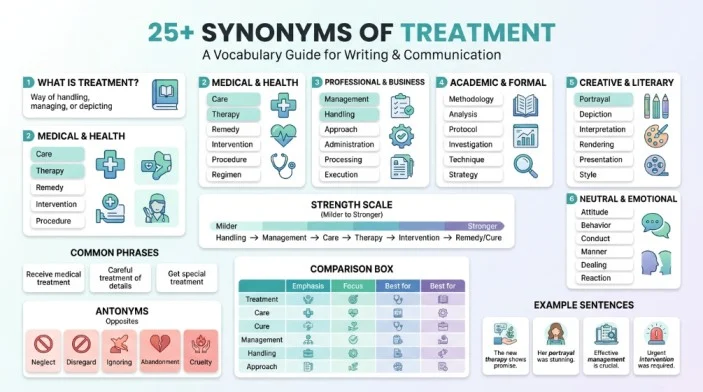
A writer may use the word treatment several times in the same essay, medical article, business report, or everyday conversation. The problem is that treatment can describe medical care, the way someone is treated, the handling of a subject, or the processing of a material, so replacing it with any random synonym can change the meaning.
Finding the right synonym of treatment means first identifying the sense you need. Words such as therapy, care, management, and intervention work well for healthcare, while handling, approach, portrayal, and processing fit other contexts. The best alternative improves precision without changing your intended message.
What Are the Best Synonyms of “Treatment”?
The best synonym of treatment depends on context. In healthcare, use therapy, care, management, intervention, or remedy. For behavior, handling or treatment may fit. For academic or creative subjects, approach or portrayal can work, while processing is appropriate for materials and technical contexts.
Meaning, Tone, and Context
Simple Definition
Treatment generally refers to what is done to deal with a medical condition, problem, person, subject, material, or situation.
The meaning changes significantly depending on context. Medicine, treatment refers to care intended to manage or improve a health condition. In phrases such as “fair treatment,” it refers to the way someone is treated. Writing, “the treatment of poverty in the novel” refers to how a subject is presented or discussed.
Part of Speech
Treatment is primarily a noun.
It can refer to:
- Medical care or therapy.
- The way a person or group is treated.
- The handling or discussion of a subject.
- A process applied to a material or object.
- A proposed approach to a problem.
Overall Tone
Treatment is generally neutral.
Its emotional tone depends on the surrounding words. “Effective treatment” sounds positive, while “cruel treatment” has a negative tone.
Formality Level
Treatment is a neutral to formal word and is widely used in professional, academic, medical, and everyday English.
Examples include:
- “The patient received treatment.”
- “The report examines the treatment of immigrants.”
- “The wood requires special treatment.”
- “The film offers a thoughtful treatment of the subject.”
Common Uses
Native English speakers commonly use treatment in these contexts:
- Medical treatment
- Cancer treatment
- Mental health treatment
- Dental treatment
- Drug treatment
- Physical therapy
- Treatment for an illness
- Fair treatment
- Equal treatment
- Cruel treatment
- Treatment of a subject
- Treatment of materials
- Water treatment
- Heat treatment
- Chemical treatment
Word Forms
| Word | Part of Speech | Example |
|---|---|---|
| Treatment | Noun | “The treatment was effective.” |
| Treat | Verb | “Doctors treat the condition.” |
| Treated | Adjective or past participle | “The treated material was tested.” |
| Treating | Verb form | “The doctor is treating the patient.” |
The most important related verb is treat, which means to provide medical care, behave toward someone in a particular way, deal with a subject, or apply a process to something.
When and How to Use “Treatment”
Use treatment when you need a broad noun that describes care, handling, or an applied process. It is especially useful when the exact type of care or approach is either already understood or explained elsewhere.
Professional
“The clinic offers specialized treatment for patients with chronic conditions.”
Here, treatment refers to professional medical care.
Academic
“The article examines the treatment of environmental issues in contemporary literature.”
In this sentence, treatment means the way a subject is handled or presented.
Workplace
“Employees expect fair treatment regardless of their position.”
Here, treatment refers to the way people are treated.
Personal
“She appreciated the kind treatment she received from her neighbors.”
The word describes someone’s behavior toward another person.
“Your doctor may recommend additional treatment after reviewing the test results.”
This use is appropriate for a professional medical message.
Resume
“Assisted with patient treatment under the supervision of licensed healthcare professionals.”
In a resume, treatment communicates healthcare experience in a concise and professional way.
Social Media
“Access to affordable medical treatment should be available to everyone.”
This use is suitable for discussions about healthcare and social issues.
Best Synonyms of “Treatment”
No single synonym works in every sentence because treatment has several distinct meanings. The best replacement depends on whether you mean medical care, a method of dealing with something, behavior toward a person, presentation of a subject, or processing of a material.
Professional Writing: Management
Management works particularly well in healthcare and professional contexts when discussing the ongoing control or care of a condition.
Example:
“The long term management of diabetes requires regular monitoring.”
It is especially useful when treatment involves continuing care rather than one specific procedure.
Academic Writing: Approach
Approach is a strong choice when treatment means the way a subject or issue is handled in research, writing, or analysis.
Example:
“The author’s approach to the topic is both balanced and detailed.”
Business Communication: Handling
When treatment refers to the way a person, issue, or situation is dealt with, handling can be more direct.
Example:
“The company’s handling of the complaint was professional.”
Casual Conversation: Care
Care is a natural alternative when discussing medical attention or support.
Example:
“She received excellent care at the hospital.”
Emotional Writing: Kindness
When treatment refers to positive behavior toward another person, kindness can express the emotional quality more clearly.
Example:
“His kindness helped her feel welcome.”
Creative Writing: Portrayal
When discussing how a writer, filmmaker, or artist presents a person, theme, or subject, portrayal is more precise.
Example:
“The novel offers a complex portrayal of family life.”
Resume Writing: Patient Care
For healthcare resumes, patient care is often more specific than simply saying treatment.
Example:
“Provided compassionate patient care in a fast paced clinical environment.”
Workplace Communication: Handling
For complaints, conflicts, and difficult situations, handling clearly describes the process of dealing with them.
Example:
“Her handling of the customer complaint demonstrated strong communication skills.”
Stronger Meaning: Intervention
Intervention can suggest a deliberate action taken to change a condition or prevent a problem from becoming worse.
Example:
“Early intervention improved the student’s academic progress.”
Softer Meaning: Care
Care can sound warmer and less clinical than treatment, particularly when discussing people.
Example:
“The patient received compassionate care throughout the recovery process.”
When Not to Use “Treatment”
When You Mean a Specific Medical Procedure
Treatment can be too broad when you know exactly what was done.
Less precise:
“The doctor provided treatment.”
Better:
“The doctor performed physical therapy.”
Why:
The second sentence tells the reader what type of medical care was provided.
When You Mean Emotional Support
Treatment can sound clinical when the focus is emotional support.
Less natural:
“Her treatment helped me through a difficult period.”
Better:
“Her support helped me through a difficult period.”
Why:
Support communicates personal encouragement more naturally.
When You Mean the Way Someone Behaves Toward Another Person
Treatment works, but sometimes a more specific word is clearer.
General:
“His treatment of his employees was fair.”
More specific:
“His respectful behavior toward his employees was fair.”
A phrase such as behavior, conduct, or attitude may better describe what actually happened.
When You Mean How a Writer Presents a Subject
Medical terms can sound confusing in literary contexts.
Less precise:
“The treatment of love in the novel is interesting.”
Better:
“The portrayal of love in the novel is interesting.”
Why:
Portrayal clearly signals that the discussion concerns artistic presentation.
When You Mean Processing a Material
Treatment may be technically correct but unnecessarily broad.
General:
“The treatment of the wood improves its durability.”
More specific:
“The preservation process improves the wood’s durability.”
The best alternative depends on the actual process being used.
When You Mean a Cure
Treatment and cure are not always interchangeable.
Treatment may manage, reduce, or control a condition without eliminating it.
Cure implies that the condition is eliminated or resolved.
Example:
“The treatment helped control the symptoms.”
This does not necessarily mean the treatment cured the condition.
Words Commonly Confused With “Treatment”
Therapy
Difference: Therapy usually refers to a specific form of treatment intended to improve a physical, mental, or emotional condition.
When to Use It: Use therapy when referring to a defined therapeutic process.
Example: “She attends physical therapy twice a week.”
Cure
Difference: A cure implies that an illness or problem has been eliminated, while treatment may simply manage it.
When to Use It: Use cure only when the condition is actually resolved.
Example: “The treatment reduced his symptoms, but it was not a permanent cure.”
Care
Difference: Care is broader and often focuses on support, attention, and overall wellbeing.
When to Use It: Use care for general healthcare or compassionate support.
Example: “The patient received excellent care after surgery.”
Management
Difference: Management emphasizes controlling or monitoring a condition over time.
When to Use It: It is particularly useful for ongoing or chronic conditions.
Example: “Good management can help control the condition.”
Intervention
Difference: Intervention usually refers to a deliberate action designed to change an outcome or prevent further problems.
When to Use It: Use it for targeted medical, educational, social, or organizational action.
Example: “Early intervention helped the student improve.”
Handling
Difference: Handling focuses on how a person deals with a situation, problem, complaint, or subject.
When to Use It: It is useful outside strictly medical contexts.
Example: “The manager’s handling of the dispute was professional.”
Best Synonyms of “Treatment” by Context
| Context | Best Synonym | Why It Works | Example |
|---|---|---|---|
| Formal writing | Management | Sounds precise and professional for ongoing care. | “The management of the condition requires monitoring.” |
| Academic writing | Approach | Describes how a subject is addressed. | “The study uses a different approach.” |
| Professional communication | Care | Clear and natural for healthcare settings. | “The patient received appropriate care.” |
| Business emails | Handling | Describes dealing with an issue. | “Thank you for your handling of this matter.” |
| Resume writing | Patient care | Clearly describes healthcare responsibilities. | “Provided patient care in a clinical setting.” |
| Workplace communication | Handling | Fits complaints and workplace situations. | “Her handling of the issue was effective.” |
| Casual conversation | Care | Natural for everyday healthcare discussions. | “He is getting good care.” |
| Everyday speaking | Help | Simple when referring broadly to assistance. | “The doctor gave him help with his recovery.” |
| Creative writing | Portrayal | Fits artistic presentation of a subject. | “The film’s portrayal of grief was powerful.” |
| Storytelling | Portrayal | Describes how characters or themes are presented. | “The story offers a realistic portrayal of loss.” |
| Emotional writing | Care | Sounds warmer and more personal. | “She appreciated the care she received.” |
| Strong emphasis | Intervention | Suggests deliberate action to change an outcome. | “Immediate intervention was necessary.” |
| Mild tone | Care | Feels less clinical and more supportive. | “The child received gentle care.” |
| Social media captions | Care | Simple and accessible for general audiences. | “Everyone deserves quality care.” |
| American English | Treatment | Common, neutral, and broadly understood. | “The patient started treatment yesterday.” |
| British English | Treatment | Also standard and natural in British English. | “He is receiving treatment at the hospital.” |
How to Choose the Best Synonym of “Treatment”
The easiest way to select the right alternative is to identify what treatment means in your sentence before replacing it.
If You Mean Medical Care
Choose:
Care: broad and supportive.
Therapy: a specific therapeutic process.
Management: ongoing control of a condition.
Intervention: a targeted action.
Remedy: something intended to solve or relieve a problem.
If You Mean Behavior Toward Someone
Choose:
Handling: how someone deals with another person or situation.
Conduct: behavior, especially in a formal context.
Treatment: the general way someone is treated.
Kindness: positive and caring behavior.
If You Mean Presentation of a Subject
Choose:
Approach: the way a subject is addressed.
Portrayal: how something is represented.
Interpretation: how someone understands or presents meaning.
Discussion: direct examination of a subject.
If You Mean Processing
Choose a word that describes the exact process, such as:
Processing: changing or preparing something through a process.
Preparation: making something ready for use.
Conditioning: altering a material or object to improve a particular quality.
Consider Your Audience
Academic readers usually benefit from precise terms such as approach, management, or intervention.
Everyday readers may prefer simpler words such as care or help.
Consider Emotional Strength
- If you want a neutral tone, use treatment, care, or management.
- If you want to emphasize a deliberate action, intervention may be stronger.
- If you want warmth, care or kindness may be better.
Consider Formality
For professional documents, use precise terminology rather than forcing sophisticated vocabulary.
For example:
“Patient treatment was provided.”
is acceptable, but:
“Provided comprehensive patient care.”
may be more informative on a resume.
Choose Natural Usage
A synonym should not merely look similar in a thesaurus. It should make sense in the complete sentence.
For example, replacing:
“The patient received treatment.”
with:
“The patient received handling.”
would change the meaning and sound unnatural.
A good synonym preserves the intended meaning while improving precision.
Real Life Examples of “Treatment”
School
Basic:
“The teacher’s treatment of the students was fair.”
More precise:
“The teacher’s fair treatment of the students created a positive classroom environment.”
College
Basic:
“The paper discusses the treatment of climate change.”
Improved:
“The paper examines the approach to climate change used by contemporary authors.”
Workplace
Basic:
“Employees deserve good treatment.”
Improved:
“Employees deserve respectful treatment and equal opportunities.”
Business
Basic:
“The company’s treatment of customer complaints needs improvement.”
Improved:
“The company’s handling of customer complaints needs improvement.”
Basic:
“The doctor will decide on the treatment after reviewing your results.”
Improved:
“The doctor will determine the most appropriate care plan after reviewing your results.”
Resume
Basic:
“Helped with patient treatment.”
Improved:
“Supported patient care and assisted healthcare professionals with daily clinical responsibilities.”
Conversation
Basic:
“She is getting treatment for her injury.”
Natural alternative:
“She is getting care for her injury.”
Storytelling
Basic:
“The treatment of the character was realistic.”
Improved:
“The portrayal of the character felt realistic and emotionally convincing.”
Blogging
Basic:
“This article explains treatment options.”
Improved:
“This article explores available treatment options and explains how they differ.”
Social Media
Basic:
“Everyone deserves fair treatment.”
Improved:
“Everyone deserves respect, dignity, and equal treatment.”
25 Best Synonyms of “Treatment”
Because treatment has several meanings, the following alternatives are grouped by the sense they can accurately replace. They are not interchangeable in every sentence.
| Synonym | Simple Meaning | Best Used For | Example Sentence |
|---|---|---|---|
| Therapy | A structured form of care | Medical and mental healthcare | “Physical therapy helped restore movement.” |
| Care | Attention and support | Healthcare and personal situations | “The patient received excellent care.” |
| Management | Ongoing control of a condition | Medicine and professional contexts | “The management of the condition requires regular checks.” |
| Intervention | Deliberate action to change an outcome | Medical, educational, and social contexts | “Early intervention improved the child’s progress.” |
| Remedy | Something used to relieve or solve a problem | Health and general problems | “Rest can be a useful remedy for mild fatigue.” |
| Cure | Something that eliminates a condition | Health contexts | “Researchers continue to search for a cure.” |
| Regimen | A planned course of treatment or care | Medical contexts | “The patient followed a strict medication regimen.” |
| Procedure | A specific medical or technical action | Healthcare and technical contexts | “The procedure was completed successfully.” |
| Medication | Medicine used to treat a condition | Medical care | “The doctor prescribed new medication.” |
| Handling | The way something is dealt with | Complaints, people, and situations | “Her handling of the complaint was professional.” |
| Approach | A particular way of dealing with something | Academic and professional writing | “The researcher used a practical approach.” |
| Portrayal | The way something is represented | Literature, film, and art | “The film’s portrayal of grief was convincing.” |
| Interpretation | A particular understanding or presentation | Academic and creative work | “His interpretation of the poem was thoughtful.” |
| Discussion | Examination of a subject | Academic and general writing | “The article includes a detailed discussion of the issue.” |
| Processing | A method of handling or changing something | Technical contexts | “The processing of the material requires heat.” |
| Preparation | Making something ready | Food, materials, and technical work | “The preparation of the sample took several hours.” |
| Conditioning | A process that changes or improves a quality | Materials and physical training | “The wood received special conditioning.” |
| Application | Putting something into use or applying a substance | Technical and practical contexts | “The application of the protective coating improved durability.” |
| Conduct | The way someone behaves | Formal discussions of behavior | “The employee’s conduct was reviewed by management.” |
| Behavior | The way someone acts | Personal and social contexts | “Her respectful behavior made everyone comfortable.” |
| Kindness | Friendly and considerate behavior | Emotional and personal contexts | “His kindness made the situation easier.” |
| Attention | Care or consideration given to someone or something | Personal and professional contexts | “The issue deserves immediate attention.” |
| Service | Assistance provided to customers or clients | Business and healthcare | “The clinic provides excellent service.” |
| Solution | Something that resolves a problem | General and professional contexts | “The team developed a practical solution.” |
| Method | A particular way of doing something | Academic, technical, and professional contexts | “This method produced more reliable results.” |
Synonyms of “Treatment” by Usage
Professional vs Personal Synonyms
In professional settings, the best synonym depends heavily on the field.
Healthcare professionals commonly use care, therapy, management, intervention, and regimen.
In personal communication, care, support, and kindness may sound warmer.
Compare:
“She received medical treatment.”
with:
“She received compassionate care.”
The second version emphasizes the human side of healthcare.
Formal vs Conversational Synonyms
Reports
Use management, approach, handling, or processing, depending on the subject.
Essays
Use approach, portrayal, interpretation, or discussion when writing about how a topic is presented.
Business Writing
Use handling, management, approach, or service where appropriate.
Presentations
Use management, intervention, approach, or method for precise professional communication.
Emails
Use the simplest accurate term. Care, treatment, handling, and management are often appropriate.
Casual Conversations
Care, therapy, and help usually sound more natural than highly technical terms.
Texting
Simple language is generally best.
Instead of:
“The patient is undergoing therapeutic intervention.”
A casual message might say:
“She is getting treatment for her injury.”
Academic Synonyms
Academic writing requires precision because the meaning of treatment changes according to the field.
Approach
Use approach when describing how a researcher, writer, or organization deals with a subject.
“The study takes a different approach to language education.”
Interpretation
Use interpretation when the focus is on meaning or analysis.
“The author’s interpretation of the evidence differs from earlier studies.”
Portrayal
Use portrayal for literature, film, art, and media.
“The novel’s portrayal of poverty is complex.”
Management
Use management in medical, environmental, and organizational research.
“Effective disease management can improve quality of life.”
Intervention
Use intervention when describing an action designed to influence an outcome.
“The educational intervention improved reading performance.”
Professional and Business Synonyms
Resumes
Use patient care, management, service, or handling depending on the role.
Example:
“Provided patient care while maintaining accurate clinical records.”
Interviews
Use specific terms instead of broad language.
Instead of saying:
“I helped with treatment.”
say:
“I supported patient care and assisted with treatment procedures.”
Meetings
Use approach, strategy, or handling when discussing problems.
Example:
“We need a better approach to customer complaints.”
Presentations
Use management, intervention, or method when discussing professional processes.
Performance Reviews
Handling can be useful when describing how someone deals with challenges.
Example:
“Her handling of difficult client situations was consistently professional.”
Client Communication
Service and care are often more customer focused.
Example:
“We are committed to providing responsive service.”
Business Emails
Choose direct language.
Example:
“Thank you for your careful handling of this matter.”
Creative and Literary Synonyms
Storytelling
Use portrayal when discussing how a character or situation is represented.
“The author’s portrayal of the main character becomes more complex throughout the story.”
Fiction
Treatment itself can refer to the way a theme is developed.
“The novel’s treatment of friendship is unusually subtle.”
A more specific alternative is:
“The novel’s portrayal of friendship is unusually subtle.”
Poetry
Use interpretation or portrayal when discussing how an idea or emotion is expressed.
Descriptive Writing
Handling can sometimes describe the writer’s technique, but approach or portrayal is usually clearer.
Speeches
Use discussion, approach, or handling depending on the topic.
“The speaker’s approach to the issue was balanced.”
Slang or Modern Synonyms
There is no widely accepted slang word that directly replaces treatment across its different meanings.
In casual American English, people may use simpler expressions such as care, help, or dealing with it, but these are context dependent rather than true slang synonyms.
For example:
Formal:
“The patient received treatment.”
Casual:
“She is getting care.”
Professional:
“The patient is receiving medical management.”
It is better to choose a natural context specific word than force a slang expression into the sentence.
Strongest to Mildest Synonyms
Because treatment can refer to several different concepts, intensity is not perfectly linear. The following scale applies mainly when treatment means action taken to address a condition or problem.
| Level | Word | Typical Effect |
|---|---|---|
| Mild | Care | General support or attention |
| Mild | Approach | A neutral way of dealing with something |
| Moderate | Therapy | A defined form of treatment |
| Moderate | Management | Ongoing control |
| Strong | Intervention | Deliberate action to change an outcome |
| Strong | Remedy | Action or measure intended to solve a problem |
| Very Strong | Cure | Implies elimination of a condition |
A crucial distinction is that cure is not simply a stronger version of treatment. A treatment can manage symptoms without curing the underlying condition.
Emotional vs Neutral Synonyms
Emotional Synonyms
When treatment describes how someone is treated personally, emotional alternatives can communicate the quality of that experience more clearly.
Kindness: emphasizes considerate behavior.
Respect: emphasizes dignity and regard.
Compassion: emphasizes concern for someone’s suffering.
Care: emphasizes attention and support.
Example:
“She remembered the kindness she received during a difficult period.”
Neutral Synonyms
For factual and professional communication, use neutral terms.
Treatment: broad and flexible.
Care: general healthcare.
Management: ongoing control.
Therapy: structured therapeutic care.
Intervention: deliberate action.
Approach: method of dealing with a subject.
These alternatives are useful in academic papers, reports, medical documents, and workplace communication.
Antonyms of “Treatment”
Because treatment has multiple meanings, its opposites are also context dependent. The following are contextual opposites used when treatment means care, attention, or proper handling.
| Antonym | Meaning | Example Sentence |
|---|---|---|
| Neglect | Failure to provide needed care or attention | The patient’s condition worsened because of neglect. |
| Mistreatment | Harmful or unfair treatment | The organization investigated reports of mistreatment. |
| Abuse | Deliberately harmful or cruel behavior | The law protects patients from abuse. |
| Abandonment | Leaving someone without needed care or support | The animal suffered after abandonment. |
| Disregard | Failure to consider something properly | The report showed a disregard for safety rules. |
| Inaction | Failure to take necessary action | Continued inaction allowed the problem to grow. |
| Withholding | Refusing to provide something needed | Withholding necessary care can create serious risks. |
| Refusal | Choosing not to provide or accept something | His refusal of medical care delayed treatment. |
| Rejection | Refusing to accept or provide something | The patient’s rejection of the proposed plan created difficulties. |
| Nonintervention | Choosing not to intervene | The case required action rather than nonintervention. |
| Mishandling | Dealing with something badly | The mishandling of the complaint damaged trust. |
| Damage | Harm caused instead of care or improvement | Improper handling resulted in significant damage. |
| Deterioration | A worsening condition instead of improvement | Without care, the patient’s condition showed deterioration. |
| Cruelty | Deliberately causing suffering or showing no compassion | The investigation uncovered evidence of cruelty. |
| Untreated state | A condition left without care or intervention | The infection became worse after remaining in an untreated state. |
Comparison: “Treatment” vs Similar Words
Treatment vs Therapy
Main Difference
Treatment is the broader term. Therapy usually refers to a particular type of treatment designed to improve a physical, mental, or emotional condition.
Which Is Stronger?
Neither is inherently stronger. Therapy is more specific.
Which Is More Formal?
Both are appropriate in professional and medical writing.
When to Use Each
Use treatment when discussing medical care generally. Use therapy when naming a specific therapeutic process.
Examples
Treatment:
“The doctor recommended treatment for the condition.”
Therapy:
“The patient began physical therapy after surgery.”
Treatment vs Care
Main Difference
Treatment often emphasizes an action or medical process. Care emphasizes ongoing attention, support, and wellbeing.
Which Is Stronger?
Neither is stronger.
Which Is More Formal?
Both are neutral and professional.
When to Use Each
Use care when discussing general healthcare or compassionate support.
Examples
Treatment:
“The treatment reduced her symptoms.”
Care:
“The hospital provided excellent care.”
Treatment vs Cure
Main Difference
Treatment may manage or reduce a condition. A cure implies that the condition is eliminated or resolved.
Which Is Stronger?
Cure makes a stronger claim.
Which Is More Formal?
Both are standard terms.
When to Use Each
Use treatment when discussing medical management. Use cure only when the condition is actually eliminated.
Examples
Treatment:
“The treatment helped control the symptoms.”
Cure:
“Researchers are searching for a cure.”
Treatment vs Management
Main Difference
Management emphasizes ongoing control, monitoring, and adjustment, while treatment can refer to a specific intervention.
Which Is Stronger?
Neither is stronger.
Which Is More Formal?
Management is particularly common in professional and medical writing.
When to Use Each
Use management for long term conditions and ongoing care.
Examples
Treatment:
“The patient started treatment last week.”
Management:
“Long term management requires regular monitoring.”
Treatment vs Handling
Main Difference
Treatment can describe care or behavior toward someone. Handling focuses on how someone deals with a person, problem, complaint, or situation.
Which Is Stronger?
Neither is stronger.
Which Is More Formal?
Both can be professional, depending on context.
When to Use Each
Use handling for complaints, disputes, and situations.
Examples
Treatment:
“The employees received fair treatment.”
Handling:
“Her handling of the complaint was professional.”
Treatment vs Approach
Main Difference
Approach describes a method or way of dealing with a subject. Treatment can also describe this meaning, but it is broader.
Which Is Stronger?
Neither is stronger.
Which Is More Formal?
Both are suitable for academic and professional writing.
When to Use Each
Use approach when discussing a method, perspective, or strategy.
Examples
Treatment:
“The article’s treatment of the issue was balanced.”
Approach:
“The author’s approach to the issue was balanced.”
Common Phrases and Expressions with “Treatment”
Medical Treatment
Meaning: Care or procedures intended to address a medical condition.
Example Sentence:
“The doctor recommended immediate medical treatment.”
Receive Treatment
Meaning: To be given medical care or another form of professional care.
Example Sentence:
“She traveled to the city to receive specialized treatment.”
Treatment Options
Meaning: Different forms of care available for a condition.
Example Sentence:
“The doctor explained several treatment options.”
Treatment Plan
Meaning: A planned course of care.
Example Sentence:
“The patient discussed the treatment plan with the specialist.”
Fair Treatment
Meaning: Being treated reasonably and equally.
Example Sentence:
“Every employee deserves fair treatment.”
Equal Treatment
Meaning: Treating people according to the same standard.
Example Sentence:
“The organization is committed to equal treatment for all employees.”
Cruel Treatment
Meaning: Behavior that causes unnecessary suffering or harm.
Example Sentence:
“The investigation focused on allegations of cruel treatment.”
Treatment of a Subject
Meaning: The way a writer, artist, researcher, or filmmaker handles a topic.
Example Sentence:
“The novel’s treatment of grief is thoughtful and realistic.”
Common Mistakes to Avoid
1. Treating Every Synonym as Interchangeable
Incorrect:
“The patient received handling at the hospital.”
Better:
“The patient received care at the hospital.”
Why:
Handling usually refers to dealing with a situation or person, not providing medical care.
2. Confusing Treatment With Cure
Incorrect:
“The treatment cured every patient.”
Better:
“The treatment helped manage the condition.”
Why:
Treatment does not automatically mean that an illness has been eliminated.
3. Using a Medical Word for a Literary Context
Incorrect:
“The treatment of the character was emotionally powerful.”
Better:
“The portrayal of the character was emotionally powerful.”
Why:
Portrayal clearly identifies artistic representation.
4. Using Informal Vocabulary in a Medical Report
Incorrect:
“The patient got help for the infection.”
Better:
“The patient received treatment for the infection.”
Why:
Treatment is more precise and appropriate for formal medical documentation.
5. Choosing an Overly Specific Synonym
Incorrect:
“The patient received therapy.”
Better:
“The patient received treatment.”
Why:
If the exact type of care is unknown, therapy may be unnecessarily specific.
6. Repeating “Treatment” Too Often
Incorrect:
“The treatment was effective. The treatment reduced symptoms, and the treatment continued for six weeks.”
Better:
“The treatment was effective. It reduced symptoms and continued for six weeks.”
Why:
Sometimes the best solution is not another synonym. Pronouns and sentence restructuring can make writing more natural.
7. Using a Strong Word Without Checking Its Meaning
Incorrect:
“The cure helped control the symptoms.”
Better:
“The treatment helped control the symptoms.”
Why:
Cure suggests elimination of the condition, while treatment can describe symptom management.
Frequently Asked Questions
1. What is the best synonym of “treatment”?
The best synonym of treatment depends on context. Therapy works for specific medical care, care for general healthcare, management for ongoing control, handling for situations, and approach for academic or professional discussions.
2. What are the best formal synonyms of “treatment”?
Formal alternatives include management, therapy, intervention, approach, procedure, and handling. The most accurate choice depends on whether treatment refers to healthcare, a professional process, behavior, or the discussion of a subject.
3. What are common informal synonyms of “treatment”?
Common everyday alternatives include care, help, and sometimes therapy, depending on context. For example, “She is getting care” sounds natural in conversation when discussing general medical attention.
4. What is another word for “treatment” in professional writing?
In professional writing, management, care, intervention, handling, or approach may replace treatment. Choose the word that describes the specific process rather than selecting a synonym simply because it sounds more formal.
5. What is the difference between “treatment” and “therapy”?
Treatment is a broad term for care or action taken to address a condition. Therapy is usually more specific and refers to a particular therapeutic method, such as physical therapy or psychotherapy.
6. What is the opposite of “treatment”?
There is no single opposite for every meaning of treatment. In healthcare, neglect, withholding care, nonintervention, and an untreated state can express the opposite. For behavior, mistreatment or abuse may be appropriate.
Conclusion
The word treatment has several meanings, so choosing the right alternative requires attention to context. In healthcare, care, therapy, management, intervention, and remedy can be useful. In academic and creative writing, approach, interpretation, and portrayal may provide greater precision, while handling works well for complaints, situations, and professional problems.
No synonym of treatment works perfectly in every sentence. The strongest choice depends on what you mean, who will read your writing, how formal the situation is, and whether you want to emphasize care, control, behavior, presentation, or a specific process.
A useful vocabulary habit is to identify the exact meaning of a word before searching for a replacement. That small step helps you choose alternatives that sound natural rather than simply similar.
Read More Related Articles:
25+ Synonyms, Meanings, Uses, Examples, and Best …
Meaning, Uses, Examples, and the Best Synonym of Complain
25+ Synonyms of Frequency | Meanings, Uses, Examples …