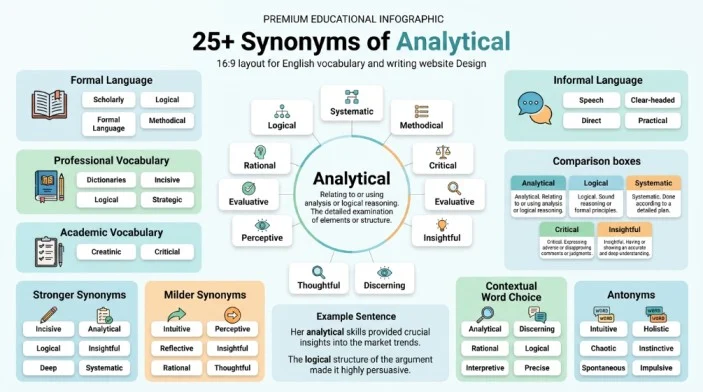
A writer can describe the same person, report, or approach as “analytical” several times in one email, essay, resume, or blog post. Repeating the same adjective may make otherwise strong writing feel flat, especially when a more precise word could show whether the person is logical, methodical, perceptive, or critical.
Learning the synonyms of analytical helps you match your vocabulary to your purpose. A resume may benefit from “methodical,” an academic paper may call for “systematic,” and a discussion about someone’s insight may be better served by “perceptive.” The right alternative does more than avoid repetition. It communicates the exact quality you want the reader to notice.
What Are the Best Synonyms of “Analytical”?
Featured Snippet Answer:
The best synonyms of analytical include logical, systematic, methodical, rational, reasoned, critical, evaluative, discerning, perceptive, insightful, and investigative. For academic and professional writing, “systematic” and “methodical” are especially useful, while “perceptive” and “insightful” work well when emphasizing understanding or depth.
“Analytical” describes someone or something that examines information carefully, breaks complex ideas into parts, and uses reasoning to understand or evaluate them. It is generally neutral to positive and is common in academic, professional, technical, and everyday contexts.
For formal writing, choose systematic, methodical, rational, or reasoned. For academic writing, critical, evaluative, systematic, or interpretive can be more precise. In professional communication, methodical, logical, and objective are useful. For creative or emotional writing, perceptive, insightful, or discerning can sound more natural.
Meaning, Tone, and Context
Simple Definition
Analytical describes a way of thinking that involves examining information carefully, separating a subject into parts, identifying relationships, and using reasoning to reach an understanding or conclusion.
For example:
Maya took an analytical approach to the customer feedback and identified three recurring problems.
Here, “analytical” shows that Maya did more than simply read the feedback. She examined it carefully and looked for meaningful patterns.
Part of Speech
Analytical is an adjective.
It commonly modifies nouns such as:
- analytical thinking
- analytical skills
- analytical approach
- analytical ability
- analytical mind
- analytical method
- analytical report
- analytical process
- analytical reasoning
Overall Tone
The word is usually neutral or positive.
It often suggests intelligence, careful reasoning, objectivity, attention to detail, and structured thought. However, context can affect its tone. Describing someone as “overly analytical” may suggest that the person thinks too much about details or struggles to make a quick decision.
Formality Level
“Analytical” is neutral to formal.
It works naturally in:
- academic papers
- business reports
- resumes
- job interviews
- professional emails
- research
- presentations
- everyday conversation
It is not overly technical, so it remains understandable in general English.
Common Uses
Native English speakers commonly use “analytical” when discussing:
- problem solving
- research
- data interpretation
- decision making
- critical thinking
- business strategy
- academic work
- personality traits
- professional skills
- financial analysis
- scientific reasoning
Word Forms
Related forms include:
- analysis, noun
- analyze, verb
- analyzed, past tense and past participle
- analyzing, present participle
- analytically, adverb
- analyst, noun for a person who analyzes information
“Analytic” is also used as an adjective and is closely related to “analytical.” In many contexts, the two words can be used interchangeably, although “analytical” is more common in general American English.
When and How to Use “Analytical”
Choose “analytical” when you want to emphasize careful examination, logical reasoning, structured thinking, or the ability to understand complex information.
Professional
The candidate demonstrated strong analytical skills when reviewing quarterly sales data.
This works well in professional communication because it connects the quality directly to a useful workplace ability.
Academic
The paper presents an analytical discussion of the causes of urban development.
Here, “analytical” signals that the paper examines and interprets its subject rather than merely describing it.
Workplace
Her analytical approach helped the team identify the source of the reporting error.
The word emphasizes structured problem solving.
Personal
Daniel is analytical by nature and usually thinks through several possibilities before making a decision.
In personal descriptions, the word refers to a person’s thinking style.
I took an analytical look at the proposal and found two areas that need clarification.
This sounds professional without being excessively formal.
Resume
Analytical professional with experience interpreting market trends and improving business processes.
On a resume, “analytical” quickly communicates a valuable problem solving ability.
Social Media
I love taking an analytical approach to books and finding patterns that are easy to miss.
Here, the word can describe thoughtful interpretation in a more casual setting.
Best Synonyms of “Analytical”
No synonym for “analytical” works perfectly in every sentence. The best choice depends on whether you want to emphasize logic, organization, careful judgment, investigation, insight, or depth of thought.
Best for Professional Writing: Methodical
“Methodical” emphasizes an organized and careful process. It is particularly useful when describing someone who follows a deliberate procedure instead of jumping to conclusions.
She used a methodical process to review the financial records.
Best for Academic Writing: Systematic
“Systematic” highlights an organized approach in which information is examined according to a clear structure or method.
The researchers used a systematic approach to examine the results.
Best for Business Communication: Logical
“Logical” emphasizes reasoning that makes sense and follows a clear line of thought.
His logical explanation helped the client understand the proposed solution.
Best for Casual Conversation: Thoughtful
“Thoughtful” is more natural when talking about a person’s careful consideration, especially outside technical or academic settings.
She gave me a thoughtful explanation of what happened.
Best for Emotional Writing: Perceptive
“Perceptive” suggests an ability to notice subtle details or understand people and situations deeply.
Her perceptive observations revealed the tension in the room.
Best for Creative Writing: Insightful
“Insightful” emphasizes valuable understanding rather than the analytical process itself.
His insightful comments changed the way I viewed the character.
Best for Resume Writing: Methodical
“Methodical” can show that you work carefully, consistently, and with attention to process.
Methodical problem solver with experience improving operational workflows.
Best for Workplace Communication: Evaluative
“Evaluative” works well when someone is assessing quality, performance, evidence, or options.
The manager took an evaluative approach when reviewing the team’s results.
Stronger Meaning: Scrutinizing
“Scrutinizing” suggests very close examination. It is stronger than “analytical” when you want to emphasize careful inspection.
The auditor conducted a scrutinizing review of the records.
Softer Meaning: Thoughtful
“Thoughtful” sounds less technical and less intense. It works when you want to emphasize careful consideration without suggesting detailed investigation.
She offered a thoughtful response to the proposal.
When Not to Use “Analytical”
When the Meaning Is Too General
“Analytical” can sometimes be too broad when the exact kind of thinking matters.
Less precise:
He has an analytical approach to the problem.
More precise:
He used a systematic approach to the problem.
“Systematic” tells the reader that the approach was organized and structured.
When You Mean Organized Rather Than Analytical
If you are describing someone who carefully follows steps, “methodical” may be stronger.
Less precise:
She is very analytical when completing complex tasks.
Better:
She is very methodical when completing complex tasks.
When You Mean Deep Understanding
“Analytical” focuses on examination. If the main point is the valuable understanding produced by that examination, “insightful” may be better.
Less precise:
His analytical comments were helpful.
Better:
His insightful comments changed our understanding of the issue.
When You Mean Careful Judgment
“Discerning” is often better when the focus is on recognizing important differences and making sound judgments.
Less precise:
She is analytical about choosing business partners.
Better:
She is discerning when choosing business partners.
When You Want a More Human Tone
“Analytical” can sound somewhat professional or technical. “Thoughtful” may work better in personal communication.
Less natural for a personal message:
Thank you for your analytical response to my situation.
More natural:
Thank you for your thoughtful response to my situation.
When You Mean Investigation
If someone actively searches for facts, evidence, or causes, “investigative” may communicate the action more clearly.
Less precise:
The journalist took an analytical approach to the case.
More specific:
The journalist took an investigative approach to the case.
Words Commonly Confused With “Analytical”
| Word | Difference | When to Use It | Example |
|---|---|---|---|
| Logical | Focuses on sound reasoning and conclusions | When emphasizing whether an idea makes sense | Her logical explanation resolved the disagreement. |
| Critical | Focuses on careful evaluation and judgment | When examining strengths, weaknesses, evidence, or assumptions | Students should develop critical reading skills. |
| Systematic | Focuses on an organized method | When a process follows a clear structure | The team used a systematic review process. |
| Methodical | Focuses on careful, orderly work | When describing a person’s working style | He is methodical when checking technical documents. |
| Insightful | Focuses on valuable understanding | When an observation reveals something meaningful | Her insightful comment improved the discussion. |
| Perceptive | Focuses on noticing subtle details | When describing strong observation or understanding | The perceptive editor noticed the hidden inconsistency. |
Best Synonyms of “Analytical” by Context
| Context | Best Synonym | Why It Works | Example |
|---|---|---|---|
| Formal writing | Systematic | Shows organized examination | The report provides a systematic evaluation of the issue. |
| Academic writing | Critical | Highlights careful evaluation | The essay offers a critical assessment of the theory. |
| Professional communication | Methodical | Shows organized, reliable thinking | She used a methodical process to solve the problem. |
| Business emails | Logical | Sounds clear and professional | Your logical explanation makes the next steps clear. |
| Resume writing | Methodical | Communicates careful work habits | Methodical professional skilled in process improvement. |
| Workplace communication | Evaluative | Emphasizes assessment | The manager used an evaluative framework. |
| Casual conversation | Thoughtful | Sounds natural and personal | That was a thoughtful way to look at it. |
| Everyday speaking | Logical | Easy to understand and conversational | His explanation was logical and easy to follow. |
| Creative writing | Insightful | Adds depth and interpretation | She offered an insightful reading of the character. |
| Storytelling | Perceptive | Highlights subtle observation | The detective was perceptive enough to notice the small clue. |
| Emotional writing | Perceptive | Suggests understanding of feelings and behavior | Her perceptive response showed that she understood his concerns. |
| Strong emphasis | Scrutinizing | Suggests very close examination | The committee gave the proposal a scrutinizing review. |
| Mild tone | Thoughtful | Softer than analytical | He gave a thoughtful response. |
| Social media captions | Insightful | Concise and expressive | Her insightful take on the film sparked discussion. |
| American English | Analytical | Standard and widely understood | The role requires strong analytical thinking. |
| British English | Analytical | Also natural and widely used | The report takes an analytical approach to the issue. |
How to Choose the Best Synonym of “Analytical”
Start by identifying what you actually want to communicate.
- If you mean clear reasoning, choose logical or reasoned.
- If you mean an organized process, choose systematic or methodical.
- If you mean careful evaluation, choose critical or evaluative.
- If you mean close examination, choose scrutinizing or exacting.
- If you mean strong observation, choose perceptive or discerning.
- If you mean valuable understanding, choose insightful.
- If you mean investigation, choose investigative.
- If you mean interpretation, choose interpretive.
Consider your audience next. A resume usually benefits from precise professional language, while a personal message may sound more natural with “thoughtful” or “perceptive.”
Finally, consider intensity. “Analytical” is fairly neutral. “Scrutinizing” sounds more intense, while “thoughtful” is softer and more personal.
Real Life Examples of “Analytical”
School
The student used an analytical approach to compare the two historical accounts.
College
Her analytical essay examined how social changes influenced the novel.
Workplace
The team needs an analytical approach to identify why customer satisfaction has declined.
Business
The company used analytical data to evaluate its pricing strategy.
I took an analytical look at the proposal and highlighted the areas that need revision.
Resume
Strong analytical thinker with experience solving operational problems and interpreting business data.
Conversation
I tend to be analytical when making major decisions because I like to consider the possible outcomes.
Storytelling
The detective’s perceptive mind allowed him to notice details that everyone else ignored.
Blogging
The article provides an insightful analysis of how changing habits affect productivity.
Social Media
An insightful review can reveal details that a quick first impression misses.
25 Best Synonyms of “Analytical”
| Synonym | Simple Meaning | Best Used For | Example Sentence |
|---|---|---|---|
| Logical | Based on clear reasoning | Everyday and professional communication | Her logical explanation convinced the team. |
| Systematic | Organized according to a method | Academic and professional writing | The researchers followed a systematic process. |
| Methodical | Careful and orderly | Work habits and professional descriptions | His methodical approach reduced errors. |
| Rational | Based on reason rather than impulse | Decisions and arguments | We need a rational response to the situation. |
| Reasoned | Supported by careful thought | Arguments and conclusions | She presented a reasoned explanation for the decision. |
| Critical | Involving careful evaluation | Academic and intellectual writing | The students developed critical reading skills. |
| Evaluative | Focused on judging quality or value | Reports and assessments | The review provides an evaluative perspective. |
| Discerning | Good at recognizing important differences | Judgment and observation | A discerning editor can spot weak arguments quickly. |
| Perceptive | Quick to notice and understand details | People and observations | Her perceptive comments revealed the underlying problem. |
| Insightful | Showing valuable understanding | Writing and discussion | His insightful analysis gave the audience a new perspective. |
| Thoughtful | Showing careful consideration | Personal and conversational writing | She gave a thoughtful response to the criticism. |
| Deliberative | Involving careful consideration before deciding | Formal discussions and decisions | The committee followed a deliberative process. |
| Scrutinizing | Examining something very closely | Audits, reviews, and investigations | The board gave the contract a scrutinizing review. |
| Investigative | Focused on discovering facts or causes | Journalism, research, and problem solving | The reporter used an investigative approach to the story. |
| Diagnostic | Used to identify the cause of a problem | Medicine, technology, and troubleshooting | The technician performed a diagnostic assessment of the system. |
| Interpretive | Focused on explaining meaning | Literature, research, and criticism | Her interpretive reading offered a fresh view of the poem. |
| Deductive | Reaching conclusions from established information | Logic, research, and reasoning | The argument uses deductive reasoning to reach its conclusion. |
| Objective | Based on evidence rather than personal preference | Reports and professional communication | The reviewer provided an objective assessment. |
| Dispassionate | Calm and unaffected by emotion | Formal analysis and criticism | The article offers a dispassionate examination of the controversy. |
| Exacting | Requiring great care and precision | Standards, reviews, and detailed work | The editor applied exacting standards to every submission. |
| Meticulous | Extremely careful about details | Professional work and procedures | Her meticulous review caught several small errors. |
| Thorough | Complete and detailed | General professional and academic use | The team conducted a thorough investigation. |
| Penetrating | Showing deep understanding of something | Criticism and intellectual writing | The author provides a penetrating analysis of the issue. |
| Reflective | Involving careful thought about experiences or ideas | Personal, academic, and creative writing | His reflective essay explored the lessons he had learned. |
| Analytic | Relating to analysis and logical examination | Academic and technical writing | The course develops analytic skills through complex problems. |
Synonyms of “Analytical” by Usage
Professional vs Personal Synonyms
In professional settings, methodical, systematic, logical, evaluative, objective, and reasoned are strong choices. They communicate competence without adding unnecessary emotion.
Personal writing often benefits from thoughtful, perceptive, insightful, or reflective. These words describe careful thinking while sounding more human and less technical.
Formal vs Conversational Synonyms
For reports and academic essays, consider:
- systematic
- methodical
- evaluative
- critical
- reasoned
- dispassionate
For presentations and business emails, consider:
- logical
- methodical
- objective
- reasoned
For casual conversation, consider:
- thoughtful
- logical
- insightful
- perceptive
Texting generally favors simpler words. Saying “That was a thoughtful way to look at it” will usually sound more natural than “That was an analytical way to look at it.”
Academic Synonyms
Academic writing benefits from precise alternatives rather than impressive sounding vocabulary.
Critical is useful when evaluating evidence, arguments, assumptions, or theories.
Systematic works when describing an organized research process.
Evaluative is appropriate when judging quality, effectiveness, or significance.
Interpretive works particularly well when explaining the meaning of literature, cultural material, or other subjects that require interpretation.
Deductive is appropriate when a conclusion follows logically from established premises or information.
Professional and Business Synonyms
- For resumes, methodical, logical, objective, and systematic can describe useful workplace abilities.
- For interviews, “analytical” and “logical” can explain problem solving skills clearly.
- For meetings, “reasoned” and “evaluative” work when discussing decisions or recommendations.
- For performance reviews, “methodical” and “thorough” can describe reliable work habits.
- For client communication, “logical” and “objective” can help describe clear explanations and evidence based recommendations without sounding unnecessarily technical.
Creative and Literary Synonyms
Creative writing usually benefits from words that reveal more than the person’s ability to analyze.
Perceptive suggests awareness of subtle behavior.
Insightful suggests meaningful understanding.
Penetrating suggests unusually deep observation.
Reflective emphasizes thoughtful consideration of experience.
Discerning can describe a character who recognizes differences that others overlook.
Slang or Modern Synonyms
There is no widely accepted slang synonym that directly replaces “analytical” without changing its meaning.
Expressions such as “deep thinker” are informal descriptions rather than exact synonyms. “Brainy” focuses more on intelligence than analytical thinking, so it should not automatically replace “analytical.”
Avoid casual expressions when writing resumes, academic papers, formal reports, or business proposals.
Strongest to Mildest Synonyms
The intensity of a synonym depends on context, but a useful general scale is:
Mild
Thoughtful, reflective
These emphasize careful consideration without suggesting intense examination.
Moderate
Logical, reasoned, rational, perceptive, methodical
These communicate clear and deliberate thinking.
Strong
Systematic, critical, evaluative, discerning, meticulous
These suggest a more structured or demanding form of examination.
Very Strong
Scrutinizing, penetrating, exacting
These can suggest unusually close, demanding, or deep examination.
Intensity should match the situation. Calling a quick review “scrutinizing” may exaggerate the amount of attention involved.
Emotional vs Neutral Synonyms
Emotional Synonyms
These alternatives can add personality, depth, or human feeling:
- thoughtful
- perceptive
- insightful
- reflective
- discerning
Use them when discussing people, relationships, stories, personal experiences, or observations.
Neutral Synonyms
These communicate reasoning more objectively:
- logical
- systematic
- methodical
- rational
- reasoned
- evaluative
- objective
- analytic
These are particularly useful in academic, technical, professional, and business writing.
Antonyms of “Analytical”
Because “analytical” describes a thinking style rather than a simple physical action, its opposites depend on what aspect you mean. The following words describe approaches that contrast with careful analysis.
| Antonym | Meaning | Example Sentence |
|---|---|---|
| Impulsive | Acting without careful thought | His impulsive decision created unnecessary problems. |
| Unthinking | Done without deliberate consideration | It was an unthinking response to a complicated issue. |
| Careless | Lacking sufficient attention | A careless review allowed several errors to remain. |
| Hasty | Done too quickly | The manager made a hasty decision without reviewing the evidence. |
| Reckless | Showing little concern for consequences | The reckless plan ignored several obvious risks. |
| Irrational | Not guided by reason | Fear led to an irrational reaction. |
| Emotional | Strongly influenced by feelings | Her emotional response made it difficult to assess the facts. |
| Intuitive | Based mainly on immediate instinct or feeling | His intuitive decision turned out to be correct. |
| Unsystematic | Lacking an organized method | The investigation was unsystematic and difficult to follow. |
| Disorganized | Lacking structure or order | The disorganized approach made the information difficult to evaluate. |
| Superficial | Concerned only with surface details | The article offered a superficial treatment of the subject. |
| Uncritical | Accepting information without sufficient evaluation | An uncritical reading may overlook important assumptions. |
| Subjective | Strongly influenced by personal views | The review was subjective rather than evidence focused. |
| Inattentive | Failing to notice important details | The inattentive reviewer missed a significant error. |
| Thoughtless | Showing little consideration | His thoughtless comment upset the team. |
Comparison: “Analytical” vs Similar Words
Analytical vs Logical
Main Difference:
“Analytical” focuses on examining information and breaking a subject into parts. “Logical” focuses on whether reasoning follows a sound and understandable pattern.
Which Is Stronger?
Neither is automatically stronger. “Analytical” emphasizes examination, while “logical” emphasizes reasoning.
Which Is More Formal?
Both are suitable for professional and academic writing.
When to Use Each:
Use “analytical” for an approach or thinking process. Use “logical” for an argument, explanation, conclusion, or decision.
Examples
Analytical: The researcher used an analytical approach to examine the data.
Logical: Her conclusion was logical and well supported.
Analytical vs Critical
Main Difference:
“Analytical” involves examining something carefully. “Critical” adds the idea of evaluating strengths, weaknesses, evidence, or assumptions.
Which Is Stronger?
“Critical” can sound stronger when judgment or evaluation is involved.
Which Is More Formal?
Both work well in academic and professional contexts.
When to Use Each:
Use “analytical” for examination. Use “critical” when the examination includes evaluation.
Examples
Analytical: The report provides an analytical overview of the results.
Critical: The essay presents a critical evaluation of the argument.
Analytical vs Systematic
Main Difference:
“Analytical” describes careful examination and reasoning. “Systematic” emphasizes a structured process.
Which Is Stronger?
Neither is inherently stronger.
Which Is More Formal?
Both are appropriate for formal writing.
When to Use Each:
Choose “systematic” when the method or process is especially important.
Examples
Analytical: She has strong analytical abilities.
Systematic: She used a systematic method to review the records.
Analytical vs Methodical
Main Difference:
“Analytical” focuses on examining and reasoning. “Methodical” focuses on doing something carefully and in an orderly sequence.
Which Is Stronger?
“Methodical” can suggest more attention to process.
Which Is More Formal?
Both are suitable for workplace communication.
When to Use Each:
Use “analytical” for thinking ability. Use “methodical” for working style or procedure.
Examples
Analytical: He is analytical when solving complex problems.
Methodical: He is methodical when checking technical documents.
Analytical vs Insightful
Main Difference:
“Analytical” describes the process of examining information. “Insightful” describes the valuable understanding that results from careful thought.
Which Is Stronger?
“Insightful” can sound stronger when praising the quality of an observation.
Which Is More Formal?
Both work in professional and academic writing, although “insightful” can sound more expressive.
When to Use Each:
Use “analytical” for process and “insightful” for understanding or interpretation.
Examples
Analytical: The article takes an analytical approach to the issue.
Insightful: The article offers an insightful explanation of the issue.
Analytical vs Perceptive
Main Difference:
“Analytical” emphasizes reasoning through information. “Perceptive” emphasizes noticing and understanding subtle details.
Which Is Stronger?
Neither is universally stronger.
Which Is More Formal?
Both are acceptable, although “perceptive” often sounds more personal.
When to Use Each:
Use “perceptive” when describing someone’s ability to notice what others miss.
Examples
Analytical: Her analytical skills helped identify the cause of the problem.
Perceptive: Her perceptive observation revealed a hidden concern.
Analytical vs Thoughtful
Main Difference:
“Analytical” suggests structured examination. “Thoughtful” suggests careful consideration and can also imply kindness or sensitivity.
Which Is Stronger?
“Analytical” is more specific about reasoning.
Which Is More Formal?
“Analytical” is generally more professional and technical.
When to Use Each:
Use “thoughtful” in personal communication when technical language would feel too distant.
Examples
Analytical: He gave an analytical assessment of the proposal.
Thoughtful: He gave a thoughtful response to my concerns.
Common Phrases and Expressions with “Analytical”
Analytical Skills
Meaning: The ability to examine information, identify relationships, and use reasoning to solve problems.
Example Sentence:
The position requires strong analytical skills and attention to detail.
Analytical Thinking
Meaning: A way of approaching problems by examining information carefully and logically.
Example Sentence:
Analytical thinking helped the team identify the cause of the decline.
Analytical Approach
Meaning: A structured way of examining a subject or problem.
Example Sentence:
The consultant took an analytical approach to the company’s operational challenges.
Analytical Mind
Meaning: A person’s tendency or ability to think logically and examine details.
Example Sentence:
Her analytical mind makes her particularly effective at solving complex problems.
Analytical Ability
Meaning: The capacity to understand information and reason through problems.
Example Sentence:
The interview tested the candidate’s analytical ability.
Analytical Reasoning
Meaning: Reasoning that involves examining information and drawing conclusions.
Example Sentence:
The assessment measures analytical reasoning and problem solving.
Analytical Framework
Meaning: A structured set of concepts or methods used to examine a subject.
Example Sentence:
The researchers developed an analytical framework for evaluating the results.
Analytical Approach to Problem Solving
Meaning: Solving a problem by breaking it into parts and examining evidence carefully.
Example Sentence:
An analytical approach to problem solving can reveal causes that are easy to overlook.
Common Mistakes to Avoid
1. Choosing a Vague Synonym
Incorrect:
She has a good way of thinking about problems.
Better:
She has a logical approach to problem solving.
“Logical” communicates the specific quality more clearly.
2. Confusing Analytical With Critical
Incorrect:
The student critically broke the data into categories.
Better:
The student analytically examined the data and grouped it into categories.
“Critical” often implies evaluation or judgment, while “analytical” better describes examination.
3. Using an Informal Alternative in Formal Writing
Incorrect:
The researcher is a deep thinker when interpreting the results.
Better:
The researcher takes an analytical approach when interpreting the results.
“Deep thinker” is understandable but less appropriate for formal academic prose.
4. Choosing an Overly Dramatic Synonym
Incorrect:
The employee conducted a penetrating review of a routine schedule.
Better:
The employee conducted a thorough review of the schedule.
“Penetrating” suggests unusually deep insight. It can be excessive for a routine task.
5. Repeating “Analytical” Too Often
Incorrect:
She has analytical skills, an analytical mindset, and an analytical approach to analytical problems.
Better:
She has strong analytical skills, a methodical mindset, and a systematic approach to complex problems.
Using related but precise alternatives makes the writing more varied.
6. Choosing the Wrong Emotional Tone
Incorrect:
Thank you for your analytical support during a difficult conversation.
Better:
Thank you for your thoughtful support during a difficult conversation.
“Analytical” sounds detached in this context. “Thoughtful” better reflects emotional consideration.
7. Using Slang in Professional Writing
Incorrect:
She is a total brain when it comes to analyzing business data.
Better:
She has strong analytical skills when interpreting business data.
The second version is clearer and more professional.
Frequently Asked Questions
What is a synonym for analytical?
Synonyms for analytical include logical, systematic, critical, methodical, and reasoned. The best choice depends on the context.
What are the most common analytical synonyms?
Common analytical synonyms include logical, thoughtful, investigative, rational, detail-oriented, and systematic.
What is the meaning of analytical synonyms?
Analytical synonyms are words that describe examining information carefully, evaluating evidence, and understanding problems through logical thinking.
What is another word for analytical?
Another word for analytical is logical, methodical, or critical. Use logical for reasoning and methodical for a structured approach.
What is an analytic synonym?
An analytic synonym is a word similar in meaning to analytic, such as logical, systematic, or reasoned. Both analytic and analytical often have the same meaning.
What is a synonym for analytical skills?
Synonyms for analytical skills include critical-thinking skills, problem-solving skills, reasoning skills, and evaluative skills.
What is a strong analytical skills synonym for a resume?
For a resume, strong alternatives include critical-thinking abilities, problem-solving expertise, data analysis skills, and logical reasoning.
What is an analytical framework synonym?
Synonyms for analytical framework include evaluation framework, assessment model, analytical model, and structured approach. The best option depends on how the framework is used.
What are the synonyms of analytical in academic writing?
In academic writing, useful synonyms for analytical include critical, systematic, interpretive, evaluative, and reasoned. Choose the term that accurately reflects the method or approach being described.
What are the best synonyms of “analytical”?
The best synonyms of analytical include logical, systematic, methodical, rational, critical, reasoned, evaluative, perceptive, discerning, and insightful. The right choice depends on whether you mean reasoning, organization, evaluation, or insight.
What are the best formal synonyms of “analytical”?
The best formal synonyms of analytical include systematic, methodical, evaluative, critical, reasoned, rational, dispassionate, and deliberative. These choices work particularly well in academic papers, reports, research, and professional communication.
What are common informal synonyms of “analytical”?
Common conversational alternatives include thoughtful, logical, perceptive, insightful, and sometimes deep thinking. These expressions can sound more natural when describing someone’s personality or everyday approach to a problem.
What is another word for “analytical” in professional writing?
Methodical is an excellent professional alternative when you want to emphasize organized and careful work. Systematic, logical, objective, and evaluative are also useful depending on the specific workplace context.
What is the difference between “analytical” and “logical”?
Analytical describes the process of examining information carefully, while logical describes reasoning that follows a sound pattern. A person can use analytical methods to examine a problem and then present a logical conclusion.
What is the opposite of “analytical”?
There is no single perfect opposite in every context. Depending on the meaning, useful contrasts include impulsive, irrational, superficial, uncritical, hasty, careless, and unsystematic. The best choice depends on what aspect you want to contrast.
Conclusion
“Analytical” describes careful examination, logical thinking, and the ability to understand information by looking closely at its parts and relationships. The best alternatives depend on the quality you want to emphasize.
Choose systematic or methodical for organized thinking, logical or reasoned for sound reasoning, critical or evaluative for judgment, and perceptive or insightful for deeper understanding. No synonym works perfectly in every sentence, so always consider your audience, tone, purpose, and intended meaning.
A simple vocabulary improvement tip is to ask what specific quality you mean before replacing a repeated word. That small step will help you choose the most accurate synonyms of analytical instead of simply choosing a word that looks similar.
Read More Related Articles:
- Synonyms for Empty | Meaning, Examples, and Better Word …
- 25+ Synonyms of Perseverance | Meanings, Uses, Examples …