When the same word keeps appearing in an essay, email, caption, or blog post, the writing can start to feel repetitive. This is especially noticeable with formal words such as posterity, where choosing a natural alternative can make the sentence much easier to understand. Learning the synonyms of posterity helps writers express the idea of future generations or descendants with the right level of formality and emotional weight.
The best replacement depends on what you mean. Future generations is usually the clearest choice, while descendants works well when you mean people who come from a particular family or person. In historical, academic, literary, and professional writing, selecting the right alternative can improve precision without making the sentence unnecessarily complicated.
What Are the Best Synonyms of “Posterity”?
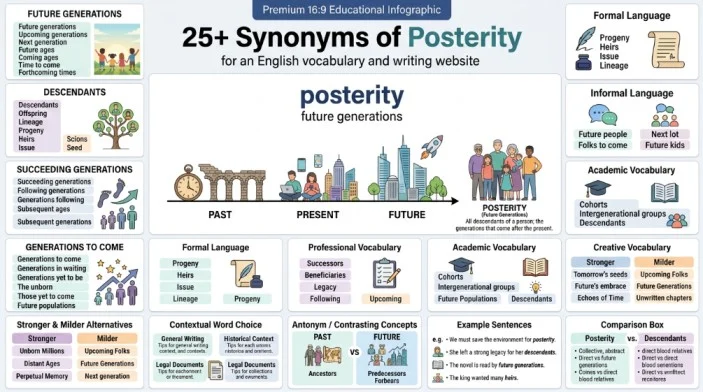
Posterity means people who will live in the future, especially future generations or descendants. The clearest synonym is future generations. Descendants works when referring to a family line, while succeeding generations suits formal and academic writing. Generations to come is more literary and expressive.
The word posterity has a formal, somewhat literary tone. It commonly appears when discussing history, legacy, achievements, records, traditions, discoveries, or actions that may affect people living in the future.
Everyday communication, future generations is usually more natural. Family history, descendants is more precise. For formal writing, succeeding generations or generations to come can work well depending on the sentence.
Meaning, Tone, and Context
Simple Definition
Posterity refers to people who will live in the future, especially later generations of people. It can also refer to the descendants of a particular person or family when the context makes that meaning clear.
For example:
The museum preserved the documents for posterity.
This means the documents were preserved so that people in the future could see or use them.
Another example is:
She hoped her work would benefit posterity.
Here, posterity means future generations.
Part of Speech
Posterity is a noun.
It is generally used as an uncountable noun, so expressions such as “the posterities” are normally incorrect.
Natural:
The invention was preserved for posterity.
Less natural and generally incorrect:
The invention was preserved for posterities.
Overall Tone
Posterity is neutral in meaning but formal and literary in tone.
The word itself does not express approval or disapproval. Its emotional effect comes from the context.
For example:
The agreement protects resources for posterity.
This sounds serious and formal.
We need to leave a better world for future generations.
This expresses essentially the same broad idea but sounds more direct and conversational.
Formality Level
Posterity is best described as formal to literary.
It is suitable for:
- Academic writing
- Historical writing
- Speeches
- Formal essays
- Literary prose
- Discussions of legacy
- Cultural preservation
- Environmental writing
- Legal or institutional language in appropriate contexts
It is less common in casual conversation.
A person is more likely to say:
We need to think about future generations.
than:
We need to think about posterity.
Common Uses
Native English speakers commonly use posterity when discussing something intended to survive or matter in the future.
Common contexts include:
- Preserving historical records
- Protecting the environment
- Leaving a legacy
- Recording cultural traditions
- Passing knowledge to future generations
- Protecting important institutions
- Discussing family history
- Preserving art or literature
- Describing long term consequences
Word Forms
Posterity does not have a useful verb, adjective, or adverb form for ordinary modern English.
The noun is the form normally used.
Related vocabulary includes:
- Descendant
- Ancestry
- Generation
- Legacy
- Heritage
- Succession
- Future generations
These related words are not interchangeable with posterity in every sentence.
When and How to Use “Posterity”
Use posterity when your sentence focuses on people who will exist in the future, particularly when the idea involves preservation, legacy, responsibility, or long term impact.
Here are seven realistic examples.
Professional
The organization created a digital archive to preserve its research for posterity.
The word works because the sentence has a formal institutional tone.
Academic
Historians preserved the original manuscripts so that posterity could study them.
This sounds appropriate in historical or academic writing.
Workplace
The company documented its early practices for posterity.
The word emphasizes preserving institutional history for future readers.
Personal
He kept his grandfather’s letters for posterity.
This gives the sentence a reflective and slightly literary quality.
We should save the original project files for posterity and future reference.
Here, posterity adds a formal touch, although “future reference” may be clearer in an ordinary workplace email.
Resume
Posterity is rarely useful in a resume because resumes usually require direct, practical language. A phrase such as “preserved historical records for future generations” is generally clearer.
Social Media
Some moments deserve to be captured for posterity.
This can work well in a thoughtful or literary caption, although “to remember for years to come” sounds more conversational.
Best Synonyms of “Posterity”
No synonym is identical to posterity in every context. The best choice depends on whether you mean all future generations, a person’s family descendants, or people who will live later.
Best for Professional Writing: Future Generations
Future generations is the safest and clearest professional alternative.
The policy should protect natural resources for future generations.
It is direct, widely understood, and suitable for reports, presentations, workplace communication, and public documents.
Best for Academic Writing: Succeeding Generations
Succeeding generations has a formal academic tone and emphasizes generations that come after the present one.
The discovery influenced scientific thinking among succeeding generations.
It works especially well in historical and scholarly discussions.
Best for Business Communication: Future Generations
Business writing usually benefits from clarity. Future generations communicates the idea without sounding unnecessarily old fashioned or literary.
Best for Casual Conversation: People in the Future
In everyday speech, people in the future can be more natural than posterity.
People in the future may look back at how we handled this problem.
It is simple and immediately understandable.
Best for Emotional Writing: Generations to Come
Generations to come adds emotional and reflective weight.
Her story will inspire generations to come.
This phrase is especially useful when discussing legacy, family, courage, art, or social change.
Best for Creative Writing: Generations to Come
Creative writing often benefits from expressive language. Generations to come can sound more evocative than the straightforward future generations.
Best for Resume Writing: Future Generations
If the concept is genuinely relevant to a resume, future generations is usually the clearest choice.
Best for Workplace Communication: Future Generations
It works naturally in sustainability, education, cultural preservation, research, and long term planning.
Stronger Meaning: Descendants
When you specifically mean people descended from a particular person or family, descendants is more precise than posterity.
Her descendants continued the family tradition.
This does not simply mean all future people. It identifies a family relationship.
Softer Meaning: People Who Come After Us
People who come after us is less formal and more personal.
We should leave the community in good condition for the people who come after us.
It is especially effective in speeches and conversational writing.
When Not to Use “Posterity”
Although posterity is accurate in many formal contexts, it is not always the best word.
When the Word Sounds Too General
If you mean a specific family line, posterity may be too broad.
Less precise:
The family celebrated posterity.
Better:
The family celebrated its descendants.
Descendants identifies the people connected to the family.
When the Word Sounds Too Formal
In casual conversation, posterity can sound unnecessarily elevated.
Formal:
We should preserve these photographs for posterity.
More natural:
We should keep these photographs for future generations.
When the Word Is Too Vague
If you are talking about a particular group of people, identify them directly.
Vague:
The decision will affect posterity.
Clearer:
The decision will affect future generations of students.
The second sentence tells the reader exactly who may be affected.
When the Word Is Too Literary
For practical business communication, posterity may distract from the main point.
Less direct:
We are recording the meeting for posterity.
Better:
We are recording the meeting for future reference.
The second version better communicates the immediate purpose.
When the Word Is Too Weak for a Family Relationship
If the sentence concerns genealogy, posterity may not provide enough detail.
Weak:
His posterity lives across several countries.
More precise:
His descendants live across several countries.
When the Word Is Too Strong in Casual Writing
A simple sentence does not need an elevated word.
Formal:
I saved the photograph for posterity.
Casual:
I saved the photograph so we could remember it later.
The second version sounds more natural in an everyday conversation.
When a Modern Phrase Is Clearer
Modern informational writing usually favors direct expressions.
Instead of:
The policy was designed for posterity.
Consider:
The policy was designed to benefit future generations.
The revised sentence gives readers the intended meaning immediately.
Words Commonly Confused With “Posterity”
Posterity vs Descendants
Difference: Posterity generally refers to future generations as a broad group, while descendants specifically refers to people descended from a particular person or family.
When to Use It: Use descendants for genealogy or family relationships.
Example:
The family donated the property so its descendants could benefit from it.
Posterity vs Progeny
Difference: Progeny refers to offspring or descendants and is often used in formal, biological, or literary contexts. It can describe the offspring of people, animals, or plants depending on context.
When to Use It: Use it when the focus is on offspring rather than future society as a whole.
Example:
The researcher studied how the trait appeared in the animals’ progeny.
Posterity vs Future Generations
Difference: These expressions overlap strongly, but future generations is more direct and modern.
When to Use It: Use future generations when clarity matters more than literary style.
Example:
The project aims to conserve water for future generations.
Posterity vs Heirs
Difference: Heirs are people legally entitled to inherit property or rights. They are not automatically synonymous with future generations.
When to Use It: Use heirs when inheritance is the central idea.
Example:
The property was transferred to his legal heirs.
Posterity vs Offspring
Difference: Offspring usually means someone’s children or the young produced by an organism. Posterity has a broader future oriented meaning.
When to Use It: Use offspring when discussing immediate descendants or biological reproduction.
Example:
The birds protect their offspring from predators.
Posterity vs Ancestors
Difference: Ancestors are people from earlier generations, while posterity concerns people in later generations.
When to Use It: Use ancestors when discussing the people who came before someone.
Example:
Her ancestors settled in the region several generations ago.
Best Synonyms of “Posterity” by Context
| Context | Best Synonym | Why It Works | Example |
|---|---|---|---|
| Formal writing | Succeeding generations | Formal and precise | The policy may benefit succeeding generations. |
| Academic writing | Future generations | Clear and widely understood | Researchers considered the effects on future generations. |
| Professional communication | Future generations | Direct and modern | The program supports education for future generations. |
| Business emails | Future reference | Better when preservation is the practical purpose | Please keep these records for future reference. |
| Resume writing | Future generations | Clear if long term impact is relevant | Developed programs designed to benefit future generations. |
| Workplace communication | Future generations | Professional without sounding archaic | Our decisions can influence future generations. |
| Casual conversation | People in the future | Natural and easy to understand | People in the future may view this differently. |
| Everyday speaking | People who come after us | Conversational and personal | We should protect this place for people who come after us. |
| Creative writing | Generations to come | Expressive and memorable | Her words may inspire generations to come. |
| Storytelling | Future generations | Keeps narration accessible | The family hoped future generations would remember the story. |
| Emotional writing | Generations to come | Adds warmth and emotional depth | His courage will be remembered by generations to come. |
| Strong emphasis | Generations yet unborn | Very strong and formal | The decision may affect generations yet unborn. |
| Mild tone | People in the future | Simple and neutral | People in the future will inherit the results. |
| Social media captions | Generations to come | Reflective and concise | A memory worth sharing with generations to come. |
| American English | Future generations | Common and natural in modern American writing | We must consider future generations. |
| British English | Future generations | Also natural and widely understood | The project could help future generations. |
How to Choose the Best Synonym of “Posterity”
Choosing the right alternative begins with meaning, not vocabulary complexity.
1: Identify Who You Mean
- If you mean people generally living in the future, choose future generations.
- If you mean people descended from one person, choose descendants.
- If you mean children or biological offspring, offspring may be more accurate.
2: Consider Your Audience
- Academic readers may accept formal expressions such as succeeding generations.
- A general audience will usually understand future generations more quickly.
3: Check the Tone
- For formal or literary writing, posterity and generations to come can work well.
- For ordinary conversation, people in the future is more natural.
4: Consider Emotional Strength
- A sentence about environmental responsibility may call for future generations.
- A speech about sacrifice and legacy may sound stronger with generations to come or generations yet unborn.
5: Prioritize Natural Usage
- A synonym is not automatically better because it sounds more sophisticated.
- If future generations communicates the idea more clearly than posterity, use the simpler expression.
6: Match the Writing Purpose
- For a report, prioritize clarity.
- For a research paper, prioritize precision.
- For a speech, consider rhythm and emotional impact.
- For fiction, consider imagery and voice.
- For a business email, use the most direct phrase available.
Real Life Examples of “Posterity”
School
Original:
The students preserved their class project for posterity.
Clearer:
The students preserved their class project so future students could see it.
The second version is easier for younger readers.
College
The university archived the research for posterity.
This works because academic and historical contexts often tolerate formal vocabulary.
Workplace
The company documented its founding history for posterity.
A more direct workplace version is:
The company documented its founding history for future employees.
Business
The business preserved its original records for posterity.
If the purpose is practical rather than historical, this may be better:
The business preserved its original records for future reference.
Please archive the final report for posterity.
More practical:
Please archive the final report for future reference.
Resume
Rather than forcing posterity into a resume, write:
Created a digital archive to preserve organizational records for future generations.
This explains the achievement more directly.
Conversation
Instead of:
We should preserve this tradition for posterity.
A natural conversational version is:
We should keep this tradition alive for future generations.
Storytelling
The old bridge became a landmark that generations to come would remember.
This has a more literary quality than simply saying “future people.”
Blogging
The decisions we make about technology today may influence future generations.
This is clear and accessible for a general online audience.
Social Media
Some family moments are worth saving for generations to come.
This sounds warm and reflective without being overly formal.
25 Best Synonyms of “Posterity”
The list below includes exact or near equivalents that can express the future generation meaning in appropriate contexts. Because posterity has more than one shade of meaning, some alternatives are closer than others.
| Synonym | Simple Meaning | Best Used For | Example Sentence |
|---|---|---|---|
| Future generations | People who will live later | General and professional writing | We should protect these resources for future generations. |
| Succeeding generations | Generations that follow the present one | Academic and formal writing | The decision affected succeeding generations. |
| Generations to come | People who will live in later generations | Emotional and creative writing | Her work may inspire generations to come. |
| Generations yet to come | Future generations that have not lived yet | Formal and reflective writing | The discovery could help generations yet to come. |
| Generations yet unborn | Future people who have not been born | Strong formal or literary writing | The policy may influence generations yet unborn. |
| People in the future | People who will live later | Plain everyday English | People in the future may study these records. |
| People who come after us | Later generations viewed from the present | Speeches and conversation | We should leave something valuable for people who come after us. |
| Those who come after us | Future people or generations | Formal speeches and essays | Those who come after us will judge the decision. |
| Later generations | Generations occurring afterward | Historical and academic writing | Later generations preserved the tradition. |
| Subsequent generations | Generations that follow | Formal academic writing | Subsequent generations expanded the original research. |
| Descendants | People descended from someone | Family history and genealogy | Her descendants continued the tradition. |
| Progeny | Offspring or descendants | Formal, biological, or literary contexts | The animal’s progeny inherited the trait. |
| Offspring | Children or young produced by an organism | Family and biological contexts | The parents worked to protect their offspring. |
| Family line | Successive members of a family | Genealogy | The tradition remained in the family line. |
| Descendant generations | Later generations within a lineage | Historical or genealogical contexts | The custom survived through descendant generations. |
| Generations following | Generations that come afterward | Formal explanatory writing | The practice continued among generations following the founders. |
| Future descendants | Descendants who will live later | Family and heritage writing | The property was preserved for future descendants. |
| Later descendants | Descendants belonging to later generations | Genealogy | Later descendants recorded the family’s history. |
| Successors | People who follow someone in a role or position | Leadership contexts | Her successors continued the program. |
| Those who follow | People who come later | Speeches and reflective prose | Those who follow may learn from this experience. |
| Future inhabitants | People who will live in a particular place later | Environmental and urban writing | The plan considers future inhabitants of the city. |
| Future citizens | Citizens who will live later | Government and civic writing | The investment could benefit future citizens. |
| Future students | Students who will attend later | Education | The archive will help future students understand the project. |
| Future readers | People who will read something later | Publishing and archival writing | The notes were preserved for future readers. |
| Coming generations | Generations that will arrive later | Formal and public writing | The program was created for coming generations. |
Synonyms of “Posterity” by Usage
Professional vs Personal Synonyms
Professional writing usually benefits from future generations, succeeding generations, and subsequent generations.
Personal writing can use generations to come, people who come after us, or future descendants when the subject involves family or legacy.
For example:
Professional:
The policy aims to conserve water for future generations.
Personal:
I hope this family story will live on for generations to come.
The first is practical. The second is more emotional.
Formal vs Conversational Synonyms
Formal choices include:
- Posterity
- Succeeding generations
- Subsequent generations
- Generations yet unborn
- Generations yet to come
Conversational choices include:
- Future generations
- People in the future
- People who come after us
- Those who come after us
A formal report may say:
The findings could influence subsequent generations of researchers.
A casual conversation might say:
Future generations may look at this very differently.
Academic Synonyms
Academic writing often benefits from precision rather than decorative vocabulary.
Useful options include:
- Future generations
- Succeeding generations
- Subsequent generations
- Later generations
- Generations to come
Subsequent generations is especially useful when discussing a sequence of historical or social developments.
Subsequent generations adapted the theory to new evidence.
Future generations is better when discussing consequences that have not yet occurred.
Climate policy may affect future generations.
Professional and Business Synonyms
For resumes, interviews, meetings, presentations, performance reviews, and client communication, the safest choice is usually future generations.
Other useful alternatives include:
- Future stakeholders
- Future employees
- Future customers
- Future citizens
- Future users
- Future readers
These are not universal synonyms for posterity. They are context specific alternatives when the intended future group is known.
For example:
We designed the system with future users in mind.
This is more precise than:
We designed the system for posterity.
Creative and Literary Synonyms
Creative writing can use more expressive alternatives:
- Generations to come
- Generations yet unborn
- Those who come after us
- Generations yet to come
- People who follow
These phrases can create a stronger sense of time, legacy, and emotional continuity.
The song carried a message that might reach generations yet to come.
The phrase adds a sense of distance and possibility.
Slang or Modern Synonyms
There is no widely accepted slang synonym for posterity that naturally replaces it in standard American English.
Modern casual expressions such as future people or people in the future are understandable, but they are not slang and may sound simplistic depending on the context.
Avoid trying to make posterity sound trendy. In most situations, replacing it with future generations is enough.
Strongest to Mildest Synonyms
The intensity of a synonym depends heavily on context. There is no objective emotional scale for every use, but the following progression is useful for writing decisions.
Mild
- People in the future
- Future generations
- Later generations
These communicate the idea plainly without strong emotion.
Moderate
- Succeeding generations
- Subsequent generations
- Generations to come
- Coming generations
These add a formal, historical, or reflective quality.
Strong
- Generations yet to come
- Those who come after us
- People who come after us
These emphasize continuity and responsibility.
Very Strong or Literary
- Generations yet unborn
This expression strongly emphasizes people who do not yet exist or have not yet been born. It is formal and often rhetorical, so it should be used selectively.
Emotional vs Neutral Synonyms
Emotional Synonyms
These expressions can add a sense of legacy, responsibility, hope, or reflection:
- Generations to come
- Generations yet to come
- People who come after us
- Those who come after us
- Generations yet unborn
Example:
Her sacrifice will be remembered by generations to come.
Neutral Synonyms
These are better when the purpose is simply to communicate information:
- Future generations
- Later generations
- Succeeding generations
- Subsequent generations
- People in the future
Example:
The policy could affect future generations.
The neutral option keeps attention on the information rather than the emotion.
Antonyms of “Posterity”
Posterity does not have a clean set of 15 standard lexical antonyms. Its central idea is future generations, so the strongest contrast is usually language referring to people or generations that came before the present.
For accuracy, the following are contextual opposites and contrasting expressions, not 15 dictionary perfect antonyms. Treating all of them as exact antonyms would be misleading.
| Contrasting Expression | Meaning | Example Sentence |
|---|---|---|
| Ancestors | People from earlier generations of a family | Her ancestors lived in the region for centuries. |
| Forebears | Earlier family members or predecessors | His forebears established the original farm. |
| Predecessors | People who held a role or position earlier | Her predecessors developed the first version of the program. |
| Earlier generations | Generations that lived before the present | Earlier generations faced different social conditions. |
| Past generations | Generations that existed previously | Past generations preserved the tradition. |
| Previous generations | Generations that came before the current one | Previous generations built many of the city’s landmarks. |
| People who came before us | Earlier people or generations | We can learn from the people who came before us. |
| Those who came before | People who lived or acted earlier | Those who came before left valuable records. |
| Earlier people | People who lived at an earlier time | Earlier people had different tools for recording information. |
| Former generations | Generations that existed previously | Former generations passed the custom from parent to child. |
| Preceding generations | Generations that came before another generation | Preceding generations shaped the institution. |
| Predecessor generations | Generations that preceded the current group | Predecessor generations established the framework. |
| The past | Earlier time or history | The past can help explain the present. |
| Previous inhabitants | People who lived in a place earlier | Previous inhabitants left evidence of settlement. |
| Earlier descendants | Descendants belonging to an earlier point in a family line | Earlier descendants recorded the family’s origins. |
These expressions should be selected according to context. For example, ancestors is the best choice for family history, while predecessors is better for people who previously held a position.
Comparison: “Posterity” vs Similar Words
Posterity vs Descendants
Main Difference
Posterity emphasizes future generations broadly. Descendants identifies people who come from a particular ancestor.
Which Is Stronger?
Neither is inherently stronger. Descendants is more specific.
Which Is More Formal?
Both can be formal, but posterity often sounds more literary.
When to Use Each
Use posterity for future generations generally. Use descendants for family relationships.
Examples
Posterity:
The invention was preserved for posterity.
Descendants:
His descendants still live in the area.
Posterity vs Future Generations
Main Difference
The meaning is very close. Future generations is more direct and modern.
Which Is Stronger?
Posterity can sound more elevated, but the underlying meaning is not necessarily stronger.
Which Is More Formal?
Posterity is more formal and literary.
When to Use Each
Use future generations for general audiences and professional communication. Use posterity when a formal or historical tone fits.
Examples
Posterity:
The records were preserved for posterity.
Future generations:
The records were preserved for future generations.
Posterity vs Progeny
Main Difference
Progeny focuses on offspring or descendants. Posterity focuses on future people or generations.
Which Is Stronger?
Neither is inherently stronger.
Which Is More Formal?
Progeny is formal and can sound technical or literary.
When to Use Each
Use progeny when offspring are the subject. Use posterity when discussing future generations or long term legacy.
Examples
Posterity:
The work was created for posterity.
Progeny:
The researcher observed the trait in the animal’s progeny.
Posterity vs Offspring
Main Difference
Offspring usually refers to children or young produced by an organism. Posterity has a broader future oriented meaning.
Which Is Stronger?
Neither is stronger.
Which Is More Formal?
Posterity is more formal. Offspring is neutral.
When to Use Each
Use offspring for immediate biological or family relationships.
Examples
Posterity:
The artist wanted the work remembered by posterity.
Offspring:
The animal protects its offspring.
Posterity vs Heirs
Main Difference
Heirs are people entitled to receive property or rights through inheritance. They are not simply future generations.
Which Is Stronger?
Neither.
Which Is More Formal?
Both are common in formal contexts, but their meanings are different.
When to Use Each
Use heirs for inheritance and legal succession. Use posterity for future generations.
Examples
Posterity:
The records were preserved for posterity.
Heirs:
The estate was divided among the heirs.
Posterity vs Ancestors
Main Difference
These words point in opposite directions through time. Posterity concerns later generations, while ancestors are earlier generations.
Which Is Stronger?
Neither.
Which Is More Formal?
Both can appear in formal or literary writing.
When to Use Each
Use ancestors for people who came before you. Use posterity for people who will come after the present.
Examples
Posterity:
The decision may affect posterity.
Ancestors:
Her ancestors settled there generations ago.
Common Phrases and Expressions with “Posterity”
Preserve for Posterity
Meaning: To protect something so people in the future can see, study, or remember it.
Example:
The museum preserved the photographs for posterity.
For the Benefit of Posterity
Meaning: For the advantage or benefit of future generations.
Example:
The land was protected for the benefit of posterity.
Leave a Legacy for Posterity
Meaning: To create something that will remain meaningful to future generations.
Example:
The author hoped to leave a lasting legacy for posterity.
Record for Posterity
Meaning: To document something so it remains available to future people.
Example:
The historian recorded the testimony for posterity.
Preserve the Memory for Posterity
Meaning: To keep a person’s memory or an event alive for future generations.
Example:
The memorial was built to preserve the memory of the victims for posterity.
Posterity Will Remember
Meaning: A statement suggesting that future generations will judge or remember an action.
Example:
Posterity will remember the scientists who helped solve the crisis.
Handed Down to Posterity
Meaning: Passed from one generation to later generations.
Example:
The tradition was handed down to posterity through family stories.
Leave Something to Posterity
Meaning: To leave behind something that future generations can inherit, study, or appreciate.
Example:
The architect wanted to leave something valuable to posterity.
Common Mistakes to Avoid
Mistake 1: Treating “Posterity” as a Synonym for “Ancestors”
Incorrect:
We studied our posterity to learn about our family history.
Better:
We studied our ancestors to learn about our family history.
Why: Ancestors are people who came before you. Posterity concerns people who come after the present.
Mistake 2: Using “Posterity” When You Mean “Heirs”
Incorrect:
The property was transferred to posterity.
Better:
The property was transferred to his heirs.
Why: The sentence concerns legal inheritance, so heirs is the precise term.
Mistake 3: Using an Overly Formal Word in Casual Writing
Less Natural:
We need to protect this park for posterity.
More Natural:
We need to protect this park for future generations.
Why: Future generations is easier and more natural for everyday audiences.
Mistake 4: Assuming “Descendants” Always Means the Same Thing
Incorrect:
The policy was designed to protect descendants from climate change.
Better:
The policy was designed to protect future generations from climate change.
Why: The sentence concerns society broadly, not descendants of a particular person.
Mistake 5: Choosing a Dramatic Expression Without a Reason
Less Effective:
This minor change will affect generations yet unborn.
Better:
This change could affect future generations.
Why: The first expression is highly dramatic. The second matches a neutral informational context.
Mistake 6: Repeating “Posterity” Too Often
Less Effective:
The archive was created for posterity. The documents were organized for posterity. The photographs were preserved for posterity.
Better:
The archive was created for future generations. The documents were carefully organized, and the photographs were preserved for historical reference.
Why: Varying language improves readability while keeping the meaning clear.
Mistake 7: Choosing a Synonym Without Checking the Intended Meaning
Less Effective:
The tradition was passed to the heirs.
Better:
The tradition was passed to future generations.
Why: Heirs concerns inheritance. Future generations correctly expresses the idea of a tradition continuing through time.
Frequently Asked Questions
1. What are the best synonyms of “posterity”?
The best synonyms of posterity include future generations, succeeding generations, generations to come, and people in the future. For family relationships, descendants is usually more precise.
2. What are the best formal synonyms of “posterity”?
Strong formal synonyms of posterity include succeeding generations, subsequent generations, generations yet to come, and generations yet unborn. Choose based on whether you want neutral formality or a more literary effect.
3. What are common informal synonyms of “posterity”?
Common conversational alternatives include future generations, people in the future, and people who come after us. These expressions are usually easier to understand than the formal word posterity.
4. What is another word for “posterity” in professional writing?
Future generations is usually the best professional alternative to posterity. It is clear, modern, and suitable for reports, presentations, workplace communication, sustainability discussions, and long term planning.
5. What is the difference between “posterity” and “descendants”?
Posterity generally means future generations, while descendants specifically means people descended from a particular person or family. Use posterity for broad future groups and descendants when a family relationship matters.
6. What is the opposite of “posterity”?
Posterity has no single perfect lexical opposite. The strongest contextual contrasts are ancestors, forebears, predecessors, earlier generations, and past generations, all of which refer to people or generations that came before.
Conclusion
Posterity refers mainly to people who will live in the future, especially future generations. It is a formal and somewhat literary word that works well when discussing history, preservation, legacy, responsibility, and long term consequences.
The best alternative depends on the situation. Future generations is the clearest all purpose choice, descendants is better for family relationships, succeeding generations suits academic writing, and generations to come adds emotional or literary force.
The most useful vocabulary habit is simple: do not choose a synonym because it sounds more sophisticated. Choose the word that communicates your exact meaning, tone, audience, and purpose most naturally. That approach makes the synonyms of posterity easier to use accurately and confidently.
Read More Related Articles:
- 50+ Synonyms of This | Meanings, Uses, Examples, and Best …
- Synonyms for Empty | Meaning, Examples, and Better Word …
- Synonyms for Creativity | Meaning, Examples, and Better …