You write an email and notice that you have used the word “unity” several times. Then it appears again in your essay, caption, resume, or school assignment. Repeating the same word can make otherwise strong writing feel flat. The best synonyms of unity can add precision without changing your intended meaning.
The right alternative depends on what you want to emphasize. Solidarity highlights shared support, harmony suggests peaceful agreement, cohesion focuses on how well parts hold together, and consensus emphasizes agreement on an idea or decision. Understanding these differences helps students, professionals, writers, and English learners choose words that sound natural and appropriate.
What Are the Best Synonyms of “Unity”?
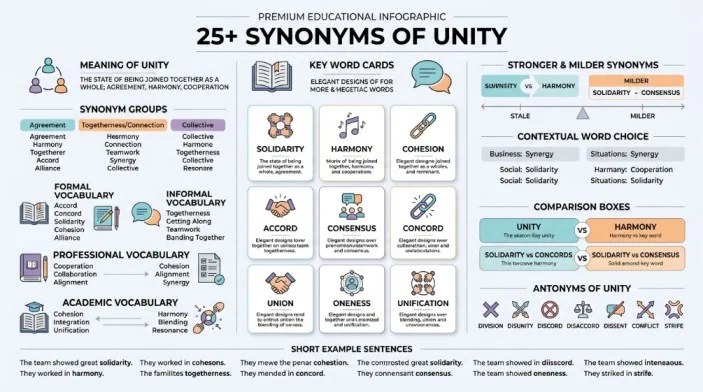
Unity means a state of being joined, combined, or in agreement. The best alternatives include harmony, solidarity, cohesion, togetherness, accord, concord, consensus, union, oneness, and unification. Choose the word according to context, because each emphasizes a slightly different kind of togetherness, agreement, or wholeness.
For formal writing, cohesion, accord, concord, solidarity, and unification can work well. Academic writing often benefits from consensus, coherence, cohesion, or agreement.
For casual conversation, togetherness, harmony, and solidarity usually sound natural. Emotional writing may benefit from togetherness, solidarity, fellowship, or oneness, while creative writing can use wholeness, harmony, coherence, or unison, depending on the intended meaning.
Meaning, Tone, and Context
Simple Definition
Unity is a noun describing a condition in which people, groups, ideas, or parts are joined together or work as one. It can describe agreement between people, the joining of separate groups, or the way separate parts form a coherent whole.
For example:
The team showed remarkable unity during the difficult project.
Here, unity means that the team remained together and worked toward a shared goal.
Part of Speech
Unity is primarily a noun.
Common patterns include:
- national unity
- family unity
- political unity
- team unity
- unity of purpose
- unity of thought
- a sense of unity
- a symbol of unity
- promote unity
- maintain unity
- achieve unity
Cambridge lists combinations such as “national unity,” “sense of unity,” “unity of purpose,” and “symbol of unity” as established uses.
Overall Tone
Unity is generally positive or neutral.
It usually creates a constructive impression because it suggests cooperation, agreement, connection, or shared purpose. The emotional effect depends on the surrounding sentence.
For example:
The community found unity after the storm.
This sounds positive.
The government called for political unity.
This is more neutral and formal.
Formality Level
Unity is a neutral to semi formal word. It works comfortably in everyday conversation, academic writing, business communication, journalism, speeches, essays, and professional documents.
It is broad enough for general communication but specific enough to sound purposeful.
Common Uses
Native English speakers commonly use unity when discussing:
- families
- communities
- teams
- organizations
- political groups
- nations
- social movements
- shared goals
- agreement
- literature and art
- design
- ideas that form a coherent whole
Unity can also describe writing itself. In academic composition, it can refer to the quality of keeping ideas focused around a central topic.
Word Forms
The main word is unity, a noun.
Related forms include:
- unite, verb
- united, adjective
- uniting, adjective or participle
- unification, noun
- unitive, adjective, meaning related to or promoting unity
The verb unite means to join people or things together or to make them become one.
When and How to Use “Unity”
Unity is a strong choice when you want to describe people, groups, ideas, or parts functioning together as a whole.
Professional
The department demonstrated unity while responding to the client’s concerns.
This emphasizes coordinated effort.
Academic
The essay achieves unity by connecting each paragraph to its central argument.
Here, unity refers to consistency and connection among ideas.
Workplace
Team unity helped the staff complete the project before the deadline.
This highlights cooperation around a shared objective.
Personal
Family unity became especially important during the difficult period.
The word carries an emotional but natural tone here.
Thank you for helping maintain unity across the project team.
This is appropriate when discussing cooperation between coworkers.
Resume
Promoted team unity by improving communication between design and marketing staff.
A resume can use unity, but collaboration, cooperation, or cohesion may sometimes describe the actual achievement more precisely.
Social Media
Different backgrounds, one community, and a shared sense of unity.
This short use gives the word an emotional and inclusive quality.
Best Synonyms of “Unity”
No synonym is identical to unity in every situation. The best choice depends on whether you mean agreement, emotional connection, organizational strength, physical combination, or the quality of forming a complete whole.
Professional Writing: Cohesion
Cohesion is especially useful when discussing how people, teams, departments, or ideas hold together.
Strong team cohesion improved communication across departments.
Academic Writing: Consensus
Consensus is best when unity specifically means broad agreement about an issue, conclusion, or decision.
The researchers reached a consensus on the interpretation of the findings.
Business Communication: Alignment
Alignment is useful when people or teams share goals, priorities, or direction.
The meeting helped create alignment between the sales and product teams.
Casual Conversation: Togetherness
Togetherness sounds warmer and more personal than unity.
The holiday brought a real sense of togetherness to the family.
Emotional Writing: Solidarity
Solidarity emphasizes support and shared commitment, especially when people face difficulty or defend a common cause.
The workers stood together in solidarity.
Creative Writing: Harmony
Harmony is expressive and flexible. It can describe peaceful relationships, balanced elements, or parts that work beautifully together.
The colors created a quiet harmony across the room.
Resume Writing: Collaboration
Collaboration is often more concrete than unity on a resume because it describes working with others toward a result.
Led cross functional collaboration between engineering and customer support.
Workplace Communication: Cooperation
Cooperation emphasizes people helping one another or working together.
The project succeeded because of close cooperation between the two teams.
Stronger Meaning: Solidarity
When unity involves firm mutual support, solidarity is usually stronger and more purposeful.
The employees showed solidarity during the organizational changes.
Softer Meaning: Togetherness
When you want warmth without a formal or political tone, togetherness is a good choice.
The event created a strong feeling of togetherness.
When Not to Use “Unity”
Unity is useful, but it can sometimes be too broad. A more precise synonym can make the sentence clearer.
When Unity Sounds Too General
Less precise:
The team needs more unity.
Better:
The team needs stronger cohesion.
Cohesion tells the reader that the problem concerns how well team members function together.
When Unity Is Too Vague
Less precise:
The organization achieved unity on the proposal.
Better:
The organization reached consensus on the proposal.
Consensus clearly indicates agreement about a specific matter.
When Unity Is Too Formal
In a casual conversation, unity can sometimes sound more serious than necessary.
Less natural:
Our family needs greater unity during dinner.
More conversational:
We need to spend more time together as a family.
When Unity Is Too Weak
If people are actively supporting one another during a difficult situation, solidarity may communicate more forcefully.
Less precise:
The workers showed unity.
Stronger:
The workers showed solidarity.
When Unity Is Too Strong
If people simply agree on one small decision, unity can sound broader than the situation requires.
Less precise:
The committee showed complete unity on the meeting time.
Better:
The committee reached agreement on the meeting time.
When a More Specific Word Is Available
Unity can describe many kinds of connection. If your sentence concerns an exact relationship, use a word that identifies it.
The departments improved coordination.
This is more specific than saying:
The departments improved unity.
Words Commonly Confused With “Unity”
Unity
Difference: A broad state of being joined, connected, or in agreement.
When to Use It: Use it when you want a general term for togetherness or shared purpose.
Example:
The group maintained unity despite different opinions.
Harmony
Difference: Harmony emphasizes peaceful compatibility and the absence of serious conflict.
When to Use It: Use it for relationships, ideas, sounds, colors, or situations that work pleasantly together.
Example:
The two departments worked in harmony.
Solidarity
Difference: Solidarity emphasizes support and shared interests, especially when people stand together during difficulty or around a cause.
When to Use It: Use it for communities, workers, social groups, or people supporting others.
Example:
The employees expressed solidarity with their coworkers.
Consensus
Difference: Consensus means general agreement about a particular issue or decision.
When to Use It: Use it in meetings, research, policy discussions, committees, and academic writing.
Example:
The committee reached consensus after several hours of discussion.
Cohesion
Difference: Cohesion emphasizes how strongly members or parts remain connected and function as a whole.
When to Use It: Use it for teams, organizations, writing, groups, and systems.
Example:
Better communication improved team cohesion.
Union
Difference: Union emphasizes joining separate people, groups, organizations, or things into one.
When to Use It: Use it when the actual act or state of joining is important.
Example:
The agreement created a stronger union between the two organizations.
Best Synonyms of “Unity” by Context
| Context | Best Synonym | Why It Works | Example |
|---|---|---|---|
| Formal writing | Concord | Sounds polished and emphasizes agreement | The nations worked toward concord. |
| Academic writing | Consensus | Clearly indicates shared agreement | The study found a broad consensus. |
| Professional communication | Cohesion | Focuses on effective group connection | The manager strengthened team cohesion. |
| Business emails | Alignment | Emphasizes shared goals | We need alignment before launch. |
| Resume writing | Collaboration | Shows active work with others | Led collaboration across departments. |
| Workplace communication | Cooperation | Highlights practical teamwork | Success required close cooperation. |
| Casual conversation | Togetherness | Sounds warm and natural | The trip created a sense of togetherness. |
| Everyday speaking | Harmony | Easy to understand and broadly useful | They live together in harmony. |
| Creative writing | Wholeness | Emphasizes a complete effect | The painting has a sense of wholeness. |
| Storytelling | Fellowship | Adds human connection | The travelers developed a strong fellowship. |
| Emotional writing | Solidarity | Communicates shared support | They stood in solidarity. |
| Strong emphasis | Unanimity | Suggests complete agreement | The decision passed with unanimity. |
| Mild tone | Agreement | Simple and direct | We reached agreement quickly. |
| Social media captions | Togetherness | Short, warm, and relatable | Celebrating friendship and togetherness. |
| American English | Unity | Natural and widely understood | The community called for unity. |
| British English | Unity | Also natural and widely understood | The speech emphasized national unity. |
How to Choose the Best Synonym of “Unity”
Start by asking what kind of unity you actually mean.
- If you mean people supporting each other: choose solidarity.
- If you mean peaceful relationships: choose harmony.
- If you mean agreement about an issue: choose consensus, agreement, or accord.
- If you mean a strong group connection: choose cohesion.
- If you mean people spending time or feeling connected: choose togetherness.
- If you mean joining separate parts: choose union or unification.
- If you mean a complete artistic or written whole: choose wholeness, coherence, or integrity.
Then consider your audience. A research paper may benefit from consensus or cohesion, while a personal post may sound more natural with togetherness.
Finally, check emotional strength. Solidarity is more purposeful than simple agreement, while agreement is usually more neutral and direct.
Real Life Examples of “Unity”
School
The class showed unity when students worked together to organize the science fair.
For a more specific version:
The class showed strong cooperation while organizing the science fair.
College
The student organization promoted unity among members from different academic backgrounds.
A more precise alternative:
The student organization promoted solidarity among members working toward the same cause.
Workplace
Unity helped the department stay focused during a demanding quarter.
A stronger professional version:
Team cohesion helped the department stay focused during a demanding quarter.
Business
The merger required unity between the two leadership teams.
If shared goals are the main idea:
The merger required alignment between the two leadership teams.
I appreciate everyone’s cooperation and commitment to keeping the project moving forward.
Here, cooperation is more specific and natural than unity.
Resume
Strengthened team unity through regular cross department meetings.
A more achievement focused version is:
Improved cross department collaboration through regular team meetings.
Conversation
There was a real sense of unity among everyone at the reunion.
A warmer conversational option is:
There was a real sense of togetherness at the reunion.
Storytelling
For one brief evening, the village found unity after years of disagreement.
A more emotional alternative:
For one brief evening, the village found harmony after years of disagreement.
Blogging
Strong communities grow through trust, cooperation, and a shared sense of unity.
Social Media
Different stories, shared dreams, one sense of unity.
25 Best Synonyms of “Unity”
The following list covers the major meanings of unity, including togetherness, agreement, joining, solidarity, and the quality of forming a complete whole. Some words are especially strong in particular contexts rather than being interchangeable in every sentence.
| Synonym | Simple Meaning | Best Used For | Example Sentence |
|---|---|---|---|
| Solidarity | Shared support and commitment | Groups, causes, difficult situations | The workers showed solidarity during the negotiations. |
| Harmony | Peaceful agreement or balance | Relationships, groups, art, design | The team worked together in harmony. |
| Cohesion | Strong connection among parts or members | Teams, organizations, writing | Better communication created greater team cohesion. |
| Togetherness | A warm feeling of being together | Families, communities, personal writing | The celebration created a strong sense of togetherness. |
| Accord | Agreement or harmony | Formal and professional writing | The two sides finally reached accord. |
| Concord | Peaceful agreement | Formal writing and literature | The leaders hoped to restore concord. |
| Consensus | General agreement on an issue | Academic and professional settings | The panel reached consensus after reviewing the evidence. |
| Unanimity | Complete agreement | Formal decisions and voting | The proposal passed with near unanimity. |
| Oneness | The condition of being one | Emotional, philosophical, and spiritual writing | The experience gave her a feeling of oneness with nature. |
| Union | The joining of separate people or groups | Organizations and formal contexts | The agreement strengthened the union between the partners. |
| Unification | The process of becoming one | Political, organizational, and formal writing | The plan encouraged the unification of the separate divisions. |
| Wholeness | The quality of forming a complete whole | Creative and reflective writing | The final chapter gives the story a sense of wholeness. |
| Integrity | Completeness and consistency | Writing, design, systems, and ideas | The revisions improved the integrity of the argument. |
| Agreement | A shared view or decision | Everyday, professional, and academic use | We reached agreement before the meeting ended. |
| Cooperation | Working together helpfully | Workplace and everyday situations | The project succeeded through cooperation. |
| Collaboration | Working jointly on something | Business, school, creative work | The campaign resulted from close collaboration. |
| Fellowship | Friendly connection within a group | Personal, literary, and community writing | The travelers developed a lasting fellowship. |
| Unison | Acting, speaking, or agreeing together | Groups, performance, and figurative writing | The audience responded in unison. |
| Coherence | Logical connection that makes something unified | Essays, arguments, writing, ideas | The editor improved the coherence of the article. |
| Like mindedness | Similar views or attitudes | Groups and personal relationships | Their like mindedness made collaboration easy. |
| Concurrence | Agreement with a view or decision | Formal and professional writing | The proposal received concurrence from the board. |
| Concert | Agreement or coordinated action | Formal and literary contexts | The organizations acted in concert to solve the problem. |
| Amity | Friendly and peaceful relations | Formal writing and diplomacy | The two communities lived in amity for decades. |
| Cohesiveness | The quality of staying strongly connected | Teams, groups, and writing | The new strategy increased the group’s cohesiveness. |
| Singleness | The condition of being one or focused as one | Formal and literary contexts | The poem has a strong singleness of purpose. |
Synonyms of “Unity” by Usage
Professional vs Personal Synonyms
Professional writing usually benefits from precise words such as cohesion, collaboration, cooperation, alignment, consensus, and accord.
Personal writing can use warmer alternatives such as togetherness, fellowship, harmony, oneness, and solidarity.
Compare:
The family developed stronger cohesion.
This is possible but sounds analytical.
The family developed a stronger sense of togetherness.
This sounds much more natural in personal writing.
Formal vs Conversational Synonyms
Formal writing can use concord, accord, concurrence, unanimity, unification, and consensus.
Conversational English usually favors agreement, harmony, togetherness, cooperation, or simply being together.
For example:
The committee reached concurrence.
This is formal.
The committee agreed.
This is simpler and more natural in ordinary speech.
Academic Synonyms
Academic writing needs precision. The best vocabulary depends on the exact idea.
- Use consensus when researchers or scholars broadly agree.
- Use cohesion when discussing how parts of a text or group connect.
- Use coherence when discussing whether ideas logically fit together.
- Use unanimity when everyone agrees.
- Use unity when discussing a central focus or the relationship between parts of a larger whole.
This distinction matters because academic synonyms are not interchangeable simply because they all suggest connection.
Professional and Business Synonyms
- For resumes, collaboration often works better than unity because it describes an action.
- For interviews, cooperation and teamwork can communicate practical ability.
- For meetings, consensus is useful when a group reaches a shared decision.
- For presentations, alignment is useful when teams share strategic priorities.
- For client communication, partnership can emphasize a cooperative relationship.
- For business emails, agreement is usually clearer than a more elevated word such as concord.
Creative and Literary Synonyms
Creative writing gives you more freedom to select words for emotional effect.
Harmony creates a peaceful image.
Wholeness suggests completeness.
Oneness can create a philosophical or emotional feeling.
Fellowship emphasizes human connection.
Unison can suggest people acting or speaking together.
Concord can add a formal or literary tone.
Choose according to the atmosphere you want rather than simply selecting the most unusual word.
Slang or Modern Synonyms
There is no single slang word that consistently replaces unity across American English.
Expressions such as all in it together or in this together can communicate a similar idea in casual speech.
We are all in this together.
This is natural in conversation and social media.
Avoid these expressions in formal academic writing unless you are intentionally using conversational language.
Strongest to Mildest Synonyms
Intensity depends on context, so this scale is a practical guide rather than a strict linguistic ranking.
Mild
Agreement, cooperation, togetherness
These words can describe ordinary connection without suggesting a powerful emotional commitment.
Moderate
Harmony, cohesion, accord, collaboration
These suggest a more established or meaningful relationship.
Strong
Solidarity, unanimity, concord, union
These can suggest firm support, complete agreement, or strong connection.
Very Strong in the Right Context
Oneness, unification, unison
These can suggest a particularly complete state of being one, depending on context.
For example, unanimity is especially strong when discussing decisions because it implies complete agreement. Solidarity is strong when people actively support one another.
Emotional vs Neutral Synonyms
Emotional Synonyms
These words often add feeling or human connection:
- solidarity
- togetherness
- fellowship
- oneness
- harmony
- amity
Use them in speeches, personal writing, social posts, stories, and community focused messages.
Neutral Synonyms
These words generally communicate the idea more objectively:
- agreement
- consensus
- cohesion
- cooperation
- union
- unification
- coherence
- concurrence
Use them when precision is more important than emotional effect.
Antonyms of “Unity”
Unity has several meanings, so its opposite can change according to context. The following 15 words represent genuine contrasts involving separation, disagreement, conflict, or fragmentation.
| Antonym | Meaning | Example Sentence |
|---|---|---|
| Disunity | Lack of unity or shared purpose | Political disunity weakened the organization. |
| Division | A state of being separated into opposing groups | The issue caused division within the community. |
| Discord | Serious disagreement or lack of harmony | Discord grew after the leadership change. |
| Disharmony | Lack of peaceful agreement | Disharmony affected the team’s performance. |
| Disagreement | Difference in opinions or views | The discussion ended in disagreement. |
| Conflict | A serious clash between people or groups | Conflict prevented the teams from cooperating. |
| Disunion | Separation or lack of union | Internal disunion made the organization unstable. |
| Separation | The state of being apart | The separation of the departments reduced communication. |
| Isolation | Being separated from others | Social isolation can weaken a sense of community. |
| Fragmentation | Breaking into disconnected parts | Fragmentation made the organization difficult to manage. |
| Dissension | Disagreement within a group | Dissension emerged among the committee members. |
| Opposition | Active resistance or disagreement | Opposition prevented the proposal from passing. |
| Alienation | A feeling of being separated or disconnected | Poor communication created alienation among employees. |
| Rivalry | Competition between people or groups | Longstanding rivalry damaged cooperation. |
| Polarization | Movement toward sharply opposing positions | Political polarization made compromise difficult. |
Comparison: “Unity” vs Similar Words
Unity vs Harmony
Main Difference: Unity is broader. Harmony focuses more strongly on peaceful compatibility.
Which Is Stronger? Neither is always stronger. Harmony emphasizes peace, while unity emphasizes togetherness.
Which Is More Formal? Both are neutral and work in formal writing.
When to Use Each: Use unity for shared purpose or group connection. Use harmony for peaceful relationships or balanced elements.
Examples
Unity:
The organization maintained unity during the transition.
Harmony:
The two teams worked together in harmony.
Unity vs Solidarity
Main Difference: Solidarity adds the idea of active support.
Which Is Stronger? Solidarity is often stronger emotionally.
Which Is More Formal? Both can work professionally, but solidarity is particularly common in social, political, and labor contexts.
When to Use Each: Use unity for general togetherness. Use solidarity when people actively stand with one another.
Examples
Unity:
The community showed unity after the disaster.
Solidarity:
Volunteers showed solidarity with affected families.
Unity vs Consensus
Main Difference: Consensus specifically concerns agreement on an issue.
Which Is Stronger? Consensus can be stronger when discussing decision making because it implies broad agreement.
Which Is More Formal? Consensus is especially suitable for academic and professional writing.
When to Use Each: Use unity for group connection. Use consensus for shared decisions or opinions.
Examples
Unity:
The committee demonstrated unity.
Consensus:
The committee reached consensus on the proposal.
Unity vs Cohesion
Main Difference: Cohesion focuses on how strongly parts or members remain connected.
Which Is Stronger? Cohesion emphasizes structural strength rather than emotion.
Which Is More Formal? Cohesion is particularly useful in professional and academic contexts.
When to Use Each: Use unity for a general state of togetherness. Use cohesion for teams, groups, systems, or writing.
Examples
Unity:
The team showed unity throughout the project.
Cohesion:
Better communication improved team cohesion.
Unity vs Union
Main Difference: Union emphasizes joining separate entities into one.
Which Is Stronger? Union can imply a more concrete or organizational joining.
Which Is More Formal? Both are appropriate in formal writing.
When to Use Each: Use unity for the state of being joined. Use union when the joining itself or resulting organization matters.
Examples
Unity:
The movement called for national unity.
Union:
The union brought several local organizations together.
Unity vs Unanimity
Main Difference: Unanimity means complete agreement, while unity can exist even when people have minor differences.
Which Is Stronger? Unanimity is stronger for agreement because it implies everyone agrees.
Which Is More Formal? Unanimity is more formal.
When to Use Each: Use unanimity for votes, decisions, or opinions. Use unity for broader group connection.
Examples
Unity:
The group maintained unity despite different opinions.
Unanimity:
The board approved the proposal with unanimity.
Common Phrases and Expressions with “Unity”
Unity in Diversity
Meaning: Different people or characteristics existing together while remaining connected.
Example:
The festival celebrated unity in diversity.
National Unity
Meaning: A shared sense of connection or common purpose among people within a nation.
Example:
The leaders called for national unity during the crisis.
Family Unity
Meaning: A strong connection among family members.
Example:
The family worked hard to preserve family unity.
Unity of Purpose
Meaning: A shared goal or intention.
Example:
The team succeeded because it had a clear unity of purpose.
A Sense of Unity
Meaning: A feeling that people belong together or share something important.
Example:
The event created a strong sense of unity.
Symbol of Unity
Meaning: A person, object, event, or idea that represents togetherness.
Example:
The monument became a symbol of unity for the community.
Maintain Unity
Meaning: Continue to remain connected or in agreement.
Example:
The leaders worked to maintain unity within the organization.
Promote Unity
Meaning: Encourage people to cooperate or remain connected.
Example:
The program was designed to promote unity among students.
These patterns are established uses of unity in English, including expressions such as “national unity,” “unity of purpose,” “sense of unity,” and “symbol of unity.”
Common Mistakes to Avoid
Mistake 1: Using Unity When You Mean Agreement
Incorrect:
We achieved unity about the meeting time.
Better:
We reached agreement about the meeting time.
Why: Agreement is more precise for a simple decision.
Mistake 2: Using Consensus for Emotional Connection
Incorrect:
The family shared a strong consensus during the reunion.
Better:
The family shared a strong sense of togetherness during the reunion.
Why: Consensus concerns agreement, while togetherness expresses emotional connection.
Mistake 3: Using Solidarity for Every Type of Unity
Incorrect:
The colors of the painting create solidarity.
Better:
The colors of the painting create harmony.
Why: Solidarity normally concerns people or groups supporting one another. Harmony works better for balanced artistic elements.
Mistake 4: Using Informal Language in Formal Writing
Incorrect:
The researchers were all in this together.
Better:
The researchers demonstrated strong collaboration.
Why: The first version is conversational. Collaboration is more suitable for an academic context.
Mistake 5: Choosing an Overly Dramatic Synonym
Incorrect:
The employees achieved complete oneness about the lunch schedule.
Better:
The employees reached agreement about the lunch schedule.
Why: Oneness is unnecessarily emotional and abstract for a simple practical decision.
Mistake 6: Repeating Unity Too Often
Incorrect:
Unity helped create unity, and the group maintained unity throughout the unity campaign.
Better:
Cooperation strengthened the group, and members maintained solidarity throughout the campaign.
Why: Varied vocabulary makes the writing smoother while preserving the central idea.
Mistake 7: Confusing Cohesion With Consensus
Incorrect:
The research team reached cohesion on the findings.
Better:
The research team reached consensus on the findings.
Why: Consensus describes agreement about findings. Cohesion describes how strongly the team functions together.
Frequently Asked Questions
1. What are the best synonyms of “unity”?
The best synonyms of unity include harmony, solidarity, cohesion, togetherness, accord, consensus, concord, union, oneness, and unification. The best choice depends on whether you mean agreement, support, connection, or wholeness.
2. What are the best formal synonyms of “unity”?
Strong formal synonyms of unity include concord, accord, consensus, unanimity, concurrence, unification, cohesion, and solidarity. Choose according to meaning, because these words emphasize different kinds of agreement or connection.
3. What are common informal synonyms of “unity”?
Common conversational alternatives include togetherness, harmony, agreement, cooperation, and being together. Togetherness is especially useful when describing a warm personal or family connection without sounding overly formal.
4. What is another word for “unity” in professional writing?
In professional writing, cohesion, collaboration, cooperation, alignment, consensus, or solidarity can replace unity depending on the meaning. Cohesion works well for teams, while consensus is better for shared decisions.
5. What is the difference between “unity” and “harmony”?
Unity describes people or parts being joined or working as one, while harmony emphasizes peaceful compatibility and balance. A team can have unity because of a shared goal, while harmony highlights how pleasantly its members interact.
6. What is the opposite of “unity”?
Common antonyms of unity include disunity, division, discord, disagreement, conflict, disunion, separation, fragmentation, dissension, opposition, alienation, rivalry, and polarization. The most suitable opposite depends on the specific meaning of unity.
Conclusion
Unity describes a state of being joined, connected, or in agreement. It can refer to people sharing a purpose, groups supporting one another, ideas forming a coherent whole, or separate parts becoming one.
The strongest alternative depends on your purpose. Choose solidarity for shared support, harmony for peaceful relationships, cohesion for strong group connection, consensus for shared decisions, togetherness for warmth, and unification when separate entities are being brought together.
No synonym works perfectly in every sentence. Before replacing unity, consider your audience, tone, intended meaning, and emotional strength. A useful vocabulary habit is to ask yourself what you specifically want to communicate, then choose the word that expresses that idea most precisely.
Using the right synonyms of unity is less about finding the fanciest replacement and more about choosing the clearest word for the situation.
Read More Related Articles:
- 50+ Synonyms of This | Meanings, Uses, Examples, and Best …
- Synonyms for Empty | Meaning, Examples, and Better Word …
- Synonyms for Creativity | Meaning, Examples, and Better …