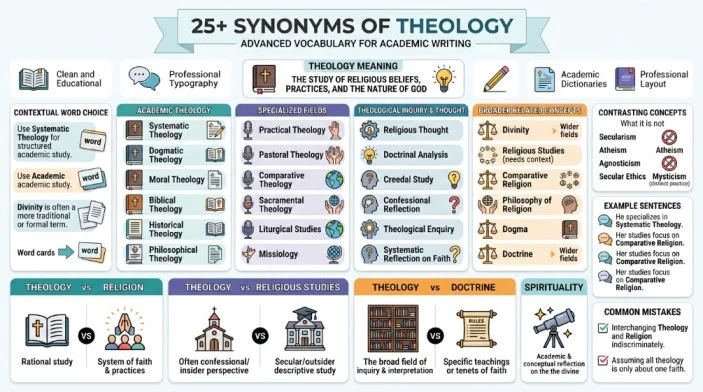
A student writing an essay about religion may type theology several times in a single paragraph. The same repetition can happen in academic papers, blog posts, lectures, book reviews, or discussions about faith and religious ideas. Finding the right synonym of theology can make the writing smoother, but accuracy matters because many related terms describe a slightly different field or approach.
The word theology generally refers to the systematic study, interpretation, or discussion of God, religious beliefs, and questions about faith. Depending on the context, alternatives such as divinity, theological study, religious thought, or theological inquiry may work, while terms such as religious studies have a broader meaning. Understanding these differences helps writers choose language that is precise rather than simply replacing one word with another.
What Are the Best Synonyms of “Theology”?
A synonym of theology is a word or phrase that refers to the study, interpretation, or systematic understanding of God, religious beliefs, or divine matters. Divinity, theological study, theological inquiry, and religious thought are useful alternatives, while religious studies is broader and should not always replace theology.
Meaning, Tone, and Context
Simple Definition
Theology is the systematic study or interpretation of God, religious beliefs, divine matters, and questions concerning faith. It can involve examining religious doctrines, sacred texts, beliefs about God, morality, creation, salvation, and the relationship between humans and the divine.
The exact meaning can vary by tradition. Christian theology, Islamic theology, Jewish theology, and other theological traditions may examine different beliefs and sources.
Part of Speech
Theology is a noun.
Overall Tone
The word is generally neutral. It does not automatically express approval or criticism of religion.
Its tone depends on how it is used. In an academic setting, theology often sounds analytical and scholarly. In religious settings, it can refer to the organized study and interpretation of a faith tradition.
Formality Level
Theology is a formal and academic term. It is especially common in:
- Universities and seminaries
- Academic books and journals
- Religious education
- Scholarly discussions
- Philosophy and religion courses
- Religious institutions
- Discussions of doctrine and belief
It can also appear in everyday conversation when people are discussing religious ideas.
Common Uses
Native English speakers commonly use theology when discussing:
- Christian theology
- Islamic theology
- Jewish theology
- Systematic theology
- Biblical theology
- Moral theology
- Historical theology
- Comparative theology
- Theological education
- Theological interpretation
- Theological arguments
- Theology and philosophy
- Theology and ethics
Word Forms
| Form | Word |
|---|---|
| Noun | theology |
| Adjective | theological |
| Noun | theologian |
| Adverb | theologically |
The adjective theological describes something related to theology.
Example:
“The course examines several theological approaches to salvation.”
A theologian is a person who studies or writes about theology.
When and How to Use “Theology”
Use theology when you are referring specifically to the systematic study, interpretation, or intellectual treatment of religious beliefs and divine matters. It is particularly appropriate when discussing doctrines, religious concepts, sacred texts, or scholarly approaches to faith.
Professional Context
“The university recently expanded its theology program.”
This works in an educational or institutional setting because theology identifies a specific academic field.
Academic Context
“The paper examines how theology influenced medieval European thought.”
Here, theology refers to a body of intellectual and religious ideas.
Workplace Context
“The organization has a strong interest in theology and religious education.”
The term works when the workplace or institution is connected to religious education or scholarship.
Personal Context
“I became interested in theology after taking a course on world religions.”
This sounds natural when someone is describing an academic or intellectual interest.
Email Context
“The attached article provides an introduction to Christian theology.”
This is suitable for an academic or religious email.
Resume Context
“Completed graduate coursework in theology and religious ethics.”
The term is precise and appropriate for an academic resume.
Social Media Context
“I’ve been reading about theology and philosophy and finding the connection fascinating.”
In an informal setting, theology can be used naturally when the subject itself is being discussed.
Best Synonyms of “Theology”
There is an important distinction to make before choosing an alternative. Theology has relatively few perfect one word synonyms in modern English. Many words and phrases associated with theology are related terms rather than exact replacements.
Professional Writing: Theological Study
Theological study is useful when you want to emphasize theology as an academic or scholarly activity.
Example:
“The institute offers advanced theological study for graduate students.”
Academic Writing: Theological Inquiry
Theological inquiry emphasizes investigation, questioning, and intellectual exploration of religious beliefs.
Example:
“The article presents a detailed theological inquiry into the concept of salvation.”
Religious Education: Divinity
Divinity can refer to the study of God or religion, particularly in academic and historical usage.
Example:
“She studied divinity at a theological institution.”
It should not be treated as an exact substitute in every sentence because divinity can also refer to a divine being or divine nature.
Scholarly Writing: Theological Scholarship
Theological scholarship highlights academic research and writing within theology.
Example:
“The book makes a valuable contribution to theological scholarship.”
Intellectual Discussion: Religious Thought
Religious thought is broader than theology and can include ideas developed by believers, philosophers, scholars, and religious communities.
Example:
“The course explores developments in medieval religious thought.”
Broader Academic Context: Religious Studies
Religious studies is not an exact synonym for theology. It is a broader academic field that can examine religions from historical, cultural, sociological, anthropological, philosophical, and other perspectives.
Example:
“She studied religious studies at the university.”
Use this term when the subject covers religion broadly rather than the systematic study of religious doctrine from within a theological framework.
Stronger Academic Emphasis: Theological Science
Theological science is a formal phrase sometimes used to describe theology as a systematic discipline. It is less common in ordinary modern writing than theology itself.
Interpretive Context: Theological Interpretation
Theological interpretation focuses on interpreting religious texts, ideas, or events through a theological framework.
Example:
“The book offers a theological interpretation of the biblical text.”
Doctrinal Context: Religious Doctrine
Religious doctrine refers to established beliefs or teachings within a religion. It is related to theology but does not mean the study of those beliefs itself.
Example:
“The course examines changes in religious doctrine over time.”
Personal Belief Context: Religious Belief
Religious belief describes what a person or community believes about religious matters. It is narrower in some contexts and broader in others than theology.
Example:
“Religious belief can influence ethical decisions.”
When Not to Use “Theology”
Although theology is precise, it is not the best choice for every discussion about religion.
When You Mean Religion as a Whole
Less precise:
“The course covers theology from many cultures.”
Better:
“The course covers religious studies from many cultures.”
Why:
If the course examines religion through history, culture, society, and anthropology, religious studies is more accurate.
When You Mean a Specific Belief
Less precise:
“The theology of the community is that charity is important.”
Better:
“The community’s religious belief emphasizes the importance of charity.”
Why:
The sentence focuses on a belief rather than the systematic study of religious ideas.
When You Mean Established Teaching
Less precise:
“The theology says that baptism is required.”
Better:
“The religious doctrine teaches that baptism is required.”
Why:
Doctrine identifies an established teaching rather than the academic study of that teaching.
When You Mean Personal Spiritual Experience
Less precise:
“Her theology changed after the experience.”
Better:
“Her religious beliefs changed after the experience.”
Why:
Personal belief is the focus, not necessarily formal theological reasoning.
When You Mean Philosophy
Less precise:
“The book presents a new theology of human knowledge.”
Better in some contexts:
“The book presents a new philosophical perspective on human knowledge.”
Why:
Not every discussion of existence, knowledge, or morality is theological.
Words Commonly Confused With “Theology”
| Word | Difference | When to Use It | Example |
|---|---|---|---|
| Religion | Refers to a broader system of beliefs, practices, traditions, and institutions. | When discussing faith as a whole. | “Religion has influenced many cultures.” |
| Religious Studies | Academically examines religion from multiple perspectives. | When studying religion as a social, cultural, or historical phenomenon. | “She is majoring in religious studies.” |
| Doctrine | Refers to established teachings or beliefs. | When discussing official religious teachings. | “The doctrine is central to the tradition.” |
| Philosophy | Examines fundamental questions about knowledge, existence, morality, and reality. | When the discussion is primarily philosophical. | “The philosopher questioned the nature of existence.” |
| Spirituality | Often refers to personal experiences or understandings of the spiritual dimension of life. | When discussing personal spiritual life. | “Meditation is part of her spirituality.” |
| Divinity | Can refer to God, divine nature, or the academic study of theology. | When discussing divine matters or certain academic traditions. | “He pursued a degree in divinity.” |
Best Synonyms of “Theology” by Context
| Context | Best Synonym or Alternative | Why It Works | Example |
|---|---|---|---|
| Formal writing | Theological study | Clearly describes systematic study. | “Theological study requires careful reading.” |
| Academic writing | Theological inquiry | Emphasizes intellectual investigation. | “The paper presents a theological inquiry.” |
| Professional communication | Theology | The original term is usually clearest. | “She teaches theology at the university.” |
| Business emails | Theology | Best when referring directly to the academic field. | “The meeting will address theology and education.” |
| Resume writing | Theological studies | Sounds natural as an area of education. | “Master’s degree in theological studies.” |
| Workplace communication | Theological study | Useful in educational or religious workplaces. | “The program supports theological study.” |
| Casual conversation | Theology | Usually more natural than an elaborate substitute. | “I’ve been studying theology.” |
| Everyday speaking | Religious thought | Useful when discussing religious ideas broadly. | “The book explores religious thought.” |
| Creative writing | Religious thought | Provides a broader and more literary expression. | “His work reflects ancient religious thought.” |
| Storytelling | Religious belief | Works when describing characters’ beliefs. | Her religious beliefs shaped her choices.” |
| Emotional writing | Spirituality | Better when focusing on personal spiritual experience. | “Her spirituality gave her comfort.” |
| Strong emphasis | Theological inquiry | Adds an intellectual and investigative emphasis. | “The issue deserves serious theological inquiry.” |
| Mild tone | Religious ideas | Less technical and easier for general readers. | “The article explores religious ideas.” |
| Social media captions | Theology | Direct and recognizable for a specialized audience. | “A fascinating discussion about theology.” |
| American English | Theology | Standard American English term. | “He teaches theology in the United States.” |
| British English | Theology | Also standard in British English. | “She studied theology at university.” |
How to Choose the Best Synonym of “Theology”
Choosing an alternative depends primarily on what aspect of theology you mean. Because many related terms have narrower or broader meanings, replacing theology mechanically can actually make a sentence less accurate.
If You Mean the Academic Field
Use theology, theological studies, or theological study.
Example:
“She earned a degree in theological studies.”
If You Mean Investigation
Use theological inquiry.
Example:
“The article develops a theological inquiry into forgiveness.”
If You Mean Religious Ideas
Use religious thought or religious ideas.
Example:
“The novel reflects the religious thought of its period.”
If You Mean Official Teachings
Use doctrine or religious doctrine.
Example:
“The discussion focuses on religious doctrine.”
If You Mean Personal Faith
Use religious belief or spirituality, depending on the context.
Example:
“Her religious beliefs shaped her approach to service.”
If You Mean Religion as an Academic Subject
Use religious studies.
Example:
“He decided to major in religious studies.”
If You Mean Divine Matters
Use divinity when the context supports it.
Example:
“The course explores questions concerning divinity.”
Real Life Examples of “Theology”
School
Basic:
“The class introduced students to theology.”
More specific:
“The class introduced students to theological ideas about creation and morality.”
College
Basic:
“She decided to study theology.”
Alternative:
“She decided to pursue theological studies.”
Workplace
Basic:
“The organization provides resources for theology students.”
Improved:
“The organization provides resources for students pursuing theological education.”
Business
Basic:
“The publisher specializes in theology.”
More precise:
“The publisher specializes in theological scholarship and religious education.”
Basic:
“I am interested in theology and would like more information about the program.”
Improved:
“I am interested in theological studies and would appreciate more information about the program.”
Resume
Basic:
“Studied theology.”
Improved:
“Completed graduate studies in theology and religious ethics.”
Conversation
Basic:
“I’ve always found theology interesting.”
Natural alternative:
“I’ve always been interested in religious thought.”
Storytelling
Basic:
“His theology influenced his decisions.”
More descriptive:
“His religious beliefs shaped nearly every decision he made.”
Blogging
Basic:
“Theology has influenced Western literature.”
More precise:
“Religious thought has influenced Western literature in many ways.”
Social Media
Basic:
“I’ve been reading about theology lately.”
Natural alternative:
“I’ve been exploring theological ideas lately.”
25 Best Synonyms and Related Alternatives for “Theology”
A vocabulary note is important here: English does not have 25 perfect one word synonyms for theology. The table therefore distinguishes practical alternatives, closely related terms, and phrases that can replace theology only in particular contexts. This avoids presenting unrelated words as exact synonyms.
| Synonym or Alternative | Simple Meaning | Best Used For | Example Sentence |
|---|---|---|---|
| Theological study | Systematic study of religious and divine matters | Academic writing | “Theological study requires careful analysis of religious texts.” |
| Theological studies | Academic study of theology and related subjects | Degrees and programs | “She earned a degree in theological studies.” |
| Theological inquiry | Investigation of theological questions | Research | “The article presents a theological inquiry into suffering.” |
| Theological scholarship | Academic research about theology | Universities and publications | “His work contributes to theological scholarship.” |
| Theological thought | Ideas and reasoning within theology | Intellectual writing | “The book examines developments in theological thought.” |
| Theological interpretation | Interpretation using a theological framework | Textual analysis | “The author offers a theological interpretation of the passage.” |
| Theological reflection | Thoughtful consideration of religious questions | Education and ministry | “The course encourages theological reflection.” |
| Theological discourse | Formal discussion of theological issues | Scholarly writing | “The debate influenced theological discourse.” |
| Theological science | Systematic treatment of theology as a discipline | Formal academic contexts | “The work presents theology as a systematic discipline.” |
| Divinity | Divine matters or, in some contexts, theological study | Academic and religious contexts | “He studied divinity at a theological school.” |
| Divinity studies | Academic study focused on divine and religious matters | Education | “She continued her divinity studies.” |
| Religious thought | Ideas concerning religion and faith | Broad intellectual discussions | “The essay examines medieval religious thought.” |
| Religious ideas | Concepts associated with religion | General writing | “The novel explores several religious ideas.” |
| Religious belief | A belief held about religious matters | Personal faith | “Religious belief influenced his worldview.” |
| Religious doctrine | Established religious teaching | Doctrinal discussions | “The text explains the religious doctrine clearly.” |
| Religious teaching | Instruction about religious beliefs | Education | “The program focuses on religious teaching.” |
| Sacred thought | Ideas concerning sacred or religious matters | Literary and historical writing | “The poem reflects ancient sacred thought.” |
| Study of God | Direct study of God and divine questions | Plain explanations | “The course was described as the study of God and divine matters.” |
| Study of the divine | Investigation of divine realities | Academic or philosophical writing | “The book explores the study of the divine.” |
| Study of religious belief | Examination of religious beliefs | General explanation | “The course involves the study of religious belief.” |
| Religious philosophy | Philosophical thinking connected to religion | Philosophy and religion | “The discussion examines religious philosophy.” |
| Faith studies | Study of faith and religious belief | General educational contexts | “The program includes faith studies.” |
| Religious scholarship | Academic research concerning religion | Research and publishing | “The journal publishes religious scholarship.” |
| Religious inquiry | Investigation of religious questions | Broad academic writing | “The project encourages religious inquiry.” |
| Theological reflection | Considered reflection on theological issues | Ministry and education | “Students were asked to write theological reflections.” |
Synonyms of “Theology” by Usage
Professional vs Personal Synonyms
In professional or academic writing, theology, theological studies, theological scholarship, and theological inquiry are generally the clearest choices.
In personal writing, religious thought, religious belief, or spirituality may be more natural when the focus is on personal faith rather than academic theology.
Professional:
“The department specializes in theological scholarship.”
Personal:
“Her religious beliefs have influenced her life.”
Formal vs Conversational Synonyms
Formal contexts benefit from precise terminology.
| Situation | Recommended Term |
|---|---|
| Research paper | Theological inquiry |
| Academic report | Theology |
| Business writing | Theology or theological studies |
| Presentation | Theology or theological thought |
| Academic email | Theological studies |
| Casual conversation | Theology |
| Texting | Religious ideas or theology |
There is no need to replace theology simply to sound sophisticated. In many situations, the original word is the clearest choice.
Academic Synonyms
Academic writing often requires distinctions between theology and broader religious studies.
Theological Inquiry
Use this when a paper investigates a particular theological question.
Theological Scholarship
Use this when discussing published academic research and scholarly contributions.
Theological Interpretation
Use this when explaining how a religious text, concept, or event is understood through theology.
Religious Studies
Use this when the research examines religion through broader academic approaches rather than theology alone.
Example:
“Religious studies may examine religious communities historically and sociologically, while theology may focus more directly on theological questions and beliefs.”
Professional and Business Synonyms
In most professional contexts connected to religion or education, theology remains the most direct and recognizable term.
Resumes
Use theology, theological studies, or theological education when describing academic qualifications.
Example:
“Master’s degree in theological studies.”
Interviews
Use theology when discussing your academic background.
Example:
“My graduate work focused on theology and ethics.”
Meetings
Use theological inquiry if the meeting involves scholarly discussion.
Example:
“The committee reviewed the proposal for theological inquiry.”
Presentations
Use theological thought when discussing historical or intellectual development.
Example:
“The presentation examines changes in theological thought.”
Performance Reviews
If the workplace is religious or educational, theological expertise may be appropriate.
Example:
“Demonstrates strong knowledge of theological literature.”
Client Communication
Use straightforward language unless the client expects specialized terminology.
Example:
“Our program provides accessible introductions to theology.”
Business Emails
Avoid unnecessarily complicated substitutes.
Better:
“The course introduces students to theology.”
Not:
“The course introduces students to the systematic intellectual investigation of divine realities.”
Clear writing is usually more professional than unnecessarily elaborate wording.
Creative and Literary Synonyms
Creative writing gives you more freedom, but the best alternative depends on what you are describing.
Religious Thought
Useful for describing the ideas that shape a character, culture, or historical period.
Religious Belief
Useful when focusing on what a character personally believes.
Spirituality
Useful when describing personal spiritual experience or inner life.
Sacred Thought
A more literary expression that can work when describing ideas connected with sacred subjects.
Theological Thought
Useful when the writing specifically concerns intellectual religious ideas.
Example:
“Her religious beliefs shaped the moral choices of the character throughout the novel.”
Slang or Modern Synonyms
There is no widely accepted slang synonym for theology. Because the word refers to a specialized field of study, replacing it with casual slang can reduce accuracy.
In informal conversation, people may simply say:
- Religious ideas
- Religious beliefs
- Faith
- Study of religion
However, these expressions are not exact synonyms.
Formal:
“I am studying theology.”
Casual:
“I’m studying religion.”
The second sentence is broader and does not necessarily mean the person is studying theology specifically.
Strongest to Mildest Synonyms
Unlike adjectives such as important, theology related terms do not form a true emotional intensity scale. Their differences are mainly about scope, academic emphasis, and subject matter.
| Level of Specificity | Term | Main Focus |
|---|---|---|
| Mild or broad | Religious ideas | General religious concepts |
| Mild or broad | Religious thought | Religious intellectual ideas |
| Moderate | Religious belief | Individual or communal beliefs |
| Moderate | Religious doctrine | Established teachings |
| Strongly academic | Theological study | Systematic academic study |
| Strongly academic | Theological inquiry | Investigation of theological questions |
| Highly specialized | Theological scholarship | Academic research |
| Highly specialized | Theological interpretation | Interpretation through a theological framework |
This is better understood as a specificity scale, not an emotional intensity scale.
Emotional vs Neutral Synonyms
Emotional Alternatives
Words such as spirituality, religious belief, and faith can sound more personal because they often relate to individual experience and conviction.
Example:
“Her spirituality became an important source of comfort.”
Neutral Alternatives
Theology, theological study, religious studies, and religious thought are generally more neutral and analytical.
Example:
“The course examines theology from a historical perspective.”
Choose neutral terminology for academic analysis and more personal vocabulary when discussing someone’s lived religious experience.
Antonyms of “Theology”
A strict antonym for theology does not really exist because theology is the name of an academic and intellectual field rather than a quality that naturally has an opposite.
The following terms can represent contrasting approaches or non-theological perspectives, but they should not be presented as perfect dictionary antonyms.
| Contrasting Term | Meaning | Example Sentence |
|---|---|---|
| Atheism | Lack of belief in God or gods | “The author discusses atheism alongside religious belief.” |
| Agnosticism | Position that knowledge of divine existence is uncertain or unavailable | “Agnosticism takes a different position on knowledge of God.” |
| Secularism | Approach that separates religious authority from certain public institutions | “The debate included questions about secularism.” |
| Nonreligion | Absence of religious affiliation or identification | “The study examines religion and nonreligion.” |
| Secular thought | Thinking not based primarily on religious authority | “The essay compares theological and secular thought.” |
| Materialism | Philosophical view emphasizing matter or physical reality | “Materialism offers a different account of reality.” |
| Naturalism | View that reality can be explained through natural causes | “Naturalism differs from theological explanations.” |
| Irreligion | Lack of religious belief or practice | “The survey included both religion and irreligion.” |
| Humanism | Approach emphasizing human values and capacities | “Humanism can provide a non-theological ethical framework.” |
| Secular philosophy | Philosophy developed without relying primarily on religious doctrine | “The author compares theology with secular philosophy.” |
| Non-theological study | Study that does not approach a subject through theology | “The paper uses a non-theological approach.” |
| Scientific inquiry | Investigation based on scientific methods | “Scientific inquiry addresses questions through empirical investigation.” |
| Empiricism | Emphasis on knowledge gained through experience or observation | “Empiricism differs from theological reasoning.” |
| Rationalism | Emphasis on reason as a source of knowledge | “Rationalism offers a different epistemological approach.” |
| Secular ethics | Ethical reasoning independent of religious doctrine | “The course compares religious ethics with secular ethics.” |
Comparison: “Theology” vs Similar Words
Theology vs Religion
Main Difference
Theology is the systematic study or interpretation of religious and divine matters. Religion is broader and can include beliefs, practices, rituals, communities, institutions, and traditions.
Which Is Stronger?
Neither is stronger. They describe different concepts.
Which Is More Formal?
Theology often sounds more academic because it identifies a specialized field.
When to Use Each
Use theology when discussing religious ideas systematically. Use religion when discussing a faith tradition as a whole.
Examples
Theology:
“The course examines Christian theology.”
Religion:
“The course examines religion in American society.”
Theology vs Religious Studies
Main Difference
Theology often examines religious beliefs and concepts from within a theological framework. Religious studies is broader and can examine religion through history, sociology, anthropology, philosophy, and other disciplines.
Which Is Stronger?
Neither is stronger.
Which Is More Formal?
Both are formal academic terms.
When to Use Each
Use religious studies for broader academic research about religion.
Examples
Theology:
“She studies Islamic theology.”
Religious Studies:
“She studies religion, culture, and society.”
Theology vs Doctrine
Main Difference
Theology is the study and interpretation of religious beliefs. Doctrine refers to established religious teachings.
Which Is Stronger?
Neither.
Which Is More Formal?
Both are formal, but doctrine is more specific when referring to official teachings.
When to Use Each
Use doctrine when identifying a particular teaching.
Examples
Theology:
“The book discusses Christian theology.”
Doctrine:
“The book explains Christian doctrine.”
Theology vs Spirituality
Main Difference
Theology generally emphasizes systematic thought and study. Spirituality often emphasizes personal experience, inner life, or one’s relationship with the spiritual dimension.
Which Is Stronger?
Neither.
Which Is More Formal?
Theology is generally more academic.
When to Use Each
Use spirituality when discussing personal spiritual experience.
Examples
Theology:
“Her research focuses on theology and ethics.”
Spirituality:
“Her spirituality influences her daily life.”
Theology vs Philosophy
Main Difference
Theology focuses on religious and divine questions. Philosophy addresses broader questions about existence, knowledge, morality, reason, and reality.
Which Is Stronger?
Neither.
Which Is More Formal?
Both are formal academic terms.
When to Use Each
Choose philosophy when the discussion does not specifically depend on religious belief or theology.
Examples
Theology:
“The course examines theological views of creation.”
Philosophy:
“The course examines philosophical theories of knowledge.”
Theology vs Divinity
Main Difference
Theology specifically refers to the study or systematic treatment of God and religious beliefs. Divinity can refer to divine nature or a divine being and can also refer to theological study in certain academic contexts.
Which Is Stronger?
Neither.
Which Is More Formal?
Both can be formal, but divinity is more context-dependent.
When to Use Each
Use theology when referring directly to the academic discipline. Use divinity when the context specifically supports its broader or traditional meaning.
Examples
Theology:
“He teaches theology.”
Divinity:
“She pursued graduate studies in divinity.”
Common Phrases and Expressions with “Theology”
Systematic Theology
Meaning:
The organized study of Christian theological beliefs and doctrines, usually by examining major topics in a structured way.
Example:
“She is taking a course in systematic theology.”
Christian Theology
Meaning:
The study and interpretation of Christian beliefs about God, Jesus, salvation, scripture, and related subjects.
Example:
“The book provides an introduction to Christian theology.”
Islamic Theology
Meaning:
Theological study and discussion concerning Islamic beliefs and concepts.
Example:
“The course introduces students to Islamic theology.”
Biblical Theology
Meaning:
A theological approach focused on themes and ideas found within the Bible and their development.
Example:
“The professor specializes in biblical theology.”
Moral Theology
Meaning:
Theological reflection on moral behavior, ethical responsibility, and related questions.
Example:
“The course examines moral theology and contemporary ethical issues.”
Theology and Philosophy
Meaning:
A phrase used when discussing the relationship between theological questions and philosophical reasoning.
Example:
“The lecture explores the relationship between theology and philosophy.”
Theology of Creation
Meaning:
Theological thinking concerning creation and the relationship between God and the created world.
Example:
“The paper examines different approaches to the theology of creation.”
Common Mistakes to Avoid
Mistake 1: Treating “Religion” as an Exact Synonym
Incorrect:
“The university department teaches religion as a synonym for theology.”
Better:
“The university department teaches theology, while the broader field of religious studies examines religion from several perspectives.”
Why:
Religion is broader than theology.
Mistake 2: Confusing Theology With Doctrine
Incorrect:
“Theology means an official religious doctrine.”
Better:
“Doctrine refers to an established religious teaching, while theology involves the systematic study and interpretation of religious beliefs.”
Why:
The terms describe different things.
Mistake 3: Using “Spirituality” for Academic Theology
Incorrect:
“She earned a degree in spirituality.”
Better:
“She earned a degree in theology.”
Why:
If the degree specifically concerns the academic study of theology, spirituality changes the meaning.
Mistake 4: Assuming Religious Studies and Theology Are Identical
Incorrect:
“Religious studies and theology always mean exactly the same thing.”
Better:
“Religious studies is broader than theology and may examine religion through several academic disciplines.”
Why:
The distinction matters in university and research contexts.
Mistake 5: Replacing Theology With a Longer Phrase Unnecessarily
Incorrect:
“The professor teaches the systematic intellectual investigation of divine realities.”
Better:
“The professor teaches theology.”
Why:
The original word is already precise and widely understood in academic contexts.
Mistake 6: Using “Divinity” in Every Context
Incorrect:
“The paper is about divinity in medieval religious scholarship.”
Better:
“The paper is about theology in medieval religious scholarship.”
Why:
Divinity has several meanings and may not communicate the intended academic field as clearly.
Mistake 7: Treating Contrasting Views as Antonyms
Incorrect:
“Atheism is the exact antonym of theology.”
Better:
“Atheism represents a contrasting position concerning belief in God, but it is not a strict dictionary antonym of theology.”
Why:
Theology is an academic field, while atheism describes a position concerning belief.
Frequently Asked Questions
What are the best synonyms of “theology”?
The best alternatives depend on context. Theological study, theological inquiry, theological scholarship, religious thought, and divinity can work in specific situations, but theology itself is often the clearest choice.
What are the best formal synonyms of “theology”?
Formal alternatives include theological study, theological inquiry, theological scholarship, theological thought, and theological interpretation. These phrases are especially useful in academic writing when you want to emphasize a particular aspect of theology.
What are common informal synonyms of “theology”?
There is no exact informal synonym for theology. In casual conversation, people may say religious ideas, religious thought, or study of religion, but these expressions are broader and should not automatically replace theology.
What is another word for “theology” in professional writing?
In professional and academic writing, theological studies or theological scholarship can work well when the context supports them. However, theology is usually the most concise and precise term for the academic discipline.
What is the difference between “theology” and “religion”?
Theology is the systematic study or interpretation of religious and divine matters. Religion is broader and can include beliefs, practices, rituals, communities, traditions, and institutions associated with a faith.
What is the opposite of “theology”?
There is no strict one word opposite of theology. Terms such as atheism, secularism, naturalism, and nonreligion represent contrasting perspectives or approaches, but they are not exact dictionary antonyms.
Conclusion
Theology refers to the systematic study, interpretation, and discussion of God, religious beliefs, and divine matters. Because it names a specific academic and intellectual field, it has fewer exact synonyms than many ordinary vocabulary words.
The best alternative depends on what you mean. Theological study and theological inquiry work well in academic contexts, theological scholarship emphasizes research, religious thought offers a broader expression, and spirituality or religious belief may be better when discussing personal faith. Religious studies is broader than theology and should be used carefully.
The most useful vocabulary habit is to identify the exact idea you want to express before choosing an alternative. That small step helps you select a synonym of theology that preserves your intended meaning instead of merely changing the word.
Read More Related Articles:
Synonyms for Empty | Meaning, Examples, and Better Word …
Synonyms for Pros and Cons | Meaning, Examples, and Better …