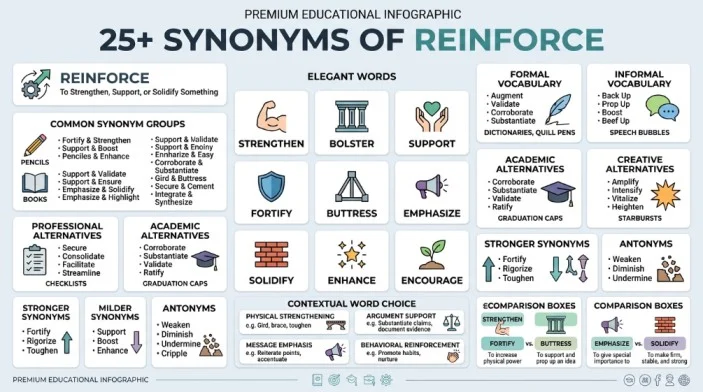
Words can change the strength and clarity of a sentence. Synonyms of Reinforce become especially useful when you want to express support, strengthen an idea, increase something, or make an argument more convincing without repeating the same verb. The right alternative depends on context, tone, and what you are actually trying to strengthen.
In English, reinforce can describe strengthening a physical structure, supporting an argument, encouraging a behavior, or making an effect more powerful. Understanding these differences helps you choose words such as strengthen, support, bolster, fortify, enhance, or reinforce with greater precision. This guide explores accurate synonyms, their meanings, tones, and practical uses so students, writers, professionals, and English learners can make their writing clearer, more natural, and more effective.
What Are the Best Synonyms of “Reinforce”?
Reinforce means to make something stronger, more effective, or more firmly established. The best alternatives include strengthen, bolster, fortify, support, and buttress for formal contexts. Emphasize works well for messages, while encourage can fit behavior. In academic and professional writing, strengthen, bolster, and support are especially useful.
Meaning, Tone, and Context
Simple Definition
Reinforce means to make something stronger or more effective. It can describe physical objects, arguments, beliefs, messages, structures, habits, or behaviors.
For example, adding steel beams can reinforce a building, while additional evidence can reinforce an argument.
The word can also describe making a behavior more likely to happen again. In psychology and education, positive feedback can reinforce a desired behavior.
Part of Speech
Reinforce is primarily a verb.
It can be used transitively, meaning it normally takes an object.
Example:
“The new evidence reinforced the researcher’s conclusion.”
Overall Tone
Reinforce is generally neutral. It does not automatically express a positive or negative attitude.
The tone depends on what is being reinforced.
Positive:
“The training reinforced good workplace habits.”
Negative:
“The advertisement reinforced an outdated stereotype.”
Formality Level
Reinforce is a neutral to moderately formal word. It works naturally in everyday English, academic writing, business communication, technical writing, and professional documents.
It is more precise than casual alternatives such as “make stronger” but is not so formal that it sounds unnatural in conversation.
Common Uses
Native English speakers commonly use reinforce when discussing:
- Arguments
- Ideas
- Beliefs
- Messages
- Evidence
- Structures
- Buildings
- Security measures
- Skills
- Habits
- Learning
- Training
- Positive behavior
- Rules
- Policies
- Relationships
- Confidence
- Expectations
Word Forms
| Word Form | Example |
|---|---|
| Verb | reinforce |
| Noun | reinforcement |
| Adjective | reinforced |
| Adverb | reinforce does not commonly have a direct adverb form |
Reinforcement refers to the act, process, or result of making something stronger or encouraging a behavior.
Example:
“The team received additional reinforcement before the final stage of the project.”
When and How to Use “Reinforce”
Use reinforce when you want to show that something is being made stronger, more convincing, more effective, or more firmly established.
The word is especially useful when an existing idea, structure, behavior, or message receives additional support.
Professional
“The manager introduced regular training sessions to reinforce the company’s safety standards.”
Here, reinforce shows that the training strengthens standards that already exist.
Academic
“The additional evidence reinforces the study’s central argument.”
This use is common when new evidence makes an existing argument more convincing.
Workplace
“Weekly meetings help reinforce clear communication across the team.”
The word suggests that meetings strengthen an existing practice.
Personal
“Her encouragement reinforced my confidence in the decision.”
Here, reinforced means made confidence stronger.
“Please review the attached examples to reinforce the key points discussed during today’s meeting.”
This wording works well when additional material supports an earlier message.
Resume
“Developed training programs that reinforced companywide compliance standards.”
In a resume, reinforced communicates a professional contribution without sounding repetitive.
Social Media
“This experience reinforced how much I value meaningful collaboration.”
The word works naturally when describing a realization that has become stronger because of an experience.
Best Synonyms of “Reinforce”
No synonym completely replaces reinforce in every situation. The best alternative depends on the sense of the word.
Professional Writing: Strengthen
Strengthen is the safest general alternative in professional writing. It clearly communicates that something has become more effective, stable, or powerful.
Example:
“The new policy will strengthen workplace safety.”
Academic Writing: Bolster
Bolster is especially useful when discussing arguments, evidence, claims, or conclusions.
Example:
“The additional data bolsters the researchers’ conclusion.”
Business Communication: Support
Support works well when something provides additional evidence, assistance, or justification.
Example:
“The survey results support our recommendation.”
Casual Conversation: Build Up
Build up is a conversational alternative when talking about confidence, strength, excitement, or momentum.
Example:
“The coach’s feedback really built up the team’s confidence.”
Emotional Writing: Encourage
Encourage can replace reinforce when the intended meaning involves making positive behavior or feelings more likely to continue.
Example:
“Her kind words encouraged him to keep trying.”
Creative Writing: Intensify
Intensify works when something becomes stronger in emotional force, effect, or degree.
Example:
“The storm intensified the sense of danger in the story.”
Resume Writing: Strengthen
Strengthen is concise and professional on resumes.
Example:
“Strengthened client relationships through consistent communication.”
Workplace Communication: Solidify
Solidify is useful when an action makes a relationship, agreement, position, or understanding more firmly established.
Example:
“The successful project solidified the partnership between the two companies.”
Stronger Meaning: Fortify
Fortify suggests deliberate strengthening, especially when protection, resistance, or durability is involved.
Example:
“The company fortified its cybersecurity systems.”
Softer Meaning: Support
Support is usually less forceful than fortify or strengthen. It is appropriate when you simply want to show that something receives additional help or evidence.
Example:
“The findings support the original hypothesis.”
When Not to Use “Reinforce”
Although reinforce is versatile, another word may sometimes communicate the intended meaning more clearly.
When the Word Sounds Too General
If you are describing a specific kind of strengthening, reinforce may not tell readers exactly what changed.
Less Precise:
“The campaign reinforced the company’s image.”
Better:
“The campaign strengthened the company’s brand identity.”
Why:
Strengthen makes the improvement in the brand image clearer.
When the Word Is Too Vague
If you mean that evidence makes an argument more convincing, bolster or support may be more precise.
Less Precise:
“The new statistics reinforced the argument.”
Better:
“The new statistics bolstered the argument.”
Why:
Bolster naturally communicates additional support for an argument.
When the Word Is Too Formal for Casual Speech
In relaxed conversation, reinforce can sometimes sound more formal than necessary.
Formal:
“That experience reinforced my belief.”
More Conversational:
“That experience strengthened my belief.”
Why:
Strengthened is familiar and natural in everyday speech.
When the Word Sounds Too Weak
If something has become much stronger or more resistant, fortify may be more appropriate.
Less Strong:
“The engineers reinforced the structure.”
Stronger:
“The engineers fortified the structure against severe weather.”
Why:
Fortify emphasizes protection and resistance.
When the Word Sounds Too Strong
If you only mean that something received evidence or assistance, support may be better.
Too Strong:
“The report reinforced the proposal.”
Better:
“The report supported the proposal.”
Why:
Support does not necessarily imply that the proposal became substantially stronger.
When You Mean Emphasis Rather Than Strength
A message can be reinforced, but if the intended meaning is simply drawing attention to a point, emphasize is often clearer.
Less Precise:
“The speaker reinforced the need for patience.”
Better:
“The speaker emphasized the need for patience.”
Why:
Emphasize directly communicates that the speaker gave the point greater attention.
Words Commonly Confused With “Reinforce”
| Word | Difference | When to Use It | Example |
|---|---|---|---|
| Strengthen | Makes something stronger or more effective. | General writing and professional communication. | “The changes strengthened the team’s performance.” |
| Support | Provides help, evidence, or justification. | Arguments, people, decisions, and ideas. | “The evidence supports the conclusion.” |
| Bolster | Adds strength, confidence, or support. | Formal writing, arguments, confidence, and claims. | “The results bolstered her confidence.” |
| Emphasize | Gives something greater attention or importance. | Messages, points, instructions, and ideas. | “The teacher emphasized the importance of practice.” |
| Fortify | Makes something stronger against damage or attack. | Structures, defenses, systems, and security. | “The company fortified its network.” |
| Encourage | Makes someone more likely to continue an action or attitude. | Behavior, effort, confidence, and participation. | “The praise encouraged students to participate.” |
Best Synonyms of “Reinforce” by Context
| Context | Best Synonym | Why It Works | Example |
|---|---|---|---|
| Formal writing | Strengthen | Clear and professional | “The reforms strengthened public services.” |
| Academic writing | Bolster | Works naturally with arguments and evidence | “The findings bolster the central claim.” |
| Professional communication | Strengthen | Broad and precise | “The program strengthened employee skills.” |
| Business emails | Support | Natural for recommendations and decisions | “The data supports our proposal.” |
| Resume writing | Strengthen | Concise and action oriented | “Strengthened customer relationships.” |
| Workplace communication | Solidify | Shows that something became more established | “The project solidified team trust.” |
| Casual conversation | Strengthen | Natural and widely understood | “That experience strengthened our friendship.” |
| Everyday speaking | Build up | Conversational and accessible | “The coach built up her confidence.” |
| Creative writing | Intensify | Adds emotional or dramatic force | “The silence intensified the tension.” |
| Storytelling | Deepen | Shows greater emotional or conceptual strength | “The experience deepened his understanding.” |
| Emotional writing | Encourage | Connects strengthening with feelings or behavior | “Her support encouraged him.” |
| Strong emphasis | Fortify | Suggests deliberate, powerful strengthening | “The team fortified its defenses.” |
| Mild tone | Support | Gives assistance without suggesting major change | “The evidence supports the idea.” |
| Social media captions | Strengthen | Simple and natural | “This experience strengthened my perspective.” |
| American English | Strengthen | Common and broadly applicable | “The training strengthened our skills.” |
| British English | Strengthen | Also natural and widely understood | “The changes strengthened the system.” |
How to Choose the Best Synonym of “Reinforce”
Choosing the right alternative becomes easier when you first identify what kind of strengthening you mean.
If You Mean Make Stronger
Choose strengthen.
Example:
“The new training strengthened employee skills.”
If You Mean Add Evidence
Choose support or bolster.
Example:
“The evidence bolstered the argument.”
If You Mean Make Something More Resistant
Choose fortify or buttress.
Example:
“The engineers fortified the bridge.”
If You Mean Give Greater Attention
Choose emphasize or underscore.
Example:
“The report emphasized the need for reform.”
If You Mean Make a Relationship More Firm
Choose solidify or strengthen.
Example:
“The agreement solidified the partnership.”
If You Mean Encourage Behavior
Choose encourage.
Example:
“Positive feedback encouraged students to continue practicing.”
If You Mean Increase Intensity
Choose intensify or amplify.
Example:
“The lighting amplified the dramatic effect.”
Consider Your Audience
For students, strengthen, support, and emphasize are easy and reliable choices.
For professionals, bolster, solidify, fortify, and strengthen can provide greater precision when the context supports them.
Consider Formality
Formal writing can comfortably use bolster, buttress, fortify, and underscore.
Everyday conversation usually sounds more natural with strengthen, support, or build up.
Consider Emotional Strength
Use support for mild emphasis, strengthen for moderate emphasis, and fortify or intensify when the context calls for stronger language.
Real Life Examples of “Reinforce”
School
Basic:
“Practice reinforces what students learn in class.”
Alternative:
“Regular practice strengthens students’ understanding of the material.”
College
Basic:
“The additional sources reinforced the paper’s argument.”
Alternative:
“The additional sources bolstered the paper’s central argument.”
Workplace
Basic:
“The workshop reinforced company policies.”
Alternative:
“The workshop strengthened employees’ understanding of company policies.”
Business
Basic:
“The partnership reinforced the company’s market position.”
Alternative:
“The partnership solidified the company’s position in the market.”
Basic:
“I am sending these examples to reinforce the main points.”
Alternative:
“I am sending these examples to support the main points discussed earlier.”
Resume
Basic:
“Reinforced customer relationships through regular communication.”
Alternative:
“Strengthened customer relationships through consistent communication.”
Conversation
Basic:
“That experience reinforced my decision.”
Alternative:
“That experience strengthened my decision.”
Storytelling
Basic:
“The darkness reinforced the feeling of fear.”
Alternative:
“The darkness intensified the feeling of fear.”
Blogging
Basic:
“These statistics reinforce the value of consistent content.”
Alternative:
“These statistics support the value of consistent content.”
Social Media
Basic:
“Today’s experience reinforced my belief in teamwork.”
Alternative:
“Today’s experience strengthened my belief in the power of teamwork.”
25 Best Synonyms of “Reinforce”
The table below includes synonyms and close alternatives across the major meanings of reinforce. Some words apply primarily to physical strengthening, while others work better for arguments, messages, beliefs, or behavior.
| Synonym | Simple Meaning | Best Used For | Example Sentence |
|---|---|---|---|
| Strengthen | Make something stronger | General usage | “The reforms strengthened the education system.” |
| Bolster | Give extra support or strength | Arguments, confidence, claims | “The new evidence bolstered the researcher’s argument.” |
| Fortify | Make stronger against damage or attack | Structures and security | “The city fortified its flood defenses.” |
| Buttress | Provide strong support | Formal arguments and structures | “The findings buttress the central theory.” |
| Support | Give help or evidence | Ideas, arguments, people | “The data supports the proposed solution.” |
| Shore up | Strengthen something that is weak | Problems, finances, systems | “The company took steps to shore up its finances.” |
| Underpin | Provide a strong foundation | Ideas, systems, arguments | “Trust underpins effective leadership.” |
| Consolidate | Make something more stable or firmly established | Gains, positions, relationships | “The merger consolidated the company’s market position.” |
| Augment | Increase or add to something | Resources and capabilities | “The new program augmented the team’s resources.” |
| Enhance | Improve quality or effectiveness | Skills, features, experiences | “The update enhanced the user experience.” |
| Intensify | Make stronger in degree or force | Emotions, effects, situations | “The music intensified the dramatic scene.” |
| Amplify | Increase strength, effect, or reach | Messages, effects, sounds | “The campaign amplified the company’s message.” |
| Solidify | Make firm or secure | Relationships, agreements, positions | “The successful launch solidified their partnership.” |
| Emphasize | Give greater attention to something | Messages and ideas | “The speaker emphasized the need for preparation.” |
| Underscore | Highlight the importance of something | Formal writing and reports | “The results underscore the value of early planning.” |
| Reaffirm | Confirm something again | Beliefs, commitments, positions | “The meeting reaffirmed the team’s commitment.” |
| Confirm | Establish that something is true | Evidence and information | “The test results confirmed the initial diagnosis.” |
| Validate | Show that something is sound or justified | Claims, ideas, methods | “The results validated the original approach.” |
| Encourage | Make an action or attitude more likely | Behavior and motivation | “Positive feedback encouraged continued effort.” |
| Promote | Help something develop or occur | Behaviors, ideas, practices | “The program promotes healthy habits.” |
| Advance | Help something progress | Ideas, causes, goals | “The research advanced our understanding of the issue.” |
| Improve | Make something better | Skills, systems, results | “The training improved employee performance.” |
| Deepen | Make stronger or more profound | Understanding and relationships | “The discussion deepened their understanding.” |
| Build up | Increase strength, confidence, or support | Casual communication | “The coach built up the player’s confidence.” |
| Reinvigorate | Give new energy or strength | Organizations, efforts, movements | “The new strategy reinvigorated the struggling team.” |
Synonyms of “Reinforce” by Usage
Professional vs Personal Synonyms
Professional writing benefits from precise alternatives such as strengthen, bolster, support, solidify, and fortify.
Example:
“The new policy strengthened compliance procedures.”
Personal writing can use simpler and warmer words such as strengthen, encourage, deepen, or build up.
Example:
“That conversation deepened our friendship.”
Formal vs Conversational Synonyms
- For reports and essays, consider bolster, buttress, underpin, underscore, and strengthen.
- For emails and presentations, support, strengthen, and emphasize are usually natural.
- For casual conversations and texting, strengthen, help, and build up sound more approachable.
Academic Synonyms
Academic writing often requires precise distinctions.
Bolster
Use bolster when evidence makes an argument or conclusion more convincing.
“The additional studies bolster the original hypothesis.”
Support
Use support when evidence provides justification for a claim.
“The results support the researchers’ conclusion.”
Underpin
Use underpin when something provides the foundation for a theory, system, or argument.
“Several principles underpin the proposed framework.”
Buttress
Use buttress when additional evidence or reasoning provides strong support.
“The historical evidence buttresses the author’s interpretation.”
Strengthen
Use strengthen when a method, argument, understanding, or conclusion becomes more effective.
“The additional analysis strengthened the study’s conclusions.”
These alternatives can make academic writing more precise than repeatedly using reinforce.
Professional and Business Synonyms
Resumes
Use strengthen, enhance, improve, or solidify when describing measurable professional contributions.
“Strengthened client relationships through proactive communication.”
Interviews
Use strengthen when explaining how experience improved a skill.
“My previous role strengthened my project management skills.”
Meetings
Use emphasize, underscore, or reinforce when discussing a key point.
“The manager emphasized the importance of meeting the deadline.”
Presentations
Use support or bolster when evidence makes a recommendation more convincing.
“These figures support our proposed strategy.”
Performance Reviews
Use strengthen, enhance, or improve when describing professional development.
“The training strengthened my leadership abilities.”
Client Communication
Use support when presenting evidence or recommendations.
“Our latest findings support the proposed solution.”
Business Emails
Use reinforce, emphasize, or clarify depending on the intended meaning.
“I would like to emphasize the importance of submitting the documents by Friday.”
Creative and Literary Synonyms
Creative writing often benefits from alternatives that describe exactly how something becomes stronger.
Intensify
Use it when emotions, tension, sounds, colors, or situations become stronger.
“The silence intensified the tension.”
Deepen
Use it when understanding, emotion, relationships, or meaning becomes richer.
“The journey deepened her appreciation for nature.”
Amplify
Use it when an effect, emotion, or message becomes more powerful.
“His words amplified the sense of urgency.”
Strengthen
Use it when a character’s belief, resolve, or relationship becomes firmer.
“The hardship strengthened her determination.”
Underscore
Use it when a detail draws attention to a theme or message.
“The final scene underscored the story’s central theme.”
Slang or Modern Synonyms
There is no single slang word that consistently functions as a direct synonym for reinforce across all meanings.
In casual American English, expressions such as build up, back up, and make stronger may sometimes replace it.
Build up can describe increasing confidence, energy, or strength.
“Her friends built up her confidence before the interview.”
Back up can mean provide support for a claim.
“The statistics back up his argument.”
However, back up should not automatically replace reinforce because it has several meanings and can sound too informal in academic or professional writing.
Strongest to Mildest Synonyms
The intensity of a synonym depends on context, but this general scale can help.
Mild
Support
Enhance
Encourage
These words can describe additional help or improvement without suggesting dramatic change.
Moderate
Strengthen
Bolster
Solidify
These suggest a noticeable increase in strength, effectiveness, or stability.
Strong
Fortify
Buttress
Intensify
These words suggest substantial strengthening or increased force.
Very Strong
Reinvigorate
Fortify
Intensify
These can imply a major increase in energy, resistance, or emotional force when the context supports it.
The scale is not absolute. For example, intensify is particularly strong for emotions or effects, while fortify is stronger for physical protection.
Emotional vs Neutral Synonyms
Emotional Synonyms
Encourage can describe strengthening someone’s motivation.
Build up can describe increasing someone’s confidence.
Deepen can describe stronger emotional connections.
Reinvigorate can describe giving renewed energy to an effort.
Intensify can describe stronger emotional experiences.
These words are useful in personal writing, storytelling, speeches, and motivational content.
Neutral Synonyms
Strengthen, support, bolster, enhance, and consolidate are generally more neutral.
They work well in reports, essays, business communication, and informational writing because they describe change without adding unnecessary emotion.
Antonyms of “Reinforce”
Because reinforce has several meanings, its opposites vary by context. The following words represent genuine opposites across its major senses.
| Antonym | Meaning | Example Sentence |
|---|---|---|
| Weaken | Make less strong | “The repeated failures weakened his confidence.” |
| Undermine | Gradually weaken support or confidence | “The contradiction undermined the argument.” |
| Damage | Harm something’s condition or effectiveness | “The storm damaged the structure.” |
| Impair | Reduce ability or effectiveness | “The injury impaired his mobility.” |
| Diminish | Make smaller or less powerful | “The criticism diminished her enthusiasm.” |
| Reduce | Make smaller in amount or degree | “The changes reduced the program’s effectiveness.” |
| Erode | Gradually weaken | “Repeated delays eroded public confidence.” |
| Destabilize | Make less stable | “The sudden changes destabilized the organization.” |
| Discourage | Make someone less likely to act | “The criticism discouraged students from participating.” |
| Dissuade | Persuade someone not to do something | “Her warning dissuaded him from taking the risk.” |
| Contradict | State that something is untrue or inconsistent | “The new evidence contradicted the earlier claim.” |
| Refute | Prove an argument or claim to be wrong | “The researchers refuted the original assumption.” |
| Invalidate | Show that something is not valid | “The error invalidated the original conclusion.” |
| Negate | Cancel or remove the effect of something | “The unexpected cost negated the financial benefit.” |
| Deplete | Reduce something substantially | “The prolonged crisis depleted the organization’s resources.” |
Comparison: “Reinforce” vs Similar Words
Reinforce vs Strengthen
Main Difference
Both words can mean making something stronger. Reinforce often suggests adding support to something that already exists, while strengthen is broader.
Which Is Stronger?
Neither is consistently stronger. Strengthen has wider everyday use.
Which Is More Formal?
Both are suitable for formal and professional writing.
When to Use Each
Use reinforce when additional support is added. Use strengthen when simply describing increased strength or effectiveness.
Examples
Reinforce:
“The evidence reinforced the original argument.”
Strengthen:
“The evidence strengthened the original argument.”
Reinforce vs Support
Main Difference
Support means providing help, evidence, or justification. Reinforce suggests making an existing thing stronger.
Which Is Stronger?
Reinforce can imply a greater strengthening effect.
Which Is More Formal?
Both are appropriate in professional and academic writing.
When to Use Each
Use support when evidence backs a claim. Use reinforce when that support makes an existing position stronger.
Examples
Reinforce:
“The statistics reinforced the message.”
Support:
“The statistics supported the message.”
Reinforce vs Bolster
Main Difference
Bolster means to strengthen or support something, especially an argument, confidence, position, or claim.
Which Is Stronger?
They are similar, although bolster often has a deliberate sense of adding support.
Which Is More Formal?
Bolster is somewhat more formal and is especially useful in polished writing.
When to Use Each
Use bolster for arguments, evidence, confidence, and positions. Use reinforce for those areas as well as physical structures and behavior.
Examples
Reinforce:
“The evidence reinforced her conclusion.”
Bolster:
“The evidence bolstered her conclusion.”
Reinforce vs Fortify
Main Difference
Fortify strongly emphasizes protection, resistance, or physical strength.
Which Is Stronger?
Fortify often sounds stronger when describing defense or protection.
Which Is More Formal?
Both can appear in formal writing, but fortify has a more specialized feel.
When to Use Each
Use reinforce for general strengthening. Use fortify when protection against damage or attack is central.
Examples
Reinforce:
“Engineers reinforced the bridge.”
Fortify:
“Engineers fortified the bridge against severe flooding.”
Reinforce vs Emphasize
Main Difference
Reinforce can mean strengthen an idea or message. Emphasize specifically means give greater attention or importance to something.
Which Is Stronger?
Neither is automatically stronger. They describe different actions.
Which Is More Formal?
Both are common in formal writing.
When to Use Each
Use emphasize when a speaker or writer highlights a point. Use reinforce when additional information strengthens that point.
Examples
Reinforce:
“The examples reinforced the lesson.”
Emphasize:
“The teacher emphasized the main lesson.”
Reinforce vs Encourage
Main Difference
Encourage focuses on motivating someone or making a behavior more likely. Reinforce is broader and can refer to physical structures, arguments, beliefs, and behavior.
Which Is Stronger?
Neither is universally stronger.
Which Is More Formal?
Both are widely used in professional and educational settings.
When to Use Each
Use encourage for motivation or behavior. Use reinforce when additional support or strength is the main idea.
Examples
Reinforce:
“The reward reinforced the desired behavior.”
Encourage:
“The teacher encouraged students to keep practicing.”
Common Phrases and Expressions with “Reinforce”
Reinforce the Message
Meaning:
To make a message clearer, stronger, or more memorable by repeating or supporting it.
Example Sentence:
“The final slide reinforced the message that customer service should remain a priority.”
Reinforce an Idea
Meaning:
To provide additional support that makes an idea stronger or more convincing.
Example Sentence:
“The examples reinforced the idea that preparation improves performance.”
Reinforce a Belief
Meaning:
To make an existing belief stronger.
Example Sentence:
“The experience reinforced her belief that patience leads to better results.”
Reinforce a Point
Meaning:
To add information or emphasis that makes a particular point clearer.
Example Sentence:
“The speaker used statistics to reinforce his main point.”
Reinforce an Argument
Meaning:
To add evidence or reasoning that makes an argument more convincing.
Example Sentence:
“The latest research reinforced the author’s argument.”
Reinforce Good Habits
Meaning:
To encourage positive habits so they are more likely to continue.
Example Sentence:
“Regular feedback can reinforce good study habits.”
Reinforce Learning
Meaning:
To strengthen knowledge or understanding through additional practice or review.
Example Sentence:
“Short quizzes help reinforce learning after each lesson.”
Reinforce a Structure
Meaning:
To physically strengthen a building, object, or construction.
Example Sentence:
“Workers reinforced the roof before the winter storms arrived.”
Common Mistakes to Avoid
1. Choosing a Vague Synonym Instead of a Precise One
Incorrect:
“The new evidence made the argument better.”
Better:
“The new evidence bolstered the argument.”
Why:
Bolstered specifically communicates that additional evidence strengthened an argument.
2. Confusing Reinforce With Emphasize
Incorrect:
“The speaker reinforced the deadline by mentioning it once.”
Better:
“The speaker emphasized the deadline by mentioning it clearly.”
Why:
Emphasize is more direct when the main idea is drawing attention to something.
3. Using an Informal Synonym in Formal Writing
Incorrect:
“The results really backed up the theory.”
Better:
“The results supported the theory.”
Why:
Backed up is conversational. Supported is more appropriate for academic and professional writing.
4. Selecting an Overly Dramatic Synonym
Incorrect:
“The teacher fortified the lesson with one additional example.”
Better:
“The teacher reinforced the lesson with one additional example.”
Why:
Fortify suggests substantial strengthening or protection. Reinforce is more natural for additional instructional material.
5. Repeating the Same Word Too Often
Incorrect:
“The examples reinforce the lesson. The discussion reinforces the lesson, and the quiz reinforces the lesson.”
Better:
“The examples reinforce the lesson. The discussion strengthens understanding, while the quiz supports retention.”
Why:
Using accurate alternatives improves variety without changing the meaning.
6. Choosing a Synonym With the Wrong Emotional Tone
Incorrect:
“The report intensified the company’s financial position.”
Better:
“The report strengthened the company’s financial position.”
Why:
Intensify is more natural for emotions, effects, conflicts, or conditions. Strengthen fits a business position better.
7. Using a Physical Strengthening Word for an Abstract Idea
Incorrect:
“The new evidence fortified the argument.”
Better:
“The new evidence bolstered the argument.”
Why:
Fortify can work metaphorically, but bolster is more natural for arguments and evidence.
Frequently Asked Questions
What is another word for reinforce?
Another word for reinforce is strengthen, support, bolster, fortify, or solidify, depending on the context.
What are the best reinforce synonyms?
Common reinforce synonyms include strengthen, bolster, support, fortify, enhance, and reinstate.
What is a reinforced synonym?
A reinforced synonym can be strengthened, fortified, supported, or bolstered, depending on how “reinforced” is used.
What is a reinforces synonym?
A reinforces synonym can be strengthens, supports, bolsters, fortifies, or confirms.
What is another word for reinforces?
Another word for reinforces is strengthens, supports, bolsters, or confirms.
What is a reinforcing synonym?
A reinforcing synonym can be strengthening, supporting, bolstering, or fortifying.
What are reinforces synonyms?
Reinforces synonyms include strengthens, supports, bolsters, fortifies, and confirms.
What’s another word for reinforce?
Another word for reinforce is strengthen. Other options include bolster, support, fortify, and enhance.
What is another word for reinforce in writing?
In writing, another word for reinforce may be strengthen, emphasize, support, confirm, or underline, depending on the intended meaning.
What are the best synonyms of “reinforce”?
The best synonyms of reinforce include strengthen, bolster, support, fortify, buttress, solidify, and enhance. The ideal choice depends on whether you mean physical strengthening, supporting an argument, or encouraging behavior.
What are the best formal synonyms of “reinforce”?
Formal synonyms include bolster, buttress, fortify, underpin, strengthen, and underscore. Bolster works especially well for arguments, while fortify is useful when discussing protection or physical strength.
What are common informal synonyms of “reinforce”?
In casual English, strengthen, build up, and back up can sometimes replace reinforce. However, each has a different meaning, so the best choice depends on whether you mean support, encouragement, or increased strength.
What is another word for “reinforce” in professional writing?
Strengthen is the most versatile professional alternative. Depending on context, bolster, support, solidify, enhance, and fortify can provide greater precision in reports, emails, resumes, and workplace communication.
What is the difference between “reinforce” and “strengthen”?
Reinforce often suggests adding support to something that already exists, while strengthen has a broader meaning of making something stronger or more effective. They are interchangeable in many contexts, but not every situation.
What is the opposite of “reinforce”?
Common opposites include weaken, undermine, diminish, erode, impair, damage, and destabilize. For arguments, contradict, refute, or invalidate may be the appropriate opposite.
Conclusion
Reinforce means to make something stronger, more effective, more convincing, or more firmly established. Its best alternatives depend on context. Strengthen is the most versatile choice, bolster works well for arguments and evidence, fortify suits protection and physical structures, support fits claims and ideas, and emphasize is better when the goal is to highlight a message.
No single synonym of reinforce works perfectly in every sentence. Consider the meaning, audience, tone, purpose, and level of formality before replacing the word. A useful vocabulary habit is to identify exactly what is becoming stronger, then choose the synonym that describes that change most precisely.
Read More Related Articles:
- 25+ Synonyms of Existence | Meanings, Uses, Examples, and …
- Synonyms for Thus | Meaning, Examples, and Better Word …
- Meaning, Uses, Examples, and the Best Synonym of Complain











1 thought on “Synonyms of Reinforce |25+ Meaning, Stronger Alternatives & Smarter Word Choices 2026”