Choosing the right alternative to should can make your English sound clearer, more precise, and better suited to the situation. In everyday speech, should often expresses advice, expectation, duty, or something considered likely. However, repeating the same word can make writing feel limited, especially in academic or professional contexts. Learning other words for should gives you more control over tone and meaning. A useful should synonym may be “ought to,” “need to,” “are expected to,” or “had better,” but each carries a slightly different level of obligation.
For students preparing for IELTS, understanding should synonyms for IELTS can also improve vocabulary range when the context allows a natural substitution. This guide explains what is the meaning of the word should, how should works in sentences, and which synonyms for should fit different situations. Use it as a practical should thesaurus to choose alternatives accurately rather than simply replacing one word with another.
Best Synonyms for Should
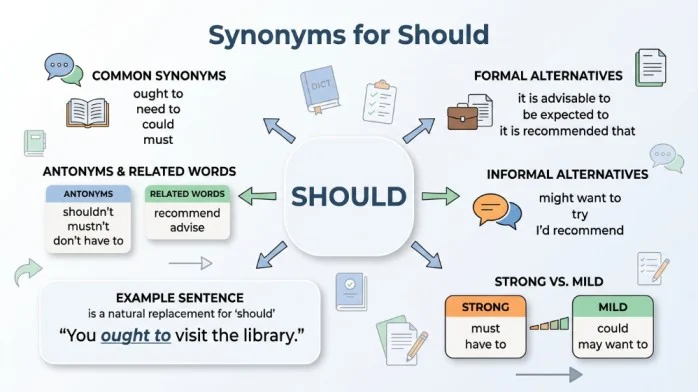
The best synonyms for should are ought to, need to, must, and could. The right choice depends on tone, context, and intensity.
- Ought to – expresses moral duty or strong advice.
- Need to – shows necessity or practical importance.
- Must – indicates obligation or a requirement.
- Could – offers a gentle suggestion rather than firm advice.
No single synonym replaces should in every sentence. Choosing the right one depends on what you want to express.
What Does Should Mean?
The word should is a modal verb that expresses advice, recommendation, expectation, probability, or obligation. It often suggests that something is the right, sensible, or desirable action without making it an absolute requirement.
Unlike must, which usually signals a firm obligation, should leaves room for personal choice or judgment.
Part of Speech:
Modal auxiliary verb
Common Uses:
- Giving advice
- Making recommendations
- Expressing expectations
- Talking about likely outcomes
- Describing moral responsibility
Example Sentences
- You should drink plenty of water during hot weather.
- We should arrive before sunset if traffic stays light.
In both examples, should suggests the preferred or expected action without making it mandatory.
Core Meaning of Should
At its core, should communicates that something is appropriate, advisable, expected, or likely.
Rather than giving an order, it encourages a particular action or expresses what is generally considered the best choice. Because of this flexible meaning, should appears in conversations, emails, reports, articles, classroom discussions, and professional communication.
Depending on context, it can express several ideas:
- Advice: You should rest after surgery.
- Recommendation: Applicants should submit all documents.
- Expectation: The package should arrive tomorrow.
- Moral duty: People should respect one another.
- Probability: The weather should improve this afternoon.
Although these uses are related, they are not identical. That is why replacing should requires careful attention to context.
Grammar and Usage Notes
Understanding how should functions in English grammar makes it easier to choose an appropriate alternative.
Part of Speech
Should is a modal auxiliary verb. Modal verbs work alongside a main verb and do not change form for different subjects.
Examples:
- I should leave.
- She should leave.
- They should leave.
The modal verb stays the same regardless of the subject.
Common Sentence Patterns
Should + Base Verb
- You should apologize.
- We should begin now.
Should Not + Base Verb
- You should not ignore the warning.
- They shouldn’t waste their time.
Question Form
- Should I call first?
- Should we wait?
Common Collocations
The word should commonly appears with phrases such as:
- should consider
- should remember
- should avoid
- should improve
- should know
- should understand
- should expect
- should follow
- should keep
- should always
These combinations sound natural because they frequently appear in everyday English.
When Should Sounds Natural
Use should when offering advice without sounding demanding.
Examples:
- You should save your work regularly.
- Students should review their notes before the exam.
- You should wear comfortable shoes for the hike.
The tone is helpful rather than forceful.
When Another Word Works Better
Sometimes another modal verb or expression communicates your meaning more clearly.
- Use must when something is mandatory.
- Use need to when emphasizing necessity.
- Use ought to for moral responsibility.
- Use could for polite suggestions.
- Use may want to when offering friendly advice.
Choosing the right alternative helps your writing match the intended tone.
Best Synonyms for Should
| Synonym | Meaning | Tone | Best Use Case | Example Sentence |
|---|---|---|---|---|
| Ought to | Moral duty or strong advice | Neutral | Advice and ethical responsibility | You ought to thank everyone who helped you. |
| Need to | Necessary action | Neutral | Practical situations | You need to update the software. |
| Must | Required or mandatory | Strong | Rules and obligations | Employees must wear identification badges. |
| Could | Gentle suggestion | Friendly | Offering options | You could ask the manager for assistance. |
| May want to | Polite recommendation | Casual | Friendly advice | You may want to double-check the address. |
| Had better | Strong warning or advice | Firm | Preventing problems | You had better leave before the storm arrives. |
| Be expected to | Required by role or situation | Formal | Professional writing | Staff members are expected to attend meetings. |
| It is advisable to | Recommended action | Formal | Academic and business writing | It is advisable to keep backup copies of important files. |
Common Synonyms for Should
The following alternatives are the most common replacements for should in everyday English. While they share a similar meaning, each one has its own tone and level of certainty.
Ought to
Meaning: Expresses advice, responsibility, or what is morally right.
Best Context: Everyday conversations, recommendations, and discussions about responsibility.
Example Sentence:
You ought to apologize after speaking so harshly.
Usage Note:
Ought to is one of the closest synonyms for should. It often sounds slightly more formal or old-fashioned in American English but is still widely understood.
Need to
Meaning: Shows that something is necessary or important.
Best Context: Practical instructions and daily responsibilities.
Example Sentence:
You need to charge your phone before leaving.
Usage Note:
Unlike should, need to usually suggests a stronger level of necessity.
Must
Meaning: Indicates a firm obligation or requirement.
Best Context: Rules, laws, workplace policies, and serious instructions.
Example Sentence:
Visitors must wear a security badge at all times.
Usage Note:
Must is much stronger than should. It often removes the sense of personal choice.
Could
Meaning: Offers a possible option or gentle suggestion.
Best Context: Friendly advice and polite conversations.
Example Sentence:
You could try restarting your computer first.
Usage Note:
This word feels less direct than should and gives the listener more freedom.
May Want to
Meaning: Gives a polite recommendation without sounding forceful.
Best Context: Customer service, emails, and friendly advice.
Example Sentence:
You may want to save a copy before making changes.
Usage Note:
This phrase is especially useful when you want to sound respectful and nonjudgmental.
Had Better
Meaning: Gives strong advice, often with an implied consequence.
Best Context: Warnings and urgent recommendations.
Example Sentence:
You had better lock the doors before leaving.
Usage Note:
Although similar to should, this expression sounds more serious because it hints that ignoring the advice could lead to problems.
Be Expected to
Meaning: Describes what is normally required or anticipated.
Best Context: Schools, workplaces, and professional communication.
Example Sentence:
Employees are expected to complete the training within two weeks.
Usage Note:
This phrase focuses on expectations rather than personal advice.
It Is Advisable to
Meaning: Suggests a wise or recommended action.
Best Context: Formal reports, guides, and professional writing.
Example Sentence:
It is advisable to keep digital copies of important documents.
Usage Note:
This formal expression is common in academic, legal, and business contexts.
Formal Synonyms for Should
Formal writing often requires wording that sounds objective and professional. Instead of repeatedly using should, consider these alternatives.
It Is Advisable to
This phrase sounds careful and professional. It recommends an action without sounding demanding.
Best For:
- Business reports
- Academic papers
- Instruction manuals
- Professional recommendations
Example:
It is advisable to review the contract before signing.
Be Expected to
Use this phrase when discussing responsibilities, standards, or policies.
Best For:
- Employee handbooks
- School guidelines
- Organizational policies
Example:
Students are expected to submit assignments before the deadline.
Be Required to
This expression communicates an official obligation rather than advice.
Best For:
- Legal documents
- Workplace policies
- Government regulations
Example:
Applicants are required to provide valid identification.
It Is Recommended That
This wording is common in research papers, technical documents, and healthcare guidance.
Best For:
- Academic writing
- Medical recommendations
- Professional guidance
Example:
It is recommended that users update the software regularly.
It Is Appropriate to
Use this expression when discussing proper behavior or suitable actions.
Best For:
- Formal correspondence
- Professional etiquette
- Educational writing
Example:
It is appropriate to acknowledge all contributors in the report.
Be Encouraged to
This phrase suggests support rather than obligation.
Best For:
- Company communications
- Educational settings
- Public information
Example:
Participants are encouraged to ask questions throughout the workshop.
Informal Synonyms for Should
Casual conversations often benefit from softer, friendlier language. These alternatives sound natural in speech, text messages, and social media.
Could
A gentle way to make a suggestion.
Example:
You could watch the tutorial before trying it yourself.
Might Want to
Friendly and conversational.
Example:
You might want to bring a jacket tonight.
Why Don’t You
A natural way to offer advice in conversation.
Example:
Why don’t you call them tomorrow morning?
Try
A simple suggestion that feels encouraging rather than forceful.
Example:
Try restarting the app before reinstalling it.
Go Ahead and
Often used when encouraging someone to take action.
Example:
Go ahead and send the email now.
I’d Recommend
Adds a personal touch to advice.
Example:
I’d recommend booking your tickets early.
My Advice Is
Useful when sharing personal opinions.
Example:
My advice is to stay calm during the interview.
Strong Synonyms for Should
Some situations require stronger wording because the action is urgent, important, or mandatory.
Must
The strongest everyday alternative.
Best Use: Laws, safety rules, and essential requirements.
Example:
Passengers must fasten their seat belts.
Need to
Shows genuine necessity.
Example:
You need to finish the application today.
Have to
Expresses an obligation created by circumstances.
Example:
We have to leave before rush hour.
Be Required to
Indicates official rules or policies.
Example:
Contractors are required to complete safety training.
Had Better
Suggests that ignoring the advice may have negative consequences.
Example:
You had better check the weather before hiking.
Cannot Afford to Ignore
Used when emphasizing serious risks.
Example:
Businesses cannot afford to ignore cybersecurity threats.
When Strong Synonyms May Be Too Strong
Avoid replacing should with stronger words when you’re simply giving friendly advice.
For example:
✔ You should get some rest.
✘ You must get some rest.
The second sentence may sound controlling unless the situation truly requires urgency.
Mild Synonyms for Should
When you want to sound polite, supportive, or less direct, mild alternatives often work better than should.
Could
Offers a suggestion without pressure.
Example:
You could ask for another opinion.
May Want to
Sounds considerate and respectful.
Example:
You may want to save your work first.
Might Consider
Suggests an option rather than advice.
Example:
You might consider taking an online course.
Can
Works well when pointing out a possible action.
Example:
You can contact customer support if you need help.
It Might Help to
A gentle way to introduce advice.
Example:
It might help to write everything down.
One Option Is To
Useful when presenting multiple choices.
Example:
One option is to schedule the meeting next week.
Why Choose Mild Alternatives?
Mild wording is often better when:
- Giving customer support.
- Writing friendly emails.
- Offering suggestions without sounding bossy.
- Talking with friends or family.
- Presenting several possible solutions.
These expressions keep the conversation open and respectful while still providing useful guidance.
Synonyms for Should by Context
The best replacement for should depends on where and how you’re using it. A word that sounds perfect in casual conversation may feel out of place in a business report, while a formal expression may sound stiff in a text message.
Everyday Conversation
Daily conversations usually call for relaxed, natural language.
Good choices include:
- could
- might want to
- try
- ought to
- why don’t you
Examples:
- You could leave a little earlier tomorrow.
- You might want to bring an umbrella.
- Why don’t you ask Alex for help?
These alternatives sound friendly and helpful without being overly direct.
Professional Writing
Business communication should be clear, respectful, and objective.
Good choices include:
- be expected to
- it is advisable to
- be encouraged to
- it is recommended that
- be required to
Examples:
- Employees are expected to complete annual training.
- It is advisable to review all financial records before submission.
- Team members are encouraged to share feedback regularly.
These expressions maintain a professional tone while communicating expectations effectively.
Academic Writing
Academic writing favors precise and evidence-based language over casual advice.
Good choices include:
- it is recommended that
- it is advisable to
- researchers should (when discussing recommendations)
- be encouraged to
Examples:
- It is recommended that future studies include larger sample sizes.
- Researchers are encouraged to examine additional variables.
- It is advisable to interpret the findings within their limitations.
These alternatives create a formal, objective style that fits scholarly writing.
Synonyms for Should by Context
Creative Writing
Creative writing gives you more freedom to choose words that match a character’s personality, emotions, or the mood of a scene. Instead of repeating should, select an alternative that sounds natural in the dialogue or narration.
Best choices:
- ought to
- had better
- could
- might want to
- need to
Examples:
- “You ought to tell her the truth before someone else does.”
- “We had better leave before the bridge closes.”
- “You could give him another chance.”
- “They need to face the consequences of their decisions.”
These alternatives help create dialogue that feels authentic and varied.
Marketing Copy
Marketing content should motivate readers without sounding pushy. Softer recommendations usually perform better than direct commands.
Best choices:
- may want to
- consider
- could
- we recommend
- it’s worth
Examples:
- You may want to explore our premium plan.
- Consider upgrading for additional features.
- It’s worth comparing all available options.
- We recommend backing up your files regularly.
These expressions encourage action while maintaining a friendly tone.
Personal Communication
Emails, text messages, and conversations with friends often benefit from warm, conversational language.
Best choices:
- could
- might want to
- ought to
- try
- I’d recommend
Examples:
- You could stop by after work.
- I’d recommend taking a few days off.
- You might want to check the weather first.
- Try getting some sleep before the exam.
These choices sound supportive instead of demanding.
Another Word for Should in a Sentence
Here are practical examples showing how different synonyms can replace should depending on the situation.
- You ought to call your parents more often.
- We need to finish this project by Friday.
- You could ask for clarification if you’re unsure.
- Employees are expected to follow the company policy.
- It is advisable to save your work frequently.
- You might want to compare prices before buying.
- Visitors must check in at the reception desk.
- I’d recommend arriving at least fifteen minutes early.
- Students are encouraged to participate in classroom discussions.
- You had better bring your passport to the airport.
- One option is to postpone the meeting until Monday.
- It is recommended that drivers check their tire pressure regularly.
- You can contact customer support for additional assistance.
- They have to submit the application before the deadline.
- It might help to write down your daily goals.
These examples show that there is no universal replacement for should. The most suitable alternative depends on the message you want to communicate.
Should Synonyms Compared
Many alternatives to should appear similar at first glance, but they differ in meaning, tone, and level of obligation.
| Word or Phrase | Meaning | Tone | Intensity | Best Use Case |
|---|---|---|---|---|
| Should | Advice or expectation | Neutral | Medium | General recommendations |
| Ought to | Moral duty or strong advice | Neutral | Medium | Ethical responsibility |
| Need to | Necessity | Neutral | Strong | Practical requirements |
| Must | Mandatory obligation | Strong | Very High | Rules, laws, safety |
| Could | Possible suggestion | Friendly | Low | Casual advice |
| May want to | Gentle recommendation | Friendly | Low | Emails and customer support |
| Had better | Warning with consequences | Firm | High | Urgent advice |
| Be expected to | Standard or responsibility | Formal | Medium | Professional writing |
| It is advisable to | Recommended action | Formal | Medium | Academic and business documents |
Key Differences
Should vs. Must
- Should gives advice.
- Must communicates a requirement.
Examples:
- You should read the instructions first. (Recommended)
- You must wear protective equipment. (Required)
Should vs. Need to
- Should suggests the best choice.
- Need to emphasizes necessity.
Examples:
- You should exercise regularly.
- You need to see a doctor immediately.
Should vs. Could
- Should recommends one option.
- Could introduces a possibility.
Examples:
- You should email the manager.
- You could email the manager if you’re unable to call.
Should vs. Ought to
These words are very close in meaning.
The main difference is that ought to often emphasizes moral responsibility or what is ethically right.
Examples:
- We should respect other people’s opinions.
- We ought to respect other people’s opinions.
Both are correct, but the second sentence places slightly more emphasis on moral obligation.
Words Similar to Should
The following words belong to the same general idea as should, but they are not always exact synonyms. They may express related concepts such as obligation, possibility, expectation, permission, or advice.
Need
Why it’s related:
Both words can describe something important.
Why it isn’t always a synonym:
Need expresses necessity rather than recommendation.
Example:
You need more sleep.
Must
Why it’s related:
Both guide behavior.
Why it isn’t always a synonym:
Must is much stronger because it expresses obligation.
Example:
You must wear a helmet.
Could
Why it’s related:
Both can suggest an action.
Why it isn’t always a synonym:
Could presents an option instead of recommending the best choice.
Example:
You could wait until tomorrow.
May
Why it’s related:
Both modal verbs help express possibility.
Why it isn’t always a synonym:
May focuses on permission or possibility rather than advice.
Example:
You may leave after the meeting.
Can
Why it’s related:
Both help describe future actions.
Why it isn’t always a synonym:
Can usually refers to ability or permission.
Example:
You can use my laptop.
Have to
Why it’s related:
Both involve responsibility.
Why it isn’t always a synonym:
Have to indicates an external obligation rather than advice.
Example:
I have to attend the meeting.
Recommend
Why it’s related:
Recommendations often use should.
Why it isn’t always a synonym:
Recommend is a main verb, not a modal verb.
Example:
I recommend reading this book.
Advise
Why it’s related:
Advice commonly includes the word should.
Why it isn’t always a synonym:
Advise describes the act of giving guidance.
Example:
The doctor advised me to rest.
Encourage
Why it’s related:
Encouragement often suggests positive action.
Why it isn’t always a synonym:
It focuses on motivating rather than recommending.
Example:
Teachers encourage students to ask questions.
Antonyms of Should
Unlike many adjectives and nouns, should does not have perfect opposites because it is a modal verb. However, several words and expressions communicate the opposite idea by suggesting that an action is unnecessary, discouraged, or prohibited.
| Antonym | Meaning | Example Sentence |
|---|---|---|
| Shouldn’t | Advises against an action | You shouldn’t ignore the warning signs. |
| Mustn’t | Prohibits an action | Visitors mustn’t enter the restricted area. |
| Needn’t | Indicates something is unnecessary | You needn’t bring any food. |
| Don’t have to | Shows there is no obligation | You don’t have to stay if you’re busy. |
| May not | Indicates lack of permission | Guests may not enter the laboratory. |
| Can avoid | Suggests skipping an action | You can avoid traffic by leaving early. |
Understanding Opposites
Notice that these expressions do not all mean exactly the same thing.
For example:
- You shouldn’t go. (Not recommended.)
- You mustn’t go. (Forbidden.)
- You don’t have to go. (Optional.)
How to Choose the Right Synonym for Should
There isn’t a single replacement for should that works in every sentence. The best choice depends on what you want to communicate and how you want your message to sound.
Match the Context
Start by thinking about where the sentence will appear.
- For everyday conversations, use could, might want to, or ought to.
- For business writing, phrases like be expected to or it is advisable to sound more professional.
- For rules or legal requirements, must or be required to is often the better choice.
Match the Tone
The tone of your writing matters just as much as the meaning.
- Use gentle language when offering friendly advice.
- Choose formal wording for reports, academic papers, and workplace communication.
- Reserve stronger expressions for situations that truly require urgency or obligation.
Check the Intensity
Some alternatives are much stronger than should.
For example:
- You should back up your files. (Recommendation)
- You must back up your files. (Requirement)
Replacing should with must changes the meaning significantly. Make sure the stronger wording is justified.
Think About Your Reader
Consider how your audience may interpret the sentence.
A manager writing company policies may need direct language, while a customer support agent usually benefits from polite suggestions.
Compare these examples:
- You must update your profile.
- You may want to update your profile.
Both are grammatically correct, but they create very different impressions.
Check Whether the Synonym Is Exact
Some related words belong to the same semantic field but cannot replace should directly.
For example:
- Recommend
- Advise
- Encourage
These words express similar ideas, but they function as main verbs rather than modal verbs.
Instead of writing:
✘ You recommend finish the report today.
Write:
✔ I recommend finishing the report today.
or
✔ You should finish the report today.
Keep the Sentence Natural
A replacement should improve the sentence, not make it sound awkward.
Instead of automatically replacing every instance of should, read the sentence aloud. If the alternative sounds forced or unnatural, keeping should may be the better choice.
Choose Simplicity When Clarity Matters
Simple language is often the clearest.
Compare these examples:
- It is advisable to review the instructions before assembly.
- You should read the instructions before putting it together.
The second sentence is shorter and easier for most readers to understand. Unless a formal tone is required, simple wording usually communicates more effectively.
Common Mistakes When Using Synonyms for Should
Replacing should without considering meaning or tone can make writing confusing. These are some of the most common mistakes.
Choosing a Word with the Wrong Tone
Some alternatives sound much more formal than others.
Less Natural
It is advisable to bring snacks to the movie.
More Natural
You should bring snacks to the movie.
The first sentence sounds unnecessarily formal for a casual situation.
Using a Synonym That Is Too Strong
Many writers replace should with must, even when there is no real obligation.
Too Strong
You must try this restaurant.
Better
You should try this restaurant.
The second sentence feels like friendly advice instead of a command.
Using Formal Language in Casual Writing
Professional expressions may sound stiff in conversations.
Instead of:
Employees are expected to enjoy the concert.
Use:
You should enjoy the concert.
Choose wording that matches the setting.
Using Casual Language in Professional Documents
The opposite problem can also occur.
Instead of writing:
You could submit your tax documents before Friday.
A professional document might say:
Applicants are required to submit their tax documents before Friday.
Professional writing often needs greater precision.
Replacing Should Without Checking the Meaning
Some alternatives only work in specific situations.
For example:
- Need to expresses necessity.
- Could suggests possibility.
- Must indicates obligation.
These meanings are related, but they are not interchangeable in every sentence.
Treating Related Words as Exact Synonyms
Words like recommend, advise, and encourage belong to the same topic, but they do not function the same way as should.
Compare:
- I advise taking the earlier train.
- You should take the earlier train.
Both communicate similar ideas, yet they have different grammatical structures.
Making the Sentence Sound Unnatural
Sometimes the simplest option is the best one.
Instead of replacing should simply to avoid repetition, ask whether the new wording improves the sentence.
If it doesn’t, keep the original word.
Quick Synonym List for Should
Common Synonyms
- ought to
- need to
- could
- must
- had better
Formal Synonyms
- it is advisable to
- be expected to
- it is recommended that
- be required to
- be encouraged to
Informal Synonyms
- might want to
- try
- why don’t you
- I’d recommend
- go ahead and
Strong Synonyms
- must
- need to
- have to
- be required to
- had better
Mild Synonyms
- could
- may want to
- might consider
- can
- it might help to
Related Words
- recommend
- advise
- encourage
- obligation
- responsibility
- expectation
- guidance
- necessity
FAQs
What Is the Meaning of the Word Should?
Should is a modal verb used to express advice, expectation, duty, or something considered appropriate or likely.
What Are Other Words for Should?
Common alternatives include ought to, are expected to, are supposed to, must, need to, and had better, depending on the context.
What Is Another Word for Should in Formal Writing?
Ought to is a formal alternative in some contexts. Are expected to and are required to can also work when the intended meaning involves expectation or obligation.
What Is a Good Should Synonym for IELTS?
For IELTS writing, useful alternatives include ought to, need to, are expected to, and are advised to. The best choice depends on the exact meaning and sentence.
What Does a Should Thesaurus Include?
A thesaurus may list alternatives such as ought to, must, need to, and be supposed to, but these words can differ in strength and meaning.
What Are the Best Synonyms for Should?
The best synonym depends on context. Ought to often expresses advice or duty, while must usually expresses a stronger obligation.
What is the best synonym for should?
The best synonym for should depends on the sentence. Ought to, need to, must, and could are among the most common alternatives. Choose one based on the level of advice, obligation, or possibility you want to express.
What is another word for should?
Another word for should can be ought to, need to, could, may want to, or had better. Each one fits different contexts and carries a different level of strength.
What is a formal synonym for should?
Formal alternatives include it is advisable to, be expected to, it is recommended that, and be required to. These expressions are common in academic, legal, and professional writing.
What is an informal synonym for should?
Informal options include could, might want to, try, I’d recommend, and why don’t you. These expressions sound friendly and conversational.
What is a stronger word for should?
Must is generally the strongest replacement for should because it expresses obligation rather than advice. Other strong alternatives include need to, have to, and be required to.
What is a milder word for should?
If you want to sound less direct, use could, may want to, might consider, or it might help to. These phrases offer suggestions without applying pressure.
What words are similar to should?
Related words include recommend, advise, encourage, need, must, can, and may. While they belong to the same semantic field, they are not always direct replacements for should.
What is the opposite of should?
There is no perfect opposite of should, but expressions such as shouldn’t, mustn’t, needn’t, and don’t have to communicate different kinds of non-obligation or prohibition.
How do I choose the right synonym for should?
Choose a synonym by considering the context, tone, formality, and strength of your message. The best alternative is the one that conveys your intended meaning naturally and accurately.
Conclusion
The word should is one of the most flexible modal verbs in English, which is why finding the right replacement requires more than simply looking at a synonym list. Depending on the context, it can express advice, expectation, recommendation, responsibility, or probability.
Some alternatives, such as ought to, stay very close in meaning, while others, including must, need to, or could, change the level of obligation or certainty. Choosing carefully helps your writing sound more natural, precise, and appropriate for your audience.
Whenever you replace should, think about the tone, the context, and the strength of the message. In many cases, should remains the clearest and most natural choice. When another word communicates your meaning more accurately, selecting the right alternative will make your writing stronger and easier to understand.
Read More Related Articles:
- Synonyms for Know | Meaning, Examples, and Better Word …
- Synonyms for Interpret | Meaning, Examples, and Better Word …