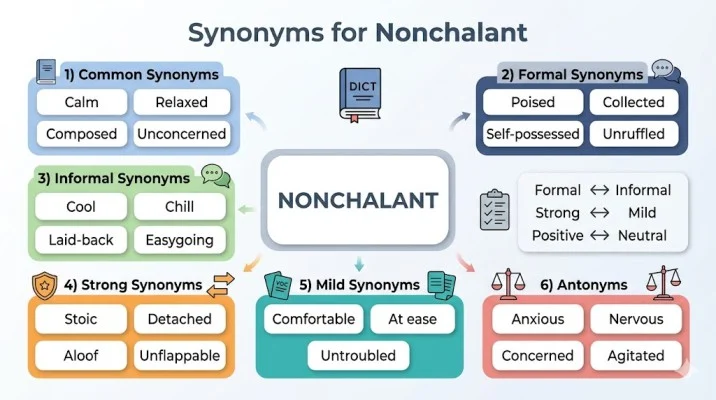
Finding the right nonchalant synonym can make your writing sound more precise, natural, and confident. Nonchalant describes a calm, seemingly unconcerned attitude, often suggesting that someone shows little worry or excitement. Depending on the situation, useful synonyms of nonchalant include unconcerned, casual, composed, indifferent, and unruffled. Each carries a slightly different tone, so choosing the closest match matters.
For writers searching for another word for nonchalant, context is key. The nonchalant meaning synonyms may range from calm and relaxed to detached or unconcerned. The adverb nonchalantly also has alternatives such as casually, calmly, and carelessly, depending on the intended meaning. This guide covers nonchalantly synonym, synonyms of nonchalantly, and nonchalantly synonyms with clear usage guidance. It also explains nonchalant synonym and antonym choices and helps you select the right synonym for nonchalant without changing the original meaning.
Best Synonyms for Nonchalant
The best synonyms for nonchalant are unconcerned, casual, composed, cool, relaxed, indifferent, calm, and unruffled. The right choice depends on the tone, context, and intensity. For example, composed emphasizes self-control, while indifferent often suggests a lack of interest or concern.
What Does Nonchalant Mean?
Nonchalant is an adjective that describes someone who appears calm, unconcerned, or not easily worried, even in situations that might make other people nervous or excited.
A nonchalant person usually gives the impression that nothing bothers them. Depending on the context, this attitude may be seen as confident, relaxed, or emotionally detached.
Part of Speech:
Adjective
Simple Definition:
Appearing calm and unconcerned, especially in situations where others might show emotion.
Example Sentences:
- She remained nonchalant even after hearing the unexpected news.
- Despite the pressure, he answered every question with a nonchalant smile.
Core Meaning of Nonchalant
At its core, nonchalant describes a person who seems unaffected by events or emotions. The word focuses more on outward behavior than on inner feelings. Someone may actually feel nervous or excited but still appear completely relaxed.
Because of this, nonchalant can carry different shades of meaning depending on the context.
Sometimes it suggests confidence and emotional control. A skilled athlete who stays calm during a championship game may be described as nonchalant because they never appear rattled.
In other situations, it can imply indifference or a lack of concern. If someone reacts nonchalantly to an important issue, others may think they do not care enough.
Understanding this subtle difference is important because not every synonym communicates the same attitude. Words like composed highlight confidence, while indifferent emphasizes emotional distance.
Grammar and Usage Notes
Part of Speech
Nonchalant functions as an adjective. It modifies nouns or follows linking verbs.
Examples:
- She looked nonchalant throughout the interview.
- His nonchalant attitude surprised everyone.
Common Sentence Patterns
- nonchalant about something
- remain nonchalant
- appear nonchalant
- seem nonchalant
- stay nonchalant
- a nonchalant attitude
- a nonchalant smile
- a nonchalant response
- a nonchalant expression
- act nonchalantly (adverb form)
When Nonchalant Sounds Natural
The word works best when describing someone’s calm appearance, relaxed behavior, or emotional self-control.
Examples include:
- Remaining calm during stressful moments.
- Acting casually despite unexpected events.
- Showing confidence without appearing anxious.
- Responding to criticism without obvious emotion.
When Another Synonym Works Better
Although nonchalant is useful, another word may fit your sentence more naturally.
- Choose composed when emphasizing self-control.
- Choose calm when focusing on emotional stability.
- Choose relaxed for casual, everyday situations.
- Choose unruffled when someone remains unaffected by pressure.
- Choose indifferent only when you truly mean the person lacks interest or concern.
- Choose cool in informal writing when describing confidence under pressure.
Selecting a synonym based on context creates smoother, more accurate writing than replacing words automatically.
Best Synonyms for Nonchalant
| Synonym | Meaning | Tone | Best Use Case | Example Sentence |
|---|---|---|---|---|
| Unconcerned | Not worried or bothered | Neutral | Everyday writing | She seemed unconcerned about the delay. |
| Composed | Calm and self-controlled | Formal | Professional and academic writing | He remained composed during the presentation. |
| Relaxed | Free from stress or tension | Casual | Everyday conversation | Everyone admired her relaxed attitude. |
| Calm | Peaceful and emotionally steady | Neutral | General writing | He stayed calm throughout the emergency. |
| Cool | Confident under pressure | Informal | Conversation and storytelling | She stayed cool despite the unexpected challenge. |
| Unruffled | Not disturbed by problems | Formal | Reports and descriptive writing | The manager remained unruffled during the crisis. |
| Casual | Informal and unconcerned | Neutral | Daily communication | His casual reply surprised the interviewer. |
| Collected | Emotionally controlled and organized | Formal | Literature and business writing | She appeared collected despite the difficult questions. |
| Detached | Emotionally distant | Neutral | Psychological or descriptive contexts | His detached manner made him difficult to read. |
| Indifferent | Showing little interest or concern | Slightly Negative | When genuine lack of concern is intended | She seemed indifferent to the criticism. |
Common Synonyms for Nonchalant
These are the most frequently used alternatives to nonchalant in everyday English. While they share a similar meaning, each word has its own tone and works best in different situations.
Unconcerned
Meaning: Not worried, anxious, or bothered about something.
Best Context: Everyday conversation, news writing, and general descriptions.
Example:
She seemed unconcerned about the last-minute schedule change.
Calm
Meaning: Emotionally steady and free from panic or stress.
Best Context: Daily communication, professional writing, and storytelling.
Example:
The pilot stayed calm throughout the turbulent flight.
Relaxed
Meaning: Comfortable, at ease, and not under pressure.
Best Context: Casual conversations and lifestyle writing.
Example:
He looked relaxed as he waited for the interview to begin.
Casual
Meaning: Informal and naturally unconcerned.
Best Context: Describing behavior, clothing, conversations, or attitudes.
Example:
Her casual response made the situation feel less serious.
Cool
Meaning: Confident and emotionally controlled, especially under pressure.
Best Context: Informal speech, fiction, and modern writing.
Example:
He stayed cool even when everyone else started to panic.
Composed
Meaning: Calm, self-controlled, and emotionally balanced.
Best Context: Professional, academic, and formal writing.
Example:
The spokesperson remained composed during difficult questions.
Collected
Meaning: Mentally organized and emotionally steady.
Best Context: Formal writing, biographies, and descriptive passages.
Example:
She appeared collected despite the unexpected announcement.
Unruffled
Meaning: Not disturbed by stress, criticism, or unexpected events.
Best Context: Formal descriptions and literary writing.
Example:
The experienced teacher remained unruffled during the emergency.
Detached
Meaning: Emotionally distant or uninvolved.
Best Context: Psychology, literature, and character descriptions.
Example:
His detached attitude made him difficult to understand.
Indifferent
Meaning: Showing little interest, concern, or emotion.
Best Context: Situations where someone genuinely does not care.
Example:
She seemed indifferent to the outcome of the competition.
Formal Synonyms for Nonchalant
Formal alternatives are useful in academic papers, business communication, professional reports, and polished writing. They often emphasize emotional control rather than a casual attitude.
Composed
This is one of the strongest formal replacements for nonchalant. It suggests confidence, discipline, and emotional stability without implying carelessness.
Best for: Business writing, presentations, leadership, and professional communication.
Example:
The executive remained composed throughout the difficult negotiation.
Collected
Collected highlights mental clarity along with emotional control. It often describes someone who thinks carefully before reacting.
Best for: Academic writing, biographies, and formal descriptions.
Example:
She gave a collected response after reviewing all the evidence.
Unruffled
This word emphasizes staying unaffected by pressure or unexpected events. It often appears in formal writing and literature.
Best for: Reports, essays, and descriptive writing.
Example:
Despite the criticism, he remained unruffled.
Self-Possessed
Self-possessed describes someone who has complete control over their emotions and behavior.
Best for: Literary analysis, formal essays, and character descriptions.
Example:
The lawyer appeared self-possessed throughout the trial.
Impassive
This synonym suggests showing very little outward emotion. It is more formal and can imply emotional restraint.
Best for: Literature, psychology, and analytical writing.
Example:
The judge maintained an impassive expression during the hearing.
Equable
Equable describes someone with a consistently calm and even temperament.
Best for: Academic and descriptive writing.
Example:
Her equable personality helped resolve workplace conflicts.
Poised
Poised combines calmness with confidence and grace.
Best for: Professional profiles, speeches, and formal descriptions.
Example:
She remained poised while answering challenging questions.
Informal Synonyms for Nonchalant
Casual alternatives work well in everyday conversation, text messages, blogs, and social media. These words sound more natural in friendly communication.
Cool
This word often describes someone who stays calm and confident under pressure.
Example:
He stayed cool when the lights suddenly went out.
Chill
Chill is a modern informal word meaning relaxed and easygoing.
Example:
She’s always so chill, even during busy weeks.
Easygoing
This synonym emphasizes a relaxed personality that rarely becomes stressed.
Example:
He’s easygoing and gets along with almost everyone.
Laid-Back
Laid-back describes someone with a very relaxed attitude toward life.
Example:
Our new manager is surprisingly laid-back.
Easy
In conversation, easy can describe a calm or relaxed attitude.
Example:
She was easy about the whole situation.
Carefree
This word suggests enjoying life without worrying too much. Unlike nonchalant, it often has a positive and cheerful meaning.
Example:
The children spent a carefree afternoon at the beach.
Breezy
Breezy describes someone who handles situations in a light, cheerful, and effortless way.
Example:
His breezy reply immediately relaxed the group.
Strong Synonyms for Nonchalant
Some alternatives express a much stronger level of emotional distance or self-control. These words should be chosen carefully because they may change the meaning of your sentence.
Indifferent
This is stronger than nonchalant because it often means someone genuinely does not care.
Best Use: When a lack of concern is intentional.
Example:
The customer appeared indifferent to the company’s apology.
Detached
This word emphasizes emotional separation rather than simple calmness.
Best Use: Psychological discussions and character analysis.
Example:
He remained detached throughout the emotional conversation.
Impassive
Impassive suggests showing almost no visible emotion at all.
Best Use: Formal writing and literary descriptions.
Example:
Her impassive face revealed nothing.
Aloof
This synonym describes someone who keeps emotional or social distance from others.
Best Use: Personality descriptions.
Example:
Many people mistakenly thought he was aloof.
Unflappable
This word describes someone who almost never becomes nervous or upset.
Best Use: Professional, leadership, and crisis situations.
Example:
The experienced surgeon remained unflappable during the operation.
Stoic
Stoic refers to someone who endures difficulties without showing emotion.
Best Use: Historical, literary, and descriptive writing.
Example:
He remained stoic despite the painful circumstances.
Note: Stoic implies emotional endurance, while nonchalant often refers only to outward appearance.
Mild Synonyms for Nonchalant
Sometimes a softer word creates a more natural sentence. Mild alternatives reduce the sense of emotional distance while keeping the idea of calmness.
Calm
A safe choice for almost any context.
Example:
She stayed calm throughout the interview.
Relaxed
This word emphasizes comfort rather than emotional detachment.
Example:
Everyone felt relaxed after the meeting ended.
Easygoing
This describes a naturally pleasant and stress-free personality.
Example:
He’s easygoing and rarely loses his temper.
Casual
This suggests an informal, comfortable attitude without sounding negative.
Example:
Her casual approach helped everyone feel welcome.
Comfortable
This focuses on feeling at ease rather than appearing emotionally distant.
Example:
He looked comfortable speaking in front of the audience.
At Ease
This phrase describes someone who feels relaxed and confident.
Example:
She seemed completely at ease during the interview.
Untroubled
This word suggests someone who is free from worry or emotional stress.
Example:
He lived with an untroubled outlook on life.
These milder alternatives are often better than nonchalant when you want to describe calmness without suggesting indifference or emotional distance.
Synonyms for Nonchalant by Context
The best synonym for nonchalant depends on where and how you use it. A word that sounds natural in a casual conversation may feel out of place in a business report or academic essay. The sections below show which alternatives work best in different situations.
Everyday Conversation
In daily speech, simple and familiar words usually sound the most natural. These synonyms describe someone who appears calm, relaxed, or not easily bothered.
Best choices:
- Relaxed
- Calm
- Cool
- Chill
- Easygoing
- Laid-back
These words fit conversations with friends, family, and coworkers because they sound natural without being overly formal.
Examples:
- She stayed calm even when everyone else became anxious.
- He’s so laid-back that very little bothers him.
- I like her easygoing personality.
- He remained cool during the unexpected delay.
Professional Writing
Business communication usually calls for words that sound respectful and polished. Instead of using casual expressions, choose synonyms that highlight confidence and emotional control.
Best choices:
- Composed
- Collected
- Poised
- Unruffled
- Calm
These alternatives work well in performance reviews, workplace reports, presentations, and professional emails.
Examples:
- The manager remained composed throughout the negotiations.
- She delivered a poised presentation despite the technical issues.
- His collected response reassured the entire team.
Academic Writing
Essays and research papers benefit from precise vocabulary. Formal synonyms communicate the same general idea while maintaining an objective tone.
Best choices:
- Composed
- Self-possessed
- Equable
- Impassive
- Unruffled
Use these words only when they accurately describe the person’s behavior.
Examples:
- The historical records describe the leader as remarkably self-possessed.
- The witness remained impassive throughout the questioning.
- Her equable temperament contributed to effective leadership.
Creative Writing
Stories often require more descriptive language to reveal a character’s personality or emotions. Different synonyms can create very different impressions.
Best choices:
- Aloof
- Detached
- Cool
- Unflappable
- Stoic
- Relaxed
Choose carefully because each word reveals something unique about the character.
Examples:
- He gave her a detached smile before walking away.
- She remained unflappable, even as chaos surrounded her.
- His aloof manner made him difficult to approach.
Personal Communication
When writing messages, emails, or letters, softer language usually feels warmer and more natural.
Best choices:
- Calm
- Relaxed
- Easygoing
- Comfortable
- At ease
These words avoid suggesting emotional distance while still expressing composure.
Examples:
- I’m glad you stayed calm during the meeting.
- You always seem so relaxed under pressure.
- She’s incredibly easygoing, which makes working with her enjoyable.
Another Word for Nonchalant in a Sentence
Below are realistic examples showing how different synonyms can replace nonchalant in natural writing.
- She remained composed during the difficult interview.
- He looked completely relaxed before the competition began.
- The firefighter stayed calm despite the dangerous conditions.
- Her easygoing personality makes everyone feel comfortable.
- The pilot remained unruffled throughout the turbulence.
- He answered every question with a cool confidence.
- She appeared collected while explaining the problem.
- His casual attitude surprised the entire group.
- The lawyer stayed poised during cross-examination.
- She sounded unconcerned about the unexpected delay.
- His detached expression revealed very little emotion.
- The experienced coach remained unflappable during the final minutes of the game.
- She gave an impassive glance before continuing her speech.
- His stoic reaction impressed everyone in the room.
- The new employee seemed completely at ease on the first day.
These examples show that although the words are related, each creates a slightly different impression. Choosing the right synonym makes your writing more accurate and engaging.
Nonchalant Synonyms Compared
Many words resemble nonchalant, but they are not interchangeable in every situation. The table below highlights the key differences.
| Synonym | Main Meaning | Tone | Intensity | Best Use Case |
|---|---|---|---|---|
| Nonchalant | Calm and seemingly unconcerned | Neutral | Medium | General descriptions |
| Calm | Emotionally steady | Neutral | Mild | Everyday writing |
| Relaxed | Comfortable and stress-free | Casual | Mild | Conversation |
| Composed | Self-controlled | Formal | Medium | Business and academic writing |
| Collected | Mentally organized and calm | Formal | Medium | Professional communication |
| Unruffled | Unaffected by pressure | Formal | Medium | Reports and literature |
| Cool | Calm with confidence | Informal | Medium | Modern conversation |
| Detached | Emotionally distant | Neutral | Strong | Character descriptions |
| Indifferent | Not caring | Slightly negative | Strong | Genuine lack of concern |
| Aloof | Socially distant | Slightly negative | Strong | Personality descriptions |
| Stoic | Enduring hardship without emotion | Formal | Strong | Literature and history |
| Unflappable | Impossible to upset | Positive | Strong | Leadership and crisis situations |
Key Differences at a Glance
- Calm focuses on emotional stability.
- Relaxed emphasizes comfort and ease.
- Composed highlights self-control.
- Cool adds confidence and modern style.
- Detached suggests emotional distance.
- Indifferent implies not caring.
- Stoic refers to enduring hardship without showing emotion.
- Unflappable describes someone who stays steady under intense pressure.
Selecting the closest match helps your writing sound more precise and natural.
Words Similar to Nonchalant
Some words belong to the same semantic field as nonchalant but are not exact synonyms. They express related ideas and may fit certain contexts, yet they cannot always replace nonchalant without changing the meaning.
Confident
Why it’s related:
Confident people often appear calm and unconcerned.
Why it isn’t an exact synonym:
Confidence describes belief in one’s abilities, while nonchalant describes outward behavior.
Example:
She gave a confident presentation.
Carefree
Why it’s related:
Both words suggest a lack of worry.
Difference:
Carefree usually has a cheerful, positive meaning, whereas nonchalant may simply describe emotional restraint.
Example:
The children enjoyed a carefree summer vacation.
Reserved
Why it’s related:
Reserved people often appear emotionally controlled.
Difference:
Reserved describes someone who naturally avoids expressing emotions rather than someone who appears unconcerned.
Example:
He’s naturally reserved around strangers.
Patient
Why it’s related:
Patient people remain calm in difficult situations.
Difference:
Patience emphasizes waiting without frustration rather than appearing unconcerned.
Example:
She remained patient while waiting for assistance.
Serene
Why it’s related:
Both words communicate calmness.
Difference:
Serene suggests deep inner peace rather than emotional indifference.
Example:
The garden created a serene atmosphere.
Balanced
Why it’s related:
Balanced people manage emotions well.
Difference:
The word focuses on emotional stability instead of appearing unconcerned.
Example:
She maintained a balanced perspective during the discussion.
Self-Controlled
Why it’s related:
Self-controlled people rarely overreact.
Difference:
It emphasizes discipline rather than a casual attitude.
Example:
He remained self-controlled despite the criticism.
Easygoing
Why it’s related:
Easygoing people rarely become stressed.
Difference:
The word describes personality more than a specific reaction.
Example:
Everyone enjoys working with her because she’s easygoing.
Why These Words Matter
These related words expand your vocabulary and help you express subtle differences in personality, emotion, and behavior. However, they should only replace nonchalant when the surrounding sentence supports the intended meaning.
Antonyms of Nonchalant
Antonyms describe the opposite of nonchalant. Instead of appearing calm or unconcerned, these words express worry, excitement, nervousness, or emotional involvement.
| Antonym | Meaning | Example Sentence |
|---|---|---|
| Anxious | Feeling worried or uneasy | She looked anxious before the interview. |
| Concerned | Showing care or worry | He was deeply concerned about the results. |
| Agitated | Emotionally disturbed or upset | The unexpected news left everyone agitated. |
| Nervous | Feeling tense or fearful | He grew nervous before speaking to the audience. |
| Restless | Unable to stay calm or still | She became restless while waiting for the decision. |
| Excitable | Easily excited or emotional | The children were excitable before the trip. |
| Flustered | Confused or embarrassed under pressure | She felt flustered after forgetting her notes. |
| Distressed | Experiencing great emotional pain or worry | The family was distressed by the unexpected news. |
These antonyms help show how nonchalant sits on the opposite end of the emotional spectrum, describing someone who appears calm rather than visibly affected.
How to Choose the Right Synonym for Nonchalant
Not every synonym works in every sentence. A good choice depends on the message you want to communicate and the audience you’re writing for.
Match the Context
Think about where the word will appear.
- Use composed or poised in business and academic writing.
- Use relaxed or calm in everyday conversation.
- Use cool or laid-back in informal settings.
Match the Tone
Some synonyms sound positive, while others carry a negative meaning.
For example:
- Composed usually sounds complimentary.
- Indifferent often suggests a lack of care.
- Detached may imply emotional distance.
Choose a word that matches the feeling you want readers to understand.
Check the Intensity
Some words express a stronger idea than others.
- Mild: calm, relaxed
- Moderate: nonchalant, composed
- Strong: stoic, impassive, unflappable
Avoid using a stronger synonym unless it accurately reflects the situation.
Think About Your Audience
Professional readers often expect formal language, while casual readers usually prefer simple vocabulary.
For example:
- Business report: composed
- Novel: aloof
- Text message: chill
Decide Whether the Word Is an Exact Synonym
Some related words share part of the meaning but cannot fully replace nonchalant.
For instance, confident and carefree describe different qualities even though they may appear similar in certain situations.
Keep the Sentence Natural
Read your sentence aloud. If the replacement sounds awkward or changes the meaning, try another synonym instead.
Simple, natural wording is usually more effective than choosing an uncommon word just to sound impressive.
Common Mistakes When Using Synonyms for Nonchalant
Even experienced writers sometimes choose the wrong alternative. Avoid these common mistakes to make your writing more accurate.
Choosing a Word With the Wrong Tone
Words like indifferent may sound much colder than nonchalant.
✔ Correct: She remained composed during the interview.
✘ Less accurate: She remained indifferent during the interview.
Using a Synonym That Is Too Strong
Words such as stoic or impassive suggest a much higher level of emotional restraint.
Use them only when that stronger meaning is intended.
Mixing Formal and Casual Language
A formal report should not suddenly use casual words like chill or laid-back.
Likewise, everyday conversation rarely needs words such as equable or impassive.
Replacing Nonchalant Without Checking the Meaning
Never assume every synonym means exactly the same thing.
For example:
- Relaxed emphasizes comfort.
- Detached emphasizes emotional distance.
- Confident emphasizes belief in one’s abilities.
Each word changes the meaning slightly.
Treating Related Words as Exact Synonyms
Words such as carefree, patient, and reserved belong to the same general semantic field but describe different personality traits.
Always consider whether the sentence still communicates the intended idea.
Making the Sentence Sound Unnatural
Using uncommon vocabulary simply to sound sophisticated can reduce clarity.
Choose the word your readers will understand most easily while preserving the correct meaning.
Quick Synonym List for Nonchalant
Common Synonyms
- Calm
- Relaxed
- Casual
- Composed
- Unconcerned
- Cool
- Collected
- Unruffled
Formal Synonyms
- Composed
- Collected
- Poised
- Self-possessed
- Equable
- Impassive
- Unruffled
Informal Synonyms
- Chill
- Cool
- Laid-back
- Easygoing
- Relaxed
- Breezy
Strong Synonyms
- Stoic
- Detached
- Indifferent
- Aloof
- Unflappable
- Impassive
Mild Synonyms
- Calm
- Comfortable
- At ease
- Relaxed
- Easygoing
- Untroubled
Related Words
- Confident
- Carefree
- Reserved
- Patient
- Serene
- Balanced
- Self-controlled
FAQs
What is a good synonym for nonchalant?
Good synonyms include unconcerned, casual, indifferent, relaxed, and composed, depending on the context.
What is another word for nonchalant?
Unconcerned is a close alternative, while casual or unfazed may sound more natural in everyday writing.
What are the synonyms of nonchalantly?
Common alternatives include casually, calmly, unconcernedly, indifferently, and coolly.
What are the nonchalant meaning synonyms?
Words with similar meanings include unconcerned, relaxed, indifferent, composed, and unfazed.
What is the antonym of nonchalant?
Common antonyms include concerned, anxious, nervous, worried, and excited.
What is a synonym for nonchalant and antonym?
A synonym is unconcerned, while an antonym is concerned or anxious.
What is the best synonym for nonchalant?
The best synonym depends on the context. For most situations, composed, calm, relaxed, and unconcerned are excellent alternatives because they preserve the central meaning while fitting different writing styles.
What is another word for nonchalant?
Several words can replace nonchalant. Common choices include casual, cool, composed, relaxed, unruffled, and collected, depending on the tone you want.
What is a formal synonym for nonchalant?
Composed is one of the strongest formal alternatives. Other suitable choices include poised, collected, self-possessed, and equable.
What is an informal synonym for nonchalant?
Cool, chill, laid-back, and easygoing are common informal alternatives used in everyday conversation.
What is a stronger word for nonchalant?
Stoic, impassive, unflappable, and detached express a stronger degree of emotional control or distance than nonchalant.
What is a milder word for nonchalant?
Calm, relaxed, comfortable, and at ease provide softer alternatives that sound more natural in many everyday situations.
What words are similar to nonchalant?
Related words include confident, carefree, reserved, patient, balanced, serene, and self-controlled. These share certain qualities with nonchalant but are not always direct substitutes.
What is the opposite of nonchalant?
Anxious, concerned, agitated, nervous, and flustered are among the most common antonyms because they describe visible worry or emotional tension.
Conclusion
Choosing the best synonyms for nonchalant is about more than replacing one word with another. Each alternative carries its own tone, level of formality, and emotional nuance. While calm, relaxed, and composed work well in many situations, stronger words like stoic or detached express a different level of emotional restraint, and informal choices such as cool or laid-back create a more conversational style.
When selecting a synonym, always consider the context, your audience, and the feeling you want to convey. A thoughtful word choice makes your writing more precise, engaging, and natural.
Read More Related Articles:
- Synonyms for Know | Meaning, Examples, and Better Word …
- Synonyms for Pathetic | Meaning, Examples, and Better Word Choices