When writing an essay, story, caption, or personal reflection, repeating the word fate can make your language feel predictable. Finding the right synonym of fate lets you express ideas about destiny, predetermined outcomes, chance, or life’s direction with much greater precision.
The best alternative depends on what you mean. Destiny often suggests a future that is meant to happen, while fortune can describe luck or a person’s circumstances. Words such as kismet, providence, and doom carry more specific cultural, emotional, or literary meanings. Understanding those differences helps you choose a word that fits your sentence instead of simply replacing one word with another.
What Are the Best Synonyms of “Fate”?
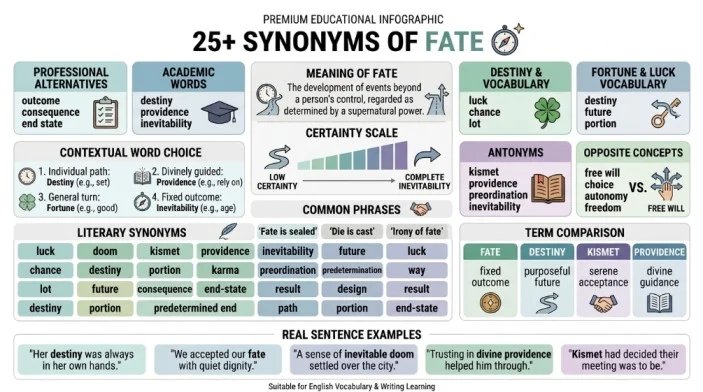
Fate refers to an outcome or course of events believed to be determined beyond a person’s control. The closest alternatives are destiny, fortune, kismet, and providence. Use destiny for a predetermined future, fortune for luck or circumstances, kismet for an inevitable outcome, and providence for divine guidance.
Meaning, Tone, and Context
Simple Definition
Fate is the idea that events in a person’s life, especially major outcomes, are determined by forces beyond their control.
The word can refer to an expected future, an unavoidable outcome, or the forces believed to shape what happens to someone.
For example:
“She believed it was her fate to become a teacher.”
Here, fate suggests that becoming a teacher was somehow destined to happen.
The word can also describe an eventual outcome:
“No one could escape the fate that awaited them.”
In this sentence, fate refers to an outcome that seems unavoidable.
Part of Speech
Fate is primarily a noun.
Examples:
- “They accepted their fate.”
- “She wondered about her fate.”
- “The hero could not escape his fate.”
The related adjective fateful describes something that has major consequences or seems to determine what happens later.
Example:
“That was a fateful decision.”
Overall Tone
Fate is generally neutral, but it can take on a positive, negative, mysterious, philosophical, or emotional tone depending on the context.
| Context | Tone of “Fate” |
|---|---|
| Personal reflection | Emotional or philosophical |
| Fiction | Mysterious or dramatic |
| Academic writing | Neutral when discussing beliefs or literature |
| Everyday conversation | Neutral to slightly dramatic |
| Religious discussion | Spiritual |
| Historical writing | Formal or analytical |
| Romantic writing | Emotional and idealistic |
Formality Level
Fate is a neutral word that works in both formal and informal English.
It is common in:
- Academic essays
- Literature
- Philosophy
- Religious discussions
- News writing
- Personal conversations
- Speeches
- Poetry
- Fiction
- Social media captions
Some alternatives, such as kismet, providence, and destiny, create a more specialized or literary tone.
Common Uses
Native English speakers commonly use fate when discussing:
- A predetermined future
- An unavoidable outcome
- A person’s life path
- Romantic relationships
- Historical events
- Luck and misfortune
- Death or survival
- Major turning points
- Philosophical questions
- Fictional characters
Common expressions include:
- “accept your fate”
- “escape your fate”
- “meet your fate”
- “change your fate”
- “seal your fate”
- “tempt fate”
- “a twist of fate”
- “fate decided”
Word Forms
| Form | Word | Example |
|---|---|---|
| Noun | fate | “They accepted their fate.” |
| Related adjective | fateful | “It was a fateful choice.” |
| Related noun | fatality | “The accident resulted in a fatality.” |
| Related adjective | fatal | “The injury proved fatal.” |
The related forms do not have exactly the same meaning as fate. In particular, fatal usually means causing death or destruction, not simply being predetermined.
When and How to Use “Fate”
Use fate when you want to emphasize an outcome that seems predetermined, unavoidable, or controlled by forces outside an individual’s direct control.
It is especially useful when discussing destiny, life paths, dramatic events, relationships, or philosophical ideas about human control.
Professional Context
“Several factors influenced the company’s fate after the merger.”
Here, fate refers to the company’s eventual outcome. It has a slightly dramatic tone, so future or outlook may be better in a highly technical report.
Academic Context
“Ancient Greek literature often explores the relationship between human choice and fate.”
Here, fate is appropriate because the sentence discusses a philosophical and literary concept.
Workplace Context
“The team’s fate depended on the results of the final presentation.”
The word creates emphasis and suggests that the presentation could determine what happens next.
Personal Context
“She felt that meeting her best friend was fate.”
This is natural in personal or romantic conversation and suggests that the meeting seemed destined.
Email Context
“The decision may determine the future of the project.”
In a professional email, future is often more neutral than fate.
Resume Context
Avoid using fate in most resumes because resumes should emphasize achievements, skills, decisions, and measurable results.
Instead of:
“My career was shaped by fate.”
A stronger resume statement would be:
“I built my career through strategic decisions and continuous professional development.”
Social Media Context
“Maybe it was fate that brought us together.”
This works naturally in a romantic or reflective caption because fate creates an emotional sense of destiny.
Best Synonyms of “Fate”
No single synonym works perfectly in every sentence because fate can refer to destiny, inevitability, fortune, or an expected outcome. The best alternative depends on the specific meaning you want to emphasize.
Professional Writing: Future
Future is often better than fate when discussing an organization’s or person’s expected direction without suggesting supernatural control.
Example:
“The company’s future depends on its ability to adapt.”
Academic Writing: Destiny
Destiny works well when discussing beliefs about a predetermined life path, especially in literature, philosophy, religion, and cultural studies.
Example:
“The novel explores the tension between free will and destiny.”
Business Communication: Outcome
Outcome is more precise and objective when referring to what eventually happens.
Example:
“The final decision will determine the outcome of the negotiations.”
Casual Conversation: Luck
Luck is a natural alternative when fate refers to chance or fortunate circumstances.
Example:
“We found the last available table. I guess it was luck.”
Emotional Writing: Destiny
Destiny can create a romantic or deeply personal sense of inevitability.
Example:
“They believed their meeting was part of their destiny.”
Creative Writing: Kismet
Kismet is an expressive alternative for an outcome or meeting believed to be destined.
Example:
“Their unexpected reunion felt like kismet.”
Resume Writing: Career Path
A resume usually should not describe professional success as fate. Career path, professional journey, or career trajectory gives readers useful information without implying that achievements were predetermined.
Example:
“My career path has been shaped by experience, leadership, and continuous learning.”
Workplace Communication: Circumstances
Circumstances works when you mean the conditions that influenced an outcome.
Example:
“The project was delayed because of circumstances beyond our control.”
Stronger Meaning: Inevitability
Inevitability emphasizes that an outcome cannot be avoided.
Example:
“The story presents the character’s defeat as an inevitability.”
Softer Meaning: Future
Future is a softer alternative because it does not imply that events are predetermined.
Example:
“She was uncertain about her future.”
When Not to Use “Fate”
Although fate is useful and expressive, it is not always the clearest word.
When Fate Sounds Too General
If you simply mean what will happen later, future is more precise.
Less effective:
“The fate of the company remains uncertain.”
Better:
“The company’s future remains uncertain.”
The second sentence sounds more neutral and straightforward.
When Fate Sounds Too Vague
If you know exactly what happened, name the outcome instead.
Less precise:
“The fate of the project was decided.”
Better:
“The board approved the project.”
Specific language gives readers more useful information.
When Fate Sounds Too Dramatic
In routine professional communication, fate can sound unnecessarily dramatic.
Less natural:
“The fate of our meeting depends on traffic.”
Better:
“Our meeting time may depend on traffic.”
The revised sentence matches the ordinary situation more naturally.
When Fate Sounds Too Philosophical
If you mean ordinary luck, use luck or chance.
Less precise:
“Fate helped us find a parking space.”
Better:
“We got lucky and found a parking space.”
When Fate Sounds Too Strong
If an outcome is uncertain rather than predetermined, avoid language that suggests inevitability.
Less accurate:
“It was fate that she got the job.”
Better:
“Her preparation and experience helped her get the job.”
When Fate Is Too Weak
In a literary or philosophical sentence about unavoidable events, future may not be strong enough.
Weaker:
“The hero’s future was already decided.”
Stronger:
“The hero’s fate was already sealed.”
When Fate Sounds Out of Place
Avoid fate when the subject is a measurable process that has no connection to destiny or inevitability.
Less natural:
“The fate of the experiment depended on accurate measurements.”
Better:
“The outcome of the experiment depended on accurate measurements.”
Words Commonly Confused With “Fate”
Destiny
Difference: Destiny usually describes a future course or purpose believed to be predetermined.
When to Use It: Use destiny when discussing a person’s supposed life path or a future that seems meant to happen.
Example:
“She believed she was destined to become a writer.”
Fortune
Difference: Fortune can mean luck, especially good or bad luck, or a person’s wealth.
When to Use It: Use fortune when the context involves luck, success, prosperity, or changing circumstances.
Example:
“His fortune changed after he started the new business.”
Kismet
Difference: Kismet refers to a supposedly predetermined event or outcome, especially something that seems destined to happen.
When to Use It: It works best in literary, romantic, or expressive writing.
Example:
“Their chance meeting felt like kismet.”
Providence
Difference: Providence generally refers to divine guidance or care that influences events.
When to Use It: Use it when the context specifically involves religious or spiritual belief.
Example:
“They believed providence had guided them safely home.”
Chance
Difference: Chance suggests randomness or lack of a predictable cause, which contrasts with the predetermined idea often associated with fate.
When to Use It: Use chance when an event occurs randomly rather than because it was destined.
Example:
“By chance, we happened to sit next to each other.”
Doom
Difference: Doom refers to an inevitable and usually negative outcome.
When to Use It: Use doom when the expected destiny is disastrous or destructive.
Example:
“The prophecy warned of the kingdom’s doom.”
Best Synonyms of “Fate” by Context
| Context | Best Synonym | Why It Works | Example |
|---|---|---|---|
| Formal writing | Destiny | Clearly expresses predetermined direction. | “The poem examines destiny and human choice.” |
| Academic writing | Destiny | Useful for philosophical and literary analysis. | “The novel questions whether destiny controls human behavior.” |
| Professional communication | Outcome | Objective and precise. | “The outcome will depend on market conditions.” |
| Business emails | Future | Neutral and practical. | “The decision could affect the future of the project.” |
| Resume writing | Career path | Focuses on deliberate professional development. | “My career path reflects years of technical experience.” |
| Workplace communication | Outcome | Avoids unnecessary drama. | “The outcome depends on the final review.” |
| Casual conversation | Luck | Natural when chance is intended. | “We got lucky and found tickets.” |
| Everyday speaking | Chance | Works for unexpected events. | “By chance, I met an old friend downtown.” |
| Creative writing | Kismet | Adds a sense of destined connection. | “Their reunion seemed like kismet.” |
| Storytelling | Destiny | Creates a sense of a predetermined journey. | “The hero struggled against his destiny.” |
| Emotional writing | Destiny | Adds romantic or philosophical feeling. | “She wondered whether their love was destiny.” |
| Strong emphasis | Inevitability | Highlights an unavoidable result. | “The story builds toward the inevitability of loss.” |
| Mild tone | Future | Removes the supernatural suggestion. | “No one knows what the future holds.” |
| Social media captions | Kismet | Expressive and memorable. | “Some meetings are simply kismet.” |
| American English | Fate | Natural and widely understood. | “Maybe it was fate.” |
| British English | Fate | Also standard and natural. | “They wondered what fate had in store.” |
How to Choose the Best Synonym of “Fate”
Choosing an alternative starts with identifying what fate means in your sentence.
If You Mean a Predetermined Life Path
Choose destiny.
“He believed his destiny was to help others.”
If You Mean Luck
Choose fortune or luck.
“Her good fortune changed everything.”
If You Mean an Unexpected Random Event
Choose chance.
“They met by chance at the airport.”
If You Mean Divine Guidance
Choose providence.
“They saw their survival as an act of providence.”
If You Mean an Inevitable Negative Outcome
Choose doom.
“The prophecy predicted the city’s doom.”
If You Mean a Neutral Result
Choose outcome.
“The outcome of the trial surprised everyone.”
If You Mean What Happens Later
Choose future.
“The future of the organization remains uncertain.”
If You Want a Romantic or Literary Tone
Choose destiny or kismet.
“Their meeting seemed like destiny.”
Consider Your Audience
Academic readers usually benefit from precise words such as destiny, inevitability, or outcome.
Friends and social media audiences may respond more naturally to fate, luck, or kismet.
Consider Emotional Strength
A sentence about an unavoidable tragedy may need doom or inevitability, while a neutral sentence about later events may simply need future.
Consider Formality
For a business report:
“The outcome remains uncertain.”
For a novel:
“Their fate remained uncertain.”
Both sentences work, but they create different impressions.
Consider Natural Usage
Never choose a synonym merely because it sounds sophisticated. The best synonym is the one that communicates your intended meaning naturally.
Real Life Examples of “Fate”
School
Basic:
“Many students write about fate in literature class.”
Stronger:
“Many students examine how the novel presents the conflict between fate and free will.”
College
Basic:
“The essay discusses the character’s fate.”
Improved:
“The essay examines whether the character’s destiny was determined from the beginning.”
Workplace
Basic:
“The fate of the project depends on the review.”
Improved:
“The outcome of the project depends on the review.”
Business
Basic:
“The company’s fate depends on the new strategy.”
Improved:
“The company’s future depends heavily on the success of the new strategy.”
Basic:
“The fate of the proposal will be decided tomorrow.”
Improved:
“The outcome of the proposal review will be decided tomorrow.”
Resume
Basic:
“Fate led me to a career in marketing.”
Improved:
“My career path developed through experience in marketing, communications, and customer strategy.”
Conversation
Basic:
“I think it was fate that we met.”
Natural:
“I think it was destiny that brought us together.”
Storytelling
Basic:
“The hero could not escape his fate.”
Literary:
“The hero struggled desperately against his destiny.”
Blogging
Basic:
“The fate of traditional advertising is uncertain.”
Improved:
“The future of traditional advertising is changing rapidly.”
Social Media
Basic:
“Maybe our meeting was fate.”
Expressive:
“Some encounters feel too perfect to be explained by chance. Maybe it was kismet.”
25 Best Synonyms of “Fate”
The following list includes close alternatives and context-specific words. Because fate has several related senses, some alternatives emphasize predetermined destiny, while others emphasize inevitability, luck, divine influence, or eventual outcome.
| Synonym | Simple Meaning | Best Used For | Example Sentence |
|---|---|---|---|
| Destiny | A future believed to be predetermined | Philosophy, literature, personal writing | “She believed her destiny was to become a teacher.” |
| Kismet | An outcome believed to be destined | Romantic and literary writing | “Their unexpected meeting felt like kismet.” |
| Fortune | Luck or circumstances affecting someone | Luck, success, literature | “Fortune favored the bold.” |
| Providence | Divine guidance or care | Religious writing | “They trusted providence during difficult times.” |
| Inevitability | The quality of being unavoidable | Academic and analytical writing | “The story emphasizes the inevitability of change.” |
| Doom | An unavoidable negative fate | Fiction and dramatic writing | “The prophecy warned of the kingdom’s doom.” |
| Lot | A person’s share or assigned condition | Formal and literary contexts | “They accepted their lot without complaint.” |
| Fortune | A person’s luck or changing circumstances | Everyday and literary contexts | “Her fortune improved after the move.” |
| Predestination | The belief that events are predetermined | Religious and philosophical writing | “The debate centers on predestination and free will.” |
| Foreordination | The idea that something has been decided beforehand | Religious and formal contexts | “The doctrine discusses divine foreordination.” |
| Decree | An authoritative decision determining something | Historical or religious contexts | “The outcome was treated as a divine decree.” |
| Will | A determined intention, especially divine will | Religious and philosophical writing | “They accepted what they believed was God’s will.” |
| Outcome | What eventually happens | Business and professional writing | “The outcome depended on several factors.” |
| Result | The consequence of an action or event | General and academic writing | “The result surprised the entire team.” |
| Future | What will happen later | Neutral everyday communication | “No one can predict the future.” |
| Prospect | A possible future situation | Professional writing | “The company’s prospects look promising.” |
| Course | The direction events take | Formal and literary writing | “The decision changed the course of his life.” |
| Path | A direction or life journey | Personal and creative writing | “She chose a different path.” |
| Calling | A strong sense of purpose | Personal and spiritual writing | “He considered teaching his calling.” |
| Lot | The circumstances assigned to a person | Literary and formal writing | “They made the best of their lot.” |
| Consequence | An effect that follows an action | Academic and analytical writing | “Every decision has consequences.” |
| End | The eventual result or conclusion | Literature and general writing | “The character could not escape his tragic end.” |
| Fatefulness | The quality of having major consequences | Literary analysis | “The fatefulness of the decision becomes clear later.” |
| Fatalism | Belief that events cannot be changed | Philosophy and social commentary | “The novel contrasts determination with fatalism.” |
| Predetermination | The idea that something is decided beforehand | Academic and philosophical writing | “The theory raises questions about predetermination.” |
Important usage note: Not all 25 words are interchangeable with fate in every sentence. Destiny, kismet, fortune, providence, and lot are among the closest alternatives. Words such as outcome, future, and result overlap with particular meanings of fate but do not carry the same sense of predetermined control.
Synonyms of “Fate” by Usage
Professional vs Personal Synonyms
Professional writing generally benefits from objective words. Personal writing can tolerate more emotional or philosophical language.
Professional choices:
- Outcome
- Result
- Future
- Prospects
- Course
Example:
“The outcome of the negotiations remains uncertain.”
This sounds more precise than:
“The fate of the negotiations remains uncertain.”
Personal choices:
- Fate
- Destiny
- Kismet
- Fortune
- Path
Example:
“I sometimes wonder whether our meeting was fate.”
The emotional tone makes fate a natural choice.
Formal vs Conversational Synonyms
Reports
Use outcome, result, consequence, or future.
Essays
Use destiny, inevitability, predetermination, or fate, depending on the subject.
Business Writing
Use outcome, future, prospects, or course.
Presentations
Use future, direction, outcome, or prospects.
Emails
Use outcome or future unless the subject is deliberately dramatic.
Casual Conversations
Use fate, luck, chance, or destiny.
Texting
Use simple expressions such as:
“Maybe it was fate.”
or:
“I guess we got lucky.”
Academic Synonyms
Academic writing requires careful distinctions between related concepts.
Fate
Use fate when analyzing a literary, philosophical, cultural, or religious concept involving predetermined events.
“The tragedy presents fate as a force beyond human control.”
Destiny
Use destiny when discussing a predetermined life path or expected purpose.
“The protagonist believes that destiny has shaped his life.”
Predestination
Use predestination when discussing a theological doctrine or philosophical position concerning predetermined outcomes.
“The text explores the relationship between predestination and human choice.”
Fatalism
Use fatalism when discussing the belief that people cannot alter predetermined events.
“The character’s fatalism prevents him from taking action.”
Inevitability
Use inevitability when the focus is on an outcome that cannot reasonably be avoided.
“The narrative creates a sense of inevitability as the conflict develops.”
These words are not interchangeable, even though they may appear in discussions about fate.
Professional and Business Synonyms
Resumes
Avoid presenting career achievements as the result of fate.
Use:
- Career path
- Professional journey
- Career trajectory
- Future direction
Example:
“My career trajectory has been shaped by leadership opportunities and technical expertise.”
Interviews
Career path is useful when explaining professional development.
“My career path gradually moved from sales into account management.”
Meetings
Use outcome when discussing what a meeting may produce.
“The outcome of today’s meeting will determine our next steps.”
Presentations
Use future or direction when discussing what happens next.
“This strategy will influence the future direction of the company.”
Performance Reviews
Use trajectory or progress rather than fate.
“The employee’s performance trajectory has improved significantly.”
Client Communication
Use outcome or result.
“The final outcome will depend on the client’s approval.”
Business Emails
Use future, outcome, or prospects.
“The decision will affect the future of the partnership.”
These choices sound more objective and avoid suggesting that business results are controlled by destiny.
Creative and Literary Synonyms
Creative writing offers more freedom to use expressive alternatives.
Destiny
Adds a sense of a predetermined life journey.
“She spent years trying to understand her destiny.”
Kismet
Adds romantic or mysterious energy.
“Their paths crossed again, as if guided by kismet.”
Doom
Creates a dark and threatening atmosphere.
“The castle stood beneath the shadow of doom.”
Providence
Adds a spiritual dimension.
“He believed providence had brought them safely through the storm.”
Lot
Can emphasize a person’s assigned circumstances.
“She refused to complain about her difficult lot.”
Inevitability
Creates a philosophical sense that an ending cannot be avoided.
“Every chapter brought the story closer to its inevitable conclusion.”
Slang or Modern Synonyms
There is no single widely accepted slang word that perfectly replaces fate.
In casual American English, people often use informal expressions such as meant to be, it was meant to happen, or just lucky.
“Meant to be”
Meaning: Something seems destined to happen.
Acceptable in: Casual conversation, romantic writing, captions, social media.
Avoid in: Academic papers, formal reports, technical documents.
Example:
“Maybe we were just meant to be.”
“Just lucky”
Meaning: An event happened because of good fortune rather than predetermined destiny.
Acceptable in: Everyday speech and informal writing.
Avoid in: Formal analytical writing.
Example:
“We weren’t following a plan. We were just lucky.”
These expressions should not be treated as exact synonyms because they change the meaning or tone of fate.
Strongest to Mildest Synonyms
There is no universal intensity scale for fate synonyms because different words emphasize different dimensions. However, the following guide is useful when comparing the strength of inevitability.
| Intensity | Word | Main Effect |
|---|---|---|
| Mild | Future | Simply refers to what happens later. |
| Mild | Prospect | Suggests a possible future. |
| Moderate | Outcome | Focuses on what eventually happens. |
| Moderate | Fate | Suggests a predetermined or unavoidable outcome. |
| Strong | Destiny | Emphasizes a predetermined life path. |
| Strong | Kismet | Suggests an event was destined to happen. |
| Very Strong | Inevitability | Emphasizes that something cannot be avoided. |
| Very Strong | Doom | Suggests an unavoidable negative outcome. |
| Very Strong | Predestination | Strongly emphasizes predetermined events, especially in theology. |
The scale should not be treated as a strict ranking. For example, providence is not simply a weaker form of fate. It adds the specific idea of divine guidance.
Emotional vs Neutral Synonyms
Emotional Synonyms
These words can add mystery, romance, spirituality, or drama.
- Fate
- Destiny
- Kismet
- Doom
- Fortune
- Providence
- Calling
Example:
“Their reunion felt like destiny.”
This sentence creates an emotional impression.
Neutral Synonyms
These alternatives focus on outcomes without implying supernatural control.
- Outcome
- Result
- Future
- Prospect
- Consequence
- Course
- Direction
Example:
“The outcome depends on the final review.”
This is more objective and suitable for professional communication.
Antonyms of “Fate”
Strict dictionary antonyms for fate are limited because fate describes a concept rather than a simple quality. The strongest opposing concepts involve personal control, choice, agency, and the belief that outcomes are not predetermined.
The following 15 terms are therefore best understood as contextual opposites or opposing concepts, rather than claiming that every word is a perfect dictionary antonym.
| Antonym or Opposing Concept | Meaning | Example Sentence |
|---|---|---|
| Free will | The ability to make choices independently. | “She believed free will shaped her future.” |
| Choice | The act of selecting between possibilities. | “His choice changed the direction of his life.” |
| Agency | The ability to act and make decisions independently. | “The character exercises agency rather than accepting a predetermined path.” |
| Self-determination | The ability to determine one’s own course. | “Self-determination allowed her to create a new future.” |
| Control | The ability to influence what happens. | “He wanted greater control over his future.” |
| Volition | The power to make a conscious choice. | “She acted through her own volition.” |
| Autonomy | Independence in making decisions. | “The organization values individual autonomy.” |
| Intentionality | Acting with a deliberate purpose. | “His decision was based on intentionality rather than chance.” |
| Deliberation | Careful consideration before making a choice. | “After careful deliberation, she accepted the offer.” |
| Planning | Deciding actions in advance to reach a goal. | “Planning helped the team shape its future.” |
| Chance | Randomness rather than predetermined design. | “The result depended largely on chance.” |
| Randomness | Lack of predictable order or determination. | “Randomness made the outcome difficult to predict.” |
| Uncertainty | A state in which the future is not known. | “Uncertainty made the final outcome impossible to predict.” |
| Contingency | Dependence on conditions that may change. | “The plan allows for contingency rather than assuming one fixed outcome.” |
| Possibility | Something that may happen but is not predetermined. | “A different outcome remained a possibility.” |
The most useful conceptual opposites in ordinary writing are free will, choice, agency, control, and self-determination. Words such as chance and randomness oppose the idea of predetermined events in a different way, so context matters.
Comparison: “Fate” vs Similar Words
Fate vs Destiny
Main Difference
Fate often emphasizes an outcome that cannot be avoided, while destiny more often suggests a predetermined future or life purpose.
Which Is Stronger?
Neither is always stronger. Fate can sound more inevitable, while destiny can sound more purposeful.
Which Is More Formal?
Both are suitable for formal writing, especially literature and philosophy.
When to Use Each
Use fate for an unavoidable outcome.
Use destiny for a predetermined life path.
Examples
Fate:
“She could not escape her fate.”
Destiny:
“He believed his destiny was to lead.”
Fate vs Fortune
Main Difference
Fate suggests predetermined events, while fortune commonly refers to luck, success, failure, or circumstances.
Which Is Stronger?
Fate usually carries a stronger sense of inevitability.
Which Is More Formal?
Both can be formal, although fortune has several meanings and requires context.
When to Use Each
Use fortune when luck or prosperity is the main idea.
Examples
Fate:
“They accepted their fate.”
Fortune:
“Good fortune helped the family recover.”
Fate vs Kismet
Main Difference
Both can suggest that something was destined, but kismet often has a more romantic, literary, or culturally expressive tone.
Which Is Stronger?
Neither is universally stronger.
Which Is More Formal?
Fate is more widely accepted in general formal English. Kismet is more specialized.
When to Use Each
Use kismet when an event feels mysteriously or romantically destined.
Examples
Fate:
“Perhaps fate brought them together.”
Kismet:
“Their meeting felt like kismet.”
Fate vs Providence
Main Difference
Providence specifically suggests divine guidance, care, or intervention.
Which Is Stronger?
They express different concepts rather than different levels of intensity.
Which Is More Formal?
Providence can sound more formal, religious, or literary.
When to Use Each
Use providence when a religious or divine explanation is intended.
Examples
Fate:
“She wondered what fate had planned.”
Providence:
“They believed providence had protected them.”
Fate vs Chance
Main Difference
Fate often suggests that events are predetermined, while chance suggests that events occur randomly or without a predetermined plan.
Which Is Stronger?
They point in opposite conceptual directions.
Which Is More Formal?
Both are neutral and suitable for formal writing.
When to Use Each
Use chance when randomness is the key idea.
Examples
Fate:
“They believed they were destined to meet.”
Chance:
“They met entirely by chance.”
Fate vs Doom
Main Difference
Doom usually refers to a disastrous or highly negative fate.
Which Is Stronger?
Doom is more emotionally negative.
Which Is More Formal?
Both can appear in literary and formal writing, but doom is more dramatic.
When to Use Each
Use doom when the inevitable outcome is destructive or tragic.
Examples
Fate:
“The hero accepted his fate.”
Doom:
“The prophecy predicted the kingdom’s doom.”
Common Phrases and Expressions with “Fate”
Accept Your Fate
Meaning: Stop resisting an outcome that seems unavoidable.
Example:
“After losing the final round, he accepted his fate.”
Escape Your Fate
Meaning: Avoid an outcome that seems predetermined.
Example:
“The hero spends the story trying to escape his fate.”
Meet Your Fate
Meaning: Experience an expected or inevitable outcome, often death.
Example:
“The warrior knew he might meet his fate on the battlefield.”
Seal Your Fate
Meaning: Do something that makes a particular outcome very likely or unavoidable.
Example:
“His refusal to apologize may have sealed his fate.”
Tempt Fate
Meaning: Take a needless risk that could produce a bad result.
Example:
“Driving that fast in heavy rain is tempting fate.”
A Twist of Fate
Meaning: An unexpected event that dramatically changes circumstances.
Example:
“By a strange twist of fate, the two old friends became business partners.”
Fate Has It
Meaning: A literary or conversational way of suggesting that events happened as though predetermined.
Example:
“Fate had it that they would meet again years later.”
Leave It to Fate
Meaning: Allow events to happen without trying to control them.
Example:
“Instead of making a decision immediately, she decided to leave it to fate.”
Common Mistakes to Avoid
1. Treating Every Synonym as Identical
Incorrect:
“Fate, chance, and destiny all mean exactly the same thing.”
Better:
“Fate, chance, and destiny overlap, but they describe different ideas.”
Why:
Fate and destiny can suggest predetermined events, while chance emphasizes randomness.
2. Using “Kismet” in Every Context
Incorrect:
“The company’s kismet depends on quarterly sales.”
Better:
“The company’s future depends on quarterly sales.”
Why:
Kismet has a specialized, often romantic or literary tone and sounds unnatural in routine business writing.
3. Confusing Fate With Luck
Incorrect:
“Winning the raffle was definitely fate.”
Better:
“Winning the raffle was incredibly lucky.”
Why:
A random lucky event is not necessarily an example of predetermined fate.
4. Using “Destiny” When You Mean an Ordinary Result
Incorrect:
“The outcome of the meeting was our destiny.”
Better:
“The outcome of the meeting depended on the final discussion.”
Why:
Outcome is more precise when you are describing a concrete result.
5. Using “Fate” in a Resume
Incorrect:
“Fate brought me into the technology industry.”
Better:
“My career path led me into the technology industry.”
Why:
Professional documents should emphasize choices, experience, skills, and achievements.
6. Making a Routine Situation Sound Dramatic
Incorrect:
“The fate of my lunch depended on whether the restaurant was open.”
Better:
“I wasn’t sure whether the restaurant would be open.”
Why:
The ordinary situation does not require dramatic vocabulary.
7. Confusing “Fatal” With “Fateful”
Incorrect:
“It was a fatal decision that changed her career.”
Better:
“It was a fateful decision that changed her career.”
Why:
Fatal usually means causing death or destruction. Fateful describes something with major consequences.
Frequently Asked Questions
What are the best synonyms of “fate”?
The best synonyms of fate include destiny, kismet, fortune, providence, and inevitability. The best choice depends on whether you mean a predetermined future, luck, divine guidance, or an unavoidable outcome.
What are the best formal synonyms of “fate”?
Formal alternatives include destiny, inevitability, predestination, providence, and foreordination. For professional documents, however, outcome, future, or result is often clearer and more objective.
What are common informal synonyms of “fate”?
Common conversational alternatives include destiny, luck, and phrases such as meant to be. Kismet can also work in informal or romantic contexts, although it has a more literary feel than everyday luck.
What is another word for “fate” in professional writing?
In professional writing, outcome, future, result, and prospects are usually better choices when you mean what will happen next. They communicate the idea without adding unnecessary philosophical or dramatic meaning.
What is the difference between “fate” and “destiny”?
Fate often focuses on an outcome that seems unavoidable, while destiny commonly suggests a predetermined future, life path, or purpose. The two overlap, but destiny can sound more purposeful or positive.
What is the opposite of “fate”?
The closest opposing concepts are free will, choice, agency, self-determination, and control. These ideas emphasize a person’s ability to shape outcomes rather than accepting events as predetermined.
Conclusion
Fate describes an outcome or course of events believed to be determined beyond a person’s control. Its closest alternatives include destiny, kismet, fortune, providence, and inevitability, but each carries a slightly different meaning, tone, or context.
For academic and literary writing, destiny, inevitability, and predestination can provide useful precision. In professional communication, outcome, future, and result are often more natural. For emotional or creative writing, fate, destiny, and kismet can create a stronger sense of mystery or significance.
No single synonym of fate works perfectly in every sentence. The best vocabulary choice depends on what you mean, who will read it, and how strongly you want to express inevitability. A useful vocabulary habit is to identify the exact idea first, then choose the word that communicates that idea most naturally.
Read More Related Articles:
25+ Synonyms, Meanings, Uses, Examples, and Best …
Meaning, Uses, Examples, and the Best Synonym of Complain
25+ Synonyms of Frequency | Meanings, Uses, Examples …