Stress is one of those words that can describe emotional strain, mental pressure, or the demands of a difficult situation. Choosing the right stress synonym can make your writing more precise and natural. In academic and professional writing, words such as pressure, strain, tension, and burden may fit different contexts, but they do not always carry exactly the same meaning. Understanding these differences helps you avoid repetition and choose language that matches your intended tone.
This guide covers common stress synonyms, including an academic pressure synonym and useful academic pressure synonyms for essays and formal writing. If you need another word for stress, a synonym for stress, or another word for stress in an essay, context matters. You may also need another word for stressed in an essay or another word for stresses in an essay when describing how pressure affects people, situations, or academic performance. Each alternative is explained with practical usage guidance.
What Are the Best Synonyms of “Stress”?
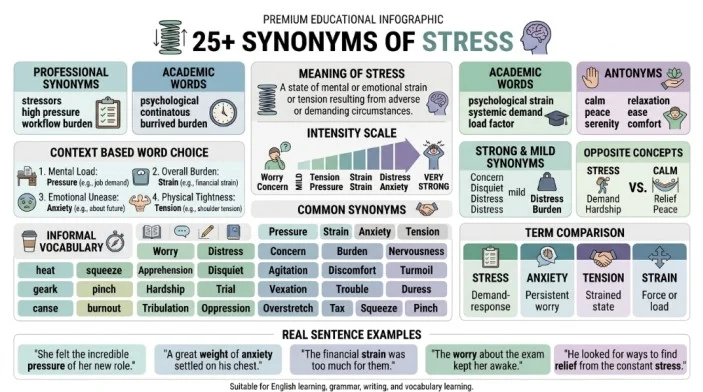
The best synonym of stress depends on its meaning. Pressure works well for demands or expectations, strain suggests difficulty or overuse, anxiety describes worry, and tension describes emotional or physical tightness. For formal writing, use pressure or strain; for emotional writing, anxiety or worry often works better.
Meaning, Tone, and Context
Simple Definition
Stress can describe a feeling of mental or emotional pressure caused by difficult circumstances, demands, uncertainty, or responsibilities. It can also describe physical tension or the emphasis placed on a particular word or idea.
Because stress has several meanings, its best synonym depends heavily on context.
For example:
“The deadline caused a lot of stress.”
- Here, stress means emotional pressure.
“The bridge was tested under extreme stress.”
- Here, stress refers to physical force or pressure.
“The speaker placed stress on the final word.”
Here, stress means emphasis.
Part of Speech
Stress can function as both a noun and a verb.
As a noun:
“Work stress affected his sleep.”
As a verb:
“The manager stressed the importance of accuracy.”
The noun meaning related to pressure has different alternatives from the verb meaning to emphasize.
Overall Tone
The emotional meaning of stress is generally negative or neutral, depending on context.
When referring to emotional pressure, it usually suggests difficulty, discomfort, worry, or strain. When referring to emphasis, however, it is neutral.
Formality Level
Stress is a neutral word that works naturally in formal, professional, academic, and informal English.
It is common in:
- Business communication
- Workplace conversations
- Academic writing
- Personal discussions
- Health related discussions
- Everyday speech
- Essays and reports
- News writing
Common Uses
Native English speakers commonly use stress to describe:
- Work pressure
- Financial difficulties
- Academic demands
- Emotional strain
- Family responsibilities
- Time pressure
- Physical strain
- Anxiety and worry
- Mental pressure
- Emphasis in speech or writing
Word Forms
| Form | Example |
|---|---|
| Noun | stress |
| Verb | stress |
| Adjective | stressful |
| Adjective | stressed |
| Related noun | stressor |
| Related noun | stressfulness |
The word stressed describes a person experiencing pressure, while stressful describes a situation that causes pressure.
“She feels stressed because her workload is heavy.”
“Her workload is stressful.”
When and How to Use “Stress”
Choose stress when you want to describe pressure, emotional difficulty, physical strain, or emphasis without needing a more specific word.
Professional
“High workloads can create significant stress for employees.”
This is natural in workplace discussions because stress clearly communicates pressure caused by work demands.
Academic
“Students may experience stress during examination periods.”
The word fits academic writing when discussing pressure associated with study or performance.
Workplace
“The new deadline has added considerable stress to the team.”
Here, stress refers to increased pressure.
Personal
“Moving to a new city caused a lot of stress.”
The word describes emotional pressure caused by a major life change.
“To reduce unnecessary stress, please submit the documents before Friday.”
This sounds professional while remaining approachable.
Resume
“Developed effective systems to manage workload and reduce workplace stress.”
A more specific synonym may be preferable on a resume, but stress can work when discussing workplace conditions.
Social Media
“Learning to manage stress has completely changed the way I approach difficult days.”
This sounds natural and conversational.
Best Synonyms of “Stress”
No single synonym works perfectly in every situation because stress has several meanings. A useful replacement should match the specific type of pressure, emotion, difficulty, or emphasis you want to communicate.
Professional Writing: Pressure
Pressure is one of the most useful alternatives when discussing deadlines, expectations, responsibilities, or demands.
“Employees often experience pressure during busy seasons.”
It is especially effective in workplace reports and business communication.
Academic Writing: Strain
Strain works well when describing the negative effect that prolonged demands can have on a person, system, relationship, or resource.
“Extended workloads can place considerable strain on students.”
Business Communication: Pressure
For business writing, pressure is usually more natural than emotional alternatives such as worry.
“The company faced pressure to reduce operating costs.”
Casual Conversation: Worry
When stress means emotional concern, worry sounds natural in everyday speech.
“I’ve had a lot of worry on my mind lately.”
However, worry is not a replacement for every meaning of stress.
Emotional Writing: Anxiety
Anxiety is appropriate when the stress involves fear, nervousness, or persistent concern.
“The uncertainty created anxiety among the employees.”
Creative Writing: Tension
Tension can add emotional atmosphere to storytelling.
“A quiet tension filled the room as everyone waited for the decision.”
Resume Writing: Pressure
For a resume, pressure can describe demanding environments without making the applicant sound overwhelmed.
“Performed effectively under pressure while managing multiple deadlines.”
Workplace Communication: Strain
Strain is useful when explaining that pressure is affecting a relationship, team, system, or individual.
“The extended deadline placed additional strain on the support team.”
Stronger Meaning: Overwhelm
Overwhelm is stronger when stress becomes so intense that a person feels unable to manage everything.
“The number of responsibilities began to overwhelm her.”
Softer Meaning: Concern
Concern is a milder alternative when you want to communicate uneasiness without suggesting severe stress.
“There is some concern about the project’s timeline.”
When Not to Use “Stress”
Although stress is flexible, it can sometimes be too broad. A more precise synonym can tell readers exactly what is happening.
When “Stress” Is Too General
If you mean external demands, pressure is often more precise.
Less precise:
“The deadline caused stress.”
Better:
“The deadline created intense pressure.”
The second sentence makes the source of the difficulty clearer.
When “Stress” Is Too Vague
If you specifically mean fear or nervousness, use anxiety.
Less precise:
“She felt stress before the interview.”
Better:
“She felt anxiety before the interview.”
When “Stress” Sounds Too Weak
If the situation is severely affecting someone, overwhelm or distress may communicate the intensity more accurately.
Less precise:
“He was experiencing stress after the accident.”
Stronger:
“He was experiencing significant distress after the accident.”
When “Stress” Is Too Strong
If you only mean mild uncertainty, concern may be better.
Less precise:
“The small delay caused stress.”
Softer:
“The small delay caused some concern.”
When You Mean Physical Pressure
In scientific or technical contexts, stress can refer to force applied to a material. Words such as load, force, or strain may be more precise depending on the intended meaning.
“The material failed under excessive load.”
When You Mean Emphasis
When stress means giving special importance to an idea, emphasize is usually clearer as a verb.
Less precise:
“The teacher stressed the main point.”
Clear alternative:
“The teacher emphasized the main point.”
Words Commonly Confused With “Stress”
Pressure
Difference: Pressure usually refers to demands or expectations placed on someone.
When to use it: Use it when external circumstances are creating difficulty.
Example:
“She is under pressure to finish the project today.”
Anxiety
Difference: Anxiety focuses on worry, fear, nervousness, or apprehension.
When to use it: Use it when emotional concern is the main idea.
Example:
“He experienced anxiety before speaking in front of the audience.”
Strain
Difference: Strain emphasizes the damaging or exhausting effect of prolonged difficulty.
When to use it: Use it for people, relationships, systems, finances, or physical effort.
Example:
“The long hours placed strain on the team.”
Tension
Difference: Tension can describe emotional conflict, nervous anticipation, or physical tightness.
When to use it: Use it when there is a sense of tightness, conflict, or suspense.
Example:
“Political tension increased after the announcement.”
Worry
Difference: Worry focuses specifically on thoughts about possible problems or negative outcomes.
When to use it: Use it in personal and conversational contexts.
Example:
“Her biggest worry was missing the deadline.”
Distress
Difference: Distress generally describes more serious emotional suffering or discomfort.
When to use it: Use it when ordinary stress does not fully communicate the severity of the situation.
Example:
“The sudden loss caused considerable distress.”
Best Synonyms of “Stress” by Context
| Context | Best Synonym | Why It Works | Example |
|---|---|---|---|
| Formal writing | Pressure | Clear and broadly applicable | Financial pressure affected the organization. |
| Academic writing | Strain | Highlights prolonged difficulty | Academic strain can affect performance. |
| Professional communication | Pressure | Natural for workplace demands | Staff members faced pressure to meet the target. |
| Business emails | Concern | Polite and measured | We have some concern about the revised schedule. |
| Resume writing | Pressure | Shows ability to handle demanding situations | Worked effectively under pressure. |
| Workplace communication | Strain | Useful for teams and relationships | The workload placed strain on the department. |
| Casual conversation | Worry | Natural for personal concerns | I have a lot of worry about the move. |
| Everyday speaking | Pressure | Common and easy to understand | I’m under a lot of pressure this week. |
| Creative writing | Tension | Builds atmosphere and suspense | Tension filled the room. |
| Storytelling | Tension | Creates emotional suspense | The tension grew as the clock approached midnight. |
| Emotional writing | Anxiety | Clearly expresses nervous concern | Anxiety kept him awake before the interview. |
| Strong emphasis | Distress | Communicates serious emotional difficulty | The event caused emotional distress. |
| Mild tone | Concern | Softer than stress or anxiety | There is some concern about the result. |
| Social media captions | Pressure | Concise and relatable | Learning to handle pressure takes time. |
| American English | Pressure | Common and natural across contexts | She works well under pressure. |
| British English | Pressure | Also widely understood and natural | He was under pressure at work. |
How to Choose the Best Synonym of “Stress”
The easiest way to choose the right synonym is to identify what kind of stress you actually mean.
If You Mean External Demands
Choose pressure.
“The team is under pressure to finish the project.”
If You Mean Emotional Worry
Choose anxiety or worry.
“The uncertainty caused anxiety.”
If You Mean Long Term Difficulty
Choose strain.
“The situation placed strain on their relationship.”
If You Mean Conflict or Suspense
Choose tension.
“There was tension between the two teams.”
If You Mean Serious Emotional Suffering
Choose distress.
“The incident caused considerable distress.”
If You Mean a Mild Problem
Choose concern.
“There is some concern about the cost.”
If You Mean Being Unable to Cope
Choose overwhelm.
“The workload began to overwhelm the new employee.”
Consider Your Audience
A school essay may benefit from strain or anxiety, while a business email may sound more natural with pressure or concern.
Consider Emotional Strength
Use mild words when the situation is manageable and stronger words when the circumstances are genuinely severe.
Consider Your Purpose
Ask whether you are describing:
- A demand
- A feeling
- A conflict
- A physical effect
- A difficult situation
- A serious emotional reaction
- A communication technique involving emphasis
This simple distinction will help you avoid using the same synonym everywhere.
Real Life Examples of “Stress”
School
Basic:
“Exams can cause stress for students.”
More precise:
“Exams can create significant pressure for students.”
College
Basic:
“College students often experience stress.”
Improved:
“College students often experience academic strain when managing demanding schedules.”
Workplace
Basic:
“The workload caused stress.”
Improved:
“The heavy workload placed considerable pressure on the team.”
Business
Basic:
“The company faced stress because of rising costs.”
Improved:
“The company faced increasing financial pressure because of rising costs.”
Basic:
“I understand that this situation may cause stress.”
Improved:
“I understand that this situation may create additional pressure.”
Resume
Basic:
“I can work well despite stress.”
Improved:
“I perform effectively under pressure while managing competing deadlines.”
Conversation
Basic:
“I’ve been feeling stressed lately.”
Alternative:
“I’ve been under a lot of pressure lately.”
Storytelling
Basic:
“Stress filled the room.”
More expressive:
“A quiet tension filled the room as everyone waited for the announcement.”
Blogging
Basic:
“Work stress can affect productivity.”
Improved:
“Workplace pressure can affect productivity when employees have limited time to recover.”
Social Media
Basic:
“Stress can make life difficult.”
More natural:
“Constant pressure can make even ordinary days feel exhausting.”
25 Best Synonyms of “Stress”
| Synonym | Simple Meaning | Best Used For | Example Sentence |
|---|---|---|---|
| Pressure | Demands or expectations | Work and deadlines | The deadline put pressure on the team. |
| Strain | Difficulty that causes exhaustion | Relationships, work, systems | The long hours placed strain on employees. |
| Anxiety | Strong worry or nervousness | Emotional situations | She felt anxiety before the presentation. |
| Tension | Emotional or physical tightness | Conflict and suspense | The tension between the groups was obvious. |
| Worry | Concern about possible problems | Everyday conversation | His biggest worry was the upcoming interview. |
| Distress | Serious emotional difficulty | Strong emotional situations | The event caused considerable distress. |
| Burden | A difficult responsibility | Personal and professional life | The extra responsibility became a heavy burden. |
| Concern | Mild worry or uneasiness | Formal and professional writing | There is growing concern about the schedule. |
| Nervousness | Feeling uneasy or anxious | Social situations | Her nervousness disappeared after she began speaking. |
| Apprehension | Uneasy expectation about something | Formal and emotional writing | He approached the decision with some apprehension. |
| Unease | A mild feeling of discomfort | Personal and descriptive writing | The unusual silence created a sense of unease. |
| Disturbance | Something that interrupts calm | General and formal contexts | The incident caused emotional disturbance among residents. |
| Agitation | A state of emotional restlessness | Emotional descriptions | His growing agitation was obvious to everyone. |
| Overwhelm | To make someone feel unable to cope | Strong emotional pressure | Multiple deadlines began to overwhelm her. |
| Frustration | Annoyance caused by difficulty | Work and everyday life | Repeated delays caused considerable frustration. |
| Hardship | Difficult living conditions | Social and economic contexts | The family experienced financial hardship. |
| Adversity | Difficult or unfavorable circumstances | Formal and motivational writing | She remained determined despite adversity. |
| Challenge | A difficult task or situation | Positive professional contexts | The new role presented an exciting challenge. |
| Load | Amount of work or responsibility | Work and technical contexts | The current load is too high for one employee. |
| Demand | Something requiring effort or attention | Business and academic contexts | The job places heavy demands on employees. |
| Complication | A problem that makes something harder | Projects and situations | The unexpected delay created another complication. |
| Conflict | Serious disagreement or opposition | Relationships and organizations | Internal conflict increased after the policy change. |
| Turmoil | Severe disorder or emotional disturbance | News and creative writing | The organization went through months of turmoil. |
| Restlessness | Inability to relax or remain still | Personal and emotional writing | He felt increasing restlessness while waiting. |
| Excitement | Strong emotional stimulation | Positive contexts | The event created excitement rather than stress for the students. |
Synonyms of “Stress” by Usage
Professional vs Personal Synonyms
Professional contexts usually require words that describe the source or effect of pressure clearly.
- Professional choices: pressure, strain, demand, load, concern, challenge.
“The team is working under significant pressure.”
Personal conversations can use warmer and more emotional vocabulary.
Personal choices: worry, anxiety, tension, nervousness, unease.
“I’ve been dealing with a lot of worry lately.”
For professional writing, avoid making every difficult situation sound emotional. A word such as pressure often keeps the tone objective.
Formal vs Conversational Synonyms
Formal writing often benefits from precise terms such as strain, pressure, apprehension, and distress.
Conversational English is more likely to use worry, pressure, nervousness, or simply stress.
For example:
Formal:
“The uncertainty created considerable apprehension among participants.”
Conversational:
“Everyone was pretty nervous about what would happen.”
The second sentence sounds more natural in everyday conversation.
Academic Synonyms
Academic writing should distinguish between emotional states and external causes.
- Use pressure when discussing demands:
“Students face increasing academic pressure.”
Use strain when describing negative effects:
“Prolonged academic strain may affect concentration.”
- Use anxiety when discussing emotional responses:
“Performance anxiety can influence students before examinations.”
Use distress when the emotional impact is especially serious:
“The event caused substantial emotional distress.”
These alternatives make academic writing more precise because they identify the specific aspect of stress being discussed.
Professional and Business Synonyms
Resumes
Pressure is especially useful for describing performance in demanding situations.
“Managed multiple priorities effectively under pressure.”
Interviews
Use pressure when discussing how you handle demanding situations.
“I stay organized and focused when working under pressure.”
Meetings
Use concern when raising an issue diplomatically.
“I have some concern about the proposed timeline.”
Presentations
Use pressure or demands when discussing workload.
“The current demands on the department have increased.”
Performance Reviews
Use strain when discussing workload effects.
“The additional workload has placed strain on the team.”
Client Communication
Use concern to maintain a professional tone.
“We understand your concern about the revised delivery date.”
Business Emails
Use pressure for workload and concern for problems.
“We recognize the pressure created by the shortened timeline.”
Creative and Literary Synonyms
Creative writing benefits from words that create atmosphere rather than simply naming a feeling.
Tension
“Tension hung over the room as the verdict approached.”
This creates suspense.
Unease
“A strange unease followed him through the empty hallway.”
This suggests that something feels wrong.
Apprehension
“She opened the letter with quiet apprehension.”
This communicates nervous expectation.
Turmoil
“Behind his calm expression, a storm of emotional turmoil continued.”
This suggests intense inner conflict.
Nervousness
“His nervousness showed in the way he kept checking the clock.”
This provides a direct description of behavior.
Slang or Modern Synonyms
There is no single slang word that perfectly replaces stress across all situations. Informal speakers sometimes use expressions such as freak out, freaking out, a lot on my plate, or under the gun.
Freak Out
Meaning: To become extremely worried, upset, or emotionally overwhelmed.
Acceptable in: Casual conversation, texting, informal social media.
Avoid in: Academic writing, resumes, formal business communication.
“Don’t freak out about the presentation. You’ve prepared well.”
A Lot on My Plate
Meaning: Having many responsibilities or problems to handle.
Acceptable in: Casual conversation and informal workplace communication.
Avoid in: Formal reports and academic writing.
“I have a lot on my plate this week.”
Under the Gun
Meaning: Under strong pressure to complete something quickly.
Acceptable in: Informal conversation and some casual workplace discussions.
Avoid in: Formal academic writing and highly formal business documents.
“We’re under the gun to finish the project.”
Strongest to Mildest Synonyms
The intensity of stress related vocabulary can vary significantly.
| Level | Words | General Effect |
|---|---|---|
| Mild | Concern, unease | Small amount of emotional discomfort |
| Moderate | Worry, nervousness, pressure | Noticeable difficulty or concern |
| Strong | Strain, anxiety, tension, burden | Significant emotional or practical pressure |
| Very Strong | Distress, overwhelm, turmoil | Serious emotional or situational difficulty |
These levels are not absolute. Context can change the strength of a word.
For example, pressure can be mild in one sentence and severe in another.
“There is some pressure to finish early.”
Compared with:
“Employees are under extreme pressure to meet the deadline.”
Emotional vs Neutral Synonyms
Emotional Synonyms
These words communicate feelings more directly:
- Anxiety
- Worry
- Nervousness
- Unease
- Distress
- Apprehension
- Agitation
- Frustration
- Turmoil
Use these when the person’s emotional experience matters.
Neutral Synonyms
These words describe the situation more objectively:
- Pressure
- Demand
- Load
- Strain
- Challenge
- Concern
Use neutral vocabulary in reports, professional documents, and objective explanations.
Antonyms of “Stress”
Because stress has several meanings, its exact opposite depends on context. The following words represent genuine or practical opposites for its common emotional and situational meanings.
| Antonym | Meaning | Example Sentence |
|---|---|---|
| Calm | Free from agitation or pressure | She remained calm during the discussion. |
| Relaxation | A state of rest and reduced tension | Regular relaxation helped him recharge. |
| Peace | A state without conflict or disturbance | The quiet environment gave her a sense of peace. |
| Ease | Freedom from difficulty or discomfort | The new system made the process easier and brought greater ease. |
| Comfort | A state of physical or emotional relief | The familiar surroundings provided comfort. |
| Tranquility | A peaceful and undisturbed state | The garden offered a feeling of tranquility. |
| Serenity | Deep calmness and peacefulness | The lake created an atmosphere of serenity. |
| Relief | Reduction or removal of worry or difficulty | Finishing the project brought enormous relief. |
| Reassurance | Something that reduces fear or concern | Her explanation provided reassurance. |
| Stability | A steady condition without major disruption | Financial stability reduced his concerns. |
| Contentment | A feeling of satisfaction and peace | She felt genuine contentment after completing the work. |
| Security | Freedom from serious fear or uncertainty | A stable income provided financial security. |
| Rest | A period without demanding activity | He needed some rest after a long week. |
| Stillness | A condition without movement or disturbance | The quiet room was filled with stillness. |
| Composure | Calm control over emotions | She maintained her composure during the difficult meeting. |
Comparison: “Stress” vs Similar Words
Stress vs Pressure
Main Difference
Stress can describe the emotional or physical response to difficulty, while pressure usually describes the demands or circumstances creating that difficulty.
Which Is Stronger?
Neither is automatically stronger. Stress focuses more on the experience, while pressure often focuses on the cause.
Which Is More Formal?
Both are neutral and appropriate for professional writing.
When to Use Each
Use pressure when discussing deadlines, expectations, or demands. Use stress when discussing the resulting condition or experience.
Examples
Stress:
“The workload caused significant stress.”
Pressure:
“The workload created significant pressure.”
Stress vs Anxiety
Main Difference
Stress often results from identifiable demands, while anxiety focuses more strongly on fear, worry, or nervous anticipation.
Which Is Stronger?
Anxiety can be stronger emotionally, but the intensity depends on context.
Which Is More Formal?
Both are suitable for formal and academic contexts.
When to Use Each
Use stress for general pressure and anxiety when worry or fear is the main idea.
Examples
Stress:
“The deadline created stress.”
Anxiety:
“The upcoming deadline created anxiety.”
Stress vs Strain
Main Difference
Stress can describe general pressure, while strain emphasizes the damaging or exhausting effect of prolonged difficulty.
Which Is Stronger?
Strain often suggests a more sustained negative effect.
Which Is More Formal?
Both work well in professional and academic writing.
When to Use Each
Use strain for relationships, systems, finances, physical effort, or long term workloads.
Examples
Stress:
“The workload caused stress.”
Strain:
“The workload placed strain on the department.”
Stress vs Tension
Main Difference
Stress generally describes pressure or difficulty. Tension describes tightness, conflict, nervous anticipation, or suspense.
Which Is Stronger?
Neither is always stronger.
Which Is More Formal?
Both are neutral and versatile.
When to Use Each
Use tension when conflict or suspense is central to the meaning.
Examples
Stress:
“The project created stress for the employees.”
Tension:
“The disagreement created tension between the employees.”
Stress vs Worry
Main Difference
Stress can result from many kinds of demands. Worry specifically involves concern about possible problems.
Which Is Stronger?
Stress can be broader, while worry is more specifically emotional.
Which Is More Formal?
Stress is more versatile in professional writing. Worry is more conversational.
When to Use Each
Use worry when discussing thoughts about an uncertain outcome.
Examples
Stress:
“Work stress affected his routine.”
Worry:
“He worried about losing his job.”
Stress vs Distress
Main Difference
Distress generally communicates more serious emotional suffering than ordinary stress.
Which Is Stronger?
Distress is usually stronger.
Which Is More Formal?
Both are appropriate in formal contexts, but distress can sound more serious and specific.
When to Use Each
Use distress when ordinary stress does not adequately describe the emotional impact.
Examples
Stress:
“The situation caused stress.”
Distress:
“The situation caused significant emotional distress.”
Common Phrases and Expressions with “Stress”
Under Stress
Meaning
Experiencing pressure, difficulty, or emotional strain.
Example Sentence
“Employees often make mistakes when they are working under severe stress.”
Stress Management
Meaning
Methods used to handle or reduce stress.
Example Sentence
“Many companies now offer stress management resources to employees.”
Stress Level
Meaning
The amount of stress someone is experiencing.
Example Sentence
“My stress level increased as the deadline approached.”
Stress Relief
Meaning
An activity or experience that reduces stress.
Example Sentence
“Walking outside is a simple form of stress relief.”
Stress Response
Meaning
The physical and emotional reaction to a demanding situation.
Example Sentence
“The body can produce a strong stress response during difficult situations.”
Work Related Stress
Meaning
Stress caused by workplace responsibilities, conditions, or demands.
Example Sentence
“Work related stress can affect concentration and productivity.”
Stressful Situation
Meaning
A situation that creates significant pressure or emotional difficulty.
Example Sentence
“Moving to a new city can be a stressful situation.”
Stress Out
Meaning
An informal expression meaning to become very worried or overwhelmed.
Example Sentence
“Try not to stress out about the presentation.”
Common Mistakes to Avoid
Mistake 1: Treating Every Synonym as Identical
Incorrect:
“The deadline caused anxiety.”
This may be correct, but if the writer means external demands rather than fear, pressure is more accurate.
Better:
“The deadline created significant pressure.”
Why:
The revised sentence identifies the source of the difficulty more precisely.
Mistake 2: Using “Anxiety” for Every Type of Stress
Incorrect:
“The company is experiencing anxiety because of rising costs.”
Better:
“The company is experiencing financial pressure because of rising costs.”
Why:
An organization can experience pressure, but anxiety usually describes an emotional state experienced by people.
Mistake 3: Using Informal Expressions in Formal Writing
Incorrect:
“The employees were freaking out about the deadline.”
Better:
“The employees were experiencing significant pressure because of the deadline.”
Why:
The revised version is appropriate for professional communication.
Mistake 4: Using “Stress” When You Mean Emphasis
Incorrect:
“The professor stressed the main argument.”
This sentence is actually grammatically acceptable, but the verb stress can sometimes create ambiguity.
Better:
“The professor emphasized the main argument.”
Why:
Emphasized makes the communication meaning immediately clear.
Mistake 5: Choosing an Overly Dramatic Word
Incorrect:
“The five minute delay caused extreme distress.”
Better:
“The five minute delay caused some concern.”
Why:
The softer word better matches a minor inconvenience.
Mistake 6: Repeating “Stress” Too Often
Incorrect:
“Stress affects employees. Stress reduces focus. Stress can increase stress related problems.”
Better:
“Workplace pressure can affect employees, reduce focus, and contribute to additional difficulties.”
Why:
The revised version removes repetition while keeping the central meaning clear.
Mistake 7: Ignoring Context
Incorrect:
“The story was full of pressure.”
Better:
“The story was filled with tension.”
Why:
Tension is more natural when describing suspense or emotional atmosphere in storytelling.
Frequently Asked Questions
What is another word for stress?
Common alternatives include pressure, strain, tension, anxiety, burden, and distress. The best choice depends on the specific context.
What is a synonym for stress in academic writing?
In an essay, useful alternatives include pressure, strain, tension, difficulty, and burden. Choose the word that matches the intended meaning.
What are synonyms for academic pressure?
Common academic pressure synonyms include school-related stress, educational pressure, study pressure, academic strain, and scholastic demands.
What is another word for stressed in an essay?
Instead of stressed, you can use overwhelmed, pressured, strained, anxious, concerned, or burdened, depending on the sentence.
What is another word for stresses in an essay?
Depending on the meaning, alternatives to stresses include emphasizes, highlights, underscores, reinforces, or places pressure on.
What are the best stress synonyms for an essay?
For formal writing, pressure, strain, tension, distress, anxiety, and burden are useful choices. The context should guide your selection.
What are the best synonyms of “stress”?
The best synonym of stress depends on meaning. Pressure, strain, anxiety, tension, worry, and distress are strong choices, but each emphasizes a different type of difficulty or emotional experience.
What are the best formal synonyms of “stress”?
The strongest formal alternatives include pressure, strain, tension, apprehension, and distress. For academic and professional writing, choose the word that most precisely identifies the source or effect of the stress.
What are common informal synonyms of “stress”?
Common informal alternatives include worry, pressure, nervousness, and expressions such as a lot on my plate. These choices work best in everyday conversations, texting, and casual social media content.
What is another word for “stress” in professional writing?
Pressure is usually the most versatile professional alternative. Depending on context, strain, demand, concern, and load can provide greater precision in workplace and business communication.
What is the difference between “stress” and “pressure”?
Stress often describes the experience or response to difficulty, while pressure usually describes the demands or circumstances causing that difficulty. For example, a deadline creates pressure, which may result in stress.
What is the opposite of “stress”?
Common opposites include calm, relaxation, peace, ease, comfort, tranquility, serenity, and relief. The best opposite depends on whether stress refers to emotional pressure, physical tension, or another meaning.
Conclusion
Stress is a flexible word that can describe emotional pressure, physical strain, difficult demands, or tension. The best synonym of stress depends on the exact meaning you want to communicate.
Use pressure for demands and expectations, strain for prolonged difficulty, anxiety for worry and nervousness, tension for conflict or suspense, and distress when the emotional effect is especially serious. In casual communication, worry may sound more natural, while professional and academic writing often benefits from more precise terms.
No synonym works perfectly in every sentence. Before replacing stress, consider your audience, tone, purpose, and intended meaning. A useful vocabulary habit is to identify the exact idea behind a common word first, then choose the alternative that expresses that idea most accurately.
Read More Related Articles:
- 25+ Synonyms, Meanings, Uses, Examples, and Best …
- Meaning, Uses, Examples, and the Best Synonym of Complain
- 25+ Synonyms of Frequency | Meanings, Uses, Examples …