A writer may use the word “innovate” several times in an essay, business proposal, resume, or blog post and eventually notice that every sentence sounds the same. Finding the right alternative can make the writing more precise and show exactly what kind of change is taking place. That is where synonyms of innovate become useful.
The best replacement depends on the intended meaning. A company may modernize its technology, a scientist may develop a new method, an entrepreneur may pioneer an approach, and a creative team may reimagine an existing idea. These words are related, but they are not interchangeable in every sentence.
Understanding their differences helps you communicate the scale, purpose, and originality of an idea more clearly. The goal is not simply to replace one word with another. It is to choose the word that gives your reader the most accurate picture.
What Are the Best Synonyms of “Innovate”?
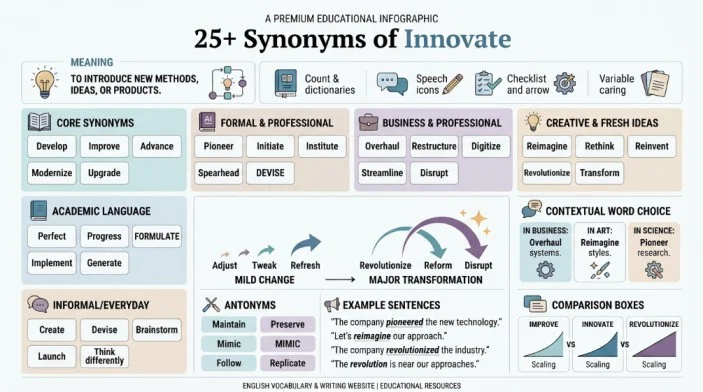
The best synonyms of innovate include invent, develop, create, devise, pioneer, introduce, modernize, transform, reimagine, reinvent, and revolutionize. For professional writing, use develop, modernize, or pioneer. For academic contexts, use develop or devise. Creative writing, reimagine or reinvent can be more expressive.
The verb innovate means to introduce new ideas, methods, products, or ways of doing something. It usually has a positive, forward looking tone and is especially common in technology, business, education, science, and creative work.
For formal writing, develop, devise, introduce, and pioneer are strong choices. In casual conversation, create, improve, change, or come up with may sound more natural. In creative writing, reimagine, reinvent, and transform can communicate a stronger sense of originality.
Meaning, Tone, and Context
Simple Definition
Innovate means to introduce a new idea, method, product, process, or approach, or to make meaningful changes that improve how something is done.
The central idea is newness combined with change. Someone who innovates is not simply doing something differently for no reason. The change usually involves a fresh approach, useful improvement, or original solution.
For example:
The company continues to innovate by developing more efficient software.
Here, innovate suggests that the company is introducing new approaches rather than merely making routine adjustments.
Part of Speech
Innovate is primarily a verb.
Examples:
- Companies must innovate to remain competitive.
- Teachers are finding new ways to innovate in the classroom.
- The team innovated by replacing a slow manual process with an automated system.
Overall Tone
Innovate generally has a positive and forward looking tone.
It often suggests creativity, progress, improvement, originality, and willingness to experiment. In business writing, it can also suggest competitiveness and adaptability.
However, the word itself does not guarantee that an innovation is successful. A company can innovate unsuccessfully, and a new idea can still have flaws.
Formality Level
Innovate is generally neutral to professional.
It is common in:
- Business reports
- Technology writing
- Academic discussions
- Corporate presentations
- Marketing
- Education
- Scientific communication
- Professional resumes
It can also appear in everyday conversation, although simpler alternatives such as “create something new” or “find a new way” may sound more natural in casual speech.
Common Uses
Native English speakers commonly use innovate when discussing:
- New products
- Technology
- Business strategies
- Scientific methods
- Educational approaches
- Manufacturing processes
- Digital services
- Creative solutions
- Organizational systems
- Social programs
For example:
The startup is innovating in the field of renewable energy.
The sentence emphasizes the company’s use of new ideas or approaches.
Word Forms
Relevant forms include:
- Innovate, verb
- Innovation, noun
- Innovative, adjective
- Innovator, noun
- Innovatively, adverb
Examples:
The company plans to innovate.
The company introduced an important innovation.
She proposed an innovative solution.
He is known as an innovator in the industry.
When and How to Use “Innovate”
Use innovate when you want to emphasize the introduction of something new or the development of a substantially different approach.
It works particularly well when the subject is actively creating or adopting new ideas rather than simply making a routine adjustment.
Professional
The company continues to innovate in digital customer service.
This works because the sentence discusses ongoing development in a professional environment.
Academic
Researchers are innovating by applying machine learning to traditional analytical methods.
Here, innovate highlights a new research approach.
Workplace
Our team needs to innovate if we want to reduce processing time.
The word fits a workplace discussion about finding better methods.
Personal
She likes to innovate when planning creative projects.
The sentence presents innovation as a personal creative habit.
We are exploring new ways to innovate our customer support process.
In professional email writing, this can work, although “improve our customer support process” may be more precise when the change is not particularly original.
Resume
Innovated internal reporting processes to reduce repetitive administrative work.
On a resume, innovate can communicate initiative and problem solving. Still, the strongest resume wording usually identifies the actual improvement and its measurable result.
Social Media
We are always looking for new ways to innovate and serve our customers better.
The word works naturally in brand communication, especially when a company wants to emphasize creativity and progress.
Best Synonyms of “Innovate”
No synonym is identical to innovate in every context. Some alternatives focus on creating something new, while others emphasize improvement, originality, leadership, transformation, or experimentation.
Professional Writing
Develop is often the safest professional alternative because it clearly suggests creating or improving something through a deliberate process.
The team developed a more efficient workflow.
Academic Writing
Devise works well when researchers or students create a new method, strategy, or solution.
Researchers devised a new approach to data analysis.
Business Communication
Modernize is especially useful when an organization updates an existing system or process.
The company plans to modernize its customer service platform.
Casual Conversation
Create or come up with often sounds more natural in everyday speech.
We came up with a better way to organize the event.
Emotional Writing
Reinvent can express a stronger feeling of personal or organizational renewal.
After the setback, she reinvented her approach to her career.
Creative Writing
Reimagine is useful when an existing concept is given a fresh interpretation.
The filmmaker reimagined the classic story for a modern audience.
Resume Writing
Developed is usually more concrete than simply writing “innovated.”
Developed a new onboarding system that simplified employee training.
Workplace Communication
Improve is appropriate when the main goal is better performance rather than originality.
The team improved the scheduling process.
Stronger Meaning
Revolutionize is much stronger than innovate. It suggests major, far reaching change.
The technology could revolutionize medical imaging.
Use it carefully because it makes a much bigger claim.
Softer Meaning
Improve is milder and more practical.
We improved the existing reporting system.
This does not necessarily suggest a completely new idea.
When Not to Use “Innovate”
When the Change Is Only a Routine Improvement
Innovate may sound too ambitious when you are describing a small adjustment.
Less precise:
We innovated the office filing system.
Better:
We improved the office filing system.
“Improved” accurately describes a useful change without implying major originality.
When You Mean “Invent”
If someone creates something that did not previously exist, invent may be more specific.
Less precise:
She innovated a new device.
Better:
She invented a new device.
Innovate focuses on introducing new approaches or improvements, while invent often emphasizes creating something entirely new.
When You Mean “Update”
If an existing system is simply brought up to date, modernize is often clearer.
Less precise:
The company innovated its old software.
Better:
The company modernized its old software.
When You Mean “Lead Something for the First Time”
Pioneer may be stronger when someone is among the first to introduce a particular approach.
Less precise:
The organization innovated the use of solar technology in the region.
Better:
The organization pioneered the use of solar technology in the region.
When the Writing Is Very Casual
Innovate can sound corporate in relaxed conversation.
Less natural:
We need to innovate our weekend plans.
More natural:
We need to come up with something new for the weekend.
When You Need a Concrete Result
Innovate can be vague if the reader does not know what changed.
Weak:
We innovated our business.
Better:
We redesigned our ordering system to make checkout faster.
Specific language is usually stronger than a broad innovation claim.
Words Commonly Confused With “Innovate”
| Word | Difference | When to Use It | Example |
|---|---|---|---|
| Invent | Focuses on creating something new that did not previously exist | Use when discussing a new product, device, method, or concept | She invented a tool that saves energy. |
| Improve | Focuses on making something better | Use for measurable or practical upgrades | The team improved the registration process. |
| Develop | Focuses on creating or advancing something through a process | Use in professional, scientific, and business contexts | Engineers developed a safer system. |
| Pioneer | Suggests being among the first to introduce or establish something | Use when emphasizing leadership and originality | The company pioneered online medical consultations. |
| Modernize | Focuses on updating something old or traditional | Use for systems, technology, organizations, or processes | The city modernized its transportation network. |
| Transform | Emphasizes major change in form, function, or character | Use when the result is substantial | Digital tools transformed the workplace. |
Best Synonyms of “Innovate” by Context
| Context | Best Synonym | Why It Works | Example |
|---|---|---|---|
| Formal writing | Develop | Precise and professional | The team developed a new procedure. |
| Academic writing | Devise | Clearly suggests creating a method or solution | Researchers devised a testing method. |
| Professional communication | Develop | Natural and versatile | We developed a more efficient workflow. |
| Business emails | Improve | Clear when discussing practical changes | We improved the reporting process. |
| Resume writing | Developed | Sounds concrete and achievement focused | Developed a new training system. |
| Workplace communication | Improve | Avoids unnecessary corporate language | We improved team coordination. |
| Casual conversation | Create | Simple and natural | They created a new way to solve the problem. |
| Everyday speaking | Come up with | Conversational and accessible | We came up with a better plan. |
| Creative writing | Reimagine | Adds originality and imagination | The author reimagined the old legend. |
| Storytelling | Reinvent | Suggests meaningful personal or creative change | She reinvented herself after moving abroad. |
| Emotional writing | Transform | Conveys substantial change | The experience transformed his outlook. |
| Strong emphasis | Revolutionize | Suggests very large change | The discovery could revolutionize the industry. |
| Mild tone | Improve | Focuses on useful progress | We improved the existing design. |
| Social media captions | Reinvent | Energetic and expressive | We reinvented our classic collection. |
| American English | Innovate | Widely understood and natural | The company continues to innovate. |
| British English | Innovate | Also standard and widely used | The organization continues to innovate. |
How to Choose the Best Synonym of “Innovate”
Choosing an alternative starts with the exact meaning you want to communicate.
1. Ask What Changed
- If something completely new was created, consider invent.
- If an existing thing became better, consider improve.
- If an existing system received a modern update, consider modernize.
2. Consider Your Audience
A research paper may benefit from devise or develop.
A business presentation may favor develop, transform, or modernize.
A casual conversation may sound more natural with create or come up with.
3. Consider Intensity
- Use improve for moderate change.
- Use innovate for meaningful new approaches.
- Use transform for major change.
- Use revolutionize only when the change is exceptionally broad or disruptive.
4. Think About Originality
If originality is the main point, invent, pioneer, reimagine, or reinvent may communicate the idea more clearly.
5. Match the Writing Purpose
For a resume, describe the action and result.
Instead of:
Innovated company operations.
Write:
Developed a new scheduling process that reduced administrative work.
The second version gives the reader useful information.
6. Prioritize Natural Usage
A synonym can be technically related but still sound unnatural in a particular sentence.
For example, “revolutionize” may be grammatically possible, but it can sound exaggerated when describing a minor software update.
Real Life Examples of “Innovate”
School
The teacher encouraged students to innovate by designing their own solutions to the environmental project.
A simpler alternative is:
The teacher encouraged students to create their own solutions.
College
The research group developed a new method for analyzing the survey results.
Here, developed is more precise than repeatedly using innovated.
Workplace
Our department improved the approval process by removing unnecessary steps.
The sentence focuses on practical improvement.
Business
The startup is innovating by offering a simpler way for small businesses to manage invoices.
Here, innovate works because the company is presenting a new approach.
We have developed a new process that should make client onboarding more efficient.
This is more specific than saying the company “innovated onboarding.”
Resume
Developed an automated reporting system that reduced manual data entry.
This gives a clearer achievement than simply writing “innovated reporting.”
Conversation
They came up with a clever way to organize the event.
The conversational phrase sounds more natural than “They innovated a clever way.”
Storytelling
After years of following the same formula, the artist reinvented her style.
Reinvented adds a sense of personal and creative change.
Blogging
Modern brands need to develop useful ideas rather than simply follow every new trend.
Develop provides a practical alternative to innovate.
Social Media
We are reimagining our classic products for a new generation.
Reimagining creates a more creative and expressive tone.
25 Best Synonyms of “Innovate”
The following list includes close synonyms and contextually appropriate alternatives. Some emphasize a particular part of innovation, such as originality, improvement, transformation, leadership, or modernization.
| Synonym | Simple Meaning | Best Used For | Example Sentence |
|---|---|---|---|
| Develop | Create or advance something through a process | Professional and academic writing | The engineers developed a safer system. |
| Invent | Create something genuinely new | Products, devices, ideas | She invented a device for conserving water. |
| Create | Bring a new idea or thing into existence | General and creative writing | The team created a simpler solution. |
| Devise | Carefully create a method or plan | Academic and formal writing | Researchers devised a new testing strategy. |
| Pioneer | Be among the first to introduce something | Leadership and historical innovation | The company pioneered digital payment services. |
| Introduce | Bring a new idea, product, or method into use | Business and professional writing | The school introduced a new learning platform. |
| Modernize | Update something for current needs | Technology and organizations | The company modernized its internal systems. |
| Improve | Make something better | Everyday and workplace communication | We improved the customer service process. |
| Transform | Change something substantially | Business, social, and creative writing | Digital technology transformed the industry. |
| Revolutionize | Change something dramatically and extensively | Strong claims and major breakthroughs | The discovery could revolutionize agriculture. |
| Reimagine | Think about an existing idea in a new way | Creative and marketing writing | The studio reimagined the traditional format. |
| Reinvent | Create a significantly different version of something | Personal, business, and creative contexts | The brand reinvented its visual identity. |
| Reform | Change a system to improve it | Government, policy, and organizations | The organization reformed its training program. |
| Reshape | Alter the structure or direction of something | Business and social writing | Technology reshaped modern communication. |
| Redesign | Design something again to improve or change it | Products, systems, and processes | The team redesigned the website. |
| Upgrade | Improve something by adding newer or better features | Technology and products | We upgraded the software platform. |
| Renew | Give something fresh energy or usefulness | Organizations, relationships, and creative work | The campaign renewed interest in the brand. |
| Advance | Move an idea, field, or process forward | Academic and professional writing | The research advanced our understanding of the disease. |
| Originate | Be the source of a new idea or concept | Formal and historical writing | She originated the concept during graduate school. |
| Conceive | Form a new idea in the mind | Creative and intellectual writing | The designer conceived a more flexible product. |
| Formulate | Develop a carefully structured idea or plan | Academic and professional contexts | The committee formulated a new strategy. |
| Engineer | Design or arrange something deliberately | Technical and business contexts | The team engineered a more efficient process. |
| Experiment | Try new methods to discover what works | Science, education, and creative work | The team experimented with alternative materials. |
| Evolve | Develop gradually into a newer form | Long term change | The service evolved as customer needs changed. |
| Disrupt | Change an established market or process in a powerful way | Business and technology | The startup disrupted the traditional delivery model. |
Synonyms of “Innovate” by Usage
Professional vs Personal Synonyms
In professional writing, develop, devise, modernize, improve, introduce, pioneer, and transform are usually stronger choices because they identify the type of change more clearly.
In personal writing, create, reinvent, reimagine, come up with, and experiment can sound more natural.
For example:
Professional:
The team developed a new client onboarding process.
Personal:
I came up with a better way to organize my notes.
Formal vs Conversational Synonyms
Formal writing often benefits from:
- Develop
- Devise
- Formulate
- Introduce
- Pioneer
- Advance
Conversational writing can use:
- Create
- Improve
- Change
- Come up with
- Try
- Experiment with
A sentence such as “The researchers devised a new approach” sounds appropriate in academic writing. In everyday speech, “They came up with a new approach” may sound more relaxed.
Academic Synonyms
Strong academic alternatives include develop, devise, formulate, advance, originate, and conceive.
These words help identify what the researcher actually did.
For example:
The researchers devised a framework for evaluating the new model.
This is more informative than:
The researchers innovated a framework.
The first sentence identifies the action more precisely.
Professional and Business Synonyms
For resumes, interviews, meetings, presentations, performance reviews, client communication, and business emails, consider:
Develop: Best for creating systems, strategies, and processes.
Improve: Best for measurable operational changes.
Modernize: Best for updating older systems.
Transform: Best for significant organizational change.
Pioneer: Best when emphasizing first mover leadership.
Redesign: Best for products, processes, websites, and systems.
Introduce: Best when bringing a new product, service, or process into use.
Creative and Literary Synonyms
Creative writing often benefits from:
- Reimagine
- Reinvent
- Transform
- Reshape
- Rework
- Create
- Conceive
These words can add more imagery and emotional meaning.
Compare:
She innovated her artistic style.
with:
She reinvented her artistic style.
The second sentence sounds more expressive because reinvent suggests a deliberate departure from the previous style.
Slang or Modern Synonyms
There is no single slang word that perfectly replaces innovate.
In informal technology or business conversations, people may use phrases such as shake things up or think outside the box, but these are expressions rather than exact synonyms.
“Shake things up” suggests making noticeable changes, but it does not necessarily mean creating a genuinely innovative solution.
Avoid such expressions in academic papers, formal reports, and professional documents when precision matters.
Strongest to Mildest Synonyms
The intensity of these words depends heavily on context, but a useful general scale is:
Mild
Improve, upgrade, renew
These suggest useful changes without necessarily implying major originality.
Moderate
Develop, introduce, modernize, redesign, reform
These indicate deliberate and meaningful change.
Strong
Innovate, pioneer, transform, reinvent, reshape
These usually communicate greater originality, leadership, or significance.
Very Strong
Revolutionize, disrupt
These suggest major change that can significantly alter an industry, system, or established way of thinking.
Use very strong terms carefully. Strong language should match the actual scale of the change.
Emotional vs Neutral Synonyms
Emotional Synonyms
These can carry more expressive force:
- Reinvent
- Reimagine
- Transform
- Revolutionize
- Reshape
- Disrupt
They are useful when the writer wants to communicate excitement, significance, or dramatic change.
Neutral Synonyms
These communicate the action more directly:
- Develop
- Improve
- Introduce
- Devise
- Modernize
- Design
- Upgrade
These are generally better when accuracy matters more than emotional impact.
Antonyms of “Innovate”
Because innovate describes introducing new approaches, its opposites often involve preserving existing methods, copying established approaches, or refusing meaningful change.
| Antonym | Meaning | Example Sentence |
|---|---|---|
| Stagnate | Stop developing or progressing | The industry began to stagnate without new ideas. |
| Preserve | Keep something in its existing form | The organization chose to preserve its traditional process. |
| Maintain | Keep something operating in its current state | The company maintained the same workflow for years. |
| Retain | Continue to keep something rather than replace it | The school retained its traditional teaching model. |
| Copy | Reproduce another person’s approach | The competitor copied the original design. |
| Imitate | Follow another model rather than create an original one | The brand imitated its larger competitor. |
| Replicate | Reproduce an existing method or result | The team replicated the previous process. |
| Duplicate | Make an additional version of something existing | The company duplicated the old system. |
| Conform | Follow established standards or expectations | The organization chose to conform to industry practices. |
| Resist | Oppose or refuse a proposed change | Some employees resisted the new technology. |
| Regress | Move backward rather than forward | The outdated policy caused the service to regress. |
| Deteriorate | Become worse over time | The system deteriorated after years without improvement. |
| Standardize | Make things follow an established standard | The company standardized every department’s workflow. |
| Conventionalize | Make something conform to conventional practice | The process became conventionalized over time. |
| Preserve tradition | Continue established practices instead of introducing new ones | The institution chose to preserve tradition. |
Comparison: “Innovate” vs Similar Words
Innovate vs Invent
Main Difference:
Innovate focuses on introducing new ideas, methods, products, or approaches. Invent more strongly emphasizes creating something that did not exist before.
Which Is Stronger?
Invent can suggest greater originality when an entirely new object or concept is created.
Which Is More Formal?
Both are standard and professional.
When to Use Each:
Use innovate for new approaches and improvements. Use invent for genuinely new creations.
Examples:
Innovate:
The company continues to innovate in digital education.
Invent:
The engineer invented a compact water purification device.
Innovate vs Develop
Main Difference:
Innovate emphasizes newness or originality. Develop emphasizes the process of creating, refining, or advancing something.
Which Is Stronger?
Innovate usually carries a stronger sense of novelty.
Which Is More Formal?
Develop is especially versatile in academic and professional writing.
When to Use Each:
Use develop when describing the process behind a new product, method, or strategy.
Examples:
Innovate:
The company needs to innovate to remain competitive.
Develop:
The engineers developed a new energy storage system.
Innovate vs Improve
Main Difference:
Innovate suggests introducing something new or substantially different. Improve simply means making something better.
Which Is Stronger?
Innovate usually implies greater originality.
Which Is More Formal?
Both are suitable for professional writing.
When to Use Each:
Use improve when the existing system remains largely intact.
Examples:
Innovate:
The startup innovated by changing how customers access the service.
Improve:
The team improved the existing checkout process.
Innovate vs Modernize
Main Difference:
Modernize specifically means updating something so it better fits current needs or technology.
Which Is Stronger?
Innovate often suggests more originality. Modernize focuses on updating.
Which Is More Formal?
Both work well in professional writing.
When to Use Each:
Use modernize for older systems, technology, institutions, and processes.
Examples:
Innovate:
The company is innovating in digital healthcare.
Modernize:
The hospital modernized its record keeping system.
Innovate vs Pioneer
Main Difference:
Pioneer emphasizes being one of the first to introduce or establish an approach.
Which Is Stronger?
Pioneer can sound stronger when leadership or first mover status matters.
Which Is More Formal?
Both are suitable for formal writing.
When to Use Each:
Use pioneer when you have evidence that a person or organization led the way.
Examples:
Innovate:
The company continues to innovate in transportation.
Pioneer:
The company pioneered an early form of electric transportation.
Innovate vs Transform
Main Difference:
Innovate emphasizes new ideas or approaches. Transform emphasizes a major change in condition, structure, or character.
Which Is Stronger?
Transform generally communicates a larger change.
Which Is More Formal?
Both work in professional and academic contexts.
When to Use Each:
Use transform when the outcome changes something substantially.
Examples:
Innovate:
The team innovated its customer service strategy.
Transform:
The new platform transformed the customer service experience.
Common Phrases and Expressions with “Innovate”
Innovate in
Meaning:
To introduce new approaches within a particular field.
Example:
The company continues to innovate in renewable energy.
Innovate to Improve
Meaning:
To use new ideas with the goal of achieving better results.
Example:
The organization must innovate to improve access to education.
Innovate and Grow
Meaning:
To develop new ideas as part of organizational growth.
Example:
The business encourages employees to innovate and grow.
Innovate for the Future
Meaning:
To create new approaches intended to address future needs.
Example:
The company invests in research to innovate for the future.
Innovation Through Technology
Meaning:
Using technology as a way to introduce new approaches.
Example:
The organization is pursuing innovation through technology.
Drive Innovation
Meaning:
To actively encourage or lead the development of new ideas.
Example:
The research team helps drive innovation across the organization.
Foster Innovation
Meaning:
To create conditions where new ideas can develop.
Example:
The manager wants to foster innovation within the team.
Encourage Innovation
Meaning:
To support people in creating and testing new ideas.
Example:
The school encourages innovation through project based learning.
Common Mistakes to Avoid
Mistake 1: Using “Innovate” When You Mean “Improve”
Incorrect:
We innovated the existing scheduling system.
Better:
We improved the existing scheduling system.
Why:
If the basic system stayed the same and only became more efficient, improve is more accurate.
Mistake 2: Treating “Innovate” and “Invent” as Identical
Incorrect:
The company innovated a completely new machine.
Better:
The company invented a completely new machine.
Why:
Invent is more natural when the emphasis is on creating a new physical object.
Mistake 3: Using Corporate Language in Casual Conversation
Incorrect:
We should innovate our weekend activities.
Better:
We should come up with something new for the weekend.
Why:
The second sentence sounds more natural in everyday American English.
Mistake 4: Using “Revolutionize” for a Small Change
Incorrect:
We revolutionized the office calendar by adding a reminder.
Better:
We improved the office calendar by adding a reminder.
Why:
Revolutionize suggests a much more dramatic transformation.
Mistake 5: Repeating “Innovate” Too Often
Incorrect:
The company innovates its products, innovates its services, and innovates its marketing.
Better:
The company develops new products, improves its services, and modernizes its marketing.
Why:
Different precise verbs make the writing clearer and less repetitive.
Mistake 6: Choosing a Synonym With the Wrong Tone
Incorrect:
The team revolutionized the filing system with a small software update.
Better:
The team modernized the filing system with a software update.
Why:
Modernized accurately communicates an update without exaggerating the result.
Mistake 7: Using Slang in Formal Writing
Incorrect:
The researchers shook things up with their new methodology.
Better:
The researchers developed a new methodology.
Why:
The second version is more appropriate for academic writing and communicates the action precisely.
Frequently Asked Questions
What are the best synonyms of “innovate”?
The best synonyms of innovate include develop, invent, devise, pioneer, introduce, modernize, improve, transform, reimagine, and reinvent. The best choice depends on whether you mean creation, improvement, modernization, or major change.
What are the best formal synonyms of “innovate”?
The strongest formal synonyms of innovate include develop, devise, formulate, introduce, pioneer, advance, and modernize. These alternatives work particularly well in academic papers, reports, research writing, and professional documents.
What are common informal synonyms of “innovate”?
Common informal alternatives include create, improve, try something new, come up with, and change. These expressions sound more natural in everyday conversation because they avoid the corporate tone that innovate can sometimes have.
What is another word for “innovate” in professional writing?
Develop is one of the most useful professional alternatives to innovate. Depending on context, modernize, improve, redesign, introduce, pioneer, or transform may be more precise because each emphasizes a different type of change.
What is the difference between “innovate” and “invent”?
Innovate generally means introducing new ideas, approaches, or improvements, while invent more strongly suggests creating something that did not previously exist. A company can innovate its process without inventing an entirely new product.
What is the opposite of “innovate”?
Common opposites of innovate include stagnate, maintain, preserve, imitate, copy, conform, resist, and regress. The best antonym depends on whether the opposite idea is maintaining an existing system, copying others, or refusing change.
Conclusion
Innovate is a useful word for describing new ideas, methods, products, and approaches, especially in business, technology, education, and professional communication. However, its alternatives can often communicate the intended meaning more precisely.
Use develop for deliberate creation, improve for practical upgrades, modernize for updating older systems, pioneer for first mover leadership, reimagine for creative reinterpretation, and transform or revolutionize when the change is genuinely substantial.
The best synonyms of innovate depend on your audience, purpose, tone, and the size of the change you are describing. A useful vocabulary habit is to ask yourself what actually happened before choosing a synonym. Specific verbs usually produce clearer and more convincing writing.
Read More Related Articles:
- 50+ Synonyms of This | Meanings, Uses, Examples, and Best …
- Synonyms for Empty | Meaning, Examples, and Better Word …
- Synonyms for Creativity | Meaning, Examples, and Better …