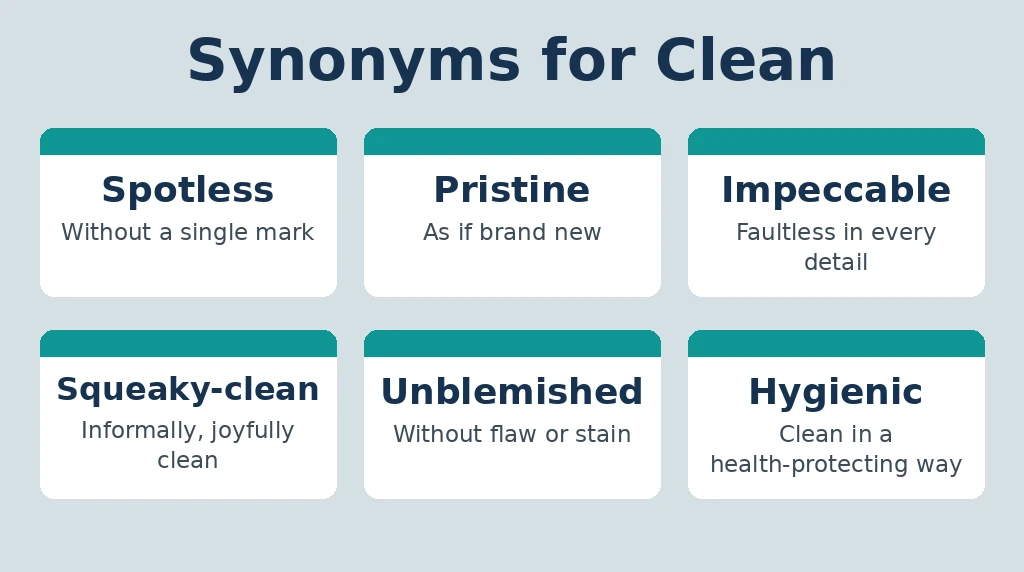
There’s a particular satisfaction in a kitchen you could eat off, a shirt that smells of weather, a record with nothing on it. Clean is the adjective English trusts with all three, and its closest synonyms divide by what has been removed: spotless and pristine when the dirt is gone, sterile and hygienic when the germs are gone, pure when the adulteration is gone, and upright and exemplary when what has been removed is blame. In fact, the satisfaction is the test, and the word should name what is gone. For example, synonyms for clean in this guide sort by the thing removed, not the shine on the surface.
This guide gathers 60 synonyms for clean and sorts them the way cleaners, doctors, judges and designers actually use them: washed, disinfected, unpolluted, moral, fair, complete, well-designed and scrubbed. Every word was checked against real thesaurus entries, and each arrives with a plain meaning and a short example. Keep the families apart and clean will never embarrass you. Mix them, and you’ll be calling a salad sterile by Friday. In other words, the sorting is the point, because the same word can wash a kitchen and certify a record. Consequently, synonyms for clean in this guide come with a meaning and an example each.
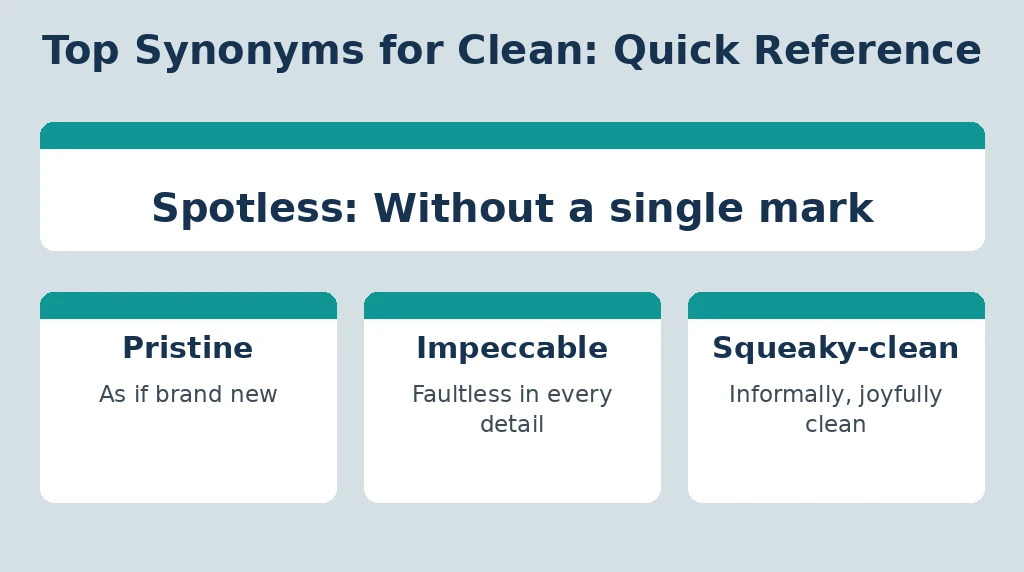
Top Synonyms for Clean: Quick Reference
These twenty-eight words cover clean’s main territories. The grouped sections below sort the full list by sense, marking which words belong to soap, which to science and which to character. In particular, the table is the shortcut, and the sections below are the full map. For instance, a writer in a hurry can take the table and go, while a careful writer reads on.
| Word | Meaning in one line | Best for |
|---|---|---|
| Spotless | Without a single mark | Kitchens, uniforms, hotels |
| Pristine | As if brand new | Snow, beaches, antiques |
| Impeccable | Faultless in every detail | Uniforms, records, taste |
| Squeaky-clean | Informally, joyfully clean | Kitchens, reputations, fun |
| Unblemished | Without flaw or stain | Records, reputations, skin |
| Hygienic | Clean in a health-protecting way | Kitchens, clinics, habits |
| Sanitary | Free from infection risks | Facilities, inspections, reports |
| Sterile | Completely free of germs | Dressings, theatres, instruments |
| Antiseptic | Killing germs, infection-proof | Herbs, sprays, procedures |
| Pure | Nothing mixed in or harmful | Water, air, ingredients |
| Fresh | New and unstale | Air, linen, water |
| Unadulterated | Nothing added or faked | Food, goods, joy |
| Moral | Clean in conduct | Living, leadership, choices |
| Decent | Respectable and sound | People, families, behaviour |
| Upright | Honest and trustworthy | Citizens, judges, dealers |
| Exemplary | Perfect as an example | Conduct, service, records |
| Virtuous | Full of moral goodness | Characters, lives, heroes |
| Complete | Total, leaving nothing out | Breaks, sweeps, victories |
| Decisive | Settling the matter | Wins, breaks, results |
| Thorough | Complete in every detail | Searches, jobs, cleaning |
| Neat | Orderly and uncluttered | Rooms, desks, handwriting |
| Tidy | Everything in its place | Desks, houses, minds |
| Elegant | Gracefully simple in design | Furniture, lines, solutions |
| Wash | Clean with water | Dishes, clothes, hands |
| Scrub | Rub hard clean | Floors, pans, hands |
| Cleanse | Clean deeply or ritually | Skin, wounds, palates |
| Disinfect | Destroy the germs | Water, surfaces, wards |
| Deep clean | Clean everything, thoroughly | Homes, surgeries, spring |
What Does Clean Mean?
Clean begins with dirt, or rather with its absence: free from dirt, marks and stains. That’s the sense of clean clothes, clean hands and a clean kitchen, the one children learn first. But the word’s real career starts with its extensions. Clean air and clean water are free not of visible dirt but of contamination. A clean record is free of blame. A clean joke is free of indecency, a clean break free of loose ends, a clean fight free of fouls. In every case, clean certifies that something unwanted isn’t there. That single test, is the unwanted thing truly absent, explains the whole family that follows. In short, the test is simple, and the absent thing is the whole subject. Therefore, a writer should sort synonyms for clean by what is absent, not by the shine.
The word is unusually busy in phrases. People come clean when they confess. They make a clean sweep when they remove everything at once. Thieves get clean away, boxers break clean, and a ship with a clean hold is empty in the certified, official way. Clean energy, clean eating and clean living show the word still expanding, always carrying the same promise: nothing hidden, nothing harmful, nothing left over. In fact, the phrases are the family at work in plain sight, and each one shows a different absence. For example, the phrases carry the promise best, because they come from real speech.
English issues these certificates constantly. A clean bill of health frees a ship, a patient or a company from suspicion. In football, a clean sheet means no goals conceded, a whole match of successful defence. A clean slate wipes a record by agreement, while clean hands, in law, belong to the party who comes to court without wrongdoing of their own. Even a clean room is a technical term now, the dust-controlled chamber where chips and medicines are made. Each phrase extends one of this guide’s families, which is why learning the families teaches the phrases for free. In particular, the certificates are the family’s work in court, sport and medicine alike. Consequently, a writer should learn synonyms for clean in phrases with the families, not apart from them.
As a verb, clean is the general of a small army: wash, scrub, wipe, rinse and a dozen specialists we’ll meet at the end of this guide. The adjective is neutral and universal, but its synonyms are graded like medals, from the everyday washed and tidy up through spotless and pristine to the almost ceremonial unsullied. Choosing among them is mostly choosing how much ceremony your sentence can carry. In fact, the general commands an army, and the medals grade the ceremony. For example, a writer should choose synonyms for clean as verbs by the job, not the polish.
Clean and Washed: Spotless, Pristine and Squeaky-Clean
The home family: things washed, laundered and inspected. These words grade the visible result, from the plain fact of washed to the gleaming extreme where a surface becomes a compliment to its keeper. In other words, the home family grades what the eye can see, and the marks are the evidence. Consequently, a writer should judge synonyms for clean for homes by the inspection, not the claim.
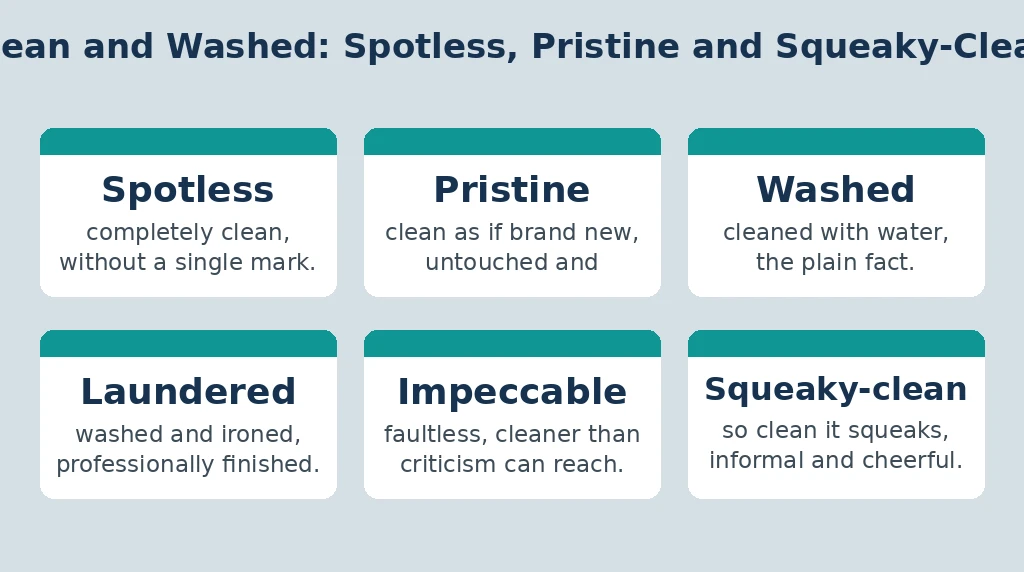
- Spotless: completely clean, without a single mark. Every morning the cleaners make sure the lobby is spotless.
- Pristine: clean as if brand new, untouched and perfect. The pristine snowfield had no footprints at all.
- Washed: cleaned with water, the plain fact. He put on a washed shirt and felt human again.
- Laundered: washed and ironed, professionally finished. She wore a freshly laundered and starched white shirt.
- Impeccable: faultless, cleaner than criticism can reach. His impeccable uniform passed every inspection.
- Squeaky-clean: so clean it squeaks, informal and cheerful. The squeaky-clean kitchen smelled of lemons.
- Unblemished: without a mark, stain or flaw. He kept an unblemished record for thirty years.
- Unsullied: not stained or spoiled, formal. Her unsullied reputation survived the scandal intact.
- Unstained: carrying no stain, literal or moral. The unstained tablecloth came out for guests.
- Unsoiled: not made dirty, still fresh. Unsoiled sheets waited in the airing cupboard.
- Unspotted: free of spots, an old and formal word. The unspotted lamb appears in old hymns and poems.
Spotless and pristine are the showpieces, and they aren’t identical. Spotless reports an inspection passed, no marks found. Pristine adds newness and untouchedness: the beach before footprints, the antique before restoration. Unblemished and unsullied already lean moral, which is why records and reputations borrow them so often, while unspotted has retired into poetry. Squeaky-clean makes the opposite journey, a kitchen word that now certifies politicians and pop stars, always with a smile. In particular, the showpieces are the sharpest tools, and the inspection proves it. Therefore, a writer should save synonyms for clean for showpieces for the moment of proof.
Laundry has always been a language of status, and this family keeps the old grammar. The washed shirt at the interview, the laundered tablecloth at the negotiation, the impeccable uniform at the inspection: each announces that someone cared before anyone was watching. Hotels understand the code perfectly, grading themselves in this vocabulary (crisp, fresh, spotless) because travellers read cleanliness as honesty. A place that hides its dirt, the reasoning goes, hides other things. A place that shows its cleaning can probably be trusted with the rest. In fact, the status is the point, and the shirt is the evidence. For instance, synonyms for clean for laundry should speak of work done, not words spent.
Clean Enough to Eat Off: Hygienic, Sterile and Sanitised
Some clean is about health rather than appearance, and it has a technical family of its own. These are the words of kitchens, clinics and inspection reports, where the enemy is invisible and the standard is safety, the same standard that governs the synonyms for safe. In short, the health family measures risk, and the shine is only the decoration. As a result, a writer should learn synonyms for clean for health as safety first.
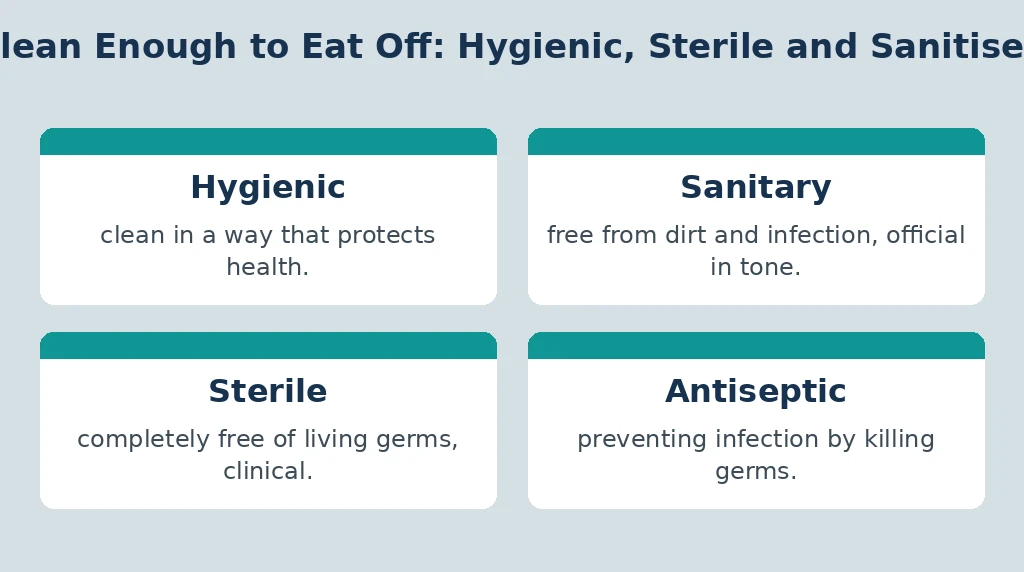
- Hygienic: clean in a way that protects health. They built a kitchen that was easy to keep hygienic.
- Sanitary: free from dirt and infection, official in tone. It was not the most sanitary place one could swim.
- Sterile: completely free of living germs, clinical. He made sure every cut was covered with a sterile dressing.
- Antiseptic: preventing infection by killing germs. These herbs have strong antiseptic qualities.
- Sterilized: made sterile by heat or treatment. The instruments arrived sterilized and sealed.
- Decontaminated: freed from dangerous substances. The site was decontaminated before building began.
Grade these carefully, because professionals do. Hygienic and sanitary describe conditions and habits, the everyday standard. Antiseptic describes substances and treatments that fight germs. Sterile is the summit, a technical term for the complete absence of living microorganisms, and using it for a merely tidy kitchen is exactly the exaggeration this family exists to prevent. A sterile kitchen is a laboratory fantasy. A hygienic one is a credit to its cook. In other words, the grading is the professional habit, and the ladder is the rule. For example, synonyms for clean for hygiene should climb the ladder step by step.
This family is also a history of survival. The discovery that washed hands save lives turned cleaning from housekeeping into medicine, and the vocabulary still carries the campaign: sanitary inspectors, antiseptic surgery, sterilized instruments, disinfected water. Whole cities owe their size to these words, and the modern deep clean of clinics and food factories is their direct descendant. When a label says sanitized for your protection, it’s quoting a century of public health, which is why the terms resist casual use. They were earned. In fact, the history is the campaign, and the words still carry it. For example, synonyms for clean for survival should come from the campaign, not the cupboard.
Clean Air and Clean Water: Pure, Fresh and Unadulterated
A smaller, older family handles the elements. Here clean means nothing harmful has got in: no chemicals in the river, no smoke in the air, no shortcuts in the food. In other words, the elements have their own family, and the absence is purity, not tidiness. Consequently, a writer should choose synonyms for clean for the elements by what is missing, not what is seen.
- Pure: free of anything mixed in or harmful. The valley fights for pure, clean river water.
- Fresh: new, clean and not stale, of air and water. The air was fresh and she felt revived.
- Unadulterated: nothing added, nothing faked, complete and pure. They sold unadulterated food, grown without chemicals.
Pure is the giant here, and it straddles chemistry and morality so completely that it gets a warning in the mistakes section. Fresh is the sensory word, what clean air feels like on the skin and in the lungs. Unadulterated is the lawyer of the family, certifying that nothing has been added, and it doubles beautifully for abstract goods: unadulterated joy is a fixed phrase precisely because adulteration is what commerce does to everything else. In particular, the giant straddles two worlds, and the warning proves it. Therefore, synonyms for clean for purity should be graded by the substance, not the shine.
The family’s newest province is power. Clean energy and clean fuel extend the old water standard to electricity and transport: nothing harmful got in, and nothing harmful comes out. Advocates chose the word deliberately, borrowing the laboratory’s authority for a political argument, and opponents contest it on exactly that ground. Whatever the debate, the usage proves the family’s core meaning once more. Clean certifies an absence, and the argument is always about which absence matters. In fact, the province is new, and the governments argue in the family’s words. For instance, synonyms for clean for power should certify the chain, not the surface.
Clean Living and Clean Play: Moral, Upright and Fair
When clean describes people rather than things, it certifies conduct. Clean living, a clean conscience, a clean record: this family grades character, and then, in the sports pages, it grades contests, where a clean player keeps the rules and a clean tackle keeps the law. In short, the conduct is the certificate, and the laundry lends the authority. As a result, a writer should choose synonyms for clean for people by conduct, not by cleanliness of hands.
- Moral: behaving according to accepted ideas of right. The committee members are moral, competent people.
- Good: morally right, the plain word. The president, they said, is a good man.
- Decent: respectable and morally sound. The hero is portrayed as an ordinary, decent man.
- Respectable: regarded as proper and honest. He came from a respectable middle-class family.
- Upright: honest, responsible and trustworthy. A very upright man, he never broke a promise.
- Exemplary: perfect as an example to others. Her exemplary conduct was cited at the hearing.
- Virtuous: full of moral goodness, slightly old-fashioned. He was portrayed as a virtuous family man.
- Undefiled: not spoiled or corrupted, formal. Few places remain undefiled by industrial noise.
And for the contest itself, two small words carry the whole ethic of sport and dealing:
- Fair: according to the rules, honestly contested. It was a hard game but a fair one.
- Legal: within the rules and the law, of play and deals. The referee ruled it a legal tackle.
Reputation is the bridge between the two lists. A person of exemplary conduct earns a spotless record, the washed family’s words doing moral work, while a player who isn’t clean, a dirty player, borrows the dirt family’s words for the opposite verdict. English runs its moral accounting in laundry metaphors more often than we notice, and this section is where the ledger is kept. In other words, the bridge joins the two lists, and the reputation is the crossing. For example, synonyms for clean for reputation should carry both families at once.
At work, this family is paperwork. The clean record gets checked before licences, visas and promotions; the clean conscience is what lets its owner sign the declaration without a pause. Employers write references in the family’s graded code: decent for satisfactory, upright for trustworthy, exemplary for the rare file they would frame. Understanding the code means you can read half the world’s filing cabinets. Using it well means describing a person’s whole history in a single adjective. In fact, the code is the paperwork, and the grade is the verdict. For example, synonyms for clean for work should follow the code, not the compliment.
A Clean Break: Complete, Total and Decisive
Clean also means thorough, with nothing left behind. A clean break, a clean sweep, a clean copy: in each case the job is complete and the edges are tidy, which is why diplomats, surgeons and departing employees all reach for this family. In other words, the thoroughness is the point, and the edges are the proof. Consequently, a writer should choose synonyms for clean for thoroughness by the job done, not the job promised.
- Complete: total and entire, leaving nothing out. He demanded a complete break with the old regime.
- Final: settling the matter for good. The judge’s decision is final and the feud is over.
- Whole: entire, with nothing missing. I have now read the whole report twice.
- Total: complete in every way, emphatic. The restructure was a total success.
- Perfect: complete and faultless, in clean sweeps and clean copies. She made a perfect copy of the drawing.
- Entire: whole, with every part included. Treatment works better when the entire family is involved.
- Decisive: settling things conclusively. It was a decisive victory and a clean one.
- Thorough: complete in every detail. Police made a thorough search of the building.
- Conclusive: putting an end to doubt. There was no conclusive evidence against him.
Complete and entire describe the coverage, total and perfect add the emphasis, and decisive and conclusive describe the effect on argument: after a clean, decisive result, there’s nothing left to dispute. Thorough is the worker of the family, as happy with searches and investigations as with spring cleaning, and it’s the bridge word that explains how clean came to mean complete at all, through the image of a job with no corner left undone. In particular, the coverage, the emphasis and the verdict are the three grades. Therefore, synonyms for clean for completeness suit the verdict that ends the matter.
Politics and business run on this family because they run on endings. The clean sweep replaces a whole board. A clean audit closes the year. The clean break ends the merger talks. In each case the word promises stakeholders the one thing institutions struggle to deliver: finality without residue. Writers covering such stories should notice how often the promise outruns the paperwork, and how the family’s warm laundry glow gets used to rinse decisions that a colder vocabulary (dismissal, termination, severance) would describe more honestly. In fact, the board, the audit and the merger are the three endings, and the word certifies all three. For example, synonyms for clean for endings should promise finality, not apologies.
Clean Lines: Neat, Tidy and Elegant Design
Designers use clean for order without ornament: clean lines, a clean layout, a clean interface. Here the enemy isn’t dirt but clutter, and the family shades into the territory of the synonyms for clear, where clean edges and clear thinking become the same compliment. In fact, the order is the ornament, and the edges are the proof. For example, synonyms for clean for design should strip the excess, not add to it.
- Neat: tidy, orderly and free of clutter. Her house was neat, tidy and gleamingly clean.
- Tidy: arranged in order, everything in place. A tidy desk can sometimes seem impossible.
- Trim: neat and compact, carefully maintained. The neighbour’s gardens were trim and green.
- Elegant: graceful and simple in design. She admired the elegant lines of the old chair.
- Simple: without complication or decoration. The simple joy of the design is its honesty.
Neat and tidy describe the achieved order, trim adds the sense of maintenance, a thing kept cut back and cared for, and elegant and simple grade the philosophy behind it. A clean design isn’t an empty one. It’s one where everything present has earned its place. That’s why the word is praise in architecture and software alike, and why messy, its everyday opposite in this sense, is a design verdict rather than a hygiene report. In short, the order is the philosophy, and the design proves it. As a result, a writer should choose synonyms for clean for design by what earns its place, not by what fills the space.
Software made this family famous a second time. A clean interface, clean code and a clean install are the industry’s highest compliments, and they all mean what the Shaker furniture makers meant: nothing present that does no work. Programmers even borrowed the completeness family for their purges, a clean build, a clean checkout. The lesson travels back to the physical desk. Clutter isn’t dirt, but both are subtractions waiting to happen, and clean is the word for a subtraction completed. In fact, the second fame is the software’s, and the desk learns from it. For example, synonyms for clean for software should mean nothing wasted, not nothing there.
Clean as a Verb: Wash, Scrub and Deep Clean
The verb family is a workforce, graded by effort and instrument, from a rinse under the tap to the full ceremonial of the deep clean. Clean itself is the general term. These are its specialists. In other words, the workforce grades by effort, and the instrument decides the rank. Consequently, a writer should choose synonyms for clean as verbs by the effort, not the polish.
- Wash: clean with water, the everyday verb. He got a job washing dishes in a pizza parlour.
- Cleanse: clean thoroughly, often skin, wounds or conscience. She demonstrated the proper way to cleanse the face.
- Scrub: rub hard with a brush or cloth. The corridors are scrubbed every night.
- Scour: clean by hard rubbing, for sinks and pans. He decided to scour the sink before guests arrived.
- Rinse: wash off soap or loose dirt with clean water. After washing, always rinse the hair in clear water.
- Wipe: clean by rubbing with a cloth or hand. She wiped her hands on the towel and sat down.
- Sponge: clean with a sponge and water, gently. Gently sponge the stain before it sets.
- Mop: clean floors with a mop and water. A woman was mopping the station stairs.
- Sweep: clean floors with a broom or brush. She was in the kitchen sweeping the floor.
- Dust: remove dust from surfaces. I dusted and polished the living room on Saturday.
- Launder: wash and iron clothes, professionally. The hotel launders sheets daily.
- Bath: wash a person or animal in a bath, British use. You do not have to bath your child every day.
- Purify: make pure by removing harmful substances. Plants can filter and purify the air in your office.
- Disinfect: destroy germs with chemicals. Chlorine is used to disinfect drinking water.
- Sanitize: make clean and hygienic, official and modern. Motels advertise sanitized glasses and sealed cups.
- Deep clean: clean thoroughly, room by room, a modern noun turned verb. They deep clean the surgery every Friday.
The list is a small manual of method. Water words come first: wash, rinse, bath and launder. Friction words follow: scrub, scour, wipe and sponge. Then come the room words, sweep, mop and dust, and finally the chemistry (purify, disinfect and sanitize), where cleaning becomes public health. Cleanse stands slightly apart, elevated in tone, the verb of skincare, rituals and consciences, and its ambitions get examined in the mistakes below. In particular, the manual is the method, and the order is the lesson. Therefore, synonyms for clean as verbs should follow the manual, not the mood.
Households schedule these verbs like a rota, and the schedule itself is vocabulary. Daily verbs are wipe, rinse and wash up; weekly verbs are mop, dust and launder; seasonal verbs are deep clean and scour, the spring offensive. Professional cleaners price by exactly this ladder, which is why advertisements list them so carefully. A learner who commands the ladder can describe any cleaning scene precisely, from a wiped counter to a decontaminated ward, without once reaching for the flat general word. In fact, the rota is the vocabulary, and the ladder is the price. For instance, synonyms for clean for households should follow the rota, not the impulse.
How to Choose the Right Synonym for Clean
Ask what has been removed. Visible dirt: washed, spotless, pristine. Germs: hygienic, antiseptic, sterile. Contaminants: pure, fresh, unadulterated. Blame: unblemished, exemplary, upright. Loose ends: complete, decisive, thorough. Clutter: neat, tidy, trim. The question sounds simple, and it prevents nearly every error in this family, because most wrong choices are right answers to the wrong removal. In short, the question is the key, and the removal is the answer. As a result, synonyms for clean for choosing should follow the removal, not the rhyme.
Then grade the ceremony. A kitchen can be clean, spotless or, with a wink, squeaky-clean; it shouldn’t be unsullied unless you’re writing its biography. A record can be clean or unblemished, exemplary if you’re its commanding officer. And in technical contexts, respect the summits: sterile, decontaminated and conclusive are terms with definitions, and spending them on ordinary tidiness devalues exactly the precision they exist to provide. In other words, the ceremony is the grade, and the summit is the limit. For example, synonyms for clean for ceremony should respect the summit, not the shine.
| Situation | Best word | Why |
|---|---|---|
| A hotel bathroom that gleams | Spotless | Inspection passed, no marks found |
| A beach before any footprints | Pristine | Untouched, as if new |
| Drinking water from a mountain spring | Pure | Nothing harmful has got in |
| A referee’s report on a hard match | Fair | Clean play means rule-abiding |
| Leaving a job with no loose ends | Clean break: complete | Thorough, finished, final |
| A website with nothing wasted on it | Clean lines: elegant, simple | Order without ornament |
When in doubt, let clean itself carry the sentence. It’s one of the most trusted adjectives in the language, and its specialists should be spent only where their extra information (the inspection, the laboratory, the ledger) is exactly what the reader needs. As a result, the trust is the promise, and the description is the deed. For instance, synonyms for clean for doubt should carry the sentence, not crowd it.
Try the method on a hard case: a hospital ward after its night routine. Washed and wiped describe the work. Hygienic states the standard. The instruments are sterile. The inspection record is spotless. And the design, trim and uncluttered, keeps the whole system possible. Six families in one room, each word paying rent. That density isn’t decoration but precision, and it’s available for any scene once the families are kept apart in the mind. In short, the ward is the test, and the method is the proof. Therefore, a writer should sort synonyms for clean for hard cases by the removal, not the alphabet.
Synonyms for Clean in Essays, Stories and Professional Writing
In essays, clean words organise judgement. A clean argument is thorough and uncluttered; a clean style is the famous one, prose with nothing wasted. Academic writers borrow the moral family for method (exemplary research, an unblemished methodology section) and the completeness family for results (conclusive, decisive, thorough). The laundry metaphors survive because they’re understood instantly, and because examiners, like inspectors, reward the visible absence of mess. In other words, the essay is the judgement, and the vocabulary is the proof. For example, synonyms for clean for essays should organise the judgement, not decorate it.
Fiction uses clean for moral weather. The character with the spotless record and the one with the sullied name are placed before they speak. Domestic scenes grade households by the washed family: the pristine kitchen of the anxious host, the merely washed shirt of the student, while a single deep clean can mark a turning point in a novel more honestly than a speech. Grief, divorce and new beginnings are all, in fiction, occasions for scrubbing. In fact, the weather is the moral, and the adjective is the shade. Consequently, synonyms for clean for fiction should shade the character, not announce the verdict.
Professional writing runs entire industries on this vocabulary. Clean records decide licences, clean audits decide careers, clean data decides budgets, and clean energy decides elections. In that world the words are terms, not decorations: a sanitised document has had things removed, a clean bill of health is a formal verdict, and coming clean is a strategy with a press release. Writers who know which family a workplace means (the laboratory, the ledger or the laundry) avoid the expensive misunderstandings. In fact, the register is the industry, and the vocabulary is the licence. As a result, synonyms for clean for professional writing should run the register, not the ornament.
Poetry and scripture have always known clean’s double life. Clean hands and a pure heart stand together in the Psalms, and the washerwomen of literature, with their unstained linen and unsullied names, carry whole moral systems on their backs. Modern poets keep the register: the pristine page, the clean line of a verse, the wiped slate of a forgiven debt. Even a learner writing a first poem can lean on the family’s ancient authority, because clean is one of the words English has been trusting with its soul for as long as with its shirts. In particular, the pairing is the double life, and the psalm is the proof. For instance, synonyms for clean for poetry should carry the moral system, not the decoration.
Antonyms for Clean
Clean’s opposites are led by the most useful small word in the laundry, the head of the whole family catalogued among the synonyms for dirty. The main antonyms are these:
- Dirty: covered with dirt, the direct everyday opposite. In fact, dirty is the plain word, and the plain word is the standard.
- Filthy: extremely dirty, the strong verdict. In other words, filthy is the verdict, and dirt is the evidence.
- Soiled: marked with dirt, formal and specific. Also, soiled suits the formal report, not the kitchen floor.
- Sullied: spoiled or stained, of reputations as much as linen. As a result, sullied stains the name along with the linen.
- Unwashed: not washed, plain and factual. Finally, unwashed states the fact, and the fact needs no apology.
- Mucky: covered in wet dirt, informal and British.
- Polluted: contaminated with harmful substances, of air and water.
- Contaminated: made impure by contact, the technical opposite.
- Corrupt: morally dirty, the opposite of clean living.
- Messy: untidy and disordered, the design opposite.
- Cluttered: full of unnecessary things, the opposite of clean lines.
Notice how the opposites mirror the families one by one: dirty and filthy fight the laundry, polluted and contaminated fight the laboratory, corrupt fights the ledger, and messy and cluttered fight the drawing board. A writer who keeps those fronts separate can describe a room that’s tidy but dirty, or a conscience that’s clean in a messy office, without tying a single knot. In fact, the mirror is the map, and the families are the legend. For example, synonyms for clean for opposites should mirror the families, not the mess.
Real life, of course, mixes the fronts constantly, which is what makes the separation worth learning. The sullied reputation survives the spotless kitchen. Under tidy fences hides the contaminated site. The corrupt official keeps an uncluttered desk. Each pairing is a small story about the difference between appearance and substance, and clean’s families, kept distinct, give a writer the exact vocabulary to tell it, one front at a time, without ever confusing the laundry with the truth. In short, the fronts mix, and the families keep them distinct. As a result, synonyms for clean for mixed fronts should follow the family, not the appearance.
Common Mistakes: Words That Are Not True Synonyms for Clean
Tidy is the commonest false friend. Tidy means arranged, and a tidy room can be thoroughly dirty, its dust in perfect order. Clean means the dirt itself is gone. Estate agents exploit the confusion daily, photographing tidy rooms in clean language, and tenants learn the difference with a fingertip along a shelf. Use tidy for order, clean for hygiene, and both when both are true. In other words, tidy means arranged, and clean means washed. Therefore, synonyms for clean for tidy rooms should name the dirt, not the order.
Cleanse promises more than it washes. In ordinary prose it’s an elevated synonym for wash, kept for skin, wounds and rituals. In modern marketing it has swollen into detox claims no verb can honour. A cleansed conscience is a fine metaphor. A cleansed liver, achieved by juice, is advertising. Choose wash for work and cleanse only where the ceremony is real. In particular, the promise is the elevation, and the wash is the work. Consequently, synonyms for clean for cleansing should promise less, not more.
Sterile has a second life that ambushes learners: it also means barren, unable to produce, and, figuratively, dull and lifeless, a sterile debate. Calling an argument or a landscape sterile when you mean clean inverts your meaning entirely. Even in its germ sense, sterile is a laboratory grade, not a compliment for kitchens, as the hygiene section explained. In fact, the second life is the trap, and the barren sense is the bait. For instance, synonyms for clean for sterile should mean germ-free, not barren.
Pure certifies composition, not surfaces. Even a filthy glass can hold pure water, which has nothing dissolved in it. Pure wool is all wool, possibly muddy wool. Learners reach for pure when they mean spotless, and the result confuses chemists and hosts alike. Keep pure for what things are made of, and spotless for how they look. In short, the glass holds the lesson, and the composition holds the rule. In practice, synonyms for clean for pure should certify the composition, not the surface.
Frequently Asked Questions
What is the best synonym for clean?
Spotless is the best all-rounder for things you can inspect: kitchens, uniforms, hotels. Pure is the word for water, air and ingredients, neat for order, and unblemished for records and reputations. Clean has no single heir because it certifies different absences, so choose by what has been removed. In fact, the all-rounder is spotless, and the choice is the removal. For example, a writer should choose synonyms for clean for inspection by what can be seen, not by what sounds grand. Above all, the inspection decides the word, and the word proves the inspection.
What is a formal or fancy word for clean?
Pristine is the elegant choice for things untouched and perfect, and unsullied the formal word for reputations. Impeccable suits records, uniforms and conduct that cannot be faulted. In technical writing, sanitised and decontaminated are the formal terms, each with a precise meaning of its own. In other words, the elegant choice is pristine, and the formal choice is unsullied. Consequently, synonyms for clean for formal writing should suit the register, not the flourish. In practice, the register rewards the precise word, not the grand one.
What words describe a clean record or a clean person?
Records are spotless, unblemished or exemplary, and people of clean conduct are upright, decent, respectable and virtuous. In sport, the word is fair or clean itself: a clean player, a clean tackle. Coming clean is the verb phrase for the moment a record is cleared by confession. In short, the record is spotless, and the person is upright. For example, synonyms for clean for records should prove the conduct, not the claim. After all, the conduct is the record, and the record is the proof.
What is the difference between clean and tidy?
Clean means the dirt is gone. Tidy means the things are in order. A tidy desk can be dusty, and a clean floor can be covered in neatly stacked boxes. Good housekeeping needs both, which is why the words so often travel together, but they report on different inspections. In particular, the dirt is the test, and the order is the second question. Therefore, synonyms for clean for tidiness should name the dirt first, not the desk. In this way, both words earn their keep, and the housekeeper keeps both.
What does a clean break mean?
A clean break is a complete and final separation with no loose ends: leaving a job, ending a partnership, closing a chapter. Its synonyms are complete, total, thorough and decisive. The image is of something cut or snapped in one piece, nothing frayed, nothing still attached. Doctors use it too, for a bone that has broken cleanly and will heal straight, which is exactly the hope the phrase carries into offices and relationships. In fact, the separation is the definition, and the loose ends are the test. As a result, synonyms for clean for breaks should finish the matter, not fray it. To sum up, the break ends the matter, and the vocabulary ends the doubt.
Final Thoughts
Clean is a certificate disguised as an adjective, and its family is the staff who issue it: spotless from the inspectors, sterile from the laboratory, pure from the chemists, upright from the character witnesses, decisive from the judges of results, and neat from the designers who cannot abide a wasted line. Learn which certificate your sentence needs and the word chooses itself. Spend the grand ones (pristine, unsullied, exemplary) where ceremony is earned, and let honest clean do the daily work it has done, without fuss, for a thousand years. In other words, the certificate is the adjective, and the family is the staff. For instance, synonyms for clean for certificates should issue the proof, not the promise. At the same time, the staff works quietly, and the certificate speaks clearly.
Keep this guide within reach of the sink and the desk, and for the fullest bench of related and historical words, the Merriam-Webster Thesaurus entry for clean is the natural next stop. May your kitchens be spotless, your water pure, your records unblemished and your breaks, when they must come, entirely clean, with nothing frayed and nothing still attached behind you. In short, the sink is the test, and the desk is the proof. Finally, synonyms for clean for the shelf should stay within reach, not within the drawer. In the end, the guide stays on the shelf, and the words stay in the sentence.
Discover More Post:
- Synonyms for Define | Meaning, Examples, and Better Word …
- Synonyms for Shape |25+ Meaning, Context, Examples …
- Synonyms for Sacrifice |25+ Meaning, Examples, and …
