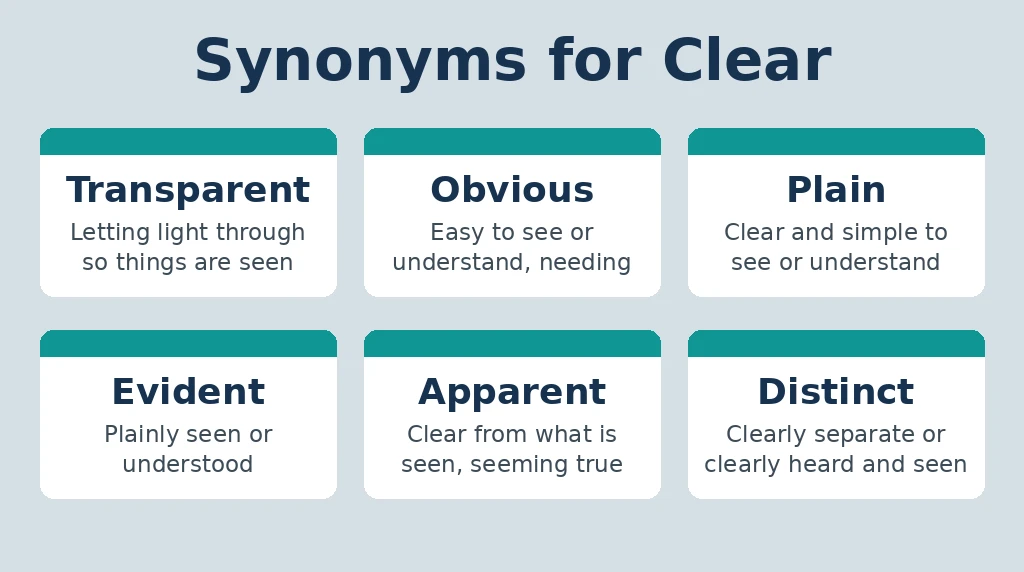
The water was clear, the answer was clear, the road was clear, and mercifully, so was the sky. One word reports that you can see through something, that you can understand something, that nothing is in the way, and that the clouds have gone home. The closest synonyms for clear split by sense: transparent, crystalline and limpid for seeing through, obvious, evident and plain for understanding at a glance, unobstructed and open for roads and exits, and cloudless and fair for weather. The word is only vague until you name which clarity you mean.
This guide covers 45 distinct synonyms for clear, grouped the way the senses divide: transparency, obviousness, clear expression, freedom from obstruction, weather, and the clear names and clear minds at the end. Every word was checked against real thesaurus entries, and each one comes with a plain meaning and a short example, so the word you choose is clear in exactly the way your sentence needs.
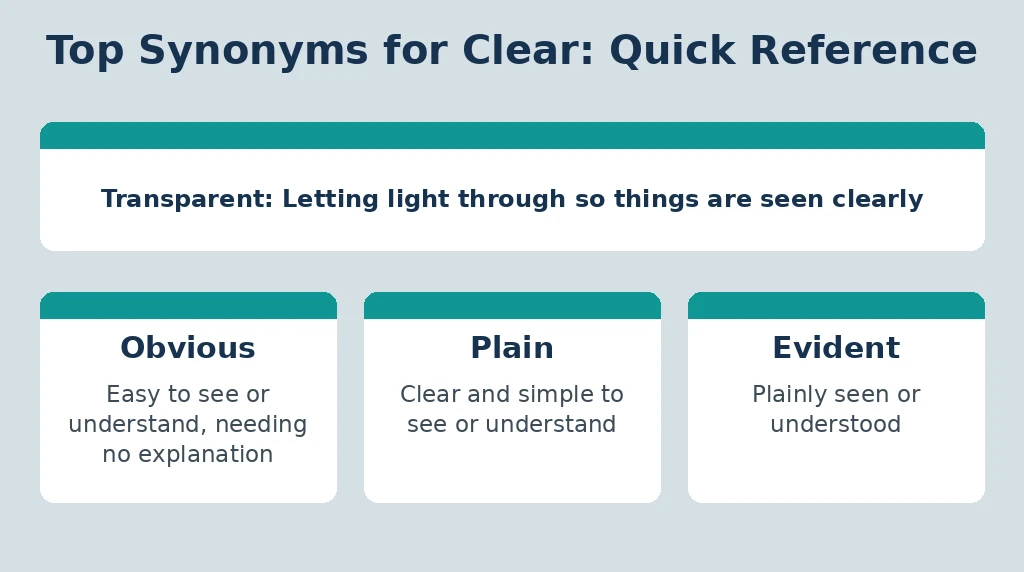
Top Synonyms for Clear: Quick Reference
In a hurry? Start here. These are the clear synonyms writers reach for most often, from the mountain stream to the open motorway. The full lists further down sort each word into its sense, but this table is the everyday toolkit.
| Word | Meaning in one line | Best for |
|---|---|---|
| Transparent | Letting light through so things are seen clearly | Glass, water, materials |
| Obvious | Easy to see or understand, needing no explanation | Answers, reasons, mistakes |
| Plain | Clear and simple to see or understand | Sight, speech, evidence |
| Evident | Plainly seen or understood | Feelings, facts, formal writing |
| Apparent | Clear from what is seen, seeming true | Reasons, damage, motives |
| Distinct | Clearly separate or clearly heard and seen | Sounds, shapes, differences |
| Manifest | Clear and undoubted, in formal tone | Truths, failures, formal prose |
| Crystal | Perfectly clear, like crystal glass | Water, lakes, streams |
| Crystalline | Clear as crystal, in formal or literary tone | Air, water, prose style |
| Limpid | Clear and still, of liquids, literary in tone | Pools, eyes, style |
| See-through | Transparent, in everyday words | Fabrics, plastic, packaging |
| Translucent | Letting some light through, but not detail | Frosted glass, screens, skin |
| Unobstructed | With nothing in the way | Views, exits, roads |
| Open | Free to pass through, not blocked | Roads, spaces, schedules |
| Free | Not blocked, busy or taken | Roads, time, passage |
| Cloudless | Without clouds, of sky and weather | Skies, nights, forecasts |
| Fair | Fine and bright, of weather | Days, forecasts, sailing |
| Unmistakable | Impossible to mistake for anything else | Signs, sounds, evidence |
| Definite | Certain and clearly fixed | Answers, plans, improvements |
| Conspicuous | Standing out so as to be clearly seen | Objects, absences, errors |
| Palpable | So clear it can almost be touched | Tension, relief, lies |
| Unequivocal | Leaving no doubt at all, formal in tone | Statements, support, answers |
| Coherent | Clear because logical and well ordered | Arguments, accounts, plans |
| Untarnished | Undamaged and unstained, of reputations | Names, records, images |
What Does Clear Mean?
Clear begins with sight: easy to see through, or easy to see. Clear water lets you count the stones on the bottom, and a clear view lets you see the valley whole. Then the word does the same favour for the mind. A clear explanation is one you can see through to the meaning, and a clear case is one whose truth shows itself without help.
Two more senses follow the same picture of nothing in the way. A clear road has no traffic or rubble stopping you, a clear desk has no clutter, and a clear sky has no cloud between you and the blue. Even a clear conscience and a clear record borrow the image: nothing hidden, nothing staining the view. It sits naturally beside bright, since the two words share the work of describing light, air and understanding.
Because one picture serves so many senses, clear goes flat when it’s asked to serve them all at once. The fix isn’t a grander word but the right family: transparency words for things you look through, obviousness words for things you grasp, openness words for things you walk through. The sections below keep the families apart.
There’s a small paradox inside the word worth noticing before the lists begin. Clear is at its strongest when it disappears. Nobody admires the glass in a good window, the prose in a good manual or the reasoning in a good verdict, because attention passes straight through to the thing beyond. Every family in this guide serves that vanishing act, which is why the plainer words so often beat the grander ones.
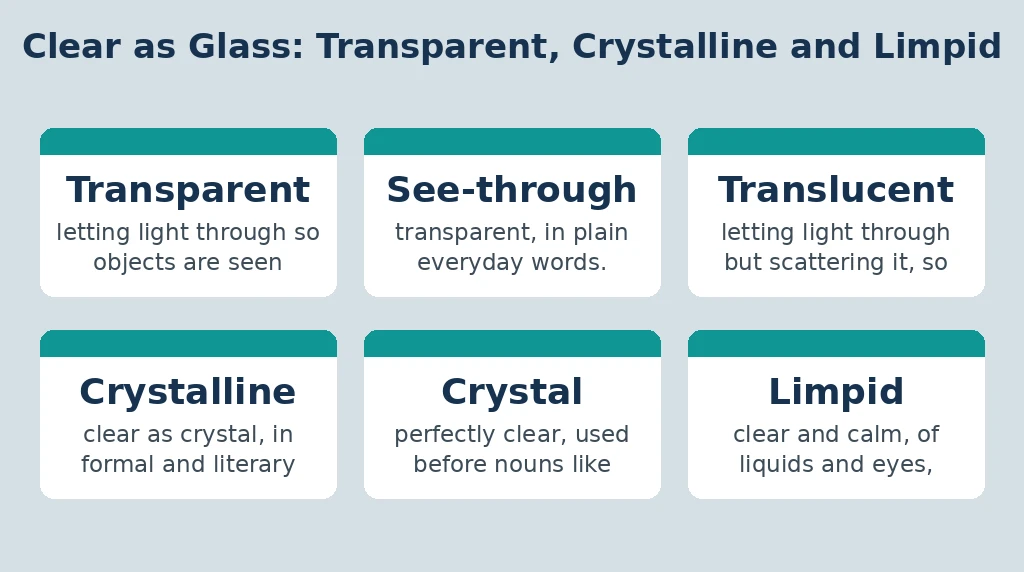
Clear as Glass: Transparent, Crystalline and Limpid
These words describe light passing through a material and the eye following it. They belong to water, glass, air and gemstones, and they range from the laboratory to the love poem.
- Transparent: letting light through so objects are seen distinctly. The tank was made of transparent plastic.
- See-through: transparent, in plain everyday words. She held the see-through folder up to the light.
- Translucent: letting light through but scattering it, so shapes blur. The bathroom window was translucent for privacy.
- Crystalline: clear as crystal, in formal and literary tone. The crystalline air made the mountains look close.
- Crystal: perfectly clear, used before nouns like water and lakes. Fish moved in the crystal stream.
- Limpid: clear and calm, of liquids and eyes, literary in tone. Trout hung in the limpid pool.
- Pellucid: completely clear, rare and formal. The pellucid shallows showed every shell.
Transparent is the technical standard, the word of science and packaging. Crystal and crystalline praise the clarity, and limpid and pellucid are the poets of the family, best saved for water, light and prose styles being admired. Translucent is the honest half-member: light passes, pictures don’t, and the mistakes section at the end explains why the difference matters.
Opticians and photographers hold a tradesman’s respect for this family that the rest of us borrow without noticing. Lens coatings are sold on clarity, windows are graded by it, and a photographer cleaning a filter is performing the whole philosophy of this guide with a cloth: remove what sits between the eye and the thing. When your writing describes a view, a screen or a photograph, the glass words (crystalline and limpid saved for poetry) will serve better than any general praise of quality.
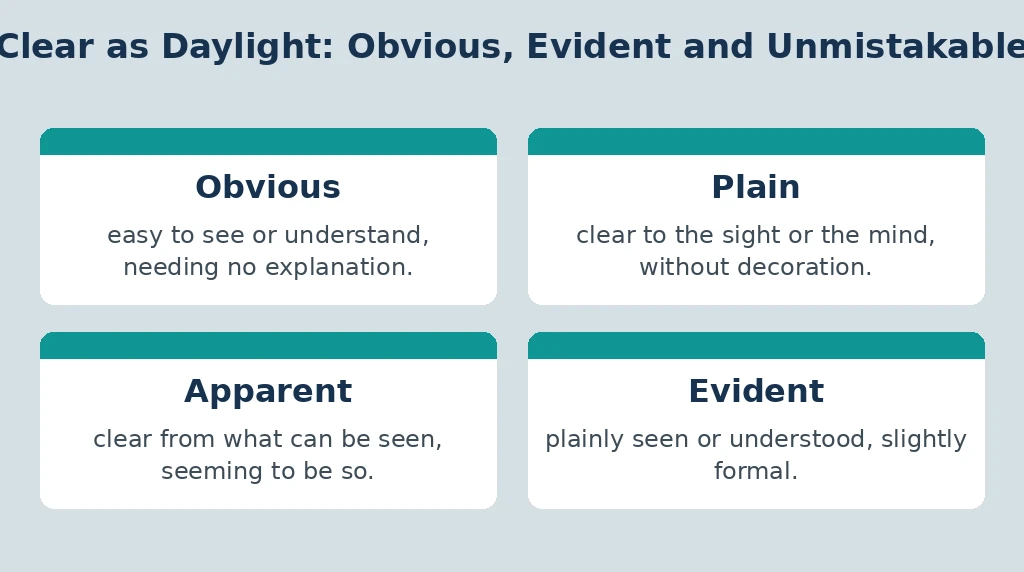
Clear as Daylight: Obvious, Evident and Unmistakable
When a fact is clear, it shows itself. This family grades how visible a truth is, from plainly there if you look to impossible to miss even if you try. It’s the busiest family in the guide, because arguments live here.
- Obvious: easy to see or understand, needing no explanation. The solution was obvious once she said it.
- Plain: clear to the sight or the mind, without decoration. It was plain that he was lying.
- Apparent: clear from what can be seen, seeming to be so. The damage was apparent at a glance.
- Evident: plainly seen or understood, slightly formal. He spoke with evident relief.
- Manifest: clearly shown and undoubted, in formal tone. Her manifest talent impressed the panel.
- Conspicuous: standing out so as to be clearly seen. His absence was conspicuous at the meeting.
- Unmistakable: impossible to mistake for anything else. We heard the unmistakable sound of the ferry.
- Palpable: so clear it can almost be felt. The relief in the room was palpable.
- Recognizable: able to be known again at once. His voice was recognizable over the noise.
- Blatant: offensively obvious, done without shame. It was a blatant attempt to cheat.
- Express: clearly and directly stated, in formal use. The rules were given in express terms.
- Cut-and-dried: completely decided and obvious, in informal use. The case was not as cut-and-dried as it looked.
- Incontrovertible: impossible to deny or dispute, very formal. The evidence was incontrovertible.
- Bold: standing out clearly, of print, lines and statements. The notice was printed in bold letters.
Obvious, plain and evident do the daily work, and they sit at different levels of politeness: plain can sound blunt, evident sounds measured. The formal end (patent, unequivocal, incontrovertible) belongs to law, science and official apologies. Blatant is the only insult in the list. It says the thing was obvious and the person should be ashamed it was.
Clear Speaking, Writing and Sound
Expression can be clear the way water is: meaning passes through without clouding. This family is small in the thesauruses because so much of it is done by phrases (make clear, spell out, say plainly), but the adjective shelf isn’t empty.
- Coherent: clear because the parts hang together logically. She gave a coherent account of the accident.
- Distinct: clearly heard or seen, separate from the background. A distinct voice called from the platform.
Distinct appears here for the second time, and it’s counted once, in the obviousness family above: a word earns one place in the count however many sections it helps. Coherent is the deeper compliment of the two. A speaker can be distinct and still talk nonsense, while a coherent answer can be followed step by step, which is what examinations, instructions and good apologies are all asking for.
Sound deserves its footnote here, because the ear has its own clarity. A distinct voice, a clear note and a bell that rings true all borrow the sight picture for hearing, and broadcasters are judged by it nightly. When you write about voices and music, the sight words still serve, as long as they describe separation and purity, a voice distinct from the noise, rather than volume, which is a different compliment entirely.
Teachers of writing have a bench test for this section’s words: swap the explanation for a window. If a reader could repeat the window’s view after one look, the explanation was plain. If they could repeat it and improve it, the writing was lucid, the rarest of the family and the one every style guide is secretly chasing. The test flatters nobody and improves everybody, which is the mark of a good bench test and, not coincidentally, of a clear sentence.
Clear Roads and Open Spaces: Nothing in the Way
Here clear is physical again: free of obstruction, ready to pass through. Fire officers, drivers and stage crews live in this sense. Note the family resemblance to clean: a clear desk has nothing on it, a clean one has nothing dirty on it, and tidiness writers confuse the two daily.
- Unobstructed: with nothing blocking the way or the view. The hall offered an unobstructed view of the stage.
- Open: free to move through, not closed or blocked. The pass stays open all winter.
- Free: not blocked, occupied or charged with obstacles. Keep the corridor free at all times.
- Empty: with nothing and nobody in it. The square was empty by midnight.
- Unhindered: not held back by anything. She worked unhindered through the afternoon.
- Unimpeded: not slowed or stopped, in formal tone. The river ran unimpeded to the sea.
- Unhampered: not weighed down or restricted. The rescue went ahead unhampered by the weather.
Unobstructed is the surveyor’s word, exact about lines of sight and lines of travel. Unhindered, unimpeded and unhampered describe journeys and projects rather than places; they say the thing moved as if the world had stepped aside. Empty is the plainest of the set and the saddest, since a clear square is a success and an empty one is a question.
The obstruction family has a modern capital in the airport and the hospital corridor, places where clear is a regulation before it is an adjective. Kept clear, marked clear, reported clear: the word appears wherever strangers must trust that a path has been made safe for them. It’s the least poetic sense in this guide and possibly the most useful one in the language.
Clear Weather: Cloudless, Fair and Fine
Forecasts own this small family. A clear sky is the obstruction sense applied to the whole sky: nothing between the eye and the blue, or between the eye and the stars.
- Cloudless: with no clouds at all. A cloudless night showed every star.
- Unclouded: not covered or darkened by cloud. The unclouded morning promised heat.
- Fair: fine, dry and bright, in weather language. The forecast promised fair weather for the regatta.
- Fine: dry and pleasant, with no rain. It was a fine day for the harvest.
Fair and fine are the forecaster’s heirlooms, and both also live second lives as words of quality, which is why they can sound old-fashioned in ordinary speech. Cloudless is the most literal and the most lyrical, and poets have used it for untroubled minds as often as for skies, a borrowing the final section picks up.
Sailors and walkers keep the weather family honest, because for them clear is information with consequences: a clear night for navigation, a clear morning for the ridge. The forecasts borrow their trust. When a modern forecast says clear, it’s repeating a judgement first made by people whose safety depended on reading the sky, which is why the word still sounds like a promise kept.
Drivers grade the obstruction family nightly without knowing its name. A clear road at dawn is a pleasure, a clear motorway after a closure is news, and the official phrases (route clear, lane clear, junction clear) are the traffic report’s whole poetry. The words earn their authority by being checkable: within the hour, anyone can drive the road and test them, which is more than can be said for most adjectives in the newspaper.
Clear Names and Clear Minds
The last family turns inward. A clear name is one with nothing staining it, and a clear mind, in everyday speech, is one that has settled the question. Both senses complete the picture of clear as the absence of anything in the way, dirt in one case and doubt in the other.
- Untarnished: undamaged and unstained, of reputations and records. He retired with an untarnished name.
- Convinced: having no doubt left, fully persuaded. She was convinced the plan would work.
- Decided: settled and definite in mind. He was quite decided about leaving.
- Resolved: firmly determined, with doubts cleared away. The captain was resolved to sail at dawn.
- Satisfied: having no remaining doubt or question. The inspector was satisfied with the accounts.
These are the boundary words of the guide, and they’re included honestly: dictionaries and thesauruses list them for the sense of clear that means settled and without doubt, the sense in “I am clear about what I want.” They belong to people rather than to glass or weather, and a careful writer will feel the join. That join is the whole story of this word, which begins with light through water and ends with a mind at rest.
Character references and verdicts are where the name sense earns its living. Clearing a person’s name is a public act, and the vocabulary around it (untarnished, unblemished records, a clean sheet in the sporting version) is graded like everything else in this guide. Choose the word as if the person will read it, which, in the age of the subject access request, they very likely will.
Clarity in the Natural World: Air, Water and Distance
Nature grades clarity with a surveyor’s eye. After rain washes the dust from the air, distant mountains step forward as if the map had shrunk, and pilots and sailors have a plain word for the measure behind the marvel: visibility, the distance at which the world gives out. Divers grade water the same way, in metres of sight, and a lake described as clear by a swimmer may be murky by the standard of the fisherman who needs to see the bottom.
The grading matters because clear, in the wild, is always clear for something: clear enough to navigate, to drink, to photograph, to land a plane. The families in this guide work the same way indoors. An explanation is clear for a reader of a certain age and knowledge; a road is clear for a lorry or only for a bicycle. The honest writer quietly names the standard, at least in their own head, before spending the adjective.
There’s a consolation for writers in the mountains after rain: clarity is mostly subtraction. The view wasn’t improved by anything added to it, only by something taken away. Sentences clear the same way, which is why the editing advice in this guide keeps returning to the delete key.
Law has made the obviousness family its working clothes, and its grades are enforced by consequences. A clear duty, a clear breach and clear evidence are phrases with case law inside them, and a lawyer choosing apparent over evident is making a professional decision, not a stylistic one. General writers inherit the ladder without the liability, but borrowing its top rungs (patent, unequivocal, incontrovertible) for everyday disagreements spends authority the sentence hasn’t earned.
How to Choose the Right Synonym for Clear
Ask what the eye, the mind or the traveller is doing. Looking through something calls for transparent and its family. Grasping a fact calls for the obviousness list, graded from plain to incontrovertible by how hard the fact pushes back. Moving through a space calls for unobstructed and open. Mixing the families produces the fog this guide exists to disperse: an argument cannot be translucent, and a window shouldn’t be called unequivocal.
Register then does the fine work. Pellucid, crystalline and manifest are formal and a little proud of it; see-through, obvious and free are the words of the kitchen table. In professional prose, the obviousness words carry real weight: a definite answer can be checked, an unequivocal one can be quoted in a hearing. And in practical writing, remember that clear instructions make work easy, so this word earns its place in manuals more than almost any other in the language.
| Situation | Best word | Why |
|---|---|---|
| Describing spring water on a label | Crystal | Short, pure and made for packaging |
| A judge summing up evidence | Incontrovertible | Formal, final and beyond dispute |
| A fire safety notice about exits | Unobstructed | The exact word of safety standards |
| A poem about a still pool | Limpid | Clear and calm in a single word |
| A manager ending all doubt | Unequivocal | Closes every second reading |
| A forecast for the weekend | Cloudless | Says precisely what the sky will do |
A test from the editing desk: delete the word clear from your sentence and see what the reader loses. If they lose nothing, the word was a throat-clearing habit and the sentence is stronger bare. If they lose the claim that the water could be seen through, the fact needed no argument or the road could be driven, restore the sentence with the specific family word that carries that claim.
Synonyms for Clear in Essays, Stories and Professional Writing
Essays run on the obviousness family, and the grading is the argument. Moving a claim from apparent to evident to incontrovertible across an essay is a way of showing the evidence grow, while calling everything obvious from the first line leaves the reader nowhere to travel. Plain is the essayist’s honesty word, and manifest and patent belong to subjects with documents behind them.
Teaching and learning deserve the last practical word, because clear is the adjective students reach for when a lesson finally lands. The vocabulary of this guide lets a student say how it landed: the example made it plain, the diagram made it distinct, the summary made it coherent. Teachers who collect those distinctions get better feedback than any satisfaction survey has yet designed.
Medicine borrows the glass family with unusual literalness: clear lungs, clear skin, a clear scan. In the clinic the word is a verdict patients wait for in corridors, and its relatives do the same work at lower stakes, an untarnished record in the notes, a distinct heartbeat on the monitor. Writers describing health in any register should know they’re spending a word that, for many readers, is remembered from the most anxious hour of their year.
Antonyms for Clear
Cloudiness answers clarity in every sense, and the opposites line up family by family:
- Cloudy: covered or filled with cloud, not clear. The water in the tank turned cloudy.
- Murky: dark and thick, hard to see through. The murky pond hid its bottom.
- Opaque: not letting light through at all. The windows were made of opaque glass.
- Unclear: not easy to understand or see. The instructions were unclear about the dates.
- Ambiguous: open to more than one meaning. He gave an ambiguous reply.
- Vague: not clearly expressed or fixed. Her memory of the day was vague.
- Uncertain: not known or settled. The result remained uncertain for hours.
- Blocked: closed off by an obstacle. The road was blocked by a fallen tree.
- Obstructed: blocked in the way or the view, formal in tone. The view was obstructed by scaffolding.
- Hidden: kept out of sight. The path was hidden by brambles.
Ambiguous and vague divide the mental fog between them: ambiguous means the words allow two readings, vague means they barely allow one. Opaque is the total opposite of transparent, the end of the scale, while murky keeps a little light and a lot of menace.
Clear in Phrases: Clear as Day, the All Clear and Clearing the Air
Clear finishes inside a crowd of fixed phrases, learned as whole units rather than synonyms. They don’t count towards the forty-five words in this guide, because each is a small story, but they show every family of the word at work in ordinary speech.
- Clear as day: completely obvious and easy to understand. The instructions were clear as day once she explained them.
- The all clear: the signal that danger has passed. The firefighters gave the all clear by noon.
- In the clear: free of danger, debt or suspicion. After the audit, the firm was in the clear.
- Clear the air: to remove tension or misunderstanding by talking honestly. A short meeting cleared the air between them.
- Steer clear of: to avoid deliberately. Steer clear of the flooded lane.
- Loud and clear: heard and understood completely, from radio speech. Your message came through loud and clear.
- Clear as mud: not clear at all, said with irony. His explanation of the rules was clear as mud.
- A clear conscience: the settled feeling of having done nothing wrong. She signed the letter with a clear conscience.
The irony in clear as mud is the family’s own joke about itself, and loud and clear carries the radio age inside it. Between them, the phrases cover sight, sound, safety and innocence, the whole map of this guide in eight short stories.
Common Mistakes: Words That Are Not True Synonyms for Clear
Translucent sits in this guide’s lists because the thesauruses put it there, under protest from physics: translucent materials let light through but scatter it, so you can’t see shapes through frosted glass. For water, glass and air where detail matters, transparent is the true synonym, and translucent should be used only where the blur is the point. Glassy is a different trap: it means smooth and shiny like glass, or fixed and staring, of eyes, and a glassy lake is mirror-still, not necessarily clear at all.
One more caution, about plain, which is counted in this guide for the obviousness family. Plain also means unattractive, unseasoned and unadorned, and a plain answer may be heard as a blunt one. Where bluntness would wound, evident and obvious describe the fact without the flavour of a reprimand.
A final note on free, the hardest-working short word in this guide. Free is counted once, among the obstruction words, but it also means costing nothing and being available, and sentences like “the road is free” can be misread by a tired eye. Where money or diaries might enter the reader’s mind, unobstructed and open say the travelling sense without the price tag, and the sentence stays as clear as its subject.
Frequently Asked Questions
What is the best synonym for clear?
For seeing through things, transparent is the standard word. For facts, obvious and evident do most of the work, and for roads and exits, unobstructed and open. The best choice is always the one from the right family.
What is the difference between clear and transparent?
Transparent is the precise, technical word for a material that light passes through so objects can be seen. Clear is the wider word: it covers transparency, but also obviousness, openness and weather, none of which transparent can describe.
What does clear mean for the weather?
Clear weather has no cloud, rain or fog in the way: a clear sky, a clear night. Cloudless and unclouded say the same thing with the emphasis on the empty sky, and fair and fine add the promise that it will stay pleasant.
What is a formal word for clear?
Pellucid and crystalline are the formal words for transparency, and manifest, patent and incontrovertible are the formal end of the obviousness family. All of them belong to law, science and ceremonial prose rather than conversation.
What is the opposite of clear?
Opaque and cloudy answer the transparency sense, unclear, ambiguous and vague answer the understanding sense, and blocked and obstructed answer the road sense. Each family of clear keeps its own opposite, as it keeps its own synonyms.
Final Thoughts
Clear is the word language uses when it wants to praise the path between a thing and its reader: light through crystal water, meaning through a plain sentence, a traveller through an open gate, a name with nothing on it. Sort the families, and the exact word is always waiting, with nothing in its way.
Keep this guide close for the next time clear feels too easy an answer, and for an even deeper bench of clear words, including rare and historical ones, the Merriam-Webster Thesaurus entry for clear is the natural next stop. May your water be limpid, your answers unequivocal, and your roads unobstructed.

2 thoughts on “Synonyms for Clear | 45+ Words for Glass, Facts, Roads and Weather”